

IEC TS 62282-7-1:2017
(Main)Fuel cell technologies - Part 7-1: Test methods - Single cell performance tests for polymer electrolyte fuel cells (PEFC)
General Information
- Abstract
IEC TS 62282-7-1:2017(E) covers cell assemblies, test station setup, measuring instruments and measuring methods, performance test methods, and test reports for PEFC single cells. This document is used for evaluating:
- the performance of membrane electrode assemblies (MEAs) for PEFCs in a single cell configuration;
- materials or structures of PEFCs in a single cell configuration;or
- the influence of impurities in fuel and/or in air on the fuel cell performance.
- Status
- Published
- Publication Date
- 26-Jan-2017
- Technical Committee
- TC 105 - Fuel cell technologies
- Drafting Committee
- MT 103 - TC 105/MT 103
Overview
IEC TS 62282-7-1:2017 - Fuel cell technologies - Part 7-1: Test methods - Single cell performance tests for polymer electrolyte fuel cells (PEFC) - defines test methods and documentation practices for evaluating polymer electrolyte fuel cell (PEFC) single cells. The Technical Specification covers cell assemblies, test station setup, measuring instruments and methods, performance tests (polarization, steady-state, long‑term, voltammetry, EIS, IR), and required test reporting. It is widely used for MEA testing, single-cell performance characterization, and studying the influence of fuel or air impurities on fuel cell behavior.
Key topics and technical requirements
- Cell components & assembly: guidance on membrane electrode assemblies (MEAs), gaskets, flow plates, current collectors, clamping hardware, temperature control and assembly procedures.
- Test station setup: minimum equipment requirements, schematic arrangements, and inputs/controls for reproducible single-cell testing.
- Measuring instruments & uncertainty: recommended instruments and measurement methods for voltage, current, internal resistance (IR), gas flow, temperature, pressure, and humidity.
- Performance tests:
- Polarization curve tests (constant stoichiometry or constant flow)
- Steady-state and long‑term operation tests
- Voltammetry (including hydrogen crossover and electrochemical surface area/ECA)
- Electrochemical impedance spectroscopy (EIS) and IR measurements
- Applied tests (Annex H - normative): gain tests, stoichiometry tests, temperature/pressure/humidity effects, limiting current, overload, subzero storage/start, membrane swelling (humidity cycling), open circuit voltage (OCV), and ORR activity.
- Test reporting: standardized report items, measurement condition description, and cell parameter documentation to ensure repeatability and traceability.
Applications and who uses this standard
- Fuel cell R&D teams: characterize new MEA formulations, catalyst layers, membranes and gas diffusion materials.
- Test laboratories and certification bodies: establish repeatable single-cell test protocols for comparison, qualification, and performance validation.
- Manufacturers and suppliers: validate materials, detect degradation mechanisms, and assess tolerance to fuel/air impurities.
- OEMs and system integrators: use single-cell data to inform stack design, balance-of-plant requirements, and environmental margins.
- Regulators and standards engineers: reference a harmonized methodology for reporting performance and durability.
Related standards
- Other parts of the IEC 62282 series (fuel cell technologies) and national test-method standards complement single-cell testing with stack- and system-level requirements.
Keywords: IEC TS 62282-7-1:2017, PEFC single cell performance, MEA testing, fuel cell test methods, polarization curve, electrochemical impedance spectroscopy, hydrogen crossover, ECA, fuel cell test station.
Relations
- Effective Date
- 05-Sep-2023
- Effective Date
- 05-Sep-2023
Get Certified
Connect with accredited certification bodies for this standard

DNV
DNV is an independent assurance and risk management provider.

Lloyd's Register
Lloyd's Register is a global professional services organisation specialising in engineering and technology.
DNV Energy Systems
Energy and renewable energy certification.
Sponsored listings
Frequently Asked Questions
IEC TS 62282-7-1:2017 is a technical specification published by the International Electrotechnical Commission (IEC). Its full title is "Fuel cell technologies - Part 7-1: Test methods - Single cell performance tests for polymer electrolyte fuel cells (PEFC)". This standard covers: IEC TS 62282-7-1:2017(E) covers cell assemblies, test station setup, measuring instruments and measuring methods, performance test methods, and test reports for PEFC single cells. This document is used for evaluating: - the performance of membrane electrode assemblies (MEAs) for PEFCs in a single cell configuration; - materials or structures of PEFCs in a single cell configuration;or - the influence of impurities in fuel and/or in air on the fuel cell performance.
IEC TS 62282-7-1:2017(E) covers cell assemblies, test station setup, measuring instruments and measuring methods, performance test methods, and test reports for PEFC single cells. This document is used for evaluating: - the performance of membrane electrode assemblies (MEAs) for PEFCs in a single cell configuration; - materials or structures of PEFCs in a single cell configuration;or - the influence of impurities in fuel and/or in air on the fuel cell performance.
IEC TS 62282-7-1:2017 is classified under the following ICS (International Classification for Standards) categories: 27.070 - Fuel cells. The ICS classification helps identify the subject area and facilitates finding related standards.
IEC TS 62282-7-1:2017 has the following relationships with other standards: It is inter standard links to IEC TS 62282-7-1:2025, IEC TS 62282-7-1:2010. Understanding these relationships helps ensure you are using the most current and applicable version of the standard.
IEC TS 62282-7-1:2017 is available in PDF format for immediate download after purchase. The document can be added to your cart and obtained through the secure checkout process. Digital delivery ensures instant access to the complete standard document.
Standards Content (Sample)
IEC TS 62282-7-1 ®
Edition 2.0 2017-01
TECHNICAL
SPECIFICATION
colour
inside
Fuel cell technologies –
Part 7-1: Test methods – Single cell performance tests for polymer electrolyte
fuel cells (PEFC)
All rights reserved. Unless otherwise specified, no part of this publication may be reproduced or utilized in any form
or by any means, electronic or mechanical, including photocopying and microfilm, without permission in writing from
either IEC or IEC's member National Committee in the country of the requester. If you have any questions about IEC
copyright or have an enquiry about obtaining additional rights to this publication, please contact the address below or
your local IEC member National Committee for further information.
IEC Central Office Tel.: +41 22 919 02 11
3, rue de Varembé Fax: +41 22 919 03 00
CH-1211 Geneva 20 info@iec.ch
Switzerland www.iec.ch
About the IEC
The International Electrotechnical Commission (IEC) is the leading global organization that prepares and publishes
International Standards for all electrical, electronic and related technologies.
About IEC publications
The technical content of IEC publications is kept under constant review by the IEC. Please make sure that you have the
latest edition, a corrigenda or an amendment might have been published.
IEC Catalogue - webstore.iec.ch/catalogue Electropedia - www.electropedia.org
The stand-alone application for consulting the entire The world's leading online dictionary of electronic and
bibliographical information on IEC International Standards, electrical terms containing 20 000 terms and definitions in
Technical Specifications, Technical Reports and other English and French, with equivalent terms in 16 additional
documents. Available for PC, Mac OS, Android Tablets and languages. Also known as the International Electrotechnical
iPad. Vocabulary (IEV) online.
IEC publications search - www.iec.ch/searchpub IEC Glossary - std.iec.ch/glossary
The advanced search enables to find IEC publications by a 65 000 electrotechnical terminology entries in English and
variety of criteria (reference number, text, technical French extracted from the Terms and Definitions clause of
committee,…). It also gives information on projects, replaced IEC publications issued since 2002. Some entries have been
and withdrawn publications. collected from earlier publications of IEC TC 37, 77, 86 and
CISPR.
IEC Just Published - webstore.iec.ch/justpublished
Stay up to date on all new IEC publications. Just Published IEC Customer Service Centre - webstore.iec.ch/csc
details all new publications released. Available online and If you wish to give us your feedback on this publication or
also once a month by email. need further assistance, please contact the Customer Service
Centre: csc@iec.ch.
IEC TS 62282-7-1 ®
Edition 2.0 2017-01
TECHNICAL
SPECIFICATION
colour
inside
Fuel cell technologies –
Part 7-1: Test methods – Single cell performance tests for polymer electrolyte
fuel cells (PEFC)
INTERNATIONAL
ELECTROTECHNICAL
COMMISSION
ICS 27.070 ISBN 978-2-8322-3768-7
– 2 – IEC TS 62282-7-1:2017 © IEC 2017
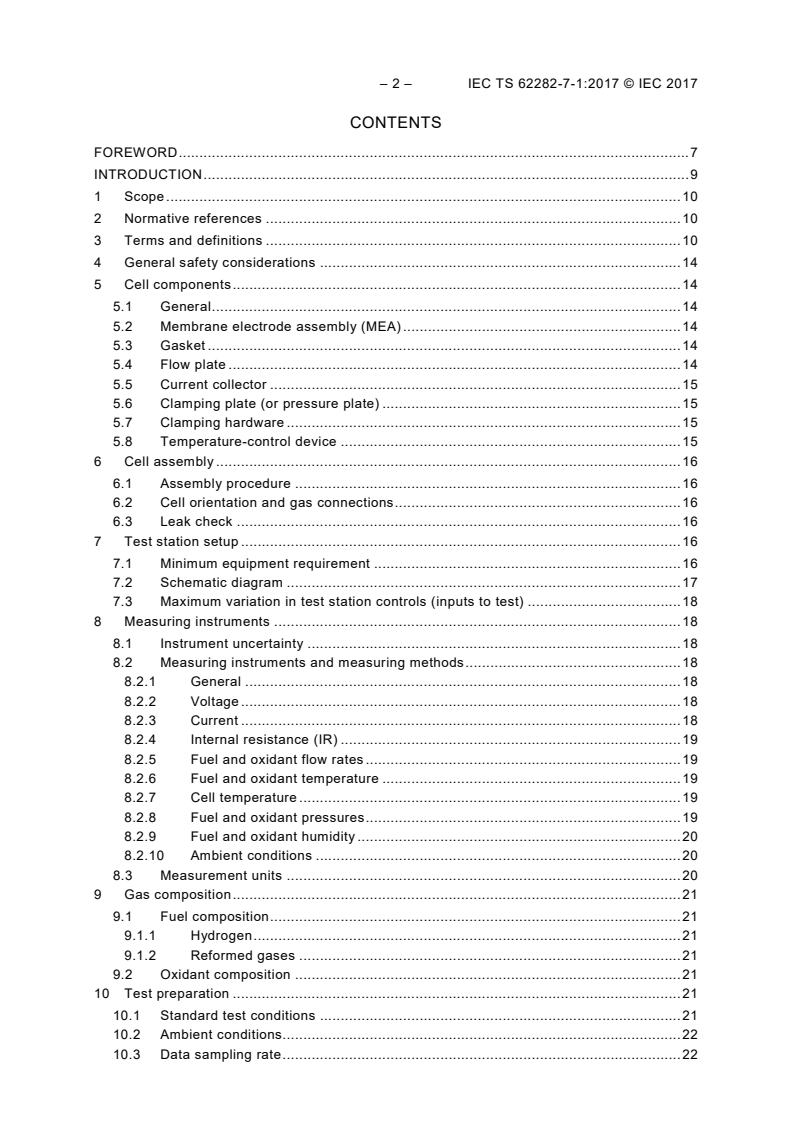
CONTENTS
FOREWORD . 7
INTRODUCTION . 9
1 Scope . 10
2 Normative references . 10
3 Terms and definitions . 10
4 General safety considerations . 14
5 Cell components . 14
5.1 General . 14
5.2 Membrane electrode assembly (MEA) . 14
5.3 Gasket . 14
5.4 Flow plate . 14
5.5 Current collector . 15
5.6 Clamping plate (or pressure plate) . 15
5.7 Clamping hardware . 15
5.8 Temperature-control device . 15
6 Cell assembly . 16
6.1 Assembly procedure . 16
6.2 Cell orientation and gas connections . 16
6.3 Leak check . 16
7 Test station setup . 16
7.1 Minimum equipment requirement . 16
7.2 Schematic diagram . 17
7.3 Maximum variation in test station controls (inputs to test) . 18
8 Measuring instruments . 18
8.1 Instrument uncertainty . 18
8.2 Measuring instruments and measuring methods . 18
8.2.1 General . 18
8.2.2 Voltage . 18
8.2.3 Current . 18
8.2.4 Internal resistance (IR) . 19
8.2.5 Fuel and oxidant flow rates . 19
8.2.6 Fuel and oxidant temperature . 19
8.2.7 Cell temperature . 19
8.2.8 Fuel and oxidant pressures . 19
8.2.9 Fuel and oxidant humidity . 20
8.2.10 Ambient conditions . 20
8.3 Measurement units . 20
9 Gas composition . 21
9.1 Fuel composition . 21
9.1.1 Hydrogen . 21
9.1.2 Reformed gases . 21
9.2 Oxidant composition . 21
10 Test preparation . 21
10.1 Standard test conditions . 21
10.2 Ambient conditions. 22
10.3 Data sampling rate . 22
10.4 Repeatability and reproducibility . 22
10.5 Number of test samples . 22
10.6 Leak check of gas circuit with inert or test gas . 23
10.7 Initial conditioning and stable state check . 23
10.8 Shutdown . 23
10.9 Reconditioning . 23
11 Basic performance test methods . 23
11.1 General . 23
11.2 Polarization curve tests . 24
11.2.1 General . 24
11.2.2 Polarization curves at constant gas stoichiometries . 24
11.2.3 Polarization curves at constant flow rate . 25
11.3 Steady-state test . 25
11.3.1 General . 25
11.3.2 Test methods . 25
11.4 Long-term operation test . 26
11.4.1 General . 26
11.4.2 Test method . 26
11.5 Voltammetry. 26
11.5.1 General . 26
11.5.2 Hydrogen crossover test . 27
11.5.3 Electrochemical surface area (ECA) measurement . 28
11.6 Internal resistance (IR) measurement . 30
11.6.1 General . 30
11.6.2 Test methods . 31
11.7 Electrochemical impedance spectroscopy (EIS) . 32
11.7.1 General . 32
11.7.2 Test conditions . 32
11.7.3 Test method . 32
11.7.4 Analysis of EIS data . 33
11.7.5 IR measurement by EIS . 33
12 Applied performance test methods . 33
13 Test report . 35
13.1 General . 35
13.2 Report items . 35
13.3 Test data description . 35
13.4 Description of measurement conditions . 36
13.5 Test cell parameter description . 36
Annex A (informative) Flow plate . 37
Annex B (informative) Cell component alignment . 39
Annex C (informative) Leak test . 40
C.1 Purpose . 40
C.2 Test procedures . 40
Annex D (informative) Initial conditioning . 42
Annex E (informative) Shutdown . 43
Annex F (informative) Reconditioning protocols . 44
Annex G (informative) Polarization curve test supplement . 45
Annex H (normative) Applied performance tests. 47
– 4 – IEC TS 62282-7-1:2017 © IEC 2017
H.1 Gain tests . 47
H.1.1 Hydrogen gain test . 47
H.1.2 Oxygen gain test. 47
H.2 Gas stoichiometry tests . 48
H.2.1 Fuel stoichiometry test . 48
H.2.2 Oxidant stoichiometry test . 48
H.3 Temperature effect test . 49
H.3.1 General . 49
H.3.2 Test method . 49
H.4 Pressure effect test . 49
H.4.1 General . 49
H.4.2 Test method . 49
H.5 Humidity effect tests . 49
H.5.1 Fuel humidity effect test . 49
H.5.2 Oxidant humidity effect test. 50
H.6 Limiting current test . 50
H.6.1 General . 50
H.6.2 Test method . 50
H.7 Overload test . 51
H.7.1 General . 51
H.7.2 Test method . 51
H.8 Subzero storage test . 51
H.8.1 General . 51
H.8.2 Test method . 51
H.9 Subzero start test . 52
H.9.1 General . 52
H.9.2 Test method . 52
H.10 Membrane swelling test (humidity cycle test) . 52
H.10.1 General . 52
H.10.2 Test conditions . 53
H.10.3 Test method . 53
H.11 Open circuit voltage (OCV) test . 53
H.11.1 General . 53
H.11.2 Test conditions . 53
H.11.3 Test method . 54
H.12 Oxygen reduction reaction (ORR) activity test . 54
H.12.1 General . 54
H.12.2 Test conditions . 54
H.12.3 Test method . 54
H.13 Fuel composition test . 56
H.13.1 General . 56
H.13.2 Test method . 56
H.14 Cycling tests . 56
H.14.1 Start/stop cycling test . 56
H.14.2 Load cycling test . 57
H.14.3 Potential cycle test (start/stop durability) . 57
H.14.4 Potential cycle test (load cycle durability) . 58
H.15 Impurity influence tests . 59
H.15.1 Influence at rated current density . 59
H.15.2 Influence on polarization curves . 60
H.15.3 Long-term impurity influence test . 61
Annex I (informative) Test report for polarization curve tests . 62
I.1 General . 62
I.2 General information . 62
I.2.1 General information on the test report . 62
I.2.2 General information concerning the test. 62
I.3 Introductory remarks . 62
I.4 Objective and scope of the test . 62
I.5 Description of cell components . 63
I.6 Background. 63
I.7 Description of the test setup . 64
I.8 Description of operating conditions, inputs and outputs . 64
I.9 Test procedure and results . 66
I.9.1 Description of startup and conditioning . 66
I.9.2 Description of shutdown (when relevant) . 66
I.9.3 Description of measurement and results . 66
I.9.4 Deviation from test procedures . 67
I.10 Data post-processing . 67
I.11 Conclusion and acceptance criteria . 67
Annex J (informative) Polarization curves in helox . 68
Annex K (informative) Test report for subzero start test . 69
Annex L (informative) Start/stop cycling test supplement . 70
Annex M (informative) Load cycling test supplement . 71
Bibliography . 73
Figure 1 – Test station schematic diagram for single cell testing . 17
Figure 2 – Typical testing flowchart . 22
Figure 3 – Hydrogen crossover test . 28
Figure 4 – Determination of adsorption/desorption charge (q ) . 29
h
Figure 5 – Determination of CO desorption charge (q ) . 30
co
Figure 6 – Measurement of ΔV . 31
CI
Figure 7 – Typical diagram of a complex impedance plot . 33
Figure A.1 – Design for flow plate (single-serpentine flow channel) . 38
Figure A.2 – Design for flow plate (triple-serpentine flow channel) . 38
Figure B.1 – Single cell assembly using typical components . 39
Figure H.1 – ORR activity test procedure . 55
Figure H.2 – Example of Tafel plot . 56
Figure H.3 – Potential cycle test (start/stop durability) procedure . 58
Figure H.4 – Potential cycle test (load cycle durability) procedure . 59
Figure J.1 – Illustration of losses identified by comparison of polarization curves in
oxygen, helox and air . 68
Figure M.1 – Dynamic load cycling profile. . 71
Figure M.2 – Second dynamic load cycling profile . 71
Figure M.3 – Dynamic load cycling based on road vehicle driving . 72
– 6 – IEC TS 62282-7-1:2017 © IEC 2017
Table 1 – Parameters and units . 21
Table 2 – Applied performance tests . 34
Table G.1 – Current density increments if maximum current density is known . 45
Table G.2 – Current density increments if maximum current density is unknown . 46
Table I.1 – Test input parameters . 65
Table I.2 – Test output parameters . 66
Table I.3 – Cell performance during startup and conditioning . 66
Table I.4 – Cell performance during test . 67
Table K.1 – Energy consumption, gas consumption and heat balance data during
subzero startup . 69
Table K.2 – Cell characteristics comparison before and after subzero testing . 69
INTERNATIONAL ELECTROTECHNICAL COMMISSION
____________
FUEL CELL TECHNOLOGIES –
Part 7-1: Test methods – Single cell performance tests
for polymer electrolyte fuel cells (PEFC)
FOREWORD
1) The International Electrotechnical Commission (IEC) is a worldwide organization for standardization comprising
all national electrotechnical committees (IEC National Committees). The object of IEC is to promote
international co-operation on all questions concerning standardization in the electrical and electronic fields. To
this end and in addition to other activities, IEC publishes International Standards, Technical Specifications,
Technical Reports, Publicly Available Specifications (PAS) and Guides (hereafter referred to as “IEC
Publication(s)”). Their preparation is entrusted to technical committees; any IEC National Committee interested
in the subject dealt with may participate in this preparatory work. International, governmental and non-
governmental organizations liaising with the IEC also participate in this preparation. IEC collaborates closely
with the International Organization for Standardization (ISO) in accordance with conditions determined by
agreement between the two organizations.
2) The formal decisions or agreements of IEC on technical matters express, as nearly as possible, an international
consensus of opinion on the relevant subjects since each technical committee has representation from all
interested IEC National Committees.
3) IEC Publications have the form of recommendations for international use and are accepted by IEC National
Committees in that sense. While all reasonable efforts are made to ensure that the technical content of IEC
Publications is accurate, IEC cannot be held responsible for the way in which they are used or for any
misinterpretation by any end user.
4) In order to promote international uniformity, IEC National Committees undertake to apply IEC Publications
transparently to the maximum extent possible in their national and regional publications. Any divergence
between any IEC Publication and the corresponding national or regional publication shall be clearly indicated in
the latter.
5) IEC itself does not provide any attestation of conformity. Independent certification bodies provide conformity
assessment services and, in some areas, access to IEC marks of conformity. IEC is not responsible for any
services carried out by independent certification bodies.
6) All users should ensure that they have the latest edition of this publication.
7) No liability shall attach to IEC or its directors, employees, servants or agents including individual experts and
members of its technical committees and IEC National Committees for any personal injury, property damage or
other damage of any nature whatsoever, whether direct or indirect, or for costs (including legal fees) and
expenses arising out of the publication, use of, or reliance upon, this IEC Publication or any other IEC
Publications.
8) Attention is drawn to the Normative references cited in this publication. Use of the referenced publications is
indispensable for the correct application of this publication.
9) Attention is drawn to the possibility that some of the elements of this IEC Publication may be the subject of
patent rights. IEC shall not be held responsible for identifying any or all such patent rights.
The main task of IEC technical committees is to prepare International Standards. In
exceptional circumstances, a technical committee may propose the publication of a Technical
Specification when
• the required support cannot be obtained for the publication of an International Standard,
despite repeated efforts, or
• the subject is still under technical development or where, for any other reason, there is the
future but no immediate possibility of an agreement on an International Standard.
Technical Specifications are subject to review within three years of publication to decide
whether they can be transformed into International Standards.
IEC TS 62282-7-1, which is a Technical Specification, has been prepared by IEC technical
committee 105: Fuel cell technologies.
– 8 – IEC TS 62282-7-1:2017 © IEC 2017
This second edition cancels and replaces the first edition published in 2010. This edition
constitutes a technical revision.
This edition includes the following significant technical changes with respect to the previous
edition:
a) addition of new tests, mainly regarding transportation applications; and,
b) restructuring of the format: basic and applied performance test methods.
The text of this Technical Specification is based on the following documents:
Enquiry draft Report on voting
105/568/DTS 105/621/RVC
Full information on the voting for the approval of this technical specification can be found in
the report on voting indicated in the above table.
This document has been drafted in accordance with the ISO/IEC Directives, Part 2.
A list of all parts of the IEC 62282 series, published under the general title: Fuel cell
technologies, can be found on the IEC website.
The committee has decided that the contents of this publication will remain unchanged until
the stability date indicated on the IEC website under "http://webstore.iec.ch" in the data
related to the specific publication. At this date, the publication will be
• transformed into an International standard,
• reconfirmed,
• withdrawn,
• replaced by a revised edition, or
• amended.
A bilingual version of this publication may be issued at a later date.
IMPORTANT – The 'colour inside' logo on the cover page of this publication indicates
that it contains colours which are considered to be useful for the correct
understanding of its contents. Users should therefore print this document using a
colour printer.
INTRODUCTION
This part of IEC 62282 describes standard single-cell test methods for polymer electrolyte fuel
cells (PEFCs). This document provides consistent and repeatable methods to test the
performance of single cells. This document should be used by component manufacturers or
stack manufacturers who assemble components in order to evaluate the performance of cell
components, including membrane-electrode assemblies (MEAs) and flow plates. This
document is also available for fuel suppliers to determine the maximum allowable impurities in
fuels.
Users of this document can selectively execute test items suitable for their purposes from
those described in this document. This document is not intended to exclude any other
methods.
– 10 – IEC TS 62282-7-1:2017 © IEC 2017
FUEL CELL TECHNOLOGIES –
Part 7-1: Test methods – Single cell performance tests
for polymer electrolyte fuel cells (PEFC)
1 Scope
This document covers cell assemblies, test station setup, measuring instruments and
measuring methods, performance test methods, and test reports for PEFC single cells.
This document is used for evaluating:
a) the performance of membrane electrode assemblies (MEAs) for PEFCs in a single cell
configuration;
b) materials or structures of PEFCs in a single cell configuration; or,
c) the influence of impurities in fuel and/or in air on the fuel cell performance.
2 Normative references
The following documents are referred to in the text in such a way that some or all of their
content constitutes requirements of this document. For dated references, only the edition
cited applies. For undated references, the latest edition of the referenced document (including
any amendments) applies.
ISO 14687-2, Hydrogen fuel – Product specification – Part 2: Proton exchange membrane
(PEM) fuel cell applications for road vehicles
3 Terms and definitions
For the purposes of this document, the following terms and definitions apply.
ISO and IEC maintain terminological databases for use in standardization at the following
addresses:
• IEC Electropedia: available at http://www.electropedia.org/
• ISO Online browsing platform: available at http://www.iso.org/obp
3.1
anode
electrode (3.8) at which the oxidation of fuel (3.11) takes place
3.2
catalyst
substance that accelerates (increases the rate of) a reaction without being consumed itself
Note 1 to entry: The catalyst lowers the activation energy of the reaction, allowing for an increase in the reaction
rate.
3.3
catalyst-coated membrane
CCM
membrane whose surfaces are coated with a catalyst layer (3.4) to form
the reaction zone of the electrode (3.8)
Note 1 to entry: See also membrane electrode assembly (MEA) (3.19).
3.4
catalyst layer
porous region adjacent to either side of the membrane containing the catalyst (3.2), typically
with ionic and electronic conductivity
Note 1 to entry: The catalyst layer comprises the spatial region where the electrochemical reactions may take
place.
3.5
cathode
electrode (3.8) at which oxidant (3.22) reduction takes place
3.6
clamping plate
pressure plate
frame used to compress the cell components together to maintain electrical conductivity and
sealing
3.7
current collector
conductive material in a fuel cell (3.12) that collects electrons from the anode (3.1) side or
conducts electrons to the cathode (3.5) side
3.8
electrode
electronic conductor (or semi-conductor) through which an electric current enters or leaves
the electrochemical cell as the result of an electrochemical reaction
Note 1 to entry: An electrode may be either an anode (3.1) or a cathode (3.5).
[SOURCE: IEC TS 62282-1:2013, 3.33]
3.9
electrolyte
liquid or solid substance containing mobile ions that render it ionically conductive
Note 1 to entry: The electrolyte is the main distinctive feature of the different fuel cell technologies (e.g. a liquid,
polymer, molten salt, solid oxide) and determines the usable operating temperature range.
[SOURCE: IEC 60050-482:2004, 482-02-29, modified — the note has been modified]
3.10
flow plate
conductive plate made of metal, a material such as graphite, or a conductive polymer that
may be a carbon-filled composite, which is incorporated with flow channels for fuel (3.11) or
an oxidant (3.22) gas feed and has an electrical contact with an electrode (3.8)
3.11
fuel
hydrogen or hydrogen-containing gas that reacts at the anode (3.1)
3.12
fuel cell
electrochemical device that converts the chemical energy of a fuel (3.11) and an oxidant
(3.22) to electrical energy (DC power), heat and reaction products
Note 1 to entry: The fuel and oxidant are typically stored outside of the fuel cell and transferred into the fuel cell
as they are consumed.
– 12 – IEC TS 62282-7-1:2017 © IEC 2017
[SOURCE: IEC/TS 62282-1:2013, 3.43]
3.13
gas diffusion electrode
GDE
component on the anode (3.1) or cathode (3.5) side comprising all electronic conductive
elements of the electrode (3.8), i.e. gas diffusion layer (3.14) and catalyst layer (3.4)
3.14
gas diffusion layer
GDL
porous substrate placed between the catalyst layer (3.4) and the flow plate (3.10) to serve as
electric contact and allow the access of reactants to the catalyst layer and the removal of
reaction products
Note 1 to entry: The gas diffusion layer is also called a porous transport layer (PTL).
[SOURCE: IEC TS 62282-1:2013, 3.57, modified — "flow plate" replaces "bipolar plate" and
note modified.]
3.15
gasket
sealing component which prevents the reactant gas from leaking out of a cell
3.16
internal resistance
ohmic resistance inside a fuel cell (3.12), measured between current collectors (3.7), caused
by the electronic and ionic resistances of the different components (electrodes (3.8),
electrolyte (3.9), flow plates (3.10) and current collectors)
Note 1 to entry: The term ohmic refers to the fact that the relation between voltage drop and current is linear and
obeys Ohm’s Law.
[SOURCE: IEC TS 62282-1:2013, 3.66, modified — "flow plates" replaces "bipolar plates"]
3.17
limiting current density
maximum current density that can be attained by the cell under a given set of test conditions
where the cell voltage sharply decreases to near zero
3.18
maximum current density
highest current density allowed for a short time as specified by the manufacturer
3.19
membrane electrode assembly
MEA
component of a fuel cell (3.12), usually PEFC (3.24), consisting of an electrolyte membrane
with gas diffusion electrodes (3.13) on either side
[SOURCE: IEC TS 62282-1:2013, 3.73, modified — "DMFC" deleted]
3.20
minimum cell voltage
lowest permitted cell voltage specified by the manufacturer
3.21
open circuit voltage
OCV
voltage across the terminals of a fuel cell (3.12) with fuel (3.11) and an oxidant (3.22) present
and in the absence of external current flow
Note 1 to entry: The open circuit voltage is expressed in V.
Note 2 to entry: Also known as "no-load voltage".
[SOURCE: IEC TS 62282-1:2013, 3.117.2]
3.22
oxidant
oxygen or oxygen-containing gas (e.g. air) that reacts at the cathode (3.5)
3.23
polymer electrolyte
polymer material containing mobile ions that render it ionically conductive
3.24
polymer electrolyte fuel cell
PEFC
fuel cell (3.12) that employs a polymer with ionic exchange capability as the electrolyte (3.9)
Note 1 to entry: The polymer electrolyte fuel cell is also called a proton exchange membrane fuel cell (PEMFC)
and solid polymer fuel cell (SPFC).
[SOURCE: IEC TS 62282-1:2013, 3.43.7]
3.25
power
energy per unit time, calculated from the voltage multiplied by the current
3.26
power density
measure calculated by dividing the power by the geometric electrode area
Note 1 to entry: Power density is expressed in W/cm .
3.27
rated current density
maximum current density specified by the manufacturer of the MEA (3.19) or single cell (3.29)
for continuous operation
3.28
rated voltage
minimum cell voltage specified by the manufacturer of the MEA (3.19) or single cell (3.29) for
continuous operation
3.29
single cell
cell typically consisting of an anode flow plate (3.10), MEA (3.19), cathode flow plate (3.10)
and sealing gaskets (3.15)
Note 1 to entry: See Annex B for additional information.
3.30
single cell test
test of the fuel cell (3.12) performance based on a single cell (3.29)
[SOURCE: IEC TS 62282-1:2013, 3.112.5]
– 14 – IEC TS 62282-7-1:2017 © IEC 2017
3.31
stoichiometry
molar ratio of the fuel (3.11) or oxidant (3.22) gas flow rate supplied to the cell to that required
by the chemical reaction, as calculated from the current
Note 1 to entry: This is the inverse value of fuel (or oxidant) utilization as defined in IEC TS 62282-1:2013.
4 General safety considerations
An operating fuel cell uses oxidizing and reducing gases. Typically, these gases are stored in
high-pressure containers. The fuel cell itself may or may not be operated at pressures greater
than atmospheric pressure.
Those who carry out single cell testing should be trained and experienced in the operation of
single cell test systems and specifically in safety procedures involving electrical equipment
and reactive, compressed gases. Safely operating a single cell test station requires
appropriate technical training and experience as well as safe facilities and equipment, all of
which are outside the scope of this document.
5 Cell components
5.1 General
The following components are typically used:
a) an MEA,
b) gaskets,
c) an anode-side flow plate and a cathode-side flow plate,
d) an anode-side current collector and a cathode-side current collector,
e) an anode-side clamping plate and a cathode-side clamping plate,
f) electrically insulating sheets,
g) clamping or axial load hardware which may include bolts, washers, springs, etc., and,
h) temperature control devices.
5.2 Membrane electrode assembly (MEA)
The electrode area shall be as large as needed to measure desired parameters. A suggested
electrode size should be approximately 25 cm , though cells having larger electrodes may
give more relevant data for practical applications. The active electrode area shall be recorded.
The approximate uncertainty in the area measurement shall also be recorded.
NOTE For a larger active area, heterogeneities in parameters such as temperature, flow rate, and/or compression
ca
...