

IEC 62552-3:2015/AMD2:2025
(Amendment)Amendment 2 - Household refrigerating appliances - Characteristics and test methods - Part 3: Energy consumption and volume
General Information
- Abstract
- Status
- Published
- Publication Date
- 26-Aug-2025
- Technical Committee
- SC 59M - Performance of electrical household and similar cooling and freezing appliances
- Drafting Committee
- MT 2 - TC 59/SC 59M/MT 2
- Current Stage
- PPUB - Publication issued
- Start Date
- 27-Aug-2025
- Completion Date
- 03-Oct-2025
Overview
IEC 62552-3:2015/AMD2:2025 is the second amendment to Part 3 of the IEC 62552 standard, which focuses on the characteristics and test methods for household refrigerating appliances, specifically addressing energy consumption and volume. Published by the International Electrotechnical Commission (IEC), this amendment refines test procedures and introduces updated requirements for measuring the energy efficiency and internal volume of refrigerators and freezers used domestically.
This standard is essential for manufacturers, testing laboratories, and regulatory bodies involved in the development, evaluation, and certification of household refrigeration appliances to ensure accurate, internationally harmonized measurements and promote energy-efficient product design.
Key Topics
Energy Consumption Testing Updates
- Revised defrost and recovery energy measurement protocols, including the reduction of the required number of valid defrost cycles from four to three.
- Clarification of defrost interval calculations for different types of defrost controllers, enhancing accuracy in energy use assessments.
- Introduction of a method for measuring the energy consumption of auxiliary components, such as anti-condensation heaters, considering ambient conditions.
Volume Measurement Methods
- Confirmation that any measurement tool is acceptable, provided it meets defined accuracy standards outlined in IEC 62552-1:2015.
- Introduction of an informative annex describing the use of 3D scanning technology as an advanced method for precise volume measurement.
- Detailed guidance on the 3D scanning process for internal and external surfaces to improve repeatability and accuracy.
Regional Factors and Parameter Adjustments
- Inclusion of regional parameters like defrost scaling factors, load multipliers, and ambient temperature conditions that can affect energy consumption results.
- Guidance on how regional energy regulations can influence standard parameters to ensure compliance and adaptability to local market requirements.
Applications
Product Development and Certification
- Manufacturers use IEC 62552-3:2015/AMD2:2025 to design and verify the energy performance and storage volume of household refrigeration appliances before market release.
- Testing laboratories apply the standardized test methods to assess compliance with international energy efficiency benchmarks and product labeling schemes.
Regulatory Compliance and Market Access
- Regulatory agencies adopt this standard to frame energy performance requirements and ensure transparent, consistent product assessments across markets.
- Enables manufacturers to meet diverse regional energy regulations through adaptable test parameters tied to ambient conditions and defrost cycles.
Energy Efficiency Improvement
- By applying the standard’s test methods, stakeholders can identify energy-saving opportunities in appliance design, aiming to reduce power consumption and environmental impact.
- The integration of 3D scanning scanning techniques facilitates accurate determination of usable volume, assisting in optimizing insulation and cabinet design.
Related Standards
- IEC 62552-1:2015 – Part 1 of the series, establishing general characteristics and test methods for household refrigerating appliances.
- IEC 62552-2:2015 – Part 2, detailing performance in terms of temperature and temperature distribution.
- IEC 62552: Series – Comprehensive guidance on household refrigeration appliances, covering various aspects of performance and testing.
- ISO/IEC Directives Part 1 & 2 – Provide procedural frameworks utilized in the development of IEC standards ensuring consistency and international applicability.
Practical Value
The amendment enhances test accuracy and harmonization of energy consumption and volume measurements, supporting manufacturers in developing efficient household refrigerators and freezers. The inclusion of advanced measurement technologies like 3D scanning offers practical improvements in volume calculation that can reduce testing time and increase precision.
By adhering to IEC 62552-3:2015/AMD2:2025, businesses and regulators gain confidence in standardized procedures, which facilitates market acceptance, fosters innovation in energy saving, and supports global sustainability goals for household electrical appliances.
Keywords: IEC 62552-3 amendment, household refrigerating appliances, energy consumption test, volume measurement, defrost intervals, 3D scanning volume measurement, refrigeration appliance standards, energy efficiency, IEC standard household refrigerators, appliance testing methods.
Relations
- Effective Date
- 05-Sep-2023
- Effective Date
- 05-Sep-2023
Frequently Asked Questions
IEC 62552-3:2015/AMD2:2025 is a standard published by the International Electrotechnical Commission (IEC). Its full title is "Amendment 2 - Household refrigerating appliances - Characteristics and test methods - Part 3: Energy consumption and volume". This standard covers: Amendment 2 - Household refrigerating appliances - Characteristics and test methods - Part 3: Energy consumption and volume
Amendment 2 - Household refrigerating appliances - Characteristics and test methods - Part 3: Energy consumption and volume
IEC 62552-3:2015/AMD2:2025 is classified under the following ICS (International Classification for Standards) categories: 97.030 - Domestic electrical appliances in general. The ICS classification helps identify the subject area and facilitates finding related standards.
IEC 62552-3:2015/AMD2:2025 has the following relationships with other standards: It is inter standard links to IEC 62552-3:2015, IEC 62552-3:2015/AMD1:2020. Understanding these relationships helps ensure you are using the most current and applicable version of the standard.
IEC 62552-3:2015/AMD2:2025 is available in PDF format for immediate download after purchase. The document can be added to your cart and obtained through the secure checkout process. Digital delivery ensures instant access to the complete standard document.
Standards Content (Sample)
IEC 62552-3 ®
Edition 1.0 2025-08
INTERNATIONAL
STANDARD
AMENDMENT 2
Household refrigerating appliances - Characteristics and test methods -
Part 3: Energy consumption and volume
ICS 97.030 ISBN 978-2-8327-0682-4
IEC 62552-3:2015-02/AMD2:2025-08(en)
All rights reserved. Unless otherwise specified, no part of this publication may be reproduced or utilized in any form or
by any means, electronic or mechanical, including photocopying and microfilm, without permission in writing from either
IEC or IEC's member National Committee in the country of the requester. If you have any questions about IEC copyright
or have an enquiry about obtaining additional rights to this publication, please contact the address below or your local
IEC member National Committee for further information.
IEC Secretariat Tel.: +41 22 919 02 11
3, rue de Varembé info@iec.ch
CH-1211 Geneva 20 www.iec.ch
Switzerland
About the IEC
The International Electrotechnical Commission (IEC) is the leading global organization that prepares and publishes
International Standards for all electrical, electronic and related technologies.
About IEC publications
The technical content of IEC publications is kept under constant review by the IEC. Please make sure that you have the
latest edition, a corrigendum or an amendment might have been published.
IEC publications search - IEC Products & Services Portal - products.iec.ch
webstore.iec.ch/advsearchform Discover our powerful search engine and read freely all the
The advanced search enables to find IEC publications by a publications previews, graphical symbols and the glossary.
variety of criteria (reference number, text, technical With a subscription you will always have access to up to date
committee, …). It also gives information on projects, content tailored to your needs.
replaced and withdrawn publications.
Electropedia - www.electropedia.org
The world's leading online dictionary on electrotechnology,
IEC Just Published - webstore.iec.ch/justpublished
Stay up to date on all new IEC publications. Just Published containing more than 22 500 terminological entries in English
details all new publications released. Available online and and French, with equivalent terms in 25 additional languages.
once a month by email. Also known as the International Electrotechnical Vocabulary
(IEV) online.
IEC Customer Service Centre - webstore.iec.ch/csc
If you wish to give us your feedback on this publication or
need further assistance, please contact the Customer
Service Centre: sales@iec.ch.
INTERNATIONAL ELECTROTECHNICAL COMMISSION
____________
Household refrigerating appliances -
Characteristics and test methods -
Part 3: Energy consumption and volume
AMENDMENT 2
FOREWORD
1) The International Electrotechnical Commission (IEC) is a worldwide organization for standardization comprising
all national electrotechnical committees (IEC National Committees). The object of IEC is to promote international
co-operation on all questions concerning standardization in the electrical and electronic fields. To this end and
in addition to other activities, IEC publishes International Standards, Technical Specifications, Technical Reports,
Publicly Available Specifications (PAS) and Guides (hereafter referred to as “IEC Publication(s)”). Their
preparation is entrusted to technical committees; any IEC National Committee interested in the subject dealt with
may participate in this preparatory work. International, governmental and non-governmental organizations liaising
with the IEC also participate in this preparation. IEC collaborates closely with the International Organization for
Standardization (ISO) in accordance with conditions determined by agreement between the two organizations.
2) The formal decisions or agreements of IEC on technical matters express, as nearly as possible, an international
consensus of opinion on the relevant subjects since each technical committee has representation from all
interested IEC National Committees.
3) IEC Publications have the form of recommendations for international use and are accepted by IEC National
Committees in that sense. While all reasonable efforts are made to ensure that the technical content of IEC
Publications is accurate, IEC cannot be held responsible for the way in which they are used or for any
misinterpretation by any end user.
4) In order to promote international uniformity, IEC National Committees undertake to apply IEC Publications
transparently to the maximum extent possible in their national and regional publications. Any divergence between
any IEC Publication and the corresponding national or regional publication shall be clearly indicated in the latter.
5) IEC itself does not provide any attestation of conformity. Independent certification bodies provide conformity
assessment services and, in some areas, access to IEC marks of conformity. IEC is not responsible for any
services carried out by independent certification bodies.
6) All users should ensure that they have the latest edition of this publication.
7) No liability shall attach to IEC or its directors, employees, servants or agents including individual experts and
members of its technical committees and IEC National Committees for any personal injury, property damage or
other damage of any nature whatsoever, whether direct or indirect, or for costs (including legal fees) and
expenses arising out of the publication, use of, or reliance upon, this IEC Publication or any other IEC
Publications.
8) Attention is drawn to the Normative references cited in this publication. Use of the referenced publications is
indispensable for the correct application of this publication.
9) IEC draws attention to the possibility that the implementation of this document may involve the use of (a)
patent(s). IEC takes no position concerning the evidence, validity or applicability of any claimed patent rights in
respect thereof. As of the date of publication of this document, IEC had not received notice of (a) patent(s), which
may be required to implement this document. However, implementers are cautioned that this may not represent
the latest information, which may be obtained from the patent database available at https://patents.iec.ch. IEC
shall not be held responsible for identifying any or all such patent rights.
Amendment 2 to IEC 62552-3:2015 has been prepared by subcommittee 59M: Performance of
electrical household and similar cooling and freezing appliances, of IEC technical committee 59:
Performance of household and similar electrical appliances.
The text of this Amendment is based on the following documents:
Draft Report on voting
59M/188/FDIS 59M/192/RVD
Full information on the voting for its approval can be found in the report on voting indicated in
the above table.
The language used for the development of this Amendment is English.
This document was drafted in accordance with ISO/IEC Directives, Part 2, and developed in
accordance with ISO/IEC Directives, Part 1 and ISO/IEC Directives, IEC Supplement, available
at www.iec.ch/members_experts/refdocs. The main document types developed by IEC are
described in greater detail at www.iec.ch/publications/.
A list of all parts in the IEC 62252 series, published under the general title Household
refrigerating appliances - characteristics and test methods, can be found on the IEC website.
The committee has decided that the contents of this document will remain unchanged until the
stability date indicated on the IEC website under webstore.iec.ch in the data related to the
specific document. At this date, the document will be
– reconfirmed,
– withdrawn, or
– revised.
___________
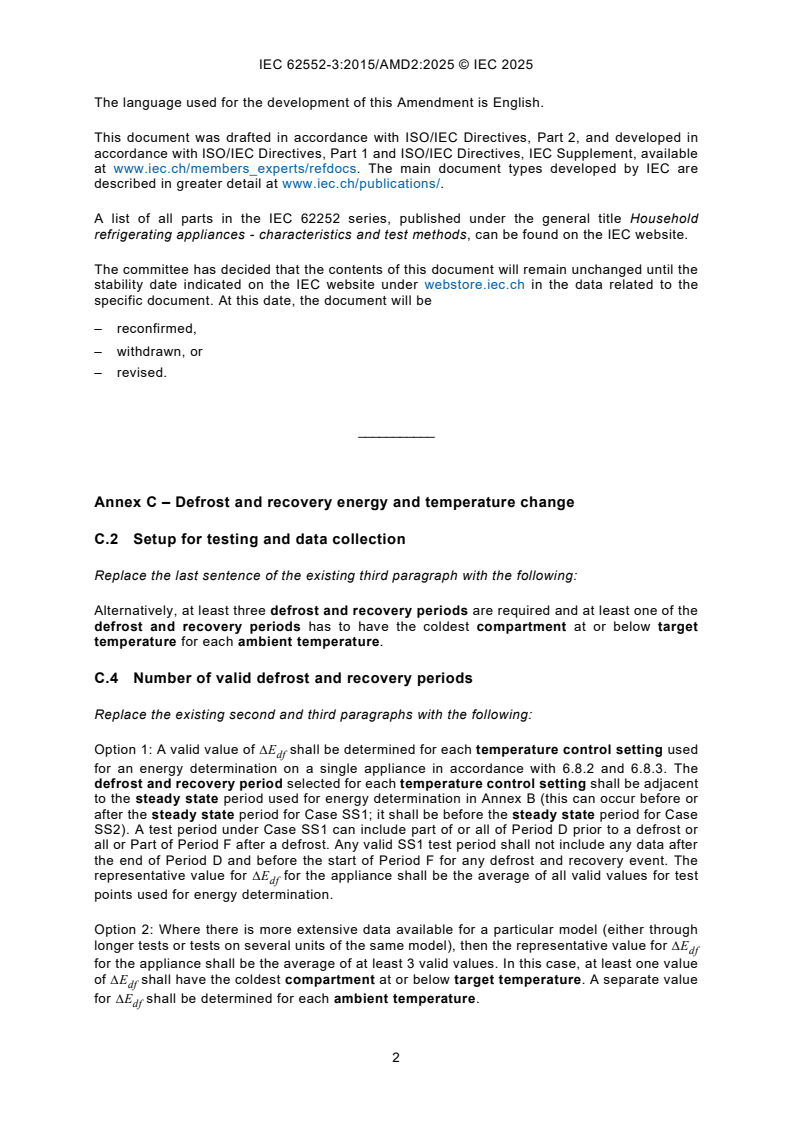
Annex C – Defrost and recovery energy and temperature change
C.2 Setup for testing and data collection
Replace the last sentence of the existing third paragraph with the following:
Alternatively, at least three defrost and recovery periods are required and at least one of the
defrost and recovery periods has to have the coldest compartment at or below target
temperature for each ambient temperature.
C.4 Number of valid defrost and recovery periods
Replace the existing second and third paragraphs with the following:
Option 1: A valid value of ∆E shall be determined for each temperature control setting used
df
for an energy determination on a single appliance in accordance with 6.8.2 and 6.8.3. The
defrost and recovery period selected for each temperature control setting shall be adjacent
to the steady state period used for energy determination in Annex B (this can occur before or
after the steady state period for Case SS1; it shall be before the steady state period for Case
SS2). A test period under Case SS1 can include part of or all of Period D prior to a defrost or
all or Part of Period F after a defrost. Any valid SS1 test period shall not include any data after
the end of Period D and before the start of Period F for any defrost and recovery event. The
representative value for ∆E for the appliance shall be the average of all valid values for test
df
points used for energy determination.
Option 2: Where there is more extensive data available for a particular model (either through
longer tests or tests on several units of the same model), then the representative value for ∆E
df
for the appliance shall be the average of at least 3 valid values. In this case, at least one value
of ∆E shall have the coldest compartment at or below target temperature. A separate value
df
for ∆E shall be determined for each ambient temperature.
df
Add the following new note after the third paragraph:
NOTE 1 The requirement for the number of valid defrosts has been reduced from 4 to 3 as it was estimated that
the effect on the final results would be marginal.
Renumber the Note at the end of Clause C.4, added by Amendment 1,
...