

IEC 60317-4:1990
(Main)Specifications for particular types of winding wires. Part 4: Solderable polyurethane enamelled round copper wire, class 130
General Information
- Abstract
- Status
- Published
- Publication Date
- 29-Mar-2000
- Technical Committee
- TC 55 - Winding wires
- Current Stage
- DELPUB - Deleted Publication
- Start Date
- 09-Jun-2015
- Completion Date
- 28-Aug-2026
Buy Documents
IEC 60317-4:1990+AMD1:1997+AMD2:1999 CSV - Specifications for particular types of winding wires - Part 4: Solderable polyurethane enamelled round copper wire, class 130 Released:3/30/2000
Overview
IEC 60317-4:1990 is an international standard published by the International Electrotechnical Commission (IEC) that specifies the requirements for solderable polyurethane enamelled round copper wire, class 130. This standard is part of the IEC 60317 series, which covers specifications for various particular types of winding wires used in electrical devices. It includes detailed parameters such as dimensions, electrical resistance, mechanical properties, thermal endurance, solderability, and packaging to ensure consistent quality and performance.
The current consolidated edition, version 3.2 (2000-03), incorporates the base 1990 edition along with amendments made in 1997 and 1999. It serves as an essential guideline for manufacturers, engineers, and quality assurance professionals involved in the production or use of enamelled copper winding wires meeting class 130 temperature ratings.
Key Topics
Product Scope
This standard applies specifically to round copper wires insulated with a polyurethane enamel coating that is solderable and rated for operation up to class 130 (130°C temperature index). It complements and integrates earlier specifications such as IEC 60182.Technical Specifications
- Dimensions: Precise nominal diameters and tolerances for copper conductor sizes.
- Electrical Resistance: Limits on direct current resistance to ensure electrical efficiency.
- Mechanical Properties: Elongation, springiness, flexibility, and adherence tests that measure insulation durability and wire handling characteristics.
- Thermal Performance: Resistance to thermal shocks and heat exposure corresponding to class 130 temperature classification.
- Chemical Resistance: Resistance to solvents, transformer oil, and refrigerants to ensure insulation integrity in various operating environments.
- Solderability: Defined parameters to verify the enamel coating allows reliable solder connections-essential for manufacturing processes in electrical winding assemblies.
- Insulation Quality: Dielectric dissipation factor, breakdown voltage, and continuity checks to guarantee electrical insulation performance.
- Abrasion Resistance: Protection against mechanical wear for conductor diameters from 0.250 mm to 2.000 mm.
- Packaging and Marking: Guidelines for proper handling, storage, and labelling to maintain wire quality through the supply chain.
Testing Methods
The standard references established testing methods from IEC 60851 series for verifying wire properties and performance criteria.
Applications
IEC 60317-4:1990 certified wires are widely used in:
- Electrical Machines: Motor and transformer windings where high temperature resistance and reliable solderability are critical.
- Electronic Components: Coils, inductors, and electromagnets requiring fine gauge copper wire with robust insulation.
- Automotive Electrical Systems: Applications demanding thermal endurance and chemical resistance to oils and refrigerants.
- Industrial Equipment: Devices exposed to mechanical stress and thermal cycling.
- Quality Manufacturing: Ensures consistent solderable enamel coatings that facilitate secure electrical connections and reduce production defects.
Using wire that complies with IEC 60317-4 ensures enhanced operational reliability, improved safety margins, and compatibility with automated winding and soldering processes.
Related Standards
- IEC 60317 Series: Covers specifications for other types of enamelled and insulated winding wires, including different class ratings and enamel formulations.
- IEC 60317-0-1: General requirements for round copper enameled wires, complementing part 4’s specific requirements.
- IEC 60851 Series: Defines the test methods for verifying the mechanical, electrical, and thermal properties of winding wires.
- IEC 60264: Details packaging requirements to maintain wire quality during storage and transport.
- IEC 60182: Earlier standard incorporated into IEC 60317 parts for continuity of copper wire specifications.
Keywords: IEC 60317-4, solderable polyurethane enamelled copper wire, winding wire standard, class 130 wire, electrical winding wire specifications, copper wire insulation, solderability, winding wire testing, polyurethane insulation wire, IEC winding wire standards.
Relations
- Effective Date
- 05-Sep-2023
- Effective Date
- 05-Sep-2023
- Effective Date
- 05-Sep-2023
Buy Documents
IEC 60317-4:1990+AMD1:1997+AMD2:1999 CSV - Specifications for particular types of winding wires - Part 4: Solderable polyurethane enamelled round copper wire, class 130 Released:3/30/2000
Get Certified
Connect with accredited certification bodies for this standard

IMQ S.p.A. (Certification)
Italian electrical product certification.

SLG Prüf- und Zertifizierungs GmbH
German testing and certification body.

UL Solutions
Global safety science company with testing, inspection and certification.
Sponsored listings
Frequently Asked Questions
IEC 60317-4:1990 is a standard published by the International Electrotechnical Commission (IEC). Its full title is "Specifications for particular types of winding wires. Part 4: Solderable polyurethane enamelled round copper wire, class 130". This standard covers: Specifications for particular types of winding wires. Part 4: Solderable polyurethane enamelled round copper wire, class 130
Specifications for particular types of winding wires. Part 4: Solderable polyurethane enamelled round copper wire, class 130
IEC 60317-4:1990 is classified under the following ICS (International Classification for Standards) categories: 29.060.10 - Wires. The ICS classification helps identify the subject area and facilitates finding related standards.
IEC 60317-4:1990 has the following relationships with other standards: It is inter standard links to IEC 60317-4:1990/AMD1:1997, IEC 60317-4:1990/AMD2:1999, IEC 60317-4:2015. Understanding these relationships helps ensure you are using the most current and applicable version of the standard.
IEC 60317-4:1990 is available in PDF format for immediate download after purchase. The document can be added to your cart and obtained through the secure checkout process. Digital delivery ensures instant access to the complete standard document.
Standards Content (Sample)
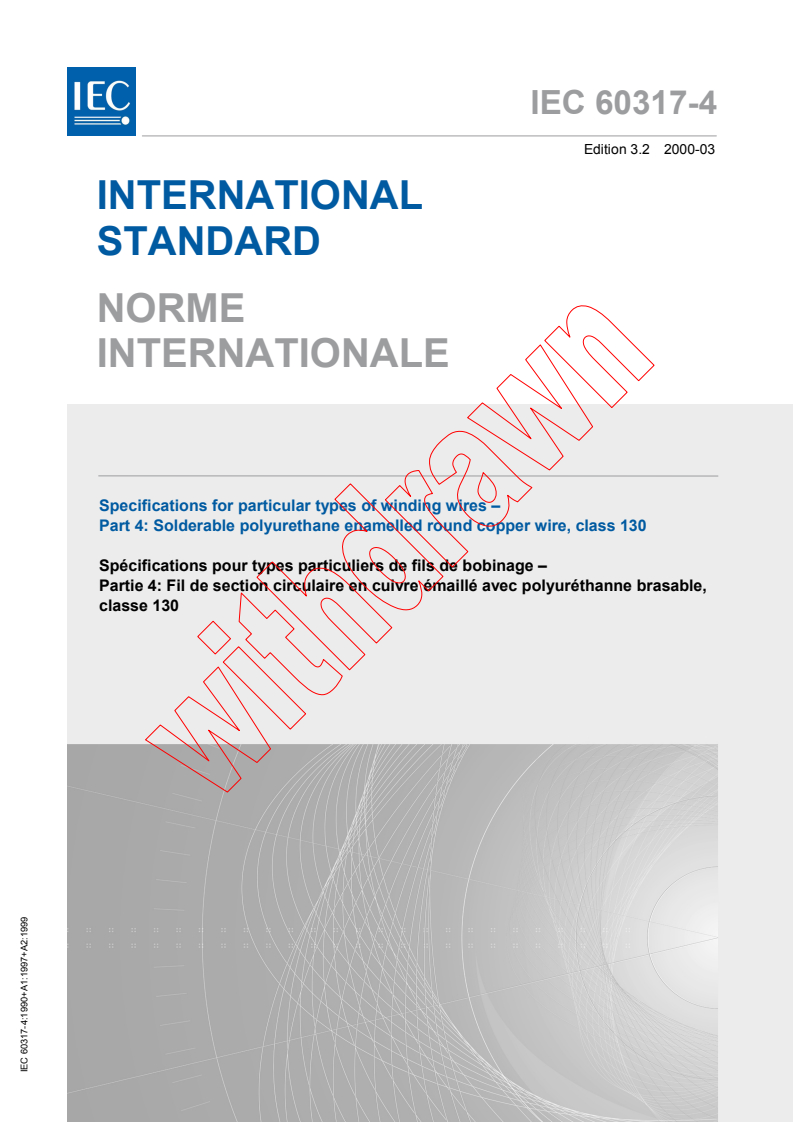
IEC 60317-4
Edition 3.2 2000-03
INTERNATIONAL
STANDARD
NORME
INTERNATIONALE
Specifications for particular types of winding wires –
Part 4: Solderable polyurethane enamelled round copper wire, class 130
Spécifications pour types particuliers de fils de bobinage –
Partie 4: Fil de section circulaire en cuivre émaillé avec polyuréthanne brasable,
classe 130
All rights reserved. Unless otherwise specified, no part of this publication may be reproduced or utilized in any form or by
any means, electronic or mechanical, including photocopying and microfilm, without permission in writing from either IEC or
IEC's member National Committee in the country of the requester.
If you have any questions about IEC copyright or have an enquiry about obtaining additional rights to this publication,
please contact the address below or your local IEC member National Committee for further information.
Droits de reproduction réservés. Sauf indication contraire, aucune partie de cette publication ne peut être reproduite
ni utilisée sous quelque forme que ce soit et par aucun procédé, électronique ou mécanique, y compris la photocopie
et les microfilms, sans l'accord écrit de la CEI ou du Comité national de la CEI du pays du demandeur.
Si vous avez des questions sur le copyright de la CEI ou si vous désirez obtenir des droits supplémentaires sur cette
publication, utilisez les coordonnées ci-après ou contactez le Comité national de la CEI de votre pays de résidence.
IEC Central Office
3, rue de Varembé
CH-1211 Geneva 20
Switzerland
Email: inmail@iec.ch
Web: www.iec.ch
About the IEC
The International Electrotechnical Commission (IEC) is the leading global organization that prepares and publishes
International Standards for all electrical, electronic and related technologies.
About IEC publications
The technical content of IEC publications is kept under constant review by the IEC. Please make sure that you have the
latest edition, a corrigenda or an amendment might have been published.
ƒ Catalogue of IEC publications: www.iec.ch/searchpub
The IEC on-line Catalogue enables you to search by a variety of criteria (reference number, text, technical committee,…).
It also gives information on projects, withdrawn and replaced publications.
ƒ IEC Just Published: www.iec.ch/online_news/justpub
Stay up to date on all new IEC publications. Just Published details twice a month all new publications released. Available
on-line and also by email.
ƒ Electropedia: www.electropedia.org
The world's leading online dictionary of electronic and electrical terms containing more than 20 000 terms and definitions
in English and French, with equivalent terms in additional languages. Also known as the International Electrotechnical
Vocabulary online.
ƒ Customer Service Centre: www.iec.ch/webstore/custserv
If you wish to give us your feedback on this publication or need further assistance, please visit the Customer Service
Centre FAQ or contact us:
Email: csc@iec.ch
Tel.: +41 22 919 02 11
Fax: +41 22 919 03 00
A propos de la CEI
La Commission Electrotechnique Internationale (CEI) est la première organisation mondiale qui élabore et publie des
normes internationales pour tout ce qui a trait à l'électricité, à l'électronique et aux technologies apparentées.
A propos des publications CEI
Le contenu technique des publications de la CEI est constamment revu. Veuillez vous assurer que vous possédez
l’édition la plus récente, un corrigendum ou amendement peut avoir été publié.
ƒ Catalogue des publications de la CEI: www.iec.ch/searchpub/cur_fut-f.htm
Le Catalogue en-ligne de la CEI vous permet d’effectuer des recherches en utilisant différents critères (numéro de référence,
texte, comité d’études,…). Il donne aussi des informations sur les projets et les publications retirées ou remplacées.
ƒ Just Published CEI: www.iec.ch/online_news/justpub
Restez informé sur les nouvelles publications de la CEI. Just Published détaille deux fois par mois les nouvelles
publications parues. Disponible en-ligne et aussi par email.
ƒ Electropedia: www.electropedia.org
Le premier dictionnaire en ligne au monde de termes électroniques et électriques. Il contient plus de 20 000 termes et
définitions en anglais et en français, ainsi que les termes équivalents dans les langues additionnelles. Egalement appelé
Vocabulaire Electrotechnique International en ligne.
ƒ Service Clients: www.iec.ch/webstore/custserv/custserv_entry-f.htm
Si vous désirez nous donner des commentaires sur cette publication ou si vous avez des questions, visitez le FAQ du
Service clients ou contactez-nous:
Email: csc@iec.ch
Tél.: +41 22 919 02 11
Fax: +41 22 919 03 00
IEC 60317-4
Edition 3.2 2000-03
INTERNATIONAL
STANDARD
NORME
INTERNATIONALE
Specifications for particular types of winding wires –
Part 4: Solderable polyurethane enamelled round copper wire, class 130
Spécifications pour types particuliers de fils de bobinage –
Partie 4: Fil de section circulaire en cuivre émaillé avec polyuréthanne brasable,
classe 130
INTERNATIONAL
ELECTROTECHNICAL
COMMISSION
COMMISSION
ELECTROTECHNIQUE
PRICE CODE
INTERNATIONALE
CD
CODE PRIX
ICS 29.060.10 ISBN 2-8318-5109-2
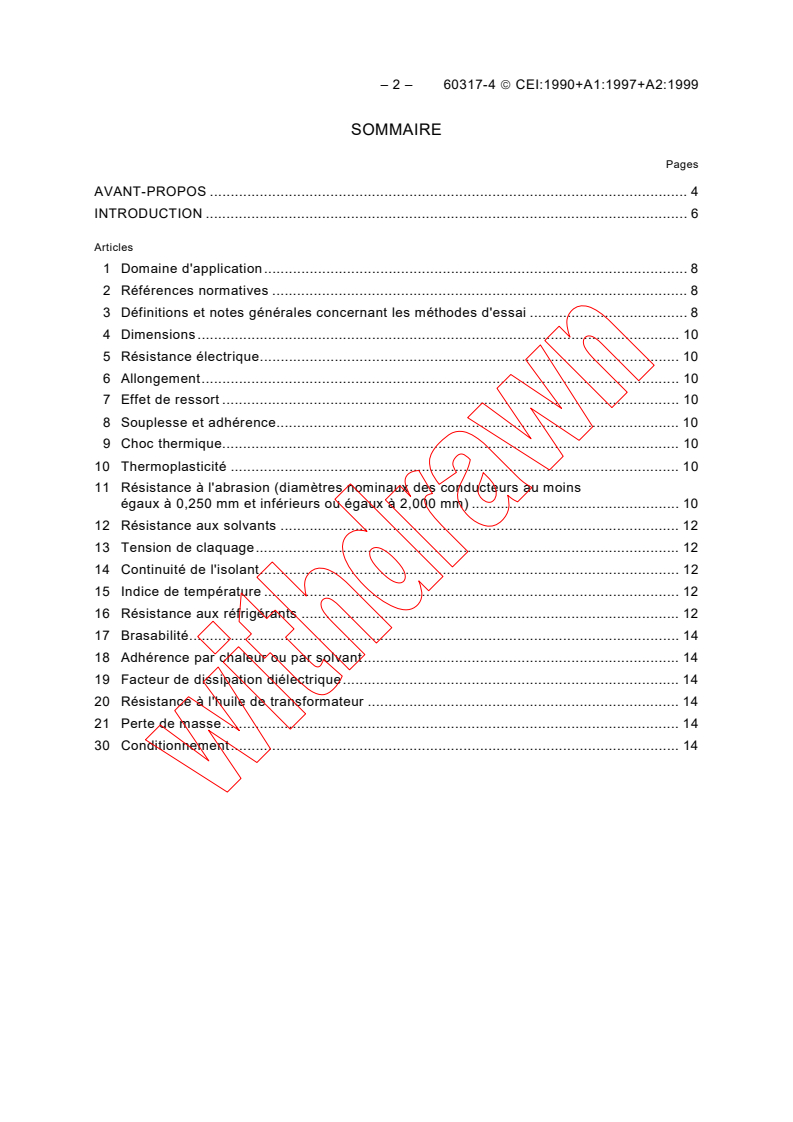
– 2 – 60317-4 CEI:1990+A1:1997+A2:1999
SOMMAIRE
Pages
AVANT-PROPOS . 4
INTRODUCTION .6
Articles
1 Domaine d'application. 8
2 Références normatives . 8
3 Définitions et notes générales concernant les méthodes d'essai . 8
4 Dimensions . 10
5 Résistance électrique. 10
6 Allongement. 10
7 Effet de ressort . 10
8 Souplesse et adhérence. 10
9 Choc thermique. 10
10 Thermoplasticité . 10
11 Résistance à l'abrasion (diamètres nominaux des conducteurs au moins
égaux à 0,250 mm et inférieurs ou égaux à 2,000 mm) . 10
12 Résistance aux solvants . 12
13 Tension de claquage. 12
14 Continuité de l'isolant. 12
15 Indice de température . 12
16 Résistance aux réfrigérants . 12
17 Brasabilité. 14
18 Adhérence par chaleur ou par solvant. 14
19 Facteur de dissipation diélectrique. 14
20 Résistance à l'huile de transformateur . 14
21 Perte de masse. 14
30 Conditionnement. 14
60317-4 IEC:1990+A1:1997+A2:1999 – 3 –
CONTENTS
Page
FOREWORD . 5
INTRODUCTION .7
Clause
1 Scope . 9
2 Normative references. 9
3 Definitions and general notes on methods of test . 9
4 Dimensions . 11
5 Electrical resistance. 11
6 Elongation. 11
7 Springiness. 11
8 Flexibility and adherence . 11
9 Heat shock. 11
10 Cut-through. 11
11 Resistance to abrasion (nominal conductor diameters from 0,250 mm up to
and including 2,000 mm). 11
12 Resistance to solvents . 13
13 Breakdown voltage. 13
14 Continuity of insulation. 13
15 Temperature index. 13
16 Resistance to refrigerants . 13
17 Solderability. 15
18 Heat or solvent bonding . 15
19 Dielectric dissipation factor . 15
20 Resistance to transformer oil . 15
21 Loss of mass . 15
30 Packaging. 15
– 4 – 60317-4 © CEI:1990+A1:1997+A2:1999
COMMISSION ÉLECTROTECHNIQUE INTERNATIONALE
____________
SPÉCIFICATIONS POUR TYPES PARTICULIERS DE FILS DE BOBINAGE –
Partie 4: Fil de section circulaire en cuivre émaillé
avec polyuréthanne brasable, classe 130
AVANT-PROPOS
1) La CEI (Commission Électrotechnique Internationale) est une organisation mondiale de normalisation
composée de l'ensemble des comités électrotechniques nationaux (Comités nationaux de la CEI). La CEI a
pour objet de favoriser la coopération internationale pour toutes les questions de normalisation dans les
domaines de l'électricité et de l'électronique. A cet effet, la CEI, entre autres activités, publie des Normes
internationales. Leur élaboration est confiée à des comités d'études, aux travaux desquels tout Comité national
intéressé par le sujet traité peut participer. Les organisations internationales, gouvernementales et non
gouvernementales, en liaison avec la CEI, participent également aux travaux. La CEI collabore étroitement
avec l'Organisation Internationale de Normalisation (ISO), selon des conditions fixées par accord entre les
deux organisations.
2) Les décisions ou accords officiels de la CEI concernant les questions techniques représentent, dans la mesure
du possible, un accord international sur les sujets étudiés, étant donné que les Comités nationaux intéressés
sont représentés dans chaque comité d’études.
3) Les documents produits se présentent sous la forme de recommandations internationales. Ils sont publiés
comme normes, spécifications techniques, rapports techniques ou guides et agréés comme tels par les
Comités nationaux.
4) Dans le but d'encourager l'unification internationale, les Comités nationaux de la CEI s'engagent à appliquer de
façon transparente, dans toute la mesure possible, les Normes internationales de la CEI dans leurs normes
nationales et régionales. Toute divergence entre la norme de la CEI et la norme nationale ou régionale
correspondante doit être indiquée en termes clairs dans cette dernière.
5) La CEI n’a fixé aucune procédure concernant le marquage comme indication d’approbation et sa responsabilité
n’est pas engagée quand un matériel est déclaré conforme à l’une de ses normes.
6) L’attention est attirée sur le fait que certains des éléments de la présente Norme internationale peuvent faire
l’objet de droits de propriété intellectuelle ou de droits analogues. La CEI ne saurait être tenue pour
responsable de ne pas avoir identifié de tels droits de propriété et de ne pas avoir signalé leur existence.
La présente Norme internationale a été établie par le comité d'études 55 de la CEI: Fils de
bobinage.
Cette troisième édition de la CEI 60317-4 remplace la deuxième édition parue en 1988.
Il a été décidé de publier la CEI 60182 et la CEI 60317 selon les nouvelles règles de
présentation. Le texte de la CEI 60182 a été incorporé sans changement technique dans la
partie correspondante de la CEI 60317. Toutes les exigences générales des fils de cuivre de
section circulaire émaillés ont été réunies dans la CEI 60317-0-1 sans changement technique
sauf indication contraire dans l'avant-propos de la CEI 60317-0-1.
La présente version consolidée de la CEI 60317-4 comprend la troisième édition (1990), son
amendement 1 (1997) [documents 55/560/FDIS et 55/604/RVD] et son amendement 2 (1999)
[documents 55/694/FDIS et 55/721/RVD].
Le contenu technique de cette version consolidée est donc identique à celui de l'édition de
base et à ses amendements; cette version a été préparée par commodité pour l'utilisateur.
Elle porte le numéro d'édition 3.2.
Une ligne verticale dans la marge indique où la publication de base a été modifiée par les
amendements 1 et 2.
60317-4 © IEC:1990+A1:1997+A2:1999 – 5 –
INTERNATIONAL ELECTROTECHNICAL COMMISSION
____________
SPECIFICATIONS FOR PARTICULAR TYPES OF WINDING WIRES –
Part 4: Solderable polyurethane enamelled round copper wire, class 130
FOREWORD
1) The IEC (I
...