


IEC 60512-1-4:1997
(Main)Electromechanical components for electronic equipment - Basic testing procedures and measuring methods - Part 1: General - Section 4: Test 1d: Contact protection effectiveness (scoop-proof)
General Information
- Abstract
Defines a standard test method to verify the ability of a connector to prevent the accidental touching of its contact by the front of the mating connector. The contents of the corrigendum of November 2000 have been included in this copy.
- Status
- Published
- Publication Date
- 29-Jul-1997
- Technical Committee
- SC 48B - Electrical connectors
- Current Stage
- PPUB - Publication issued
- Start Date
- 30-Jul-1997
- Completion Date
- 31-Aug-1997
Buy Documents
IEC 60512-1-4:1997 - Electromechanical components for electronic equipment - Basic testing procedures and measuring methods - Part 1: General - Section 4: Test 1d: Contact protection effectiveness (scoop-proof)
Overview
IEC 60512-1-4:1997 is an international standard published by the International Electrotechnical Commission (IEC) that defines a basic testing procedure and measuring method for evaluating the contact protection effectiveness of electromechanical connectors used in electronic equipment. This particular standard, under Part 1: General - Section 4: Test 1d, specifically focuses on the "scoop-proof" test, designed to verify a connector's ability to prevent accidental contact with its pins or sockets during mating.
This test is primarily relevant to cylindrical multi-contact connectors, commonly used in critical applications where preventing unintentional electrical contact is vital for safety and reliability. The latest edition includes amendments up to November 2000 to ensure current technical relevancy.
Key Topics
Scope and Purpose:
The standard establishes a uniform method to test connectors for resistance against accidental contact ("scoop-proofness"), thereby preventing damage or electrical hazards caused by improper mating.Test Methods:
Two principal test methods are described:- Method A: Focuses on improper mating of connectors with opposite gender contacts (female to male and vice versa) at various angles and rotations to detect any accidental electrical continuity.
- Method B: Involves coupling connectors with the same gender contacts (male to male) to observe for electrical breakdown or flashover.
Test Preparation:
Connectors must be fully equipped with contacts and wired according to their detailed specifications before testing.Measurement Setup:
An ohmmeter or similar continuity detection device connects the housing shell to all contacts wired together on the mating side, monitoring for any unintentional contact.Pass/Fail Criteria:
- Method A: No electrical continuity should be detected during abnormal mating attempts.
- Method B: No arcing or dielectric breakdown should occur under specified test voltages.
Voltage Proof Test:
Additional voltage stress tests per IEC 60512-2 (or updated editions) validate dielectric strength between contact groups.Specification Details:
When applying this standard, test parameters such as specimen preparation, wiring, test voltages, and allowable deviations must be clearly defined in the product's detail specification.
Applications
Connector Safety Assurance:
Ensuring that electromechanical connectors prevent accidental contact is crucial in safety-critical electronic systems across aerospace, industrial automation, military, telecommunications, and medical equipment.Product Development and Quality Control:
Manufacturers can use this standardized "scoop-proof" test method to verify and document connector safety features during design, production, and incoming inspection.Compliance and Certification:
Products intended for international markets rely on IEC standards for consistent testing and certification, which helps reduce market entry barriers and establishes reliability trust.Connector Design Validation:
Design engineers apply this method to validate connector housings, contact arrangements, and insulator geometries to minimize risks of short circuits or electric shock.
Related Standards
IEC 60512-2: Basic testing procedures including electrical continuity, contact resistance, insulation resistance, and voltage proof tests, complementing the scoop-proof test by covering additional electrical reliability aspects.
IEC 60050 (International Electrotechnical Vocabulary): For standardized terminology related to electromechanical components and tests, ensuring clarity and understanding in documentation.
IEC 60027, IEC 60417, IEC 60617: Standards related to graphical symbols, letter symbols, and schematic representations used for electrical and electronic equipment, aiding consistent communication of connector features and test results.
By adhering to IEC 60512-1-4:1997, manufacturers and users of electronic connectors can achieve reliable contact protection effectiveness, reducing the risk of improper mating damage, improving safety, and ensuring enhanced product quality. This targeted test method supports the global harmonization of electromechanical connector testing protocols and plays a vital role in high-reliability electronic system design.
Relations
- Effective Date
- 05-Sep-2023
Buy Documents
IEC 60512-1-4:1997 - Electromechanical components for electronic equipment - Basic testing procedures and measuring methods - Part 1: General - Section 4: Test 1d: Contact protection effectiveness (scoop-proof)
Frequently Asked Questions
IEC 60512-1-4:1997 is a standard published by the International Electrotechnical Commission (IEC). Its full title is "Electromechanical components for electronic equipment - Basic testing procedures and measuring methods - Part 1: General - Section 4: Test 1d: Contact protection effectiveness (scoop-proof)". This standard covers: Defines a standard test method to verify the ability of a connector to prevent the accidental touching of its contact by the front of the mating connector. The contents of the corrigendum of November 2000 have been included in this copy.
Defines a standard test method to verify the ability of a connector to prevent the accidental touching of its contact by the front of the mating connector. The contents of the corrigendum of November 2000 have been included in this copy.
IEC 60512-1-4:1997 is classified under the following ICS (International Classification for Standards) categories: 31.220.01 - Electromechanical components in general. The ICS classification helps identify the subject area and facilitates finding related standards.
IEC 60512-1-4:1997 has the following relationships with other standards: It is inter standard links to IEC 60512-1-4:1997/COR1:2000. Understanding these relationships helps ensure you are using the most current and applicable version of the standard.
IEC 60512-1-4:1997 is available in PDF format for immediate download after purchase. The document can be added to your cart and obtained through the secure checkout process. Digital delivery ensures instant access to the complete standard document.
Standards Content (Sample)
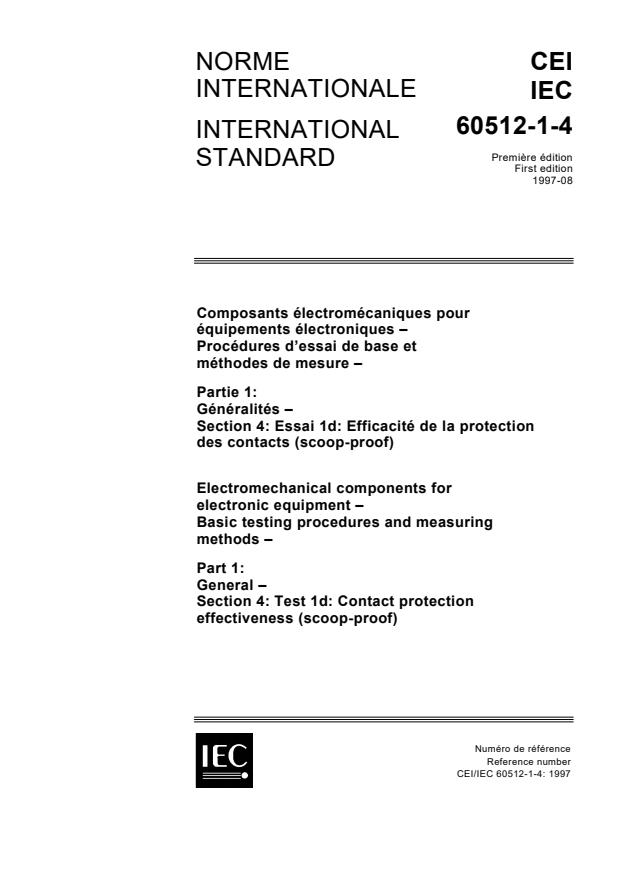
NORME
CEI
INTERNATIONALE
IEC
60512-1-4
INTERNATIONAL
Première édition
STANDARD
First edition
1997-08
Composants électromécaniques pour
équipements électroniques –
Procédures d’essai de base et
méthodes de mesure –
Partie 1:
Généralités –
Section 4: Essai 1d: Efficacité de la protection
des contacts (scoop-proof)
Electromechanical components for
electronic equipment –
Basic testing procedures and measuring
methods –
Part 1:
General –
Section 4: Test 1d: Contact protection
effectiveness (scoop-proof)
Numéro de référence
Reference number
CEI/IEC 60512-1-4: 1997
Numéros des publications Numbering
Les publications de la CEI sont numérotées à partir de As from the 1st January 1997 all IEC publications are
60000 dès le 1er janvier 1997. issued with a designation in the 60000 series.
Publications consolidées Consolidated publications
Les versions consolidées de certaines publications de Consolidated versions of some IEC publications
la CEI incorporant amendements sont disponibles. Par including amendments are available. For example,
exemple, les numéros d’édition 1.0, 1.1 et 1.2 edition numbers 1.0, 1.1 and 1.2 refer, respectively, to
indiquent respectivement la publication de base, la the base publication, the base publication
publication de base incorporant l’amendement 1, et la incorporating amendment 1 and the base publication
publication de base incorporant les amendements 1 incorporating amendments 1 and 2.
et 2.
Validité de la présente publication Validity of this publication
Le contenu technique des publications de la CEI est The technical content of IEC publications is kept under
constamment revu par la CEI afin qu'il reflète l'état constant review by the IEC, thus ensuring that the
actuel de la technique. content reflects current technology.
Des renseignements relatifs à la date de Information relating to the date of the reconfirmation of
reconfirmation de la publication sont disponibles dans the publication is available in the IEC catalogue.
le Catalogue de la CEI.
Les renseignements relatifs à ces révisions, à l'établis- Information on the revision work, the issue of revised
sement des éditions révisées et aux amendements editions and amendments may be obtained from
peuvent être obtenus auprès des Comités nationaux de IEC National Committees and from the following
la CEI et dans les documents ci-dessous: IEC sources:
• Bulletin de la CEI • IEC Bulletin
• Annuaire de la CEI • IEC Yearbook
Accès en ligne* On-line access*
• Catalogue des publications de la CEI • Catalogue of IEC publications
Publié annuellement et mis à jour régulièrement Published yearly with regular updates
(Accès en ligne)* (On-line access)*
Terminologie, symboles graphiques Terminology, graphical and letter
et littéraux symbols
En ce qui concerne la terminologie générale, le lecteur For general terminology, readers are referred to
se reportera à la CEI 60050: Vocabulaire Electro- IEC 60050: International Electrotechnical Vocabulary
technique International (VEI). (IEV).
Pour les symboles graphiques, les symboles littéraux For graphical symbols, and letter symbols and signs
et les signes d'usage général approuvés par la CEI, le approved by the IEC for general use, readers are
lecteur consultera la CEI 60027: Symboles littéraux à referred to publications IEC 60027: Letter symbols to
utiliser en électrotechnique, la CEI 60417: Symboles be used in electrical technology, IEC 60417: Graphical
symbols for use on equipment. Index, survey and
graphiques utilisables sur le matériel. Index, relevé et
compilation des feuilles individuelles, et la CEI 60617: compilation of the single sheets and IEC 60617:
Symboles graphiques pour schémas. Graphical symbols for diagrams.
Publications de la CEI établies par IEC publications prepared by the same
le même comité d'études technical committee
L'attention du lecteur est attirée sur les listes figurant The attention of readers is drawn to the end pages of
à la fin de cette publication, qui énumèrent les this publication which list the IEC publications issued
publications de la CEI préparées par le comité by the technical committee which has prepared the
d'études qui a établi la présente publication. present publication.
* Voir adresse «site web» sur la page de titre. * See web site address on title page.
NORME
CEI
INTERNATIONALE
IEC
60512-1-4
INTERNATIONAL
Première édition
STANDARD
First edition
1997-08
Composants électromécaniques pour
équipements électroniques –
Procédures d’essai de base et
méthodes de mesure –
Partie 1:
Généralités –
Section 4: Essai 1d: Efficacité de la protection
des contacts (scoop-proof)
Electromechanical components for
electronic equipment –
Basic testing procedures and measuring
methods –
Part 1:
General –
Section 4: Test 1d: Contact protection
effectiveness (scoop-proof)
IEC 1997 Droits de reproduction réservés Copyright - all rights reserved
Aucune partie de cette publication ne peut être reproduite ni No part of this publication may be reproduced or utilized in
utilisée sous quelque forme que ce soit et par aucun any form or by any means, electronic or mechanical,
procédé, électronique ou mécanique, y compris la photo- including photocopying and microfilm, without permission in
copie et les microfilms, sans l'accord écrit de l'éditeur. writing from the publisher.
International Electrotechnical Commission 3, rue de Varembé Geneva, Switzerland
Telefax: +41 22 919 0300 e-mail: inmail@iec.ch IEC web site http: //www.iec.ch
CODE PRIX
Commission Electrotechnique Internationale
E
PRICE CODE
International Electrotechnical Commission
Pour prix, voir catalogue en vigueur
For price, see current catalogue
– 2 – 60512-1-4 © CEI:1997
COMMISSION ÉLECTROTECHNIQUE INTERNATIONALE
___________
COMPOSANTS ÉLECTROMÉCANIQUES
POUR ÉQUIPEMENTS ÉLECTRONIQUES –
PROCÉDURES D'ESSAI DE BASE ET MÉTHODES DE MESURE –
Partie 1: Généralités –
Section 4: Essai 1d: Efficacité de la protection des contacts
(scoop-proof)
AVANT-PROPOS
1) La CEI (Commission Electrotechnique Internationale) est une organisation mondiale de normalisation composée
de l'ensemble des comités électrotechniques nationaux (Comités nationaux de la CEI). La CEI a pour objet de
favoriser la coopération internationale pour toutes les questions de normalisation dans les domaines de
l'électricité et de l'électronique. A cet effet, la CEI, entre autres activités, publie des Normes internationales.
Leur élaboration est confiée à des comités d'études, aux travaux desquels tout Comité national intéressé par le
sujet traité peut participer. Les organisations internationales, gouvernementales et non gouvernementales, en
liaison avec la CEI, participent également aux travaux. La CEI collabore étroitement avec l'Organisation
Internationale de Normalisation (ISO), selon des conditions fixées par accord entre les deux organisations.
2) Les décisions ou accords officiels de la CEI concernant les questions techniques représentent, dans la mesure
du possible un accord international sur les sujets étudiés, étant donné que les Comités nationaux intéressés
sont représentés dans chaque comité d’études.
3) Les documents produits se présentent sous la forme de recommandations internationales. Ils sont publiés
comme normes, rapports techniques ou guides et agréés comme tels par les Comités nationaux.
4) Dans le but d'encourager l'unification internationale, les Comités nationaux de la CEI s'engagent à appliquer de
façon transparente, dans toute la mesure possible, les Normes internationales de la CEI dans leurs normes
nationales et régionales. Toute divergence entre la norme de la CEI et la norme nationale ou régionale
correspondante doit être indiquée en termes clairs dans cette dernière.
5) La CEI n’a fixé aucune procédure concernant le marquage comme indication d’approbation et sa responsabilité
n’est pas engagée quand un matériel est déclaré conforme à l’une de ses normes.
6) L’attention est attirée sur le fait que certains des éléments de la présente Norme internationale peuvent faire
l’objet de droits de propriété intellectuelle ou de droits analogues. La CEI ne saurait être tenue pour
responsable de ne pas avoir identifié de tels droits de propriété et de ne pas avoir signalé leur existence.
La Norme internationale CEI 60512-1-4 a été établie par le sous-comité 48B: Connecteurs, du
comité d'études 48 de la CEI: Composants électromécaniques et structures mécaniques pour
équipements électroniques.
La norme complète comprendra d'autres essais qui paraîtront au fur et à mesure de leur mise
au point.
Le texte de la présente norme est issu des documents suivants:
FDIS Rapport de vote
48B/598/FDIS 48B/644/RVD
Le rapport de vote indiqué dans le tableau ci-dessus donne toute information sur le vote ayant
abouti à l’approbation de cette norme.
Le contenu du corrigendum de novembre 2000 a été pris en considération dans cet exemplaire.
60512-1-4 © IEC:1997 – 3 –
INTERNATIONAL ELECTROTECHNICAL COMMISSION
___________
ELECTROMECHANICAL COMPONENTS FOR ELECTRONIC EQUIPMENT –
BASIC TESTING PROCEDURES AND MEASURING METHODS –
Part 1: General –
Section 4: Test 1d: Contact protection effectiveness
(scoop-proof)
FOREWORD
1) The IEC (International Electrotechnical Commission) is a worldwide organization for standardization comprising
all national electrotechnical committees (IEC National Committees). The object of the IEC is to promote
international co-operation on all questions concerning standardization in the electrical and electronic fields. To
this end and in addition to other activities, the IEC publishes International Standards. Their preparation is
entrusted to technical committees; any IEC National Committee interested in the subject dealt with may
participate in this preparatory work. International, governmental and non-governmental organizations liaising
with the IEC also participate in this preparation. The IEC collaborates closely with the
...