


IEC 61373:2010/COR1:2011
(Corrigendum)Corrigendum 1 - Railway applications - Rolling stock equipment - Shock and vibration tests
General Information
- Abstract
- Status
- Published
- Publication Date
- 11-Oct-2011
- Technical Committee
- TC 9 - Electrical equipment and systems for railways
- Current Stage
- DELPUB - Deleted Publication
- Start Date
- 17-Jul-2026
- Completion Date
- 28-Aug-2026

Relations
- Effective Date
- 05-Sep-2023
- Effective Date
- 05-Sep-2023
Get Certified
Connect with accredited certification bodies for this standard

IRIS Certification (UNIFE)
International Railway Industry Standard certification.

TÜV SÜD Rail GmbH
TÜV SÜD railway certification services.

Bureau Veritas Railway Certification
Railway and transportation certification.
Sponsored listings
Frequently Asked Questions
IEC 61373:2010/COR1:2011 is a standard published by the International Electrotechnical Commission (IEC). Its full title is "Corrigendum 1 - Railway applications - Rolling stock equipment - Shock and vibration tests". This standard covers: Corrigendum 1 - Railway applications - Rolling stock equipment - Shock and vibration tests
Corrigendum 1 - Railway applications - Rolling stock equipment - Shock and vibration tests
IEC 61373:2010/COR1:2011 is classified under the following ICS (International Classification for Standards) categories: 45.060.01 - Railway rolling stock in general. The ICS classification helps identify the subject area and facilitates finding related standards.
IEC 61373:2010/COR1:2011 has the following relationships with other standards: It is inter standard links to IEC 61373:2010, IEC 61373:2026. Understanding these relationships helps ensure you are using the most current and applicable version of the standard.
IEC 61373:2010/COR1:2011 is available in PDF format for immediate download after purchase. The document can be added to your cart and obtained through the secure checkout process. Digital delivery ensures instant access to the complete standard document.
Standards Content (Sample)
IEC 61373
(Second edition – 2010)
Railway applications – Rolling stock equipment – Shock and vibration tests
CORRIGENDUM 1
Page 9
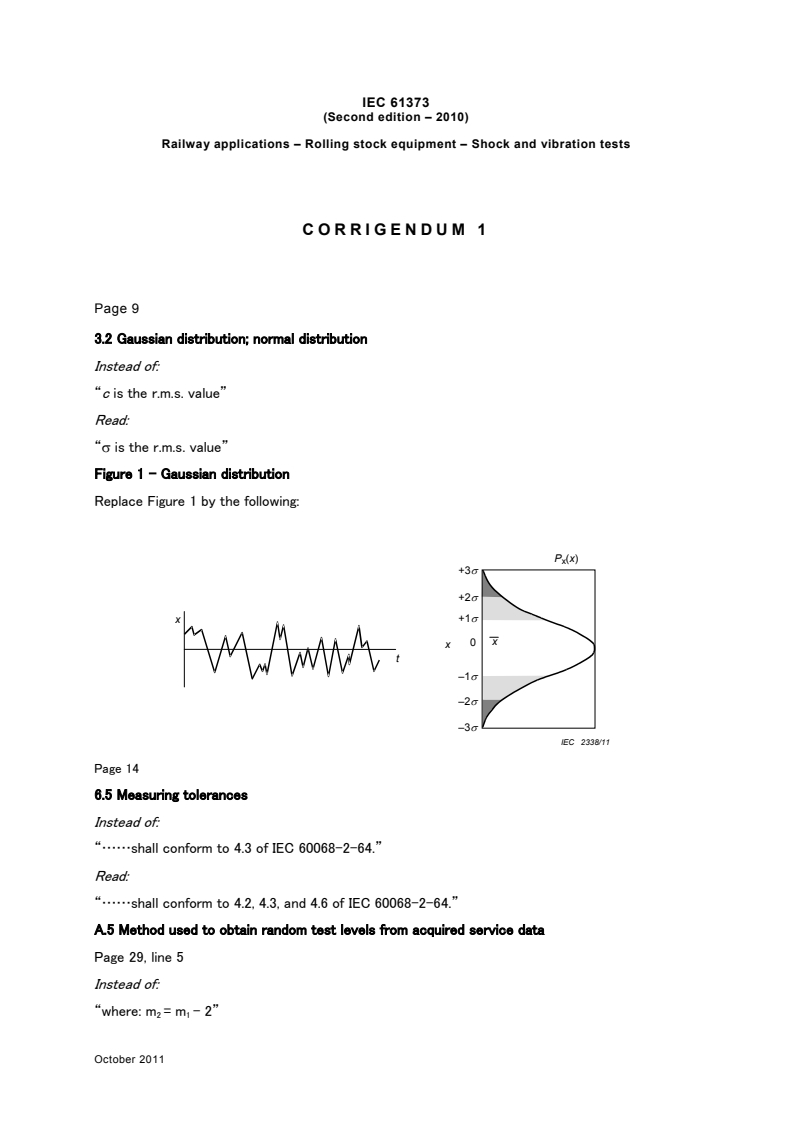
3.2 Gaussian distribution; normal distribution
Instead of:
“c is the r.m.s. value”
Read:
“σ is the r.m.s. value”
Figure 1 – Gaussian distribution
Replace Figure 1 by the following:
P (x)
x
+3σ
+2σ
x +1σ
x
x
t
–1σ
–2σ
–3σ
IEC 2338/11
Page 14
6.5 Measuring tolerances
Instead of:
“……shall conform to 4.3 of IEC 60068-2-64.”
Read:
“……shall conform to 4.2, 4.3, and 4.6 of IEC 60068-2-64.”
A.5 Method used to obtain random test levels from acquired service data
Page 29, line 5
Instead of:
“where: m = m - 2”
2 1
October 2011
Read:
“where: m = m + 2”
2 1
Page 29, line 8
Instead of:
m2
“∆c ”
Read:
m2
“∆σ ”
Formula D.4
Page 34
Instead of:
“……= AS - STD”
Read:
“……= AS + STD”
Formula D.5
Page 34
Instead of:
“……= AS – (2 × STD)”
Read:
“……= AS + (2 × STD)”
October 2011
CEI 61373
(Deux
...
This May Also Interest You
IEC 61373:2026 specifies the requirements for testing items of equipment intended for use on railway vehicles which are subsequently subjected to vibrations and shock owing to the nature of railway operational environment. To gain assurance that the quality of the equipment is acceptable, it is exposed to tests of reasonable duration that simulate the service conditions seen throughout its expected life.
Simulated long-life testing can be achieved in a number of ways each having their associated advantages and disadvantages, the following being the most common:
a) amplification: where the amplitudes are increased and the time base decreased;
b) time compression: where the amplitude history is retained and the time base is decreased (increase of the frequency);
c) decimation: where time slices of the historical data are removed when the amplitudes are below a specified threshold value.
The amplification method as stated in item a) above, is used in this document and together with the publications referred to in Clause 2; it defines the default test procedure to be followed when vibration testing items for use on railway vehicles.
Whilst this document is primarily concerned with railway vehicles on fixed rail systems, its wider use is not precluded. For systems operating on pneumatic tyres, or other transportation systems such as trolleybuses, where the level of shock and vibration clearly differ from those obtained on fixed rail systems, specific test levels can be considered. In that case, the frequency spectra and the shock duration and amplitude are computed in compliance with the guidelines in Annex A.
Annex F provides the functional random vibration load that can be considered by the user for urban vehicles operating on pneumatic tyres.
This document applies to single axis testing. However, multi-axis testing is possible.
The anchoring bolts at the fixing point(s) of the equipment are not evaluated in this document.
This document is intended to evaluate equipment which is attached to the main structure of the vehicle (and components mounted thereon). It is not intended to test equipment which forms part of the main structure. Main structure in the sense of this document means car body, bogie and axle.
The following items are out of scope of this document:
– the traction motors for railway vehicles;
– any mechanical substructure not equipped with electrical, electronic or pneumatic component.
Additional or special vibration tests for some specific equipment are not specified in this document, for example:
a) equipment mounted on, or linked to, items which are known to produce defined frequency excitation;
b) equipment such as pantographs, shoegear, or suspension components which are known to be exposed to specific shock and vibration excitation;
c) equipment intended for use in special operational environments as specified by the customer;
d) transportation and handling tests.
This third edition cancels and replaces the second edition published in 2010. This edition constitutes a technical revision.
This edition includes the following significant technical changes with respect to the previous edition:
a) consideration of specific ASD spectra from onboard measurements and certification limited to the specific case;
b) exclusion from the scope of applicability of traction motors and any substructure not equipped with electrical, electronic or pneumatic device;
c) clarification for order of testing and typical test sequence, taking into account the possibility of simultaneous multi-axis testing;
d) recommendation and guidance for removing resilient mounts of the equipment (if located between the equipment and the main structure) during the long-life test;
e) qualification of the fixture device used to attach the equipment to the test bench;
f) guidance for using a measuring point as a possibility to assess mechanical integrity;
g) change of the method to calculate the acceleration ratio which shall b
- Standard73 pagesEnglish languagesale 15% off
IEC 60310:2026 specifies the terms and definitions, classification, service conditions, characteristics and test methods for transformers and inductors on board rolling stock. This document is applicable to traction and auxiliary power transformers installed on board rolling stock and to the various types of power inductors inserted in the traction and auxiliary circuits of rolling stock, of dry or liquid-immersed design. This document is also applicable to the traction transformers of three-phase AC line-side powered vehicles and to the transformers inserted in the single-phase or polyphase auxiliary circuits of vehicles, after agreement between purchaser and manufacturer. This document does not apply to instrument transformers, transformers of a rated output below 1 kVA single-phase or 5 kVA poly-phase, and inductors of a rated output below 1 kVAR single-phase or 5 kVAR poly-phase on board rolling stock. This document does not cover accessories such as tap changers, resistors, heat exchangers, fans, etc., intended for mounting on transformers or inductors, which are tested separately according to the relevant rules. This fifth edition cancels and replaces the fourth edition published in 2016. This edition constitutes a technical revision.
This edition includes the following significant technical changes with respect to the previous edition:
a) typical circuits for transformer and inductors are added;
b) letter symbols for cooling methods are added;
c) dielectric test table is modified;
d) subclauses for the tests of transformers and inductors are restructured;
e) temperature test for dry type transformer and dry type inductors are separated in different subclauses;
f) requirements for shock and vibration tests are updated according to IEC 61373:20.
- Standard76 pagesEnglish languagesale 15% off
- Standard163 pagesEnglish languagesale 15% off
IEC 61375-1:2026 applies to the architecture of data communication systems in open trains, i.e. it covers the architecture of a communication system for the data communication between vehicles of the said open trains, the data communication within the vehicles and the data communication from train to the ground. The applicability of IEC 61375-1 to the train network technologies allows for interoperability of individual vehicles within open trains in international traffic. The data communication systems inside vehicles are given as recommended solutions to cope with the said TCN. In any case, proof of compatibility between a proposed train backbone and a proposed consist network will have to be brought by the supplier. IEC 61375-1 might be additionally applicable to closed trains and multiple unit trains when so agreed between purchaser and supplier. This fourth edition cancels and replaces the third edition published in 2012. This edition constitutes a technical revision.
This edition includes the following significant technical changes with respect to the previous edition:
a) Extension of train backbone topologies: aggregated and segregated topology;
b) Added independent consist orientation check with segregated train backbone topology;
c) Introduction of wireless technologies: wireless train backbone and wireless consist network;
d) Possibility of virtual networks;
e) Definition of data classes and protocol requirements suitable for the OMTS domain;
f) New clause about cybersecurity in train communication networks.
- Standard200 pagesEnglish languagesale 15% off
- Standard65 pagesFrench languagesale 15% off
- Standard128 pagesEnglish and French languagesale 15% off
IEC 62590-2-1:2025 This document includes the following significant technical changes with respect to IEC 62589 and the former IEC 62590:
a) Reduction of the requirements for uncontrolled rectifiers only;
b) Interface model for the different systems connected;
c) Energy efficiency addressed.
This part of IEC 62590 describes functions and working principles, specifies requirements, interfaces and test methods of uncontrolled rectifiers for DC electric traction power supply systems. Uncontrolled rectifiers connect a 3AC power network with a DC electric traction system with a unidirectional power flow using diode assemblies.
The coordination between the transformer and the rectifier diode assembly is included.
This document applies to fixed installations of following electric traction power supply systems:
• railway networks;
• metropolitan transport networks including metros, tramways, trolleybuses and fully automated transport systems, magnetic levitated transport systems, electric road systems.
This first edition of IEC 62590-2-1, in conjunction with the other parts of the IEC 62590 series, cancels and replaces the first edition of IEC 62589 published in 2010 and the second edition of IEC 62590 published in 2019.
- Standard45 pagesEnglish languagesale 15% off
- Standard47 pagesFrench languagesale 15% off
- Standard92 pagesEnglish and French languagesale 15% off
IEC 63341-2:2025 applies to on-board hydrogen fuel systems (HFSs) used to supply the fuel cells for the traction power and the auxiliaries supply of railway vehicles (such as hybrid vehicles as defined in IEC 62864-1).
This document applies to hydrogen storage in gaseous form. Other means of storage (such as liquid, liquid cryo-compressed, metal hydrides) are not covered in this document.
This document applies to any rolling stock type (e.g. light rail vehicles, tramways, streetcars, metros, commuter trains, regional trains, high speed trains, locomotives).
This document addresses the on-board mechanical, fluidic and electrical interfaces between the on-board hydrogen fuel system and fuelling station. The fuelling station, fuelling protocol and communication for the fuelling protocol are not in the scope of this document.
This document defines:
– the scope of supply of hydrogen fuel system and the description of the interfaces with sub systems internal and external to the rolling stock such as fuel cell power system, fuelling station systems;
– the environmental constraints;
– the design requirements to support HFS compliance with railway applications;
– the safety and reliability requirements to design and install the HFS for railway applications;
– the marking and labelling requirements;
– the requirements related to storage, transportation, installation and maintenance;
– the validation (type, routine and investigation tests) requirements.
- Standard71 pagesEnglish languagesale 15% off
- Standard79 pagesFrench languagesale 15% off
- Standard150 pagesEnglish and French languagesale 15% off
IEC 63341-1:2025 applies to fuel cell power systems installed onboard rolling stock for railway applications (e.g. light rail vehicles, tramways, streetcars, metros, commuter trains, regional trains, high speed trains, locomotives). Fuel cell power systems specified in this document are used for the traction power and the auxiliary supply of railway vehicles such as hybrid vehicles, and in case of use as an auxiliary onboard power source. This document applies to the fuel cell technology called proton exchange membrane fuel cell (PEMFC), with the use of hydrogen as fuel source and the use of air as oxidant source. This document does not apply for hydrogen fuel system which is specified in IEC 63341-2, as HFS is not within the scope of this document. This document does not apply for power conversion equipment which is specified in IEC 61287-1 and is not within the scope this document.
This document specifies:
- the scope of supply and the description of the interfaces (fluidic, electrical, thermal and mechanical) of the fuel cell power system;
- the description of the environmental conditions;
- the specification and description of all the requirements to ensure the fuel cell power system conformance with a railway application;
- the process to validate the fuel cell power system sizing required for a specific load profile;
- the safety, reliability and protection requirements to design the fuel cell power system for a railway application;
- the marking and labelling requirements;
- the requirements related to storage, transportation, installation and maintenance;
- the tests (type, routine and investigation) required to validate the fuel cell power system.
- Standard63 pagesEnglish languagesale 15% off
- Standard68 pagesFrench languagesale 15% off
- Standard131 pagesEnglish and French languagesale 15% off
IEC 62278-1:2025 addresses railway specifics, enables conflicts between RAMS elements to be controlled and managed effectively.
This document specifies:
a) a process, based on the system life cycle and tasks within it, for managing RAMS;
b) a systematic process, tailorable to the type and size of the system under consideration, for specifying requirements for RAMS and demonstrating that these requirements are achieved.
This document does not specify:
c) RAMS targets, quantities, requirements or solutions for specific railway applications;
d) rules or processes pertaining to the certification of railway products against the requirements of this document;
e) an approval process for the railway stakeholders.
This document is applicable to railway application fields, including signalling, rolling stock and fixed installations, and specifically:
f) to the specification and demonstration of RAMS for all railway applications and at all levels of such an application, as appropriate, from complete railway systems to major systems and to individual and combined subsystems and components within these major systems, including those containing software; in particular:
- to new systems;
- to new systems integrated into existing systems already accepted, but only to the extent and insofar as the new system with the new functionality is being integrated. It is otherwise not applicable to any unmodified aspects of the existing system;
- as far as reasonably practicable, to modifications and extensions of existing systems already accepted, but only to the extent and insofar as existing systems are being modified. It is otherwise not applicable to any unmodified aspect of the existing system;
g) at all relevant phases of the life cycle of an application;
h) for use by railway duty holders and the railway suppliers.
This document is not applicable to:
i) any unmodified aspects of the existing system;
j) existing systems which remain unmodified, including those systems already compliant with IEC 62278:2002.
This first edition, together with IEC 62278-2, cancels and replaces IEC 62278:2002. This edition constitutes a technical revision.
This edition includes the following significant technical changes with respect to the previous edition:
a) added 5.2 on multi level system approach;
b) added 5.3 on railway system overview;
c) added 5.9 on risk reduction strategy;
d) updated the content of correlation of RAMS management process and system life cycle in 6.2;
e) added 6.4 on organizational requirements;
f) added 6.5 on application of this document and adaptability to project scope and size;
g) added 6.8 on independent safety assessment;
h) added Clause 8 on safety case;
i) added Annex D providing guidance on system definition;
The IEC 62278 series forms part of the railway sector specific application of IEC 61508. IEC 62278, IEC 62279 and IEC 62425 comprise the railway sector equivalent of the IEC 61508 series so far as railway communication, signalling and processing systems are concerned. When compliance with these documents has been demonstrated, further evaluation of compliance with the IEC 61508 series is not foreseen. A list of all parts in the IEC 62278 series, published under the general title Railway applications – Specification and demonstration of reliability, availability, maintainability and safety (RAMS), can be found on the IEC website.
- Standard97 pagesEnglish languagesale 15% off
- Standard102 pagesFrench languagesale 15% off
- Standard199 pagesEnglish and French languagesale 15% off
IEC 62278-2:2025 considers the safety-related generic aspects of the RAMS life cycle and defines methods and tools which are independent of the actual technology of the systems and subsystems.
This document provides:
a) methods for the understanding of the systems approach to safety which is a key concept of IEC 62278;
b) methods to derive the safety requirements and their safety integrity requirements for the system and to apportion them to the subsystems;
c) methods to derive the safety integrity levels (SIL) for the safety-related electronic functions;
d) guidance and methods for the following areas:
1) safety process;
2) safety demonstration and acceptance;
3) organization and independence of roles;
4) risk assessment;
5) specification of safety requirements;
6) apportionment of functional safety requirements;
7) design and implementation;
e) the user of this document with the methods to assure safety with respect to the system under consideration and its interactions;
f) guidance about the definition of the system under consideration, including identification of the interfaces and the interactions of this system with its subsystems or other systems, in order to conduct the risk analysis.
This document does not specify:
g) RAMS targets, quantities, requirements or solutions for specific railway applications;
h) rules or processes pertaining to the certification of railway products against the requirements of this document;
i) an approval process by the safety authority.
This document is applicable:
j) to the specification and demonstration of RAMS for all railway applications and at all levels of such an application, as appropriate, from complete railway systems to major systems and to individual and combined subsystems and components within these major systems, including those containing software; in particular:
1) to new systems;
2) to new systems integrated into existing systems already accepted, but only to the extent and insofar as the new system with the new functionality is being integrated. It is otherwise not applicable to any unmodified aspects of the existing system;
3) as far as reasonably practicable, to modifications and extensions of existing systems already accepted, but only to the extent and insofar as existing systems are being modified. It is otherwise not applicable to any unmodified aspect of the existing system;
k) at all relevant phases of the life cycle of an application;
l) for use by railway duty holders and the railway suppliers.
This document is not applicable to:
m) any unmodified aspect of the existing system;
n) existing systems which remain unmodified, including those systems already compliant with IEC 62278:2002.
IEC 62278-2:2025, together with IEC 62278-1, cancels and replaces IEC 62278:2002. This edition constitutes a technical revision.
This edition includes the following significant technical changes with respect to the previous edition:
a) creation of this new Part 2 providing, for the first time, safety-related guidance and methods that support the safety management process provided in IEC 62278-1:2025.
The IEC 62278 series forms part of the railway sector specific application of IEC 61508. IEC 62278, IEC 62279 and IEC 62425 comprise the railway sector equivalent of the IEC 61508 series so far as railway communication, signalling and processing systems are concerned. When compliance with these documents has been demonstrated, further evaluation of compliance with the IEC 61508 series is not foreseen. A list of all parts in the IEC 62278 series, published under the general title Railway applications - Specification and demonstration of reliability, availability, maintainability and safety (RAMS), can be found on the IEC website.
- Standard78 pagesEnglish languagesale 15% off
- Standard81 pagesFrench languagesale 15% off
- Standard159 pagesEnglish and French languagesale 15% off
IEC 63536:2025 specifies minimum functional requirements for urban rail signalling and control systems (for use in urban guided passenger transport lines and networks)
- which operate on line-of-sight or using automatic interlock signalling with intermittent supervision,
- not covered by the existing UGTMS standard IEC 62290 series, and
- not forming a part of an urban traffic control system but possibly interfaced with such systems.
The document is restricted to minimum functional requirements which allow users to define more specific requirements based on the given framework of the system requirements at top level. This document is not applicable to command and control systems for urban rail using continuous data transmission and continuous supervision of train movements by train protection profile (already covered by the IEC 62290 series).
- Standard29 pagesEnglish languagesale 15% off
- Standard32 pagesFrench languagesale 15% off
- Standard61 pagesEnglish and French languagesale 15% off
IEC 62590-1:2025 specifies the common requirements and definitions for all power converter applications in fixed installations for power supply of railway systems.
This document applies to fixed installations of following electric traction systems:
railway networks,
metropolitan transport networks including metros, tramways, trolleybuses and fully automated transport systems, magnetic levitated transport systems, electric road systems.
This document applies to AC/DC converters, DC converters and AC converters. Converters for improvement of power quality and for energy saving are also included.
Converters connected to electric traction systems feeding 3AC, 1AC or DC systems for auxiliary purpose are not in the scope of this document but some aspects such as insulation coordination and railway specific conditions can be referred to.
This document, in conjunction with the other parts of IEC 62590, cancels and replaces IEC 62589:2010 and the former IEC 62590:2019.
This document includes the following significant technical changes with respect to IEC 62589:2010 and the former IEC 62590:2019:
a) Split into common requirements and special requirements for different converters;
b) Interface Model for the different systems connected;
c) Split into circuits with their requirements like insulation coordination;
d) Energy efficiency addressed.
- Standard106 pagesEnglish and French languagesale 15% off