

IEC 60444-6:2013
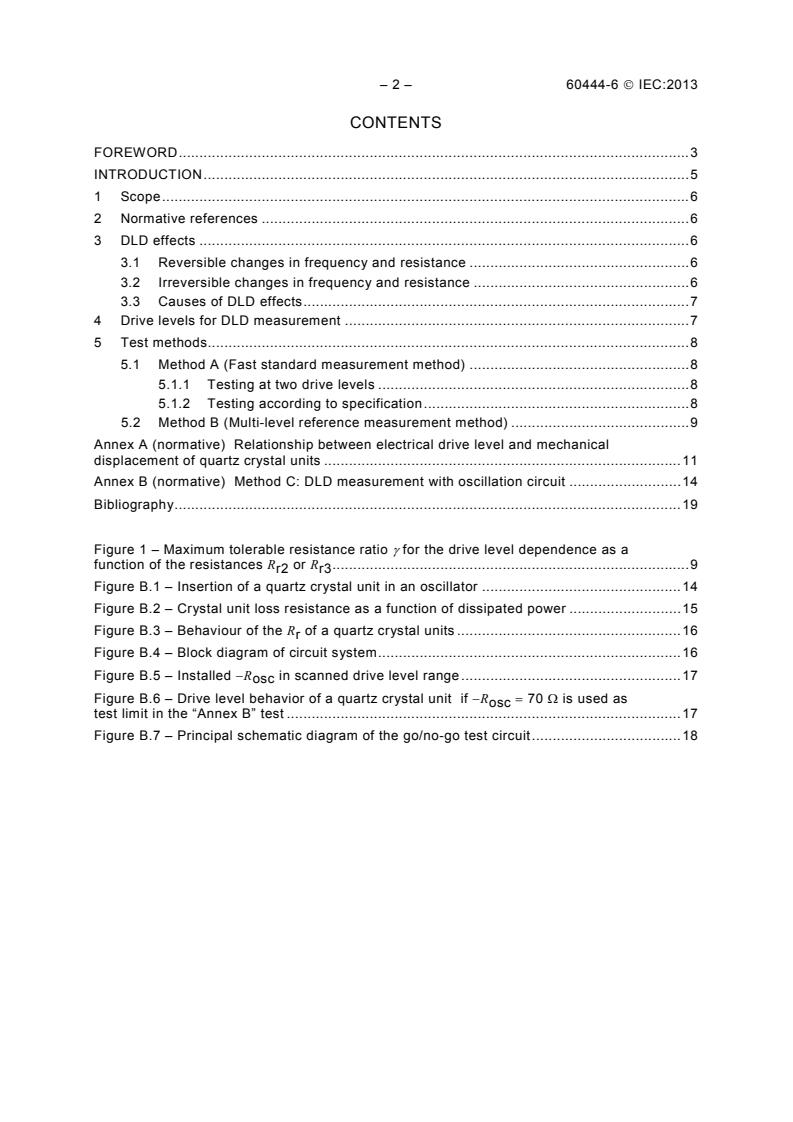
(Main)Measurement of quartz crystal unit parameters - Part 6: Measurement of drive level dependence (DLD)
General Information
- Abstract
IEC 60444-6:2013 applies to the measurements of drive level dependence (DLD) of quartz crystal units. Two test methods and one referential method are described. This edition includes the following significant technical changes with respect to the previous edition:
a) DLD measurement with oscillation circuit had the traditional method to detect the DLD abnormal modes at present time. Therefore, this method made the transition to the Annex B.
b) High reliability crystal unit is needed to use for various applications at the present day, in order to upgrade the inspection capabilities for DLD abnormal modes, the multi-level reference measurement method was introduced into this specification.
- Status
- Published
- Publication Date
- 18-Jun-2013
- Technical Committee
- TC 49 - Piezoelectric, dielectric and electrostatic devices and associated materials for frequency control, selection and detection
- Drafting Committee
- WG 11 - TC 49/WG 11
- Current Stage
- DELPUB - Deleted Publication
- Start Date
- 01-Sep-2021
- Completion Date
- 24-Apr-2020
Buy Documents

IEC 60444-6:2013 - Measurement of quartz crystal unit parameters - Part 6: Measurement of drive level dependence (DLD)
IEC 60444-6:2013 - Measurement of quartz crystal unit parameters - Part 6: Measurement of drive level dependence (DLD)
Overview
IEC 60444-6:2013 is an international standard published by the International Electrotechnical Commission (IEC) that specifies methods for the measurement of drive level dependence (DLD) in quartz crystal units. DLD is a critical parameter reflecting how the electrical drive power affects the resonant frequency and resistance of quartz crystals. Understanding and accurately measuring DLD is essential for ensuring the reliability and performance of quartz crystal devices used in frequency control and timing applications.
This second edition, published in 2013, introduces significant technical updates compared to the 1995 version. The standard describes two primary test methods (Method A and Method C) and a referential method (Method B), aiming to offer precise inspection capabilities, including the detection of abnormal DLD modes for high-reliability crystal units.
Key Topics
Scope of Measurement
IEC 60444-6:2013 focuses on the measurement of drive level dependence in quartz crystal units across their full operating frequency range. It covers fundamental and overtone mode quartz resonators used in various electronic devices.Drive Level Dependence (DLD) Effects
- Reversible changes involve frequency and resistance shifts that return to baseline when drive levels are cycled between low and high levels.
- Irreversible changes reflect permanent alterations in unit parameters caused by stress or damage during high drive levels, seriously impacting device performance.
- DLD effects arise from both intrinsic piezoelectric properties and manufacturing imperfections such as particles on resonators, mechanical damage, and electrode defects.
Test Methods
- Method A: A fast, standard measurement utilizing a π-network test circuit suitable for general DLD testing.
- Method B: A multi-level reference measurement method offering enhanced detection of abnormal DLD modes. This method allows finer inspection and is used as a benchmark for reliability testing.
- Method C: Oscillator circuit-based testing performed under fixed conditions, ideal for volume testing of fundamental mode crystal units.
Technical Specifications
The standard defines crucial parameters such as tolerable resistance ratios and specifies conditions for reversible and irreversible behavior assessment. It also includes normative annexes for relating electrical drive levels to mechanical displacement and detailed oscillator measurement setup.
Applications
IEC 60444-6:2013 is vital for manufacturers and quality assurance teams involved in the production and testing of quartz crystal resonators used in:
- Frequency control devices in telecommunications
- Precision timing components in computing and networking equipment
- Filters and oscillators in RF applications
- Automotive electronics and aerospace navigation systems requiring high stability and reliability
- Medical devices and instrumentation relying on precise frequency references
By adhering to this standard, manufacturers can:
- Ensure consistent product performance under varying power conditions
- Detect abnormal DLD behaviors that may compromise device lifespan or stability
- Improve end-user confidence through rigorous testing procedures compliant with international norms
- Facilitate global market access by meeting harmonized technical requirements
Related Standards
For comprehensive characterization and testing of quartz crystal units, IEC 60444-6 is used in conjunction with other parts of the IEC 60444 series, including:
- IEC 60444-1: Basic measurements of resonance frequency and resistance using zero-phase technique
- IEC 60444-5: Methods employing automatic network analyzers and error correction for equivalent parameter determination
- IEC 60444-8: Test fixtures tailored for surface-mounted quartz crystal units
These complementary standards provide a unified framework for assessing all critical parameters of quartz crystal units, facilitating robust design, manufacturing, and quality control processes.
Keywords: IEC 60444-6, quartz crystal unit, drive level dependence, DLD measurement, piezoelectric resonators, quartz oscillator testing, frequency control, crystal stability, DLD test methods, IEC standards, high reliability crystal units, quartz resonator parameters.
Relations
- Effective Date
- 05-Sep-2023
Buy Documents
IEC 60444-6:2013 - Measurement of quartz crystal unit parameters - Part 6: Measurement of drive level dependence (DLD)
IEC 60444-6:2013 - Measurement of quartz crystal unit parameters - Part 6: Measurement of drive level dependence (DLD)
Frequently Asked Questions
IEC 60444-6:2013 is a standard published by the International Electrotechnical Commission (IEC). Its full title is "Measurement of quartz crystal unit parameters - Part 6: Measurement of drive level dependence (DLD)". This standard covers: IEC 60444-6:2013 applies to the measurements of drive level dependence (DLD) of quartz crystal units. Two test methods and one referential method are described. This edition includes the following significant technical changes with respect to the previous edition: a) DLD measurement with oscillation circuit had the traditional method to detect the DLD abnormal modes at present time. Therefore, this method made the transition to the Annex B. b) High reliability crystal unit is needed to use for various applications at the present day, in order to upgrade the inspection capabilities for DLD abnormal modes, the multi-level reference measurement method was introduced into this specification.
IEC 60444-6:2013 applies to the measurements of drive level dependence (DLD) of quartz crystal units. Two test methods and one referential method are described. This edition includes the following significant technical changes with respect to the previous edition: a) DLD measurement with oscillation circuit had the traditional method to detect the DLD abnormal modes at present time. Therefore, this method made the transition to the Annex B. b) High reliability crystal unit is needed to use for various applications at the present day, in order to upgrade the inspection capabilities for DLD abnormal modes, the multi-level reference measurement method was introduced into this specification.
IEC 60444-6:2013 is classified under the following ICS (International Classification for Standards) categories: 31.140 - Piezoelectric devices. The ICS classification helps identify the subject area and facilitates finding related standards.
IEC 60444-6:2013 has the following relationships with other standards: It is inter standard links to IEC 60444-6:2021. Understanding these relationships helps ensure you are using the most current and applicable version of the standard.
IEC 60444-6:2013 is available in PDF format for immediate download after purchase. The document can be added to your cart and obtained through the secure checkout process. Digital delivery ensures instant access to the complete standard document.
Standards Content (Sample)
IEC 60444-6 ®
Edition 2.0 2013-06
INTERNATIONAL
STANDARD
NORME
INTERNATIONALE
Measurement of quartz crystal unit parameters –
Part 6: Measurement of drive level dependence (DLD)
Mesure des paramètres des résonateurs à quartz –
Partie 6: Mesure de la dépendance du niveau d'excitation (DNE)
All rights reserved. Unless otherwise specified, no part of this publication may be reproduced or utilized in any form
or by any means, electronic or mechanical, including photocopying and microfilm, without permission in writing from
either IEC or IEC's member National Committee in the country of the requester.
If you have any questions about IEC copyright or have an enquiry about obtaining additional rights to this publication,
please contact the address below or your local IEC member National Committee for further information.
Droits de reproduction réservés. Sauf indication contraire, aucune partie de cette publication ne peut être reproduite ni
utilisée sous quelque forme que ce soit et par aucun procédé, électronique ou mécanique, y compris la photocopie et les
microfilms, sans l'accord écrit de la CEI ou du Comité national de la CEI du pays du demandeur.
Si vous avez des questions sur le copyright de la CEI ou si vous désirez obtenir des droits supplémentaires sur cette
publication, utilisez les coordonnées ci-après ou contactez le Comité national de la CEI de votre pays de résidence.
IEC Central Office Tel.: +41 22 919 02 11
3, rue de Varembé Fax: +41 22 919 03 00
CH-1211 Geneva 20 info@iec.ch
Switzerland www.iec.ch
About the IEC
The International Electrotechnical Commission (IEC) is the leading global organization that prepares and publishes
International Standards for all electrical, electronic and related technologies.
About IEC publications
The technical content of IEC publications is kept under constant review by the IEC. Please make sure that you have the
latest edition, a corrigenda or an amendment might have been published.
Useful links:
IEC publications search - www.iec.ch/searchpub Electropedia - www.electropedia.org
The advanced search enables you to find IEC publications The world's leading online dictionary of electronic and
by a variety of criteria (reference number, text, technical electrical terms containing more than 30 000 terms and
committee,…). definitions in English and French, with equivalent terms in
It also gives information on projects, replaced and additional languages. Also known as the International
withdrawn publications. Electrotechnical Vocabulary (IEV) on-line.
IEC Just Published - webstore.iec.ch/justpublished Customer Service Centre - webstore.iec.ch/csc
Stay up to date on all new IEC publications. Just Published If you wish to give us your feedback on this publication
details all new publications released. Available on-line and or need further assistance, please contact the
also once a month by email. Customer Service Centre: csc@iec.ch.
A propos de la CEI
La Commission Electrotechnique Internationale (CEI) est la première organisation mondiale qui élabore et publie des
Normes internationales pour tout ce qui a trait à l'électricité, à l'électronique et aux technologies apparentées.
A propos des publications CEI
Le contenu technique des publications de la CEI est constamment revu. Veuillez vous assurer que vous possédez
l’édition la plus récente, un corrigendum ou amendement peut avoir été publié.
Liens utiles:
Recherche de publications CEI - www.iec.ch/searchpub Electropedia - www.electropedia.org
La recherche avancée vous permet de trouver des Le premier dictionnaire en ligne au monde de termes
publications CEI en utilisant différents critères (numéro de électroniques et électriques. Il contient plus de 30 000
référence, texte, comité d’études,…). termes et définitions en anglais et en français, ainsi que
Elle donne aussi des informations sur les projets et les les termes équivalents dans les langues additionnelles.
publications remplacées ou retirées. Egalement appelé Vocabulaire Electrotechnique
International (VEI) en ligne.
Just Published CEI - webstore.iec.ch/justpublished
Service Clients - webstore.iec.ch/csc
Restez informé sur les nouvelles publications de la CEI.
Just Published détaille les nouvelles publications parues. Si vous désirez nous donner des commentaires sur
Disponible en ligne et aussi une fois par mois par email. cette publication ou si vous avez des questions
contactez-nous: csc@iec.ch.
IEC 60444-6 ®
Edition 2.0 2013-06
INTERNATIONAL
STANDARD
NORME
INTERNATIONALE
Measurement of quartz crystal unit parameters –
Part 6: Measurement of drive level dependence (DLD)
Mesure des paramètres des résonateurs à quartz –
Partie 6: Mesure de la dépendance du niveau d'excitation (DNE)
INTERNATIONAL
ELECTROTECHNICAL
COMMISSION
COMMISSION
ELECTROTECHNIQUE
PRICE CODE
INTERNATIONALE
CODE PRIX R
ICS 31.140 ISBN 978-2-83220-876-2
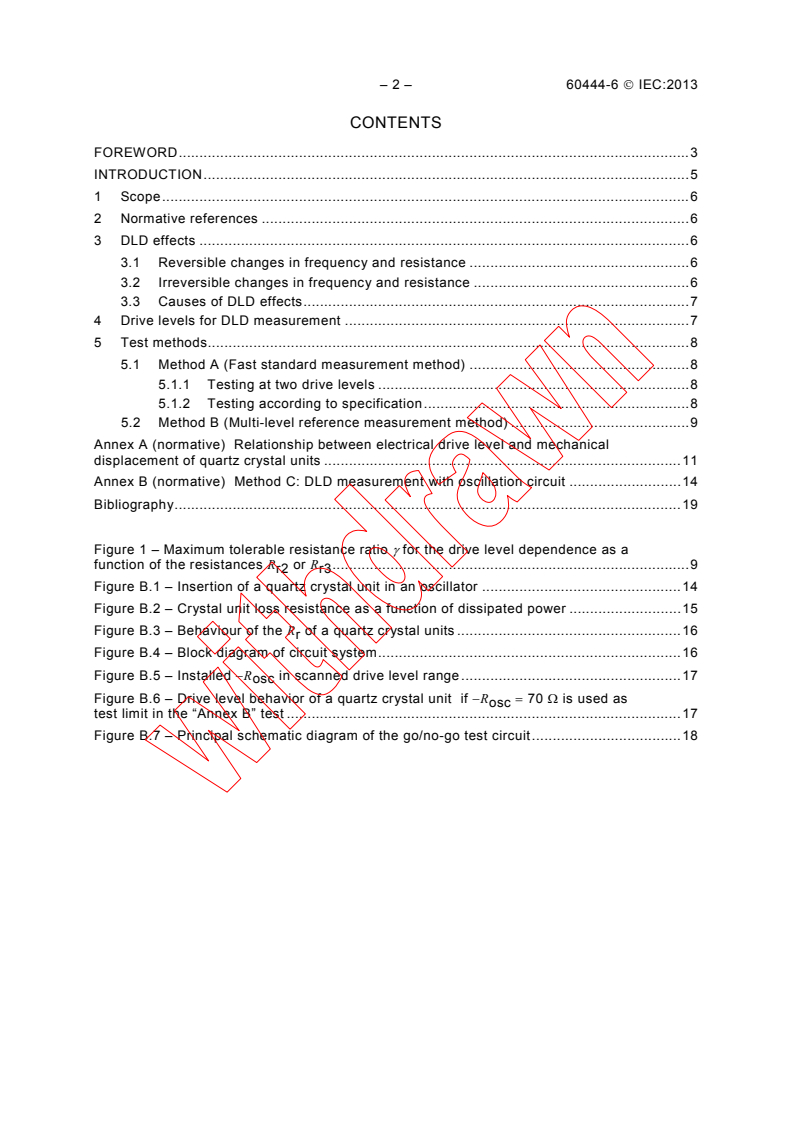
– 2 – 60444-6 IEC:2013
CONTENTS
FOREWORD . 3
INTRODUCTION . 5
1 Scope . 6
2 Normative references . 6
3 DLD effects . 6
3.1 Reversible changes in frequency and resistance . 6
3.2 Irreversible changes in frequency and resistance . 6
3.3 Causes of DLD effects . 7
4 Drive levels for DLD measurement . 7
5 Test methods. 8
5.1 Method A (Fast standard measurement method) . 8
5.1.1 Testing at two drive levels . 8
5.1.2 Testing according to specification . 8
5.2 Method B (Multi-level reference measurement method) . 9
Annex A (normative) Relationship between electrical drive level and mechanical
displacement of quartz crystal units . 11
Annex B (normative) Method C: DLD measurement with oscillation circuit . 14
Bibliography . 19
Figure 1 – Maximum tolerable resistance ratio γ for the drive level dependence as a
function of the resistances R or R . 9
r2 r3
Figure B.1 – Insertion of a quartz crystal unit in an oscillator . 14
Figure B.2 – Crystal unit loss resistance as a function of dissipated power . 15
Figure B.3 – Behaviour of the R of a quartz crystal units . 16
r
Figure B.4 – Block diagram of circuit system . 16
Figure B.5 – Installed −R in scanned drive level range . 17
osc
Figure B.6 – Drive level behavior of a quartz crystal unit if −R = 70 Ω is used as
osc
test limit in the “Annex B” test . 17
Figure B.7 – Principal schematic diagram of the go/no-go test circuit . 18
60444-6 IEC:2013 – 3 –
INTERNATIONAL ELECTROTECHNICAL COMMISSION
____________
MEASUREMENT OF QUARTZ CRYSTAL UNIT PARAMETERS –
Part 6: Measurement of drive level dependence (DLD)
FOREWORD
1) The International Electrotechnical Commission (IEC) is a worldwide organization for standardization comprising
all national electrotechnical committees (IEC National Committees). The object of IEC is to promote
international co-operation on all questions concerning standardization in the electrical and electronic fields. To
this end and in addition to other activities, IEC publishes International Standards, Technical Specifications,
Technical Reports, Publicly Available Specifications (PAS) and Guides (hereafter referred to as “IEC
Publication(s)”). Their preparation is entrusted to technical committees; any IEC National Committee interested
in the subject dealt with may participate in this preparatory work. International, governmental and non-
governmental organizations liaising with the IEC also participate in this preparation. IEC collaborates closely
with the International Organization for Standardization (ISO) in accordance with conditions determined by
agreement between the two organizations.
2) The formal decisions or agreements of IEC on technical matters express, as nearly as possible, an international
consensus of opinion on the relevant subjects since each technical committee has representation from all
interested IEC National Committees.
3) IEC Publications have the form of recommendations for international use and are accepted by IEC National
Committees in that sense. While all reasonable efforts are made to ensure that the technical content of IEC
Publications is accurate, IEC cannot be held responsible for the way in which they are used or for any
misinterpretation by any end user.
4) In order to promote international uniformity, IEC National Committees undertake to apply IEC Publications
transparently to the maximum extent possible in their national and regional publications. Any divergence
between any IEC Publication and the corresponding national or regional publication shall be clearly indicated in
the latter.
5) IEC itself does not provide any attestation of conformity. Independent certification bodies provide conformity
assessment services and, in some areas, access to IEC marks of conformity. IEC is not responsible for any
services carried out by independent certification bodies.
6) All users should ensure that they have the latest edition of this publication.
7) No liability shall attach to IEC or its directors, employees, servants or agents including individual experts and
members of its technical committees and IEC National Committees for any personal injury, property damage or
other damage of any nature whatsoever, whether direct or indirect, or for costs (including legal fees) and
expenses arising out of the publication, use of, or reliance upon, this IEC Publication or any other IEC
Publications.
8) Attention is drawn to the Normative references cited in this publication. Use of the referenced publications is
indispensable for the correct application of this publication.
9) Attention is drawn to the possibility that some of the elements of this IEC Publication may be the subject of
patent rights. IEC shall not be held responsible for identifying any or all such patent rights.
International Standard IEC 60444-6 has been prepared by lEC technical committee 49:
Piezoelectric, dielectric and electrostatic devices and associated materials for frequency
control, selection and detection.
This second edition cancels and replaces the first edition published in 1995. This edition
constitutes a technical revision.
This edition includes the following significant technical changes with respect to the previous
edition:
a) DLD measurement with oscillation circuit had the traditional method to detect the DLD
abnormal modes at present time. Therefore, this method made the transition to the
Annex B.
b) High reliability crystal unit is needed to use for various applications at the present day, in
order to upgrade the inspection capabilities for DLD abnormal modes, the multi-level
reference measurement method was introduced into this specification.
– 4 – 60444-6 IEC:2013
The text of this standard is based on the following documents:
CDV Report on voting
49/1004/CDV 49/1038/RVC
Full information on the voting for the approval of this standard can be found in the report on
voting indicated in the above table.
This publication has been drafted in accordance with the ISO/IEC Directives, Part 2.
A list of all parts in the IEC 60444 series, published under the general title Measurement of
quartz crystal unit parameters, can be found on the IEC website.
60444-6 IEC:2013 – 5 –
INTRODUCTION
The drive level (expressed as power/voltage across or current through the crystal unit) forces
the resonator to produce mechanical oscillations by way of piezoelectric effect. In this process,
the acceleration work is converted to kinetic and elastic energy and the power loss to heat.
The latter conversion is due to the inner and outer friction of the quartz resonator.
The frictional losses depend on the velocity of the vibrating masses and increase when the
oscillation is no longer linear or when critical velocities, elongations or strains, excursions or
accelerations are attained in the quartz resonator or at its surfaces and mounting points (see
Annex A). This causes changes in resistance and frequency, as well as further changes due
to the temperature dependence of these parameters.
At “high” drive levels (e.g. above 1 mW or 1 mA for AT-cut crystal units) changes are
observed by all crystal units and these also can result in irreversible amplitude and frequency
changes. Any further increase of the drive level may destroy the resonator.
Apart from this effect, changes in frequency and resistance are observed at “low” drive levels
in some crystal units, e.g. below 1 mW or 50 µA for AT-cut crystal units). In this case, if the
loop gain is not sufficient, the start-up of the oscillation is difficult. In crystal filters, the
transducer attenuation and ripple will change.
Furthermore, the coupling between a specified mode of vibration and other modes (e.g. of the
resonator itself, the mounting and the back-fill gas) also depends on the level of drive.
Due to the differing temperature response of these modes, these couplings give rise to
changes of frequency and resistance of the specified mode within narrow temperature ranges.
These changes increase with increasing drive level. However, this effect will not be
considered further in this part of IEC 60444.
The first edition of IEC 60444-6 was published in 1995. However, it has not been revised until
today. In the meantime the demand for tighter specification and measurement of DLD has
increased.
In this new edition, the concept of DLD in IEC 60444-6:1995 is maintained. However, the
more suitable definition for the user’s severe requirements was introduced. Also, the
specifications based on the matters arranged in the Stanford meeting in June, 2011 are taken
into consideration.
– 6 – 60444-6 IEC:2013
MEASUREMENT OF QUARTZ CRYSTAL UNIT PARAMETERS –
Part 6: Measurement of drive level dependence (DLD)
1 Scope
This part of IEC 60444 applies to the measurements of drive level dependence (DLD) of
quartz crystal units. Two test methods (A and C) and one referential method (B) are described.
“Method A”, based on the π-network according to IEC 60444-1, can be used in the complete
frequency range covered by this part of IEC 60444. “Reference Method B”, based on the π-
network or reflection method according to IEC 60444-1, IEC 60444-5 or IEC 60444-8 can be
used in the complete frequency range covered by this part of IEC 60444. “Method C”, an
oscillator method, is suitable for measurements of fundamental mode crystal units in larger
quantities with fixed conditions.
2 Normative references
The following documents, in whole or in part, are normatively referenced in this document and
are indispensable for its application. For dated references, only the edition cited applies. For
undated references, the latest edition of the referenced document (including any
amendments) applies.
IEC 60444-1, Measurement of quartz crystal unit parameters by zero phase technique in a π-
network – Part 1: Basic method for the measurement of resonance frequency and resonance
resistance of quartz crystal units by zero phase technique in a π-network
IEC 60444-5, Measurement of quartz crystal units parameters – Part 5: Methods for the
determination of equivalent electrical parameters using automatic network analyzer
techniques and error correction
IEC 60444-8, Measurement of quartz crystal unit parameters – Part 8: Test fixture for surface
mounted quartz crystal units
3 DLD effects
3.1 Reversible changes in frequency and resistance
Reversible changes are changes in frequency and resistance occurring under the same drive
levels after repeated measurements made alternatively at low and high levels, or after
continuous or quasi-continuous measurements from the lowest to the highest level and back,
if these changes remain within the limits of the measurement accuracy.
3.2 Irreversible changes in frequency and resistance
Irreversible changes are significant changes in frequency and/or resistance occurring at low
level after an intermediate measurement at high level e.g. when a previously high resistance
at low level has changed in the repeated measurement to a low resistance. Especially, when
the crystal unit has not been operated for several days, its resistance may have changed back
to a high value when operated again at a lower level. Greater attention should be paid to the
irreversible effect since it can significantly impair the performance of devices, which are
operated only sporadically.
60444-6 IEC:2013 – 7 –
3.3 Causes of DLD effects
Whereas the mostly reversible effects are due to excessive crystal drive level, the irreversible
effects are due to production, especially to imperfect production techniques. Examples of
causes are:
– Particles on the resonator surface (partly bound by oils, cleaning agents. solvents or
bound electro-statically);
– Mechanical damage of the resonator (e.g. fissures due to excessively coarse lapping
abrasive which may increase in size);
– Gas and oil inclusions in the electrodes (e.g. due to a poor vacuum or an inadequate
coating rate during evaporation);
– Poor contacting of the electrodes at the mounting (e.g. the conductive adhesive has an
inadequate metal component, was insufficiently baked out or was overheated; also
excessive contact resistance between the conductive adhesive and the electrodes or
mounting);
– Mechanical stresses between mounting, electrodes and quartz element.
4 Drive levels for DLD measurement
For the DLD measurement, a low and a high level of drive (and possibly further levels) are
applied. The high level is the nominal drive level, which should be equal to the level in the
application at its steady state.
It should be noted that this level should be below the maximum applicable level that is derived
in Annex A. If not specified, a standard value for the crystal current of 1 mA, corresponding to
the velocity v max = 0,2 m/s for AT-cut crystal units, shall be used. The drive level in watts is
then calculated with the mean value of the specified maximum and minimum resistances.
The minimum drive level occurring at the start-up of an oscillator can be determined only in a
few cases by active or passive measuring methods due to the noise limits of the measuring
instruments for measurements according to IEC 60444-1, at approximately 1 nW or 10 µA
(depending on the equipment, the lowest power value can be reduced to 0,1 nW or 1 µA).
A velocity v max = 0,01 m/s, corresponding to 50 µA for AT-cut crystals, has proved to be
practical value for π-network measurements (see “Method A”).
In the following, two methods and one referential method of DLD measurement are described.
“Method A” is based on the π-network method according to IEC 60444-1, which can be used
in the complete frequency range covered by this standard. It allows the fast selection of drive
level sensitive quartz crystal units by a sequence of three measurements. The allowed
variation of the resonance resistances given in Figure 1 is based on long-term examinations
of crystal units of different manufacturers and proved to be a reliable indicator for crystal units
showing start-up problems. If necessary, this method should also is extended by measuring a
large number of different drive levels. However, in practice, this is not necessary in most
cases (see 5.1).
“Method B” is used for devices where strict oscillation start-up requirements have to be
fulfilled and for high reliability devices.
“Method C” in Annex B is an oscillator method, which is especially suitable for measuring
fundamental mode crystal units in larger quantities with fixed measurement conditions
(maximum drive level, R max) in an economical way.
r
If the proposed measurement techniques are not sufficient in special cases, the user should
have an original oscillator with slightly reduced feedback or an original filter.
– 8 – 60444-6 IEC:2013
“Method B” is stricter than “Method A”.
“Method B” is based on the π-network method or reflection method according to IEC 60444-1,
IEC 60444-5 or IEC 60444-8, which can be used in the complete frequency range covered by
this standard.
Recommendation: These methods can be used for all types of crystals, however:
– “Method A” is recommended for filter and oscillator crystals.
– “Method B” is recommended for applications with strict start-up conditions, for high
reliability and for high stability applications. It is the reference method for failure analysis
etc.
– “Method C” in Annex B is a go/no-go measurement technique for oscillator crystals.
5 Test methods
5.1 Method A (Fast standard measurement method)
5.1.1 Testing at two drive levels
Testing is performed at low and high drive levels as described in Clause 3 with measurements
of resonance frequency and resistance according to IEC 60444-1. The tolerances are ± 10 %
for the levels of current and ± 20 % for those of power.
a) Storage for at least one day at 105 °C and after that at least 2 hours at room temperature
or, storage for one week at room temperature.
b) The temperature should be kept constant during the measurement (in accordance with
IEC 60444-1 and IEC 60444-5).
= f R = R .
c) Measurement at low drive level (10 µA): f
,
r r1 r 11
d) Measurement at high drive level (1 mA): f = f R = R .
,
r r2 r 12
e) Measurement at low drive level (10 µA): f = f , R = R .
r r3 r 13
f) Calculation of γ = R /R . The value of γ shall be smaller than the maximum value of γ
12 11 12 12
given by the line drawn in Figure 1 (abscissa = R ).
-6
g) The tolerable frequency change f − f shall be 5 × 10 × f unless otherwise
r2 r1 r1
specified in the detail specification.
h) Calculation of γ = R /R . The value of γ shall be smaller than (γ + 1)/2, where the
13 11 13 13
value of γ is taken from Figure 1(abscissa = R ).
-6
i) The tolerable frequency change f − f shall be 2,5 × 10 × f , unless otherwise
r3 r1 r1
specified in the detail specification.
j) The resistance value shall not exceed the maximum value given by the detail specification
at any drive levels.
5.1.2 Testing according to specification
Testing is performed at low to high drive levels and back again to low level as described
in 5.1.1. These and, if necessary, further levels with their tolerances, the permissible
deviations of the frequency and resistance as well as storage conditions shall be specified in
the detail specification.
NOTE 1 The given γ-curve was verified by results obtained over many years of experience with crystal units for
many oscillator types. In most cases, there will be no trouble in start-up, but in critical oscillator configurations,
problems may occur. As it is not possible to manufacture crystal units, which have a constant resistance at any
drive level, the proposed ϒ-curve gives tolerable relations.
Definition of drive level values can be agreed between manufacturer and customer.
60444-6 IEC:2013 – 9 –
Use the nominal drive level of the detail specification as value for the high drive level. For
measurement at very high drive levels an additional amplifier may be required.
2,4
1,7
2,2
1,6
1,5
2,0
1,4
1,8
1,3
1,6
1,4 1,2
1,2 1,1
1,0
1,0
1 2 3 5 8 10 20 30 50 80 100 200 300 500
Resistance R (Ω)
IEC 1484/13
Figure 1 – Maximum tolerable resistance ratio γ for the drive
level dependence as a function of the resistances R or R
r2 r3
NOTE 2 The equation for the recommended drive level (if not otherwise specified in the data sheet) is as follows.
Details can be found in Annex A of IEC 60122-2-1:1991, Amendment 1:1993.
nA
I = K ⋅
q
f
where,
I is the recommended current for oscillating state;
q
n is the overtone, fundamental vibration mode, n = 1;
A is the electrode size in mm ;
f is the frequency in MHz;
-2 -1/2
K is 0,35 mA ⋅ mm ⋅ S .
5.2 Method B (Multi-level reference measurement method)
Testing is performed at low and high drive levels as described in Clause 3 with measurements
of resonance frequency and resistance according to IEC 60444-5. The tolerances are ±10 %
for the levels of current and ±20 % for those of power.
a) Storage for at least one day at 105 °C and after that at least 2 hours at room temperature
or storage for one week at room temperature.
NOTE If considered as necessary, the customer and the maker agree on a higher temperature and a longer
duration for the storage before DLD measurement.
b) The temperature should be kept constant during the measurement IAW (in accordance
with IEC 60444-5).
c) The drive level is applied by two types of measurement units. It should also be applied
sequentially starting from the lowest to the highest value and then back to the lowest
value. A definition for the unit of drive levels shall be specified between the crystal
manufacturer and the user.
Resistance ratio γ
(γ + 1)/2
– 10 – 60444-6 IEC:2013
1) When the unit of a drive level is mA;
Measurement drives level: from 2 µA to nominal drive level in at least 7 levels which
are logarithmically scaled. (Refer to the equation given under line item f)).
2) When the unit of a drive level is µW;
Measurement drives level: From 2 nW to nominal drive level in at least 7 levels which
are logarithmically scaled. (Refer to the equation given under line item f)).
d) The maximum frequency excursion over all drive levels shall be less than following
specifications.
f (i) − f (i)
s ,max s ,min -6
< 5 × 10
(1)
f
NOM
or,
f (i) − f (i)
s ,max s ,min
< 0,5 × f
(2)
ADJ
f
NOM
where
f (i) is the maximum value for frequency measurement values with i = 1 to 2⋅N-1 drive levels;
s ,max
f (i) is the minimum value for frequency measurement values with i = 1 to 2⋅N-1 drive levels;
s ,min
f is the nominal frequency;
NOM
f is the practical specification for frequency adjustment tolerance.
ADJ
e) The maximum ratio of resistance change and the maximum resistance over drive levels
shall be as following specifications.
R (i)
1 ,max
< γ
(1)
R (i)
1 ,min
and
R (1) (γ +1)
(2) <
R (2 ⋅ N −1) 2
and
(3) R (i) < R
1 ,max 1,max
where,
R (i) is the maximum value for resistance measurement values with i = 1 to 2⋅N-1 drive levels;
1 ,max
R (i) is the minimum value for resistance measurement values with i = 1 to 2⋅N-1 drive levels;
1 ,min
R is the maximum resistance, specified by the detail specification.
1,max
γ is the resistance ratio.
f) The N drive levels should be logarithmically scaled, i.e. DL = DL × K. The equation for
N+1 N
the recommended drive level (if not otherwise specified in the data sheet) is as follows.
DL N −1
max
K =
DL
min
g) A larger number of drive levels may be necessary in special applications, e.g. those
caused by mechanical coupling with nonlinear spurious resonances (dips) and for failure
analysis.
60444-6 IEC:2013 – 11 –
Annex A
(normative)
Relationship between electrical drive level and
mechanical displacement of quartz crystal units
The power loss of a crystal unit in watts is given by:
P = I ⋅ R
c 1
where
I is the current through the crystal unit in amperes.
is the motional resistance in ohms.
R
The reactive power is given by:
I
P = = P ⋅ Q
B c
2πf ⋅ C
where
f is the resonance frequency in hertz.
C is the motional capacitance in farads.
Q is the quality factor.
The electric energy in watt seconds is given by:
P I
B
A = =
EL
f
2πf ⋅ C
The mechanical energy of a crystal unit can be represented by the following terms:
A = A + A + A + A
mech kin elast pot B
A = ⋅ ρ ⋅V ⋅ v (kinetic energy)
kin
A = ⋅ c ⋅V ⋅ x (elastic energy)
elast
2 2
A = ⋅ ρ ⋅V ⋅ s ⋅ (2πf ) (potential energy)
pot
1 ρ ⋅V ⋅ b
A = ⋅ (acceleration work)
B
(2πf )
ρ = 2 650 kg/m (density)
– 12 – 60444-6 IEC:2013
where
V is the volume of the oscillating area in cubic meters (m );
v = ds/dt is the velocity in meters per seconds (m/s);
c is the modulus of elasticity of the mode of vibration (for AT-cut crystal units,
' 10
c = c = 2,93 × 10 N/m )
x is ∆l/l is the elongation;
s is the excursion from rest position in meters;
2 2 2
b = d s/dt is the acceleration in meters per square seconds (m/s );
n is the overtone order.
The volume V can be calculated from the electrode area F and the electrode spacing d.
EL
From the static capacitance:
F
EL
C = ε ⋅ε ⋅ = C
e r 0 0
d
where
ε is the relative dielectric constant of AT-cut quartz material and is equal to 4,54;
r
−12
ε is the electric field constant and is equal to 8,86 ×10 F/m;
N is the frequency constant equal to f ⋅(d / n). N = 1 665 Hz⋅m for AT-cut crystal units;
n is the overtone order.
We obtain the following:
2 2
C n ⋅ N
V = ⋅
ε ⋅ε
r 0 f
and the maximum current from the maximum velocities, elongations, excursions or
accelerations of the mechanical vibrations:
π ⋅ ρ ⋅ N
I = K ⋅ n ⋅ C ⋅ C ⋅ v where K =
max 1 0 1 max 1
ε ⋅ε
r 0
π ⋅ c ⋅ N
I = K ⋅ n ⋅ C ⋅ C ⋅ x where K =
max 2 0 1 max 2
ε ⋅ε
r 0
3 2
4 ⋅π ⋅ ρ ⋅ N
I = K ⋅ n ⋅ C ⋅ C ⋅ s where K =
max 3 0 1 max 3
ε ⋅ε
r 0
b ρ ⋅ N
max
I = K ⋅ n ⋅ C ⋅ C ⋅ where K =
max 4 0 1 4
f 4 ⋅π ⋅ε ⋅ε
r 0
60444-6 IEC:2013 – 13 –
For non-convex AT-cut crystal units, the following also applies:
C C = γ = 200 ⋅ n
0 1
where
n is the overtone order.
The following is obtained with C = 5 pF for the currents:
o
I = 50 mA I = 1 mA
max,1 max,2
v = 0,01 m/s v = 0,2 m/s
1 2
-6 -5
x = 1,8 × 10 x = 3,6 × 10
1 2
at f = 10 MHz:
-11 -9
s = 6,7 × 10 m s = 1,3 × 10 m
1 2
5 2 6 2
b = 2,6 × 10 m/s b = 5,3 × 10 m/s
1 1
-12 -10
s = 6,7 × 10 m s = 1,3 × 10 m
1 2
6 2 7 2
b = 2,6 × 10 m/s b = 5,3 × 10 m/s
1 2
Depending on the frequency, quality factor and mode of vibration of the crystal unit and the
volume of the vibrating zone, maximum currents or levels result from limit considerations for
every type of a crystal unit. These shall not be exceeded when using these devices in
oscillators and filters.
The maximum drive level shall be selected so that with a further increase of the drive level by
50 %, the resistance does not increase reversibly by more than 10 % or the frequency
-6
changes by more than 0,5 × 10 .
– 14 – 60444-6 IEC:2013
Annex B
(normative)
Method C: DLD measurement with oscillation circuit
To detect the DLD effect over the whole drive level range, the method described in 5.1 is very
costly and is not applicable as a 100 % go/no-go test. The method proposed below tests the
crystal units on its maximum R during start-up in an economical manner. This method can be
r
applied as a 100 % final inspection as well as in a 100 % incoming inspection. It can also be
used as an instrument to judge whether the crystal unit meets the requirements on R
rmax
given in the detail specification.
The crystal unit in the oscillator can be represented as indicated in Figure B.1.
There will be no oscillation when the magnitude of the −R of the circuit is lower than R of
osc r
the crystal unit.
During start-up, the R of the crystal unit may behave as shown in Figure B.2.
r
When measuring the crystal unit several times, the characteristic can shift slightly to the right
or to the left or it can flatten.
The ratio γ = R /R may also differ from measurement to measurement. This ratio does not
r2 r1
necessarily mean that the oscillator may stop working if a certain value of γ is reached. The
most important aspect is the safety margin between the maximum occurring R of the crystal
r
unit and the value of R of the oscillator circuit.
osc
It is recommended that the circuit should have a –R of ≥ 3R because in the
osc r max
as well as –R can shift.
temperature range, the R
r max osc
During the start-up, the drive level will move from the low values (left side of the graphics in
Figure B.3) to the nominal drive level.
The principle of measurement is presented in Figure B.4.
The test set-up consists of a carefully designed crystal oscillator which can be considered as
a true negative resistance over a wide frequency range, a feedback network which limits the
power dissipation in the crystal unit to 1 mW and a detector circuit with an LED for visual
indication.
–R
osc
R
r
IEC 1485/13
Figure B.1 – Insertion of a quartz crystal unit in an oscillator
60444-6 IEC:2013 – 15 –
Oscillation conditions:
– loop gain > 1, which means −R > R
osc r
– feedback signal at oscillator input shall have correct phase.
∆R
R
r2
R
r1
P P
2 1
–15 –3
P (W)
c
10 10
IEC 1486/13
Figure B.2 – Crystal unit loss resistance as a function of dissipated power
NOTE The ratio R /R is not a reproducible value since the crystal unit curve slightly shifts at different
r2 r1
measurement cycles.
The negative resistance (and with it the DLD reject level) of the oscillator can be changed by
connecting a positive resistor in series with the oscillator. In this manner, each value between
0 Ω and 200 Ω may be selected. Connecting a quartz crystal unit with a sufficiently low R
r
value between the test clamps, the oscillation will build up starting from the initial noise level
-16 -15
(approximately 10 W to 10 W) to its limiting point for 1 mW as shown in Figure B.5.
During the start-up, the R of the crystal unit is continuously compared with a Calibrated-
r,max
R and the result is detected and transferred into a go/no-go decision.
osc
If the crystal unit under test shows a certain degree of DLD, it is possible that the oscillation
amplitude will not reach the 1 mW limiting point (point B in Figure B.6). In the example given
in Figure B.6, the build-up of the oscillation is terminated at a much lower level of drive
(point A). Normally in such cases, no oscillation is observed and only with very sensitive
equipment can some oscillation be detected.
If a crystal unit reaches the 1 mW level (point B), the LED indicator will light up. This means
that the quartz crystal unit’s resonance resistance did not exceed the DLD reject level during
the start-up.
The advantages of this measurement method are that it is fast, easy to calibrate, inexpensive
and it has a simple set-up. A detailed electrical diagram is shown in Figure B.7. The
equipment is commercially available.
Resonance resistance R (Ω)
r
– 16 – 60444-6 IEC:2013
–R (good circuit)
osc
–R (bad circuit)
osc
R
r max
–15 –3
P (W)
10 10 c
IEC 1487/13
Figure B.3 – Behaviour of the R of a quartz crystal units
r
Feedback
Detector
–200 Ω
Adjusting Crystal unit
IEC 1488/13
resistor under test
Figure B.4 – Block diagram of circuit system
Resonance resistance R (Ω)
r
60444-6 IEC:2013 – 17 –
–200
Limitation starts here
–150
–100
–50
–15 –3
P (W)
c
10 10
IEC 1489/13
Figure B.5 – Installed −R in scanned drive level range
osc
–100
–R (–70 Ω in this example)
osc
A
–50
B
–15 –3
P (W)
c
10 10
IEC 1490/13
Figure B.6 – Drive level behavior of a quartz crystal unit
if −R = 70 Ω is used as test limit in the “Annex B” test
osc
Resonance resistance R (Ω) Oscillator resistance –R (Ω)
r osc
– 18 – 60444-6 IEC:2013
78L12
220 µH
24 V
10 nF 10 nF 10 nF 10 nF 10 nF
27 kΩ 560 Ω 150 Ω
T5
56 nF
200 Ω
1 kΩ 470 Ω
T2
T3
T1
D4
TTL
470 pF D1 T4
OUT
D2 D3
10 kΩ 470 k470 kΩΩ 47 kΩ 2,2 kΩ 33 kΩ 1 kΩ
56 nF 10 nF
0 V
R
v
10 nF 10 nF
Cristal unit
IEC 1491/13
Figure B.7 – Principal schematic diagram of the go/no-go test circuit
60444-6 IEC:2013 – 19 –
Bibliography
IEC 60122-2-1:1991, Quartz crystal units for frequency control and selection – Part 2: Guide
to the use of quartz crystal units for frequency control and selection – Section one: Quartz
crystal units for microprocessor clock supply
Amendment 1:1993
_____________
– 20 – 60444-6 CEI:2013
SOMMAIRE
AVANT-PROPOS . 21
INTRODUCTION . 23
1 Domaine d’application . 24
2 Références normatives . 24
3 Effets de la DNE . 24
3.1 Changements réversibles de la fréquence et de la résistance . 24
3.2 Changements irréversibles de la fréquence et de la résistance. 24
3.3 Causes des effets de la DNE . 25
4 Niveaux d'excitation pour la mesure de la DNE. 25
5 Méthodes d’essai . 26
5.1 Méthode A (méthode de mesure rapide normalisée) . 26
5.1.1 Essai à deux niveaux d'excitation . 26
5.1.2 Essai conformément à la spécification . 27
5.2 Méthode B (méthode de mesure de référence à plusieurs niveaux) . 28
Annexe A (normative) Relation entre le niveau d'excitation électrique et le
déplacement mécanique des résonateurs à quartz . 30
Annexe B (normative) Méthode C: Mesure de la DNE avec un circuit d'oscillation . 33
Bibliographie . 38
Figure 1 – Rapport des résistances maximales tolérables γ pour la dépendance du
niveau d'excitation en fonction des résistances R ou R . 27
r2 r3
Figure B.1 – Insertion d'un résonateur à quartz dans un oscillateur . 33
Figure B.2 – Résistance de perte d'un résonateur en fonction de la puissance dissipée . 34
Figure B.3 – Comportement de R d'un résonateur à quartz . 35
r
Figure B.4 – Schéma de circuit . 35
Figure B.5 – −R installée dans une gamme de niveaux d'excitation balayés . 36
osc
Figure B.6– Comportement du niveau d'excitation d'un résonateur à quartz si
−R = 70 Ω est utilisée comme limite de l'essai de l'Annexe B . 36
osc
Figure B.7 – Schéma principal du circuit d'essai tout-ou-rien . 37
60444-6 CEI:2013 – 21 –
COMMISSION ÉLECTROTECHNIQUE INTERNATIONALE
____________
MESURE DES PARAMÈTRES DES RÉSONATEURS À QUARTZ –
Partie 6: Mesure de la dépendance du niveau d'excitation (DNE)
AVANT-PROPOS
1) La Commission Electrotechnique Internationale (CEI) est une organisation mondiale de normalisation
composée de l'ensemble des comités électrotechniques nationaux (Comités nationaux de la CEI). La CEI a
pour objet de favoriser la coopération internationale pour toutes les questions de normalisation dans les
domaines de l'électricité et de l'électronique. A cet effet, la CEI – entre autres activités – publie des Normes
internationales, des Spécifications techniques, des Rapports techniques, des Spécifications accessibles au
public (PAS) et des Guides (ci-après dénommés "Publication(s) de la CEI"). Leur élaboration est confiée à des
comités d'études, aux travaux desquels tout Comité national intéressé par le sujet traité peut participer. Les
organisations internationales, gouvernementales et non gouvernementales, en liaison avec la CEI, participent
également aux travaux. La CEI collabore étroitement avec l'Organisation Internationale de Normalisation (ISO),
selon des conditions fixées par accord entre les deux organisations.
2) Les décisions ou accords officiels de la CEI concernant les questions techniques représentent, dans la mesure
du possible, un accord international sur les sujets étudiés, étant donné que les Comités nationaux de la CEI
intéressés sont représentés dans chaque comité d’études.
3) Les Publications de la CEI se présentent sous la forme de recommandations internationales et sont agréées
comme telles par les Comités nationaux de la CEI. Tous les efforts raisonnables sont entrepris afin que la CEI
s'assure de l'exactitude du contenu technique de ses publications; la CEI ne peut pas être tenue responsable
de l'éventuelle mauvaise utilisation ou interprétation qui en est faite par un quelconque utilisateur final.
4) Dans le but d'encourager l'uniformité internationale, les Comités nationaux de la CEI s'engagent, dans toute la
mesure possible, à appliquer de façon transparente les Publications de la CEI dans leurs publications
nationales et régionales. Toutes divergenc
...
IEC 60444-6 ®
Edition 2.0 2013-06
INTERNATIONAL
STANDARD
NORME
INTERNATIONALE
Measurement of quartz crystal unit parameters –
Part 6: Measurement of drive level dependence (DLD)
Mesure des paramètres des résonateurs à quartz –
Partie 6: Mesure de la dépendance du niveau d'excitation (DNE)
All rights reserved. Unless otherwise specified, no part of this publication may be reproduced or utilized in any form
or by any means, electronic or mechanical, including photocopying and microfilm, without permission in writing from
either IEC or IEC's member National Committee in the country of the requester.
If you have any questions about IEC copyright or have an enquiry about obtaining additional rights to this publication,
please contact the address below or your local IEC member National Committee for further information.
Droits de reproduction réservés. Sauf indication contraire, aucune partie de cette publication ne peut être reproduite ni
utilisée sous quelque forme que ce soit et par aucun procédé, électronique ou mécanique, y compris la photocopie et les
microfilms, sans l'accord écrit de la CEI ou du Comité national de la CEI du pays du demandeur.
Si vous avez des questions sur le copyright de la CEI ou si vous désirez obtenir des droits supplémentaires sur cette
publication, utilisez les coordonnées ci-après ou contactez le Comité national de la CEI de votre pays de résidence.
IEC Central Office Tel.: +41 22 919 02 11
3, rue de Varembé Fax: +41 22 919 03 00
CH-1211 Geneva 20 info@iec.ch
Switzerland www.iec.ch
About the IEC
The International Electrotechnical Commission (IEC) is the leading global organization that prepares and publishes
International Standards for all electrical, electronic and related technologies.
About IEC publications
The technical content of IEC publications is kept under constant review by the IEC. Please make sure that you have the
latest edition, a corrigenda or an amendment might have been published.
Useful links:
IEC publications search - www.iec.ch/searchpub Electropedia - www.electropedia.org
The advanced search enables you to find IEC publications The world's leading online dictionary of electronic and
by a variety of criteria (reference number, text, technical electrical terms containing more than 30 000 terms and
committee,…). definitions in English and French, with equivalent terms in
It also gives information on projects, replaced and additional languages. Also known as the International
withdrawn publications. Electrotechnical Vocabulary (IEV) on-line.
IEC Just Published - webstore.iec.ch/justpublished Customer Service Centre - webstore.iec.ch/csc
Stay up to date on all new IEC publications. Just Published If you wish to give us your feedback on this publication
details all new publications released. Available on-line and or need further assistance, please contact the
also once a month by email. Customer Service Centre: csc@iec.ch.
A propos de la CEI
La Commission Electrotechnique Internationale (CEI) est la première organisation mondiale qui élabore et publie des
Normes internationales pour tout ce qui a trait à l'électricité, à l'électronique et aux technologies apparentées.
A propos des publications CEI
Le contenu technique des publications de la CEI est constamment revu. Veuillez vous assurer que vous possédez
l’édition la plus récente, un corrigendum ou amendement peut avoir été publié.
Liens utiles:
Recherche de publications CEI - www.iec.ch/searchpub Electropedia - www.electropedia.org
La recherche avancée vous permet de trouver des Le premier dictionnaire en ligne au monde de termes
publications CEI en utilisant différents critères (numéro de électroniques et électriques. Il contient plus de 30 000
référence, texte, comité d’études,…). termes et définitions en anglais et en français, ainsi que
Elle donne aussi des informations sur les projets et les les termes équivalents dans les langues additionnelles.
publications remplacées ou retirées. Egalement appelé Vocabulaire Electrotechnique
International (VEI) en ligne.
Just Published CEI - webstore.iec.ch/justpublished
Service Clients - webstore.iec.ch/csc
Restez informé sur les nouvelles publications de la CEI.
Just Published détaille les nouvelles publications parues. Si vous désirez nous donner des commentaires sur
Disponible en ligne et aussi une fois par mois par email. cette publication ou si vous avez des questions
contactez-nous: csc@iec.ch.
IEC 60444-6 ®
Edition 2.0 2013-06
INTERNATIONAL
STANDARD
NORME
INTERNATIONALE
Measurement of quartz crystal unit parameters –
Part 6: Measurement of drive level dependence (DLD)
Mesure des paramètres des résonateurs à quartz –
Partie 6: Mesure de la dépendance du niveau d'excitation (DNE)
INTERNATIONAL
ELECTROTECHNICAL
COMMISSION
COMMISSION
ELECTROTECHNIQUE
PRICE CODE
INTERNATIONALE
CODE PRIX R
ICS 31.140 ISBN 978-2-83220-876-2
– 2 – 60444-6 IEC:2013
CONTENTS
FOREWORD . 3
INTRODUCTION . 5
1 Scope . 6
2 Normative references . 6
3 DLD effects . 6
3.1 Reversible changes in frequency and resistance . 6
3.2 Irreversible changes in frequency and resistance . 6
3.3 Causes of DLD effects . 7
4 Drive levels for DLD measurement . 7
5 Test methods. 8
5.1 Method A (Fast standard measurement method) . 8
5.1.1 Testing at two drive levels . 8
5.1.2 Testing according to specification . 8
5.2 Method B (Multi-level reference measurement method) . 9
Annex A (normative) Relationship between electrical drive level and mechanical
displacement of quartz crystal units . 11
Annex B (normative) Method C: DLD measurement with oscillation circuit . 14
Bibliography . 19
Figure 1 – Maximum tolerable resistance ratio γ for the drive level dependence as a
function of the resistances R or R . 9
r2 r3
Figure B.1 – Insertion of a quartz crystal unit in an oscillator . 14
Figure B.2 – Crystal unit loss resistance as a function of dissipated power . 15
Figure B.3 – Behaviour of the R of a quartz crystal units . 16
r
Figure B.4 – Block diagram of circuit system . 16
Figure B.5 – Installed −R in scanned drive level range . 17
osc
Figure B.6 – Drive level behavior of a quartz crystal unit if −R = 70 Ω is used as
osc
test limit in the “Annex B” test . 17
Figure B.7 – Principal schematic diagram of the go/no-go test circuit . 18
60444-6 IEC:2013 – 3 –
INTERNATIONAL ELECTROTECHNICAL COMMISSION
____________
MEASUREMENT OF QUARTZ CRYSTAL UNIT PARAMETERS –
Part 6: Measurement of drive level dependence (DLD)
FOREWORD
1) The International Electrotechnical Commission (IEC) is a worldwide organization for standardization comprising
all national electrotechnical committees (IEC National Committees). The object of IEC is to promote
international co-operation on all questions concerning standardization in the electrical and electronic fields. To
this end and in addition to other activities, IEC publishes International Standards, Technical Specifications,
Technical Reports, Publicly Available Specifications (PAS) and Guides (hereafter referred to as “IEC
Publication(s)”). Their preparation is entrusted to technical committees; any IEC National Committee interested
in the subject dealt with may participate in this preparatory work. International, governmental and non-
governmental organizations liaising with the IEC also participate in this preparation. IEC collaborates closely
with the International Organization for Standardization (ISO) in accordance with conditions determined by
agreement between the two organizations.
2) The formal decisions or agreements of IEC on technical matters express, as nearly as possible, an international
consensus of opinion on the relevant subjects since each technical committee has representation from all
interested IEC National Committees.
3) IEC Publications have the form of recommendations for international use and are accepted by IEC National
Committees in that sense. While all reasonable efforts are made to ensure that the technical content of IEC
Publications is accurate, IEC cannot be held responsible for the way in which they are used or for any
misinterpretation by any end user.
4) In order to promote international uniformity, IEC National Committees undertake to apply IEC Publications
transparently to the maximum extent possible in their national and regional publications. Any divergence
between any IEC Publication and the corresponding national or regional publication shall be clearly indicated in
the latter.
5) IEC itself does not provide any attestation of conformity. Independent certification bodies provide conformity
assessment services and, in some areas, access to IEC marks of conformity. IEC is not responsible for any
services carried out by independent certification bodies.
6) All users should ensure that they have the latest edition of this publication.
7) No liability shall attach to IEC or its directors, employees, servants or agents including individual experts and
members of its technical committees and IEC National Committees for any personal injury, property damage or
other damage of any nature whatsoever, whether direct or indirect, or for costs (including legal fees) and
expenses arising out of the publication, use of, or reliance upon, this IEC Publication or any other IEC
Publications.
8) Attention is drawn to the Normative references cited in this publication. Use of the referenced publications is
indispensable for the correct application of this publication.
9) Attention is drawn to the possibility that some of the elements of this IEC Publication may be the subject of
patent rights. IEC shall not be held responsible for identifying any or all such patent rights.
International Standard IEC 60444-6 has been prepared by lEC technical committee 49:
Piezoelectric, dielectric and electrostatic devices and associated materials for frequency
control, selection and detection.
This second edition cancels and replaces the first edition published in 1995. This edition
constitutes a technical revision.
This edition includes the following significant technical changes with respect to the previous
edition:
a) DLD measurement with oscillation circuit had the traditional method to detect the DLD
abnormal modes at present time. Therefore, this method made the transition to the
Annex B.
b) High reliability crystal unit is needed to use for various applications at the present day, in
order to upgrade the inspection capabilities for DLD abnormal modes, the multi-level
reference measurement method was introduced into this specification.
– 4 – 60444-6 IEC:2013
The text of this standard is based on the following documents:
CDV Report on voting
49/1004/CDV 49/1038/RVC
Full information on the voting for the approval of this standard can be found in the report on
voting indicated in the above table.
This publication has been drafted in accordance with the ISO/IEC Directives, Part 2.
A list of all parts in the IEC 60444 series, published under the general title Measurement of
quartz crystal unit parameters, can be found on the IEC website.
60444-6 IEC:2013 – 5 –
INTRODUCTION
The drive level (expressed as power/voltage across or current through the crystal unit) forces
the resonator to produce mechanical oscillations by way of piezoelectric effect. In this process,
the acceleration work is converted to kinetic and elastic energy and the power loss to heat.
The latter conversion is due to the inner and outer friction of the quartz resonator.
The frictional losses depend on the velocity of the vibrating masses and increase when the
oscillation is no longer linear or when critical velocities, elongations or strains, excursions or
accelerations are attained in the quartz resonator or at its surfaces and mounting points (see
Annex A). This causes changes in resistance and frequency, as well as further changes due
to the temperature dependence of these parameters.
At “high” drive levels (e.g. above 1 mW or 1 mA for AT-cut crystal units) changes are
observed by all crystal units and these also can result in irreversible amplitude and frequency
changes. Any further increase of the drive level may destroy the resonator.
Apart from this effect, changes in frequency and resistance are observed at “low” drive levels
in some crystal units, e.g. below 1 mW or 50 µA for AT-cut crystal units). In this case, if the
loop gain is not sufficient, the start-up of the oscillation is difficult. In crystal filters, the
transducer attenuation and ripple will change.
Furthermore, the coupling between a specified mode of vibration and other modes (e.g. of the
resonator itself, the mounting and the back-fill gas) also depends on the level of drive.
Due to the differing temperature response of these modes, these couplings give rise to
changes of frequency and resistance of the specified mode within narrow temperature ranges.
These changes increase with increasing drive level. However, this effect will not be
considered further in this part of IEC 60444.
The first edition of IEC 60444-6 was published in 1995. However, it has not been revised until
today. In the meantime the demand for tighter specification and measurement of DLD has
increased.
In this new edition, the concept of DLD in IEC 60444-6:1995 is maintained. However, the
more suitable definition for the user’s severe requirements was introduced. Also, the
specifications based on the matters arranged in the Stanford meeting in June, 2011 are taken
into consideration.
– 6 – 60444-6 IEC:2013
MEASUREMENT OF QUARTZ CRYSTAL UNIT PARAMETERS –
Part 6: Measurement of drive level dependence (DLD)
1 Scope
This part of IEC 60444 applies to the measurements of drive level dependence (DLD) of
quartz crystal units. Two test methods (A and C) and one referential method (B) are described.
“Method A”, based on the π-network according to IEC 60444-1, can be used in the complete
frequency range covered by this part of IEC 60444. “Reference Method B”, based on the π-
network or reflection method according to IEC 60444-1, IEC 60444-5 or IEC 60444-8 can be
used in the complete frequency range covered by this part of IEC 60444. “Method C”, an
oscillator method, is suitable for measurements of fundamental mode crystal units in larger
quantities with fixed conditions.
2 Normative references
The following documents, in whole or in part, are normatively referenced in this document and
are indispensable for its application. For dated references, only the edition cited applies. For
undated references, the latest edition of the referenced document (including any
amendments) applies.
IEC 60444-1, Measurement of quartz crystal unit parameters by zero phase technique in a π-
network – Part 1: Basic method for the measurement of resonance frequency and resonance
resistance of quartz crystal units by zero phase technique in a π-network
IEC 60444-5, Measurement of quartz crystal units parameters – Part 5: Methods for the
determination of equivalent electrical parameters using automatic network analyzer
techniques and error correction
IEC 60444-8, Measurement of quartz crystal unit parameters – Part 8: Test fixture for surface
mounted quartz crystal units
3 DLD effects
3.1 Reversible changes in frequency and resistance
Reversible changes are changes in frequency and resistance occurring under the same drive
levels after repeated measurements made alternatively at low and high levels, or after
continuous or quasi-continuous measurements from the lowest to the highest level and back,
if these changes remain within the limits of the measurement accuracy.
3.2 Irreversible changes in frequency and resistance
Irreversible changes are significant changes in frequency and/or resistance occurring at low
level after an intermediate measurement at high level e.g. when a previously high resistance
at low level has changed in the repeated measurement to a low resistance. Especially, when
the crystal unit has not been operated for several days, its resistance may have changed back
to a high value when operated again at a lower level. Greater attention should be paid to the
irreversible effect since it can significantly impair the performance of devices, which are
operated only sporadically.
60444-6 IEC:2013 – 7 –
3.3 Causes of DLD effects
Whereas the mostly reversible effects are due to excessive crystal drive level, the irreversible
effects are due to production, especially to imperfect production techniques. Examples of
causes are:
– Particles on the resonator surface (partly bound by oils, cleaning agents. solvents or
bound electro-statically);
– Mechanical damage of the resonator (e.g. fissures due to excessively coarse lapping
abrasive which may increase in size);
– Gas and oil inclusions in the electrodes (e.g. due to a poor vacuum or an inadequate
coating rate during evaporation);
– Poor contacting of the electrodes at the mounting (e.g. the conductive adhesive has an
inadequate metal component, was insufficiently baked out or was overheated; also
excessive contact resistance between the conductive adhesive and the electrodes or
mounting);
– Mechanical stresses between mounting, electrodes and quartz element.
4 Drive levels for DLD measurement
For the DLD measurement, a low and a high level of drive (and possibly further levels) are
applied. The high level is the nominal drive level, which should be equal to the level in the
application at its steady state.
It should be noted that this level should be below the maximum applicable level that is derived
in Annex A. If not specified, a standard value for the crystal current of 1 mA, corresponding to
the velocity v max = 0,2 m/s for AT-cut crystal units, shall be used. The drive level in watts is
then calculated with the mean value of the specified maximum and minimum resistances.
The minimum drive level occurring at the start-up of an oscillator can be determined only in a
few cases by active or passive measuring methods due to the noise limits of the measuring
instruments for measurements according to IEC 60444-1, at approximately 1 nW or 10 µA
(depending on the equipment, the lowest power value can be reduced to 0,1 nW or 1 µA).
A velocity v max = 0,01 m/s, corresponding to 50 µA for AT-cut crystals, has proved to be
practical value for π-network measurements (see “Method A”).
In the following, two methods and one referential method of DLD measurement are described.
“Method A” is based on the π-network method according to IEC 60444-1, which can be used
in the complete frequency range covered by this standard. It allows the fast selection of drive
level sensitive quartz crystal units by a sequence of three measurements. The allowed
variation of the resonance resistances given in Figure 1 is based on long-term examinations
of crystal units of different manufacturers and proved to be a reliable indicator for crystal units
showing start-up problems. If necessary, this method should also is extended by measuring a
large number of different drive levels. However, in practice, this is not necessary in most
cases (see 5.1).
“Method B” is used for devices where strict oscillation start-up requirements have to be
fulfilled and for high reliability devices.
“Method C” in Annex B is an oscillator method, which is especially suitable for measuring
fundamental mode crystal units in larger quantities with fixed measurement conditions
(maximum drive level, R max) in an economical way.
r
If the proposed measurement techniques are not sufficient in special cases, the user should
have an original oscillator with slightly reduced feedback or an original filter.
– 8 – 60444-6 IEC:2013
“Method B” is stricter than “Method A”.
“Method B” is based on the π-network method or reflection method according to IEC 60444-1,
IEC 60444-5 or IEC 60444-8, which can be used in the complete frequency range covered by
this standard.
Recommendation: These methods can be used for all types of crystals, however:
– “Method A” is recommended for filter and oscillator crystals.
– “Method B” is recommended for applications with strict start-up conditions, for high
reliability and for high stability applications. It is the reference method for failure analysis
etc.
– “Method C” in Annex B is a go/no-go measurement technique for oscillator crystals.
5 Test methods
5.1 Method A (Fast standard measurement method)
5.1.1 Testing at two drive levels
Testing is performed at low and high drive levels as described in Clause 3 with measurements
of resonance frequency and resistance according to IEC 60444-1. The tolerances are ± 10 %
for the levels of current and ± 20 % for those of power.
a) Storage for at least one day at 105 °C and after that at least 2 hours at room temperature
or, storage for one week at room temperature.
b) The temperature should be kept constant during the measurement (in accordance with
IEC 60444-1 and IEC 60444-5).
= f R = R .
c) Measurement at low drive level (10 µA): f
,
r r1 r 11
d) Measurement at high drive level (1 mA): f = f R = R .
,
r r2 r 12
e) Measurement at low drive level (10 µA): f = f , R = R .
r r3 r 13
f) Calculation of γ = R /R . The value of γ shall be smaller than the maximum value of γ
12 11 12 12
given by the line drawn in Figure 1 (abscissa = R ).
-6
g) The tolerable frequency change f − f shall be 5 × 10 × f unless otherwise
r2 r1 r1
specified in the detail specification.
h) Calculation of γ = R /R . The value of γ shall be smaller than (γ + 1)/2, where the
13 11 13 13
value of γ is taken from Figure 1(abscissa = R ).
-6
i) The tolerable frequency change f − f shall be 2,5 × 10 × f , unless otherwise
r3 r1 r1
specified in the detail specification.
j) The resistance value shall not exceed the maximum value given by the detail specification
at any drive levels.
5.1.2 Testing according to specification
Testing is performed at low to high drive levels and back again to low level as described
in 5.1.1. These and, if necessary, further levels with their tolerances, the permissible
deviations of the frequency and resistance as well as storage conditions shall be specified in
the detail specification.
NOTE 1 The given γ-curve was verified by results obtained over many years of experience with crystal units for
many oscillator types. In most cases, there will be no trouble in start-up, but in critical oscillator configurations,
problems may occur. As it is not possible to manufacture crystal units, which have a constant resistance at any
drive level, the proposed ϒ-curve gives tolerable relations.
Definition of drive level values can be agreed between manufacturer and customer.
60444-6 IEC:2013 – 9 –
Use the nominal drive level of the detail specification as value for the high drive level. For
measurement at very high drive levels an additional amplifier may be required.
2,4
1,7
2,2
1,6
1,5
2,0
1,4
1,8
1,3
1,6
1,4 1,2
1,2 1,1
1,0
1,0
1 2 3 5 8 10 20 30 50 80 100 200 300 500
Resistance R (Ω)
IEC 1484/13
Figure 1 – Maximum tolerable resistance ratio γ for the drive
level dependence as a function of the resistances R or R
r2 r3
NOTE 2 The equation for the recommended drive level (if not otherwise specified in the data sheet) is as follows.
Details can be found in Annex A of IEC 60122-2-1:1991, Amendment 1:1993.
nA
I = K ⋅
q
f
where,
I is the recommended current for oscillating state;
q
n is the overtone, fundamental vibration mode, n = 1;
A is the electrode size in mm ;
f is the frequency in MHz;
-2 -1/2
K is 0,35 mA ⋅ mm ⋅ S .
5.2 Method B (Multi-level reference measurement method)
Testing is performed at low and high drive levels as described in Clause 3 with measurements
of resonance frequency and resistance according to IEC 60444-5. The tolerances are ±10 %
for the levels of current and ±20 % for those of power.
a) Storage for at least one day at 105 °C and after that at least 2 hours at room temperature
or storage for one week at room temperature.
NOTE If considered as necessary, the customer and the maker agree on a higher temperature and a longer
duration for the storage before DLD measurement.
b) The temperature should be kept constant during the measurement IAW (in accordance
with IEC 60444-5).
c) The drive level is applied by two types of measurement units. It should also be applied
sequentially starting from the lowest to the highest value and then back to the lowest
value. A definition for the unit of drive levels shall be specified between the crystal
manufacturer and the user.
Resistance ratio γ
(γ + 1)/2
– 10 – 60444-6 IEC:2013
1) When the unit of a drive level is mA;
Measurement drives level: from 2 µA to nominal drive level in at least 7 levels which
are logarithmically scaled. (Refer to the equation given under line item f)).
2) When the unit of a drive level is µW;
Measurement drives level: From 2 nW to nominal drive level in at least 7 levels which
are logarithmically scaled. (Refer to the equation given under line item f)).
d) The maximum frequency excursion over all drive levels shall be less than following
specifications.
f (i) − f (i)
s ,max s ,min -6
< 5 × 10
(1)
f
NOM
or,
f (i) − f (i)
s ,max s ,min
< 0,5 × f
(2)
ADJ
f
NOM
where
f (i) is the maximum value for frequency measurement values with i = 1 to 2⋅N-1 drive levels;
s ,max
f (i) is the minimum value for frequency measurement values with i = 1 to 2⋅N-1 drive levels;
s ,min
f is the nominal frequency;
NOM
f is the practical specification for frequency adjustment tolerance.
ADJ
e) The maximum ratio of resistance change and the maximum resistance over drive levels
shall be as following specifications.
R (i)
1 ,max
< γ
(1)
R (i)
1 ,min
and
R (1) (γ +1)
(2) <
R (2 ⋅ N −1) 2
and
(3) R (i) < R
1 ,max 1,max
where,
R (i) is the maximum value for resistance measurement values with i = 1 to 2⋅N-1 drive levels;
1 ,max
R (i) is the minimum value for resistance measurement values with i = 1 to 2⋅N-1 drive levels;
1 ,min
R is the maximum resistance, specified by the detail specification.
1,max
γ is the resistance ratio.
f) The N drive levels should be logarithmically scaled, i.e. DL = DL × K. The equation for
N+1 N
the recommended drive level (if not otherwise specified in the data sheet) is as follows.
DL N −1
max
K =
DL
min
g) A larger number of drive levels may be necessary in special applications, e.g. those
caused by mechanical coupling with nonlinear spurious resonances (dips) and for failure
analysis.
60444-6 IEC:2013 – 11 –
Annex A
(normative)
Relationship between electrical drive level and
mechanical displacement of quartz crystal units
The power loss of a crystal unit in watts is given by:
P = I ⋅ R
c 1
where
I is the current through the crystal unit in amperes.
is the motional resistance in ohms.
R
The reactive power is given by:
I
P = = P ⋅ Q
B c
2πf ⋅ C
where
f is the resonance frequency in hertz.
C is the motional capacitance in farads.
Q is the quality factor.
The electric energy in watt seconds is given by:
P I
B
A = =
EL
f
2πf ⋅ C
The mechanical energy of a crystal unit can be represented by the following terms:
A = A + A + A + A
mech kin elast pot B
A = ⋅ ρ ⋅V ⋅ v (kinetic energy)
kin
A = ⋅ c ⋅V ⋅ x (elastic energy)
elast
2 2
A = ⋅ ρ ⋅V ⋅ s ⋅ (2πf ) (potential energy)
pot
1 ρ ⋅V ⋅ b
A = ⋅ (acceleration work)
B
(2πf )
ρ = 2 650 kg/m (density)
– 12 – 60444-6 IEC:2013
where
V is the volume of the oscillating area in cubic meters (m );
v = ds/dt is the velocity in meters per seconds (m/s);
c is the modulus of elasticity of the mode of vibration (for AT-cut crystal units,
' 10
c = c = 2,93 × 10 N/m )
x is ∆l/l is the elongation;
s is the excursion from rest position in meters;
2 2 2
b = d s/dt is the acceleration in meters per square seconds (m/s );
n is the overtone order.
The volume V can be calculated from the electrode area F and the electrode spacing d.
EL
From the static capacitance:
F
EL
C = ε ⋅ε ⋅ = C
e r 0 0
d
where
ε is the relative dielectric constant of AT-cut quartz material and is equal to 4,54;
r
−12
ε is the electric field constant and is equal to 8,86 ×10 F/m;
N is the frequency constant equal to f ⋅(d / n). N = 1 665 Hz⋅m for AT-cut crystal units;
n is the overtone order.
We obtain the following:
2 2
C n ⋅ N
V = ⋅
ε ⋅ε
r 0 f
and the maximum current from the maximum velocities, elongations, excursions or
accelerations of the mechanical vibrations:
π ⋅ ρ ⋅ N
I = K ⋅ n ⋅ C ⋅ C ⋅ v where K =
max 1 0 1 max 1
ε ⋅ε
r 0
π ⋅ c ⋅ N
I = K ⋅ n ⋅ C ⋅ C ⋅ x where K =
max 2 0 1 max 2
ε ⋅ε
r 0
3 2
4 ⋅π ⋅ ρ ⋅ N
I = K ⋅ n ⋅ C ⋅ C ⋅ s where K =
max 3 0 1 max 3
ε ⋅ε
r 0
b ρ ⋅ N
max
I = K ⋅ n ⋅ C ⋅ C ⋅ where K =
max 4 0 1 4
f 4 ⋅π ⋅ε ⋅ε
r 0
60444-6 IEC:2013 – 13 –
For non-convex AT-cut crystal units, the following also applies:
C C = γ = 200 ⋅ n
0 1
where
n is the overtone order.
The following is obtained with C = 5 pF for the currents:
o
I = 50 mA I = 1 mA
max,1 max,2
v = 0,01 m/s v = 0,2 m/s
1 2
-6 -5
x = 1,8 × 10 x = 3,6 × 10
1 2
at f = 10 MHz:
-11 -9
s = 6,7 × 10 m s = 1,3 × 10 m
1 2
5 2 6 2
b = 2,6 × 10 m/s b = 5,3 × 10 m/s
1 1
-12 -10
s = 6,7 × 10 m s = 1,3 × 10 m
1 2
6 2 7 2
b = 2,6 × 10 m/s b = 5,3 × 10 m/s
1 2
Depending on the frequency, quality factor and mode of vibration of the crystal unit and the
volume of the vibrating zone, maximum currents or levels result from limit considerations for
every type of a crystal unit. These shall not be exceeded when using these devices in
oscillators and filters.
The maximum drive level shall be selected so that with a further increase of the drive level by
50 %, the resistance does not increase reversibly by more than 10 % or the frequency
-6
changes by more than 0,5 × 10 .
– 14 – 60444-6 IEC:2013
Annex B
(normative)
Method C: DLD measurement with oscillation circuit
To detect the DLD effect over the whole drive level range, the method described in 5.1 is very
costly and is not applicable as a 100 % go/no-go test. The method proposed below tests the
crystal units on its maximum R during start-up in an economical manner. This method can be
r
applied as a 100 % final inspection as well as in a 100 % incoming inspection. It can also be
used as an instrument to judge whether the crystal unit meets the requirements on R
rmax
given in the detail specification.
The crystal unit in the oscillator can be represented as indicated in Figure B.1.
There will be no oscillation when the magnitude of the −R of the circuit is lower than R of
osc r
the crystal unit.
During start-up, the R of the crystal unit may behave as shown in Figure B.2.
r
When measuring the crystal unit several times, the characteristic can shift slightly to the right
or to the left or it can flatten.
The ratio γ = R /R may also differ from measurement to measurement. This ratio does not
r2 r1
necessarily mean that the oscillator may stop working if a certain value of γ is reached. The
most important aspect is the safety margin between the maximum occurring R of the crystal
r
unit and the value of R of the oscillator circuit.
osc
It is recommended that the circuit should have a –R of ≥ 3R because in the
osc r max
as well as –R can shift.
temperature range, the R
r max osc
During the start-up, the drive level will move from the low values (left side of the graphics in
Figure B.3) to the nominal drive level.
The principle of measurement is presented in Figure B.4.
The test set-up consists of a carefully designed crystal oscillator which can be considered as
a true negative resistance over a wide frequency range, a feedback network which limits the
power dissipation in the crystal unit to 1 mW and a detector circuit with an LED for visual
indication.
–R
osc
R
r
IEC 1485/13
Figure B.1 – Insertion of a quartz crystal unit in an oscillator
60444-6 IEC:2013 – 15 –
Oscillation conditions:
– loop gain > 1, which means −R > R
osc r
– feedback signal at oscillator input shall have correct phase.
∆R
R
r2
R
r1
P P
2 1
–15 –3
P (W)
c
10 10
IEC 1486/13
Figure B.2 – Crystal unit loss resistance as a function of dissipated power
NOTE The ratio R /R is not a reproducible value since the crystal unit curve slightly shifts at different
r2 r1
measurement cycles.
The negative resistance (and with it the DLD reject level) of the oscillator can be changed by
connecting a positive resistor in series with the oscillator. In this manner, each value between
0 Ω and 200 Ω may be selected. Connecting a quartz crystal unit with a sufficiently low R
r
value between the test clamps, the oscillation will build up starting from the initial noise level
-16 -15
(approximately 10 W to 10 W) to its limiting point for 1 mW as shown in Figure B.5.
During the start-up, the R of the crystal unit is continuously compared with a Calibrated-
r,max
R and the result is detected and transferred into a go/no-go decision.
osc
If the crystal unit under test shows a certain degree of DLD, it is possible that the oscillation
amplitude will not reach the 1 mW limiting point (point B in Figure B.6). In the example given
in Figure B.6, the build-up of the oscillation is terminated at a much lower level of drive
(point A). Normally in such cases, no oscillation is observed and only with very sensitive
equipment can some oscillation be detected.
If a crystal unit reaches the 1 mW level (point B), the LED indicator will light up. This means
that the quartz crystal unit’s resonance resistance did not exceed the DLD reject level during
the start-up.
The advantages of this measurement method are that it is fast, easy to calibrate, inexpensive
and it has a simple set-up. A detailed electrical diagram is shown in Figure B.7. The
equipment is commercially available.
Resonance resistance R (Ω)
r
– 16 – 60444-6 IEC:2013
–R (good circuit)
osc
–R (bad circuit)
osc
R
r max
–15 –3
P (W)
10 10 c
IEC 1487/13
Figure B.3 – Behaviour of the R of a quartz crystal units
r
Feedback
Detector
–200 Ω
Adjusting Crystal unit
IEC 1488/13
resistor under test
Figure B.4 – Block diagram of circuit system
Resonance resistance R (Ω)
r
60444-6 IEC:2013 – 17 –
–200
Limitation starts here
–150
–100
–50
–15 –3
P (W)
c
10 10
IEC 1489/13
Figure B.5 – Installed −R in scanned drive level range
osc
–100
–R (–70 Ω in this example)
osc
A
–50
B
–15 –3
P (W)
c
10 10
IEC 1490/13
Figure B.6 – Drive level behavior of a quartz crystal unit
if −R = 70 Ω is used as test limit in the “Annex B” test
osc
Resonance resistance R (Ω) Oscillator resistance –R (Ω)
r osc
– 18 – 60444-6 IEC:2013
78L12
220 µH
24 V
10 nF 10 nF 10 nF 10 nF 10 nF
27 kΩ 560 Ω 150 Ω
T5
56 nF
200 Ω
1 kΩ 470 Ω
T2
T3
T1
D4
TTL
470 pF D1 T4
OUT
D2 D3
10 kΩ 470 k470 kΩΩ 47 kΩ 2,2 kΩ 33 kΩ 1 kΩ
56 nF 10 nF
0 V
R
v
10 nF 10 nF
Cristal unit
IEC 1491/13
Figure B.7 – Principal schematic diagram of the go/no-go test circuit
60444-6 IEC:2013 – 19 –
Bibliography
IEC 60122-2-1:1991, Quartz crystal units for frequency control and selection – Part 2: Guide
to the use of quartz crystal units for frequency control and selection – Section one: Quartz
crystal units for microprocessor clock supply
Amendment 1:1993
_____________
– 20 – 60444-6 CEI:2013
SOMMAIRE
AVANT-PROPOS . 21
INTRODUCTION . 23
1 Domaine d’application . 24
2 Références normatives . 24
3 Effets de la DNE . 24
3.1 Changements réversibles de la fréquence et de la résistance . 24
3.2 Changements irréversibles de la fréquence et de la résistance. 24
3.3 Causes des effets de la DNE . 25
4 Niveaux d'excitation pour la mesure de la DNE. 25
5 Méthodes d’essai . 26
5.1 Méthode A (méthode de mesure rapide normalisée) . 26
5.1.1 Essai à deux niveaux d'excitation . 26
5.1.2 Essai conformément à la spécification . 27
5.2 Méthode B (méthode de mesure de référence à plusieurs niveaux) . 28
Annexe A (normative) Relation entre le niveau d'excitation électrique et le
déplacement mécanique des résonateurs à quartz . 30
Annexe B (normative) Méthode C: Mesure de la DNE avec un circuit d'oscillation . 33
Bibliographie . 38
Figure 1 – Rapport des résistances maximales tolérables γ pour la dépendance du
niveau d'excitation en fonction des résistances R ou R . 27
r2 r3
Figure B.1 – Insertion d'un résonateur à quartz dans un oscillateur . 33
Figure B.2 – Résistance de perte d'un résonateur en fonction de la puissance dissipée . 34
Figure B.3 – Comportement de R d'un résonateur à quartz . 35
r
Figure B.4 – Schéma de circuit . 35
Figure B.5 – −R installée dans une gamme de niveaux d'excitation balayés . 36
osc
Figure B.6– Comportement du niveau d'excitation d'un résonateur à quartz si
−R = 70 Ω est utilisée comme limite de l'essai de l'Annexe B . 36
osc
Figure B.7 – Schéma principal du circuit d'essai tout-ou-rien . 37
60444-6 CEI:2013 – 21 –
COMMISSION ÉLECTROTECHNIQUE INTERNATIONALE
____________
MESURE DES PARAMÈTRES DES RÉSONATEURS À QUARTZ –
Partie 6: Mesure de la dépendance du niveau d'excitation (DNE)
AVANT-PROPOS
1) La Commission Electrotechnique Internationale (CEI) est une organisation mondiale de normalisation
composée de l'ensemble des comités électrotechniques nationaux (Comités nationaux de la CEI). La CEI a
pour objet de favoriser la coopération internationale pour toutes les questions de normalisation dans les
domaines de l'électricité et de l'électronique. A cet effet, la CEI – entre autres activités – publie des Normes
internationales, des Spécifications techniques, des Rapports techniques, des Spécifications accessibles au
public (PAS) et des Guides (ci-après dénommés "Publication(s) de la CEI"). Leur élaboration est confiée à des
comités d'études, aux travaux desquels tout Comité national intéressé par le sujet traité peut participer. Les
organisations internationales, gouvernementales et non gouvernementales, en liaison avec la CEI, participent
également aux travaux. La CEI collabore étroitement avec l'Organisation Internationale de Normalisation (ISO),
selon des conditions fixées par accord entre les deux organisations.
2) Les décisions ou accords officiels de la CEI concernant les questions techniques représentent, dans la mesure
du possible, un accord international sur les sujets étudiés, étant donné que les Comités nationaux de la CEI
intéressés sont représentés dans chaque comité d’études.
3) Les Publications de la CEI se présentent sous la forme de recommandations internationales et sont agréée
...