


ISO 8070:2007
(Main)Milk and milk products — Determination of calcium, sodium, potassium and magnesium contents — Atomic absorption spectrometric method
Milk and milk products — Determination of calcium, sodium, potassium and magnesium contents — Atomic absorption spectrometric method
ISO 8070│IDF 119:2007 specifies a flame atomic absorption spectrometric method for the determination of calcium, sodium, potassium and magnesium contents in milk and milk products. The method is applicable for milk and whey, buttermilk, yogurt, cream, dried milk, butter, cheese, casein and caseinate.
Lait et produits laitiers — Détermination des teneurs en calcium, sodium, potassium et magnésium — Méthode spectrométrique par absorption atomique
L'ISO 8070 | FIL 119:2007 spécifie une méthode par spectrométrie d'absorption atomique dans la flamme pour la détermination des teneurs en calcium, sodium, potassium et magnésium dans le lait et les produits laitiers. Cette méthode s'applique au lait et lactosérum, au babeurre, au yogourt, à la crème, au lait en poudre, au beurre, au fromage, aux caséine et caséinate.
General Information
- Status
- Published
- Publication Date
- 05-Aug-2007
- Technical Committee
- ISO/TC 34/SC 5 - Milk and milk products
- Drafting Committee
- ISO/TC 34/SC 5 - Milk and milk products
- Current Stage
- 9093 - International Standard confirmed
- Start Date
- 12-Dec-2023
- Completion Date
- 12-Feb-2026
Relations
- Effective Date
- 15-Apr-2008
Overview
ISO 8070:2007 (IDF 119:2007) specifies a flame atomic absorption spectrometric (AAS) method for determining the contents of calcium, sodium, potassium and magnesium in milk and milk products. The standard applies to a wide range of matrices including milk, whey, buttermilk, yogurt, cream, dried milk, butter, cheese, casein and caseinate. It was prepared jointly by ISO and the International Dairy Federation (IDF) and replaces earlier editions.
Key topics
- Analytical principle: organic matter is decomposed (dry ashing or wet digestion) and the resulting solution is measured by flame AAS; test and calibration solutions are atomized into an air–acetylene flame and absorbance is read at element-specific wavelengths.
- Target elements & wavelengths:
- Calcium: 422.7 nm
- Sodium: 589.6 nm
- Potassium: 766.5 nm
- Magnesium: 285.2 nm
- Sample decomposition options:
- Dry ashing in a programmable furnace
- Wet digestion (open or pressurized microwave-assisted systems or PTFE vessels)
- Reagents & standards: nitric acid (concentrated and diluted), lanthanum trichloride solution, hydrogen peroxide, and commercially available ion stock solutions; preparation of a multi-element working standard is described.
- Apparatus requirements: flame AAS with air–acetylene burner, specified pipettes and volumetric flasks, crucibles, microwave digestion systems, ovens, centrifuge and other laboratory equipment.
- Quality control & performance: procedures for preparation of test samples, calibration, calculation and expression of results, and sections on precision (repeatability and reproducibility) and test reporting.
Applications
- Routine quality control and compositional analysis in dairy processing plants and testing laboratories.
- Regulatory compliance testing and nutrient labelling verification for milk and milk products.
- Research and development in dairy science where reliable quantification of Ca, Na, K and Mg is required.
- Method transfer and validation in contract analytical laboratories performing mineral analysis by atomic absorption spectrometry.
Who should use this standard
- Food chemists and analytical laboratory managers in the dairy industry
- Public health and regulatory laboratories
- Third‑party testing and certification bodies
- Instrument manufacturers and method validation specialists
Related standards
- ISO 648, ISO 1042 (laboratory glassware)
- ISO 3696 (water for analytical laboratory use)
- ISO 707 / IDF 50 (recommended sampling for milk)
ISO 8070 is a practical, prescriptive method for laboratories needing standardized, comparable results for mineral content in dairy matrices using flame AAS.
ISO 8070:2007 - Milk and milk products -- Determination of calcium, sodium, potassium and magnesium contents -- Atomic absorption spectrometric method
ISO 8070:2007 - Lait et produits laitiers -- Détermination des teneurs en calcium, sodium, potassium et magnésium -- Méthode spectrométrique par absorption atomique
Get Certified
Connect with accredited certification bodies for this standard

BSI Group
BSI (British Standards Institution) is the business standards company that helps organizations make excellence a habit.

Bureau Veritas
Bureau Veritas is a world leader in laboratory testing, inspection and certification services.

DNV
DNV is an independent assurance and risk management provider.
Sponsored listings
Frequently Asked Questions
ISO 8070:2007 is a standard published by the International Organization for Standardization (ISO). Its full title is "Milk and milk products — Determination of calcium, sodium, potassium and magnesium contents — Atomic absorption spectrometric method". This standard covers: ISO 8070│IDF 119:2007 specifies a flame atomic absorption spectrometric method for the determination of calcium, sodium, potassium and magnesium contents in milk and milk products. The method is applicable for milk and whey, buttermilk, yogurt, cream, dried milk, butter, cheese, casein and caseinate.
ISO 8070│IDF 119:2007 specifies a flame atomic absorption spectrometric method for the determination of calcium, sodium, potassium and magnesium contents in milk and milk products. The method is applicable for milk and whey, buttermilk, yogurt, cream, dried milk, butter, cheese, casein and caseinate.
ISO 8070:2007 is classified under the following ICS (International Classification for Standards) categories: 67.100.10 - Milk and processed milk products. The ICS classification helps identify the subject area and facilitates finding related standards.
ISO 8070:2007 has the following relationships with other standards: It is inter standard links to ISO 8070:1987. Understanding these relationships helps ensure you are using the most current and applicable version of the standard.
ISO 8070:2007 is available in PDF format for immediate download after purchase. The document can be added to your cart and obtained through the secure checkout process. Digital delivery ensures instant access to the complete standard document.
Standards Content (Sample)
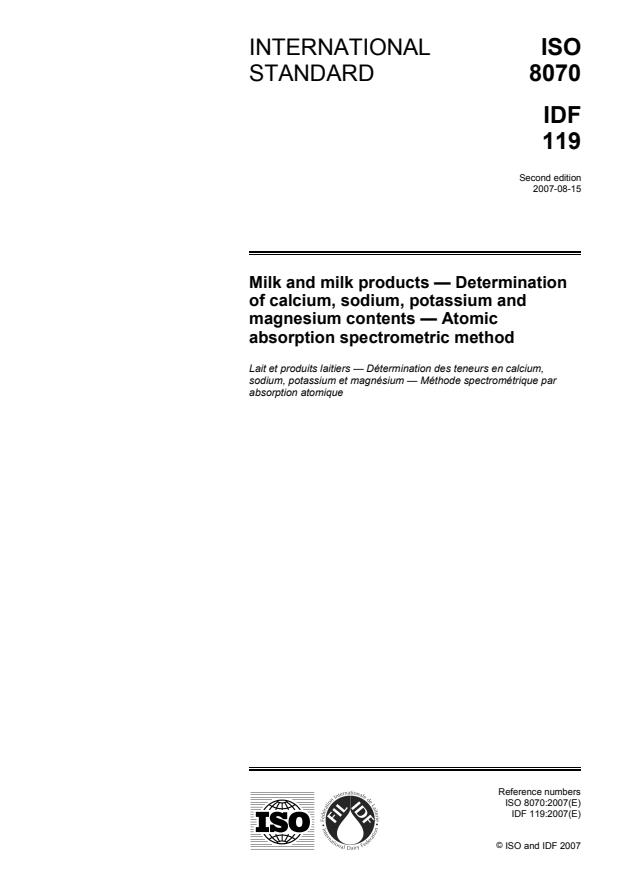
INTERNATIONAL ISO
STANDARD 8070
IDF
Second edition
2007-08-15
Milk and milk products — Determination
of calcium, sodium, potassium and
magnesium contents — Atomic
absorption spectrometric method
Lait et produits laitiers — Détermination des teneurs en calcium,
sodium, potassium et magnésium — Méthode spectrométrique par
absorption atomique
Reference numbers
IDF 119:2007(E)
©
ISO and IDF 2007
IDF 119:2007(E)
PDF disclaimer
This PDF file may contain embedded typefaces. In accordance with Adobe's licensing policy, this file may be printed or viewed but
shall not be edited unless the typefaces which are embedded are licensed to and installed on the computer performing the editing. In
downloading this file, parties accept therein the responsibility of not infringing Adobe's licensing policy. Neither the ISO Central
Secretariat nor the IDF accepts any liability in this area.
Adobe is a trademark of Adobe Systems Incorporated.
Details of the software products used to create this PDF file can be found in the General Info relative to the file; the PDF-creation
parameters were optimized for printing. Every care has been taken to ensure that the file is suitable for use by ISO member bodies
and IDF national committees. In the unlikely event that a problem relating to it is found, please inform the ISO Central Secretariat at the
address given below.
© ISO and IDF 2007
All rights reserved. Unless otherwise specified, no part of this publication may be reproduced or utilized in any form or by any means,
electronic or mechanical, including photocopying and microfilm, without permission in writing from either ISO or IDF at the respective
address below.
ISO copyright office International Dairy Federation
Case postale 56 • CH-1211 Geneva 20 Diamant Building • Boulevard Auguste Reyers 80 • B-1030 Brussels
Tel. + 41 22 749 01 11 Tel. + 32 2 733 98 88
Fax + 41 22 749 09 47 Fax + 32 2 733 04 13
E-mail copyright@iso.org E-mail info@fil-idf.org
Web www.iso.org Web www.fil-idf.org
Published in Switzerland
ii © ISO and IDF 2007 – All rights reserved
IDF 119:2007(E)
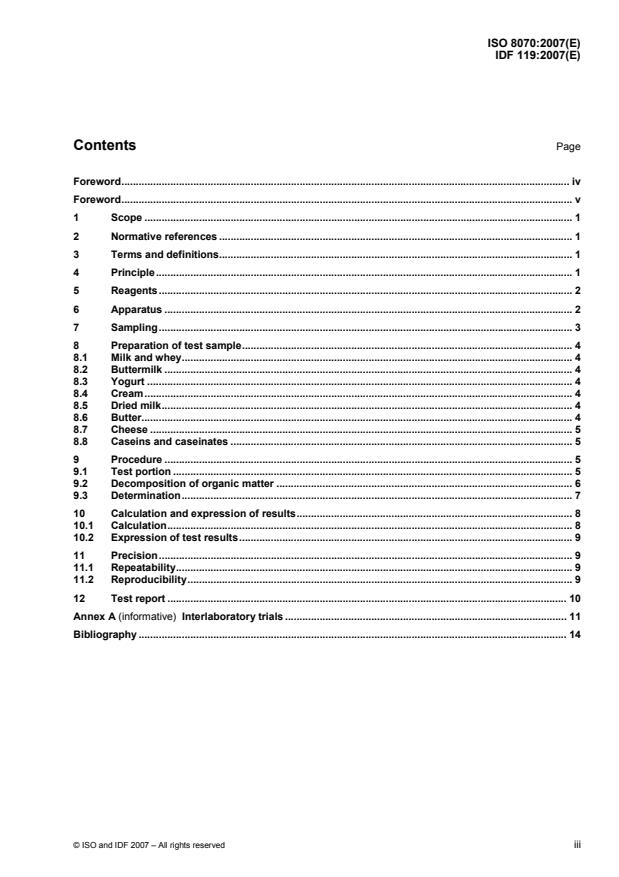
Contents Page
Foreword. iv
Foreword. v
1 Scope . 1
2 Normative references . 1
3 Terms and definitions. 1
4 Principle. 1
5 Reagents. 2
6 Apparatus . 2
7 Sampling. 3
8 Preparation of test sample. 4
8.1 Milk and whey. 4
8.2 Buttermilk . 4
8.3 Yogurt . 4
8.4 Cream. 4
8.5 Dried milk. 4
8.6 Butter. 4
8.7 Cheese . 5
8.8 Caseins and caseinates . 5
9 Procedure . 5
9.1 Test portion . 5
9.2 Decomposition of organic matter . 6
9.3 Determination. 7
10 Calculation and expression of results. 8
10.1 Calculation. 8
10.2 Expression of test results. 9
11 Precision. 9
11.1 Repeatability. 9
11.2 Reproducibility. 9
12 Test report . 10
Annex A (informative) Interlaboratory trials . 11
Bibliography . 14
IDF 119:2007(E)
Foreword
ISO (the International Organization for Standardization) is a worldwide federation of national standards
bodies (ISO member bodies). The work of preparing International Standards is normally carried out through
ISO technical committees. Each member body interested in a subject for which a technical committee has
been established has the right to be represented on that committee. International organizations, governmental
and non-governmental, in liaison with ISO, also take part in the work. ISO collaborates closely with the
International Electrotechnical Commission (IEC) on all matters of electrotechnical standardization.
International Standards are drafted in accordance with the rules given in the ISO/IEC Directives, Part 2.
The main task of technical committees is to prepare International Standards. Draft International Standards
adopted by the technical committees are circulated to the member bodies for voting. Publication as an
International Standard requires approval by at least 75 % of the member bodies casting a vote.
Attention is drawn to the possibility that some of the elements of this document may be the subject of patent
rights. ISO shall not be held responsible for identifying any or all such patent rights.
ISO 8070⎪IDF 119 was prepared by Technical Committee ISO/TC 34, Food products, Subcommittee SC 5,
Milk and milk products, and the International Dairy Federation (IDF). It is being published jointly by ISO and
IDF.
This second edition of ISO 8070⎪IDF 119 cancels and replaces the first edition (ISO 8070:1987), which has
been technically revised.
iv © ISO and IDF 2007 – All rights reserved
IDF 119:2007(E)
Foreword
IDF (the International Dairy Federation) is a worldwide federation of the dairy sector with a National
Committee in every member country. Every National Committee has the right to be represented on the IDF
Standing Committees carrying out the technical work. IDF collaborates with ISO in the development of
standard methods of analysis and sampling for milk and milk products.
Draft International Standards adopted by the Action Teams and Standing Committees are circulated to the
National Committees for voting. Publication as an International Standard requires approval by at least 50 % of
the IDF National Committees casting a vote.
Attention is drawn to the possibility that some of the elements of this document may be the subject of patent
rights. IDF shall not be held responsible for identifying any or all such patent rights.
ISO 8070⎪IDF 119 was prepared by the International Dairy Federation (IDF) and Technical Committee
ISO/TC 34, Food products, Subcommittee SC 5, Milk and milk products. It is being published jointly by IDF
and ISO.
All work was carried out by the Joint ISO-IDF Action Team Minor compounds, of the Standing Committee on
Minor components and characterization of physical properties, under the aegis of its project leaders,
Mr L. Noël (FR) and Mr. M. Carl (DE).
This edition of ISO 8070⎪IDF 119 cancels and replaces IDF 119A:1987 and IDF 154:1992, which have been
technically revised.
INTERNATIONAL STANDARD
IDF 119:2007(E)
Milk and milk products — Determination of calcium, sodium,
potassium and magnesium contents — Atomic absorption
spectrometric method
1 Scope
This International Standard specifies a flame atomic absorption spectrometric method for the determination of
calcium, sodium, potassium and magnesium contents in milk and milk products.
The method is applicable for milk and whey, buttermilk, yogurt, cream, dried milk, butter, cheese, casein and
caseinate.
2 Normative references
The following referenced documents are indispensable for the application of this document. For dated
references, only the edition cited applies. For undated references, the latest edition of the referenced
document (including any amendments) applies.
ISO 648, Laboratory glassware — One-mark pipettes
ISO 1042, Laboratory glassware — One-mark volumetric flasks
ISO 3696, Water for analytical laboratory use — Specification and test methods
3 Terms and definitions
For the purposes of this document, the following terms and definitions apply.
3.1
calcium, sodium, potassium, magnesium contents
mass fraction of substances determined by the procedure specified in this International Standard
NOTE The respective contents are expressed in milligrams per gram.
4 Principle
The organic matter is decomposed by dry ashing or by wet digestion using nitric acid either in an open
microwave-assisted wet digestion system or in a pressurized microwave-assisted wet digestion system or in a
pressurized polytetrafluoroethylene (PTFE) decomposition vessel or any appropriate instrumentation in wet
digestion. The ash containing calcium, sodium, potassium, and magnesium is dissolved in a nitric acid
solution in the case of dry ashing, or the digests diluted in the case of wet digestion. The test and calibration
solutions are atomized into an air–acetylene flame of an atomic absorption spectrometer and their absorption
is measured at appropriate wavelengths.
IDF 119:2007(E)
5 Reagents
Use reagents of recognized analytical grade, unless otherwise specified, and water complying with grade 2 in
accordance with ISO 3696, unless otherwise stated.
SAFETY PRECAUTIONS — When using acids, operators should protect themselves by wearing
glasses and gloves. Manipulation of acids shall be done under an appropriate fume hood.
5.1 Nitric acid (HNO ), concentrated, with a mass fraction of 65 %.
5.2 Nitric acid (HNO ) solution, with a volume fraction of 25 %.
Dilute 25 ml of nitric acid (5.1) to 100 ml with water and mix.
5.3 Lanthanum trichloride solution, with c(LaCl .7H O) = 27 g/l.
3 2
Dissolve 27 g of lanthanum trichloride heptahydrate (LaCl .7H O) in an amount of water. Dilute to 1 litre and
3 2
mix.
5.4 Calcium ion stock solution.
2+
Commercially available or equivalent corresponding to c(Ca ) = 1 g/l.
5.5 Sodium ion stock solution.
+
Commercially available or equivalent corresponding to c(Na ) = 1 g/l.
5.6 Potassium ion stock solution.
+
Commercially available or equivalent corresponding to c(K ) = 1 g/l.
5.7 Magnesium ion stock solution.
2+
Commercially available or equivalent corresponding to c(Mg ) = 1 g/l.
5.8 Standard working solution, containing 100 mg/l calcium, 20 mg/l sodium, 20 mg/l potassium and
10 mg/l magnesium ions.
Pipette 10 ml of calcium ion stock solution (5.4), 2 ml sodium ion stock solution (5.5), 2 ml potassium ion stock
solution (5.6) and 1 ml magnesium ion stock solution (5.7) into a 100 ml one-mark volumetric flask (6.3) and
mix. Add 5 ml of nitric acid solution (5.2). Dilute to the 100 ml mark with water and mix again.
Store the standard working solution in a PE-HD bottle (6.7) so that any contamination is avoided.
5.9 Light petroleum (petroleum ether), with a boiling range of between 40 °C and 60 °C.
Distil the light petroleum, if necessary, in a contamination free distillation unit.
5.10 Hydrogen peroxide (H O ), with a volume fraction of 30 %.
2 2
6 Apparatus
6.1 General
Keep the clean glassware in a nitric acid solution with a mass fraction of about 10 %. Clean all glassware and
plastic ware thoroughly with the 10 % nitric acid and keep it in that solution for at least 6 h. Before use, rinse
the glassware and plastic ware three times with double-distilled water and allow it all to dry.
2 © ISO and IDF 2007 – All rights reserved
IDF 119:2007(E)
Store the clean glassware and plastic ware in a dust-free environment to ensure that they are free from any
contamination when used.
Usual laboratory apparatus, and in particular, the following.
6.2 Analytical balance, capable of weighing to the nearest 1 mg, with a readability of 0,1 mg.
6.3 One-mark volumetric flasks, of nominal capacities 20 ml, 50 ml, 100 ml, 250 ml and 1000 ml,
complying with the requirements of ISO 1042.
6.4 One-mark pipettes, of nominal capacities 1 ml, 2 ml, 5 ml and 10 ml, complying with the requirements
of ISO 648.
6.5 Micropipette, capable of adjusting to between 1 ml and 5 ml, with plastic pipette tips.
6.6 Graduated measuring cylinder, of capacity 10 ml.
6.7 High-density polyethylene (PE-HD) bottles, capable of storing the standard and sample solutions.
6.8 Silica crucibles, of capacity between 25 ml and 50 ml.
6.9 Programmable furnace oven, capable of attaining a minimum temperature of 550 °C ± 25 °C and of
programming with a heating rate of 50 °C/h.
6.10 Open focused microwave-assisted wet digestion system, delivering 200 W microwave power,
equipped with appropriate vessels of capacity 50 ml, with an adapted cooling system.
6.11 Pressurized microwave-assisted wet digestion system, with operator selectable output of between
0 W and 1 000 W microwave power, provided with temperature and pressure controllers and an air cooling
device, equipped with appropriate vessels of capacity 50 ml, commercially available or equivalent.
6.12 Decomposition vessels, made of stainless steel, with adapted PTFE inner vessels of capacity 23 ml
with screw caps (pressurized wet decomposition PTFE vessel), commercially available or equivalent.
6.13 Oven, capable of attaining a temperature of 150 °C (for digestion bombs).
6.14 Flame atomic absorption spectrometer, with an air–acetylene burner, suitable for measuring at
different wavelengths: at 422,7 nm for calcium, at 589,6 nm for sodium, at 766,5 nm for potassium and
285,2 nm for magnesium ion content-determination procedures; equipped with hollow cathode lamps of single
element type or combined type.
6.15 Water baths, capable of maintaining temperatures of 20 °C ± 2 °C, at 40 °C ± 1 °C, at 45 °C ± 1 °C,
and at 65 °C ± 1°C.
6.16 Centrifuge, capable of producing a radial acceleration of 2 500g, with tubes of capacity at least 150 ml.
6.17 Appropriate grinding device.
6.18 Sieve, free of contaminated material, with nominal size of aperture 0,5 mm.
7 Sampling
A representative sample should have been sent to the laboratory. It should not have been damaged or
changed during transport or storage.
Sampling is not part of the method specified in this International Standard. A recommended sampling method
is given in ISO 707⎪IDF 50.
Store the test sample in such a way that deterioration and change in its composition are prevented.
IDF 119:2007(E)
8 Preparation of test sample
Avoid any contamination of the test sample.
8.1 Milk and whey
Place the test sample in the water bath (6.15) set at 20 °C and mix carefully. If in the case of milk the fat is not
evenly dispersed, warm the test sample slowly in a water bath (6.15) set at 40 °C. Mix gently by inversion only.
When the sample is mixed thoroughly then cool quickly again in the water bath (6.15) set at 20 °C.
8.2 Buttermilk
Remove, if necessary, any butter granules. Immediately before weighing (9.1.1.1 or 9.1.2.1), place the test
sample in the water bath (6.15) set at 20 °C and mix carefully.
8.3 Yogurt
Place the test sample in the water bath (6.15) set at 20 °C and mix carefully. If the serum separates, stir the
sample vigorously immediately before weighing (9.1.1.1 or 9.1.2.1).
8.4 Cream
Place the test sample in the water bath (6.15) set at 20 °C. Mix or stir thoroughly but not so vigorously as to
cause frothing or churning. If the cream is very thick, or if the fat is not evenly dispersed, warm the sample
slowly in a water bath (6.15) set at 40 °C to facilitate mixing. Cool the test sample quickly in the water bath
(6.15) set at 20 °C.
NOTE Reliable results cannot be expected if adequate mixing of the test sample is not achieved or if the test sample
shows any evidence of churning or any other signs of abnormality.
8.5 Dried milk
Transfer the test sample into a container of capacity about twice the volume of the sample and provided with
an airtight lid. Close the container immediately. Mix the milk powder thoroughly by repeatedly shaking and
inverting the container.
8.6 Butter
Because of the possible inhomogeneous distribution of the ions in butter they are determined in the serum.
NOTE The ion contents in the fat fraction, obtained from butter in the way described, are negligible compared with
the contents in the serum and can be ignored.
Weigh, to the nearest 100 mg, 100 g of test sample in a dry centrifuge tube (6.16), of which the mass has
been determined previously. Place the tube in a water bath (6.15) set at 45 °C. As soon as the butter is melted,
centrifuge the tube with a radial acceleration of 2 500g.
Remove as much as possible the clear fat layer from the tube by using a pipette. Add 10 ml light petroleum
(5.9) to dilute the remaining fat layer in the tube and remove the mixture again with a pipette. Repeat the
addition and removal of light petroleum mixture twice.
Remove the residual light petroleum by warming the tube in a water bath (6.15) set at 65 °C. Cool in the water
bath (6.15) set in advance at 20 °C. Dry the outside of the tube with a clean paper tissue. Weigh the tube and
its contents to the nearest 100 mg. Mix the contents carefully immediately before weighing the test sample
(9.1.1.1 or 9.1.2.1).
NOTE The butter can also be digested directly if dry ashing or pressurized microwave-assisted
...
NORME ISO
INTERNATIONALE 8070
FIL
Deuxième édition
2007-08-15
Lait et produits laitiers — Détermination
des teneurs en calcium, sodium,
potassium et magnésium — Méthode
spectrométrique par absorption atomique
Milk and milk products — Determination of calcium, sodium, potassium
and magnesium contents — Atomic absorption spectrometric method
Numéros de référence
FIL 119:2007(F)
©
ISO et FIL 2007
FIL 119:2007(F)
PDF – Exonération de responsabilité
Le présent fichier PDF peut contenir des polices de caractères intégrées. Conformément aux conditions de licence d'Adobe, ce fichier
peut être imprimé ou visualisé, mais ne doit pas être modifié à moins que l'ordinateur employé à cet effet ne bénéficie d'une licence
autorisant l'utilisation de ces polices et que celles-ci y soient installées. Lors du téléchargement de ce fichier, les parties concernées
acceptent de fait la responsabilité de ne pas enfreindre les conditions de licence d'Adobe. Le Secrétariat central de l'ISO et la FIL
déclinent toute responsabilité en la matière.
Adobe est une marque déposée d'Adobe Systems Incorporated.
Les détails relatifs aux produits logiciels utilisés pour la création du présent fichier PDF sont disponibles dans la rubrique General Info
du fichier; les paramètres de création PDF ont été optimisés pour l'impression. Toutes les mesures ont été prises pour garantir
l'exploitation de ce fichier par les comités membres de l'ISO et les comités nationaux de la FIL. Dans le cas peu probable où
surviendrait un problème d'utilisation, veuillez en informer le Secrétariat central de l'ISO à l'adresse donnée ci-dessous.
DOCUMENT PROTÉGÉ PAR COPYRIGHT
© ISO et FIL 2007
Droits de reproduction réservés. Sauf prescription différente, aucune partie de cette publication ne peut être reproduite ni utilisée sous
quelque forme que ce soit et par aucun procédé, électronique ou mécanique, y compris la photocopie et les microfilms, sans l'accord écrit
soit de l'ISO soit de la FIL, à l'une ou l'autre des adresses ci-après.
ISO copyright office Fédération Internationale de Laiterie
Case postale 56 • CH-1211 Geneva 20 Diamant Building • Boulevard Auguste Reyers 80 • B-1030 Bruxelles
Tel. + 41 22 749 01 11 Tel. + 32 2 733 98 88
Fax + 41 22 749 09 47 Fax + 32 2 733 04 13
E-mail copyright@iso.org E-mail info@fil-idf.org
Web www.iso.org Web www.fil-idf.org
Publié en Suisse
ii © ISO et FIL 2007 – Tous droits réservés
FIL 119:2007(F)
Sommaire Page
Avant-propos. iv
Avant-propos. v
1 Domaine d'application. 1
2 Références normatives . 1
3 Termes et définitions. 1
4 Principe. 1
5 Réactifs . 2
6 Appareillage . 3
7 Échantillonnage . 4
8 Préparation de l'échantillon pour essai. 4
8.1 Lait et lactosérum . 4
8.2 Babeurre . 4
8.3 Yogourt . 4
8.4 Crème. 4
8.5 Lait en poudre . 4
8.6 Beurre . 4
8.7 Fromage. 5
8.8 Caséines et caséinates . 5
9 Mode opératoire . 5
9.1 Prise d'essai . 5
9.2 Minéralisation de la matière organique . 6
9.3 Détermination. 7
10 Calcul et expression des résultats. 9
10.1 Calcul . 9
10.2 Expression des résultats d'essai . 9
11 Fidélité . 9
11.1 Répétabilité. 10
11.2 Reproductibilité. 10
12 Rapport d'essai . 10
Annexe A (informative) Essais interlaboratoires . 12
Bibliographie . 15
© ISO et FIL 2007 – Tous droits réservés iii
FIL 119:2007(F)
Avant-propos
L'ISO (Organisation internationale de normalisation) est une fédération mondiale d'organismes nationaux
de normalisation (comités membres de l'ISO). L'élaboration des Normes internationales est en général
confiée aux comités techniques de l'ISO. Chaque comité membre intéressé par une étude a le droit de faire
partie du comité technique créé à cet effet. Les organisations internationales, gouvernementales et non
gouvernementales, en liaison avec l'ISO participent également aux travaux. L'ISO collabore étroitement avec
la Commission électrotechnique internationale (CEI) en ce qui concerne la normalisation électrotechnique.
Les Normes internationales sont rédigées conformément aux règles données dans les Directives ISO/CEI,
Partie 2.
La tâche principale des comités techniques est d'élaborer les Normes internationales. Les projets de Normes
internationales adoptés par les comités techniques sont soumis aux comités membres pour vote. Leur
publication comme Normes internationales requiert l'approbation de 75 % au moins des comités membres
votants.
L'attention est appelée sur le fait que certains des éléments du présent document peuvent faire l'objet de
droits de propriété intellectuelle ou de droits analogues. L'ISO ne saurait être tenue pour responsable de ne
pas avoir identifié de tels droits de propriété et averti de leur existence.
L'ISO 8070⎪FIL 119 a été élaborée par le comité technique ISO/TC 34, Produits alimentaires, sous-comité
SC 5, Lait et produits laitiers, et la Fédération internationale de laiterie (FIL). Elle est publiée conjointement
par l'ISO et la FIL.
Cette deuxième édition de l'ISO 8070⎪FIL 119 annule et remplace la première édition (ISO 8070:1987), qui a
fait l'objet d'une révision technique.
iv © ISO et FIL 2007 – Tous droits réservés
FIL 119:2007(F)
Avant-propos
La FIL (Fédération internationale de laiterie) est une fédération mondiale du secteur laitier avec un Comité
National dans chacun de ses pays membres. Chaque Comité National a le droit de faire partie des Comités
permanents de la FIL auxquels sont confiés les travaux techniques. La FIL collabore avec l'ISO pour
l'élaboration de méthodes normalisées d'analyse et d'échantillonnage pour le lait et les produits laitiers.
Les projets de Normes internationales adoptés par les Équipes d'Action et les Comités permanents sont
soumis aux Comités Nationaux pour vote. Leur publication comme Normes internationales requiert
l'approbation de 50 % au moins des Comités Nationaux de la FIL votants.
L'attention est appelée sur le fait que certains des éléments du présent document peuvent faire l'objet de
droits de propriété intellectuelle ou de droits analogues. La FIL ne saurait être tenue pour responsable de ne
pas avoir identifié de tels droits de propriété et averti de leur existence.
L'ISO 8070⎪FIL 119 a été élaborée par la Fédération internationale de laiterie (FIL) et le comité technique
ISO/TC 34, Produits alimentaires, sous-comité SC 5, Lait et produits laitiers. Elle est publiée conjointement
par la FIL et l'ISO.
L'ensemble des travaux a été confié à l'Équipe d'Action mixte ISO-FIL du Comité permanent chargé de
Composants mineurs, du Comité représentatif sur les Composants mineurs et caractérisation des propriétés
physiques sous l'égide de ses chefs de projet, Monsieur L. Noël (FR) et Monsieur M. Carl (DE).
Cette édition de l'ISO 8070⎪FIL 119 annule et remplace la FIL 119A:1987 et la FIL 154:1992, qui ont fait
l'objet d'une révision technique.
© ISO et FIL 2007 – Tous droits réservés v
NORME INTERNATIONALE
FIL 119:2007(F)
Lait et produits laitiers — Détermination des teneurs en calcium,
sodium, potassium et magnésium — Méthode spectrométrique
par absorption atomique
1 Domaine d'application
Le présente Norme internationale spécifie une méthode par spectrométrie d'absorption atomique dans la
flamme pour déterminer des teneurs en calcium, sodium, potassium et magnésium dans le lait et les produits
laitiers.
Cette méthode s'applique au lait et lactosérum, au babeurre, au yogourt, à la crème, au lait en poudre, au
beurre, au fromage, à la caséine et au caséinate.
2 Références normatives
Les documents de référence suivants sont indispensables pour l'application du présent document. Pour les
références datées, seule l'édition citée s'applique. Pour les références non datées, la dernière édition du
document de référence (y compris les éventuels amendements) s'applique.
ISO 648, Verrerie de laboratoire — Pipettes à un trait
ISO 1042, Verrerie de laboratoire — Fioles jaugées à un trait
ISO 3696, Eau pour laboratoire à usage analytique — Spécification et méthodes d'essai
3 Termes et définitions
Pour les besoins du présent document, les termes et définitions suivants s'appliquent.
3.1
teneurs en calcium, sodium, potassium, magnésium
fraction massique de substances déterminée selon le mode opératoire décrit dans la présente Norme
internationale
NOTE Les teneurs sont exprimées en milligrammes par gramme.
4 Principe
La matière organique est minéralisée par incinération par voie sèche ou par voie humide, avec de l'acide
nitrique, soit dans un micro-ondes ouvert équipé d'un système de digestion humide ou dans un micro-ondes
pressurisé équipé d'un système de digestion humide ou encore dans un récipient en polytétrafluoroéthylène
(PTFE) pour minéralisation pressurisé ou dans tout appareil approprié pour la digestion par voie humide. Les
cendres contenant du calcium, sodium, potassium et magnésium sont dissoutes dans une solution d'acide
nitrique pour l'incinération par voie sèche ou les produits de la minéralisation sont dilués dans le cas de la
minéralisation par voie humide. Des solutions d'essais et étalons sont vaporisés dans la flamme
aéroacétylénique d'un spectromètre à absorption atomique et leur absorption est mesurée aux longueurs
d'onde appropriées.
© ISO et FIL 2007 – Tous droits réservés 1
FIL 119:2007(F)
5 Réactifs
Utiliser uniquement des réactifs de qualité analytique reconnue et de l'eau de qualité 2 conforme à l'ISO 3696,
sauf spécification contraire.
PRÉCAUTIONS DE SÉCURITÉ — Il convient, lors de la manipulation des acides, que les opérateurs
protègent leurs mains et leurs yeux. La manipulation des acides doit être effectuée sous une hotte
appropriée.
5.1 Acide nitrique (HNO ), concentré, ayant une fraction massique de 65 %.
5.2 Solution d'acide nitrique (HNO ), ayant une fraction volumique de 25 %.
Diluer 25 ml de solution d'acide nitrique (5.1) avec de l'eau jusqu'à 100 ml et mélanger.
5.3 Solution de chlorure de lanthane, avec c(LaCl ,7H O) = 27 g/l.
3 2
Dissoudre 27 g de solution de chlorure de lanthane heptahydraté (LaCl ,7H O) dans un volume d'eau. Diluer
3 2
jusqu'à un litre et mélanger.
5.4 Solution mère d'ions calcium.
2+
Solution disponible dans le commerce ou équivalent correspondant à c(Ca ) = 1 g/l.
5.5 Solution mère d'ions sodium.
+
Solution disponible dans le commerce ou équivalent correspondant à c(Na ) = 1 g/l.
5.6 Solution mère d'ions potassium.
+
Solution disponible dans le commerce ou équivalent correspondant à c(K ) = 1 g/l.
5.7 Solution mère d'ions magnésium.
2+
Solution disponible dans le commerce ou équivalent correspondant à c(Mg ) = 1 g/l.
5.8 Solution étalon de travail, contenant 100 mg/l d'ions calcium, 20 mg/l d'ions sodium, 20 mg/l d'ions
potassium et 10 mg/l d'ions magnésium.
Introduire à l'aide d'une pipette, 10 ml de solution mère d'ions calcium (5.4), 2 ml de solution mère d'ions
sodium (5.5), 2 ml de solution mère d'ions potassium (5.6) et 1 ml de solution mère d'ions magnésium (5.7)
dans une fiole jaugée à un trait de 100 ml (6.3) et mélanger. Ajouter 5 ml de solution d'acide nitrique (5.2).
Diluer jusqu'au trait de 100 ml avec de l'eau et mélanger à nouveau.
Conserver la solution étalon de travail dans une bouteille en PE-HD (6.7), afin d'éviter toute contamination.
5.9 Éther de pétrole, dont le point d'ébullition est compris entre 40 °C et 60 °C.
Distiller, le cas échéant, l'éther de pétrole dans une unité de distillation exempte de toute contamination.
5.10 Peroxyde d'hydrogène (H O ), ayant une fraction volumique de 30 %.
2 2
2 © ISO et FIL 2007 – Tous droits réservés
FIL 119:2007(F)
6 Appareillage
6.1 Généralités
Conserver la verrerie nettoyée dans une solution d'acide nitrique ayant une fraction massique d'environ 10 %.
Nettoyer soigneusement toute la verrerie ainsi que les récipients en plastique dans l'acide nitrique à 10 % et
la conserver dans cette solution pendant au moins 6 h. Avant d'utiliser la verrerie et les récipients en plastique,
les rincer trois fois avec de l'eau bidistillée et laisser sécher.
Conserver la verrerie et les récipients en plastique nettoyés bien à l'abri de la poussière, afin d'être sûr qu'au
moment de leur utilisation ils n'aient pas été souillés.
Utiliser l'appareillage courant de laboratoire et, en particulier, ce qui suit.
6.2 Balance analytique, capable de peser à 1 mg près, avec une précision de lecture à 0,1 mg près.
6.3 Fioles jaugées à un trait, capacités de 20 ml, 50 ml, 100 ml, 250 ml et 1 000 ml, conformes aux
exigences de l'ISO 1042.
6.4 Pipettes à un trait, capacités de 1 ml, 2 ml, 5 ml et 10 ml, conformes aux exigences de l'ISO 648.
6.5 Micropipette, capacité ajustée entre 1 ml et 5 ml, avec embouts de pipette en plastique.
6.6 Éprouvette graduée, capacité de 10 ml.
6.7 Bouteilles en polyéthylène haute densité (PE-HD), pouvant stocker les solutions étalons et
d'échantillons.
6.8 Creusets de silice, capacité comprise entre 25 ml et 50 ml.
6.9 Four programmable, pouvant atteindre une température minimale de 550 °C ± 25 °C et pouvant être
programmé avec un taux d'échauffement de 50 °C/h.
6.10 Système de minéralisation par voie humide équipé d'un four à micro-ondes ouvert, ayant une
puissance de 200 W, des récipients appropriés d'une capacité de 50 ml et un système de refroidissement
adapté.
6.11 Système de minéralisation par voie humide équipé d'un four à micro-ondes pressurisé, ayant
une puissance comprise entre 0 W et 1 000 W réglable par l'opérateur, muni de régulateurs de pression et de
température, et d'un dispositif de refroidissement, équipé de récipients appropriés d'une capacité de 50 ml, du
type disponible dans le commerce ou équivalent.
6.12 Récipients pour la minéralisation, en acier inoxydable, dont l'intérieur est en PTFE, d'une capacité de
23 ml, avec bouchon à vis (récipient par voie humide pressurisé, en PTFE), du type disponible dans le
commerce ou équivalent.
6.13 Four, pouvant atteindre une température de 150 °C (pour les bombes à minéralisation).
6.14 Spectromètre à absorption atomique dans la flamme, muni d'un brûleur aéroacétylénique,
permettant d'effectuer des mesurages à différentes longueurs d'onde: 422,7 nm pour le calcium, 589,6 nm
pour le sodium, 766,5 nm pour le potassium et 285,2 nm pour la détermination de la teneur en magnésium;
équipé de lampes à cathode creuse de type élément simple ou élément combiné.
6.15 Bains d'eau, pouvant maintenir une température de 20 °C ± 2 °C, à 40 °C ± 1 °C, à 45 °C ± 1 °C, et à
65 °C ± 1 °C.
6.16 Centrifugeuse, pouvant produire une accélération radiale de 2 500g, avec des tubes d'une capacité
minimale de 150 ml.
© ISO et FIL 2007 – Tous droits réservés 3
FIL 119:2007(F)
6.17 Broyeur adapté.
6.18 Tamis, exempt de souillures, avec une ouverture de maille nominale de 0,5 mm.
7 Échantillonnage
Il convient que le laboratoire ait reçu un échantillon réellement représentatif. Il convient qu'il n'ait été ni
endommagé, ni modifié lors du transport ou du stockage.
L'échantillonnage ne fait pas partie de la méthode spécifiée dans la présente Norme internationale. Une
méthode d'échantillonnage recommandée est donnée dans l'ISO 707⎪FIL 50.
Conserver les échantillons d'essai de sorte à éviter toute détérioration et modification de leur composition.
8 Préparation de l'échantillon pour essai
Éviter toute contamination de l'échantillon pour essai.
8.1 Lait et lactosérum
Placer l'échantillon d'essai dans un bain d'eau (6.15) à 20 °C et mélanger soigneusement. S'agissant de lait,
si la graisse n'est pas répartie de façon homogène, chauffer doucement l'échantillon pour essai dans un bain
d'eau (6.15) à 40 °C. Mélanger doucement seulement en retournant le récipient. Une fois l'échantillon
soigneusement mélangé, refroidir rapidement une nouvelle fois dans le bain d'eau (6.15) à 20 °C.
8.2 Babeurre
Retirer, le cas échéant, les granules présentes dans le beurre. Immédiatement avant la pesée (9.1.1.1
ou 9.1.2.1), placer l'échantillon d'essai dans un bain d'eau (6.15) à 20 °C et mélanger soigneusement.
8.3 Yogourt
Placer l'échantillon d'essai dans un bain d'eau (6.15) à 20 °C et mélanger soigneusement. Si le sérum se
sépare, mélanger vigoureusement l'échantillon immédiatement avant la pesée (9.1.1.1 ou 9.1.2.1).
8.4 Crème
Placer l'échantillon d'essai dans un bain d'eau (6.15) à 20 °C. Mélanger ou agiter vigoureusement, mais sans
faire de mousse ou battre la crème. Si la crème est très épaisse, ou si la répartition de la graisse n'est pas
homogène, chauffer doucement dans un bain d'eau (6.15) à 40 °C pour faciliter le mélange. Refroidir
rapidement l'échantillon d'essai dans un bain d'eau (6.15) à 20 °C.
NOTE Les résultats ne sont fiables que si l'échantillon pour essai est suffisamment bien mélangé ou s'il présente des
signes que sa transformation en beurre est amorcée, ou révèle tout autre signe anormal.
8.5 Lait en poudre
Verser l'échantillon pour essai dans un récipient d'une capacité environ deux fois supérieure au volume de
l'échantillon et muni d'un couvercle hermétique. Fermer immédiatement le récipient. Mélanger soigneusement
le lait en poudre en agitant de manière répétée et en renversant le récipient.
8.6 Beurre
En raison de leur possible répartition hétérogène dans le beurre, les ions sont déterminés dans le sérum.
4 © ISO et FIL 2007 – Tous droits réservés
FIL 119:2007(F)
NOTE La teneur en ions dans la fraction correspondant aux matières grasses, obtenue à partir du beurre comme
décrit auparavant, est négligeable par comparaison aux teneurs dans le sérum et peut donc être ignorée.
Peser, à 100 mg près, 100 g d'échantillon pour essai dans un tube de centrifugation sec (6.16), pour lequel la
masse a été préalablement déterminée. Placer le tube dans un bain d'eau (6.15) à 45 °C. Dès que le beurre
est fondu, centrifuger le tube avec une accélération radiale de 2 500g.
Retirer au maximum la couche de matières grasses limpide du tube à l'aide d'une pipette. Ajouter 10 ml
d'éther de pétrole (5.9) pour diluer la couche de matières grasses restante et aspirer ce mélange à l'aide
d'une pipette. Répéter deux fois cette manipulation (ajout d'éther de pétrole et retrait du mélange obtenu).
Retirer le résidu d'éther de pétrole en chauffant le tube dans un bain d'eau (6.15) à 65°C. Refroidir dans un
bain d'eau (6.15) réglé à l'avance à 20 °C. Sécher l'extérieur du tube avec un mouchoir en papier propre.
Peser le tube et son contenu avec une précision de l'ordre de 100 mg. Mélanger soigneusement avant la
pesée de l'échantillon pour essai (9.1.1.1 ou 9.1.2.1).
NOTE Le beurre peut aussi être digéré directement si on utilise l'incinération par voie sèche ou un micro-ondes
pressurisé équipé d'un système de digestion humide, dans lequel le beurre est chauffé à 30 °C, homogénéisé après une
agitation minutieuse et une prise d'essai prélevée directement.
...
МЕЖДУНАРОДНЫЙ ISO
СТАНДАРТ 8070
IDF
Второе издание
2007-08-15
Молоко и молочные продукты.
Определение содержания кальция,
натрия, калия и магния.
Спектрометрический метод атомной
абсорбции
Milk and milk products — Determination of calcium, sodium, potassium
and magnesium contents — Atomic absorption spectrometric method
Ответственность за подготовку русской версии несёт GOST R
(Российская Федерация) в соответствии со статьёй 18.1 Устава ISO
Ссылочные номера
IDF 119:2007(R)
©
ISO и IDF 2007
IDF 119:2007(R)
Отказ от ответственности при работе в PDF
Настоящий файл PDF может содержать интегрированные шрифты. В соответствии с условиями лицензирования, принятыми
фирмой Adobe, этот файл можно распечатать или смотреть на экране, но его нельзя изменить, пока не будет получена
лицензия на установку интегрированных шрифтов в компьютере, на котором ведется редактирование. В случае загрузки
настоящего файла заинтересованные стороны принимают на себя ответственность за соблюдение лицензионных условий
фирмы Adobe. Центральный секретариат ISO не несет никакой ответственности в этом отношении.
Adobe — торговый знак Adobe Systems Incorporated.
Подробности, относящиеся к программным продуктам, использованным для создания настоящего файла PDF, можно найти
в рубрике General Info файла; параметры создания PDF оптимизированы для печати. Были приняты во внимание все меры
предосторожности с тем, чтобы обеспечить пригодность настоящего файла для использования комитетами – членами ISO. В
редких случаях возникновения проблемы, связанной со сказанным выше, просим информировать Центральный секретариат
по адресу, приведенному ниже.
ДОКУМЕНТ ЗАЩИЩЕН АВТОРСКИМ ПРАВОМ
© ISO 2006
Все права сохраняются. Если не указано иное, никакую часть настоящей публикации нельзя копировать или использовать в
какой-либо форме или каким-либо электронным или механическим способом, включая фотокопии и микрофильмы, без
предварительного письменного согласия ISO, которое должно быть получено после запроса о разрешении, направленного по
адресу, приведенному ниже, или в комитет-член ISO в стране запрашивающей стороны.
ISO copyright office International Dairy Federation
Case postale 56 • CH-1211 Geneva 20 Diamant Building • Boulevard Auguste Reyers 80 • B-1030 Brussels
Tel. + 41 22 749 01 11 Tel. + 32 2 733 98 88
Fax + 41 22 749 09 47 Fax + 32 2 733 04 13
E-mail copyright @ iso.ch E-mail info@fil-idf.org
Web www.iso.ch Web www.fil-idf.org
Опубликовано в Швейцарии
ii © ISO и IDF 2007 — Все права сохраняются
IDF 119:2007(R)
Содержание Страница
Предисловие . iv
Предисловие . v
1 Область применения . 1
2 Нормативные ссылки . 1
3 Термины и определения . 1
4 Принцип . 1
5 Реактивы . 2
6 Аппаратура . 2
7 Отбор проб . 4
8 Подготовка пробы для испытания . 4
8.1 Молоко и сыворотка . 4
8.2 Пахта . 4
8.3 Йогурт . 4
8.4 Сливки . 4
8.5 Сухое молоко . 4
8.6 Сливочное масло . 4
8.7 Сыр . 5
8.8 Казеины и казеинаты . 5
9 Методика . 5
9.1 Проба для анализа . 5
9.2 Разложение органических веществ . 6
9.3 Определение. 7
10 Расчет и выражение результатов . 9
10.1 Расчет . 9
10.2 Выражение результатов испытания . 9
11 Прецизионность . 9
11.1 Повторяемость . 10
11.2 Воспроизводимость . 10
12 Протокол испытания . 10
Приложение А (информативное) Межлабораторные испытания . 11
Библиография . 14
© ISO и IDF 2007 — Все права сохраняются iii
IDF 119:2007(R)
Предисловие
Международная организация по стандартизации (ISO) является всемирной федерацией
национальных организаций по стандартизации (комитетов-членов ISO). Разработка международных
стандартов обычно осуществляется техническими комитетами ISO. Каждый комитет-член ISO,
заинтересованный в деятельности, для которой был создан технический комитет, имеет право быть
представленным в этом комитете. Международные организации, правительственные и
неправительственные, имеющие связи с ISO, также принимают участие в работах. ISO
непосредственно сотрудничает с Международной электротехнической комиссией (IEC) по всем
вопросам электротехнической стандартизации.
Международные стандарты разрабатываются в соответствии с правилами, приведенными в
Директивах ISO/IEC, Часть 2.
Основная задача технических комитетов состоит в подготовке международных стандартов. Проекты
международных стандартов, одобренные техническими комитетами, рассылаются комитетам-членам
на голосование. Их опубликование в качестве международных стандартов требует одобрения, по
меньшей мере, 75 % комитетов-членов, принимающих участие в голосовании.
Следует иметь в виду, что некоторые элементы настоящего документа могут быть объектом патентных
прав. ISO не должен нести ответственность за идентификацию какого-либо одного или всех патентных
прав.
ISO 8070IDF 119 подготовлен Техническим комитетом ISO/TC 34, Пищевые продукты, Подкомитетом
SC 5, Молоко и молочные продукты, и Международной федерацией молочной промышленности (IDF).
Этот стандарт должен быть опубликован совместно ISO и IDF.
Настоящее издание ISO 8070IDF 119 отменяет и заменяет первое издание (ISO 8070:1987), которое
было подвергнуто техническому пересмотру.
iv © ISO и IDF 2007 — Все права сохраняются
IDF 119:2007(R)
Предисловие
Международная федерация молочной промышленности (IDF) является всемирной федерацией
предприятий молочной отрасли, каждый член которой представлен в ней своим национальным
комитетом. Каждый национальный комитет имеет право быть представленным в Постоянных
комитетах IDF, осуществляющих техническую работу. IDF сотрудничает с ISO по вопросам разработки
стандартных методов анализа и отбора проб молока и молочных продуктов.
Проекты международных стандартов, принятые Рабочими группами и Постоянными комитетами,
рассылаются национальным комитетам для голосования. Их опубликование в качестве
международных стандартов требует одобрения не менее 50 % национальных комитетов IDF,
принимающих участие в голосовании.
Следует иметь в виду, что некоторые элементы настоящего документа могут быть объектом патентных
прав. IDF не должен нести ответственность за идентификацию какого-либо одного или всех патентных
прав.
ISO 8070IDF 119 подготовлен Международной федерацией молочной промышленности (IDF) и
Техническим комитетом ISO/TC 34, Пищевые продукты, Подкомитетом SC 5, Молоко и молочные
продукты. Этот стандарт должен быть опубликован совместно IDF и ISO.
Вся работа была проведена совместной Рабочей группой ISO-IDF Второстепенные соединения,
Постоянного комитета Второстепенные компоненты и определение физических свойств, под
руководством руководителей проекта, м-ра Л. Ноэля (Франция) и м-ра М. Карла (Германия).
Настоящее издание ISO 8070IDF 119 отменяет и заменяет IDF 119A:1987 и IDF 154:1992, которые
были подвергнуты техническому пересмотру.
© ISO и IDF 2007 — Все права сохраняются v
МЕЖДУНАРОДНЫЙ СТАНДАРТ
IDF 119:2007(R)
Молоко и молочные продукты. Определение содержания
кальция, натрия, калия и магния. Спектрометрический
метод атомной абсорбции
1 Область применения
Настоящий международный стандарт устанавливает спектрометрический метод атомной абсорбции в
пламени для определения содержания кальция, натрия, калия и магния в молоке и молочных
продуктах.
Метод применим к молоку, сыворотке, пахте, йогурту, сливкам, сухому молоку, сливочному маслу,
сыру, казеину и казеинату.
2 Нормативные ссылки
Следующие ссылочные нормативные документы являются обязательными при применении данного
документа. Для жестких ссылок применяется только цитированное издание документа. Для плавающих
ссылок необходимо использовать самое последнее издание нормативного ссылочного документа
(включая любые изменения).
ISO 648, Посуда лабораторная стеклянная. Пипетки с одной меткой
ISO 1042, Посуда лабораторная стеклянная. Мерные колбы с одной меткой
ISO 3696, Вода для лабораторного анализа. Технические требования и методы испытаний
3 Термины и определения
Применительно к настоящему документу используются следующие термины и определения.
3.1
содержание кальция, натрия, калия, магния
calcium, sodium, potassium, magnesium contents
массовая доля веществ, определенных по методике, установленной в этом международном стандарте
ПРИМЕЧАНИЕ Соответствующее содержание выражается в миллиграммах на грамм.
4 Принцип
Разрушают органические вещества в результате сухого или мокрого озоления, при мокром озолении
используют азотную кислоту либо в открытой микроволновой системе, либо в микроволновой системе
под давлением, либо в сосуде под давлением из политетрафторэтилена (PTFE), либо в любом
соответствующем аппарате для мокрого озоления. Растворяют золу, содержащую кальций, натрий,
калий и магний, в азотной кислоте в случае сухого озоления или разбавляют гидролизаты в случае
мокрого озоления. Атоминизируют испытуемый и калибровочный растворы в воздушно-ацетиленовом
пламени атомного абсорбционного спектрометра и измеряют их оптическую плотность при
соответствующих длинах волн.
© ISO и IDF 2007 — Все права сохраняются 1
IDF 119:2007(R)
5 Реактивы
Используют реактивы только признанного аналитического качества, если не указано иначе, и воду,
соответствующую классу 2 по ISO 3696, если не указано иначе.
МЕРЫ ПРЕДОСТОРОЖНОСТИ — При использовании кислот оператору следует носить очки и
перчатки. Манипуляции с кислотами должны выполняться в соответствующем вытяжном шкафу.
5.1 Азотная кислота (HNO ), концентрированная, массовая доля 65 %.
5.2 Раствор азотной кислоты (HNO ), объемная доля 25 %.
Разбавляют 25 мл азотной кислоты (5.1) до 100 мл водой и перемешивают.
5.3 Раствор трихлорида лантана, концентрация c(LaCl 7H O) = 27 г/л.
3 2
Растворяют 27 г гептагидрата трихлорида лантана (LaCl 7H O) в воде. Разбавляют до 1 л и
3 2
перемешивают.
5.4 Основной раствор иона кальция.
2+
Имеющийся в продаже или эквивалентный реактив, соответствующий концентрации c(Ca ) = 1 г/л.
5.5 Основной раствор иона натрия.
+
Имеющийся в продаже или эквивалентный реактив, соответствующий концентрации c(Na ) = 1 г/л.
5.6 Основной раствор иона калия.
+
Имеющийся в продаже или эквивалентный реактив, соответствующий концентрации c(K ) = 1 г/л.
5.7 Основной раствор иона магния.
2+
Имеющийся в продаже или эквивалентный реактив, соответствующий концентрации c(Mg ) = 1 г/л.
5.8 Стандартный рабочий раствор, содержащий 100 мг/л иона кальция, 20 мг/л иона натрия,
20 мг/л иона калия и 10 мг/л иона магния.
Отбирают пипеткой 10 мл основного раствора иона кальция (5.4), 2 мл основного раствора иона
натрия (5.5), 2 мл основного раствора иона калия (5.6) и 1 мл основного раствора иона магния (5.7) в
мерную колбу с одной меткой вместимостью 100 мл (6.3) и перемешивают. Добавляют 5 мл раствора
азотной кислоты (5.2). Разбавляют до метки 100 мл водой и снова перемешивают.
Хранят стандартный рабочий раствор в бутылке из полиэтилена высокой плотности PE-HD (6.7) таким
образом, чтобы предотвратить какое-либо загрязнение.
5.9 Петролейный эфир, пределы кипения от 40 °C до 60 °C.
Перегоняют, если необходимо, петролейный эфир в чистый сосуд.
5.10 Пероксид водорода (H O ), объемная доля 30 %.
2 2
6 Аппаратура
6.1 Общие положения
Выдерживают чистую стеклянную лабораторную посуду в растворе азотной кислоты с массовой долей
10 %. Тщательно очищают всю стеклянную и пластмассовую лабораторную посуду 10 %-ным
2 © ISO и IDF 2007 — Все права сохраняются
IDF 119:2007(R)
раствором азотной кислоты и выдерживают ее в этом растворе, по меньшей мере, 6 ч. Перед
использованием три раза ополаскивают стеклянную и пластмассовую посуду водой двойной перегонки
и дают возможность ей высохнуть.
Хранят чистую стеклянную и пластмассовую лабораторную посуду в беспыльных условиях,
гарантирующих отсутствие какого-либо загрязнения при ее использовании.
Используют обычную лабораторную аппаратуру и, в частности, следующую.
6.2 Аналитические весы, способные взвешивать с точностью до 1 мг, и возможностью считывания до 0,1 мг.
6.3 Мерные колбы с одной меткой, номинальной вместимостью 20 мл, 50 мл, 100 мл, 250 мл и 1 000 мл,
соответствующие требованиям ISO 1042.
6.4 Пипетки с одной меткой, номинальной вместимостью 1 мл, 2 мл, 5 мл и 10 мл,
соответствующие требованиям ISO 648.
6.5 Микропипетка, способная регулировать объем от 1 мл до 5 мл, с пластмассовыми кончиками.
6.6 Градуированный цилиндр, вместимостью 10 мл.
6.7 Бутылки из полиэтилена высокой плотности (PE-HD), для хранения стандартного раствора и
раствора пробы.
6.8 Кварцевые тигли, вместимостью от 25 мл до 50 мл.
6.9 Печь с программным управлением, способная поддерживать минимальную температуру
550 °C ± 25 °C и программировать скорость нагрева 50 °C/ч.
6.10 Открытая микроволновая система для мокрого озоления, с мощностью СВЧ-сигналов 200 Вт,
оборудованная соответствующими сосудами вместимостью 50 мл и адаптированной системой
охлаждения.
6.11 Микроволновая система для мокрого озоления под давлением, с управляющим устройством,
способным отбирать выходную мощность СВЧ-сигналов от 0 Вт до 1 000 Вт, с регуляторами
температуры и давления и устройством охлаждения воздуха, оборудованная соответствующими
сосудами вместимостью 50 мл, имеющаяся в продаже или эквивалентного качества.
6.12 Сосуды для разложения, изготовленные из нержавеющей стали, с соответствующими
внутренними сосудами из политетрафторэтилена (PTFE) вместимостью 23 мл с навинчивающимися
крышками (сосуды из PTFE для разложения под давлением), имеющиесяся в продаже или
эквивалентного качества.
6.13 Печь, способная поддерживать температуру 150 °C (для бомб для озоления).
6.14 Пламенный атомный абсорбционный спектрометр, с воздушно-ацетиленовой горелкой,
пригодный для измерения при различных длинах волн: 422,7 нм — для методики определения содержания
иона кальция, 589,6 нм — для методики определения содержания иона натрия, 766,5 нм — для методики
определения содержания иона калия и 285,2 нм — для методики определения содержания иона магния;
оборудованный лампами с полым катодом для одного элемента или комбинированного типа.
6.15 Водяные бани, пригодные для поддержания температур 20 °C ± 2 °C, 40 °C ± 1 °C, 45 °C ± 1 °C и 65 °C ± 1°C.
6.16 Центрифуга, позволяющая создавать радиальное ускорение 2 500 г, с пробирками
вместимостью, по меньшей мере, 150 мл.
6.17 Соответствующее измельчающее устройство.
6.18 Сито, не содержащее загрязненного материала, с номинальным размером отверстий 0,5 мм.
© ISO и IDF 2007 — Все права сохраняются 3
IDF 119:2007(R)
7 Отбор проб
В лабораторию следует поставлять представительную пробу. Она не должна подвергаться порче или
изменению во время транспортировки или хранения.
Отбор проб не включен в метод, установленный в этом международном стандарте. Рекомендуемый
метод отбора проб приводится в ISO 707IDF 50.
Хранят пробу для испытания так, чтобы предотвратить порчу и изменение состава.
8 Подготовка пробы для испытания
Предотвращают любое загрязнение пробы для испытания.
8.1 Молоко и сыворотка
Помещают пробу для испытания на водяную баню (6.15), отрегулированную при температуре 20 °C, и
осторожно перемешивают. При испытании молока, в котором жир распределен неравномерно, медленно
нагревают пробу для испытания на водяной бане (6.15), отрегулированной при температуре 40 °C.
Осторожно перемешивают только путем переворачивания. Как только проба будет полностью перемешана,
быстро снова охлаждают ее на водяной бане (6.15), отрегулированной при температуре 20 °C.
8.2 Пахта
Удаляют, если необходимо, масляные зерна. Непосредственно перед взвешиванием (9.1.1.1 или
9.1.2.1) помещают пробу для испытания на водяную баню (6.15), отрегулированную при температуре
20 °C, и осторожно перемешивают.
8.3 Йогурт
Помещают пробу для испытания на водяную баню (6.15), отрегулированную при температуре 20 °C, и
осторожно перемешивают. В случае отделения сыворотки энергично взбалтывают пробу
непосредственно перед взвешиванием (9.1.1.1 или 9.1.2.1).
8.4 Сливки
Помещают пробу для испытания на водяную баню (6.15), отрегулированную при температуре 20 °C.
Перемешивают или взбалтывают пробу тщательно, но не слишком энергично, чтобы не вызвать
вспенивания или сбивания. В случае высокожирных сливок или сливок, в которых жир распределен
неравномерно, медленно нагревают пробу для испытания на водяной бане (6.15), отрегулированной
при температуре 40 °C, для ускорения смешивания. Быстро охлаждают ее на водяной бане (6.15),
отрегулированной при температуре 20 °C.
ПРИМЕЧАНИЕ Невозможно ожидать достоверных результатов, если не было достигнуто достаточного
смешивания пробы для испытания или если в ней обнаружены какие-либо признаки сбивания или других
отклонений от нормы.
8.5 Сухое молоко
Переносят пробу для испытания в контейнер с воздухонепроницаемой крышкой, вместимость которого
примерно в два раза превышает объем пробы. Сразу же закрывают контейнер крышкой. Тщательно
смешивают порошок при многократном встряхивании и переворачивании контейнера.
8.6 Сливочное масло
Из-за возможного неравномерного распределения ионов в сливочном масле определяют их
содержание в плазме масла.
4 © ISO и IDF 2007 — Все права сохраняются
IDF 119:2007(R)
ПРИМЕЧАНИЕ Содержание ионов в жировой фракции, полученной из масла указанным способом,
пренебрежимо мало по сравнению с их содержанием в плазме и может не учитываться.
Взвешивают с точностью до 100 мг 100 г пробы для испытания в сухой пробирке для
центрифугирования (6.16), масса которой была предварительно определена. Помещают пробирку на
водяную баню (6.15), отрегулированную при температуре 45 °C. Как только сливочное масло
расплавится, центрифугируют пробирку при радиальном ускорении 2 500 г.
Удаляют с помощью пипетки, насколько это возможно, прозрачный слой жира из пробирки. Добавляют
10 мл петролейного эфира (5.9) для разбавления оставшегося в пробирке жирового слоя и снова
удаляют смесь пипеткой. Повторяют добавление петролейного эфира и удаление смеси с ним дважды.
Удаляют остаточный петролейный эфир при нагревании пробирки на водяной бане (6.15),
отрегулированной при температуре 65 °C. Охлаждают на водяной бане (6.15), заранее
отрегулированной при температуре 20 °C. Вытирают наружную поверхность пробирки чистой тонкой
бумагой. Взвешивают пробирку с содержим
...
Questions, Comments and Discussion
Ask us and Technical Secretary will try to provide an answer. You can facilitate discussion about the standard in here.
Loading comments...