

ISO 16249:2013
(Main)Springs — Symbols
General Information
- Abstract
ISO 16249:2013 specifies specifies general principles for the creation of symbols of physical quantities, coefficients, and parameters for metal springs. It specifies the presentation of basic characters, subscripts, and application symbols for use in the field of helical compression springs, helical extension springs, helical torsion springs, flat springs, and leaf springs with attention to technical product documentation, especially for describing and ordering.
- Status
- Published
- Publication Date
- 08-Apr-2013
- Technical Committee
- ISO/TC 227 - Springs
- Drafting Committee
- ISO/TC 227 - Springs
- Current Stage
- 9092 - International Standard to be revised
- Start Date
- 12-Mar-2024
- Completion Date
- 29-Aug-2026
Overview - What ISO 16249:2013 covers
ISO 16249:2013, "Springs - Symbols," defines the general principles for creating and presenting symbols used to describe physical quantities, coefficients, and parameters of metal springs. It standardizes basic characters, subscripts, and application symbols for use across helical compression springs, helical extension springs, helical torsion springs, flat springs, and leaf springs. The standard is intended to improve clarity in technical product documentation, specification, testing, and ordering.
Key technical topics and requirements
- Composition of spring symbols: Symbols are formed from a basic character (Latin or Greek letter) possibly followed by one or two subscripts; up to two sets of subscripts are allowed and are separated by a comma without space.
- Character sets and style:
- Permitted characters: upper/lower-case Latin and Greek letters and Arabic digits (with some letters excluded to avoid confusion).
- Italic vs roman typeface: variables and subscripts representing physical quantities are italic; other subscripts and Arabic-number subscripts are roman (with rules for running numbers).
- Conventions for letter choice:
- Latin letters typically represent measured quantities (length, diameter, load); Greek letters are often used for calculated quantities (stress, deflection).
- Upper case letters describe whole-spring properties; lower case letters describe material or partial dimensions.
- Subscript rules:
- Subscripts should be as short as possible (1–3 characters), derived from English terms, and use case consistently (single-character subscripts normally upper case; multi-character subscripts normally lower case).
- Creation of new symbols: New symbols must follow the stated composition rules and drawing on English-based designations and established practice.
- Application symbol sets: The standard provides lists and examples of application symbols for each spring type (compression, extension, torsion, flat, leaf), including common parameters such as D (mean coil diameter), d (wire diameter), F (spring load), L0 (free length), s (deflection), τ (torsional stress), σ (bending stress), E (modulus of elasticity), and G (modulus of rigidity).
Practical applications - who uses ISO 16249
- Design and mechanical engineers - to document spring dimensions, loads, stresses, and performance unambiguously.
- Technical writers and CAD/drawing specialists - to ensure consistent symbol usage in drawings and specifications.
- Manufacturers and suppliers - to standardize ordering, testing criteria, and acceptance tolerances.
- Quality, testing, and procurement teams - to specify test points, run-out, maximum/minimum conditions, and acceptance criteria.
- Standards committees and educators - for teaching and extending symbol conventions.
Related standards
- ISO 26909 - Springs: Vocabulary
- ISO 80000-1 and ISO 80000-4 - Quantities and units (general and mechanics)
Using ISO 16249 helps eliminate ambiguity in spring documentation, facilitates international communication, and supports consistent specification, testing, and procurement of spring components.
Relations
- Effective Date
- 09-Feb-2026
Frequently Asked Questions
ISO 16249:2013 is a standard published by the International Organization for Standardization (ISO). Its full title is "Springs — Symbols". This standard covers: ISO 16249:2013 specifies specifies general principles for the creation of symbols of physical quantities, coefficients, and parameters for metal springs. It specifies the presentation of basic characters, subscripts, and application symbols for use in the field of helical compression springs, helical extension springs, helical torsion springs, flat springs, and leaf springs with attention to technical product documentation, especially for describing and ordering.
ISO 16249:2013 specifies specifies general principles for the creation of symbols of physical quantities, coefficients, and parameters for metal springs. It specifies the presentation of basic characters, subscripts, and application symbols for use in the field of helical compression springs, helical extension springs, helical torsion springs, flat springs, and leaf springs with attention to technical product documentation, especially for describing and ordering.
ISO 16249:2013 is classified under the following ICS (International Classification for Standards) categories: 01.100.20 - Mechanical engineering drawings; 21.160 - Springs. The ICS classification helps identify the subject area and facilitates finding related standards.
ISO 16249:2013 has the following relationships with other standards: It is inter standard links to EN ISO 22705-2:2025. Understanding these relationships helps ensure you are using the most current and applicable version of the standard.
ISO 16249:2013 is available in PDF format for immediate download after purchase. The document can be added to your cart and obtained through the secure checkout process. Digital delivery ensures instant access to the complete standard document.
Standards Content (Sample)
INTERNATIONAL ISO
STANDARD 16249
First edition
2013-04-01
Springs — Symbols
Ressorts — Symboles
Reference number
©
ISO 2013
© ISO 2013
All rights reserved. Unless otherwise specified, no part of this publication may be reproduced or utilized otherwise in any form
or by any means, electronic or mechanical, including photocopying, or posting on the internet or an intranet, without prior
written permission. Permission can be requested from either ISO at the address below or ISO’s member body in the country of
the requester.
ISO copyright office
Case postale 56 • CH-1211 Geneva 20
Tel. + 41 22 749 01 11
Fax + 41 22 749 09 47
E-mail copyright@iso.org
Web www.iso.org
Published in Switzerland
ii © ISO 2013 – All rights reserved
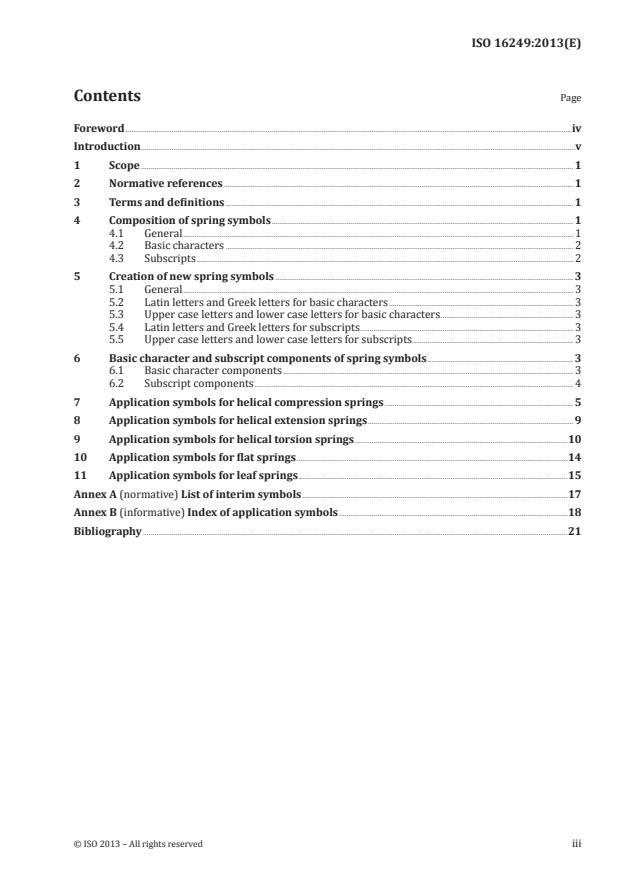
Contents Page
Foreword .iv
Introduction .v
1 Scope . 1
2 Normative references . 1
3 Terms and definitions . 1
4 Composition of spring symbols . 1
4.1 General . 1
4.2 Basic characters . 2
4.3 Subscripts . 2
5 Creation of new spring symbols . 3
5.1 General . 3
5.2 Latin letters and Greek letters for basic characters . 3
5.3 Upper case letters and lower case letters for basic characters . 3
5.4 Latin letters and Greek letters for subscripts . 3
5.5 Upper case letters and lower case letters for subscripts . . 3
6 Basic character and subscript components of spring symbols . 3
6.1 Basic character components . 3
6.2 Subscript components . 4
7 Application symbols for helical compression springs . 5
8 Application symbols for helical extension springs . 9
9 Application symbols for helical torsion springs .10
10 Application symbols for flat springs .14
11 Application symbols for leaf springs .15
Annex A (normative) List of interim symbols .17
Annex B (informative) Index of application symbols .18
Bibliography .21
Foreword
ISO (the International Organization for Standardization) is a worldwide federation of national standards
bodies (ISO member bodies). The work of preparing International Standards is normally carried out
through ISO technical committees. Each member body interested in a subject for which a technical
committee has been established has the right to be represented on that committee. International
organizations, governmental and non-governmental, in liaison with ISO, also take part in the work.
ISO collaborates closely with the International Electrotechnical Commission (IEC) on all matters of
electrotechnical standardization.
The procedures used to develop this document and those intended for its further maintenance are
described in the ISO/IEC Directives, Part 1. In particular the different approval criteria needed for the
different types of ISO documents should be noted. This document was drafted in accordance with the
editorial rules of the ISO/IEC Directives, Part 2. www.iso.org/directives
Attention is drawn to the possibility that some of the elements of this document may be the subject of
patent rights. ISO shall not be held responsible for identifying any or all such patent rights. Details of
any patent rights identified during the development of the document will be in the Introduction and/or
on the ISO list of patent declarations received. www.iso.org/patents
Any trade name used in this document is information given for the convenience of users and does not
constitute an endorsement.
The committee responsible for this document is ISO/TC 227, Springs.
iv © ISO 2013 – All rights reserved
Introduction
Several spring symbols related to cylindrical helical compression springs specified in ISO 2162-2 have
been quoted according to this International Standard.
In this International Standard, existing spring symbols that have been used globally and customarily
among several nations or regions are adopted without major alteration.
Existing spring symbols that have been used locally or in a limited nation/region have been redesigned
in a logical way according to a particular rule for creating new spring symbols.
INTERNATIONAL STANDARD ISO 16249:2013(E)
Springs — Symbols
1 Scope
This International Standard specifies general principles for the creation of symbols of physical quantities,
coefficients, and parameters for metal springs. It specifies the presentation of basic characters, subscripts,
and application symbols for use in the field of helical compression springs, helical extension springs,
helical torsion springs, flat springs, and leaf springs with attention to technical product documentation,
especially for describing and ordering.
2 Normative references
The following documents, in whole or in part, are normatively referenced in this document and are
indispensable for its application. For dated references, only the edition cited applies. For undated
references, the latest edition of the referenced document (including any amendments) applies.
ISO 26909, Springs — Vocabulary
ISO 80000-1, Quantities and units — Part 1: General
ISO 80000-4, Quantities and units — Part 4: Mechanics
3 Terms and definitions
For the purposes of this document, the terms and definitions given in ISO 26909 and the following apply.
3.1
basic character
main part of spring symbols representing physical quantities, coefficients, and parameters of springs
3.2
subscript
second part of spring symbols that follows basic characters in order to modify the physical quantities,
coefficients, and parameters with respect to properties, feature, numbering, etc.
3.3
application symbol
combination of basic character and subscript
EXAMPLE Application symbol
4 Composition of spring symbols
4.1 General
Simple spring symbols consist of basic characters alone. Subscripts may be added to these basic
characters to create more complex symbols.
Quantities and units used are specified in accordance with ISO 80000-1 and ISO 80000-4.
For the purpose of international applicability, all basic characters and subscripts should be derived
from English words, and designations used in technical literature up to the time of publication of this
International Standard are adopted as far as possible. Wide conformity of the symbols for springs has
been attempted.
The characters that are permitted to be used for spring symbols are Latin letters (upper case or lower
case), Greek letters (upper case or lower case), and Arabic numbers.
NOTE 1 As there is a risk of confusion with the Arabic number 0, the following Latin letters have not been
specified: O (upper case letter), o (lower case letter).
NOTE 2 As there is a risk of confusion with Latin letters, the following Greek letters have not been specified: Α,
Β, Ε, Ζ, Η, Ι, Κ, κ, Μ, Ν, Ο, ο, Ρ, Τ, Υ and Χ.
4.2 Basic characters
Basic characters consist of one upper case letter or lower case letter written in Latin or Greek alphabet.
The letter should be derived from the corresponding spring term or designation in English.
Variables shall be in italic typeface.
EXAMPLES D for coil diameter, τ for torsional stress
4.3 Subscripts
Subscripts consist of one, two or three letters, digits, or letter/digit combinations of Latin letters, Greek
letters or Arabic numbers.
EXAMPLE 1 D (e: one letter)
e
EXAMPLE 2 A (L0: two letters)
L0
EXAMPLE 3 d (max: three letters)
max
Subscripts should be as short as possible. A single letter/digit is preferable; however, when the symbol
of a single letter/digit overlaps with an existing symbol or if it is difficult to describe the meaning with
a single letter/digit, two or three letters/digits are acceptable.
EXAMPLE 4 A (M: one letter taken from “moment”)
M
EXAMPLE 5 d (max: three letters taken from “maximum”)
max
The letters should be derived from the corresponding spring terms or designation in English.
Subscripts that represent physical quantities shall be printed in italic typeface. Others shall be printed
in roman typeface. Subscripts of Arabic numbers should be printed in roman typeface. However, running
numbers are generally printed in italic typeface.
EXAMPLE 6 A (L0: free length: italic type)
L0
EXAMPLE 7 l (A: length at leg A: roman type)
A
EXAMPLE 8 L (1: running number: italic type)
Up to two sets of subscripts are permitted in one spring symbol. In this case, they shall be separated by
means of a comma (,) but without a space between them.
EXAMPLE 9 r , (w,A: effective working radius of leg A)
w A
2 © ISO 2013 – All rights reserved
5 Creation of new spring symbols
5.1 General
New spring symbols created in the future should follow the rules described below. The composition of
the symbols should conform to Clause 4.
5.2 Latin letters and Greek letters for basic characters
Latin letters for basic characters are used when describing coefficients or quantities measured by
devices or instruments, e.g. length, diameter, and load (including mean value).
Greek letters for basic characters are used when describing the quantities calculated, e.g. stress,
deflection, and amount of loss.
5.3 Upper case letters and lower case letters for basic characters
Upper case letters for basic characters are used when describing quantities of the whole spring
shape or function.
EXAMPLES 1 L for spring length, D for diameter of coil, F for spring load
Lower case letters for basic characters are used when describing quantities of spring materials or
partial dimensions.
EXAMPLES 2 d for diameter of wire, l for straight length at coil end
5.4 Latin letters and Greek letters for subscripts
Basic Latin letters and Greek letters shall be used for subscripts.
When subscripts are abbreviated terms, they shall be in Latin typeface only.
5.5 Upper case letters and lower case letters for subscripts
In the case of subscripts consisting of a single character, upper case letters should be used basically.
When a subscript consists of a single character and the upper case letter of this character is already used
for an existing symbol, the lower case letter may be used.
When an upper case letter is used as a basic character, the corresponding subscript should be the
upper case letter.
When a lower case letter is used as a basic character, the corresponding subscript should be the
lower case letter.
In the case of subscripts consisting of two or three characters, lower case letters should be used basically.
6 Basic character and subscript components of spring symbols
6.1 Basic character components
Basic characters are shown in Table 1.
Table 1 — List of basic characters
No. Symbol Parameter Compression Extension Torsion Flat Leaf
1.1 A permissible variation X X X X X
1.2 b width or breadth — — — X X
1.3 C camber — — — — X
1.4 D spring diameter X X X — —
1.5 d wire diameter X X X — —
1.6 E modulus of elasticity — — X X X
perpendicularity X — — — —
1.7 e
parallelism X — — — —
1.8 F spring load or force X X X X X
1.9 f frequency X X X X X
1.10 G modulus of rigidity X X — — —
1.11 H spring height — — — — X
1.12 L spring length X X X — —
leg length — — X — —
1.13 l beam length — — — X —
span length — — — — X
1.14 M moment or spring torque — — X X —
1.15 m hook opening — X — — —
1.16 N number of cycles X X X X X
number of coils X X X — —
1.17 n
number of leaves — — — — X
1.18 p pitch X — — — —
R
1.19 spring rate X X X X X
See Annex A
1.20 r radius — X X X —
1.21 s spring deflection X X — X X
1.22 T temperature X X X X X
1.23 t thickness of beam or leaf — — — X X
position angle when
— — X — —
unloaded only
1.24 α
torsional angle or
— — X — —
working angle
1.25 Δ amount of change X X X X X
1.26 σ bending stress — — X X X
1.27 τ torsional stress X X — — —
6.2 Subscript components
Subscripts are shown in Table 2.
4 © ISO 2013 – All rights reserved
Table 2 — List of subscripts
No. Symbol Parameter Compression Extension Torsion Flat Leaf
eye A — — — — X
2.1 A
leg A — — X — —
coiling body — X X — —
2.2 B eye B — — — — X
leg B — — X — —
2.3 c solid X — — — —
diameter of coil or diameter of
2.4 D X X X — —
spring
2.5 d mandrel or inner guide X — X — —
2.6 E eye — — — — X
external or outside X X X — —
2.7 e
natural X X X X X
2.8 F spring load or force X X X X X
2.9 H hook — X — — —
deflection between two posi-
2.10 h X X X — —
tions
inside or inner X X X — —
2.11 i
initial — X — — —
2.12 L0 free length X X — — —
2.13 M moment or spring torque — — X — —
2.14 max maximum X X X X X
2.15 min minimum X X X X X
2.16 n maximum test point X X X — —
2.17 R required X X X X X
2.18 ST straight — — — — X
2.19 t total X — — — —
2.20 w effective working — — X — —
2.21 0 free condition or unloaded X X X X X
measuring position of perpen-
1 X — — — —
dicularity
2.22
running number (specified
1 X X X X X
position)
measuring position of parallel-
2 X — — — —
ism
2.23
running number (specified
2 X X X X X
position)
7 Application symbols for helical compression springs
Application symbols for helical compression springs are shown in Tab
...