


ISO 13535:2000
(Main)Petroleum and natural gas industries - Drilling and production equipment - Hoisting equipment
Petroleum and natural gas industries - Drilling and production equipment - Hoisting equipment
La présente Norme internationale définit les exigences pour la conception, la fabrication et les essais des équipements de levage utilisables pour les opérations de forage et de production. La présente Norme internationale couvre les équipements de levage utilisés pour le forage et la production suivants : a) poulies de levage b) moufles mobiles et fixes c) adaptateurs entre moufles et crochets d) pièces de connexion et d'adaptation pour bras élévateurs e) crochets de forage ; f) crochets pour tubes de production et barres de pompage g) bras élévateurs ; h) élévateurs pour tubes de cuvelage, de production, tiges et masse-tiges de forage i) élévateurs pour barres de pompage ; j) adaptateurs d'oeillets de têtes d'injection k) têtes d'injection (rotary swivels) ; l) têtes d'injection motorisées (powerswivels) m) raccords motorisés (powersubs) ; n) cales à coins lorsqu'elles peuvent être utilisées comme élévateurs o) réas ; p) compensateurs de pilonnement en ligne q) équipements de vissage de tiges carrées lorsqu'ils peuvent être utilisés comme équipement de levage r) réservoirs sous pression et tuyauterie installés sur des équipements de levage s) colliers de sûreté lorsqu'ils peuvent être utilisés comme équipement de levage t) chariots rétractables (doilies) (annexe B). La présente Norme internationale établit des exigences correspondant à deux niveaux de spécification de produits (PSL). Ces deux appellations PSL définissent différents niveaux d'exigences techniques. Toutes les exigences des chapitres 4 à 11 sont applicables à PSL 1, à moins d'être expressément identifié comme PSL 2. PSL 2 comprend toutes les exigences de PSL 1 plus des pratiques complémentaires prescrites dans le présent document. Des exigences supplémentaires ne s'appliquent que lorsqu'elles sont spécifiées. L'annexe A donne un nombre d'exigences supplémentaires normalisées.
Industries du pétrole et du gaz naturel — Équipements de forage et de production — Équipement de levage
General Information
Relations
Overview
ISO 13535:2000 - Petroleum and natural gas industries: Drilling and production equipment - Hoisting equipment defines requirements for the design, manufacture and testing of lifting and hoisting equipment used in drilling and production operations. It covers a wide range of rig hoisting components - from sheaves and travelling blocks to elevators, swivels and powered subs - and establishes two product specification levels (PSL 1 and PSL 2) to reflect different degrees of technical requirement.
Key topics and requirements
- Scope of equipment: sheaves, travelling blocks, block-to-hook adapters, connectors and elevator adapters, drilling hooks, elevator links and elevators (for casing, tubing, drill pipe, drill collars and pump rods), rotary swivels, power swivels, power subs, wedges (when used as hoists), inline heave compensators, make-up/torque equipment when used for lifting, pressure vessels/piping mounted on lifting gear, safety collars and retractable dollies (annex B).
- Design: design conditions, strength analysis, sizing classes, contact geometry and rating determination, load-rating principles and documentation requirements.
- Testing and verification: design verification tests, sampling, proof-load tests, functional and hydrostatic testing, and alternative test procedures.
- Materials and welding: material specifications and qualification, mechanical and chemical requirements, welding qualifications, post‑weld heat treatment and repair controls.
- Quality control and inspection: manufacturing quality systems, dimensional checks, NDT/volumetric examination (see Annex A supplementary requirements), measuring and test equipment.
- Marking & documentation: product and rating marking, serialization, traceability and manufacturer documentation to be supplied with equipment.
- Annexes: normative supplementary requirements (Annex A), guidance on dollies (Annex B) and informative guidance for heat‑treatment qualification (Annex C).
Applications and users
ISO 13535 is used by:
- Manufacturers of drilling and production hoisting equipment for design, fabrication and testing standards.
- Drilling contractors, rig operators and asset owners specifying and procuring hoisting gear.
- Engineering and inspection teams for conformity assessment, QA/QC and acceptance testing.
- Certification bodies and regulators referencing recognized hoisting safety practices. Practical uses include equipment selection, creating test protocols, supplier evaluation and ensuring traceability and safety of lifting systems on land rigs and offshore platforms.
Related standards
- API Spec 8C (reference basis for this ISO edition)
- ISO/TC 67 publications (materials, equipment and offshore structures for petroleum and natural gas industries)
Keywords: ISO 13535, hoisting equipment, drilling equipment, elevators, travelling block, rotary swivel, power swivel, lifting gear, drilling hook, petroleum industry standards.
Standards Content (Sample)
INTERNATIONAL ISO
STANDARD 13535
First edition
2000-12-15
Petroleum and natural gas industries —
Drilling and production equipment —
Hoisting equipment
Industries du pétrole et du gaz naturel — Équipements de forage et de
production — Équipement de levage
Reference number
©
ISO 2000
PDF disclaimer
This PDF file may contain embedded typefaces. In accordance with Adobe's licensing policy, this file may be printed or viewed but shall not
be edited unless the typefaces which are embedded are licensed to and installed on the computer performing the editing. In downloading this
file, parties accept therein the responsibility of not infringing Adobe's licensing policy. The ISO Central Secretariat accepts no liability in this
area.
Adobe is a trademark of Adobe Systems Incorporated.
Details of the software products used to create this PDF file can be found in the General Info relative to the file; the PDF-creation parameters
were optimized for printing. Every care has been taken to ensure that the file is suitable for use by ISO member bodies. In the unlikely event
that a problem relating to it is found, please inform the Central Secretariat at the address given below.
All rights reserved. Unless otherwise specified, no part of this publication may be reproduced or utilized in any form or by any means, electronic
or mechanical, including photocopying and microfilm, without permission in writing from either ISO at the address below or ISO's member body
in the country of the requester.
ISO copyright office
Case postale 56 � CH-1211 Geneva 20
Tel. + 41 22 749 01 11
Fax + 41 22 749 09 47
E-mail copyright@iso.ch
Web www.iso.ch
Printed in Switzerland
ii © ISO 2000 – All rights reserved
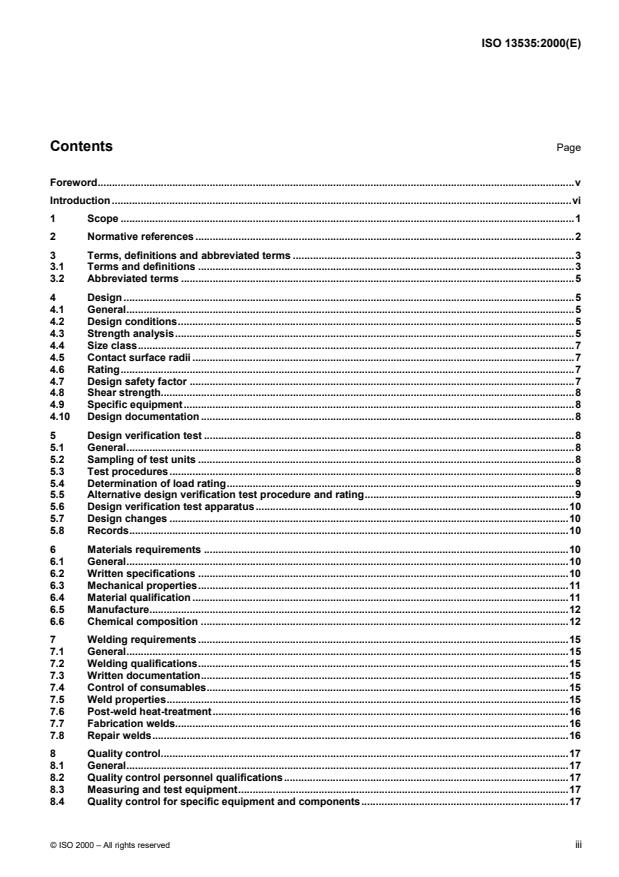
Contents Page
Foreword.v
Introduction.vi
1 Scope .1
2 Normative references .2
3 Terms, definitions and abbreviated terms .3
3.1 Terms and definitions .3
3.2 Abbreviated terms .5
4 Design .5
4.1 General.5
4.2 Design conditions.5
4.3 Strength analysis.5
4.4 Size class.7
4.5 Contact surface radii .7
4.6 Rating.7
4.7 Design safety factor .7
4.8 Shear strength.8
4.9 Specific equipment.8
4.10 Design documentation .8
5 Design verification test .8
5.1 General.8
5.2 Sampling of test units .8
5.3 Test procedures.8
5.4 Determination of load rating.9
5.5 Alternative design verification test procedure and rating.9
5.6 Design verification test apparatus.10
5.7 Design changes .10
5.8 Records.10
6 Materials requirements .10
6.1 General.10
6.2 Written specifications .10
6.3 Mechanical properties.11
6.4 Material qualification .11
6.5 Manufacture.12
6.6 Chemical composition .12
7 Welding requirements .15
7.1 General.15
7.2 Welding qualifications.15
7.3 Written documentation.15
7.4 Control of consumables.15
7.5 Weld properties.15
7.6 Post-weld heat-treatment.16
7.7 Fabrication welds.16
7.8 Repair welds.16
8 Quality control.17
8.1 General.17
8.2 Quality control personnel qualifications.17
8.3 Measuring and test equipment.17
8.4 Quality control for specific equipment and components.17
8.5 Dimensional verification .22
8.6 Proof load test.22
8.7 Hydrostatic testing.23
8.8 Functional testing .23
9 Equipment.24
9.1 General.24
9.2 Hoisting sheaves.24
9.3 Travelling blocks.25
9.4 Block-to-hook adapters.26
9.5 Connectors, link-adapters and drill-pipe elevator-adapters.26
9.6 Drilling hooks .26
9.7 Elevator links.26
9.8 Elevators .26
9.9 Rotary swivels.29
9.10 Power swivels.36
9.11 Power subs.36
9.12 Wireline anchors .37
9.13 Drill-string motion compensators .37
9.14 Pressure vessels and piping .37
9.15 Anti-friction bearings.37
9.16 Safety clamps when capable of being used as hoisting equipment .37
10 Marking .38
10.1 Product marking.38
10.2 Rating marking.38
10.3 Composite equipment marking .38
10.4 Component traceability .38
10.5 Serialization.38
10.6 Marking method .38
11 Documentation.38
11.1 General.38
11.2 Documentation to be kept by the manufacturer.39
11.3 Documentation to be delivered with the equipment .39
Annex A (normative) Supplementary requirements .41
A.1 General.41
A.2 SR 1 Proof load test.41
A.3 SR 2 Low temperature test.41
A.4 SR 3 Data book.41
A.5 SR 4 Additional volumetric examination of castings.42
A.6 SR 5 Volumetric examination of wrought material.42
Annex B (normative) Guide dollies.43
B.1 General.43
B.2 Principal loading conditions and corresponding safety factors .43
B.3 Loads and load combinations .43
B.4 Fatigue considerations.44
B.5 Special safety precautions.44
Annex C (informative) Guidance for qualification of heat-treatment equipment.45
C.1 Temperature tolerance .45
C.2 Furnace calibration.45
C.3 Instruments.46
Bibliography .47
iv © ISO 2000 – All rights reserved
Foreword
ISO (the International Organization for Standardization) is a worldwide federation of national standards bodies (ISO
member bodies). The work of preparing International Standards is normally carried out through ISO technical
committees. Each member body interested in a subject for which a technical committee has been established has
the right to be represented on that committee. International organizations, governmental and non-governmental, in
liaison with ISO, also take part in the work. ISO collaborates closely with the International Electrotechnical
Commission (IEC) on all matters of electrotechnical standardization.
International Standards are drafted in accordance with the rules given in the ISO/IEC Directives, Part 3.
Draft International Standards adopted by the technical committees are circulated to the member bodies for voting.
Publication as an International Standard requires approval by at least 75 % of the member bodies casting a vote.
Attention is drawn to the possibility that some of the elements of this International Standard may be the subject of
patent rights. ISO shall not be held responsible for identifying any or all such patent rights.
International Standard ISO 13535 was prepared by Technical Committee ISO/TC 67, Materials, equipment and
offshore structures for petroleum and natural gas industries, Subcommittee SC 4, Drilling and production
equipment.
Annexes A and B form a normative part of this International Standard. Annex C is for information only.
Introduction
rd
This International Standard is based upon API Spec 8C [2], 3 edition, December 1997.
Users of this International Standard should be aware that further or differing requirements may be needed for
individual applications. This International Standard is not intended to inhibit a vendor from offering, or the purchaser
from accepting, alternative equipment or engineering solutions for the individual application. This may be
particularly applicable where there is innovative or developing technology. Where an alternative is offered, the
vendor should identify any variations from this International Standard and provide details.
vi © ISO 2000 – All rights reserved
INTERNATIONAL STANDARD ISO 13535:2000(E)
Petroleum and natural gas industries — Drilling and production
equipment — Hoisting equipment
1 Scope
This International Standard provides requirements for the design, manufacture and testing of hoisting equipment
suitable for use in drilling and production operations.
This International Standard is applicable to the following drilling and production hoisting equipment:
a) hoisting sheaves;
b) travelling blocks and hook blocks;
c) block-to-hook adapters;
d) connectors and link adapters;
e) drilling hooks;
f) tubing hooks and sucker-rod hooks;
g) elevator links;
h) casing elevators, tubing elevators, drill-pipe elevators and drill-collar elevators;
i) sucker-rod elevators;
j) rotary swivel-bail adapters;
k) rotary swivels;
l) power swivels;
m) power subs;
n) spiders, if capable of being used as elevators;
o) wire-line anchors;
p) drill-string motion compensators;
q) kelly spinners, if capable of being used as hoisting equipment;
r) pressure vessels and piping mounted onto hoisting equipment;
s) safety clamps, if capable of being used as hoisting equipment;
t) guide dollies (annex B).
This International Standard establishes requirements for two product specification levels (PSLs). These two PSL
designations define different levels of technical requirements. All the requirements of clause 4 through clause 11
are applicable to PSL 1 unless specifically identified as PSL 2. PSL 2 includes all the requirements of PSL 1 plus
the additional practices as stated herein.
Supplementary requirements apply only when specified. Annex A gives a number of standardized supplementary
requirements.
2 Normative references
The following normative documents contain provisions which, through reference in this text, constitute provisions of
this International Standard. For dated references, subsequent amendments to, or revisions of, any of these
publications do not apply. However, parties to agreements based on this International Standard are encouraged to
investigate the possibility of applying the most recent editions of the normative documents indicated below.
Members of ISO and IEC maintain registers of currently valid International Standards.
ISO 10422, Petroleum and natural gas industries – Threading, gauging and thread inspection of casing ,tubing and
line pipe threads – Specifications.
ISO 11960, Petroleum and natural gas industries – Steel pipes for use as casing or tubing for wells.
1)
API RP 9B, Application, Care, and Use of Wire Rope for Oil Field Service.
API Spec 7, Rotary Drill Stem Elements.
2)
ASME B31.3, Chemical Plant and Petroleum Refinery Piping.
ASME V BPVC Section 5, 1998, Non-destructive Examination.
ASME VIII, DIV 1, Rules for Construction of Pressure Vessels.
ASME IX, Welding and Brazing specification.
3)
ASTM A370, Standard Test Methods and Definitions for Mechanical Testing of Steel Products.
ASTM A 388, Standard Practice for Ultrasonic Examination of Heavy Steel Forgings.
ASTM A 488, Standard Practice for Steel Castings, Welding, Qualifications of Procedures and Personnel.
ASTM A 770, Standard Specification for Through-Thickness Tension Testing of Steel Plates for Special
Applications.
ASTM E 4, Load Verification of Testing Machines.
ASTM E 125, Standard Reference Photographs for Magnetic Particle Indications on Ferrous Castings.
ASTM E 165, Standard Test Method for Liquid Penetrant Examination.
ASTM E 186, Standard Reference Radiographs for Heavy-Walled (2 to 4 1/2-in. (51 to 114-mm)) Steel Castings.
ASTM E 280, Standard Reference Radiographs for Heavy-Walled (4 1/2 to 12-in. (114 to 305-mm)) Steel Castings.
1) American Petroleum Institute; 1220 L St N.W.; Washington DC, 20005; USA.
th
2) American Society of Mechanical Engineers; 345 East 47 Street; New York, NY 10017; USA.
3) American Society for Testing and Materials; 100 Barr Harbor Drive; West Conshohocken, PA 19428; USA.
2 © ISO 2000 – All rights reserved
ASTM E 428, Standard Practice for Fabrication and Control of Steel Reference Blocks Used in Ultrasonic
Inspection.
ASTM E 446, Standard Reference Radiographs for Steel Castings Up to 2 in. (51 mm) in Thickness.
ASTM E 709, Standard Guide for Magnetic Particle Examination.
4)
ASNT-TC-IA , Recommended practice for personnel qualification and certification in non-destructive testing.
AWS D1.1, Structural welding code.
AWS QC1, Standard for AWS Certification of Welding Inspectors.
EN 287 (all parts), Approval testing of welders – Fusion welding.
EN 288 (all parts), Specification and qualification of welding procedures for metallic materials.
5)
MSS SP-55, Quality standard for steel castings for valves, flanges and fittings and other piping components –
Visual method for evaluation of surface irregularities.
3 Terms, definitions and abbreviated terms
For the purposes of this International Standard, the following terms, definitions and abbreviated terms apply.
3.1 Terms and definitions
3.1.1
bearing-load rating
calculated maximum load for bearings subjected to the primary load
3.1.2
design load
sum of static and dynamic loads that would induce the maximum allowable stress in an item
3.1.3
design safety factor
factor to account for a certain safety margin between the maximum allowable stress and the specified minimum
yield strength of a material
3.1.4
design verification test
test performed to validate the integrity of the design calculations used
3.1.5
dynamic load
load applied to the equipment due to acceleration effects
3.1.6
equivalent-round
standard for comparing various shaped sections to round bars, used for determining the response to hardening
characteristics when heat-treating low-alloy and martensitic corrosion-resistant steels
4) American Society for Nondestructive Testing; 4153 Arlingate Plaza; Box 28518; Columbus, OH 43228; USA.
5) Manufacturers' Standardization Society of the Valve and Fittings Industry; 127 Park Street NE; Vienna, VA 22180; USA.
3.1.7
linear indication
indication revealed by NDE, having a length of at least three times the width
3.1.8
load rating
maximum operating load, both static and dynamic, to be applied to the equipment
NOTE The load rating is numerically equivalent to the design load.
3.1.9
maximum allowable stress
specified minimum yield strength divided by the design safety factor
3.1.10
primary load
axial load which equipment is subjected to in operations
3.1.11
primary-load-carrying component
component of the equipment through which the primary load is carried
3.1.12
product specification level
degree of controls applied on materials and processes for the primary-load-carrying components of the equipment
NOTE The two product specification levels are identified by the code PSL 1 or PSL 2.
3.1.13
proof load test
production load test performed to validate the load rating of a unit
3.1.14
repair
removal of defects from, and refurbishment of, a component or assembly by welding, during the manufacture of
new equipment
NOTE The term "repair", as referred to in this International Standard, applies only to the repair of defects in materials
during the manufacture of new equipment.
3.1.15
rounded indication
indication revealed by NDE, with a circular shape or with an elliptical shape having a length of less than three times
the width
3.1.16
safe working load
the design load minus the dynamic load
3.1.17
size class
designation by which dimensionally-interchangeable equipment of the same maximum load rating is identified
3.1.18
special process
operation which may change or affect the mechanical properties, including toughness, of the materials used in the
equipment
4 © ISO 2000 – All rights reserved
3.1.19
test unit
prototype unit upon which a design verification test is conducted
3.2 Abbreviated terms
ER equivalent-round
HAZ heat-affected zone
PSL product specification level
NDE non-destructive examination
PLC principal loading condition
PWHT post-weld heat-treatment
4 Design
4.1 General
Hoisting equipment shall be designed, manufactured and tested so that it is in every respect fit for its intended
purpose. The equipment shall safely transfer the load for which it is intended. The equipment shall be designed for
simple and safe operation. Guide dollies shall be designed in accordance with annex B.
4.2 Design conditions
The following design conditions shall apply:
a) the operator of the equipment shall be responsible for determination of the safe working load for any hoisting
operation;
b) the minimum design and operating temperature shall be – 20 °C, unless supplementary requirement SR 2 has
been applied (see A.3).
CAUTION — The equipment should not be used at the full load rating at temperatures below –20 °C unless appropriate
materials with the required toughness properties at lower design temperatures have been used (see A.3).
4.3 Strength analysis
4.3.1 General
The equipment design analysis shall address excessive yielding, fatigue and buckling as possible modes of failure.
The strength analysis shall be generally based on the elastic theory. An ultimate strength (plastic) analysis may,
however, be used where appropriate. Finite-element mesh analysis, in conjunction with analytical methods, may be
used.
All forces that may govern the design shall be taken into account. For each cross-section to be considered, the
most unfavourable combination, position and direction of forces shall be used.
4.3.2 Simplified assumptions
Simplified assumptions regarding stress distribution and stress concentration may be used, provided that the
assumptions are made in accordance with generally accepted practice or based on sufficiently comprehensive
experience or tests.
4.3.3 Empirical relationships
Empirical relationships may be used in lieu of analysis, provided such relationships are supported by documented
strain gauge test results that verify the stresses within the component. Equipment or components which, by their
design, do not permit the attachment of strain gauges to verify the design shall be qualified by testing in
accordance with 5.5.
4.3.4 Equivalent stress
The strength analysis shall be based on elastic theory. The nominal equivalent stress, according to the
Von Mises-Hencky theory, caused by the design load shall not exceed the maximum allowable stress AS as
max
calculated by equation (1).
YS
min
AS � (1)
max
SF
D
where
YS is the specified minimum yield strength;
min
SF is the design safety factor.
D
4.3.5 Ultimate strength (plastic) analysis
An ultimate strength (plastic) analysis may be performed under any one of the following conditions:
a) for contact areas;
b) for areas of highly localized stress concentrations caused by part geometry, and other areas of high stress
gradients where the average stress in the section is less than or equal to the maximum allowable stress as
defined in 4.3.4.
In such areas, the elastic analysis shall govern for all values of stress below the average stress.
In the case of plastic analysis, the equivalent stress as defined in 4.3.4 shall not exceed the maximum allowable
stress AS as calculated by equation (2).
max
TS
min
AS � (2)
max
SF
D
where
TS is the specified minimum ultimate tensile strength;
min
SF is the design safety factor.
D
4.3.6 Stability analysis
The stability analysis shall be carried out according to generally accepted theories of buckling.
6 © ISO 2000 – All rights reserved
4.3.7 Fatigue analysis
The fatigue analysis shall be based on a period of time of not less than 20 years, unless otherwise agreed.
The fatigue analysis shall be carried out according to generally accepted theories. A method that may be used is
defined in reference [3].
4.4 Size class
The size class shall represent the dimensional interchangeability and the load rating of equipment.
4.5 Contact surface radii
Figure 7, Figure 8, Figure 9 and Table 6 show radii of hoisting-tool contact surfaces. These contact radii are
applicable to hoisting tools used in drilling (including tubing hooks), but all other work-over tools are excluded.
4.6 Rating
All hoisting equipment furnished under this International Standard shall be rated as specified herein.
Such ratings shall consist of a load rating for all equipment and a bearing-load rating for all equipment containing
bearings within the primary load path.
The bearing-load rating is intended primarily to achieve consistency of ratings, but is also intended to provide a
reasonable service life for bearings when used at loads within the equipment-load rating.
The load rating shall be based on the design safety factor as specified in 4.7, the specified minimum yield strength
of the material used in the primary-load-carrying components and the stress distribution as determined by design
calculations and/or data developed in a design verification load test as specified in 5.5.
The load rating shall be marked on the equipment (refer to clause 10).
4.7 Design safety factor
The design safety factor shall be established from Table 1 as follows.
Table 1 — Design safety factor
Load rating
Design safety factor
R
SF
D
kN (ton)
1 334 kN (150 short tons) and less 3,00
a
1 334 kN (150 short tons) to 4 448 kN (500 short tons) inclusive
3,00 – [0,75 � (R – 1 334)/3 114]
Over 4 448 kN (500 short tons) 2,25
a
In this formula, the value of R shall be in kilonewtons.
The design safety factor is intended as a design criterion and shall not under any circumstances be construed as
allowing loads on the equipment in excess of the load rating.
4.8 Shear strength
For purposes of design calculations involving shear, the ratio of yield strength in shear to yield strength in tension
shall be 0,58.
4.9 Specific equipment
Refer to clause 9 for all additional equipment-specific design requirements.
4.10 Design documentation
Documentation of the design shall include methods, assumptions, calculations and design requirements. Design
requirements shall include, but not be limited to, those criteria for size, test and operating pressures, material,
environmental and specification requirements, and pertinent requirements upon which the design is to be based.
The requirements shall also apply to design change documentation.
5 Design verification test
5.1 General
To assure the integrity of equipment design, design verification testing shall be performed as specified below.
Design verification testing of equipment shall be carried out and/or certified by a department or organization
independent of the design function.
Equipment which, by virtue of its simple geometric form, permits accurate stress analysis through calculation only
shall be exempted from design verification testing.
5.2 Sampling of test units
To qualify design calculations applied to a family of units with an identical design concept but of varying sizes and
ratings, the following sampling options apply:
� a minimum of three units of the design shall be subjected to design verification testing. The test units shall be
selected from the lower end, middle and upper end of the size/rating range;
� alternatively, the required number of test units shall be established on the basis that each test unit also
qualifies one size or rating above and below that of the selected test unit.
NOTE The second option generally applies to limited product size/rating ranges.
5.3 Test procedures
5.3.1 Functional test
Load the test unit to the design load. After this load has been released, check the unit to verify that the functions of
the equipment and its components have not been impaired by this loading.
5.3.2 Design verification test
Apply strain gauges to the test unit at all places where high stresses are anticipated, provided that the configuration
of the units permits such techniques. Tools such as finite-element analysis, models, brittle lacquer, etc. should be
used to confirm the proper location of the strain gauges. Three element strain gauges should be applied in critical
8 © ISO 2000 – All rights reserved
areas to permit determination of the shear stresses and to eliminate the need for exact orientation of the strain
gauges.
The design verification test load to be applied to the test unit shall be determined as follows:
Design verification test load = 0,8� R � SF , but not less than 2R (3)
D
where
R is the loadratinginkilonewtons;
SF is the design safety factor as defined in 3.1.3 and 4.7.
D
Load the unit to the design verification test load. This test load should be applied carefully, reading the strain gauge
values and observing the yield. The test unit should be loaded as many times as necessary to obtain adequate
data.
The stress values computed from the strain gauge readings shall not exceed the values obtained from design
calculations (based on the design verification test load) by more than the uncertainty of the testing apparatus
specified in 5.6. Failure to meet this requirement or premature failure of any test unit shall be cause for a complete
reassessment of the design followed by additional testing of an identical number of test units as originally required,
including a test unit of the same size and rating as the one that failed.
Upon completion of the design verification test, disassemble the unit and check the dimensions of each part for
evidence of yielding.
Individual parts of a unit may be tested separately if the holding fixtures simulate the load conditions applicable to
thepartintheassembledunit.
5.4 Determination of load rating
Determine the load rating from the results of the design verification test and/or the design and stress-distribution
calculations required by clause 4. The stresses at that rating shall not exceed the values allowed in 4.3. Localized
yielding is permitted at areas of contact. In a test unit that has been design-verification tested, the critical
permanent deformation determined by strain gauges or other suitable means shall not exceed 0,2 %, except in
contact areas. If the stresses exceed the allowable values, redesign the affected part or parts to obtain the desired
rating. Stress-distribution calculations may be used to establish the load rating of equipment only if the results of
the analysis are shown to be within acceptable engineering allowances as verified by the design verification test
prescribed by clause 5.
5.5 Alternative design verification test procedure and rating
Destructive testing of the test unit may be used, provided an accurate yield and tensile strength of the material
used in the equipment has been determined. This may be accomplished by using tensile-test specimens of the
actual material in the part destructively tested and determining the yield-to-ultimate strength ratio. The ratio is then
used to rate the equipment by the following equation:
YS
m
RL�� (4)
b
TS � SF
aD
where
SF is the design safety factor (see 4.7);
D
YS is the minimum specified yield strength;
m
TS is the actual ultimate tensile strength;
a
L is the breaking load;
b
R is the load rating.
Since this method of design qualification is not derived from stress calculations, qualification shall be limited to the
specific model, size and rating tested.
5.6 Design verification test apparatus
Calibrate the loading apparatus used to simulate the working load on the test unit in accordance with ASTM E 4 so
as to ensure that the prescribed test load is obtained. For loads exceeding 3 558 kN (400 short tons), verify the
load-testing apparatus with calibration devices traceable to a Class A calibration device and having an uncertainty
of less than 2,5 %.
Test fixtures shall load the test unit (or part) in essentially the same manner as in actual service and with essentially
the same areas of contact on the load-bearing surface. All equipment used to load the test unit (or part) shall be
verified as to its capability to perform the test.
5.7 Design changes
When any change in design or manufacturing method changes the load rating, a supportive design verification test
in conformance with clause 5 shall be carried out. The manufacturer shall evaluate all changes in design or
manufacturing methods to determine whether the load rating is affected. This evaluation shall be documented.
5.8 Records
All design verification records and supporting data shall be subject to the same controls as specified for design
documentation in 11.2.
6 Materials requirements
6.1 General
All materials shall be suitable for the intended service.
The remainder of clause 6 describes the various material qualification, property and processing requirements for
primary-load-carrying components and pressure-containing components unless otherwise specified.
6.2 Written specifications
Materials shall be produced to a written material specification which shall, as a minimum, define the following
parameters and limitations:
� mechanical property requirements;
� material qualification;
� processing requirements, including permitted melting, working and heat treatment;
� chemical composition and tolerances;
� repair-welding requirements.
The description of the working practice shall include the forging reduction-ratio.
10 © ISO 2000 – All rights reserved
6.3 Mechanical properties
Materials shall meet the property requirements specified in the manufacturer's material specification.
The impact toughness shall be determined from the average of three tests, using full-size test pieces if the size of
the component permits. If it is necessary for sub-size impact test pieces to be used, the acceptance criteria for
impact values shall be those stated below but multiplied by the appropriate adjustment factor listed in Table 3. Sub-
size test pieces of width less than 5 mm shall not be used.
For materials of a specified minimum yield strength of at least 310 MPa (45 ksi), the average impact toughness
shall be at least 42 J (31 ft-lb) at –20 °C, with no individual value less than 32 J (24 ft-lb).
For materials with a minimum specified minimum yield strength of less than 310 MPa (45 ksi), the average impact
toughness shall be 27 J (20 ft-lb) at –20 °C with no individual value less than 20 J (15 ft-lb).
For design temperatures below – 20 °C (e.g. arctic service), supplementary impact toughness requirements shall
apply, see annex A, SR2.
Where the design requires through-thickness properties, materials shall be tested for reduction of area in the
through-thickness direction in accordance with ASTM A 770. The minimum reduction shall be 25 %.
PSL 2 components shall be fabricated from materials meeting the applicable requirements for ductility specified in
Table 2.
Table 2 — Elongation requirements (PSL-2)
Yield strength Elongation, minimum
%
a a
MPa (ksi)
L =4d L =5d
o o
Less than 310 (45) 23 20
310 to 517 (45 to 75) 20 18
Over 517 to 758 (Over 75 to 110) 17 15
Over 758 (Over 110) 14 12
a
Where L is the gauge length and d is the diameter.
o
Table 3 — Adjustment factors for sub-size impact specimens
Specimen dimensions Adjustment factor
mm
0,833
10,0� 7,5
0,667
10,0� 5,00
6.4 Material qualification
Perform the mechanical tests on qualification test-coupons representing the heat and heat-treatment lot used in the
manufacture of the component. Tests shall be performed in accordance with ASTM A 370, or equivalent standards,
using material in the final heat-treated condition. For the purposes of material qualification testing, PWHT is not
considered heat-treatment, provided that the PWHT temperature is below that which changes the heat-treatment
condition of the base material.
Determine the size of the qualification test-coupon for a part using the equivalent-round method. Figure 1 and
Figure 2 illustrate the basic models for determining the equivalent-round of simple solid and hollow parts. Any of
the shapes shown may be used for the qualification test-coupon. Figure 4 describes the steps for determining the
governing equivalent-round for more complex sections. Determine the equivalent-round of a part using the actual
dimensions of the part in the "as-heat-treated" condition. The equivalent-round of the qualification test-coupon shall
be equal to or greater than the equivalent-round dime
...
МЕЖДУНАРОДНЫЙ ISO
СТАНДАРТ 13535
Первое издание
2000-12-15
Промышленность нефтяная и газовая.
Оборудование добычное буровое.
Подъёмное оборудование
Petroleum and natural gas industries — Drilling and production equipment
— Hoisting equipment
Ответственность за подготовку русской версии несёт GOST R
(Российская Федерация) в соответствии со статьёй 18.1 Устава ISO
Ссылочный номер
©
ISO 2000
Отказ от ответственности при работе в PDF
Настоящий файл PDF может содержать интегрированные шрифты. В соответствии с условиями лицензирования, принятыми
фирмой Adobe, этот файл можно распечатать или смотреть на экране, но его нельзя изменить, пока не будет получена лицензия на
интегрированные шрифты и они не будут установлены на компьютере, на котором ведется редактирование. В случае загрузки
настоящего файла заинтересованные стороны принимают на себя ответственность за соблюдение лицензионных условий фирмы
Adobe. Центральный секретариат ISO не несет никакой ответственности в этом отношении.
Adobe - торговый знак фирмы Adobe Systems Incorporated.
Подробности, относящиеся к программным продуктам, использованные для создания настоящего файла PDF, можно найти в
рубрике General Info файла; параметры создания PDF были оптимизированы для печати. Были приняты во внимание все меры
предосторожности с тем, чтобы обеспечить пригодность настоящего файла для использования комитетами-членами ISO. В редких
случаях возникновения проблемы, связанной со сказанным выше, просьба проинформировать Центральный секретариат по
адресу, приведенному ниже
ДОКУМЕНТ ЗАЩИЩЕН АВТОРСКИМ ПРАВОМ
© ISO 2000
Все права сохраняются. Если не указано иное, никакую часть настоящей публикации нельзя копировать или использовать в какой-
либо форме или каким-либо электронным или механическим способом, включая фотокопии и микрофильмы, без предварительного
письменного согласия ISO, которое должно быть получено после запроса о разрешении, направленного по адресу, приведенному
ниже, или в комитет-член ISO в стране запрашивающей стороны.
ISO copyright office
Case postale 56 • CH-1211 Geneva 20
Tel. + 41 22 749 01 11
Fax + 41 22 749 09 47
E-mail copyright@iso.org
Web www.iso.org
Опубликовано в Швейцарии
©
ii ISO 2000 – Все права сохраняются
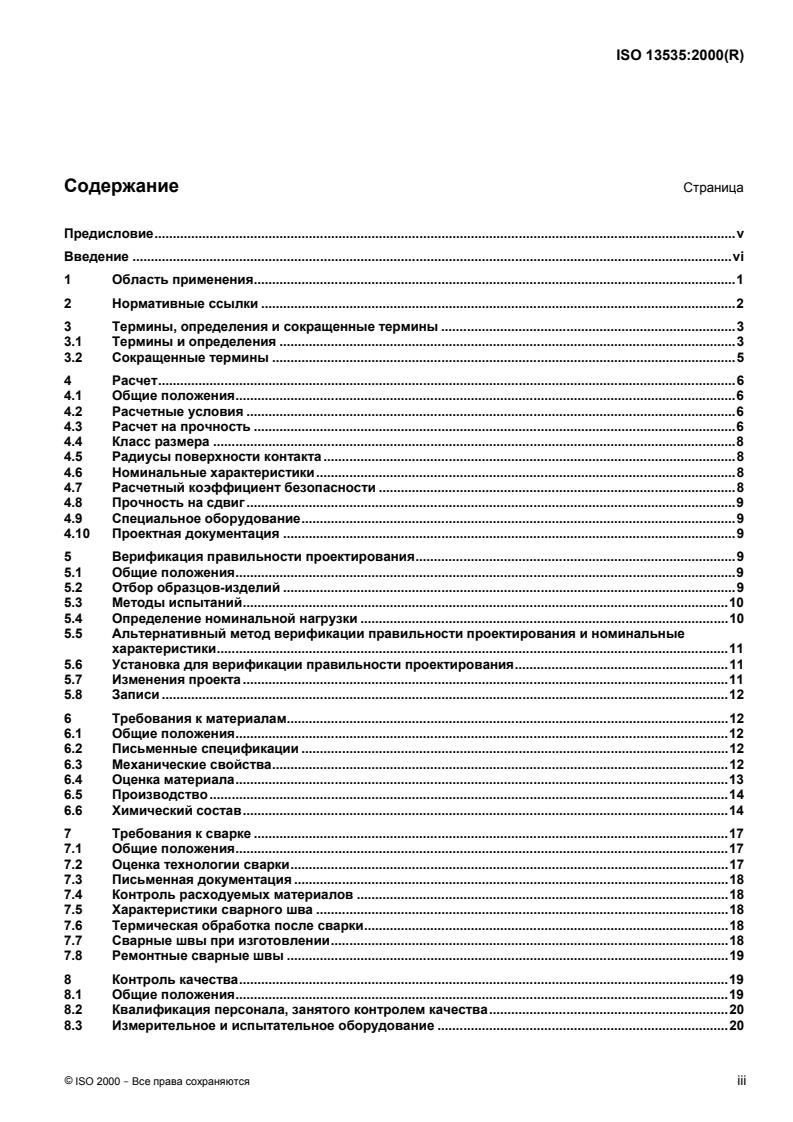
Содержание Страница
Предисловие.v
Введение .vi
1 Область применения.1
2 Нормативные ссылки .2
3 Термины, определения и сокращенные термины .3
3.1 Термины и определения .3
3.2 Сокращенные термины .5
4 Расчет.6
4.1 Общие положения.6
4.2 Расчетные условия .6
4.3 Расчет на прочность .6
4.4 Класс размера .8
4.5 Радиусы поверхности контакта .8
4.6 Номинальные характеристики.8
4.7 Расчетный коэффициент безопасности .8
4.8 Прочность на сдвиг.9
4.9 Специальное оборудование.9
4.10 Проектная документация .9
5 Верификация правильности проектирования.9
5.1 Общие положения.9
5.2 Отбор образцов-изделий .9
5.3 Методы испытаний.10
5.4 Определение номинальной нагрузки .10
5.5 Альтернативный метод верификации правильности проектирования и номинальные
характеристики.11
5.6 Установка для верификации правильности проектирования.11
5.7 Изменения проекта.11
5.8 Записи .12
6 Требования к материалам.12
6.1 Общие положения.12
6.2 Письменные спецификации .12
6.3 Механические свойства.12
6.4 Оценка материала.13
6.5 Производство.14
6.6 Химический состав.14
7 Требования к сварке .17
7.1 Общие положения.17
7.2 Оценка технологии сварки.17
7.3 Письменная документация .18
7.4 Контроль расходуемых материалов .18
7.5 Характеристики сварного шва .18
7.6 Термическая обработка после сварки.18
7.7 Сварные швы при изготовлении.18
7.8 Ремонтные сварные швы .19
8 Контроль качества.19
8.1 Общие положения.19
8.2 Квалификация персонала, занятого контролем качества.20
8.3 Измерительное и испытательное оборудование .20
©
ISO 2000 – Все права сохраняются iii
8.4 Контроль качества для конкретного оборудования и компонентов.20
8.5 Верификация размерности .26
8.6 Контрольное испытание под нагрузкой.26
8.7 Опрессовка (гидравлические испытания под давлением).26
8.8 Функциональные испытания.27
9 Оборудование.27
9.1 Общие положения.27
9.2 Подъемные шкивы .27
9.3 Талевые блоки.29
9.4 Переходники блок-крюк.30
9.5 Соединительные устройства, соединительные переходники и переходники элеватора
для бурильных труб.30
9.6 Буровые крюки.30
9.7 Штропы элеваторов.30
9.8 Элеваторы.30
9.9 Вертлюги .33
9.10 Приводные вертлюги.40
9.11 Вращатели для навинчивания ведущей трубы .40
9.12 Механизмы крепления неподвижного конца талевого каната .41
9.13 Компенсаторы бурильной колонны.41
9.14 Сосуды и трубы для работы под давлением .41
9.15 Антифрикционные подшипники .41
9.16 Предохранительные хомуты в случае их использования как подъемного оборудования.42
10 Маркировка .42
10.1 Маркировка изделия .42
10.2 Маркировка номинальной характеристики .42
10.3 Маркировка сложного оборудования .42
10.4 Прослеживаемость компонента.42
10.5 Серийность.42
10.6 Метод маркировки .43
11 Документация .43
11.1 Общие положения.43
11.2 Документация, которая хранится у изготовителя .43
11.3 Документация, которая поставляется с оборудованием .44
Приложение A (нормативное) Дополнительные требования.45
A.1 Общие положения.45
A.2 SR 1 испытание под пробной нагрузкой .45
A.3 SR 2 Испытание при низкой температуре .45
A.4 SR 3 Подборка данных.45
A.5 SR 4 Дополнительное объемное обследование отливок.46
A.6 SR 5 Объемное испытание деформируемого материала.46
Приложение B (нормативное) Направляющие каретки.47
B.1 Общие положения.47
B.2 Условия основного нагружения и соответствующие коэффициенты безопасности.47
B.3 Нагрузки и сочетание нагрузок .47
B.4 Проблемы усталости.48
B.5 Специальные меры предосторожности.48
Приложение С (информативное) Руководство по аттестации оборудования для термической
обработки .49
C.1 Допуски на температуру .49
C.2 Калибровка печи .49
C.3 Приборы .50
Библиография .51
©
iv ISO 2000 – Все права сохраняются
Предисловие
Международная организация по стандартизации (ISO) является всемирной федерацией национальных
организаций по стандартизации (комитетов-членов ISO). Разработка международных стандартов обычно
осуществляется техническими комитетами ISO. Каждый комитет-член, заинтересованный в деятельности,
для которой был создан технический комитет, имеет право быть представленным в этом комитете.
Международные правительственные и неправительственные организации, имеющие связи с ISO, также
принимают участие в работах. Что касается стандартизации в области электротехники, то ISO работает в
тесном сотрудничестве с Международной электротехнической комиссией (IEC).
Проекты международных стандартов разрабатываются в соответствии с правилами Директив ISO/IEC,
Часть 3.
Основная задача технических комитетов заключается в подготовке международных стандартов. Проекты
международных стандартов, принятые техническими комитетами, рассылаются комитетам-членам на
голосование. Их опубликование в качестве международных стандартов требует одобрения не менее 75 %
комитетов-членов, принимающих участие в голосовании.
Следует иметь в виду, что некоторые элементы настоящего международного стандарта могут быть
объектом патентных прав. ISO не может нести ответственность за идентификацию какого-либо одного или
всех патентных прав.
Международный стандарт ISO 13535 был разработан Техническим комитетом ISO/TC 67, Материалы,
оборудование и морские конструкции для нефтяной и газовой промышленности, Подкомитетом SC 4,
Буровое и эксплуатационное оборудование.
Приложения A и B образуют нормативную часть данного международного стандарта. Приложение C
приведено только для информации.
©
ISO 2000 – Все права сохраняются v
Введение
е
Данный международный стандарт разработан на базе API Spec 8C [2], 3 издание, декабрь 1997.
Пользователям данного международного стандарта следует знать, что для отдельных задач могут
потребоваться дополнительные или другие требования. Данный международный стандарт не ставит целью
запретить продавцу предлагать, а покупателю пользоваться другим оборудованием или применять другие
технические решения в каждом отдельном случае. Это, в частности, касается инновационных или
развивающихся технологий. Там где имеется альтернатива, продавцу рекомендуется определить отличия
от данного международного стандарта и представить детали.
©
vi ISO 2000 – Все права сохраняются
МЕЖДУНАРОДНЫЙ СТАНДАРТ ISO 13535:2000(R)
Промышленность нефтяная и газовая. Оборудование
добычное буровое. Подъемное оборудование
1 Область применения
Данный международный стандарт представляет требования к проектированию, производству и испытанию
подъемного оборудования, пригодного для использования в буровых работах и добыче нефти и газа.
Данный международный стандарт применим к следующему буровому и добычному подъемному
оборудованию:
a) подъемные шкивы;
b) передвижные блоки и крюкоблоки;
c) переходники блок-крюк;
d) соединители и адаптеры соединений;
e) буровые крюки;
f) крюки для спуска и подъема насосно-компрессорных труб и крюки для насосных штанг;
g) штропы элеваторов;
h) элеваторы для обсадных труб, элеваторы для лифтовых труб, элеваторы для бурильных труб и
элеваторы для утяжеленных бурильных труб;
i) элеваторы для насосных штанг;
j) адаптеры для штроп вертлюга;
k) вертлюги;
l) вертлюги с приводом;
m) вращатели для навинчивания ведущей трубы;
n) захваты, если их можно использовать в качестве элеваторов;
o) устройства для крепления канатов;
p) компенсаторы бурильной колонны;
q) навинчиватели ведущей трубы, если их можно использовать как подъемное оборудование;
r) сосуды для работы под давлением и трубы, установленные на подъемном оборудовании;
©
ISO 2000 – Все права сохраняются 1
s) предохранительные хомуты, если их можно использовать как подъемное оборудование;
t) направляющие каретки талевого блока (приложение B).
Настоящий международный стандарт устанавливает требования к двум уровням технических характеристик
(PSLs). Эти два обозначения PSL определяют разные уровни технических требований. Все требования
разделов 4 - 11 применимы к PSL 1, если специально не указан уровень PSL 2. PSL 2 включает все
требования PSL 1 плюс дополнительные в соответствии с установленным в данном стандарте.
Дополнительные требования применяются только, если они установлены. В приложении A приведен ряд
стандартизованных дополнительных требований.
2 Нормативные ссылки
Следующие нормативные документы содержат положения, которые посредством ссылок в данном
тексте составляют положения настоящей части ISO 3547. Для жестких ссылок последующие поправки к
любой из данных публикаций или пересмотры любой из них не применимы. Однако сторонам-участницам
соглашений на основе этой части ISO 3547 рекомендуется выяснить возможность применения самого
последнего издания нормативных ссылочных документов. Для плавающих ссылок необходимо
использовать самое последнее издание нормативного ссылочного документа Страны-члены ISO и IEC
ведут указатели действующих международных стандартов.
ISO 10422, Промышленность нефтяная и газовая. Нарезание, калибрование и производственный
контроль резьбы обсадных, насосно-компрессорных труб и трубопроводов. Технические условия
ISO 11960, Промышленность нефтяная и газовая. Стальные трубы для применения в скважинах в
качестве обсадных или насосно-компрессорных
1)
API RP 9B, Канаты проволочные для нефтепромыслов. Применение и уход
API Spec 7, Элементы бурильной колонны при вращательном бурении
2)
ASME B31.3, Трубопроводы на химических и нефтеперерабатывающих заводах
ASME V BPVC Section 5, 1998, Неразрушающий контроль
ASME VIII, DIV 1, Правила конструирования сосудов для работы под давлением
ASME IX, Сварка и пайка. Технические условия
3)
ASTM A 370, Стандартные методы и определения для механических испытаний стальных изделий
ASTM A 388, Стандартная практика ультразвукового контроля тяжелых стальных поковок
ASTM A 488, Стандартная практика литья и сварки стали, аттестация методов и персонала
ASTM A 770, Плиты стальные специального назначения. Испытание на растяжение по толщине.
Технические условия
1) Американский институт нефти , American Petroleum Institute; 1220 L St N.W.; Washington DC, 20005; USA.
th
2) Американское общество инженеров-механиков, American Society of Mechanical Engineers; 345 East 47 Street; New
York, NY 10017; USA.
3) Американское общество по материалам и испытаниям, American Society for Testing and Materials; 100 Barr Harbor
Drive; West Conshohocken, PA 19428; USA.
©
2 ISO 2000 – Все права сохраняются
ASTM E 4, Верификация нагрузки испытательных машин
ASTM E 125, Фотографии стандартных образцов для магнитопорошковой дефектоскопии отливок из
чугуна и стали
ASTM E 165, Стандартный метод капиллярного неразрушающего контроля
ASTM E 186, Рентгенограммы стандартные для толстостенных стальных отливок (от 2 до 4 1/2-
дюймов. (от 51 до 114-мм))
ASTM E 280, Рентгенограммы стандартные для толстостенных стальных отливок (от 4 1/2 до 12-
дюймов (от 114 до 305-мм))
ASTM E 428, Стандартная практика изготовления и контроля стальных стандартных образцов,
используемых в ультразвуковом контроле
ASTM E 446, Рентгенограммы стандартные для стальных отливок толщиной до 2 дюймов. (51 мм)
ASTM E 709, Руководство по магнитопорошковой дефектоскопии
4)
ASNT-TC-IA , Рекомендованная практика по квалификации и сертификации персонала, занятого
неразрушающими испытаниями
AWS D1.1, Свод правил по сварке конструкций
AWS QC1, Стандарт сертификации AWS инспекторов по сварке
EN 287 (все части), Аттестационные испытания сварщиков. Сварка плавлением
EN 288 (все), Спецификация и аттестация технологий сварки металлических материалов
5)
MSS SP-55, Стандарт качества стальных отливок для клапанов, фланцев, фитингов и другой
трубной арматуры. Визуальный метод оценки неровностей поверхности
3 Термины, определения и сокращенные термины
Применительно к данному международному стандарту используются следующие термины, определения и
сокращенные термины.
3.1 Термины и определения
3.1.1
номинальная нагрузка на подшипник
bearing-load rating
максимальная рассчитанная нагрузка на подшипники, подвергающиеся первичной нагрузке
4) Американское общество по неразрушающему контролю, American Society for Nondestructive Testing; 4153 Arlingate
Plaza; Box 28518; Columbus, OH 43228; USA.
5) Общество изготовителей по стандартам в области производства трубной арматуры, Manufacturers' Standardization
Society of the Valve and Fittings Industry; 127 Park Street NE; Vienna, VA 22180; USA.
©
ISO 2000 – Все права сохраняются 3
3.1.2
расчетная нагрузка
design load
сумма статических и динамических нагрузок, которые индуцируют максимально допустимое напряжение в
изделии
3.1.3
коэффициент безопасности (запас прочности)
design safety factor
коэффициент для расчета определенной границы безопасности между максимально допустимым
напряжением и заданным минимальным пределом текучести материала
3.1.4
верификация правильности проектирования
design verification test
испытание, выполняемое для валидации безошибочности используемых проектных расчетов
3.1.5
динамическая нагрузка
dynamic load
нагрузка, прикладываемая к оборудованию в результате эффектов ускорения
3.1.6
эквивалент круглости
equivalent-round
эталон сравнения различных фасонных секций с круглыми стержнями, используемыми для определения
реакции на закалку при термической обработке низколегированных и мартенситных коррозионно-стойких
сталей
3.1.7
линейная индикация
linear indication
индикация, получаемая при неразрушающем контроле (NDE), имеющая длину, как минимум, втрое
превышающую ширину
3.1.8
номинальная нагрузка
load rating
максимальная рабочая нагрузка, как статическая, так и динамическая, которая должна прикладываться к
оборудованию
ПРИМЕЧАНИЕ Номинальная нагрузка численно равна расчетной нагрузке.
3.1.9
максимально допустимое напряжение
maximum allowable stress
установленное значение предела текучести, деленное на расчетный коэффициент безопасности
3.1.10
первичная нагрузка
primary load
осевая нагрузка, которой подвергается оборудование при эксплуатации
3.1.11
элемент, несущий первичную нагрузку
primary-load-carrying component
элемент оборудования, к которому прикладывается первичная нагрузка
©
4 ISO 2000 – Все права сохраняются
3.1.12
уровень технических требований к продукции
product specification level
степень контроля, осуществляемого над материалами и процессами в отношении элементов оборудования,
несущих первичную нагрузку
ПРИМЕЧАНИЕ Два уровня технических требований к продукции определены обозначениями PSL 1 или PSL 2.
3.1.13
испытание под пробной нагрузкой
proof load test
испытание под нагрузкой, выполняемое для валидации расчетной нагрузки на единицу
3.1.14
ремонт
repair
устранение дефектов, и восстановление, компонента или узла с помощью сварки в процессе производства
нового оборудования
ПРИМЕЧАНИЕ Термин "ремонт", применительно к данному международному стандарту, применяется
исключительно к устранению дефектов в материалах в процессе производства нового оборудования.
3.1.15
закругленная индикация
rounded indication
индикация, обнаруженная NDE, закругленной формы или эллиптической формы, имеющая длину меньше,
чем утроенная ширина
3.1.16
безопасная эксплуатационная нагрузка
safe working load
расчетная нагрузка минус динамическая нагрузка
3.1.17
класс размера
size class
обозначение, посредством которого идентифицируют оборудование с одинаковой максимальной
номинальной нагрузкой взаимозаменяемое по размерам
3.1.18
специальная технология
special process
операция, которая может изменить или неблагоприятно повлиять на механические свойства, включая
прочность (ударную вязкость), материалов, используемых в оборудовании
3.1.19
образец-изделие
test unit
опытное изделие, на котором проводится верификация правильности проектирования
3.2 Сокращенные термины
ER эквивалент круглости
HAZ зона термического влияния
PSL уровень технических требований к продукции
©
ISO 2000 – Все права сохраняются 5
NDE неразрушающий контроль
PLC состояние основного нагружения
PWHT термическая обработка после сварки
4 Расчет
4.1 Общие положения
Подъемное оборудование должно быть спроектировано, изготовлено и испытано, так чтобы в любом
отношении было пригодно к применению по назначению. Оборудование должно безопасно нести нагрузку,
на которую оно рассчитано. Оборудование должно быть рассчитано для простой и безопасной операции.
Направляющие каретки должны рассчитываться в соответствии с приложением B.
4.2 Расчетные условия
Должен применяться следующий расчетный режим:
a) оператор оборудования должен нести ответственность за определение безопасной эксплуатационной
нагрузки для любой подъемной операции;
b) минимальная расчетная и рабочая температура должна быть – 20 °C, если не применяется
дополнительное требование SR 2 (см. A.3).
ПРЕДУПРЕЖДЕНИЕ — Не рекомендуется использовать оборудование при полной расчетной
нагрузке при температурах ниже –20 °C, если не используются специальные материалы с
требуемыми характеристиками прочности при более низких рабочих температурах (см. A.3).
4.3 Расчет на прочность
4.3.1 Общие положения
Анализ расчета конструкции должен включать исследование на избыточную податливость, усталость и
выпучивание (продольный изгиб) как возможные модели отказа.
Расчет прочности должен в основном базироваться на теории упругих деформаций. Можно, однако,
применить расчет предела (пластической) прочности, если необходимо. Можно использовать метод сетки
конечных элементов наряду с другими методами анализа.
Необходимо учесть все нагрузки, которые могут влиять на конструкцию. Для каждого рассматриваемого
поперечного сечения необходимо использовать наиболее неблагоприятное сочетание, точку приложения и
направление сил.
4.3.2 Допущения для упрощения
Для упрощения можно использовать предположения, относящиеся к распределению напряжений и
концентрации напряжений, при условии, что эти допущения сделаны в соответствии с обычно принятой
практикой или на основе достаточного опыта или испытаний.
4.3.3 Эмпирические соотношения
Вместо анализа можно использовать эмпирические соотношения, при условии, что такие соотношения
опираются на подтвержденные документально результаты измерений датчиками деформаций, с помощью
которых верифицируют напряжения в пределах рассматриваемого компонента. Оборудование или
©
6 ISO 2000 – Все права сохраняются
элементы оборудования, которые по своей конструкции не позволяют подсоединение тензодатчиков для
проверки правильности расчета, должны проверяться в ходе испытаний в соответствии с 5.5.
4.3.4 Эквивалентное напряжение
Расчет прочности должен основываться на теории упругих деформаций. Номинальное эквивалентное
напряжение, согласно теории Von Mises-Hencky, вызываемое расчетной нагрузкой, не должно превышать
максимально допустимого напряжения AS , рассчитанного по формуле (1).
max
YS
min
AS = (1)
max
SF
D
где
YS заданный минимальный предел текучести;
min
SF расчетный коэффициент безопасности.
D
4.3.5 Расчет предела (пластической) прочности
Расчет предела (пластической) прочности можно выполнить при одном из следующих условий:
a) для соприкасающихся участков;
b) для участков высокой концентрации напряжений за счет геометрии детали и других участков с
большим градиентом напряжений, на которых среднее напряжение в сечении меньше или равно
максимально допустимому напряжению в соответствии с 4.3.4.
На таких участках, все значения напряжений ниже среднего напряжения должны определяться в
соответствии с анализом упругих деформаций.
В случае анализа пластических деформаций эквивалентное напряжение, определенное в соответствии с
4.3.4, не должно превышать максимально допустимое напряжение AS , рассчитанное по формуле (2).
max
TS
min
AS = (2)
max
SF
D
где
TS заданный минимальный предел прочности при растяжении;
min
SF расчетный коэффициент безопасности.
D
4.3.6 Анализ устойчивости
Анализ устойчивости должен выполняться согласно общепринятым теориям продольного изгиба.
4.3.7 Анализ усталостной прочности
Анализ усталостной прочности должен проводиться на основе периода не менее 20 лет, если нет иных
указаний.
Анализ усталостной прочности должен проводиться согласно общепринятым теориям. Метод, который
можно использовать, описан в ссылке [3].
©
ISO 2000 – Все права сохраняются 7
4.4 Класс размера
Класс размера должен представлять взаимозаменяемость размеров и номинальную нагрузку
оборудования.
4.5 Радиусы поверхности контакта
На Рисунках 7, 8, 9 и в Таблице 6 показаны радиусы поверхностей контакта захватного (подъемного)
оборудования. Эти радиусы применимы к подъемным устройствам, используемым в бурении (включая
крюки для спуска и подъема насосно-компрессорных труб), но исключая все другое ремонтное
оборудование.
4.6 Номинальные характеристики
Все подъемное оборудование, поставляемое в соответствии с данным международным стандартом,
должно иметь номинальные характеристики в соответствии с указанным далее.
расчеты должны включать номинальную нагрузку для всего оборудования и номинальную нагрузку на
подшипники для всего оборудования, которое имеет подшипники на пути первичного нагружения.
Номинальная грузоподъемность, в первую очередь, предназначена для достижения согласованности
номинальных характеристик, а также для обеспечения достаточного срока службы подшипников при
использовании их под нагрузками, не выходящими за диапазон номинальных нагрузок на оборудование.
Номинальная нагрузка должна рассчитываться на основе расчетного коэффициента безопасности в
соответствии с 4.7, установленного минимального предела текучести материала, используемого в
элементах, несущих первичную нагрузку, и распределения напряжений в соответствии с проектными
расчетами и/или данными, полученными при верификации правильности проектирования нагрузки в
соответствии с 5.5.
Номинальная нагрузка должна быть промаркирована на оборудовании (см. раздел 10).
4.7 Расчетный коэффициент безопасности
Расчетный коэффициент безопасности должен быть установлен по Таблице 1.
Таблица 1 — Расчетный коэффициент безопасности
Номинальная нагрузка
Расчетный коэффициент
R
безопасности
kН (тонна)
SF
D
1 334 kН (150 коротких тонн) и меньше 3,00
a
от 1 334 kН (150 коротких тонн) до 4 448 kН (500 коротких
3,00 – [0,75 × (R – 1 334)/3 114]
тонн) включительно
Свыше 4 448 kН (500 коротких тонн) 2,25
a
В данной формуле значение R должно быть выражено в килоньютонах.
©
8 ISO 2000 – Все права сохраняются
Расчетный коэффициент безопасности используется как расчетный критерий и ни при каких
обстоятельствах не должен толковаться как допустимые нагрузки на оборудование сверх номинальной.
4.8 Прочность на сдвиг
Применительно к проектным расчетам, включающим сдвиг, отношение предела текучести при сдвиге к
пределу текучести при растяжении должно составлять 0,58.
4.9 Специальное оборудование
См. раздел 9 в отношении всех дополнительных требований к расчету.
4.10 Проектная документация
Проектная документация должна включать методы, допущения, расчеты и требования к расчетам.
Требования к расчетам должны включать, но этим не ограничиваться, те критерии размера, пробное и
рабочее давление, материал, требования по охране окружающей среды и технические требования, а также
относящиеся к делу требования, на которых основан проект.
Эти требования также должны применяться к документации по внесению изменений в проект.
5 Верификация правильности проектирования
5.1 Общие положения
Чтобы обеспечить безошибочность расчета оборудования, необходимо выполнить верификацию
правильности проектирования в соответствии с указанным ниже.
Верификация правильности проектирования оборудования должна осуществляться и/или подтверждаться
отделом или организацией, не связанной с функциями проектирования.
Оборудование, которое в силу своей простой геометрической формы позволяет выполнить точный анализ
напряжений только путем расчетов, должно быть освобождено от верификации правильности
проектирования.
5.2 Отбор образцов-изделий
Для оценки проектных расчетов, применяемых к семейству образцов с идентичной концепцией конструкции,
но имеющих различные размеры и номинальные характеристики применяются следующие варианты
отбора:
⎯ минимум три изделия данной конструкции должны подвергаться верификации правильности
проектирования. Образцы-изделия должны выбираться от нижней границы, середины и верхней
границы диапазона размера/номинальной характеристики;
⎯ альтернативно, требуемое число образцов-изделий должно устанавливаться на той основе, что каждый
образец также характеризует один размер или номинальную характеристику выше и ниже размера и
номинальной характеристики выбранного образца.
ПРИМЕЧАНИЕ Второй вариант обычно применяют, чтобы ограничить диапазоны размеров/номинальных
характеристик продукции.
©
ISO 2000 – Все права сохраняются 9
5.3 Методы испытания
5.3.1 Функциональное испытание
Прикладывают к образцу-изделию расчетную нагрузку. После снятия этой нагрузки проверяют образец,
чтобы убедиться, что функции оборудования и его компонентов не пострадали при таком нагружении.
5.3.2 Верификация правильности проектирования
На образце-изделии устанавливают датчики деформации во всех местах, где ожидаются высокие
напряжения, при условии, что конфигурация образцов позволяет осуществлять такие приемы. Для
подтверждения правильного расположения датчиков деформации рекомендуется использовать такие
инструменты, как анализ методом конечных элементов, модели, ломкие покрытия лаком и т.д. На
критических участках следует применять трехэлементные датчики деформации, чтобы можно было
определить напряжения сдвига и устранить необходимость точной ориентации используемых датчиков.
Нагрузка, которую прикладывают к образцу при верификации правильности проектирования, должна быть
определена следующим образом:
Нагрузка при верификации правильности проектирования = 0,8 × R ⋅ SF , на не меньше 2R (3)
D
где
R номинальная нагрузка в килоньютонах;
SF расчетный коэффициент безопасности, определенный в 3.1.3 и 4.7.
D
Прикладывают к образцу нагрузку, рассчитанную для верификации правильности проектирования. Эту
нагрузку следует прикладывать осторожно, считывая показания датчика деформации и наблюдая
пластическую деформацию. Изделие-образец следует нагружать столько раз, сколько необходимо для
получения адекватных данных.
Значения напряжений, рассчитанные по показаниям датчиков деформации, не должны превышать
значений, полученных из проектных расчетов (на основе нагрузки, рассчитанной для верификации
правильности проектирования), более чем на неопределенность для испытательной установки, заданной в
5.6. Невыполнение этого требования или преждевременный отказ какого-либо образца должен повлечь за
собой полную переоценку проекта с последующим дополнительным испытанием такого же количества
изделий-образцов, которое требуется в первоначальном испытании, включая образец такого же размера и
с такими же характеристиками, как не прошедший испытание образец.
По завершении верификации правильности проектирования разбирают изделие-образец и проверяют
размеры каждой его части для анализа пластической (остаточной) деформации).
Отдельные детали образца можно испытывать по отдельности, если крепежные конструкции (держатели)
имитируют условия нагружения, применяемые к этой детали в собранном узле.
5.4 Определение номинальной нагрузки
Номинальную нагрузку определяют по результатам верификации правильности проектирования и/или
проектирования и расчетов распределения напряжений, требуемых в разделе 4. напряжения при такой
номинальной нагрузке не должны превышать значений, допускаемых в 4.3. Локализованная остаточная
деформация допускается в зонах контакта. В образце-изделии, прошедшем верификацию правильности
проектирования, критическая пластическая необратимая деформация, определенная датчиками
деформации или другими подходящими средствами, не должна превышать 0,2 %, за исключением зон
контакта. Если напряжения превышают допустимые значения, необходимо выполнить перерасчет
рассматриваемой детали или деталей, чтобы получить желаемые номинальные характеристики. Расчеты
распределения напряжений можно использовать для создания номинальной нагрузки только в том случае,
©
10 ISO 2000 – Все права сохраняются
если показано, что результаты анализа попадают в пределы приемлемых инженерных допусков в
соответствии с верификацией правильности проектирования, предписанной разделом 5.
5.5 Альтернативный метод верификации правильности проектирования и номинальные
характеристики
Можно применить разрушающие испытания к изделию-образцу, при условии точного определения предела
текучести и предела прочности при растяжении материала, используемого в оборудовании. Эти испытания
могут выполняться с применением образцов для испытания на растяжение фактического материала
детали, подлежащей разрушающему испытанию и определением отношения пластической деформации к
предельной прочности. Затем это отношение используют для оценки оборудования по следующей
формуле:
YS
m
R= L ⋅ (4)
b
TS ⋅ SF
a D
где
SF расчетный коэффициент безопасности (см. 4.7);
D
YS минимальный заданный предел текучести;
m
TS фактическая предельная прочность при растяжении;
a
L разрушающая нагрузка;
b
R номинальная нагрузка.
Поскольку такой метод оценки проекта не выводится из расчетов напряжений, оценка должна быть
ограничена конкретной испытуемой моделью, размером и номинальными характеристиками.
5.6 Установка для верификации правильности проектирования
Калибруют установку, имитирующую воздействие рабочей нагрузки на образец-изделие в соответствии с
ASTM E 4, так чтобы быть уверенным в достижении предписанной испытательной нагрузки. Для нагрузок,
превышающих 3 558 кН (400 коротких тонн), поверяют нагружающую установку с помощью калибровочных
устройств, прослеживаемых до калибровочного устройства класса A и имеющих неопределенность менее
2,5 %.
Зажимные приспособления в испытании должны давать нагрузку на образец-изделие (или его деталь)
практически аналогичную нагрузке, прикладываемой при фактической эксплуатации, на те же самые
участки контакта на несущей нагрузку поверхности. Все оборудование, используемое для нагружения
образца (или его детали), должно быть поверено в отношении его пригодности к выполнению данного
испытания.
5.7 Изменения проекта
Если происходит какое-либо изменение в проекте, или
...
Frequently Asked Questions
ISO 13535:2000 is a standard published by the International Organization for Standardization (ISO). Its full title is "Petroleum and natural gas industries - Drilling and production equipment - Hoisting equipment". This standard covers: La présente Norme internationale définit les exigences pour la conception, la fabrication et les essais des équipements de levage utilisables pour les opérations de forage et de production. La présente Norme internationale couvre les équipements de levage utilisés pour le forage et la production suivants : a) poulies de levage b) moufles mobiles et fixes c) adaptateurs entre moufles et crochets d) pièces de connexion et d'adaptation pour bras élévateurs e) crochets de forage ; f) crochets pour tubes de production et barres de pompage g) bras élévateurs ; h) élévateurs pour tubes de cuvelage, de production, tiges et masse-tiges de forage i) élévateurs pour barres de pompage ; j) adaptateurs d'oeillets de têtes d'injection k) têtes d'injection (rotary swivels) ; l) têtes d'injection motorisées (powerswivels) m) raccords motorisés (powersubs) ; n) cales à coins lorsqu'elles peuvent être utilisées comme élévateurs o) réas ; p) compensateurs de pilonnement en ligne q) équipements de vissage de tiges carrées lorsqu'ils peuvent être utilisés comme équipement de levage r) réservoirs sous pression et tuyauterie installés sur des équipements de levage s) colliers de sûreté lorsqu'ils peuvent être utilisés comme équipement de levage t) chariots rétractables (doilies) (annexe B). La présente Norme internationale établit des exigences correspondant à deux niveaux de spécification de produits (PSL). Ces deux appellations PSL définissent différents niveaux d'exigences techniques. Toutes les exigences des chapitres 4 à 11 sont applicables à PSL 1, à moins d'être expressément identifié comme PSL 2. PSL 2 comprend toutes les exigences de PSL 1 plus des pratiques complémentaires prescrites dans le présent document. Des exigences supplémentaires ne s'appliquent que lorsqu'elles sont spécifiées. L'annexe A donne un nombre d'exigences supplémentaires normalisées.
La présente Norme internationale définit les exigences pour la conception, la fabrication et les essais des équipements de levage utilisables pour les opérations de forage et de production. La présente Norme internationale couvre les équipements de levage utilisés pour le forage et la production suivants : a) poulies de levage b) moufles mobiles et fixes c) adaptateurs entre moufles et crochets d) pièces de connexion et d'adaptation pour bras élévateurs e) crochets de forage ; f) crochets pour tubes de production et barres de pompage g) bras élévateurs ; h) élévateurs pour tubes de cuvelage, de production, tiges et masse-tiges de forage i) élévateurs pour barres de pompage ; j) adaptateurs d'oeillets de têtes d'injection k) têtes d'injection (rotary swivels) ; l) têtes d'injection motorisées (powerswivels) m) raccords motorisés (powersubs) ; n) cales à coins lorsqu'elles peuvent être utilisées comme élévateurs o) réas ; p) compensateurs de pilonnement en ligne q) équipements de vissage de tiges carrées lorsqu'ils peuvent être utilisés comme équipement de levage r) réservoirs sous pression et tuyauterie installés sur des équipements de levage s) colliers de sûreté lorsqu'ils peuvent être utilisés comme équipement de levage t) chariots rétractables (doilies) (annexe B). La présente Norme internationale établit des exigences correspondant à deux niveaux de spécification de produits (PSL). Ces deux appellations PSL définissent différents niveaux d'exigences techniques. Toutes les exigences des chapitres 4 à 11 sont applicables à PSL 1, à moins d'être expressément identifié comme PSL 2. PSL 2 comprend toutes les exigences de PSL 1 plus des pratiques complémentaires prescrites dans le présent document. Des exigences supplémentaires ne s'appliquent que lorsqu'elles sont spécifiées. L'annexe A donne un nombre d'exigences supplémentaires normalisées.
ISO 13535:2000 is classified under the following ICS (International Classification for Standards) categories: 75.180.10 - Exploratory, drilling and extraction equipment. The ICS classification helps identify the subject area and facilitates finding related standards.
ISO 13535:2000 has the following relationships with other standards: It is inter standard links to ISO/NP 13535. Understanding these relationships helps ensure you are using the most current and applicable version of the standard.
You can purchase ISO 13535:2000 directly from iTeh Standards. The document is available in PDF format and is delivered instantly after payment. Add the standard to your cart and complete the secure checkout process. iTeh Standards is an authorized distributor of ISO standards.
Questions, Comments and Discussion
Ask us and Technical Secretary will try to provide an answer. You can facilitate discussion about the standard in here.
Loading comments...