

ISO/PAS 34506:2026
(Main)Road vehicles — Test scenarios for automated driving systems — Qualification of virtual test environments
- Abstract
This document establishes a qualification scheme for virtual test environments (VTE) used in the evaluation of automated driving systems (ADS). It specifies criteria and procedures for assessing the VTE in open-loop and closed-loop configurations. This document does not apply to the validation or assessment of individual simulation models (for example, sensor or vehicle dynamics models) and does not apply to the evaluation of ADS performance.
- Status
- Published
- Publication Date
- 06-Oct-2026
- Technical Committee
- ISO/TC 22/SC 33 - Vehicle dynamics and chassis components
- Drafting Committee
- ISO/TC 22/SC 33/WG 9 - Test scenarios of automated driving systems
- Current Stage
- 6060 - International Standard published
- Start Date
- 07-Oct-2026
- Completion Date
- 07-Oct-2026


ISO/PAS 34506:2026 is an ISO Publicly Available Specification for road vehicles that sets out how to qualify virtual test environments (VTE) used to evaluate automated driving systems (ADS). It specifies criteria and procedures for assessing VTEs in open-loop and closed-loop configurations, so test teams can judge whether the virtual environment is suitable for the intended ADS test purpose.
What does ISO/PAS 34506:2026 specify?
ISO/PAS 34506:2026 establishes a qualification scheme for VTE used in ADS evaluation. It focuses on the credibility of the virtual environment itself, not on proving the ADS performance.
The document applies to VTE in open-loop and closed-loop configurations. It excludes validation or assessment of individual simulation models, such as sensor or vehicle dynamics models, and it excludes evaluation of ADS performance.
The document is organized into these main clauses:
- Clause 1 - Scope
- Clause 2 - Normative references
- Clause 3 - Terms and definitions
- Clause 4 - Abbreviated terms
- Clause 5 - Virtual test environment
- Clause 6 - VTE qualification framework
That structure matters in practice because it separates the definition of the VTE, the rules for using it, and the way its credibility is qualified.
What are the key requirements of ISO/PAS 34506:2026?
ISO/PAS 34506:2026 says a VTE must be built, used and qualified in a way that supports repeatable ADS testing. The most important requirements are grouped around the VTE structure, the test scenario workflow, and the three qualification pillars of process, usage and performance.
1. The VTE must be organized around three modules
Clause 5.2 identifies a simulation module, a scenario execution module and a scenario description module. The simulation module provides the models and inputs that stimulate the system under test, while the scenario execution module handles synchronization, user interface, test control and communication with the ADS.
The scenario description module handles the test scenario information, including ODD attributes and the behavior of scenario entities. In practice, this means the test environment must be able to describe both the road situation and the conditions that affect sensing, planning and actuation.
2. Test scenarios must be prepared for reproducible execution
Clause 5.2.2 describes a create, format, store workflow for pre-execution inputs. The inputs should include relevant static, dynamic and environmental elements, and they should represent real-world dynamics with realistic objects.
The format phase should use an SDL, and the format should be unambiguous and reproducible. That matters because a scenario that cannot be interpreted consistently by the VTE cannot support reliable test results.
3. Execution must define pass/fail, abort and observation rules
Clause 5.2.3 requires the test procedure to define pass/fail criteria, abort criteria and the observation variables to monitor, record and evaluate. It also separates execution into an analysis step and a decision step.
For practical use, this means teams must decide in advance what counts as success, when a run must stop, and what data must be logged for later review. The document also ties scenario choice and performance metrics to the ODD and to the behavioral competencies of the ADS.
4. Qualification is based on process, usage and performance
Clause 6 says qualification rests on three pillars: process, usage and performance. This is the core of the document.
For process qualification, Clause 6.2 calls for an audit of input data, verification of models and calculations, and traceable software release management. For usage qualification, Clause 6.3 requires documented procedures, defined intended use and limitations, and sufficient team expertise. For performance qualification, Clause 6.4 and 6.5 describe how to compare VTE outputs with real-world evidence or, for synthetic edge cases, how to justify credibility through component-level evidence and error propagation analysis.
5. Real-world data must be suitable for the intended VTE purpose
Clause 6.4.4 requires real-world data quality to match the intended purpose and target accuracy of the VTE. The document allows direct collection and public datasets, but the data must support reliable comparison.
The clause points to GNSS, IMU, LiDAR, radar and imaging sensors as typical data sources. It also asks for accurate synchronization, signal continuity, relevant weather and road conditions, and static and dynamic objects that match the ODD. In practice, the data set becomes the evidence base for checking whether the VTE behaves like the real world for the scenarios being tested.
6. Synthetic test cases need a structured justification
Clause 6.5 addresses cases where there is no 1:1 real-world comparison, such as edge cases or safety-critical rare events. The method decomposes the VTE into components, defines tolerances, sets up an error propagation method such as fault tree analysis (FTA), and validates each component with representative data or tests.
This matters when teams need to justify a simulation-based test that cannot be matched directly to field data. The document requires a qualitative argument only after the component errors and overall aggregated error are shown to stay within the allowed tolerance.
What terms does ISO/PAS 34506:2026 define?
- Virtual test environment (VTE) - A simulation toolchain and associated data used to carry out testing according to the test objectives.
- Automated driving system (ADS) - The driving automation system being evaluated by the test environment.
- Operational design domain (ODD) - The operating conditions and attributes that define where and how the ADS is intended to work.
- Dynamic driving task (DDT) - The driving task whose scenes and interactions are represented in the scenario descriptions.
- System under test (SUT) - The system being exercised and observed during the virtual test.
- Scenario description language (SDL) - The language used to define test scenarios in a format that the VTE can interpret.
- Vehicle-in-the-loop (ViL) - A hybrid test configuration where the vehicle is part of the test environment.
Who uses ISO/PAS 34506:2026?
ISO/PAS 34506:2026 is used by ADS developers, simulation engineers, validation teams, safety engineers and approval-testing organizations working on road vehicles. It also matters to suppliers of simulation toolchains, sensor models and scenario authoring tools.
In practice, these users apply the document when they need to qualify a VTE for development testing, approval testing, campaign planning, or repeatable scenario-based evaluation. Buyers and quality managers can use it to check whether a supplier’s virtual testing setup has defined procedures, traceability and evidence for credibility.
Which standards are used with ISO/PAS 34506:2026?
- ISO 34501 - Provides the vocabulary for ADS test scenarios and supplies the terms used in the document.
- ISO 34503 - Specifies the ODD structure and supports ODD-based scenario definition and analysis.
- ISO 34505 - Supports scenario evaluation and test case generation, and is referenced for scenario structure and data handling.
- ISO 34502 - Gives the scenario based safety evaluation framework cited in the related scenario-based testing set.
- ISO 34504 - Covers scenario categorization used alongside the related scenario-based testing documents.
- ISO/TS 21934-2 - Offers guidance on virtual simulation and calculation verification.
- ISO 26262-8 - Supports supporting processes relevant to verification and data collection practice.
- ISO 26262-2 - Provides competence-related guidance for personnel involved in safety lifecycle activities.
- ISO 21448 - Supports data collection procedures for road vehicle safety of the intended functionality.
- ISO 23150 - Supports the format and quality of sensor output data.
- ISO 14978 - Supports GNSS data quality criteria.
- ISO/IEC 17025 - Supports laboratory competence for calibration of measurement equipment.
- ISO/FDIS 11010-2 - Supports perception sensor model classification.
What does the ISO/PAS 34506:2026 document contain?
ISO/PAS 34506:2026 includes a figure showing an example VTE evaluation process, a table of example VTE configurations, and a modular framework for VTE components. It also contains detailed subclauses on scenario preparation, execution, logging, and recovery planning.
Clause 6 contains the qualification framework, including audits of input data, software release traceability, user documentation, team expertise, real-world data collection and synthetic test case validation. The document also describes how to build a simulated map from real-world sources and how to assemble a synthetic digital world for simulation testing.
Get Certified
Connect with accredited certification bodies for this standard

TÜV Rheinland
TÜV Rheinland is a leading international provider of technical services.

TÜV SÜD
TÜV SÜD is a trusted partner of choice for safety, security and sustainability solutions.

BSI Group
BSI (British Standards Institution) is the business standards company that helps organizations make excellence a habit.
Sponsored listings
Frequently Asked Questions
ISO/PAS 34506:2026 is a technical specification published by the International Organization for Standardization (ISO). Its full title is "Road vehicles — Test scenarios for automated driving systems — Qualification of virtual test environments". This standard covers: This document establishes a qualification scheme for virtual test environments (VTE) used in the evaluation of automated driving systems (ADS). It specifies criteria and procedures for assessing the VTE in open-loop and closed-loop configurations. This document does not apply to the validation or assessment of individual simulation models (for example, sensor or vehicle dynamics models) and does not apply to the evaluation of ADS performance.
This document establishes a qualification scheme for virtual test environments (VTE) used in the evaluation of automated driving systems (ADS). It specifies criteria and procedures for assessing the VTE in open-loop and closed-loop configurations. This document does not apply to the validation or assessment of individual simulation models (for example, sensor or vehicle dynamics models) and does not apply to the evaluation of ADS performance.
ISO/PAS 34506:2026 is classified under the following ICS (International Classification for Standards) categories: 43.020 - Road vehicles in general. The ICS classification helps identify the subject area and facilitates finding related standards.
ISO/PAS 34506:2026 is available in PDF format for immediate download after purchase. The document can be added to your cart and obtained through the secure checkout process. Digital delivery ensures instant access to the complete standard document.
Standards Content (Sample)
Publicly
Available
Specification
ISO/PAS 34506
First edition
Road vehicles — Test scenarios
2026-10
for automated driving systems
— Qualification of virtual test
environments
Véhicules routiers — Scénarios d'essai pour les systèmes de
conduite automatisée — Qualification des environnements d'essai
virtuels
Reference number
© ISO 2026
All rights reserved.
This ISO publication is protected by copyright and is owned by ISO and/or its licensors.
The content of this ISO publication is provided under licence, not sold. Use is subject to the applicable licence terms issued by ISO,
an ISO member body, or an authorized third-party distributor.
Except as required for implementation or expressly permitted by a separate licence, no part of this ISO publication may be
reproduced, distributed, modified, used, or made available in any form or by any means – electronic or mechanical, including
photocopying, scanning, recording, or posting on internal or external digital platforms.
Any use beyond the scope of the granted rights is prohibited and may result in legal action.
ISO copyright office
CP 401 • CH-1214 Vernier, Geneva
Phone: +41 22 749 01 11
Email: copyright@iso.org
Website: www.iso.org
Published in Switzerland
ii
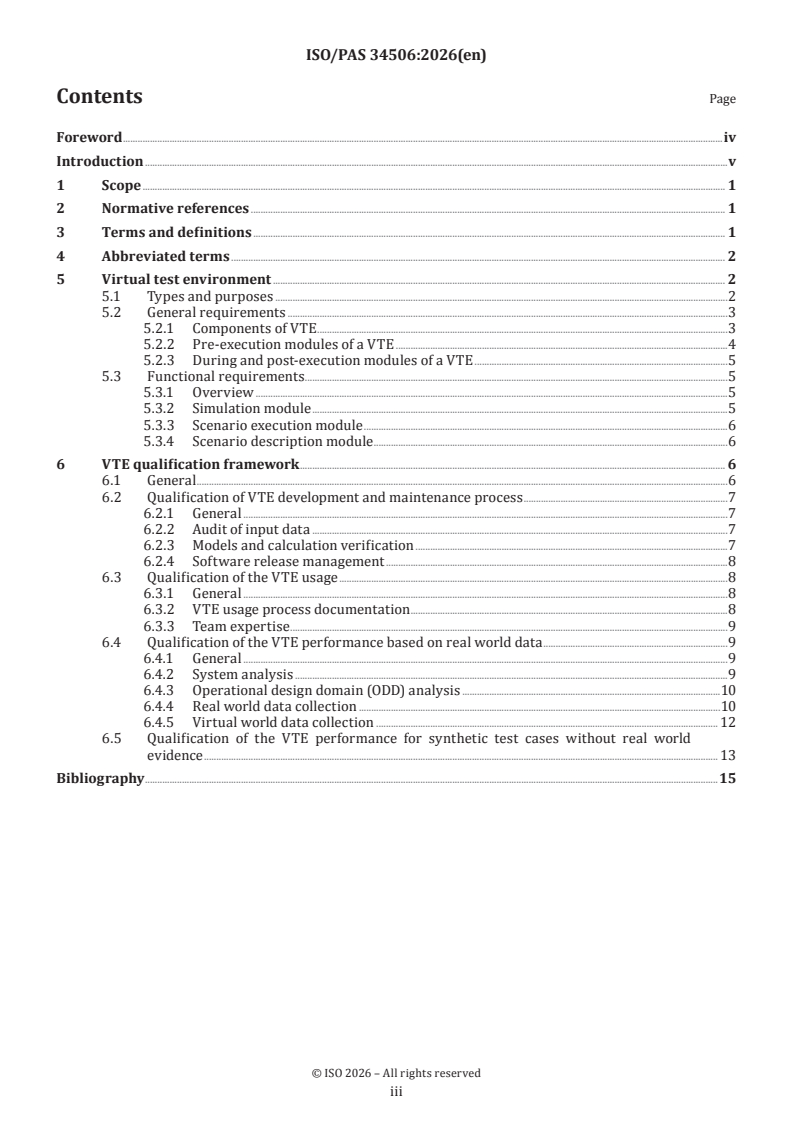
Contents Page
Foreword .iv
Introduction .v
1 Scope . 1
2 Normative references . 1
3 Terms and definitions . 1
4 Abbreviated terms . 2
5 Virtual test environment . 2
5.1 Types and purposes .2
5.2 General requirements .3
5.2.1 Components of VTE .3
5.2.2 Pre-execution modules of a VTE .4
5.2.3 During and post-execution modules of a VTE .5
5.3 Functional requirements . .5
5.3.1 Overview .5
5.3.2 Simulation module .5
5.3.3 Scenario execution module .6
5.3.4 Scenario description module .6
6 VTE qualification framework . 6
6.1 General .6
6.2 Qualification of VTE development and maintenance process .7
6.2.1 General .7
6.2.2 Audit of input data .7
6.2.3 Models and calculation verification .7
6.2.4 Software release management .8
6.3 Qualification of the VTE usage .8
6.3.1 General .8
6.3.2 VTE usage process documentation .8
6.3.3 Team expertise . .9
6.4 Qualification of the VTE performance based on real world data .9
6.4.1 General .9
6.4.2 System analysis .9
6.4.3 Operational design domain (ODD) analysis .10
6.4.4 Real world data collection .10
6.4.5 Virtual world data collection . 12
6.5 Qualification of the VTE performance for synthetic test cases without real world
evidence . 13
Bibliography .15
iii
Foreword
ISO (the International Organization for Standardization) is a worldwide federation of national standards
bodies (ISO member bodies). The work of preparing International Standards is normally carried out through
ISO technical committees. Each member body interested in a subject for which a technical committee
has been established has the right to be represented on that committee. International organizations,
governmental and non-governmental, in liaison with ISO, also take part in the work. ISO collaborates closely
with the International Electrotechnical Commission (IEC) on all matters of electrotechnical standardization.
The procedures used to develop this document and those intended for its further maintenance are described
in the ISO/IEC Directives, Part 1. In particular, the different approval criteria needed for the different types
of ISO document should be noted (see www.iso.org/directives).
ISO draws attention to the possibility that the implementation of this document may involve the use of (a)
patent(s). ISO takes no position concerning the evidence, validity or applicability of any claimed patent
rights in respect thereof. As of the date of publication of this document, ISO had not received notice of (a)
patent(s) which may be required to implement this document. However, implementers are cautioned that
this may not represent the latest information, which may be obtained from the patent database available at
www.iso.org/patents. ISO shall not be held responsible for identifying any or all such patent rights.
Any trade name used in this document is information given for the convenience of users and does not
constitute an endorsement.
For an explanation of the voluntary nature of standards, the meaning of ISO specific terms and expressions
related to conformity assessment, as well as information about ISO’s adherence to the World Trade
Organization (WTO) principles in the Technical Barriers to Trade (TBT), see www.iso.org/iso/foreword.html.
This document was prepared by Technical Committee ISO/TC 22, Road vehicles, Subcommittee SC 33, Vehicle
dynamics, chassis components and driving automation systems testing.
Any feedback or questions on this document should be directed to the user’s national standards body. A
complete listing of these bodies can be found at www.iso.org/members.html.
iv
Introduction
The development, verification and validation of automated driving systems (ADS) presents a significant
challenge for both industry and regulatory authorities. Conventional physical testing methods can no
longer provide the necessary test coverage to assure safety with an acceptable degree of statistical
significance. Regulatory bodies such as the United Nations Economic Commission for Europe (UNECE) and
the US Department of Transportation (USDOT) have already recognized virtual testing as a complementary
methodology alongside track testing, real-world testing, and in-service monitoring and reporting (see
[1] [2]
References ). However, several open questions should be addressed before virtual testing can be applied
[2] [3]
as evidence for the assessment of the ADS. Some of these questions, identified in References and ,
include: (a) how reliability is defined in relation to automated operation, (b) the minimum degree of fidelity
required for simulation models to enable virtual testing, (c) how these simulation models are validated,
and (d) logistical considerations, such as which models are used, who supplies these models, and how, or
[4]
if proprietary algorithms may be included. See ISO/TS 21934-2 for complementary standards on virtual
simulation.
While simulation models play a crucial role in the evaluation process, this document focuses on another
important element: the assessment of the credibility of the virtual test environments (VTEs). The approach
outlined in this document aims to ensure that VTEs can accurately and reliably replicate real-world
conditions, which is critical for trusting the validity of the virtual test results. Therefore, it is important
to determine whether a VTE can produce reliable and accurate representations of real-world testing for
pre-defined purposes, for example sensing and/or planning and/or acting, or end-to-end-simulations. The
purpose of this document is to propose metrics that can be used as quantitative measures to assess whether
a VTE accurately represents real-world conditions.
The document provides recommendations and requirements for the development and evaluation of VTEs.
The methods described can be part of a quality assurance framework for VTEs to meet certain requirements
of adequacy. Figure 1 illustrates an example methodology for the qualification of the VTE by comparing
outputs from real-world data with output data from simulation.
Figure 1 — Example schematic view of VTE evaluation process. Real world includes proving ground
testing
[5] [6] [7] [8]
NOTE 1 This document is part of a set of documents (ISO 34501 , ISO 34502 , ISO 34503 , ISO 34504 and
[9]
ISO 34505 ), which provides guidance and an overview of the scenario-based testing approach for ADS.
NOTE 2 Examples of applicable VTE configurations include model-in-the-loop (MiL) and software-in-the-loop (SiL)
testing methodologies and can extend to hybrid testing techniques, such as hardware-in-the-loop (HiL) and vehicle-in-
the-loop (ViL).
v
Publicly Available Specification ISO/PAS 34506:2026(en)
Road vehicles — Test scenarios for automated driving
systems — Qualification of virtual test environments
1 Scope
This document establishes a qualification scheme for virtual test environments (VTE) used in the evaluation
of automated driving systems (ADS). It specifies criteria and procedures for assessing the VTE in open-loop
and closed-loop configurations.
This document does not apply to the validation or assessment of individual simulation models (for example,
sensor or vehicle dynamics models) and does not apply to the evaluation of ADS performance.
2 Normative references
The following documents are referred to in the text in such a way that some or all of their content constitutes
requirements of this document. For dated references, only the edition cited applies. For undated references,
the latest edition of the referenced document (including any amendments) applies.
ISO 34501, Road vehicles — Test scenarios for automated driving systems — Vocabulary
ISO 34503, Road Vehicles — Test scenarios for automated driving systems — Specification for operational
design domain
3 Terms and definitions
For the purposes of this document, the terms and definitions given in ISO 34501, ISO 34503 and the following
apply.
ISO and IEC maintain terminological databases for use in standardization at the following addresses:
— ISO Online browsing platform: available at http:// www .iso .org/ obp
— IEC Electropedia: available at http:// www .electropedia .org/
3.1
virtual test environment
VTE
simulation toolchain and associated data enabling testing according to the test objectives
Note 1 to entry: The virtual test environment (VTE) enables resimulation based on recorded data and/or simulation
based on artificial data.
Note 2 to entry: The virtual test environment (VTE) may include models or representations of scenery elements
(e.g. roadway environment, such as road lanes, traffic signs), dynamic elements (e.g. vehicles and other actors, like
pedestrians), and environmental conditions (e.g. time of day, rainfall, etc.).
Note 3 to entry: A virtual test environment (VTE) may also have a framework of algorithms showing other dynamic
elements, such as vehicles, pedestrians, active traffic signals interacting with the static elements and with each other.
Note 4 to entry: A virtual test environment (VTE) can be fully virtual or a combination of virtual and hardware
components combined to form a test environment.
Note 5 to entry: A virtual test environment (VTE) can enable simulated interactions with a function or a feature of the
automated driving system (ADS).
3.2
scenario
sequence of scenes usually including the automated driving system(s) (ADS) /subject vehicle(s), and its/their
interactions in the process of performing the dynamic driving task (DDT)
[10]
[SOURCE: ISO 34501:2022 , 3.4, modified — Note 1 to entry and the Example have been deleted.]
4 Abbreviated terms
ADS automated driving system
API application programming interface
DDT dynamic driving task
GNSS global navigation satellite system
HiL hardware-in-the-loop
IMU inertial measurement unit
LiDAR light detection and ranging
MiL model-in-the-loop
ML machine learning
OBU on-board unit
ODD operational design domain
RTK real time kinematic
SDL scenario description language
SiL software-in-the-loop
SUT system under test
ViL vehicle-in-the-loop
VTE virtual test environment
5 Virtual test environment
5.1 Types and purposes
Depending upon the purpose of the VTE, various configurations may exist for a VTE with different
components being virtualised. For the testing of an ADS, irrespective of the software architecture (e.g.
end-to-end artificial intelligence or modular configuration), the ADS has the perception, planning and
actuation functionalities. In order to execute the test, the ADS needs to be stimulated by and connected to
a test environment which may or may not have the driver-in-the-loop. Depending on the ADS under test, its
interfaces, and the availability of information (white-, grey-, black box), different virtual test methods may
be used to test the ADS. For example, the "New Assessment/Test Method for Automated Driving (NATM)
[11]
Guidelines for Validating Automated Driving System (ADS)" includes MiL/SiL, HiL and ViL as simulation
approaches. In addition, open-loop simulation approaches can also serve as a form of VTE, wherein recorded
or simulated stimuli are provided to the sensor to observe the outputs of the ADS, while keeping these
outputs isolated from the driving environment for test-specific reasons, such as reduced complexity. Refer
[9]
to ISO 34505 for more details on test scenario evaluation and test case generation.
Table 1 presents examples of VTE configurations for various subject under test.
Table 1 — Examples of VTE configurations for various subject under test
Test platform
Driving
(functionality Sensor ADS software Actuator Driver + HMI
environment
under test)
SiL virtual virtual virtual virtual virtual
(any)
HiL real and virtual real and virtual virtual virtual virtual
(perception)
HiL virtual real and virtual virtual virtual virtual
(planning)
HiL virtual virtual real and virtual virtual real and virtual
(actuation)
HiL virtual virtual real and virtual virtual real
(Driver handover)
Proving ground real and virtual real real real and virtual real
(any)
Open road real and virtual real and virtual real real and virtual real
(any)
Open loop (any) real and virtual real and virtual real and virtual real and virtual real and virtual
5.2 General requirements
5.2.1 Components of VTE
Figure 2 illustrates the components of a VTE: simulation module, scenario execution module and scenario
description module. Each module includes further components to enable the testing.
NOTE The chosen architecture is a high-level and simplified architecture enabling a structured explanation
within the document. The implemented structure can deviate to address the specific needs of the VTE, as described in
5.1.
a) The simulation module shall include all necessary models and inputs to enable the testing of the ADS.
Therefore, it should include an engine which provides all relevant signals to stimulate the SUT.
b) The scenario execution module shall process all the relevant information of the test case, synchronize
the engines and include the user interface, test analysis and test control.
To enable automated testing, the test scenario execution module shall incorporate predefined criteria
for both completion and termination. Examples of such criteria include achieving the final pose for
successful completion or detecting time-to-collision (TTC) below a specific threshold for termination.
Additionally, the module shall establish the communication between the VTE and the ADS.
c) The scenario description module shall process all relevant test scenario-related information. This
can include ODD attributes and the behaviour of test scenario entities, including traffic density, road
[9]
conditions and weather variations. A possible structure can be found in ISO 34505 .
Figure 2 — Modularised virtual test environment framework illustrating VTE components
5.2.2 Pre-execution modules of a VTE
An execution in a VTE requires configuration instructions, test scenario content and execution instruction.
The input to the test scenario module is a test scenario, which is built in three steps: "create," "format" and
"store."
a) Create phase
1) The input should include all relevant information to ensure reproducible test scenarios with the
required level of fidelity. This can include static, dynamic, and environmental elements, which may
be two or three dimensional. The input should include ODD attributes (e.g. traffic patterns, road
conditions and weather effects). For example, if the scenario entails a transition from dry weather
to rainy weather, the VTE should be able to simulate the effect of changing weather on the scenario
execution and its effect on the perception of the sensors as part of the ADS.
2) Input test scenarios that are executed in the VTE should accurately represent real-world dynamics
with realistic static and dynamic objects.
3) Digital information from, for example, backend, infrastructure and OBU should be included, if
needed.
b) Format phase
1) Inputs should be defined using an SDL, with which it may be capable of international extensions and
compatibility in the future.
2) The VTE should be able to interpret the information specified in the SDL used for the specific
scenario and instantiate various elements of the scenario during runtime. While multiple SDLs
exist, the choice of SDL used should be compatible with the VTE used for ADS testing.
3) The format should be defined in such a way that it is unambiguous and that it allows reproducible
testing.
c) Store phase
[9]
1) Inputs may be stored in a database for retrieval and analysis (see ISO 34505 for details).
5.2.3 During and post-execution modules of a VTE
During and post-execution of a test run in a VTE, the test procedure shall define:
a) pass/fail criteria;
b) abort criteria;
c) the observation variables to be monitored, recorded and evaluated.
This execution phase shall be performed in two steps:
— Analysis step: Each test run shall be analysed to establish if the pass/fail criteria are met. Each execution
may involve identification, monitoring, recording and logging of relevant observation variables.
— Decision step: Each test run shall be assessed to establish if the stopping criteria are met. This may
include definition and monitoring of pre-defined test runs or pre-defined stopping criteria.
For a scalable safety assurance framework for ADS, the selected scenarios and performance metrics shall
correspond to the ODD and the behavioural competencies of the ADS. Performance metrics shall address
ODD coverage by the selected scenarios and shall include consideration of out-of-ODD conditions. Therefore,
the requirements for the VTE inputs, execution configuration and outputs shall be defined in relation to the
ODD and the behaviour competencies of the ADS.
[9]
NOTE ISO 34505 provides a methodology for scenario evaluation and test case generation, including
consideration of the operational design domain and test criteria.
5.3 Functional requirements
5.3.1 Overview
The following subclauses describe general requirements and recommendations related to the three major
modules: "5.3.2, simulation module"; "5.3.3, scenario execution module"; and "5.3.4, scenario description
module", introduced in 5.2.
In addition, and related to the pu
...