

ISO 3536:2016
(Main)Road vehicles — Safety glazing materials — Vocabulary
General Information
- Abstract
ISO 3536:2016 defines terms relating to safety glazing materials for road vehicles.
- Status
- Withdrawn
- Publication Date
- 01-Jun-2016
- Technical Committee
- ISO/TC 22/SC 35 - Lighting and visibility
- Drafting Committee
- ISO/TC 22/SC 35/WG 2 - Safety glazing
- Current Stage
- 9599 - Withdrawal of International Standard
- Start Date
- 12-Jan-2026
- Completion Date
- 29-Aug-2026
Buy Documents


ISO 3536:2016 - Road vehicles -- Safety glazing materials -- Vocabulary
ISO 3536:2016 - Road vehicles — Safety glazing materials — Vocabulary/2/2016
Overview
ISO 3536:2016 - Road vehicles - Safety glazing materials - Vocabulary defines the standardized terms and definitions used for safety glazing in road vehicles. This ISO vocabulary clarifies language for manufacturers, test laboratories, regulators and vehicle designers by establishing consistent meanings for glazing types, optical properties and assembly concepts. The third edition replaces the earlier edition and reflects technical revision of glazing terminology.
Key Topics
ISO 3536:2016 focuses on precise vocabulary rather than test methods or performance limits. Important terms and concepts covered include:
- Safety glazing material - definition and functional intent (minimizing injury, meeting visibility, strength and durability requirements).
- Types of glazing - toughened safety glass, laminated safety glass (ordinary and treated), plastic safety glazing, glass-plastic glazing material, bullet resistant glazing, and security glazing.
- Assemblies and units - interlayer, double glazed unit, double window, safety glass faced with plastics, and design glazing outline.
- Optical properties - luminous transmittance, luminous reflectance, optical deviation / angle of deviation, secondary image, and optical distortion.
- Geometry and installation - wedge, radius of curvature, rake (inclination) angle, shade band, opaque obscuration, vision area, and primary vision area.
- Test/sample definitions - test specimen/test piece, head injury criteria (HIC) as a referenced concept in glazing impacts.
These standardized terms support consistent interpretation in specifications, test reports and regulatory documents.
Applications
ISO 3536:2016 is used wherever precise glazing terminology is required:
- Automotive OEMs and glazing suppliers drafting specifications and contracts.
- Certification bodies and type approval authorities interpreting test reports and regulatory texts.
- Test laboratories preparing reports on glazing optical and mechanical behavior.
- Vehicle designers and safety engineers specifying windscreen, side and rear glazing for visibility and occupant protection.
- Standards writers and policymakers harmonizing national regulations and technical requirements.
Using consistent vocabulary reduces ambiguity in procurement, conformity assessment and legal requirements related to road-vehicle glazing.
Related Standards
ISO 3536:2016 is a vocabulary standard linked to broader glazing and vehicle-safety standards. It is intended to be used alongside performance and test standards for glazing, regional regulations (for example UNECE Regulation No. 43 on safety glazing) and other ISO documents from ISO/TC 22/SC 35 on lighting and visibility. These complementary documents define test methods, acceptance criteria and installation requirements.
Relations
- Effective Date
- 23-Sep-2023
- Effective Date
- 30-Apr-2011
Buy Documents
ISO 3536:2016 - Road vehicles -- Safety glazing materials -- Vocabulary
ISO 3536:2016 - Road vehicles — Safety glazing materials — Vocabulary/2/2016
Get Certified
Connect with accredited certification bodies for this standard

TÜV Rheinland
TÜV Rheinland is a leading international provider of technical services.

TÜV SÜD
TÜV SÜD is a trusted partner of choice for safety, security and sustainability solutions.

DEKRA Certification Inc.
DEKRA US certification services.
Sponsored listings
Frequently Asked Questions
ISO 3536:2016 is a standard published by the International Organization for Standardization (ISO). Its full title is "Road vehicles — Safety glazing materials — Vocabulary". This standard covers: ISO 3536:2016 defines terms relating to safety glazing materials for road vehicles.
ISO 3536:2016 defines terms relating to safety glazing materials for road vehicles.
ISO 3536:2016 is classified under the following ICS (International Classification for Standards) categories: 01.040.43 - Road vehicle engineering (Vocabularies); 01.040.81 - Glass and ceramics industries (Vocabularies); 43.040.65 - Glazing and wiper systems; 81.040.30 - Glass products. The ICS classification helps identify the subject area and facilitates finding related standards.
ISO 3536:2016 has the following relationships with other standards: It is inter standard links to ISO 3536:2026, ISO 3536:1999. Understanding these relationships helps ensure you are using the most current and applicable version of the standard.
ISO 3536:2016 is available in PDF format for immediate download after purchase. The document can be added to your cart and obtained through the secure checkout process. Digital delivery ensures instant access to the complete standard document.
Standards Content (Sample)
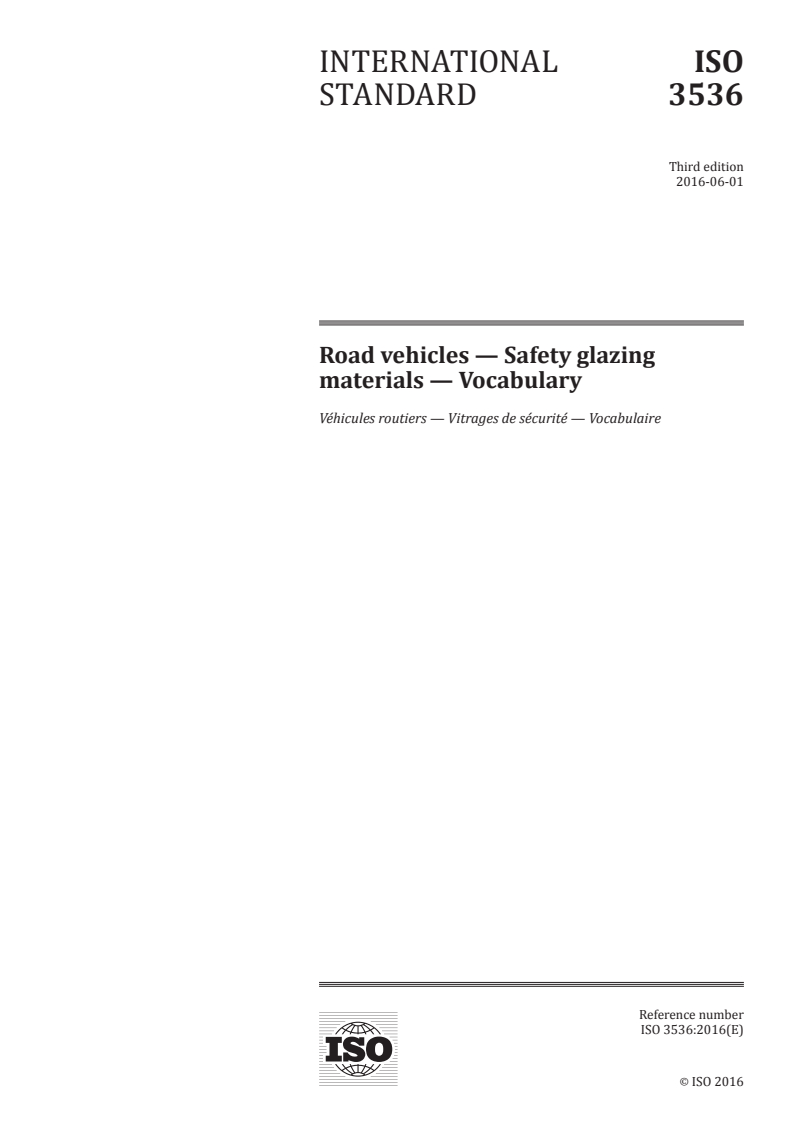
INTERNATIONAL ISO
STANDARD 3536
Third edition
2016-06-01
Road vehicles — Safety glazing
materials — Vocabulary
Véhicules routiers — Vitrages de sécurité — Vocabulaire
Reference number
©
ISO 2016
© ISO 2016, Published in Switzerland
All rights reserved. Unless otherwise specified, no part of this publication may be reproduced or utilized otherwise in any form
or by any means, electronic or mechanical, including photocopying, or posting on the internet or an intranet, without prior
written permission. Permission can be requested from either ISO at the address below or ISO’s member body in the country of
the requester.
ISO copyright office
Ch. de Blandonnet 8 • CP 401
CH-1214 Vernier, Geneva, Switzerland
Tel. +41 22 749 01 11
Fax +41 22 749 09 47
copyright@iso.org
www.iso.org
ii © ISO 2016 – All rights reserved
Contents Page
Foreword .iv
1 Scope . 1
2 Terms and definitions . 1
Foreword
ISO (the International Organization for Standardization) is a worldwide federation of national standards
bodies (ISO member bodies). The work of preparing International Standards is normally carried out
through ISO technical committees. Each member body interested in a subject for which a technical
committee has been established has the right to be represented on that committee. International
organizations, governmental and non-governmental, in liaison with ISO, also take part in the work.
ISO collaborates closely with the International Electrotechnical Commission (IEC) on all matters of
electrotechnical standardization.
The procedures used to develop this document and those intended for its further maintenance are
described in the ISO/IEC Directives, Part 1. In particular the different approval criteria needed for the
different types of ISO documents should be noted. This document was drafted in accordance with the
editorial rules of the ISO/IEC Directives, Part 2 (see www.iso.org/directives).
Attention is drawn to the possibility that some of the elements of this document may be the subject of
patent rights. ISO shall not be held responsible for identifying any or all such patent rights. Details of
any patent rights identified during the development of the document will be in the Introduction and/or
on the ISO list of patent declarations received (see www.iso.org/patents).
Any trade name used in this document is information given for the convenience of users and does not
constitute an endorsement.
For an explanation on the meaning of ISO specific terms and expressions related to conformity assessment,
as well as information about ISO’s adherence to the World Trade Organization (WTO) principles in the
Technical Barriers to Trade (TBT) see the following URL: www.iso.org/iso/foreword.html.
The committee responsible for this document is ISO/TC 22, Road vehicles, Subcommittee SC 35, Lighting
and visibility.
This third edition cancels and replaces the second edition (ISO 3536:1999), which has been technically
revised.
iv © ISO 2016 – All rights reserved
INTERNATIONAL STANDARD ISO 3536:2016(E)
Road vehicles — Safety glazing materials — Vocabulary
1 Scope
This International Standard defines terms relating to safety glazing materials for road vehicles.
2 Terms and definitions
For the purposes of this document, the following terms and definitions apply.
2.1
safety glazing material
glazing material consisting of organic and/or inorganic materials so constructed or treated to minimize
the likelihood of injury to persons as a result of contact with these safety glazing materials when used
in a vehicle and which complies with specified requirements for visibility, strength, and durability
2.2
toughened safety glass
glazing material consisting of a single layer of glass which has been subjected to special thermal or
chemical treatment to increase its mechanical strength and to condition its fragmentation after shatter
2.3
laminated safety glass
glazing material consisting of two or more layers of glass held together by one or more interlayers (2.4)
Note 1 to entry: The following two types are recognized:
— ordinary: when none of the layers of glass, of which it is composed, has been treated, i.e. normal annealed glass;
— treated: when at least one of the layers of glass, of which it is composed, is toughened safety glass (2.2) or glass
which has been treated in any controlled process in order to give it increased resistance to mechanical and
thermal stress.
2.4
interlayer
plastic material designed to be used to permanently bond together the component layers of laminated
safety glass (2.3)
2.5
glass-plastic glazing material
glazing material which may comprise one layer of glass and one or more layers of plastic in which a
plastic surface faces inward towards the vehicle passenger compartment when installed in the vehicle
2.6
plastic safety glazing material
safety glazing material (2.1) that contains, as an essential ingredient, one or more layers of organic
polymeric substances
Note 1 to entry: The following two types are recognized:
— rigid plastic: organic polymeric material which maintains its structural stiffness over the intended use range;
— flexible plastic: organic polyme
...
INTERNATIONAL ISO
STANDARD 3536
Third edition
2016-06-01
Road vehicles — Safety glazing
materials — Vocabulary
Véhicules routiers — Vitrages de sécurité — Vocabulaire
Reference number
©
ISO 2016
© ISO 2016, Published in Switzerland
All rights reserved. Unless otherwise specified, no part of this publication may be reproduced or utilized otherwise in any form
or by any means, electronic or mechanical, including photocopying, or posting on the internet or an intranet, without prior
written permission. Permission can be requested from either ISO at the address below or ISO’s member body in the country of
the requester.
ISO copyright office
Ch. de Blandonnet 8 • CP 401
CH-1214 Vernier, Geneva, Switzerland
Tel. +41 22 749 01 11
Fax +41 22 749 09 47
copyright@iso.org
www.iso.org
ii © ISO 2016 – All rights reserved
Contents Page
Foreword .iv
1 Scope . 1
2 Terms and definitions . 1
Foreword
ISO (the International Organization for Standardization) is a worldwide federation of national standards
bodies (ISO member bodies). The work of preparing International Standards is normally carried out
through ISO technical committees. Each member body interested in a subject for which a technical
committee has been established has the right to be represented on that committee. International
organizations, governmental and non-governmental, in liaison with ISO, also take part in the work.
ISO collaborates closely with the International Electrotechnical Commission (IEC) on all matters of
electrotechnical standardization.
The procedures used to develop this document and those intended for its further maintenance are
described in the ISO/IEC Directives, Part 1. In particular the different approval criteria needed for the
different types of ISO documents should be noted. This document was drafted in accordance with the
editorial rules of the ISO/IEC Directives, Part 2 (see www.iso.org/directives).
Attention is drawn to the possibility that some of the elements of this document may be the subject of
patent rights. ISO shall not be held responsible for identifying any or all such patent rights. Details of
any patent rights identified during the development of the document will be in the Introduction and/or
on the ISO list of patent declarations received (see www.iso.org/patents).
Any trade name used in this document is information given for the convenience of users and does not
constitute an endorsement.
For an explanation on the meaning of ISO specific terms and expressions related to conformity assessment,
as well as information about ISO’s adherence to the World Trade Organization (WTO) principles in the
Technical Barriers to Trade (TBT) see the following URL: www.iso.org/iso/foreword.html.
The committee responsible for this document is ISO/TC 22, Road vehicles, Subcommittee SC 35, Lighting
and visibility.
This third edition cancels and replaces the second edition (ISO 3536:1999), which has been technically
revised.
iv © ISO 2016 – All rights reserved
INTERNATIONAL STANDARD ISO 3536:2016(E)
Road vehicles — Safety glazing materials — Vocabulary
1 Scope
This International Standard defines terms relating to safety glazing materials for road vehicles.
2 Terms and definitions
For the purposes of this document, the following terms and definitions apply.
2.1
safety glazing material
glazing material consisting of organic and/or inorganic materials so constructed or treated to minimize
the likelihood of injury to persons as a result of contact with these safety glazing materials when used
in a vehicle and which complies with specified requirements for visibility, strength, and durability
2.2
toughened safety glass
glazing material consisting of a single layer of glass which has been subjected to special thermal or
chemical treatment to increase its mechanical strength and to condition its fragmentation after shatter
2.3
laminated safety glass
glazing material consisting of two or more layers of glass held together by one or more interlayers (2.4)
Note 1 to entry: The following two types are recognized:
— ordinary: when none of the layers of glass, of which it is composed, has been treated, i.e. normal annealed glass;
— treated: when at least one of the layers of glass, of which it is composed, is toughened safety glass (2.2) or glass
which has been treated in any controlled process in order to give it increased resistance to mechanical and
thermal stress.
2.4
interlayer
plastic material designed to be used to permanently bond together the component layers of laminated
safety glass (2.3)
2.5
glass-plastic glazing material
glazing material which may comprise one layer of glass and one or more layers of plastic in which a
plastic surface faces inward towards the vehicle passenger compartment when installed in the vehicle
2.6
plastic safety glazing material
safety glazing material (2.1) that contains, as an essential ingredient, one or more layers of organic
polymeric substances
Note 1 to entry: The following two types are recognized:
— rigid plastic: organic polymeric material which maintains its structural stiffness over the intended use range;
— flexible plastic: organic polyme
...