

ISO 10454:2025
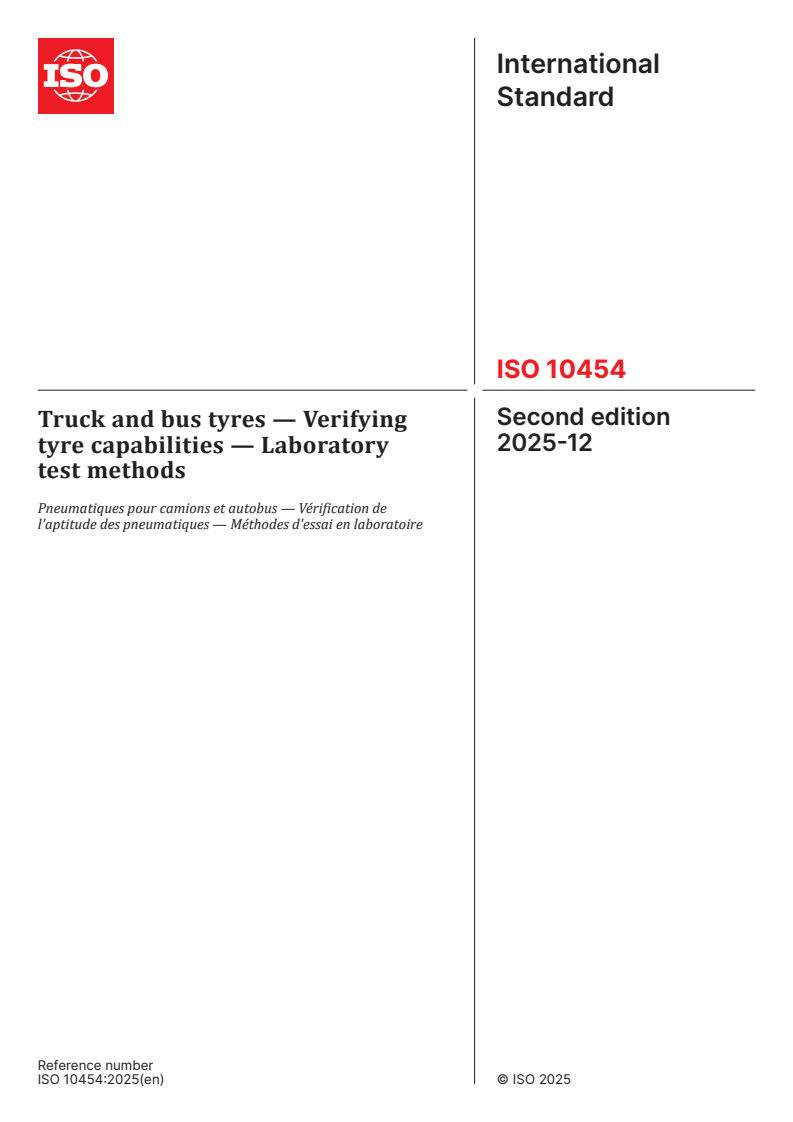
(Main)Truck and bus tyres — Verifying tyre capabilities — Laboratory test methods
General Information
- Abstract
This document specifies laboratory test methods for verifying the capabilities of truck and bus tyres. Of the test methods presented, only some will be required, depending on the type of tyre to be tested. This document applies to all truck and bus tyres. The test methods presented in this document do not apply to the gradation of tyre performance or quality levels.
- Status
- Published
- Publication Date
- 30-Nov-2025
- Technical Committee
- ISO/TC 31/SC 4 - Truck and bus tyres and rims
- Drafting Committee
- ISO/TC 31/SC 4 - Truck and bus tyres and rims
- Current Stage
- 6060 - International Standard published
- Start Date
- 01-Dec-2025
- Due Date
- 23-Jun-2026
- Completion Date
- 01-Dec-2025
Overview
ISO 10454:2025 - "Truck and bus tyres - Verifying tyre capabilities - Laboratory test methods" defines laboratory procedures to verify the structural and performance capabilities of truck and bus tyres. The standard applies to all truck and bus tyres and specifies which test methods are appropriate depending on tyre type (strength test, endurance test, high‑speed performance test for LT/C tyres). It does not provide a system for grading tyre performance or quality levels.
Key topics and technical requirements
- Scope and terminology: Uses tyre industry definitions from ISO 4223‑1 (e.g., bead separation, ply separation, speed symbol). Applicable to tyres marked with speed symbols (E, F, G … H) and load indices.
- Test equipment
- Test drum: smooth steel cylindrical drum, typically 1.7 m ±1% or 2.0 m ±1% diameter; larger diameters allowed for endurance tests. Drum width must meet or exceed tyre overall width.
- Plunger: cylindrical steel plunger with hemispherical end. Diameters per load index: ≤121 → 19 mm; 122–134 → 32 mm; ≥135 → 38 mm.
- Inflation pressure gauges: scale at least 100 kPa above test pressure; specified accuracy.
- Strength test (tread breaking energy)
- Tyre mounted on test rim and inflated to minimum pressure for maximum single‑formation load.
- Plunger forced into tread at 50 mm/min ± 2.5 mm/min at five circumferential points.
- Breaking energy W (joules) computed as W = (F × P) / 2000, where F = force (N) and P = penetration (mm); tyre average from test points.
- Endurance test (speed category ≤ 150 km/h)
- Assesses resistance under full load and moderate sustained speed; not applicable to LT/C tyres.
- Test parameters (speed, load percentages, durations) are given in tabulated form (Table 3) and depend on maximum load rating and speed symbol. Ambient temperature and load/pressure control requirements specified.
- High‑speed performance test for LT/C tyres (light‑truck/commercial) is addressed separately (Clause 5.3) with conditions depending on speed category.
Applications - who uses ISO 10454:2025
- Tyre manufacturers - product development, validation of structural strength and endurance.
- Independent testing laboratories - reproducible laboratory verification of truck and bus tyre capabilities.
- Regulatory and conformity bodies - verifying compliance with laboratory performance requirements.
- Fleet operators and OEMs - technical due diligence for tyre procurement and safety assessments.
Related standards
- ISO 4223‑1 - Definitions of tyre industry terms (normative reference).
- ISO 4209‑1 - Truck and bus tyres and rims (metric series).
- Prepared by ISO/TC 31 (Tyres, rims and valves), Subcommittee SC 4.
Keywords: ISO 10454:2025, truck and bus tyres, tyre laboratory test methods, strength test, endurance test, high‑speed performance, LT/C tyres, test drum, breaking energy, speed symbol.
Relations
- Effective Date
- 24-Jun-2023
Get Certified
Connect with accredited certification bodies for this standard

DIN CERTCO
DIN Group product certification.

Smithers Quality Assessments
US management systems and product certification.
Sponsored listings
Frequently Asked Questions
ISO 10454:2025 is a standard published by the International Organization for Standardization (ISO). Its full title is "Truck and bus tyres — Verifying tyre capabilities — Laboratory test methods". This standard covers: This document specifies laboratory test methods for verifying the capabilities of truck and bus tyres. Of the test methods presented, only some will be required, depending on the type of tyre to be tested. This document applies to all truck and bus tyres. The test methods presented in this document do not apply to the gradation of tyre performance or quality levels.
This document specifies laboratory test methods for verifying the capabilities of truck and bus tyres. Of the test methods presented, only some will be required, depending on the type of tyre to be tested. This document applies to all truck and bus tyres. The test methods presented in this document do not apply to the gradation of tyre performance or quality levels.
ISO 10454:2025 is classified under the following ICS (International Classification for Standards) categories: 83.160.10 - Road vehicle tyres. The ICS classification helps identify the subject area and facilitates finding related standards.
ISO 10454:2025 has the following relationships with other standards: It is inter standard links to ISO 10454:1993. Understanding these relationships helps ensure you are using the most current and applicable version of the standard.
ISO 10454:2025 is available in PDF format for immediate download after purchase. The document can be added to your cart and obtained through the secure checkout process. Digital delivery ensures instant access to the complete standard document.
Standards Content (Sample)
International
Standard
ISO 10454
Second edition
Truck and bus tyres — Verifying
2025-12
tyre capabilities — Laboratory
test methods
Pneumatiques pour camions et autobus — Vérification de
l'aptitude des pneumatiques — Méthodes d'essai en laboratoire
Reference number
© ISO 2025
All rights reserved. Unless otherwise specified, or required in the context of its implementation, no part of this publication may
be reproduced or utilized otherwise in any form or by any means, electronic or mechanical, including photocopying, or posting on
the internet or an intranet, without prior written permission. Permission can be requested from either ISO at the address below
or ISO’s member body in the country of the requester.
ISO copyright office
CP 401 • Ch. de Blandonnet 8
CH-1214 Vernier, Geneva
Phone: +41 22 749 01 11
Email: copyright@iso.org
Website: www.iso.org
Published in Switzerland
ii
Contents Page
Foreword .iv
1 Scope . 1
2 Normative references . 1
3 Terms and definitions . 1
4 Test equipment . 3
5 Testing. 4
5.1 Strength test .4
5.1.1 Preparation of tyre .4
5.1.2 Test procedure.4
5.2 Endurance test for tyres with speed category 150 km/h or below .5
5.2.1 Preparation of tyre .5
5.2.2 Test procedure.5
5.3 High-speed performance test for LT/C tyres .7
5.3.1 High-speed performance test for LT/C tyres with speed category up to 150 km/h .7
5.3.2 High speed performance test for LT/C tyres with speed category 160 km/h and
above .8
6 Requirements . 9
6.1 Test sample .9
6.2 Strength test .9
6.3 Endurance test .10
6.4 High-speed performance test for LT/C tyres with speed category 150 km/h or below . .10
6.5 High-speed performance test for LT/C tyres with speed category 160 km/h or above .10
Annex A (informative) Old test conditions for tyres with non-standard marking .11
iii
Foreword
ISO (the International Organization for Standardization) is a worldwide federation of national standards
bodies (ISO member bodies). The work of preparing International Standards is normally carried out through
ISO technical committees. Each member body interested in a subject for which a technical committee
has been established has the right to be represented on that committee. International organizations,
governmental and non-governmental, in liaison with ISO, also take part in the work. ISO collaborates closely
with the International Electrotechnical Commission (IEC) on all matters of electrotechnical standardization.
The procedures used to develop this document and those intended for its further maintenance are described
in the ISO/IEC Directives, Part 1. In particular, the different approval criteria needed for the different types
of ISO document should be noted. This document was drafted in accordance with the editorial rules of the
ISO/IEC Directives, Part 2 (see www.iso.org/directives).
ISO draws attention to the possibility that the implementation of this document may involve the use of (a)
patent(s). ISO takes no position concerning the evidence, validity or applicability of any claimed patent
rights in respect thereof. As of the date of publication of this document, ISO had not received notice of (a)
patent(s) which may be required to implement this document. However, implementers are cautioned that
this may not represent the latest information, which may be obtained from the patent database available at
www.iso.org/patents. ISO shall not be held responsible for identifying any or all such patent rights.
Any trade name used in this document is information given for the convenience of users and does not
constitute an endorsement.
For an explanation of the voluntary nature of standards, the meaning of ISO specific terms and expressions
related to conformity assessment, as well as information about ISO's adherence to the World Trade
Organization (WTO) principles in the Technical Barriers to Trade (TBT), see www.iso.org/iso/foreword.html.
This document was prepared by Technical Committee ISO/TC 31, Tyres, rims and valves, Subcommittee SC 4,
Truck and bus tyres and rims.
This second edition cancels and replaces the first edition (ISO 10454:1993), which has been technically
revised.
The main changes are as follows:
— the endurance test for tyres with speed symbol Q and above is replaced by the high-speed performance
test for light commercial vehicle (LT/C) tyres in 5.3;
— test conditions for tyres with speed symbol E and load index > 121 and speed symbol N are introduced
in the endurance test in Table 3;
— test conditions for drums with diameters different than 1,7 m are introduced in the endurance test in
Table 3;
— the description of the strength test in 5.1. is revised;
— tyres that are not marked with load indices are considered.
Any feedback or questions on this document should be directed to the user’s national standards body. A
complete listing of these bodies can be found at www.iso.org/members.html.
iv
International Standard ISO 10454:2025(en)
Truck and bus tyres — Verifying tyre capabilities —
Laboratory test methods
1 Scope
This document specifies laboratory test methods for verifying the capabilities of truck and bus tyres. Of the
test methods presented, only some will be required, depending on the type of tyre to be tested.
This document applies to all truck and bus tyres.
The test methods presented in this document do not apply to the gradation of tyre performance or quality levels.
2 Normative references
The following documents are referred to in the text in such a way that some or all of their content constitutes
requirements of this document. For dated references, only the edition cited applies. For undated references,
the latest edition of the referenced document (including any amendments) applies.
ISO 4209-1, Truck and bus tyres and rims (metric series) — Part 1: Tyres
ISO 4223-1, Definitions of some terms used in the tyre industry — Part 1: Pneumatic tyres
3 Terms and definitions
For the purposes of this document, the terms and definitions given in ISO 4223-1 and the following apply.
ISO and IEC maintain terminology databases for use in standardization at the following addresses:
— ISO Online browsing platform: available at https:// www .iso .org/ obp
— IEC Electropedia: available at https:// www .electropedia .org/
3.1
bead separation
breakdown of bond between components in the bead area
[SOURCE: ISO 4223-1:2017, 3.8.1]
3.2
belt separation
parting of rubber compound between belt layers or between belts and plies
[SOURCE: ISO 4223-1:2017, 3.8.2]
3.3
chunking
breaking away of pieces of either the tread or the sidewall, or both
[SOURCE: ISO 4223-1:2017, 3.8.3, modified — "breaking away of pieces of the sidewall" added.]
3.4
cord separation
parting of the cords from their rubber coating
[SOURCE: ISO 4223-1:2017, 3.8.4]
3.5
cracking
any parting within the tread, sidewall or innerliner of the tyre that may extend to cord material
[SOURCE: ISO 4223-1:2017, 3.8.5]
3.6
innerliner separation
parting of innerliner from cord material in the carcass
3.7
maximum load rating
reference mass corresponding to the load index used to define the load capacity of the tyre or the maximum
load marked on the tyre
3.8
open splice
any parting at any junction of tread, sidewall or innerliner that extends to cord material
[SOURCE: ISO 4223-1:2017, 3.8.11]
3.9
ply separation
parting of adjacent plies
[SOURCE: ISO 4223-1:2017, 3.8.7]
3.10
sidewall separation
parting of the rubber compound from the cord material in the sidewall
3.11
special tread tyre
tyre with a tread pattern that is primarily designed to provide satisfactory performance under special
service conditions
Note 1 to entry: Examples of special service conditions are mixed on- and off-road use or use on city busses.
3.12
test rim
any rim on which a tyre is allowed to be fitted in accordance with ISO 4209-1 and whose contour is one of
those specified for the fitment of the test tyre
3.13
test drum speed
peripheral speed of the steel test drum
3.14
tread separation
pulling away of the tread from the tyre carcass
[SOURCE: ISO 4223-1:2017, 3.8.9]
3.15
light-truck or commercial tyre
LT/C tyre
tyre designed primarily for light-duty trucks and cargo vans and marked with "LT", "C" or "CP"
3.16
reference test inflation pressure
minimum cold inflation pressure for the maximum load rating of the tyre in single formation
3.17
speed symbol
letter code reported in Table 1 which defines the maximum speed which the tyre can sustain
Table 1 — Speed symbols
Corresponding speed
Speed symbol
km/h
E 70
F 80
G 90
J 100
K 110
L 120
M 130
N 140
P 150
Q 160
R 170
S 180
T 190
U 200
H 210
4 Test equipment
The test equipment consists of items in 4.1 to 4.3.
4.1 Test drum, cylindrical driven flywheel (drum) having a diameter of 1,7 m ± 1 % or 2 m ± 1 % or, for
the endurance test specified in 5.2, having a larger diameter.
The surface of the drum shall be smooth steel. The width of the test surface shall be equal to or exceed the
overall width of the test tyre.
For the test drum, the loading device may be a dead-weight cantilevered system with a hydraulic or
pneumatic system. The accuracy shall be within ±1,5 % of the full scale.
For the test drum, the speed capability of the equipment shall be adequate for the requirements of the test
+2
methods. The accuracy of the test drum speed shall be within km/h at the full scale.
4.2 Plunger, cylindrical steel plunger of sufficient length with a hemispherical end and a diameter as
shown in Table 2, with reference to the tyre load index.
For the plunger equipment, the loading device shall permit gradual application of the force. Indicators of
displacement and of force shall be provided with an accuracy within ±1 % of full scale.
For the plunger equipment, the speed of the displacement shall be controlled with an accuracy within ±3 %
of the full scale.
Table 2 — Plunger diameter
Dimensions in millimetres
Plunger diameter
Load index in single formation
±0,5
≤ 121 19
122 – 134 32
≥ 135 38
4.3 Inflation pressure gauges, with a maximum scale value which is at least 100 kPa larger than the test
inflation pressure of the tyre under test with an accuracy within +20 kPa.
5 Testing
5.1 Strength test
This test is used for assessing the capability of the tyre structure, with respect to breaking energy, in the
tread area.
5.1.1 Preparation of tyre
5.1.1.1 Mount the tyre on a test rim and inflate it to the minimum pressure specified for the maximum
load rating in single formation, or maximum dual load, where they differ.
5.1.1.2 An inner tube of the same size shall be used for all measurements on tube-type tyres and may be
used in tubeless tyres.
5.1.1.3 Maintain the assembly at test room temperature for at least 3 h.
5.1.2 Test procedure
5.1.2.1 Clean the plunger prior to each test using a clean, soft cloth and a water-soluble rubber lubricant or
water-miscible solvent. Wipe completely dry and clean off any residue or foreign matter. Clean the tyre prior
to each test using a
...