

ISO/TS 25375
(Main)Oil and gas industries including lower carbon energy — Multi-component for thermal recovery — Flooding development plan design
- Abstract
This technical specification provides the adaptable reservoir conditions and recommended application methods of multi-component thermal flooding for heavy oil reservoirs. NOTE: This technical specification is only applicable to heavy oil reservoirs.
- Status
- Not Published
- Technical Committee
- SC 10 - ISO/TC 67/SC 10
- Drafting Committee
- SC 10 - ISO/TC 67/SC 10
- Current Stage
- 6000 - International Standard under publication
- Start Date
- 26-Aug-2026
- Completion Date
- 10-Oct-2026
Buy Documents

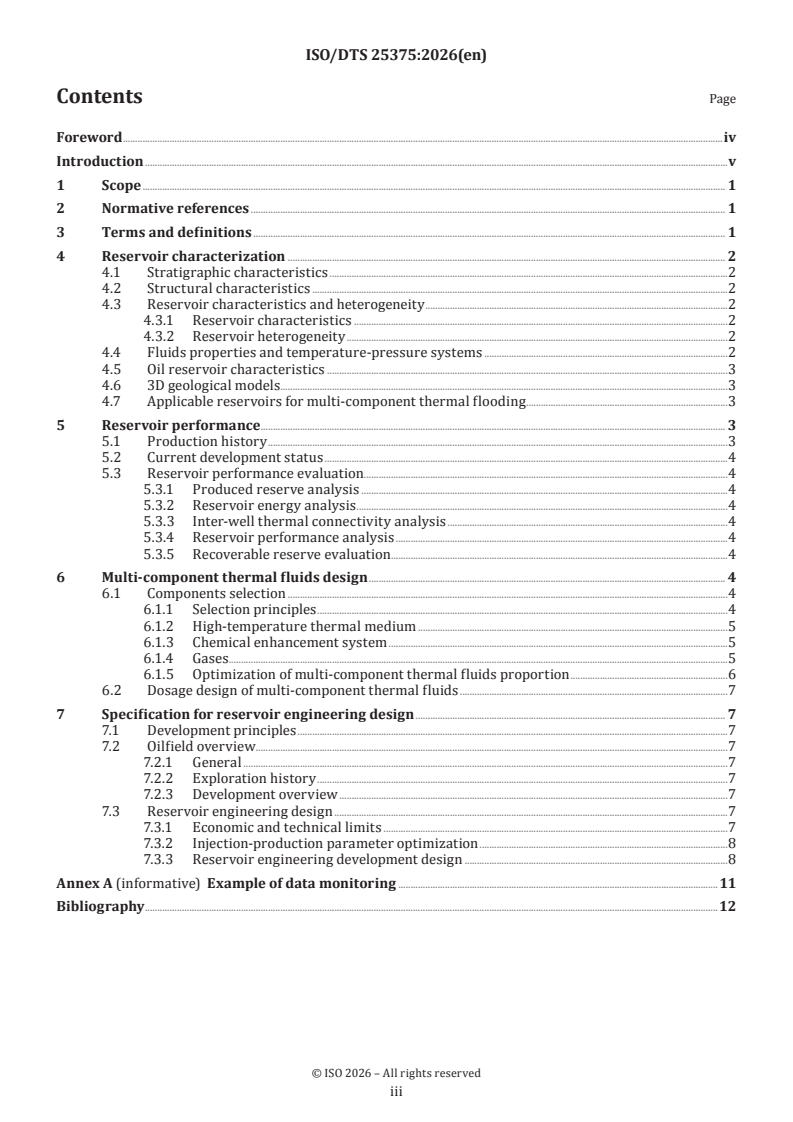

ISO/DTS 25375 - Oil and gas industries including lower carbon energy — Multi-component for thermal recovery — Flooding development plan design
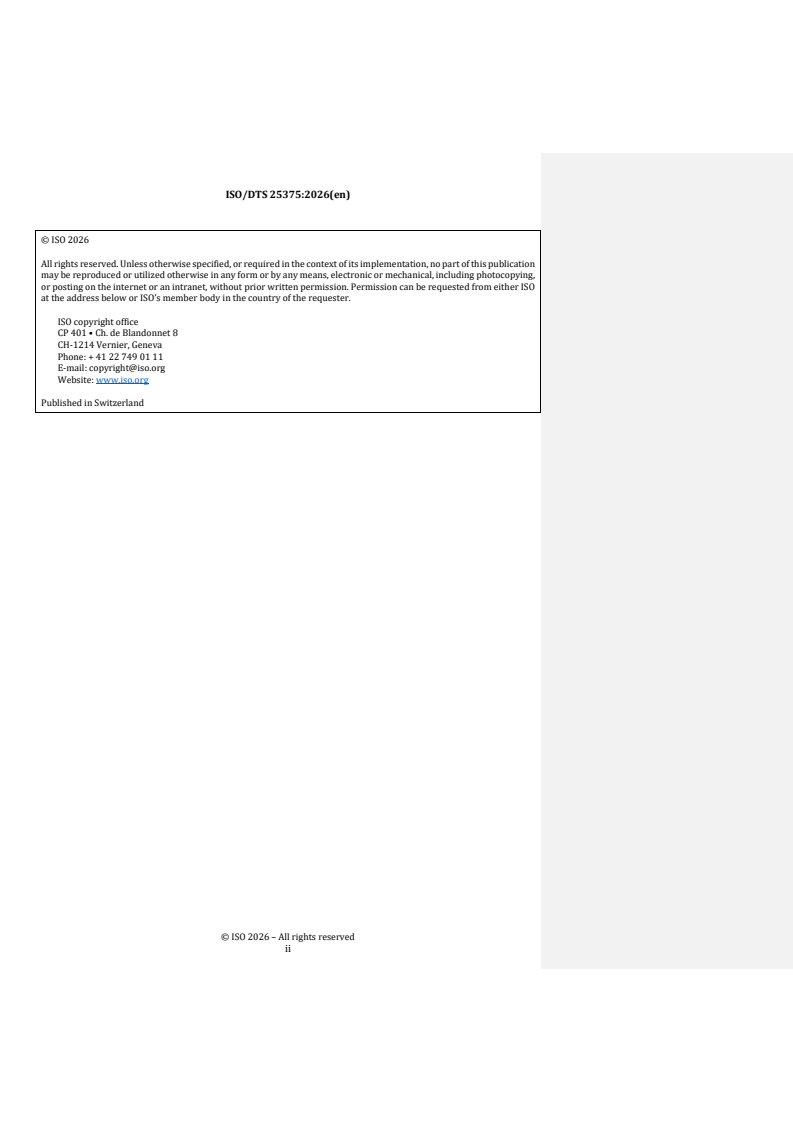
REDLINE ISO/DTS 25375 - Oil and gas industries including lower carbon energy — Multi-component for thermal recovery — Flooding development plan design
ISO/TS 25375 is an ISO technical specification for designing multi-component thermal flooding development plans in heavy oil reservoirs. It tells reservoir and field teams how to screen reservoir conditions, choose thermal fluids, set injection and well-pattern parameters, and organize monitoring for onshore and offshore heavy oil projects.
What does ISO/TS 25375 specify?
ISO/TS 25375 specifies the design content and technical rules for a multi-component thermal flooding development plan. It applies to heavy oil reservoirs and focuses on how to select suitable reservoirs, design the fluid system, and build the reservoir engineering plan.
The document is organized into:
- Scope, references, terms and definitions
- Reservoir characterization
- Reservoir performance
- Multi-component thermal fluids design
- Reservoir engineering design
- Annex A with example monitoring data
| Annex | What it covers |
|---|---|
| Annex A | Example monitoring parameters for injection wells and production wells |
What are the key requirements of ISO/TS 25375?
ISO/TS 25375 starts with reservoir screening, then moves to fluid design, then to engineering design for field deployment. In practice, this means users first decide whether a reservoir is suitable, then define the thermal fluid system, and finally fix the development plan and operating targets.
Reservoir characterization and applicability
Clause 4 requires a description of stratigraphy, structure, heterogeneity, fluid properties, temperature-pressure conditions, oil reservoir characteristics, and 3D geological models. This matters because the development plan has to be based on reservoir structure and fluid behavior, not just on production targets.
Clause 4.7 sets the screening logic for applicable reservoirs. The document requires screening by oil properties, depth, thickness, net-to-gross, permeability, porosity, oil saturation, aquifer size ratio, and formation pressure. It also states that reservoir pressure should be below 10 MPa before multi-component thermal flooding.
For very viscous heavy oil, Clause 4.7 points users toward other thermal methods when the reservoir is shallow and has few interlayers. It also recommends multi-component thermal flooding where cumulative effective thickness and single-layer effective thickness are sufficient, which helps planners avoid applying the method to weak candidates.
Multi-component thermal fluids design
Clause 6 says the thermal fluid system should combine steam, chemical agents, and gases to improve sweep efficiency, reduce steam channelling, and reduce heat loss. In practice, teams need to choose components as a system, not as separate additives.
Clause 6.1.2 gives the thermal medium preference, with high-temperature steam as the first choice and high-temperature hot water as an option in some conditions. Clause 6.1.3 requires chemical selection to target viscosity reduction, oil displacement, foaming, or profile control, and it calls for performance testing at reservoir temperature.
Clause 6.1.4 covers gas choice. ISO/TS 25375 identifies nitrogen, carbon dioxide, flue gas, and light hydrocarbons as candidate gases, with selection based on pressure, oil viscosity, thermal efficiency, well-bore string type, and operating constraints. The injected gas must have oxygen content below 1%, which helps control safety and process stability.
Clause 6.1.5 and 6.2 require optimization of fluid proportions and dosage using experiments, numerical simulation, and reservoir engineering methods. This is the core design work: selecting the steam, chemical, and gas balance, then defining injection volume, sequence, concentration, slug size, gas-liquid ratio, and frequency.
Reservoir engineering design
Clause 7 requires the development plan to optimize injection parameters and well patterns to improve sweep and displacement efficiency, reduce steam channelling, and lower steam-oil ratio and energy use. The practical outcome is a field plan with economic and technical limits, not just a conceptual scheme.
Clause 7.3 covers well-pattern optimization, well spacing, timing for thermal flooding conversion, timing for chemical injection, and channelling prevention. It also requires bottom hole steam quality to be at least 50%, and it requires the plan to define monitoring, data collection, and plan-implementation controls.
What terms does ISO/TS 25375 define?
- Multi-component thermal fluids (MCTF) - A high-temperature system of steam, hot water, gases, and chemical agents used to improve oil recovery in heavy oil fields.
- Steam injection rate - The quantity of steam injected into a well per day.
- Gas injection rate - The quantity of gas injected into a well per day.
- Production-injection ratio - The ratio of liquid production rate to steam injection rate in a block during the process.
- Gas-liquid ratio (GLR) - The ratio of gas volume to liquid volume under operating conditions.
- Steam-oil ratio (SOR) - The ratio of crude oil produced to water-equivalent steam injected.
- Chemical slug - A discrete volume of chemical solution injected into the well to form a displacement zone.
- Timing for thermal flooding conversion - The conditions used to decide when to convert steam huff and puff to multi-component thermal fluids.
Who uses ISO/TS 25375?
ISO/TS 25375 is used by reservoir engineers, production engineers, thermal recovery designers, and oilfield development planners working on heavy oil projects. It is also relevant to operators, EOR technology suppliers, and technical teams responsible for screening reservoirs, choosing injection fluids, optimizing well patterns, and setting monitoring programs for onshore and offshore fields.
Which standards are used with ISO/TS 25375?
ISO/TS 25375 refers to these standards and uses them for background methods, terminology, or operating context:
- ISO 22475-1 - Provides technical principles for sampling soil, rock, and groundwater, and is cited for reservoir parameter information.
- ISO 18335:2024 - Supports information on reservoir-related parameters used in screening.
- ISO 1998-2:1998 - Provides petroleum terminology for properties and tests, including API gravity and dynamic viscosity.
- ISO 696 - Provides the modified Ross-Miles method for foaming power measurement.
- ISO 862:1984 - Provides vocabulary for surface active agents.
- ISO/TS 26762:2025 - Is cited because its GLR definition differs from the GLR used in this document.
- ISO 15156-1:2020 - Supports material selection for H2S-containing environments.
- ISO 45001:2018 - Supports occupational health and safety management requirements.
What does the ISO/TS 25375 document contain?
ISO/TS 25375 contains reservoir screening guidance, design principles, optimization methods, and implementation requirements for multi-component thermal flooding. It includes a reservoir characterization sequence, performance evaluation methods, fluid-selection rules, proportioning guidance, and reservoir-engineering design steps.
The document also includes tables that classify applicable reservoirs, summarize recommended chemical performance, and show suggested multi-component fluid proportions for different reservoir categories. Annex A gives example monitoring parameters for injection wells and production wells, which helps teams build their field data-collection plan.
It also describes the use of geological models, production history review, numerical simulation, reservoir analogy, and injection-production characteristic curves. In practice, these are the methods used to turn reservoir data into a workable development plan and to track whether the plan is performing as intended.
Buy Documents
ISO/DTS 25375 - Oil and gas industries including lower carbon energy — Multi-component for thermal recovery — Flooding development plan design
REDLINE ISO/DTS 25375 - Oil and gas industries including lower carbon energy — Multi-component for thermal recovery — Flooding development plan design
Get Certified
Connect with accredited certification bodies for this standard

Element Materials Technology
Materials testing and product certification.

ABS Group Brazil
ABS Group certification services in Brazil.

ABS Quality Evaluations Inc.
American Bureau of Shipping quality certification.
Sponsored listings
Frequently Asked Questions
ISO/TS 25375 is a draft published by the International Organization for Standardization (ISO). Its full title is "Oil and gas industries including lower carbon energy — Multi-component for thermal recovery — Flooding development plan design". This standard covers: This technical specification provides the adaptable reservoir conditions and recommended application methods of multi-component thermal flooding for heavy oil reservoirs. NOTE: This technical specification is only applicable to heavy oil reservoirs.
This technical specification provides the adaptable reservoir conditions and recommended application methods of multi-component thermal flooding for heavy oil reservoirs. NOTE: This technical specification is only applicable to heavy oil reservoirs.
ISO/TS 25375 is classified under the following ICS (International Classification for Standards) categories: 75.020 - Extraction and processing of petroleum and natural gas. The ICS classification helps identify the subject area and facilitates finding related standards.
ISO/TS 25375 is available in PDF format for immediate download after purchase. The document can be added to your cart and obtained through the secure checkout process. Digital delivery ensures instant access to the complete standard document.
Standards Content (Sample)
FINAL DRAFT
Technical
Specification
ISO/DTS 25375
ISO/TC 67/SC 10
Oil and gas industries including
Secretariat: SAC
lower carbon energy — Multi-
Voting begins on:
component for thermal recovery —
2026-06-30
Flooding development plan design
Voting terminates on:
2026-08-25
Industries du pétrole et du gaz, y compris les énergies à faible
teneur en carbone — Multi-composants pour la récupération
thermique — Elaboration de la stratégie d’injection
RECIPIENTS OF THIS DRAFT ARE INVITED TO SUBMIT,
WITH THEIR COMMENTS, NOTIFICATION OF ANY
RELEVANT PATENT RIGHTS OF WHICH THEY ARE AWARE
AND TO PROVIDE SUPPOR TING DOCUMENTATION.
IN ADDITION TO THEIR EVALUATION AS
BEING ACCEPTABLE FOR INDUSTRIAL, TECHNO
LOGICAL, COMMERCIAL AND USER PURPOSES, DRAFT
INTERNATIONAL STANDARDS MAY ON OCCASION HAVE
TO BE CONSIDERED IN THE LIGHT OF THEIR POTENTIAL
TO BECOME STAN DARDS TO WHICH REFERENCE MAY BE
MADE IN NATIONAL REGULATIONS.
Reference number
ISO/DTS 25375:2026(en) © ISO 2026
FINAL DRAFT
ISO/DTS 25375:2026(en)
Technical
Specification
ISO/DTS 25375
ISO/TC 67/SC 10
Oil and gas industries including
Secretariat: SAC
lower carbon energy — Multi-
Voting begins on:
component for thermal recovery —
Flooding development plan design
Voting terminates on:
Industries du pétrole et du gaz, y compris les énergies à faible
teneur en carbone — Multi-composants pour la récupération
thermique — Elaboration de la stratégie d’injection
RECIPIENTS OF THIS DRAFT ARE INVITED TO SUBMIT,
WITH THEIR COMMENTS, NOTIFICATION OF ANY
RELEVANT PATENT RIGHTS OF WHICH THEY ARE AWARE
AND TO PROVIDE SUPPOR TING DOCUMENTATION.
© ISO 2026
IN ADDITION TO THEIR EVALUATION AS
All rights reserved. Unless otherwise specified, or required in the context of its implementation, no part of this publication may
BEING ACCEPTABLE FOR INDUSTRIAL, TECHNO
LOGICAL, COMMERCIAL AND USER PURPOSES, DRAFT
be reproduced or utilized otherwise in any form or by any means, electronic or mechanical, including photocopying, or posting on
INTERNATIONAL STANDARDS MAY ON OCCASION HAVE
the internet or an intranet, without prior written permission. Permission can be requested from either ISO at the address below
TO BE CONSIDERED IN THE LIGHT OF THEIR POTENTIAL
or ISO’s member body in the country of the requester.
TO BECOME STAN DARDS TO WHICH REFERENCE MAY BE
MADE IN NATIONAL REGULATIONS.
ISO copyright office
CP 401 • Ch. de Blandonnet 8
CH-1214 Vernier, Geneva
Phone: +41 22 749 01 11
Email: copyright@iso.org
Website: www.iso.org
Published in Switzerland Reference number
ISO/DTS 25375:2026(en) © ISO 2026
ii
ISO/DTS 25375:2026(en)
Contents Page
Foreword .iv
Introduction .v
1 Scope . 1
2 Normative references . 1
3 Terms and definitions . 1
4 Reservoir characterization . 2
4.1 Stratigraphic characteristics .2
4.2 Structural characteristics .2
4.3 Reservoir characteristics and heterogeneity .2
4.3.1 Reservoir characteristics .2
4.3.2 Reservoir heterogeneity .2
4.4 Fluids properties and temperature-pressure systems .2
4.5 Oil reservoir characteristics .3
4.6 3D geological models.3
4.7 Applicable reservoirs for multi-component thermal flooding .3
5 Reservoir performance . . 3
5.1 Production history .3
5.2 Current development status .4
5.3 Reservoir performance evaluation . . .4
5.3.1 Produced reserve analysis .4
5.3.2 Reservoir energy analysis .4
5.3.3 Inter-well thermal connectivity analysis .4
5.3.4 Reservoir performance analysis .4
5.3.5 Recoverable reserve evaluation.4
6 Multi-component thermal fluids design . 4
6.1 Components selection .4
6.1.1 Selection principles .4
6.1.2 High-temperature thermal medium .5
6.1.3 Chemical enhancement system .5
6.1.4 Gases.5
6.1.5 Optimization of multi-component thermal fluids proportion .6
6.2 Dosage design of multi-component thermal fluids .7
7 Specification for reservoir engineering design . 7
7.1 Development principles .7
7.2 Oilfield overview . .7
7.2.1 General .7
7.2.2 Exploration history .7
7.2.3 Development overview .7
7.3 Reservoir engineering design .7
7.3.1 Economic and technical limits .7
7.3.2 Injection-production parameter optimization .8
7.3.3 Reservoir engineering development design .8
Annex A (informative) Example of data monitoring .11
Bibliography .12
iii
ISO/DTS 25375:2026(en)
Foreword
ISO (the International Organization for Standardization) is a worldwide federation of national standards
bodies (ISO member bodies). The work of preparing International Standards is normally carried out through
ISO technical committees. Each member body interested in a subject for which a technical committee
has been established has the right to be represented on that committee. International organizations,
governmental and non-governmental, in liaison with ISO, also take part in the work. ISO collaborates closely
with the International Electrotechnical Commission (IEC) on all matters of electrotechnical standardization.
The procedures used to develop this document and those intended for its further maintenance are described
in the ISO/IEC Directives, Part 1. In particular, the different approval criteria needed for the different types
of ISO document should be noted. This document was drafted in accordance with the editorial rules of the
ISO/IEC Directives, Part 2 (see www.iso.org/directives).
ISO draws attention to the possibility that the implementation of this document may involve the use of (a)
patent(s). ISO takes no position concerning the evidence, validity or applicability of any claimed patent
rights in respect thereof. As of the date of publication of this document, ISO had not received notice of (a)
patent(s) which may be required to implement this document. However, implementers are cautioned that
this may not represent the latest information, which may be obtained from the patent database available at
www.iso.org/patents. ISO shall not be held responsible for identifying any or all such patent rights.
Any trade name used in this document is information given for the convenience of users and does not
constitute an endorsement.
For an explanation of the voluntary nature of standards, the meaning of ISO specific terms and expressions
related to conformity assessment, as well as information about ISO's adherence to the World Trade
Organization (WTO) principles in the Technical Barriers to Trade (TBT), see www.iso.org/iso/foreword.html.
This document was prepared by Technical Committee TC 67, Oil and gas industries including lower carbon
energy, Subcommittee SC 10, Enhanced oil recovery.
Any feedback or questions on this document should be directed to the user’s national standards body. A
complete listing of these bodies can be found at www.iso.org/members.html.
iv
ISO/DTS 25375:2026(en)
Introduction
This document, developed by users and suppliers of the multi-component thermal flooding technology, is
intended to provide efficient and low-carbon emission recovery of heavy oil reservoirs worldwide.
The multi-component thermal flooding technology is an enhanced oil recovery (EOR) method for heavy
oil reservoirs, boasting advantages of production enhancement, efficiency improvement and low-carbon
characteristics. Leveraging the synergistic effects of heat, chemical agents, and gases, this technology
could solve the problems in steam flooding processes, including difficulties in steam chamber expansion,
displacement imbalance, and excessive heat loss, thereby effectively enhancing oil recovery in heavy oil
reservoirs.
Due to the significant differences in the characteristics of buried depth, oil viscosity and pressure of heavy oil
reservoirs in different oil regions, the multi-component thermal fluids and displacement methods employed
are not identical. This leads to notable differences in reservoir applicability and production enhancement
effect of the multi-component thermal flooding technology across different oilfields. The international
unified technical standard and specification have not been established, which limits the application and
popularization of this technology across world.
This document gives relatively universal technical specifications for the multi-component thermal flooding
development technology. It can assist international oil companies in carrying out heavy oil thermal recovery
technical services.
v
FINAL DRAFT Technical Specification ISO/DTS 25375:2026(en)
Oil and gas industries including lower carbon energy — Multi-
component for thermal recovery — Flooding development
plan design
1 Scope
This document provides the design content and technical specification for the scheme of the multi-component
thermal flooding development plan, which is applicable to onshore and offshore heavy oil reservoirs.
2 Normative references
There are no normative references in this document.
3 Terms and definitions
For the purposes of this document, the following terms and definitions apply.
ISO and IEC maintain terminology databases for use in standardization at the following addresses:
— IEC Electropedia: available at http:// www .electropedia .org/
— ISO Online browsing platform: available at http:// www .iso .org/ obp
3.1
multi-component thermal fluids
MCTF
high temperature binary or ternary system composed of steam, hot water, gases and chemical agents, used
to improve oil recovery in heavy oil fields
Note 1 to entry: Gas components can include N , CO , CH , flue gas, etc.
2 2 4
3.2
steam injection rate
quantity of steam injected into the well per day
3.3
gas injection rate
quantity of gas injected into the well per day
3.4
production-injection ratio
ratio of the liquid production rate to the steam injection rate (3.2) in the block during the multi-component
thermal flooding process
3.5
gas-liquid ratio
GLR
ratio of gas volume to liquid volume under operating conditions
Note 1 to entry: GLR (3.5) is generally measured in standard units, e.g. cubic meters per cubic meter.
[1]
Note 2 to entry: GLR (3.5) in ISO/TS 26762:2025 is defined as ratio of produced gas flow rate to the produced total
liquid flow rate, which uses measures of produced gas/liquid and is different from the GLR (3.5) in this document.
ISO/DTS 25375:2026(en)
3.6
steam-oil ratio
SOR
volume ratio of crude oil produced to water-equivalent steam injected
3.7
chemical slug
discrete volume of chemical solution injected separately into the injection well to form a displacement zone
in the reservoir
3.8
timing for thermal flooding conversion
conditions for converting the steam huff and puff to the multi-component thermal fluids (3.1)
3.9
well pattern
arrangement and distribution pattern of production wells and injection wells in oil and gas field development
3.10
well spacing
horizontal distance between injection wells and production wells
3.11
aquifer size ratio
ratio of water-filled pore volume to hydrocarbon-filled pore volume
4 Reservoir characterization
4.1 Stratigraphic characteristics
It should include stratigraphic sequence, detailed stratigraphic subdivision and correlation.
4.2 Structural characteristics
It should include fault system and structural morphology.
4.3 Reservoir characteristics and heterogeneity
4.3.1 Reservoir characteristics
It should include reservoir petrology, sedimentary facies, physical properties, reservoir spatial distribution,
microscopic pore structure, reservoir sensitivity, and wettability characteristics.
4.3.2 Reservoir heterogeneity
The following information should be provided:
a) the intralayer, interlayer, and planar heterogeneity;
b) the lithology, occurrence, thickness, permeability, and distribution of interlayers;
c) the sand body coordination number, connectivity, connectivity coefficient, and size of connected sand
bodies.
4.4 Fluids properties and temperature-pressure systems
It should include fluids properties, geothermal gradient, and pressure coefficient.
ISO/DTS 253
...
ISO/DTS 25375
ISO/TC 67/SC 10
ISO/CD TS 25375(en)
Secretariat: SAC
Date: 2026-06-16
Oil and gas industries including lower carbon energy — Multi-
component for thermal recovery — Flooding development plan
design
Industries du pétrole et du gaz, y compris les énergies à faible teneur en carbone — Multi-composants pour la
récupération thermique — Elaboration de la stratégie d’injection
ISO/DTS 25375:2026(en)
All rights reserved. Unless otherwise specified, or required in the context of its implementation, no part of this publication
may be reproduced or utilized otherwise in any form or by any means, electronic or mechanical, including photocopying,
or posting on the internet or an intranet, without prior written permission. Permission can be requested from either ISO
at the address below or ISO’s member body in the country of the requester.
ISO copyright office
CP 401 • Ch. de Blandonnet 8
CH-1214 Vernier, Geneva
Phone: + 41 22 749 01 11
E-mail: copyright@iso.org
Website: www.iso.org
Published in Switzerland
ii
ISO/DTS 25375:2026(en)
Contents
Foreword . iv
Introduction . v
1 Scope . 1
2 Normative references . 1
3 Terms and definitions . 1
4 Reservoir characterization . 2
4.1 Stratigraphic characteristics . 2
4.2 Structural characteristics . 2
4.3 Reservoir characteristics and heterogeneity . 2
4.4 Fluids properties and temperature-pressure systems . 3
4.5 Oil reservoir characteristics . 3
4.6 3D geological models . 3
4.7 Applicable reservoirs for multi-component thermal flooding . 3
5 Reservoir performance . 4
5.1 Production history . 4
5.2 Current development status . 4
5.3 Reservoir performance evaluation . 4
6 Multi-component thermal fluids design . 4
6.1 Components selection . 4
6.2 Dosage design of multi-component thermal fluids . 7
7 Specification for reservoir engineering design. 7
7.1 Development principles . 7
7.2 Oilfield overview . 7
7.3 Reservoir engineering design . 8
Annex A (informative) Example of data monitoring . 11
Bibliography . 12
iii
ISO/DTS 25375:2026(en)
Foreword
ISO (the International Organization for Standardization) is a worldwide federation of national standards
bodies (ISO member bodies). The work of preparing International Standards is normally carried out through
ISO technical committees. Each member body interested in a subject for which a technical committee has been
established has the right to be represented on that committee. International organizations, governmental and
non-governmental, in liaison with ISO, also take part in the work. ISO collaborates closely with the
International Electrotechnical Commission (IEC) on all matters of electrotechnical standardization.
The procedures used to develop this document and those intended for its further maintenance are described
in the ISO/IEC Directives, Part 1. In particular, the different approval criteria needed for the different types of
ISO document should be noted. This document was drafted in accordance with the editorial rules of the
ISO/IEC Directives, Part 2 (see www.iso.org/directives).
ISO draws attention to the possibility that the implementation of this document may involve the use of (a)
patent(s). ISO takes no position concerning the evidence, validity or applicability of any claimed patent rights
in respect thereof. As of the date of publication of this document, ISO [had/had not] received notice of (a)
patent(s) which may be required to implement this document. However, implementers are cautioned that this
may not represent the latest information, which may be obtained from the patent database available at
www.iso.org/patents. ISO shall not be held responsible for identifying any or all such patent rights.
Any trade name used in this document is information given for the convenience of users and does not
constitute an endorsement.
For an explanation of the voluntary nature of standards, the meaning of ISO specific terms and expressions
related to conformity assessment, as well as information about ISO's adherence to the World Trade
Organization (WTO) principles in the Technical Barriers to Trade (TBT), see www.iso.org/iso/foreword.html.
This document was prepared by Technical Committee TC67TC 67, Oil and gas industries including lower carbon
energy, Subcommittee SC10SC 10, Enhanced oil recovery.
Any feedback or questions on this document should be directed to the user’s national standards body. A
complete listing of these bodies can be found at www.iso.org/members.html.
iv
ISO/DTS 25375:2026(en)
Introduction
This document, developed by users and suppliers of the multi-component thermal flooding technology, is
intended to provide efficient and low-carbon emission recovery of heavy oil reservoirs worldwide.
The multi-component thermal flooding technology is an enhanced oil recovery (EOR) method for heavy oil
reservoirs, boasting advantages of production enhancement, efficiency improvement and low-carbon
characteristics. Leveraging the synergistic effects of heat, chemical agents, and gases, this technology could
solve the problems in steam flooding processes, including difficulties in steam chamber expansion,
displacement imbalance, and excessive heat loss, thereby effectively enhancing oil recovery in heavy oil
reservoirs.
Due to the significant differences in the characteristics of buried depth, oil viscosity and pressure of heavy oil
reservoirs in different oil regions, the multi-component thermal fluids and displacement methods employed
are not identical. This leads to notable differences in reservoir applicability and production enhancement
effect of the multi-component thermal flooding technology across different oilfields. The international unified
technical standard and specification have not been established, which limits the application and
popularization of this technology across world.
This document gives relatively universal technical specifications for the multi-component thermal flooding
development technology. It would effectivelycan assist international oil companies in carrying out heavy oil
thermal recovery technical services.
v
ISO/DTS 25375:2026(en)
Oil and gas industries including lower carbon energy — Multi-
component for thermal recovery — Flooding development plan design
1 Scope
This document provides the design content and technical specification for the scheme of the multi-component
thermal flooding development plan, which is applicable to onshore and offshore heavy oil reservoirs.
2 Normative references
There are no normative references in this document.
3 Terms and definitions
For the purposes of this document, the following terms and definitions apply.
ISO and IEC maintain terminologicalterminology databases for use in standardization at the following
addresses:
— IEC Electropedia: available at http://www.electropedia.org/
— ISO Online browsing platform: available at http://www.iso.org/obp
3.1
multi-component thermal fluids
MCTF, noun
high temperature binary or ternary system composed of steam, hot water, gases and chemical agents, used to
improve oil recovery in heavy oil fields
Note 1 to entry: Gas components maycan include N2, CO2, CH4, flue gas, etc.
3.2
steam injection rate
quantity of steam injected into the well per day
3.3
gas injection rate
quantity of gas injected into the well per day
3.4
production-injection ratio
ratio of the liquid production rate to the steam injection rate (3.2) in the block during the multi-component
thermal flooding process
3.5
gas-liquid ratio
GLR, noun
ratio of gas volume to liquid volume under operating conditions
Note 1 to entry: GLR (3.5) is generally measured in standard units, e.g. cubic meters per cubic meter.
Note 2 to entry: GLR (3.5) in ISO/TS 26762:2025 is defined as ratio of produced gas flow rate to the produced total liquid
flow rate, which uses measures of produced gas/liquid and is different from the GLR (3.5) in this document.
ISO/DTS 25375:2026(en)
3.6
steam-oil ratio
SOR, noun
volume ratio of crude oil produced to water-equivalent steam injected
3.7
chemical slug
discrete volume of chemical solution injected separately into the injection well to form a displacement zone
in the reservoir
3.8
timing for thermal flooding conversion
conditions for converting the steam huff and puff to the multi-component thermal fluids (3.1)
3.9
well pattern
arrangement and distribution pattern of production wells and injection wells in oil and gas field development
3.10
well spacing
horizontal distance between injection wells and production wells
3.11
aquifer size ratio
ratio of water-filled pore volume to hydrocarbon-filled pore volume
4 Reservoir characterization
4.1 Stratigraphic characteristics
It should include stratigraphic sequence, detailed stratigraphic subdivision and correlation.
4.2 Structural characteristics
It should include fault system and structural morphology.
4.3 Reservoir characteristics and heterogeneity
4.3.1 Reservoir characteristics
It should include reservoir petrology, sedimentary facies, physical properties, reservoir spatial distribution,
microscopic pore structure, reservoir sensitivity, and wettability characteristics.
4.3.2 Reservoir heterogeneity
The following information should be provided:
a) the intralayer, interlayer, and planar heterogeneity;
b) the lithology, occurrence, thickness, permeability, and distribution of interlayers;
c) the sand body coordination number, connectivity, connectivity coefficient, and size of connected sand
bodies.
ISO/DTS 25375:2026(en)
4.4 Fluids properties and temperature-pressure systems
It should include fluids properties, geothermal gradient, and pressure coefficient.
4.5 Oil Reservoirreservoir characteristics
It should include electrical property criteria for oil-water identification, oil-water contact determination, oil-
water distribution, and oil reservoir type.
4.6 3D geological models
Structural model, stratigraphic model, facies model, and property model should be built. The reserve
estimation should be calculated based on these models.
4.7 Applicable reservoirs for multi-component thermal flooding
The applicable reservoirs should be analysed by following principles:
a) the applicable reservoirs should be screened according to parameters such as crude oil property, the
depth of the oil reservoir, effective thickness, net-to-gross thickness, permeability, porosity, oil saturation,
aquifer size ratio, and formation pressure. For additional information of these parameters, refer to ISO
22475-1 and ISO 18335:2024;
Field Code Changed
b) considering gravity API and dynamic viscosity of formation oil, the applicable reservoirs for multi-
component thermal flooding may be referenced in Table 1. For additional information of gravity API and
dynamic viscosity, refer to ISO 1998-2:1998;
Field Code Changed
c) the reservoir pressure should be less than 10MPa before multi-component thermal flooding;
d) for heavy oil reservoirs with a oil viscosity of no less than 50 000 mPa·s, a depth of less than 800 meters,
and fewer interlayers, steam assisted gravity drainage (SAGD) or vapour extraction (VAPEX) method
should be adopted rather than multi-component thermal flooding;
e) multi-component thermal flooding is recommended for heavy oil reservoirs with a cumulative effective
thickness of no less than 8 metersm, where the effective thickness of a single layer should be no less than
3 metersm.
Table 1 — Applicable reservoirs for multi-component thermal flooding
Reservoir Categories
Parameters
Type Ⅰ Type Ⅱ Type Ⅲ
Dynamic viscosity of oil at
reservoir
50 to 10 000 10 000 to 50 000 > 50 000
conditions / mPa·s
Gravity API 10 to 22,3 < 10
Reservoir depth / m < 1 500 < 1 300 < 1 100
Accumulated effective
> 8 > 12 > 15
thickness of oil layers / m
Net to total thickness ratio > 0,4 > 0,5 > 0,5
Porosity / % > 15 > 20 > 25
Oil saturation / % > 40 > 45 > 45
ISO/DTS 25375:2026(en)
Reservoir Categories
Parameters
Type Ⅰ Type Ⅱ Type Ⅲ
Permeability
> 400 > 800 > 1 000
-3 2
/ 10 μm
aquifer size ratio < 5
5 Reservoir performance
5.1 Production history
The production history may be divided based on changes in development methods, water-cut characteristics,
or major adjustment measures.
5.2 Current development status
Development indicators and current state of reservoirs and wells should be described, including the water
cut, cumulative oil production, cumulative water production, cumulative steam injection, oil recovery, oil
production rate, and steam-oil ratio.
5.3 Reservoir performance evaluation
5.3.1 Produced reserve analysis
The produced reserve analysis should include the status of produced reserves and the distribution
cha
...