

ISO/IEC 17021-3:2017
(Main)Conformity assessment — Requirements for bodies providing audit and certification of management systems — Part 3: Competence requirements for auditing and certification of quality management systems
General Information
- Abstract
ISO/IEC 17021‑3:2017 specifies additional competence requirements for personnel involved in the audit and certification process for quality management systems (QMS) and complements the existing requirements of ISO/IEC 17021‑1.
- Status
- Published
- Publication Date
- 13-Mar-2017
- Technical Committee
- ISO/CASCO - Committee on conformity assessment
- Drafting Committee
- ISO/CASCO - Committee on conformity assessment
- Current Stage
- 9093 - International Standard confirmed
- Start Date
- 03-Sep-2026
- Completion Date
- 12-Sep-2026
Buy Documents
ISO/IEC 17021-3:2017 - Conformity assessment -- Requirements for bodies providing audit and certification of management systems
ISO/IEC 17021-3:2017 - Conformity assessment — Requirements for bodies providing audit and certification of management systems — Part 3: Competence requirements for auditing and certification of quality management systems/14/2017
ISO/IEC 17021-3:2017 - Évaluation de la conformité -- Exigences pour les organismes procédant a l'audit et a la certification des systemes de management
ISO/IEC 17021-3:2017 - Évaluation de la conformité — Exigences pour les organismes procédant à l'audit et à la certification des systèmes de management — Partie 3: Exigences de compétence pour l'audit et la certification des systèmes de management de la qualité/14/2017
ISO/IEC 17021-3:2017 - Conformity assessment -- Requirements for bodies providing audit and certification of management systems
ISO/IEC 17021-3:2017 - Conformity assessment — Requirements for bodies providing audit and certification of management systems — Part 3: Competence requirements for auditing and certification of quality management systems/4/2018
Overview
ISO/IEC 17021-3:2017 specifies additional competence requirements for personnel involved in the audit and certification of Quality Management Systems (QMS). It complements ISO/IEC 17021‑1 by defining the specific QMS knowledge and skills auditors, audit teams, reviewers and certification decision‑makers need when assessing QMS based on ISO 9001 (and applicable to other QMS applications). The standard was published in 2017 and updates prior technical guidance to reflect ISO 9001:2015 concepts.
Key topics and requirements
- Scope and purpose: Adds QMS‑specific competence requirements to the generic requirements in ISO/IEC 17021‑1. Applicable primarily to QMS audits based on ISO 9001.
- Audit team competence: An audit team must have the collective competence necessary to meet audit objectives. Individual members need not possess every competency if the team as a whole does.
- Fundamental QMS knowledge (auditors must know):
- Quality management principles and related terminology
- The process approach and monitoring/measurement
- PDCA cycle (plan‑do‑check‑act)
- Role of leadership in QMS
- Risk‑based thinking: determining risks and opportunities
- Documented information structures and quality tools/methods
- Context of the organization: Auditors need business‑sector knowledge to evaluate whether an organization has identified relevant external/internal issues, interested parties’ needs, and appropriate QMS scope.
- Client‑specific knowledge: Familiarity with terminology, technology, statutory/regulatory requirements, product/service/process characteristics, infrastructure and external provision affecting product/service quality; and how organization type, size and governance affect QMS implementation.
- Competence for reviewers/decision makers: Knowledge of fundamental QMS concepts, process approach, risk‑based thinking and scope applicability when reviewing audit reports and making certification decisions.
- Annex A: Informative summary of required knowledge areas for different certification functions.
Practical applications
- Helps certification bodies define role‑based competence criteria, selection and training of auditors, and audit team composition.
- Guides audit team leaders and HR/training providers in designing competency matrices, learning plans and continuing professional development.
- Supports accreditation bodies and assessors when evaluating certification body personnel competence.
- Useful to organizations preparing for certification to understand auditor expectations (context analysis, risk‑based approach, leadership).
Who should use this standard
- Certification bodies offering QMS certification
- QMS auditors, lead auditors and technical experts
- Personnel responsible for audit report review and certification decisions
- Accreditation assessors, training providers and organizations seeking ISO 9001 certification
Related standards
- ISO/IEC 17021‑1:2015 (generic requirements for certification bodies)
- ISO 9001:2015 (QMS requirements)
- ISO 9000, ISO 19011 and ISO 9004 (guidance and foundational QMS concepts)
Keywords: ISO/IEC 17021-3:2017, QMS auditing, competence requirements, certification bodies, ISO 9001, audit team, risk-based thinking, context of the organization.
Relations
- Effective Date
- 30-Jan-2016
Buy Documents
ISO/IEC 17021-3:2017 - Conformity assessment -- Requirements for bodies providing audit and certification of management systems
ISO/IEC 17021-3:2017 - Conformity assessment — Requirements for bodies providing audit and certification of management systems — Part 3: Competence requirements for auditing and certification of quality management systems/14/2017
ISO/IEC 17021-3:2017 - Évaluation de la conformité -- Exigences pour les organismes procédant a l'audit et a la certification des systemes de management
ISO/IEC 17021-3:2017 - Évaluation de la conformité — Exigences pour les organismes procédant à l'audit et à la certification des systèmes de management — Partie 3: Exigences de compétence pour l'audit et la certification des systèmes de management de la qualité/14/2017
ISO/IEC 17021-3:2017 - Conformity assessment -- Requirements for bodies providing audit and certification of management systems
ISO/IEC 17021-3:2017 - Conformity assessment — Requirements for bodies providing audit and certification of management systems — Part 3: Competence requirements for auditing and certification of quality management systems/4/2018
Get Certified
Connect with accredited certification bodies for this standard

BSI Group
BSI (British Standards Institution) is the business standards company that helps organizations make excellence a habit.

Bureau Veritas
Bureau Veritas is a world leader in laboratory testing, inspection and certification services.

DNV
DNV is an independent assurance and risk management provider.
Sponsored listings
Frequently Asked Questions
ISO/IEC 17021-3:2017 is a standard published by the International Organization for Standardization (ISO). Its full title is "Conformity assessment — Requirements for bodies providing audit and certification of management systems — Part 3: Competence requirements for auditing and certification of quality management systems". This standard covers: ISO/IEC 17021‑3:2017 specifies additional competence requirements for personnel involved in the audit and certification process for quality management systems (QMS) and complements the existing requirements of ISO/IEC 17021‑1.
ISO/IEC 17021‑3:2017 specifies additional competence requirements for personnel involved in the audit and certification process for quality management systems (QMS) and complements the existing requirements of ISO/IEC 17021‑1.
ISO/IEC 17021-3:2017 is classified under the following ICS (International Classification for Standards) categories: 03.120.20 - Product and company certification. Conformity assessment. The ICS classification helps identify the subject area and facilitates finding related standards.
ISO/IEC 17021-3:2017 has the following relationships with other standards: It is inter standard links to ISO/IEC TS 17021-3:2013. Understanding these relationships helps ensure you are using the most current and applicable version of the standard.
ISO/IEC 17021-3:2017 is available in PDF format for immediate download after purchase. The document can be added to your cart and obtained through the secure checkout process. Digital delivery ensures instant access to the complete standard document.
Standards Content (Sample)
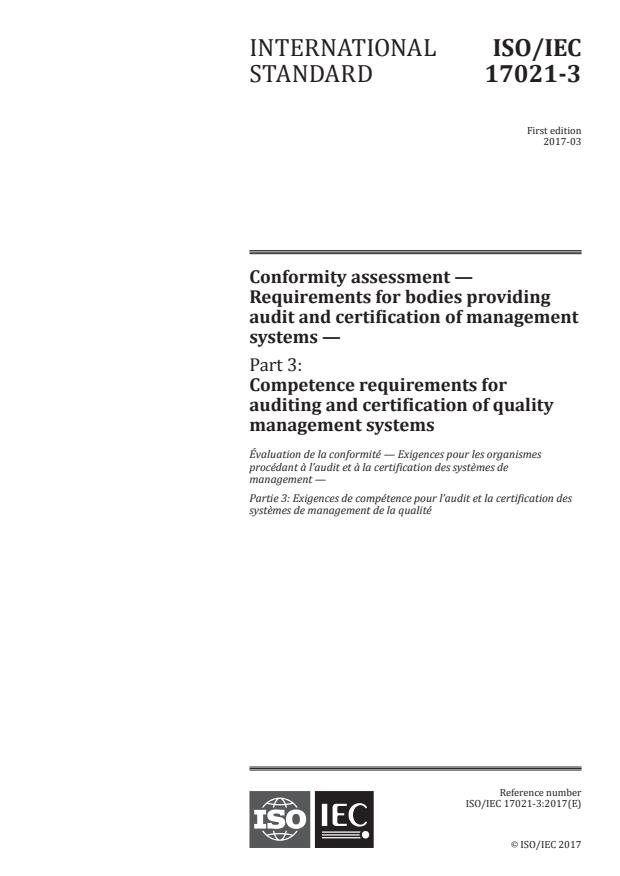
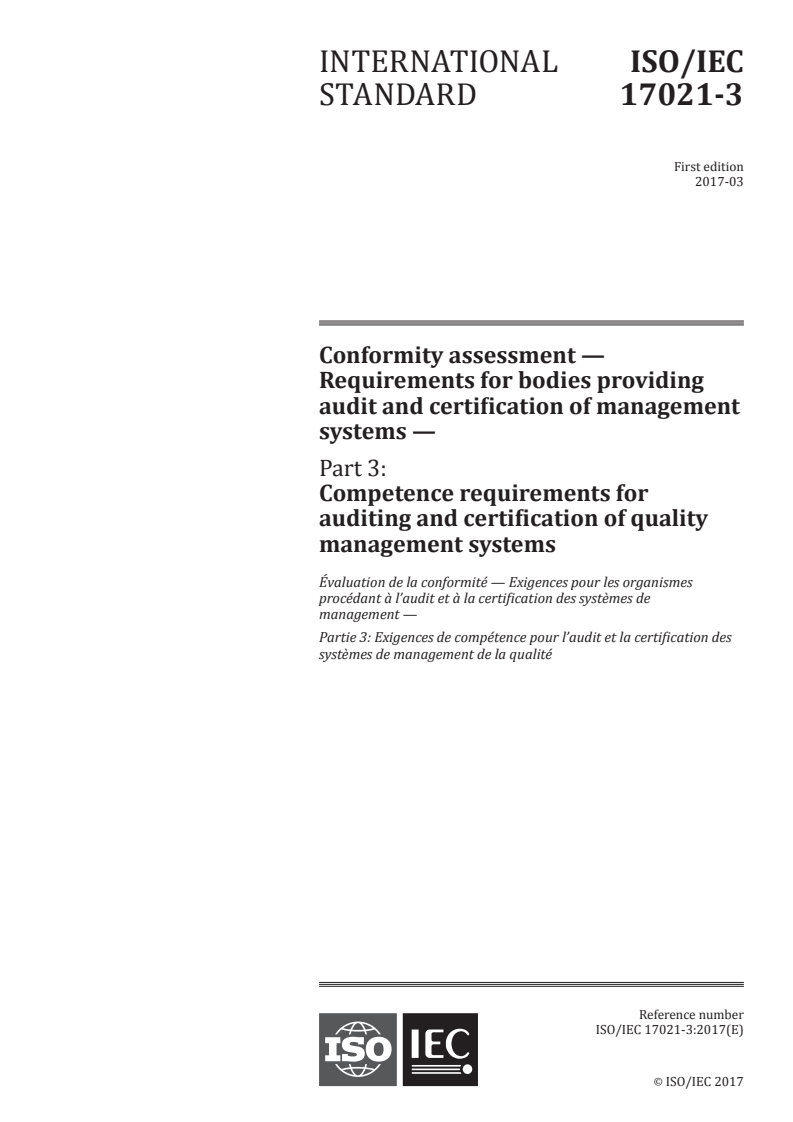
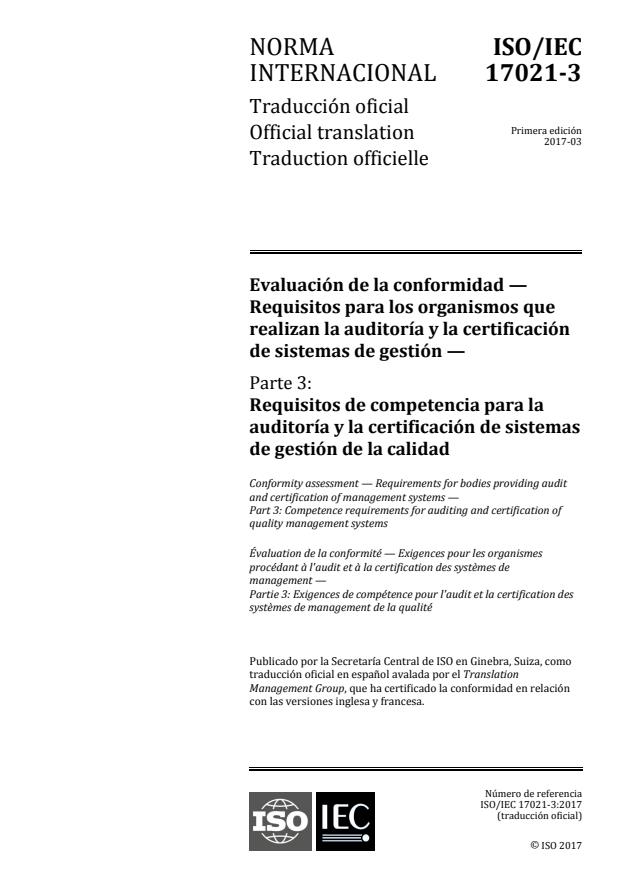
INTERNATIONAL ISO/IEC
STANDARD 17021-3
First edition
2017-03
Conformity assessment —
Requirements for bodies providing
audit and certification of management
systems —
Part 3:
Competence requirements for
auditing and certification of quality
management systems
Évaluation de la conformité — Exigences pour les organismes
procédant à l’audit et à la certification des systèmes de
management —
Partie 3: Exigences de compétence pour l’audit et la certification des
systèmes de management de la qualité
Reference number
©
ISO/IEC 2017
© ISO/IEC 2017, Published in Switzerland
All rights reserved. Unless otherwise specified, no part of this publication may be reproduced or utilized otherwise in any form
or by any means, electronic or mechanical, including photocopying, or posting on the internet or an intranet, without prior
written permission. Permission can be requested from either ISO at the address below or ISO’s member body in the country of
the requester.
ISO copyright office
Ch. de Blandonnet 8 • CP 401
CH-1214 Vernier, Geneva, Switzerland
Tel. +41 22 749 01 11
Fax +41 22 749 09 47
copyright@iso.org
www.iso.org
ii © ISO/IEC 2017 – All rights reserved
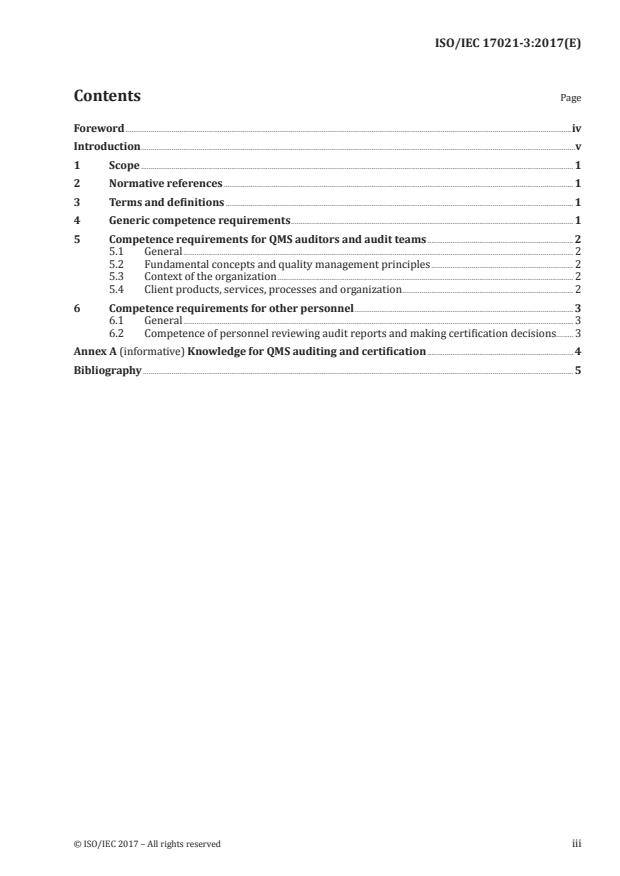
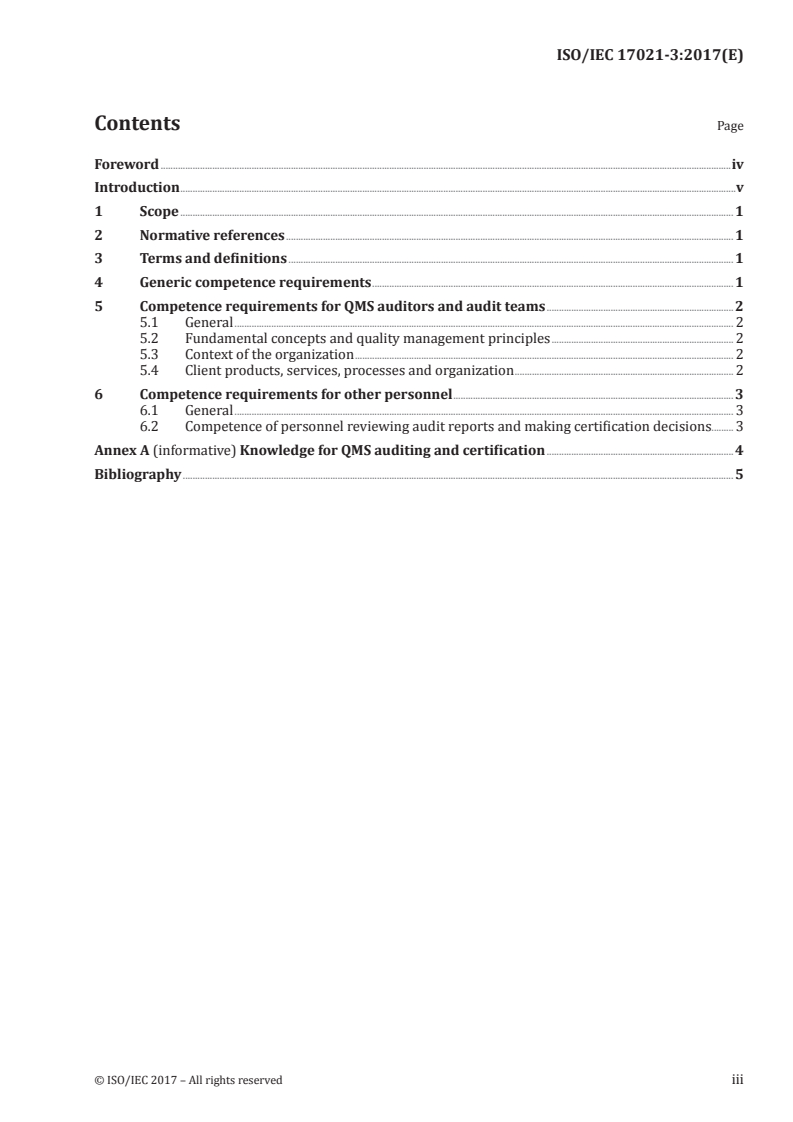
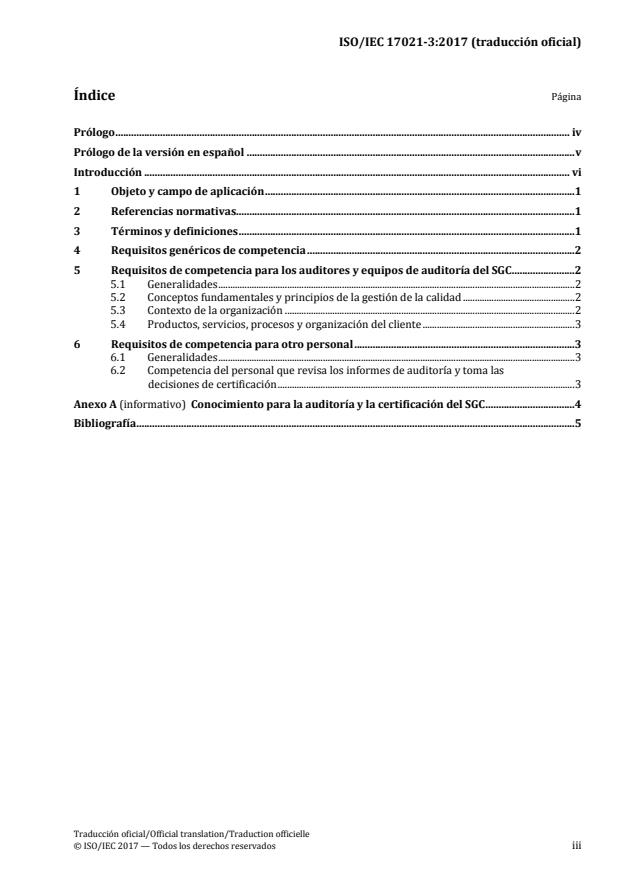
Contents Page
Foreword .iv
Introduction .v
1 Scope . 1
2 Normative references . 1
3 Terms and definitions . 1
4 Generic competence requirements . 1
5 Competence requirements for QMS auditors and audit teams . 2
5.1 General . 2
5.2 Fundamental concepts and quality management principles . 2
5.3 Context of the organization . 2
5.4 Client products, services, processes and organization . 2
6 Competence requirements for other personnel . 3
6.1 General . 3
6.2 Competence of personnel reviewing audit reports and making certification decisions. 3
Annex A (informative) Knowledge for QMS auditing and certification . 4
Bibliography . 5
© ISO/IEC 2017 – All rights reserved iii
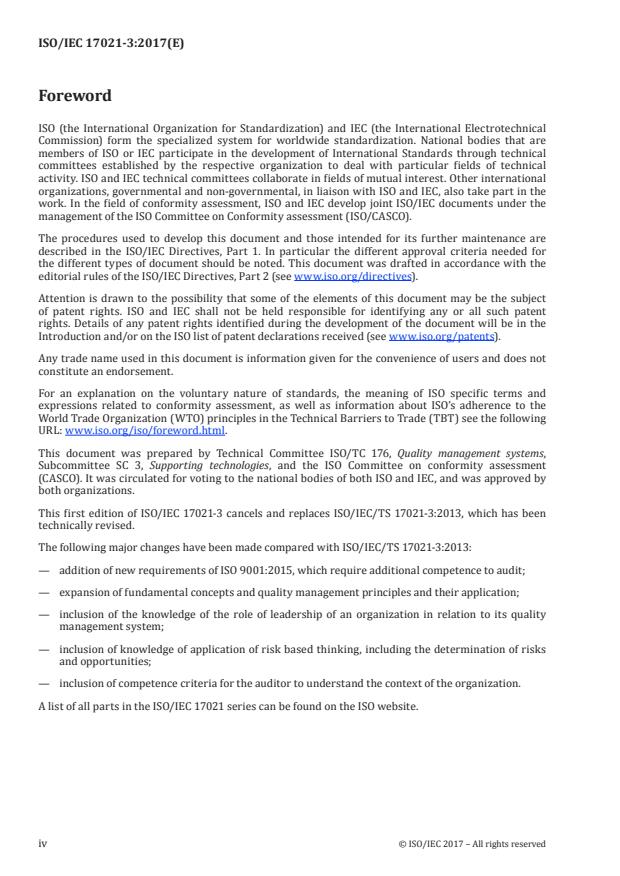
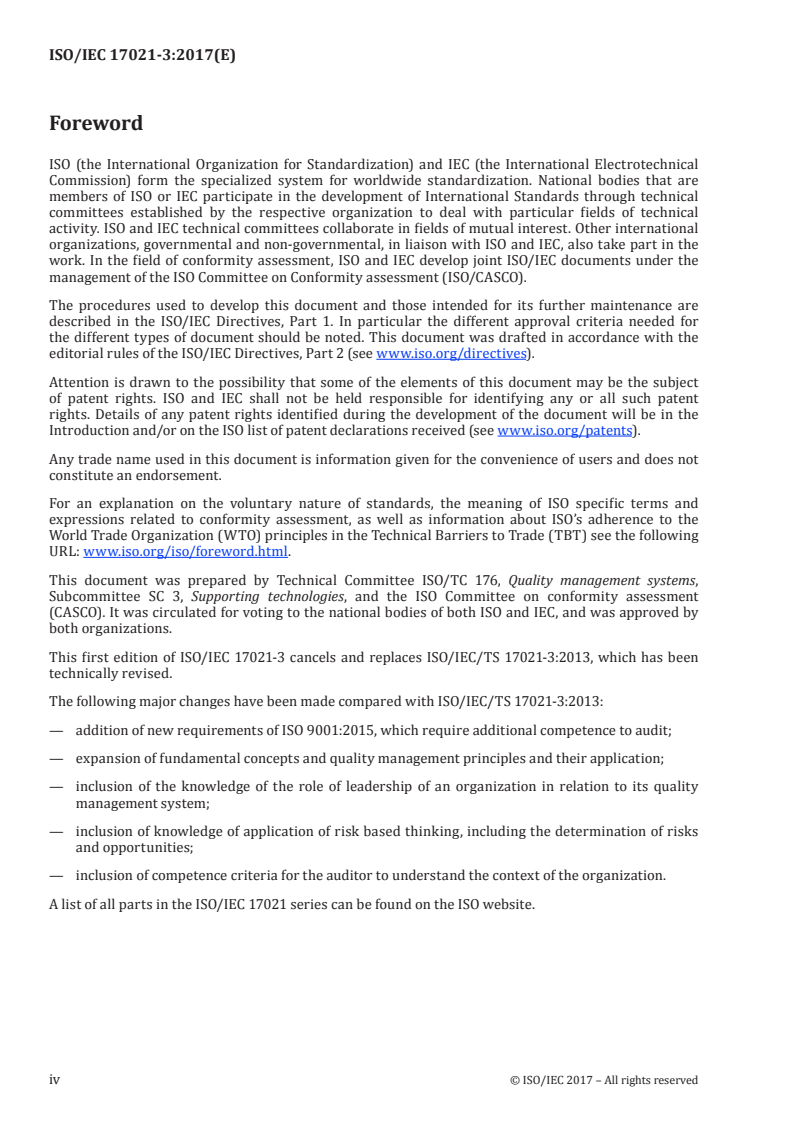
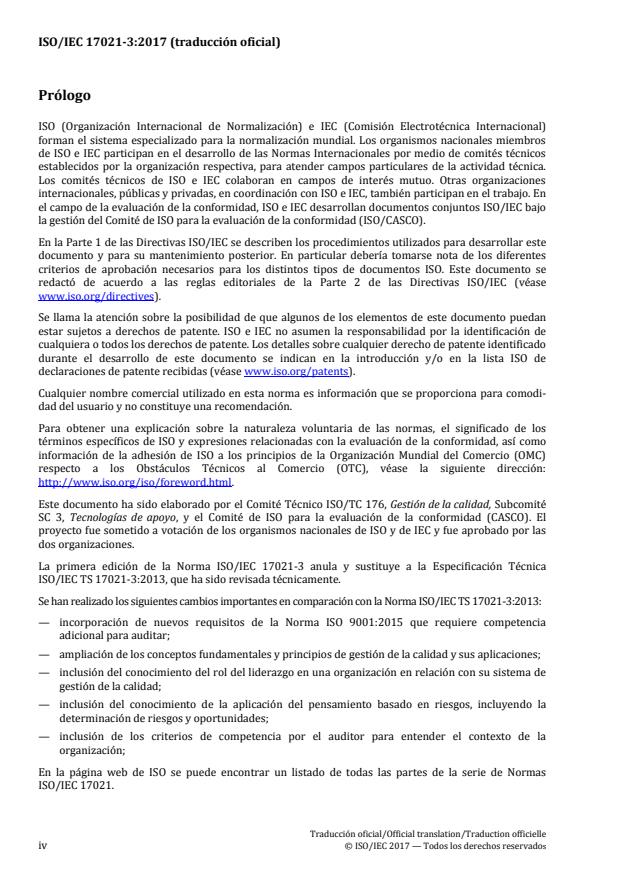
Foreword
ISO (the International Organization for Standardization) and IEC (the International Electrotechnical
Commission) form the specialized system for worldwide standardization. National bodies that are
members of ISO or IEC participate in the development of International Standards through technical
committees established by the respective organization to deal with particular fields of technical
activity. ISO and IEC technical committees collaborate in fields of mutual interest. Other international
organizations, governmental and non-governmental, in liaison with ISO and IEC, also take part in the
work. In the field of conformity assessment, ISO and IEC develop joint ISO/IEC documents under the
management of the ISO Committee on Conformity assessment (ISO/CASCO).
The procedures used to develop this document and those intended for its further maintenance are
described in the ISO/IEC Directives, Part 1. In particular the different approval criteria needed for
the different types of document should be noted. This document was drafted in accordance with the
editorial rules of the ISO/IEC Directives, Part 2 (see www .iso .org/ directives).
Attention is drawn to the possibility that some of the elements of this document may be the subject
of patent rights. ISO and IEC shall not be held responsible for identifying any or all such patent
rights. Details of any patent rights identified during the development of the document will be in the
Introduction and/or on the ISO list of patent declarations received (see www .iso .org/ patents).
Any trade name used in this document is information given for the convenience of users and does not
constitute an endorsement.
For an explanation on the voluntary nature of standards, the meaning of ISO specific terms and
expressions related to conformity assessment, as well as information about ISO’s adherence to the
World Trade Organization (WTO) principles in the Technical Barriers to Trade (TBT) see the following
URL: w w w . i s o .org/ iso/ foreword .html.
This document was prepared by Technical Committee ISO/TC 176, Quality management systems,
Subcommittee SC 3, Supporting technologies, and the ISO Committee on conformity assessment
(CASCO). It was circulated for voting to the national bodies of both ISO and IEC, and was approved by
both organizations.
This first edition of ISO/IEC 17021-3 cancels and replaces ISO/IEC/TS 17021-3:2013, which has been
technically revised.
The following major changes have been made compared with ISO/IEC/TS 17021-3:2013:
— addition of new requirements of ISO 9001:2015, which require additional competence to audit;
— expansion of fundamental concepts and quality management principles and their application;
— inclusion of the knowledge of the role of leadership of an organization in relation to its quality
management system;
— inclusion of knowledge of application of risk based thinking, including the determination of risks
and opportunities;
— inclusion of competence criteria for the auditor to understand the context of the organization.
A list of all parts in the ISO/IEC 17021 series can be found on the ISO website.
iv © ISO/IEC 2017 – All rights reserved
Introduction
This document complements ISO/IEC 17021-1. In particular, it clarifies the requirements for the
competence of personnel involved in the certification process set out in ISO/IEC 17021-1:2015, Clause 7
and Annex A.
Certification bodies have a responsibility to interested parties, including their clients and the customers
of the organizations whose management systems are certified, to ensure that only those auditors who
demonstrate the relevant competence are allowed to conduct quality management system (QMS) audits.
It is intende
...
INTERNATIONAL ISO/IEC
STANDARD 17021-3
First edition
2017-03
Conformity assessment —
Requirements for bodies providing
audit and certification of management
systems —
Part 3:
Competence requirements for
auditing and certification of quality
management systems
Évaluation de la conformité — Exigences pour les organismes
procédant à l’audit et à la certification des systèmes de
management —
Partie 3: Exigences de compétence pour l’audit et la certification des
systèmes de management de la qualité
Reference number
©
ISO/IEC 2017
© ISO/IEC 2017, Published in Switzerland
All rights reserved. Unless otherwise specified, no part of this publication may be reproduced or utilized otherwise in any form
or by any means, electronic or mechanical, including photocopying, or posting on the internet or an intranet, without prior
written permission. Permission can be requested from either ISO at the address below or ISO’s member body in the country of
the requester.
ISO copyright office
Ch. de Blandonnet 8 • CP 401
CH-1214 Vernier, Geneva, Switzerland
Tel. +41 22 749 01 11
Fax +41 22 749 09 47
copyright@iso.org
www.iso.org
ii © ISO/IEC 2017 – All rights reserved
Contents Page
Foreword .iv
Introduction .v
1 Scope . 1
2 Normative references . 1
3 Terms and definitions . 1
4 Generic competence requirements . 1
5 Competence requirements for QMS auditors and audit teams . 2
5.1 General . 2
5.2 Fundamental concepts and quality management principles . 2
5.3 Context of the organization . 2
5.4 Client products, services, processes and organization . 2
6 Competence requirements for other personnel . 3
6.1 General . 3
6.2 Competence of personnel reviewing audit reports and making certification decisions. 3
Annex A (informative) Knowledge for QMS auditing and certification . 4
Bibliography . 5
© ISO/IEC 2017 – All rights reserved iii
Foreword
ISO (the International Organization for Standardization) and IEC (the International Electrotechnical
Commission) form the specialized system for worldwide standardization. National bodies that are
members of ISO or IEC participate in the development of International Standards through technical
committees established by the respective organization to deal with particular fields of technical
activity. ISO and IEC technical committees collaborate in fields of mutual interest. Other international
organizations, governmental and non-governmental, in liaison with ISO and IEC, also take part in the
work. In the field of conformity assessment, ISO and IEC develop joint ISO/IEC documents under the
management of the ISO Committee on Conformity assessment (ISO/CASCO).
The procedures used to develop this document and those intended for its further maintenance are
described in the ISO/IEC Directives, Part 1. In particular the different approval criteria needed for
the different types of document should be noted. This document was drafted in accordance with the
editorial rules of the ISO/IEC Directives, Part 2 (see www .iso .org/ directives).
Attention is drawn to the possibility that some of the elements of this document may be the subject
of patent rights. ISO and IEC shall not be held responsible for identifying any or all such patent
rights. Details of any patent rights identified during the development of the document will be in the
Introduction and/or on the ISO list of patent declarations received (see www .iso .org/ patents).
Any trade name used in this document is information given for the convenience of users and does not
constitute an endorsement.
For an explanation on the voluntary nature of standards, the meaning of ISO specific terms and
expressions related to conformity assessment, as well as information about ISO’s adherence to the
World Trade Organization (WTO) principles in the Technical Barriers to Trade (TBT) see the following
URL: w w w . i s o .org/ iso/ foreword .html.
This document was prepared by Technical Committee ISO/TC 176, Quality management systems,
Subcommittee SC 3, Supporting technologies, and the ISO Committee on conformity assessment
(CASCO). It was circulated for voting to the national bodies of both ISO and IEC, and was approved by
both organizations.
This first edition of ISO/IEC 17021-3 cancels and replaces ISO/IEC/TS 17021-3:2013, which has been
technically revised.
The following major changes have been made compared with ISO/IEC/TS 17021-3:2013:
— addition of new requirements of ISO 9001:2015, which require additional competence to audit;
— expansion of fundamental concepts and quality management principles and their application;
— inclusion of the knowledge of the role of leadership of an organization in relation to its quality
management system;
— inclusion of knowledge of application of risk based thinking, including the determination of risks
and opportunities;
— inclusion of competence criteria for the auditor to understand the context of the organization.
A list of all parts in the ISO/IEC 17021 series can be found on the ISO website.
iv © ISO/IEC 2017 – All rights reserved
Introduction
This document complements ISO/IEC 17021-1. In particular, it clarifies the requirements for the
competence of personnel involved in the certification process set out in ISO/IEC 17021-1:2015, Clause 7
and Annex A.
Certification bodies have a responsibility to interested parties, including their clients and the customers
of the organizations whose management systems are certified, to ensure that only those auditors who
demonstrate the relevant competence are allowed to conduct quality management system (QMS) audits.
It is intende
...
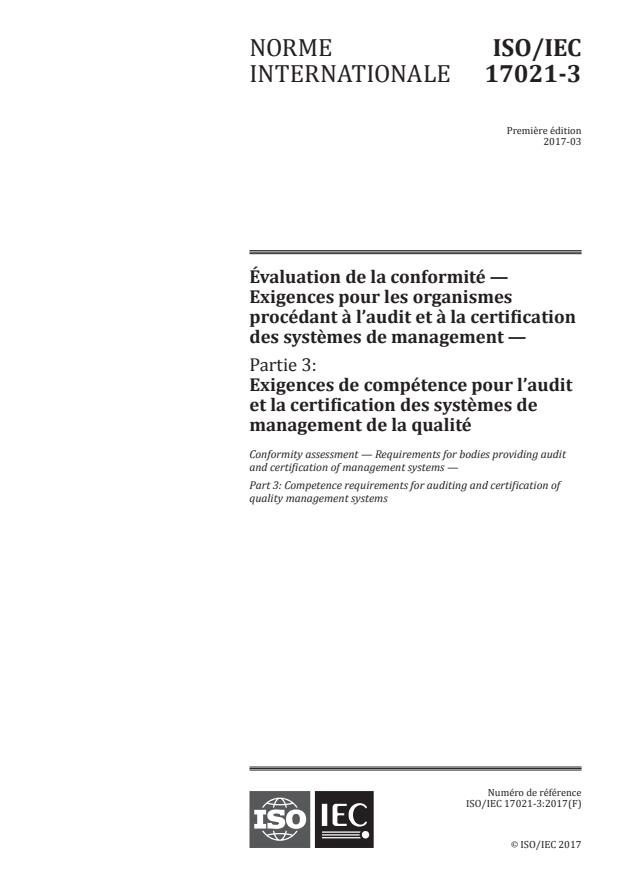
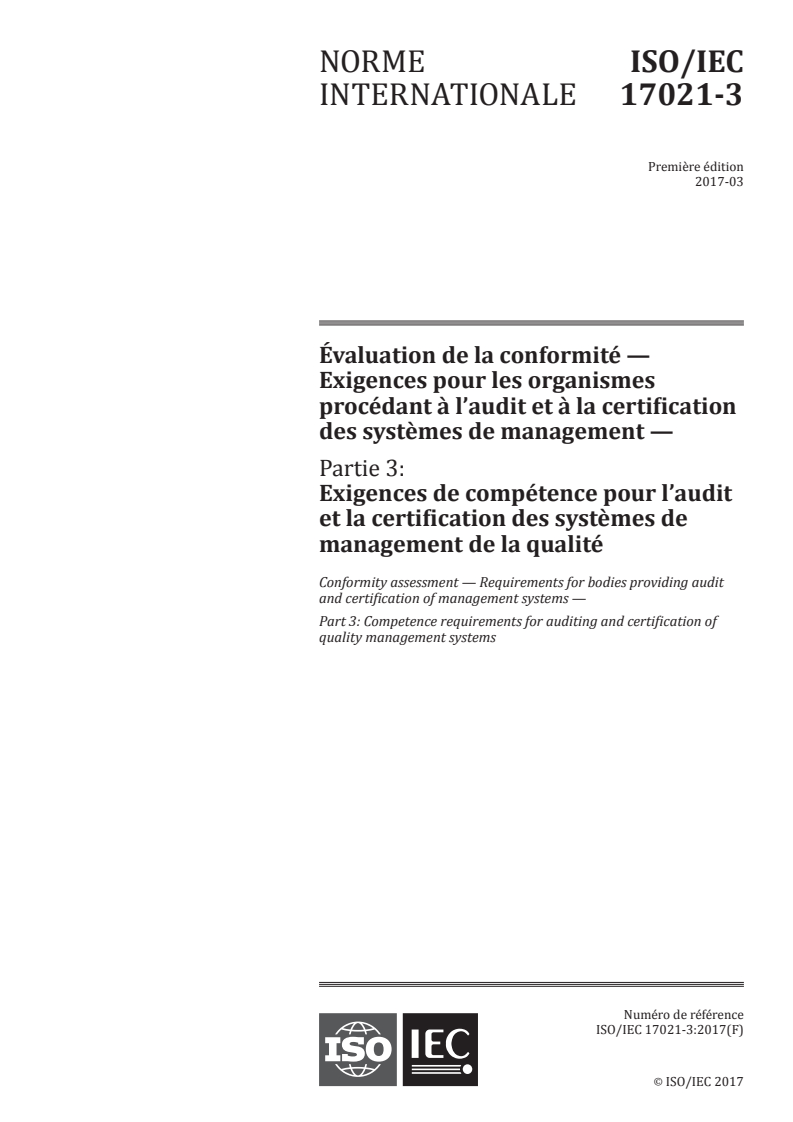
NORME ISO/IEC
INTERNATIONALE 17021-3
Première édition
2017-03
Évaluation de la conformité —
Exigences pour les organismes
procédant à l’audit et à la certification
des systèmes de management —
Partie 3:
Exigences de compétence pour l’audit
et la certification des systèmes de
management de la qualité
Conformity assessment — Requirements for bodies providing audit
and certification of management systems —
Part 3: Competence requirements for auditing and certification of
quality management systems
Numéro de référence
©
ISO/IEC 2017
DOCUMENT PROTÉGÉ PAR COPYRIGHT
© ISO/IEC 2017, Publié en Suisse
Droits de reproduction réservés. Sauf indication contraire, aucune partie de cette publication ne peut être reproduite ni utilisée
sous quelque forme que ce soit et par aucun procédé, électronique ou mécanique, y compris la photocopie, l’affichage sur
l’internet ou sur un Intranet, sans autorisation écrite préalable. Les demandes d’autorisation peuvent être adressées à l’ISO à
l’adresse ci-après ou au comité membre de l’ISO dans le pays du demandeur.
ISO copyright office
Ch. de Blandonnet 8 • CP 401
CH-1214 Vernier, Geneva, Switzerland
Tel. +41 22 749 01 11
Fax +41 22 749 09 47
copyright@iso.org
www.iso.org
ii © ISO/IEC 2017 – Tous droits réservés
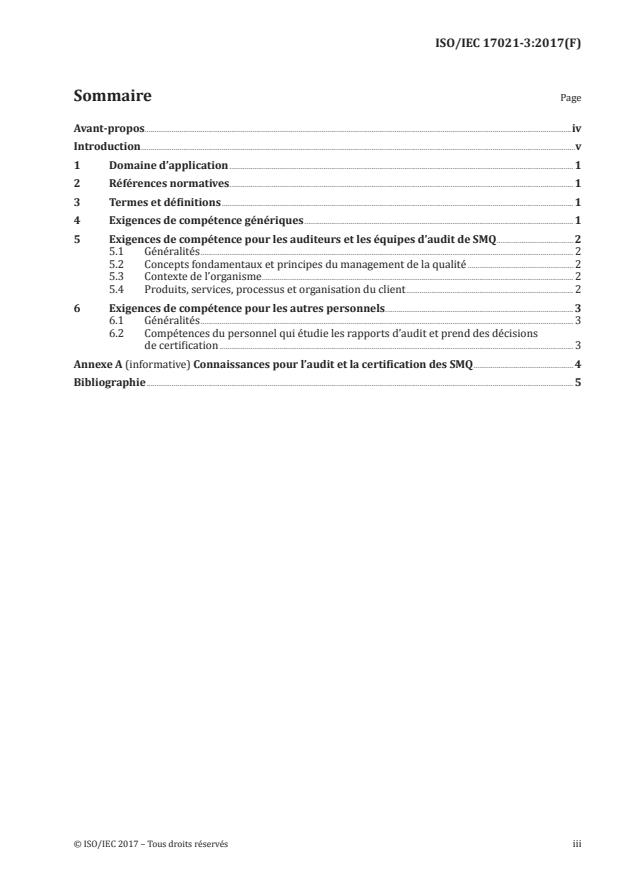
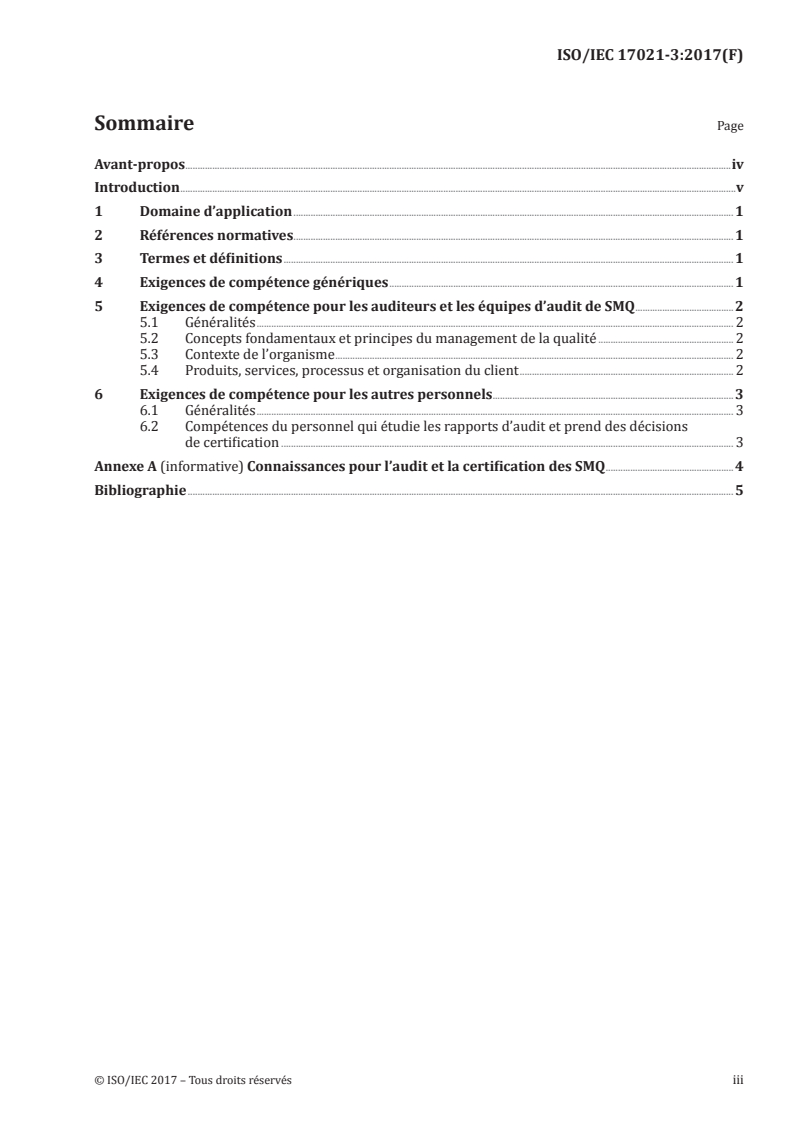
Sommaire Page
Avant-propos .iv
Introduction .v
1 Domaine d’application . 1
2 Références normatives . 1
3 Termes et définitions . 1
4 Exigences de compétence génériques . 1
5 Exigences de compétence pour les auditeurs et les équipes d’audit de SMQ .2
5.1 Généralités . 2
5.2 Concepts fondamentaux et principes du management de la qualité . 2
5.3 Contexte de l’organisme . 2
5.4 Produits, services, processus et organisation du client . 2
6 Exigences de compétence pour les autres personnels . 3
6.1 Généralités . 3
6.2 Compétences du personnel qui étudie les rapports d’audit et prend des décisions
de certification . 3
Annexe A (informative) Connaissances pour l’audit et la certification des SMQ .4
Bibliographie . 5
© ISO/IEC 2017 – Tous droits réservés iii
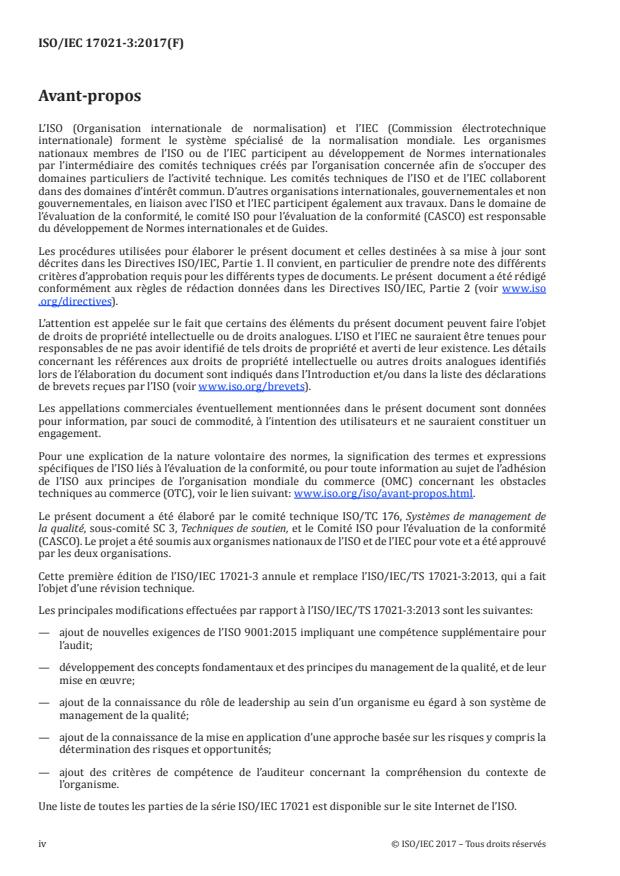
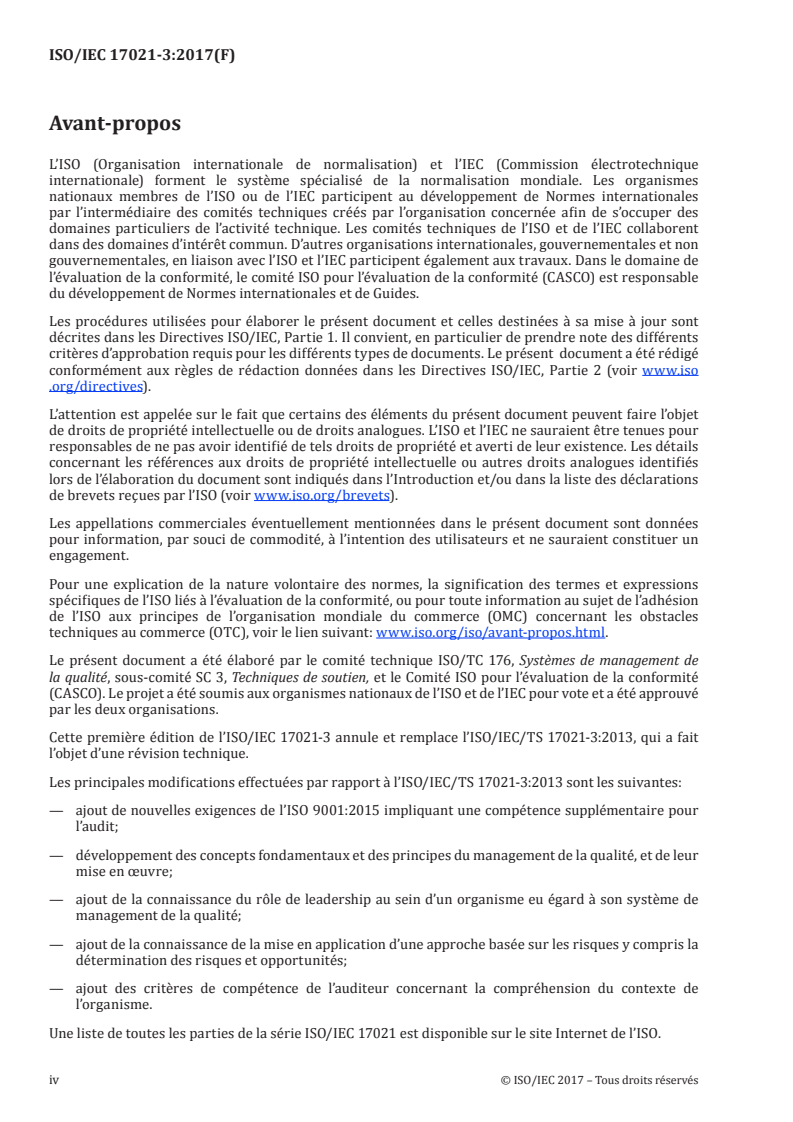
Avant-propos
L’ISO (Organisation internationale de normalisation) et l’IEC (Commission électrotechnique
internationale) forment le système spécialisé de la normalisation mondiale. Les organismes
nationaux membres de l’ISO ou de l’IEC participent au développement de Normes internationales
par l’intermédiaire des comités techniques créés par l’organisation concernée afin de s’occuper des
domaines particuliers de l’activité technique. Les comités techniques de l’ISO et de l’IEC collaborent
dans des domaines d’intérêt commun. D’autres organisations internationales, gouvernementales et non
gouvernementales, en liaison avec l’ISO et l’IEC participent également aux travaux. Dans le domaine de
l’évaluation de la conformité, le comité ISO pour l’évaluation de la conformité (CASCO) est responsable
du développement de Normes internationales et de Guides.
Les procédures utilisées pour élaborer le présent document et celles destinées à sa mise à jour sont
décrites dans les Directives ISO/IEC, Partie 1. Il convient, en particulier de prendre note des différents
critères d’approbation requis pour les différents types de documents. Le présent document a été rédigé
conformément aux règles de rédaction données dans les Directives ISO/IEC, Partie 2 (voir www .iso
.org/ directives).
L’attention est appelée sur le fait que certains des éléments du présent document peuvent faire l’objet
de droits de propriété intellectuelle ou de droits analogues. L’ISO et l’IEC ne sauraient être tenues pour
responsables de ne pas avoir identifié de tels droits de propriété et averti de leur existence. Les détails
concernant les références aux droits de propriété intellectuelle ou autres droits analogues identifiés
lors de l’élaboration du document sont indiqués dans l’Introduction et/ou dans la liste des déclarations
de brevets reçues par l’ISO (voir www .iso .org/ brevets).
Les appellations commerciales éventuellement mentionnées dans le présent document sont données
pour information, par souci de commodité, à l’intention des utilisateurs et ne sauraient constituer un
engagement.
Pour une explication de la nature volontaire des normes, la signification des termes et expressions
spécifiques de l’ISO liés à l’évaluation de la conformité, ou pour toute information au sujet de l’adhésion
de l’ISO aux principes de l’organisation mondiale du commerce (OMC) concernant les obstacles
techniques au commerce (OTC), voir le lien suivant: w w w . i s o .org/ iso/ avant -propos .html.
Le présent document a été élaboré par le comité technique ISO/TC 176, Systèmes de management de
la qualité, sous-comité SC 3, Techniques de soutien, et le Comité ISO pour l’évaluation de la conformité
(CASCO). Le projet a été soumis aux organismes nationaux de l’ISO et de l’IEC pour vote et a été approuvé
par les deux organisations.
Cette première édition de l’ISO/IEC 17021-3 annule et remplace l’ISO/IEC/TS 17021-3:2013, qui a fait
l’objet d’une révision technique.
Les principales modifications effectuées par rapport à l’ISO/IEC/TS 17021-3:2013 sont les suivantes:
— ajout de nouvelles exigences de l’ISO 9001:2015 impliquant une compétence supplémentaire pour
l’audit;
— développement des concepts fondamentaux et des principes du management de la qualité, et de leur
mise en œuvre;
— ajout de la connaissance du rôle de leadership au sein d’un organisme eu égard à son système de
management de la qualité;
— ajout de la connaissance de la mise en application d’une approche basée sur les risques y compris la
détermination des risques et opportunités;
— ajout des critères de compétence de l’auditeur concernant la compréhension du contexte de
l’organisme.
Une liste de toutes les parties de la série ISO/IEC 17021 est disponible sur le site Internet de l’ISO.
iv © ISO/IEC 2017 – Tous droits réservés
Introduction
Le présent document vient compléter l’ISO/IEC 17021-1. En particulier, il clarifie les exigences
concernant les compétences du personnel intervenant dans le processus de certification établies dans
l’ISO/IEC 17021-1:2015, Article 7 et Annexe A.
Les organismes de certification ont la responsabilité envers les parties intéressées, notamment leurs
clients et les clients des organismes dont les systèmes de management sont certifiés, de faire en sorte
que seuls des auditeurs faisant preuve des compétences appropriées soient autorisés à réaliser des
audits de systèmes de management de la qualité (SMQ).
Il convient que tous les personnels impliqués dans des fonctions de certification possèdent les
compétences génériques décrites dans l’ISO/IEC 17021-1
...
NORME ISO/IEC
INTERNATIONALE 17021-3
Première édition
2017-03
Évaluation de la conformité —
Exigences pour les organismes
procédant à l’audit et à la certification
des systèmes de management —
Partie 3:
Exigences de compétence pour l’audit
et la certification des systèmes de
management de la qualité
Conformity assessment — Requirements for bodies providing audit
and certification of management systems —
Part 3: Competence requirements for auditing and certification of
quality management systems
Numéro de référence
©
ISO/IEC 2017
DOCUMENT PROTÉGÉ PAR COPYRIGHT
© ISO/IEC 2017, Publié en Suisse
Droits de reproduction réservés. Sauf indication contraire, aucune partie de cette publication ne peut être reproduite ni utilisée
sous quelque forme que ce soit et par aucun procédé, électronique ou mécanique, y compris la photocopie, l’affichage sur
l’internet ou sur un Intranet, sans autorisation écrite préalable. Les demandes d’autorisation peuvent être adressées à l’ISO à
l’adresse ci-après ou au comité membre de l’ISO dans le pays du demandeur.
ISO copyright office
Ch. de Blandonnet 8 • CP 401
CH-1214 Vernier, Geneva, Switzerland
Tel. +41 22 749 01 11
Fax +41 22 749 09 47
copyright@iso.org
www.iso.org
ii © ISO/IEC 2017 – Tous droits réservés
Sommaire Page
Avant-propos .iv
Introduction .v
1 Domaine d’application . 1
2 Références normatives . 1
3 Termes et définitions . 1
4 Exigences de compétence génériques . 1
5 Exigences de compétence pour les auditeurs et les équipes d’audit de SMQ .2
5.1 Généralités . 2
5.2 Concepts fondamentaux et principes du management de la qualité . 2
5.3 Contexte de l’organisme . 2
5.4 Produits, services, processus et organisation du client . 2
6 Exigences de compétence pour les autres personnels . 3
6.1 Généralités . 3
6.2 Compétences du personnel qui étudie les rapports d’audit et prend des décisions
de certification . 3
Annexe A (informative) Connaissances pour l’audit et la certification des SMQ .4
Bibliographie . 5
© ISO/IEC 2017 – Tous droits réservés iii
Avant-propos
L’ISO (Organisation internationale de normalisation) et l’IEC (Commission électrotechnique
internationale) forment le système spécialisé de la normalisation mondiale. Les organismes
nationaux membres de l’ISO ou de l’IEC participent au développement de Normes internationales
par l’intermédiaire des comités techniques créés par l’organisation concernée afin de s’occuper des
domaines particuliers de l’activité technique. Les comités techniques de l’ISO et de l’IEC collaborent
dans des domaines d’intérêt commun. D’autres organisations internationales, gouvernementales et non
gouvernementales, en liaison avec l’ISO et l’IEC participent également aux travaux. Dans le domaine de
l’évaluation de la conformité, le comité ISO pour l’évaluation de la conformité (CASCO) est responsable
du développement de Normes internationales et de Guides.
Les procédures utilisées pour élaborer le présent document et celles destinées à sa mise à jour sont
décrites dans les Directives ISO/IEC, Partie 1. Il convient, en particulier de prendre note des différents
critères d’approbation requis pour les différents types de documents. Le présent document a été rédigé
conformément aux règles de rédaction données dans les Directives ISO/IEC, Partie 2 (voir www .iso
.org/ directives).
L’attention est appelée sur le fait que certains des éléments du présent document peuvent faire l’objet
de droits de propriété intellectuelle ou de droits analogues. L’ISO et l’IEC ne sauraient être tenues pour
responsables de ne pas avoir identifié de tels droits de propriété et averti de leur existence. Les détails
concernant les références aux droits de propriété intellectuelle ou autres droits analogues identifiés
lors de l’élaboration du document sont indiqués dans l’Introduction et/ou dans la liste des déclarations
de brevets reçues par l’ISO (voir www .iso .org/ brevets).
Les appellations commerciales éventuellement mentionnées dans le présent document sont données
pour information, par souci de commodité, à l’intention des utilisateurs et ne sauraient constituer un
engagement.
Pour une explication de la nature volontaire des normes, la signification des termes et expressions
spécifiques de l’ISO liés à l’évaluation de la conformité, ou pour toute information au sujet de l’adhésion
de l’ISO aux principes de l’organisation mondiale du commerce (OMC) concernant les obstacles
techniques au commerce (OTC), voir le lien suivant: w w w . i s o .org/ iso/ avant -propos .html.
Le présent document a été élaboré par le comité technique ISO/TC 176, Systèmes de management de
la qualité, sous-comité SC 3, Techniques de soutien, et le Comité ISO pour l’évaluation de la conformité
(CASCO). Le projet a été soumis aux organismes nationaux de l’ISO et de l’IEC pour vote et a été approuvé
par les deux organisations.
Cette première édition de l’ISO/IEC 17021-3 annule et remplace l’ISO/IEC/TS 17021-3:2013, qui a fait
l’objet d’une révision technique.
Les principales modifications effectuées par rapport à l’ISO/IEC/TS 17021-3:2013 sont les suivantes:
— ajout de nouvelles exigences de l’ISO 9001:2015 impliquant une compétence supplémentaire pour
l’audit;
— développement des concepts fondamentaux et des principes du management de la qualité, et de leur
mise en œuvre;
— ajout de la connaissance du rôle de leadership au sein d’un organisme eu égard à son système de
management de la qualité;
— ajout de la connaissance de la mise en application d’une approche basée sur les risques y compris la
détermination des risques et opportunités;
— ajout des critères de compétence de l’auditeur concernant la compréhension du contexte de
l’organisme.
Une liste de toutes les parties de la série ISO/IEC 17021 est disponible sur le site Internet de l’ISO.
iv © ISO/IEC 2017 – Tous droits réservés
Introduction
Le présent document vient compléter l’ISO/IEC 17021-1. En particulier, il clarifie les exigences
concernant les compétences du personnel intervenant dans le processus de certification établies dans
l’ISO/IEC 17021-1:2015, Article 7 et Annexe A.
Les organismes de certification ont la responsabilité envers les parties intéressées, notamment leurs
clients et les clients des organismes dont les systèmes de management sont certifiés, de faire en sorte
que seuls des auditeurs faisant preuve des compétences appropriées soient autorisés à réaliser des
audits de systèmes de management de la qualité (SMQ).
Il convient que tous les personnels impliqués dans des fonctions de certification possèdent les
compétences génériques décrites dans l’ISO/IEC 17021-1
...
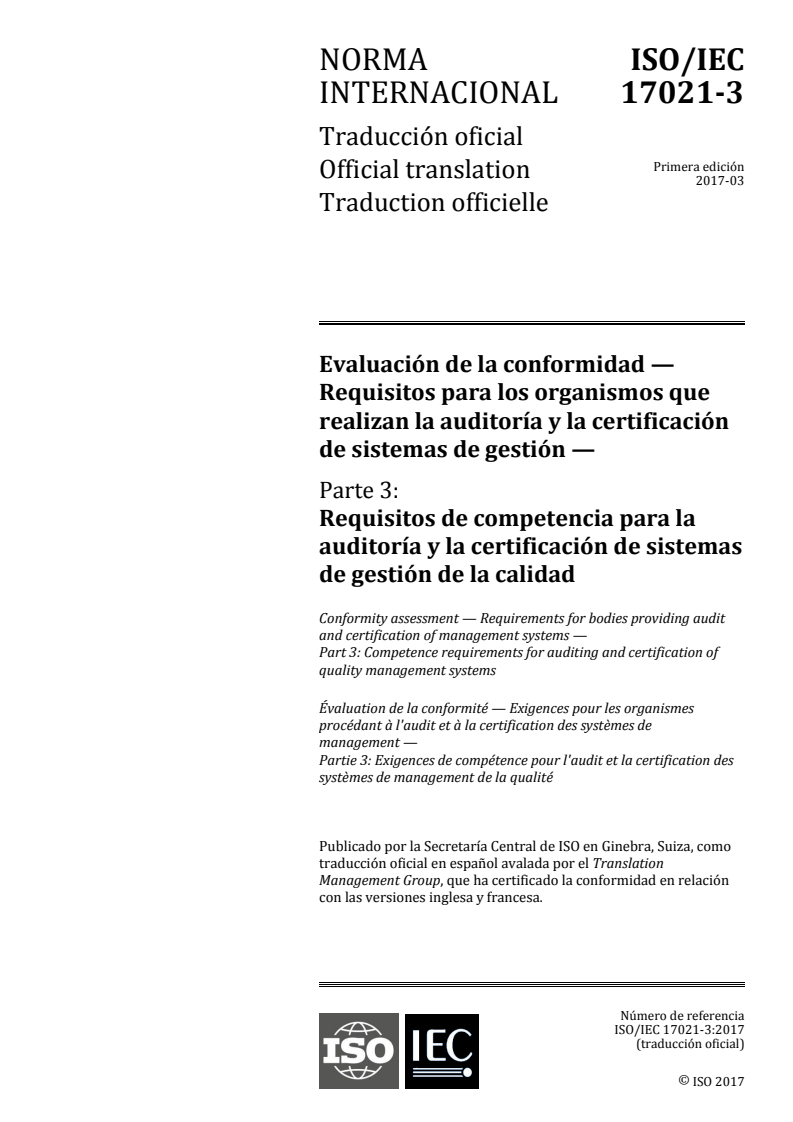
NORMA ISO/IEC
INTERNACIONAL 17021-3
Traducción oficial
Primera edición
Official translation
2017-03
Traduction officielle
Evaluación de la conformidad —
Requisitos para los organismos que
realizan la auditoría y la certificación
de sistemas de gestión —
Parte 3:
Requisitos de competencia para la
auditoría y la certificación de sistemas
de gestión de la calidad
Conformity assessment — Requirements for bodies providing audit
and certification of management systems —
Part 3: Competence requirements for auditing and certification of
quality management systems
Évaluation de la conformité — Exigences pour les organismes
procédant à l'audit et à la certification des systèmes de
management —
Partie 3: Exigences de compétence pour l'audit et la certification des
systèmes de management de la qualité
Publicado por la Secretaría Central de ISO en Ginebra, Suiza, como
traducción oficial en español avalada por el Translation
Management Group, que ha certificado la conformidad en relación
con las versiones inglesa y francesa.
Número de referencia
(traducción oficial)
©
ISO 2017
DOCUMENTO PROTEGIDO POR COPYRIGHT
© ISO/IEC 2017. Publicado en Suiza
Reservados los derechos de reproducción. Salvo prescripción diferente, no podrá reproducirse ni utilizarse ninguna parte de
esta publicación bajo ninguna forma y por ningún medio, electrónico o mecánico, incluidos el fotocopiado, o la publicación en
Internet o una Intranet, sin la autorización previa por escrito. La autorización puede solicitarse a ISO en la siguiente dirección o
al organismo miembro de ISO en el país solicitante.
ISO copyright office
Ch. de Blandonnet 8 CP 401
CH-1214 Vernier, Ginebra, Suiza
Tel. + 41 22 749 01 11
Fax + 41 22 749 09 47
E-mail copyright@iso.org
Web www.iso.org
Versión española publicada en 2017
Traducción oficial/Official translation/Traduction officielle
ii © ISO/IEC 2017 — Todos los derechos reservados
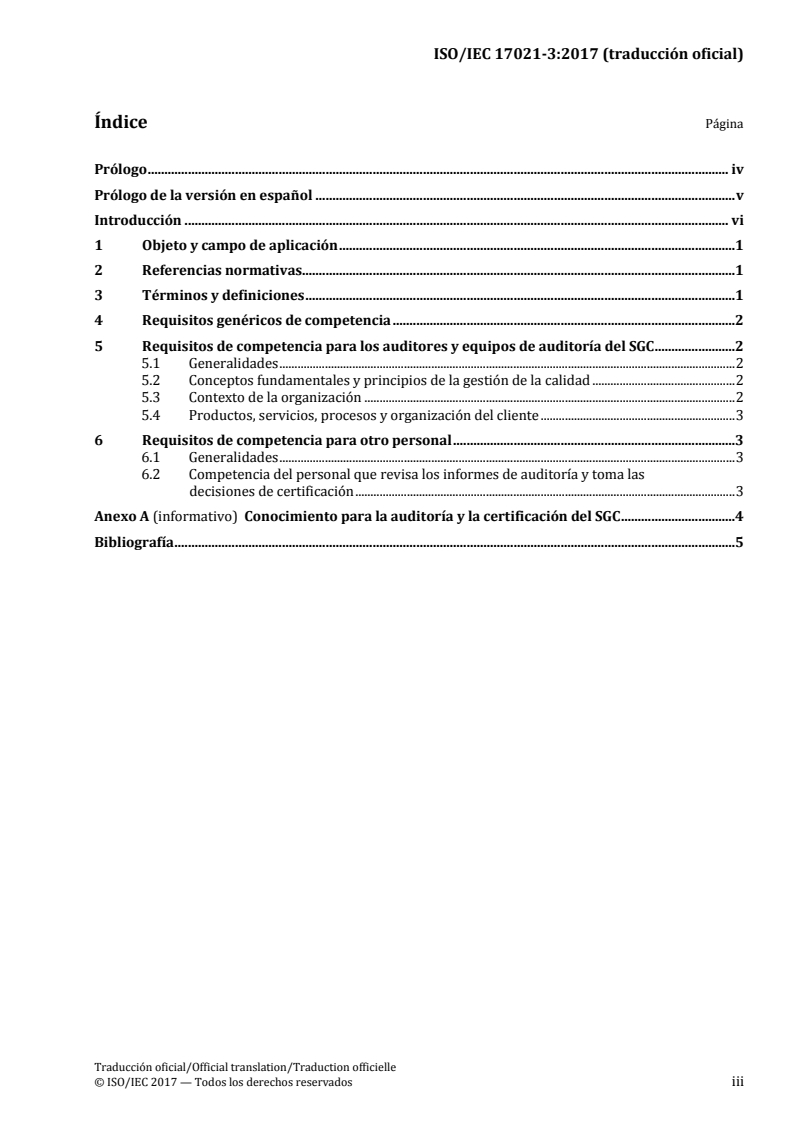
Índice Página
Prólogo . iv
Prólogo de la versión en español . v
Introducción . vi
1 Objeto y campo de aplicación .1
2 Referencias normativas.1
3 Términos y definiciones .1
4 Requisitos genéricos de competencia .2
5 Requisitos de competencia para los auditores y equipos de auditoría del SGC .2
5.1 Generalidades . 2
5.2 Conceptos fundamentales y principios de la gestión de la calidad . 2
5.3 Contexto de la organización . 2
5.4 Productos, servicios, procesos y organización del cliente . 3
6 Requisitos de competencia para otro personal .3
6.1 Generalidades . 3
6.2 Competencia del personal que revisa los informes de auditoría y toma las
decisiones de certificación . 3
Anexo A (informativo) Conocimiento para la auditoría y la certificación del SGC .4
Bibliografía .5
Traducción oficial/Official translation/Traduction officielle
© ISO/IEC 2017 — Todos los derechos reservados iii
Prólogo
ISO (Organización Internacional de Normalización) e IEC (Comisión Electrotécnica Internacional)
forman el sistema especializado para la normalización mundial. Los organismos nacionales miembros
de ISO e IEC participan en el desarrollo de las Normas Internacionales por medio de comités técnicos
establecidos por la organización respectiva, para atender campos particulares de la actividad técnica.
Los comités técnicos de ISO e IEC colaboran en campos de interés mutuo. Otras organizaciones
internacionales, públicas y privadas, en coordinación con ISO e IEC, también participan en el trabajo. En
el campo de la evaluación de la conformidad, ISO e IEC desarrollan documentos conjuntos ISO/IEC bajo
la gestión del Comité de ISO para la evaluación de la conformidad (ISO/CASCO).
En la Parte 1 de las Directivas ISO/IEC se describen los procedimientos utilizados para desarrollar este
documento y para su mantenimiento posterior. En particular debería tomarse nota de los diferentes
criterios de aprobación necesarios para los distintos tipos de documentos ISO. Este documento se
redactó de acuerdo a las reglas editoriales de la Parte 2 de las Directivas ISO/IEC (véase
www.iso.org/directives).
Se llama la atención sobre la posibilidad de que algunos de los elementos de este documento puedan
estar sujetos a derechos de patente. ISO e IEC no asumen la responsabilidad por la identificación de
cualquiera o todos los derechos de patente. Los detalles sobre cualquier derecho de patente identificado
durante el desarrollo de este documento se indican en la introducción y/o en la lista ISO de
declaraciones de patente recibidas (véase www.iso.org/patents).
Cualquier nombre comercial utilizado en esta norma es información que se proporciona para comodi-
dad del usuario y no constituye una recomendación.
Para obtener una explicación sobre la naturaleza voluntaria de las normas, el significado de los
términos específicos de ISO y expresiones relacionadas con la evaluación de la conformidad, así como
información de la adhesión de ISO a los principios de la Organización Mundial del Comercio (OMC)
respecto a los Obstáculos Técnicos al Comercio (OTC), véase la siguiente dirección:
http://www.iso.org/iso/foreword.html.
Este documento ha sido elaborado por el Comité Técnico ISO/TC 176, Gestión de la calidad, Subcomité
SC 3, Tecnologías de apoyo, y el Comité de ISO para la evaluación de la conformidad (CASCO). El
proyecto fue sometido a votación de los organismos nacionales de ISO y de IEC y fue aprobado por las
dos organizaciones.
La primera edición de la Norma ISO/IEC 17021-3 anula y sustituye a la Especificación Técnica
ISO/IEC TS 17021-3:2013, que ha sido revisada técnicamente.
Se han realizado los siguientes cambios importantes en comparación con la Norma ISO/IEC TS 17021-3:2013:
— incorporación de nuevos requisitos de la Norma ISO 9001:2015 que requiere competencia
adicional para auditar;
— ampliación de los conceptos fundamentales y principios de gestión de la calidad y sus aplicaciones;
— inclusión del conocimiento del rol del liderazgo en una organización en relación con su sistema de
gestión de la calidad;
— inclusión del conocimiento de la aplicación del pensamiento basado en riesgos, incluyendo la
determinación de riesgos y oportunidades;
— inclusión de los criterios de competencia por el auditor para entender el contexto de la
organización;
En la página web de ISO se puede encontrar un listado de todas las partes de la serie de Normas
ISO/IEC 17021.
Traducción oficial/Official translation/Traduction officielle
iv © ISO/IEC 2017 — Todos los derechos reservados
Prólogo de la versión en español
Este documento ha sido traducido por el Grupo de Trabajo Spanish Translation Task Force (STTF) del
Comité Técnico ISO/CASCO, Comité para la evaluación de la conformidad, en el que participan
representantes de los organismos nacionales de normalización y representantes del sector empresarial
de los siguientes países:
Argentina, Bolivia, Chile, Colombia, Costa Rica, Cuba, Ecuador, España, Estados Unidos de América,
Guatemala, Honduras, México, Panamá, Perú, República Dominicana y Uruguay.
Igualmente, en el citado Grupo de Trabajo participan representantes de COPANT (Comisión Paname-
ricana de Normas Técnicas) e INLAC (Instituto Latinoamericano de la Calidad).
Esta traducción es parte del resultado del trabajo que el Grupo ISO/CASCO/STTF viene desarrollando
desde su creación en el año 2002 para lograr la unificación de la terminología en lengua española en el
ámbito de la evaluación de la conformidad.
Traducción oficial/Official translation/Traduction officielle
© ISO/IEC 2017 — Todos los derechos reservados v
Introducción
Este documento complementa a la Norma ISO/IEC 17021-1. En particular, aclara los requisitos de
competencia del personal involucrado en el proceso de certificación establecido en el Capítulo 7 y en el
Anexo A de la Norma ISO/IEC 17021-1:2015.
Los organismos de certificación son responsables ante las partes interesadas, incluidos sus clientes y los
clientes de las organizaciones cuyos sistemas de gest
...
NORMA ISO/IEC
INTERNACIONAL 17021-3
Traducción oficial
Primera edición
Official translation
2017-03
Traduction officielle
Evaluación de la conformidad —
Requisitos para los organismos que
realizan la auditoría y la certificación
de sistemas de gestión —
Parte 3:
Requisitos de competencia para la
auditoría y la certificación de sistemas
de gestión de la calidad
Conformity assessment — Requirements for bodies providing audit
and certification of management systems —
Part 3: Competence requirements for auditing and certification of
quality management systems
Évaluation de la conformité — Exigences pour les organismes
procédant à l'audit et à la certification des systèmes de
management —
Partie 3: Exigences de compétence pour l'audit et la certification des
systèmes de management de la qualité
Publicado por la Secretaría Central de ISO en Ginebra, Suiza, como
traducción oficial en español avalada por el Translation
Management Group, que ha certificado la conformidad en relación
con las versiones inglesa y francesa.
Número de referencia
(traducción oficial)
©
ISO 2017
DOCUMENTO PROTEGIDO POR COPYRIGHT
© ISO/IEC 2017. Publicado en Suiza
Reservados los derechos de reproducción. Salvo prescripción diferente, no podrá reproducirse ni utilizarse ninguna parte de
esta publicación bajo ninguna forma y por ningún medio, electrónico o mecánico, incluidos el fotocopiado, o la publicación en
Internet o una Intranet, sin la autorización previa por escrito. La autorización puede solicitarse a ISO en la siguiente dirección o
al organismo miembro de ISO en el país solicitante.
ISO copyright office
Ch. de Blandonnet 8 CP 401
CH-1214 Vernier, Ginebra, Suiza
Tel. + 41 22 749 01 11
Fax + 41 22 749 09 47
E-mail copyright@iso.org
Web www.iso.org
Versión española publicada en 2017
Traducción oficial/Official translation/Traduction officielle
ii © ISO/IEC 2017 — Todos los derechos reservados
Índice Página
Prólogo . iv
Prólogo de la versión en español . v
Introducción . vi
1 Objeto y campo de aplicación .1
2 Referencias normativas.1
3 Términos y definiciones .1
4 Requisitos genéricos de competencia .2
5 Requisitos de competencia para los auditores y equipos de auditoría del SGC .2
5.1 Generalidades . 2
5.2 Conceptos fundamentales y principios de la gestión de la calidad . 2
5.3 Contexto de la organización . 2
5.4 Productos, servicios, procesos y organización del cliente . 3
6 Requisitos de competencia para otro personal .3
6.1 Generalidades . 3
6.2 Competencia del personal que revisa los informes de auditoría y toma las
decisiones de certificación . 3
Anexo A (informativo) Conocimiento para la auditoría y la certificación del SGC .4
Bibliografía .5
Traducción oficial/Official translation/Traduction officielle
© ISO/IEC 2017 — Todos los derechos reservados iii
Prólogo
ISO (Organización Internacional de Normalización) e IEC (Comisión Electrotécnica Internacional)
forman el sistema especializado para la normalización mundial. Los organismos nacionales miembros
de ISO e IEC participan en el desarrollo de las Normas Internacionales por medio de comités técnicos
establecidos por la organización respectiva, para atender campos particulares de la actividad técnica.
Los comités técnicos de ISO e IEC colaboran en campos de interés mutuo. Otras organizaciones
internacionales, públicas y privadas, en coordinación con ISO e IEC, también participan en el trabajo. En
el campo de la evaluación de la conformidad, ISO e IEC desarrollan documentos conjuntos ISO/IEC bajo
la gestión del Comité de ISO para la evaluación de la conformidad (ISO/CASCO).
En la Parte 1 de las Directivas ISO/IEC se describen los procedimientos utilizados para desarrollar este
documento y para su mantenimiento posterior. En particular debería tomarse nota de los diferentes
criterios de aprobación necesarios para los distintos tipos de documentos ISO. Este documento se
redactó de acuerdo a las reglas editoriales de la Parte 2 de las Directivas ISO/IEC (véase
www.iso.org/directives).
Se llama la atención sobre la posibilidad de que algunos de los elementos de este documento puedan
estar sujetos a derechos de patente. ISO e IEC no asumen la responsabilidad por la identificación de
cualquiera o todos los derechos de patente. Los detalles sobre cualquier derecho de patente identificado
durante el desarrollo de este documento se indican en la introducción y/o en la lista ISO de
declaraciones de patente recibidas (véase www.iso.org/patents).
Cualquier nombre comercial utilizado en esta norma es información que se proporciona para comodi-
dad del usuario y no constituye una recomendación.
Para obtener una explicación sobre la naturaleza voluntaria de las normas, el significado de los
términos específicos de ISO y expresiones relacionadas con la evaluación de la conformidad, así como
información de la adhesión de ISO a los principios de la Organización Mundial del Comercio (OMC)
respecto a los Obstáculos Técnicos al Comercio (OTC), véase la siguiente dirección:
http://www.iso.org/iso/foreword.html.
Este documento ha sido elaborado por el Comité Técnico ISO/TC 176, Gestión de la calidad, Subcomité
SC 3, Tecnologías de apoyo, y el Comité de ISO para la evaluación de la conformidad (CASCO). El
proyecto fue sometido a votación de los organismos nacionales de ISO y de IEC y fue aprobado por las
dos organizaciones.
La primera edición de la Norma ISO/IEC 17021-3 anula y sustituye a la Especificación Técnica
ISO/IEC TS 17021-3:2013, que ha sido revisada técnicamente.
Se han realizado los siguientes cambios importantes en comparación con la Norma ISO/IEC TS 17021-3:2013:
— incorporación de nuevos requisitos de la Norma ISO 9001:2015 que requiere competencia
adicional para auditar;
— ampliación de los conceptos fundamentales y principios de gestión de la calidad y sus aplicaciones;
— inclusión del conocimiento del rol del liderazgo en una organización en relación con su sistema de
gestión de la calidad;
— inclusión del conocimiento de la aplicación del pensamiento basado en riesgos, incluyendo la
determinación de riesgos y oportunidades;
— inclusión de los criterios de competencia por el auditor para entender el contexto de la
organización;
En la página web de ISO se puede encontrar un listado de todas las partes de la serie de Normas
ISO/IEC 17021.
Traducción oficial/Official translation/Traduction officielle
iv © ISO/IEC 2017 — Todos los derechos reservados
Prólogo de la versión en español
Este documento ha sido traducido por el Grupo de Trabajo Spanish Translation Task Force (STTF) del
Comité Técnico ISO/CASCO, Comité para la evaluación de la conformidad, en el que participan
representantes de los organismos nacionales de normalización y representantes del sector empresarial
de los siguientes países:
Argentina, Bolivia, Chile, Colombia, Costa Rica, Cuba, Ecuador, España, Estados Unidos de América,
Guatemala, Honduras, México, Panamá, Perú, República Dominicana y Uruguay.
Igualmente, en el citado Grupo de Trabajo participan representantes de COPANT (Comisión Paname-
ricana de Normas Técnicas) e INLAC (Instituto Latinoamericano de la Calidad).
Esta traducción es parte del resultado del trabajo que el Grupo ISO/CASCO/STTF viene desarrollando
desde su creación en el año 2002 para lograr la unificación de la terminología en lengua española en el
ámbito de la evaluación de la conformidad.
Traducción oficial/Official translation/Traduction officielle
© ISO/IEC 2017 — Todos los derechos reservados v
Introducción
Este documento complementa a la Norma ISO/IEC 17021-1. En particular, aclara los requisitos de
competencia del personal involucrado en el proceso de certificación establecido en el Capítulo 7 y en el
Anexo A de la Norma ISO/IEC 17021-1:2015.
Los organismos de certificación son responsables ante las partes interesadas, incluidos sus clientes y los
clientes de las organizaciones cuyos sistemas de gest
...