


ISO 7537:1989
(Main)Petroleum products — Determination of total acid number — Semi-micro colour-indicator titration method
Petroleum products — Determination of total acid number — Semi-micro colour-indicator titration method
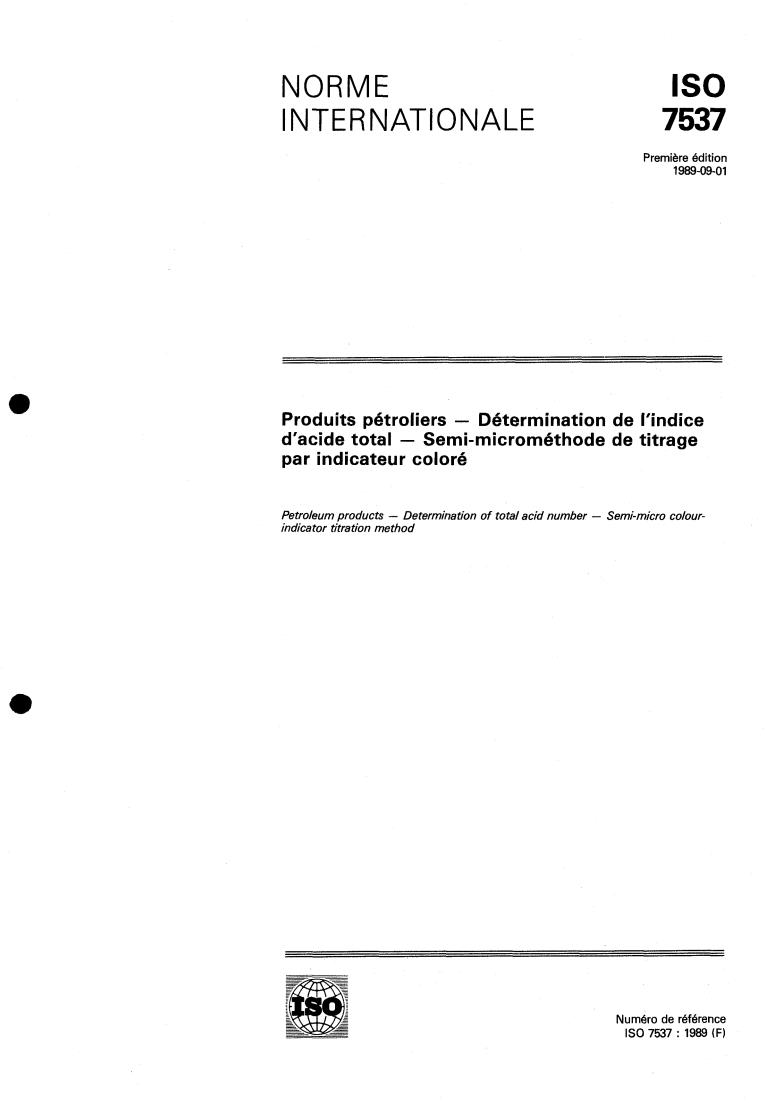
Produits pétroliers — Détermination de l'indice d'acide total — Semi-microméthode de titrage par indicateur coloré
General Information
- Status
- Withdrawn
- Publication Date
- 20-Sep-1989
- Withdrawal Date
- 20-Sep-1989
- Current Stage
- 9599 - Withdrawal of International Standard
- Start Date
- 10-Jul-1997
- Completion Date
- 12-Feb-2026
Relations
- Effective Date
- 15-Apr-2008
ISO 7537:1989 - Petroleum products -- Determination of total acid number -- Semi-micro colour-indicator titration method
ISO 7537:1989 - Petroleum products — Determination of total acid number — Semi-micro colour-indicator titration method Released:9/21/1989
Get Certified
Connect with accredited certification bodies for this standard

ABS Quality Evaluations Inc.
American Bureau of Shipping quality certification.

Element Materials Technology
Materials testing and product certification.

ABS Group Brazil
ABS Group certification services in Brazil.
Sponsored listings
Frequently Asked Questions
ISO 7537:1989 is a standard published by the International Organization for Standardization (ISO). Its full title is "Petroleum products — Determination of total acid number — Semi-micro colour-indicator titration method". This standard covers: Petroleum products — Determination of total acid number — Semi-micro colour-indicator titration method
Petroleum products — Determination of total acid number — Semi-micro colour-indicator titration method
ISO 7537:1989 is classified under the following ICS (International Classification for Standards) categories: 75.080 - Petroleum products in general. The ICS classification helps identify the subject area and facilitates finding related standards.
ISO 7537:1989 has the following relationships with other standards: It is inter standard links to ISO 7537:1997. Understanding these relationships helps ensure you are using the most current and applicable version of the standard.
ISO 7537:1989 is available in PDF format for immediate download after purchase. The document can be added to your cart and obtained through the secure checkout process. Digital delivery ensures instant access to the complete standard document.
Standards Content (Sample)
INTER NATIONAL IS0
STANDARD
First edition
1989-09-01 '
Petroleum products - Determination of total
acid number - Semi-micro colour-indicator
titration method
Produits pétroliers - Détermination de l'indice d'acide total - Semi-microméthode
de titrage par indicateur coloré
Reference number
IS0 7537 : 1989 (E)
Foreword
IS0 (the International Organization for Standardization) is a worldwide federation of
national standards bodies (IS0 member bodies). The work of preparing International
Standards is normally carried out through IS0 technical committees. Each member
body interested in a subject for which a technical committee has been established has
the right to be represented on that committee. International organizations, govern-
mental and non-governmental, in liaison with ISO, also take part in the work. IS0
collaborates closely with the International Electrotechnical Commission (IEC) on all
matters of electrotechnical standardization.
Draft International Standards adopted by the technical committees are circulated to
the member bodies for approval before their acceptance as International Standards by
the IS0 Council. They are approved in accordance with IS0 procedures requiring at
least 75 % approval by the member bodies voting.
International Standard IS0 7537 was prepared by Technical Committee ISO/TC 28,
Petroleum products and lubricants.
O IS0 1989
All rights reserved. No part of this publication may be reproduced or utilized in any form or by any
means, electronic or mechanical, including photocopying and microfilm, without permission in
writing from the publisher.
International Organization for Standardization
Case postale 56 O CH-I211 Genève 20 O Switzerland
Printed in Switzerland
INTERNATIONAL STANDARD
IS0 7537 : 1989 (E)
Petroleum products - Determination of total acid
number - Semi-micro colour-indicator titration
method
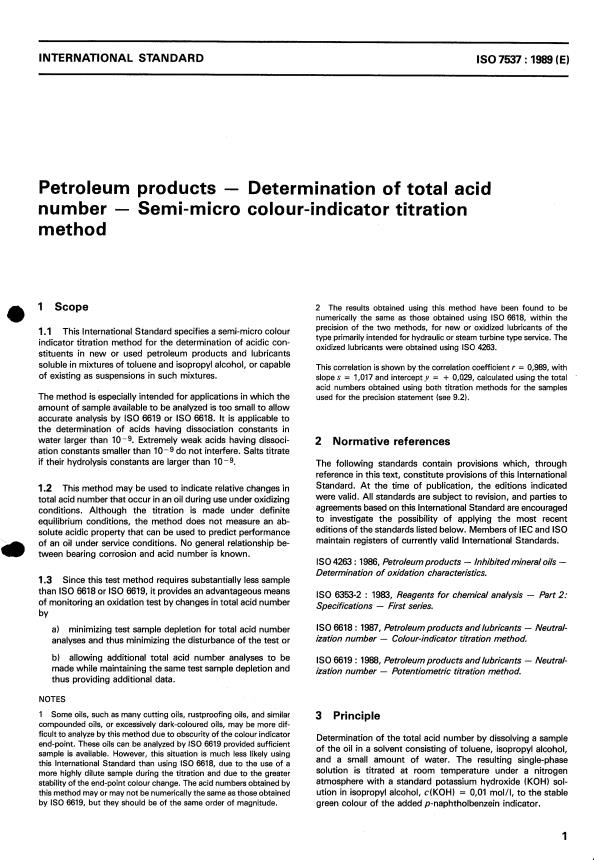
1 Scope 2 The results obtained using this method have been found to be
numerically the same as those obtained using IS0 6618, within the
precision of the two methods, for new or oxidized lubricants of the
1.1 This International Standard specifies a semi-micro colour
type primarily intended for hydraulic or steam turbine type service. The
indicator titration method for the determination of acidic con-
oxidized lubricants were obtained using IS0 4263.
stituents in new or used petroleum products and lubricants
soluble in mixtures of toluene and isopropyl alcohol, or capable
This correlation is shown by the correlation coefficient r = 0,989, with
of existing as suspensions in such mixtures.
slope s = 1,017 and intercept y = + 0,029, calculated using the total
acid numbers obtained using both titration methods for the samples
The method is especially intended for applications in which the used for the precision statement (see 9.2).
amount of sample available to be analyzed is too small to allow
accurate analysis by IS0 6619 or IS0 6618. It is applicable to
the determination of acids having dissociation constants in
water larger than 10-9. Extremely weak acids having dissoci-
2 Normative references
ation constants smaller than 10-9 do not interfere. Salts titrate
if their hydrolysis constants are larger than 10-9.
The following standards contain provisions which, through
reference in this text, constitute provisions of this International
Standard. At the time of publication, the editions indicated
1.2 This method may be used to indicate relative changes in
were valid. All standards are subject to revision, and parties to
total acid number that occur in an oil during use under oxidizing
agreements based on this International Standard are encouraged
conditions. Although the titration is made under definite
to investigate the possibility of applying the most recent
equilibrium conditions, the method does not measure an ab-
editions of the standards listed below. Members of IEC and IS0
solute acidic property that can be used to predict performance
maintain registers of currently valid International Standards.
of an oil under service conditions. No general relationship be-
tween bearing corrosion and acid number is known.
IS0 4263 : 1986, Petroleum products - lnhibitedmineral oils -
Determination of oxidation characteristics.
1.3 Since this test method requires substantially less sample
than IS0 6618 or IS0 6619, it provides an advantageous means
IS0 6353-2 : 1983, Reagents for chemical analysis - Part 2:
of monitoring an oxidation test by changes in total acid number
Specifications - First series.
bY
IS0 6618 : 1987, Petroleum products and lubricants - Neutral-
a) minimizing test sample depletion for total acid number
ization number - Colour-indicator titration method.
analyses and thus minimizing the disturbance of the test or
b) allowing additional total acid number analyses to be
IS0 6619 : 1988, Petroleum products and lubricants - Neutral-
made while maintaining the same test sample depletion and
ization number - Potentiometric titration method.
thus providing additional data.
NOTES
1 Some oils, such as many cutting oils, rustproofing oils, and similar
3 Principle
compounded oils, or excessively dark-coloured oils, may be more dif-
ficult to analyze by this method due to obscurity of the colour indicator
Determination of the total acid number by dissolving a sample
IS0 6619 provided sufficient
end-point. These oils can be analyzed by
of the oil in a solvent consisting of toluene, isopropyl alcohol,
sample is available. However, this situation is much less likely using
and a small amount of water. The resulting single-phase
this International Standard than using IS0 6618, due to the use of a
solution is titrated at room temperature under a nitrogen
more highly dilute sample during the titration and due to the greater
(KOH) sol-
atmosphere with a standard potassium hydroxide
stability of the end-point colour change. The acid numbers obtained by
this method may or may not be numerically the same as those obtained ution in isopropyl alcohol, c(K0H) = 0,Ol mol/l, to the stable
by IS0 6619, but they should be of the same order of magnitude.
green colour of the added p-naphtholbenzein indicator.
IS0 7537 : 1989 (E)
Store the titrant in a chemically resistant dispensing bottle out
4 Definition
of contact with cork, rubber, or saponifiable stopcock lubricant
total acid number: The quantity of KOH, expressed in and protected by a guard tube containing soda-lime. Minimize
exposure of the titrant to light by storing in the dark or in an
milligrams, required to titrate all acids or salts present in one
gram of the sample having dissociation or hydrolysis constants amber bottle or by wrapping the bottle with aluminium foil.
larger than 10 -9.
NOTE - Because of the relatively large coefficient of cubic expansion
of organic liquids such as isopropyl alcohol, the standard alcoholic sol-
utions should be standardized at temperatures close to those employed
in the titrations of samples.
5 Reagents and materials
During the analysis, unless otherwise stated, use only reagents 5.5.2 Standardization
of recognized analytical grade. All reference to water shall be
Standardize the titrant against dried (at least 1 h at 110 'Cl,
understood to mean freshly distilled (carbon dioxide free)
pure potassium hydrogen phthalate using the method specified
water.
in 8.1 for the total acid number analysis, but using water
(40 ml f 1 mi) as the solvent and 6 drops of phenolphthalein
5.1 p-Naphtholbenzein indicator solution, conforming to
solution as the indicator.
the specifications given in annexes A and B of IS0 6618.
Carry out the blank in the same manner, but omitting the
Prepare a solution containing 10 g of p-naphtholbenzein per
potassium hydrogen phthalate. Standardize the titrant fre-
litre of titration solvent.
a
quently enough to detect variations exceeding 0,000 3 mol/l.
Take the mean normality determined by at least duplicate
5.2 Nitrogen, dry and carbon dioxide free.
analyses as the titrant concentration for the total acid number
calculations.
NOTE - In order to obtain repeatable results and a stable end-point
colour change, it is especially important that the nitrogen purge gas be
free of carbon dioxide. Prepurified grade nitrogen has been found to be
5.6 Toluene, complying with the requirements of
satisfactory.
IS0 6353-2.
5.3 Phenolphthalein indicator solution
6 Apparatus
Dissolve 0,lO g of pure, solid phenolphthalein in 50 ml of water
50 ml of 95 % i V/ V) ethanol.
and
6.1 Titration burette, micro-scale, automatic, with 0,Ol ml
subdivisions and at least a 2 ml burette capacity.
5.4 Titration solvent
6.2 Titrant reservoir, preferably one which is integral with
the automatic burette, such as that shown in figure 1.
Add 500 ml of toluene and 5 ml of water to 495 ml of anhydrous
isopropyl alcohol.
If a titrant reservoir separate from the automatic burette is
used, the line connecting the reservoir with the burette shall be
5.5 Potassium hydroxide, alcoholic solution, standard all glass.
*
= 0,01 mol/l.
volumetric, c(K0H)
Exposure of the titrant to light shall be minimized by the use of
amber glass for the reservoir, by wrapping the reservoir with
5.5.1 Preparation foil such as aluminium foil, or by other suitable means.
The tube in the reservoir for titrant withdrawal shall be adjusted
Add 3 g of solid KOH to approximately 1 litre of anhydrous
so that the end of the tube is about 20 mm from the bottom of
0,9 % water) in a 2 litre
isopropyl alcohol (containing less than
the reservoir so that any precipitate that may collect on the bot-
conical flask. Boil the mixture gently on a steam bath for 15 min
tom of the reservoir will not be disturbed. To further avoid
while stirring to prevent caking of solids on the bottom of the
disturbing any precipitate in the reservoir, movement of the
flask.
reservoir shal
...
NORME IS0
I N T E R NAT I O N A LE 7537
Première édition
1989-09-01
Produits pétroliers - Détermination de l'indice
- Semi-microméthode de titrage
d'acide total
par i nd ka teu r coloré
Petroleum products - Determination of total acid number - Semi-micro colour-
indicator titration method
Numéro de référence
IS0 7537 : 1989 (FI
IS0 7537 : 1989 (FI
Avant-propos
L'ISO (Organisation internationale de normalisation) est une fédération mondiale
d'organismes nationaux de normalisation (comités membres de I'ISO). L'élaboration
des Normes internationales est en général confiée aux comités techniques de 1'1S0.
Chaque comité membre intéressé par une étude a le droit de faire partie du comité
technique créé à cet effet. Les organisations internationales, gouvernementales et non
I'ISO participent également aux travaux. L'ISO
gouvernementales, en liaison avec
collabore étroitement avec la Commission électrotechnique internationale (CE11 en ce
qui concerne la normalisation électrotechnique.
Les projets de Normes internationales adoptés par les comités techniques sont soumis
aux comités membres pour approbation, avant leur acceptation comme Normes inter-
nationales par le Conseil de I'ISO. Les Normes internationales sont approuvées confor-
mément aux procédures de I'ISO qui requièrent l'approbation de 75 % au moins des
comités membres votants.
La Norme internationale IS0 7537 a été élaborée par le comité technique ISO/TC 28,
Produits pétroliers et lubrifiants.
O IS0 1989
Droits de reproduction réservés. Aucune partie de cette publication ne peut être reproduite ni
utilisée sous quelque forme que ce soit et par aucun procédé, électronique ou mécanique,
y compris la photocopie et les microfilms, sans l'accord écrit de l'éditeur.
Organisation internationale de normalisation
Case postale 56 O CH-121 1 Genève 20 O Suisse
Imprimé en Suisse
NORME INTERNATIONALE IS0 7537 : 1989 (F)
~~~
Produits pétroliers - Détermination de l'indice
d'acide total - Semi-microméthode de titrage par
indicateur coloré
1 Domaine d'application méthode, en raison de la coloration foncée au point de virage de I'indi-
cateur coloré. Ces huiles peuvent être analysées par I'ISO 6619, du
moment que l'on dispose d'une quantité suffisante d'échantillon.
1 .I La présente Norme internationale prescrit une semi-
Cependant, cette situation risque de se produire beaucoup plus rare-
microméthode de titrage par indicateur coloré pour la détermi- ment avec la présente Norme internationale qu'avec I'ISO 6618, car la
présente Norme utilise un échantillon beaucoup plus dilué pendant le
nation des constituants acides des produits pétroliers et des
titrage et, en outre, en raison de la plus grande stabilité du changement
lubrifiants, neufs ou usés, solubles dans des mélanges de
de couleur au point final le point de virage présente une stabilité plus
et de propanol-2, ou pouvant se présenter en suspen-
toluène
grande. Les indices d'acide obtenus par cette méthode peuvent être
sion dans de tels mélanges.
numériquement identiques à ceux obtenus par I'ISO 6619, comme ils
peuvent être différents, mais ils devraient avoir le même ordre de
La méthode est destinée tout particulièrement à être appliquée
grandeur.
lorsque la quantité d'échantillon disponible à analyser est trop
2 On a constaté que les résultats obtenus par cette méthode étaient
petite pour permettre une analyse précise selon I'ISO 6619 ou
numériquement les mêmes que ceux obtenus par l'utilisation de
1'1S0 6618. Elle est applicable à la détermination des acides
I'ISO 6618, dans les limites de précision des deux méthodes, pour les
ayant des constantes de dissociation dans l'eau supérieures à
lubrifiants neufs ou oxydés du type fondamentalement destiné aux
10 -9. Les acides extrêmement faibles, présentant une cons-
fluides hydrauliques ou aux huiles turbines. Les lubrifiants oxydés ont
tante de dissociation inférieure à 10-9, ne perturbent pas les
été obtenus par l'utilisation de 1'1S0 4263.
résultats. Les sels sont titrés si leur constante d'hydrolyse est
Cette corrélation est démontrée par le coefficient de corrélation
supérieure à 10-9.
r = 0,989, avec une pente s = 1,017 et une ordonnée à l'origine
y = + 0,029, calculés avec les indices d'acide total obtenus par les
deux méthodes de titrage, pour les échantillons utilisés à propos du
1.2 Cette méthode peut être utilisée pour indiquer les modifi-
contrôle de fidélité (voir 9.2).
cations relatives de l'indice d'acide total qui se produisent dans
une huile en cours d'utilisation dans des conditions oxydantes.
Bien que le titrage soit effectué dans des conditions d'équilibre
2 Références normatives
parfaitement définies, la méthode ne mesure pas une propriété
0 d'acide absolue susceptible d'être utilisée pour prévoir les per-
Les normes suivantes contiennent des dispositions qui, par
formances d'une huile dans les conditions de service. L'on ne
suite de la référence qui en est faite, constituent des disposi-
connaît aucune relation générale entre la corrosion des paliers
tions valables pour la présente Norme internationale. Au
et l'indice d'acide.
moment de la publication de cette norme, les éditions indiquées
étaient en vigueur. Toute norme est sujette à révision et les
1.3 Comme cette méthode d'essai exige un échantillon de
parties prenantes des accords fondés sur cette Norme interna-
volume nettement plus faible que dans I'ISO 6618 ou I'ISO 6619, tionale sont invitées à rechercher la possibilité d'appliquer les
elle fournit un moyen avantageux de surveiller un essai d'oxy- éditions les plus récentes des normes indiquées ci-après. Les
dation par l'étude des variations de l'indice d'acide total membres de la CE1 et de 1'1S0 possèdent le registre des Normes
internationales en vigueur à un moment donné.
a) en minimisant l'épuisement de l'échantillon d'essai uti-
lisé pour l'analyse de l'indice d'acide total, et donc en mini-
IS0 4263 : 1986, Produits pétroliers - Huiles minérales
misant les perturbations apportées à l'essai; ou
inhibées - Détermination des caractéristiques d'oxydation.
b) en permettant d'effectuer un plus grand nombre
IS0 6353-2 : 1983, Réactifs pour analyse chimique - Partie 2:
d'analyses de l'indice d'acide total, tout en conservant le Spécifications - Première série.
même épuisement de l'échantillon d'essai, ce qui permet
IS0 6618 : 1987, Produits pétroliers et lubrifiants - Détermina-
d'obtenir un plus grand nombre de résultats.
tion de l'indice de neutralisation - Méthode de titrage par indi-
cateur coloré.
NOTES
IS0 6619 : 1988, Produits pétroliers et lubrifiants - Détermina-
1 Certaines huiles, comme de nombreuses huiles de coupe, les huiles
tion de l'indice de neutralisation - Méthode par titrage
anti-rouille et les huiles composées analogues, ou bien des huiles extrê-
potentiométrique.
mement foncées, risquent d'être plus difficiles à analyser par cette
IS0 7537 : 1989 (FI
Refroidir à la température ambiante, mettre un bouchon pour
3 Principe
éviter tout contact avec l'atmosphère ambiante et laisser
Détermination de l'indice d'acide total par dissolution d'un
reposer jusqu'au lendemain (environ 16 h).
échantillon de l'huile dans un solvant comprenant du toluène,
Filtrer le liquide surnageant à travers un filtre à membrane au
du propanol-2 et une faible quantité d'eau. La solution mono-
10 pn, en évitant toute expo-
phasique obtenue est titrée à la température ambiante sous polytétrafluoréthylène (PTFE) de
sition inutile à l'atmosphère, puis diluer la solution (environ
atmosphère d'azote avec une solution étalon d'hydroxyde
0,05 mol/l avec du propanol-2 anhydre jusqu'à un volume total
de potassium, c(KOH) = 0,Ol mol/l, étalonnée dans du
d'environ 5 litres) pour obtenir la concentration finale de
propanol-2 jusqu'à obtention d'une coloration verte stable de
f 0,002 mol/l.
l'indicateur p-naphtolbenzéine ajouté. 0,010 mol/l
Stocker le produit de titrage dans un flacon distributeur résis-
tant aux produits chimiques, hors de contact avec le liège, le
4 Définition
caoutchouc ou un lubrifiant saponifiable pour robinet, ce flacon
indice d'acide total: Quantité de KOH, exprimée en milligram- étant en outre protégé par un tube de garde contenant de la
chaux sodée. Réduire au maximum l'exposition du produit de
mes, nécessaire pour titrer tous les acides ou tous les sels se
trouvant dans 1 gramme d'échantillon, et dont la constante de titrage à la lumière en le stockant à l'obscurité ou dans un
flacon coloré, ou bien en enveloppant le flacon avec une feuille
dissociation ou d'hydrolyse est supérieure à 10-9.
d'aluminium.
NOTE - En raison du coefficient de dilatation volumique relativement
5 Réactifs
élevé des liquides organiques, du type propanol-2, il faut étalonner les
solutions alcooliques à des températures proches de celles employées
Au cours de l'analyse, sauf indications différentes, utiliser uni-
pour le titrage des échantillons.
quement des réactifs de qualité analytique reconnue, et de l'eau
distillée ou de l'eau de pureté équivalente.
5.5.2 Étalonnage
Toute référence à l'eau doit être comprise comme se rapportant
La solution de titrage est étalonné avec du phtalate acide de
à de l'eau fraîchement distillée, exempte de dioxyde de
potassium pur, séché à 110 OC pendant au moins 1 h, et en uti-
carbone.
lisant la méthode décrite en 8.1 pour l'analyse de l'indice
d'acide total, sauf que l'on utilise 40 ml I 1 ml d'eau en tant
5.1 p-Naphtolbenzéine, solution d'indicateur conforme aux
que solvant, l'indicateur consistant en 6 gouttes d'une solution
spécifications données dans les annexes A et B de I'ISO 6618.
de phénolphtaléine.
Préparer une solution contenant 10 g de p-naphtolbenzéine par
litre de solvant de titrage. Le témoin est obtenu de la même manière, sauf que l'on n'uti-
lise pas de phtalate acide de potassium. Étalonner le produit de
titrage à des périodicités suffisamment rapprochées pour
5.2 Azote. sec et exempt de dioxyde de carbone.
déceler des variations de 0,Oûû 3 mol/l ou plus.
NOTE - Pour obtenir des résultats répétables et un virage stable, il est
La concentration moyenne, déterminée par au moins deux
particulièrement important que l'azote utilisé comme gaz de purge soit
analyses, est utilisée en tant que concentration de la solution de
exempt de dioxyde de carbone. L'on a constaté que de l'azote qualité
titrage pour les calculs de l'indice d'acide total.
pré-purifiée donnait de bons résultats.
Toluène, conforme aux spécifications de I'ISO 6353-2
5.3 Phénolphtaléine, solution d'indicateur. 5.6
(réactif R 39).
Dissoudre 0,lO g de phénolphtaléine solide pure dans 50 ml
d'eau et 50 ml d'éthanol à 95 % ( V/ VI.
6 Appareillage
5.4 Solvant de titrage
Matériel courant de laboratoire, et notamment:
Ajouter 500 ml de toluène et 5 ml d'eau à 495 ml de propanol-2
anhydre.
6.1 Burette de titrage, type microburette, automatique,
graduations 0,Ol ml, capacité totale d'au moins 2 ml.
5.5 Hydroxyde de potassium, solution titrée,
c(KOH) = 0,01mol/l dans le propanol-2.
6.2 Réservoir A solution de titrage, de préférence réservoir
solidaire de la burette automatique, comme représenté à la
5.5.1 Préparation figure 1.
Ajouter 3 g de KOH solide à environ 1 litre de propanol-2 On peut utiliser un réservoir à solution de titrage distinct de la
anhydre (contenant moins de 0,9 % d'eau) dans une fiole burette automatique si la conduite reliant le réservoir à la
conique de 2 litres. Porter doucement le mélange à ébullition burette est entièrement en verre.
sur un bain de vapeur pendant 15 min tout en agitant pour
II faut réduire au maximum l'exposition du produit de titrage à
éviter la prise en motte des solides sur le fond de la fiole
la lumière, en utilisant un verre coloré pour le réservoir, en
enveloppant ce dernier par exemple avec une feuille d'alumi-
Ajouter environ 1 g d'hydroxyde de baryum et, de nouveau,
porter doucement à ébullition pendant 10 min. nium, ou par d'autres moyens convenables.
...
Questions, Comments and Discussion
Ask us and Technical Secretary will try to provide an answer. You can facilitate discussion about the standard in here.
Loading comments...