

ISO 7278-2:2022/Amd 1:2026
(Amendment)Petroleum measurement systems — Part 2: Pipe prover design, calibration and operation — Amendment 1
- Status
- Published
- Publication Date
- 02-Jun-2026
- Technical Committee
- ISO/TC 28/SC 2 - Measurement of petroleum and related products
- Drafting Committee
- ISO/TC 28/SC 2/WG 4 - Metering and meter calibration
- Current Stage
- 6060 - International Standard published
- Start Date
- 03-Jun-2026
- Due Date
- 25-Apr-2028
- Completion Date
- 03-Jun-2026
Buy Documents
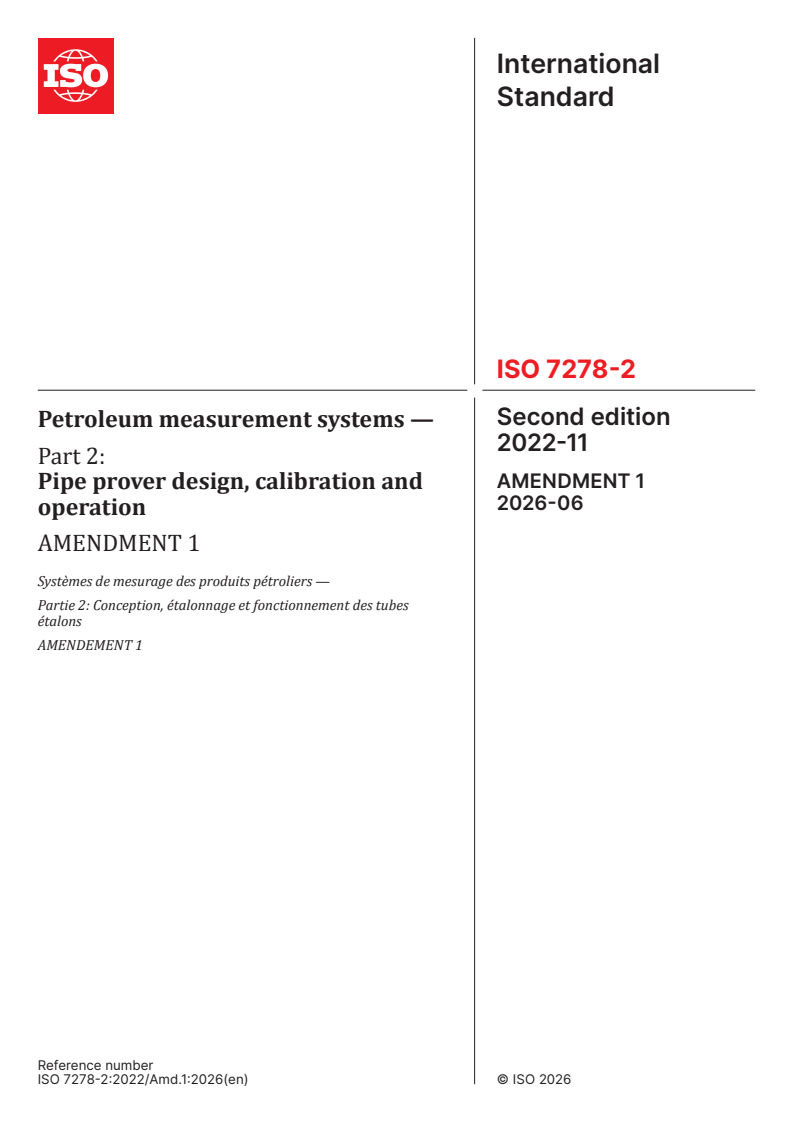

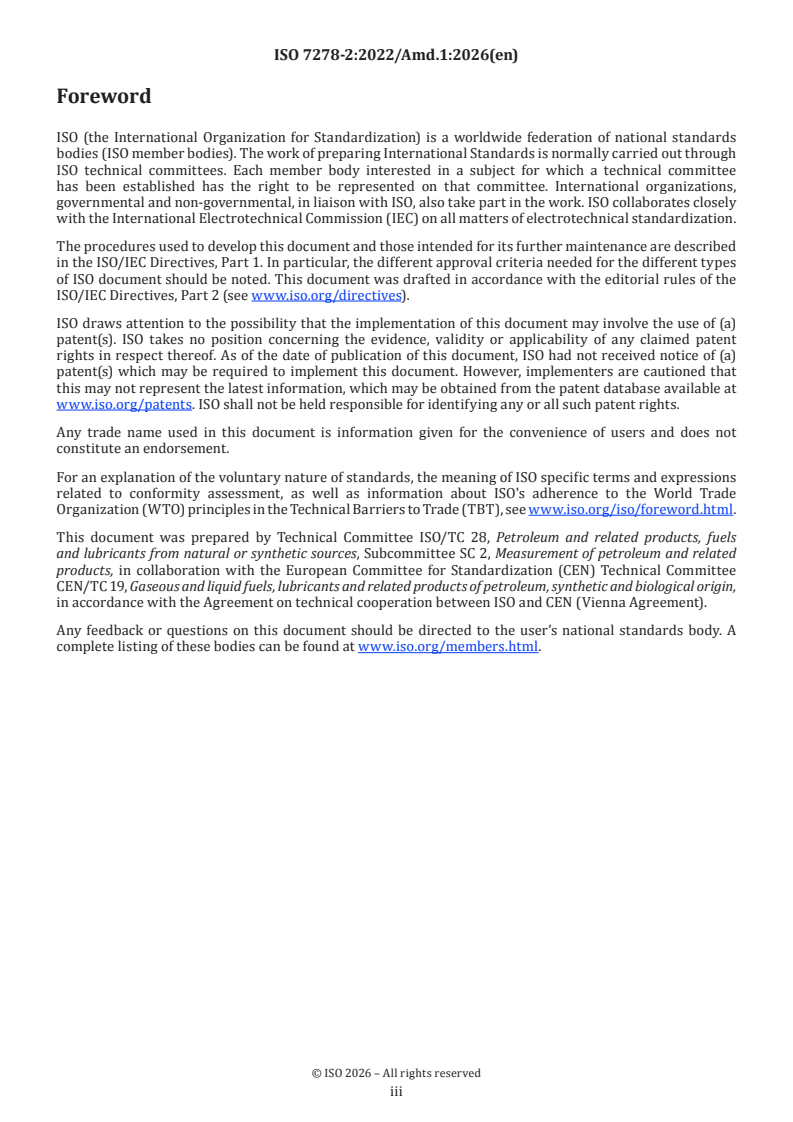

ISO 7278-2:2022/Amd 1:2026 - Petroleum measurement systems — Part 2: Pipe prover design, calibration and operation — Amendment 1
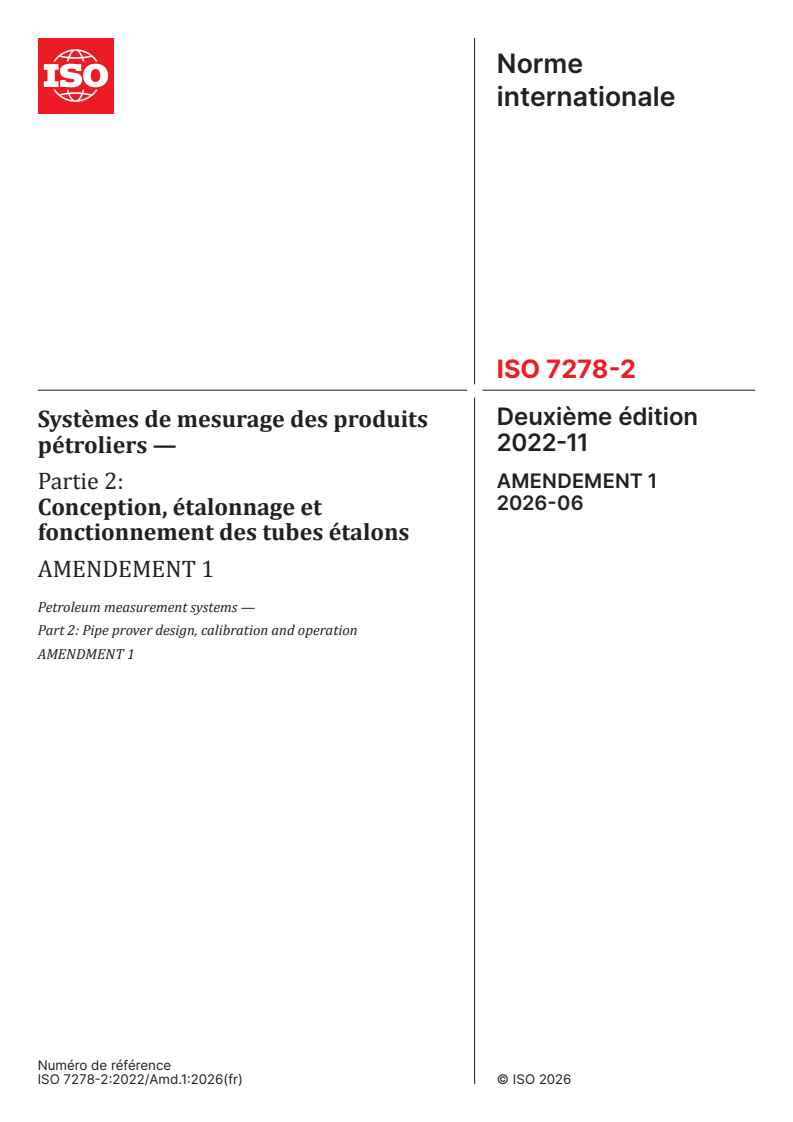
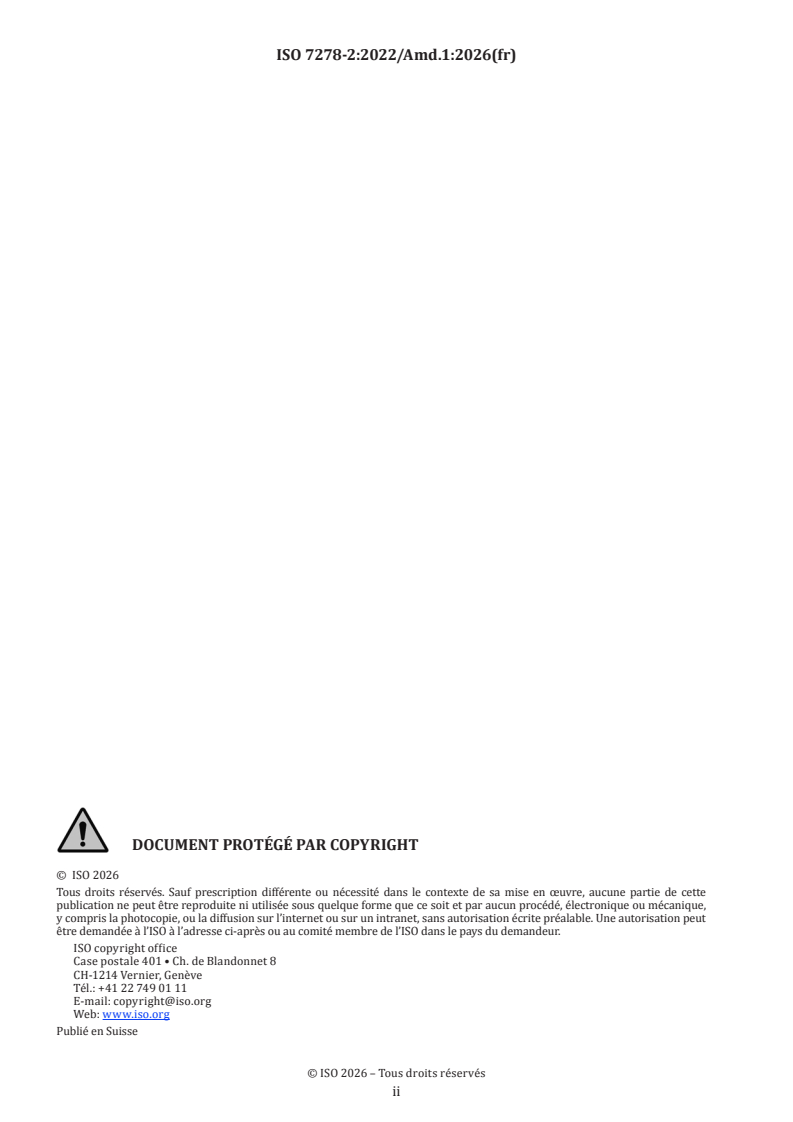

ISO 7278-2:2022/Amd 1:2026 - Systèmes de mesurage des produits pétroliers — Partie 2: Conception, étalonnage et fonctionnement des tubes étalons — Amendement 1
ISO 7278-2:2022/Amd 1:2026 is an ISO amendment to Petroleum measurement systems - Part 2: Pipe prover design, calibration and operation. It updates how prover spheres are inspected and sized, adds checks before calibration, and adds a reporting note for temporary calibration arrangements. The amendment is for people who design, operate, inspect, calibrate, or report on pipe provers used in petroleum measurement.
What does ISO 7278-2:2022/Amd 1:2026 specify?
ISO 7278-2:2022/Amd 1:2026 specifies changes to ISO 7278-2:2022. It revises the guidance for sphere inspection and sizing in Clause 6, adds a pre-calibration leak-check paragraph in Clause 11, and adds a reporting item in Annex H.
- Clause 6.5.2 text is deleted.
- New Clause 6.5.4, Sphere inspection and sizing, is inserted.
- Clause 11.2 gains a paragraph on leak checking and safe sphere removal before calibration.
- Annex H.1 gains a new item on recording temporary modifications used during calibration.
In practice, the amendment tightens the steps used to confirm sphere condition, measurement quality, and calibration traceability.
What are the key requirements of ISO 7278-2:2022/Amd 1:2026?
ISO 7278-2:2022/Amd 1:2026 gives updated guidance for selecting, checking, measuring, and reporting prover spheres. The main practical point is that the sphere must fit the prover correctly, be measured with suitable instruments, and be checked for wear or leakage before calibration work continues.
- Sphere inspection and sizing, Clause 6.5.4 - New and removed spheres are to be inspected in the same general way, and an extracted sphere should have an "as found" diameter recorded. This matters because it gives the operator a condition check before the sphere is put back into service or replaced.
- Ordering and compatibility, Clause 6.5.4 - When ordering a new or replacement sphere, the prover inside diameter and the required oversize inflation are to be provided, and the sphere should suit the fluid and operating conditions. In practice, this helps avoid mismatches that can cause leakage, poor switching, or material problems.
- Visual and dimensional checks, Clause 6.5.4 - The sphere should be checked for bulges, flats, cuts, abrasions, wear, degradation, softening, and expiry date where applicable. This means diameter alone is not enough - the surface condition also has to be judged.
- Measurement methods, Clause 6.5.4 - The document describes three usual measurement approaches: an outside micrometre or calliper with a calibrated length standard, slip rings, or a purpose-made diameter/circumference tape. This matters because the chosen method has to suit the sphere size and provide the needed resolution and uncertainty.
- Measurement practice and traceability, Clause 6.5.4 - Instruments should be calibrated to a recognised standard, inspected periodically, and re-calibrated at intervals based on use and experience. The sphere should be measured with adequate discrimination, and the measurement method should support the required uncertainty.
- Multiple diameters and ovality, Clause 6.5.4 - The sphere is measured across at least two perpendicular diameters, with one measurement across the filling valve(s), and the smallest diameter is reported. The difference between the largest and smallest diameter should stay within the ovality criterion cited from API MPMS, chapter 4 section 9, part 2, so that worn or distorted spheres can be rejected.
- Before calibration, Clause 11.2 - The system should be checked for leakage before calibration starts, and the operation or leak checking of a four-way valve, or the seal leakage test of a piston prover, should be carried out when appropriate. This reduces the risk of calibrating with a faulty prover condition.
- Calibration reporting, Annex H.1 - Any temporary modification made to help calibration, such as capping leaking drains or manually assisting a four-way valve, should be recorded in the calibration report. That gives the calibration record context and helps later review.
What terms does ISO 7278-2:2022/Amd 1:2026 define?
- Pipe prover - The prover covered by ISO 7278-2, used for design, calibration, and operation guidance.
- Sphere displacer - The sphere that is withdrawn from the prover for inspection and measurement.
- As found diameter - The diameter recorded when a removed sphere is first measured in its existing condition.
- Inflation size diameter - The sphere size used to set the intended operating inflation.
- Ovality - The difference between the largest and smallest measured sphere diameters, used to judge whether the sphere is acceptable.
- Four-way valve - A valve whose operation and leakage may be checked before calibration.
- Piston prover - A prover type for which a seal leakage test may be carried out before calibration.
Who uses ISO 7278-2:2022/Amd 1:2026?
ISO 7278-2:2022/Amd 1:2026 is used by people who work with pipe provers in petroleum measurement. That includes prover designers, calibration technicians, field operators, inspection staff, and quality or metrology personnel who need to confirm sphere condition and document calibration readiness. Buyers and maintenance teams can also use it to specify the checks and records they expect from suppliers and service providers.
What changed in ISO 7278-2:2022/Amd 1:2026 from the previous edition?
ISO 7278-2:2022/Amd 1:2026 is Amendment 1 to ISO 7278-2:2022.
- The former text in 6.5.2 is deleted.
- A new 6.5.4 on sphere inspection and sizing is added.
- Clause 11.2 now includes a pre-calibration leak-check and sphere inspection step.
- Annex H.1 now requires temporary calibration modifications to be recorded as observations.
Which standards are used with ISO 7278-2:2022/Amd 1:2026?
- API MPMS, chapter 4 section 9, part 2 - Cited for the ovality criterion used to judge whether a sphere is acceptable.
What does the ISO 7278-2:2022/Amd 1:2026 document contain?
ISO 7278-2:2022/Amd 1:2026 contains amendment instructions rather than a full standalone technical method. It gives the revised sphere inspection and sizing guidance, including how to choose a measurement method, how to measure across multiple diameters, and how to judge wear or ovality. It also adds a pre-calibration leakage check and a requirement to record any temporary setup changes in the calibration report.
Relations
- Effective Date
- 12-Feb-2026
- Effective Date
- 10-May-2025
- Effective Date
- 26-Apr-2025
Buy Documents
ISO 7278-2:2022/Amd 1:2026 - Petroleum measurement systems — Part 2: Pipe prover design, calibration and operation — Amendment 1
ISO 7278-2:2022/Amd 1:2026 - Systèmes de mesurage des produits pétroliers — Partie 2: Conception, étalonnage et fonctionnement des tubes étalons — Amendement 1
Get Certified
Connect with accredited certification bodies for this standard

Element Materials Technology
Materials testing and product certification.

ABS Group Brazil
ABS Group certification services in Brazil.

ABS Quality Evaluations Inc.
American Bureau of Shipping quality certification.
Sponsored listings
Frequently Asked Questions
ISO 7278-2:2022/Amd 1:2026 is a standard published by the International Organization for Standardization (ISO). Its full title is "Petroleum measurement systems — Part 2: Pipe prover design, calibration and operation — Amendment 1". This standard covers: Petroleum measurement systems — Part 2: Pipe prover design, calibration and operation — Amendment 1
Petroleum measurement systems — Part 2: Pipe prover design, calibration and operation — Amendment 1
ISO 7278-2:2022/Amd 1:2026 is classified under the following ICS (International Classification for Standards) categories: 75.180.30 - Volumetric equipment and measurements. The ICS classification helps identify the subject area and facilitates finding related standards.
ISO 7278-2:2022/Amd 1:2026 has the following relationships with other standards: It is inter standard links to EN ISO 7278-2:2022/A1:2026, ISO 11745:2022, ISO 7278-2:2022. Understanding these relationships helps ensure you are using the most current and applicable version of the standard.
ISO 7278-2:2022/Amd 1:2026 is available in PDF format for immediate download after purchase. The document can be added to your cart and obtained through the secure checkout process. Digital delivery ensures instant access to the complete standard document.
Standards Content (Sample)
International
Standard
ISO 7278-2
Second edition
Petroleum measurement systems —
2022-11
Part 2:
AMENDMENT 1
Pipe prover design, calibration and
2026-06
operation
AMENDMENT 1
Systèmes de mesurage des produits pétroliers —
Partie 2: Conception, étalonnage et fonctionnement des tubes
étalons
AMENDEMENT 1
Reference number
ISO 7278-2:2022/Amd.1:2026(en) © ISO 2026
ISO 7278-2:2022/Amd.1:2026(en)
© ISO 2026
All rights reserved. Unless otherwise specified, or required in the context of its implementation, no part of this publication may
be reproduced or utilized otherwise in any form or by any means, electronic or mechanical, including photocopying, or posting on
the internet or an intranet, without prior written permission. Permission can be requested from either ISO at the address below
or ISO’s member body in the country of the requester.
ISO copyright office
CP 401 • Ch. de Blandonnet 8
CH-1214 Vernier, Geneva
Phone: +41 22 749 01 11
Email: copyright@iso.org
Website: www.iso.org
Published in Switzerland
ii
ISO 7278-2:2022/Amd.1:2026(en)
Foreword
ISO (the International Organization for Standardization) is a worldwide federation of national standards
bodies (ISO member bodies). The work of preparing International Standards is normally carried out through
ISO technical committees. Each member body interested in a subject for which a technical committee
has been established has the right to be represented on that committee. International organizations,
governmental and non-governmental, in liaison with ISO, also take part in the work. ISO collaborates closely
with the International Electrotechnical Commission (IEC) on all matters of electrotechnical standardization.
The procedures used to develop this document and those intended for its further maintenance are described
in the ISO/IEC Directives, Part 1. In particular, the different approval criteria needed for the different types
of ISO document should be noted. This document was drafted in accordance with the editorial rules of the
ISO/IEC Directives, Part 2 (see www.iso.org/directives).
ISO draws attention to the possibility that the implementation of this document may involve the use of (a)
patent(s). ISO takes no position concerning the evidence, validity or applicability of any claimed patent
rights in respect thereof. As of the date of publication of this document, ISO had not received notice of (a)
patent(s) which may be required to implement this document. However, implementers are cautioned that
this may not represent the latest information, which may be obtained from the patent database available at
www.iso.org/patents. ISO shall not be held responsible for identifying any or all such patent rights.
Any trade name used in this document is information given for the convenience of users and does not
constitute an endorsement.
For an explanation of the voluntary nature of standards, the meaning of ISO specific terms and expressions
related to conformity assessment, as well as information about ISO's adherence to the World Trade
Organization (WTO) principles in the Technical Barriers to Trade (TBT), see www.iso.org/iso/foreword.html.
This document was prepared by Technical Committee ISO/TC 28, Petroleum and related products, fuels
and lubricants from natural or synthetic sources, Subcommittee SC 2, Measurement of petroleum and related
products, in collaboration with the European Committee for Standardization (CEN) Technical Committee
CEN/TC 19, Gaseous and liquid fuels, lubricants and related products of petroleum, synthetic and biological origin,
in accordance with the Agreement on technical cooperation between ISO and CEN (Vienna Agreement).
Any feedback or questions on this document should be directed to the user’s national standards body. A
complete listing of these bodies can be found at www.iso.org/members.html.
iii
ISO 7278-2:2022/Amd.1:2026(en)
Petroleum measurement systems —
Part 2:
Pipe prover design, calibration and operation
AMENDMENT 1
6.5.2
Delete the following text.
A means to verify the diameter of the sphere should be available. The use of a calibrated steel circumference
tape measure is the preferred method. The diameter is calculated from the measurement of circumference.
All measurements of diameter are taken with the tape in a vertical orientation. To achieve this, the tape is
placed around the chosen equator of the sphere and the sphere rotated until the tape is vertical and then
pulled tight. The supporting surface for the sphere should be chosen with care to ensure the sphere and
tape are not damaged during the measurement process. It is noted that very large spheres may distort under
their own weight and measurement procedures and methods should take account of this.
The sphere is measured several times across a number of diameters in order to identify any ovality in the
sphere. Once diameter and ovality are established as being satisfactory the final reported diameter is the
smallest of the diameters measured.
Callipers and diameter rings can be used to provide a validation that the sphere is not oval and to provide a
rough guide to confirm the size of the sphere.
The sphere should be inspected for bulges, flats or surface defects not shown by diametric measurements
alone.
When initially sizing or inspecting a sphere, it is good practice to over-inflate the sphere to check for leakage
of fluid from the inflation (Schrader) valve, the seam or the body. The sphere can then be reduced to the
correct inflation size by letting water out of the valve. The sphere is held with the valve in a vertical position
thereby ensuring there is no air left in the sphere.
When ordering a new or replacement sphere, the manufacturer should be provided with both the prover
inside diameter and the inflation size diameter, or the percentage of the oversize value required, so they
can provide a sphere of the optimum size as well as matching to the fluid and conditions to ensure material
compatibility.
6.5.4
Insert the following new subclause:
6.5.4 Sphere inspection and sizing
New spheres and spheres which have been removed from a prover should be inspected in the same way.
Removal of a sphere and initial inspection should foll
...
Norme
internationale
ISO 7278-2
Deuxième édition
Systèmes de mesurage des produits
2022-11
pétroliers —
AMENDEMENT 1
Partie 2:
2026-06
Conception, étalonnage et
fonctionnement des tubes étalons
AMENDEMENT 1
Petroleum measurement systems —
Part 2: Pipe prover design, calibration and operation
AMENDMENT 1
Numéro de référence
ISO 7278-2:2022/Amd.1:2026(fr) © ISO 2026
ISO 7278-2:2022/Amd.1:2026(fr)
DOCUMENT PROTÉGÉ PAR COPYRIGHT
© ISO 2026
Tous droits réservés. Sauf prescription différente ou nécessité dans le contexte de sa mise en œuvre, aucune partie de cette
publication ne peut être reproduite ni utilisée sous quelque forme que ce soit et par aucun procédé, électronique ou mécanique,
y compris la photocopie, ou la diffusion sur l’internet ou sur un intranet, sans autorisation écrite préalable. Une autorisation peut
être demandée à l’ISO à l’adresse ci-après ou au comité membre de l’ISO dans le pays du demandeur.
ISO copyright office
Case postale 401 • Ch. de Blandonnet 8
CH-1214 Vernier, Genève
Tél.: +41 22 749 01 11
E-mail: copyright@iso.org
Web: www.iso.org
Publié en Suisse
ii
ISO 7278-2:2022/Amd.1:2026(fr)
Avant-propos
L'ISO (Organisation internationale de normalisation) est une fédération mondiale d'organismes nationaux
de normalisation (comités membres de l'ISO). L'élaboration des Normes internationales est en général
confiée aux comités techniques de l'ISO. Chaque comité membre intéressé par une étude a le droit de faire
partie du comité technique créé à cet effet. Les organisations internationales, gouvernementales et non
gouvernementales, en liaison avec l'ISO participent également aux travaux. L'ISO collabore étroitement avec
la Commission électrotechnique internationale (IEC) en ce qui concerne la normalisation électrotechnique.
Les procédures utilisées pour élaborer le présent document et celles destinées à sa mise à jour sont
décrites dans les Directives ISO/IEC, Partie 1. Il convient, en particulier, de prendre note des différents
critères d'approbation requis pour les différents types de documents ISO. Le présent document a
été rédigé conformément aux règles de rédaction données dans les Directives ISO/IEC, Partie 2 (voir
www.iso.org/directives).
L’ISO attire l’attention sur le fait que la mise en application du présent document peut entraîner l’utilisation
d’un ou de plusieurs brevets. L’ISO ne prend pas position quant à la preuve, à la validité et à l’applicabilité
de tout droit de brevet revendiqué à cet égard. À la date de publication du présent document, l’ISO avait pas
reçu notification qu’un ou plusieurs brevets pouvaient être nécessaires à sa mise en application. Toutefois,
il y a lieu d’avertir les responsables de la mise en application du présent document que des informations
plus récentes sont susceptibles de figurer dans la base de données de brevets, disponible à l'adresse
www.iso.org/brevets. L’ISO ne saurait être tenue pour responsable de ne pas avoir identifié tout ou partie de
tels droits de propriété.
Les appellations commerciales éventuellement mentionnées dans le présent document sont données pour
information, par souci de commodité, à l’intention des utilisateurs et ne sauraient constituer un engagement.
Pour une explication de la nature volontaire des normes, la signification des termes et expressions
spécifiques de l'ISO liés à l'évaluation de la conformité, ou pour toute information au sujet de l'adhésion de
l'ISO aux principes de l’Organisation mondiale du commerce (OMC) concernant les obstacles techniques au
commerce (OTC), voir www.iso.org/avant-propos.
Le présent document a été élaboré par le comité technique ISO/TC 28, Produits pétroliers et produits connexes,
combustibles et lubrifiants d’origine synthétique ou biologique, Sous-Comité SC 2, Mesurage du pétrole et des
produits connexes, en collaboration avec le comité technique CEN/TC 19, Carburants et combustibles gazeux
et liquides, lubrifiants et produits connexes, d'origine pétrolière, synthétique et biologique, du Comité Européen
de Normalisation (CEN) conformément à l'Accord de coopération technique entre l'ISO et le CEN (Accord de
Vienne).
Il convient que l’utilisateur adresse tout retour d’information ou toute question concernant le présent
document à l’organisme national de normalisation de son pays. Une liste exhaustive desdits organismes se
trouve à l’adresse www.iso.org/fr/members.html.
iii
ISO 7278-2:2022/Amd.1:2026(fr)
Systèmes de mesurage des produits pétroliers —
Partie 2:
Conception, étalonnage et fonctionnement des tubes étalons
AMENDEMENT 1
6.5.2
Supprimer le texte suivant:
Il convient qu'un moyen de vérification du diamètre de la sphère soit disponible. L'utilisation d'un ruban
de mesure de circonférence, en acier et étalonné, est la méthode préférée. Le diamètre est calculé à partir
de la mesure de la circonférence. Toutes les mesures de diamètres sont réalisées avec le ruban orienté
verticalement. Pour ce faire, le ruban est placé autour de l'équateur choisi de la sphère, la sphère est ensuite
tournée jusqu'à ce que le ruban soit vertical, puis le ruban est resserré. Il convient que la surface supportant
la sphère soit choisie avec soin, afin d'éviter d'endommager la sphère et le ruban pendant la mesure. Il est à
noter que les très grandes sphères peuvent se déformer sous l'effet de leur propre poids et il convient que les
modes opératoires et méthodes de mesure en tiennent compte.
La sphère est mesurée plusieurs fois, sur différents diamètres, afin d'identifier toute ovalité dans la sphère.
Une fois qu'il a été établi que le diamètre et l'ovalité de la sphère sont satisfaisants, le diamètre final déclaré
est le plus petit des diamètres mesurés.
À des fins de validation, des pieds à coulisse et gabarits de diamètre peuvent être utilisés pour vérifier que la
sphère n'est pas ovale et pour confirmer approximativement la dimension de la sphère.
Il convient d'inspecter la sphère afin de détecter les renflements, zones planes ou autres défauts de surface
qui ne sont pas repérés par une mesure de diamètre seule.
Lors du dimensionnement initial ou de l'inspection d'une sphère, il est de bonne pratique de sur-gonfler la
sphère pour vérifier que le fluide ne fuit pas au niveau de la valve de gonflage (Schrader), de la jointure ou
du corps. La sphère peut ensuite être dégonflée jusqu'à sa dimension correcte en laissant l'eau s'échapper de
la valve. La sphère est positionnée de sorte que la valve soit en position verticale, s'assurant ainsi qu'il n'y a
plus d'air dans la sphère.
Lorsqu'une nouvelle sphère ou une sphère de remplacement est commandée, il convient de fournir au fabricant
le diamètre interne du tube étalon et le diamètre de gonflage, ou le pourcentage du surdimensionnement
requis, de sorte qu'il puisse fournir une sphère de taille optimale et adaptée au fluide et aux conditions
données, afin d'assurer la compatibilité des matériaux.
6.5.4
Insérer le nouveau paragraphe comme suit:
6.5.4 Inspection et dimensionnement des sphères
Il convient d'inspecter les sphères neuves et celles qui ont été déposées d’un tube étalon de la même manière.
Que ce soit pour l'inspection initiale d'une nouvelle sphère ou l'inspection d'une sphère déposée, il convient
de suivre les recommandations données en 13.3.
ISO 7278-2:2022/Amd.1:2026(fr)
Lors de la commande d’une sphère neuve ou de remplacement, il convient d'indiquer au fabricant le diamètre
intérieur du tube étalon ainsi que la taille ou le pourcentage de sur-gonflage attendu. Il convient aussi de
s’assurer de la com
...