


ISO 9832:2002
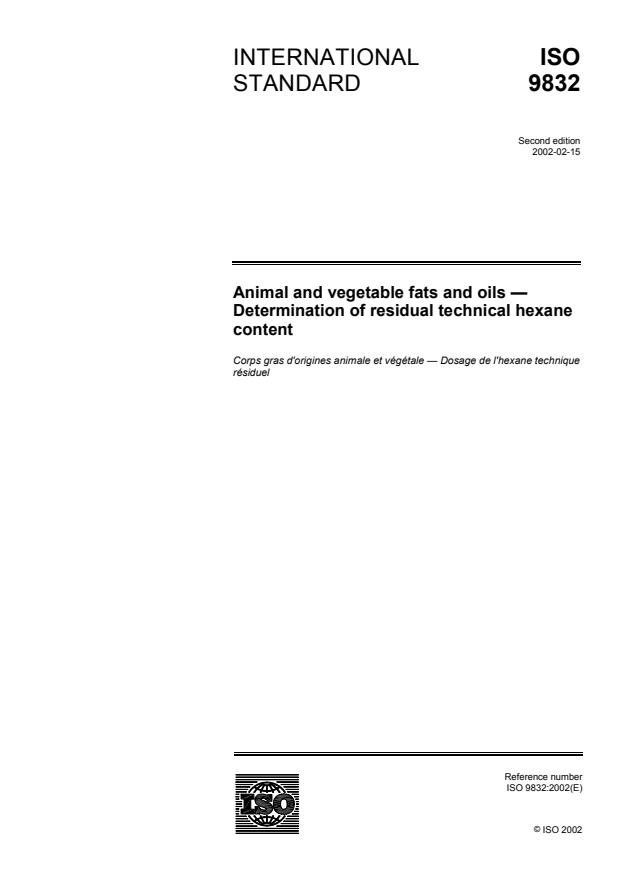
(Main)Animal and vegetable fats and oils — Determination of residual technical hexane content
Animal and vegetable fats and oils — Determination of residual technical hexane content
This International Standard specifies a method for the determination of the residual technical hexane content of animal and vegetable fats and oils. The method is suitable for the determination of hexane contents between 10 mg and 1 500 mg per kilogram of fat or oil. The method is not applicable to marine oils
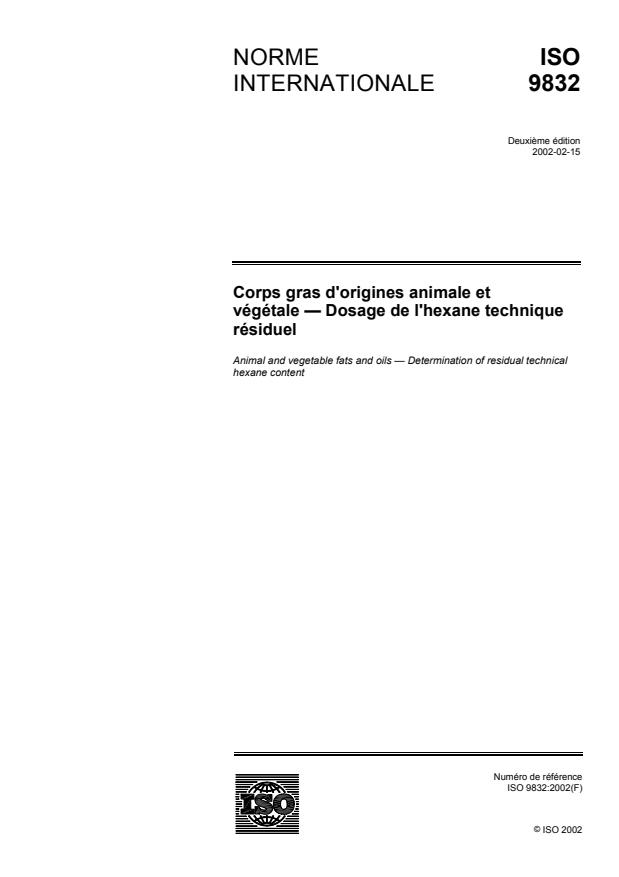
Corps gras d'origines animale et végétale — Dosage de l'hexane technique résiduel
La présente Norme internationale spécifie une méthode de dosage de l'hexane technique résiduel dans les corps gras d'origines animale et végétale (désignés ci-après par «corps gras»). Cette méthode convient pour le dosage de teneurs en hexane comprises entre 10 mg et 1 500 mg par kilogramme de corps gras. La méthode n'est pas applicable aux huiles marines.
General Information
- Status
- Published
- Publication Date
- 06-Mar-2002
- Technical Committee
- ISO/TC 34/SC 11 - Animal and vegetable fats and oils
- Drafting Committee
- ISO/TC 34/SC 11 - Animal and vegetable fats and oils
- Current Stage
- 9093 - International Standard confirmed
- Start Date
- 22-Sep-2023
- Completion Date
- 12-Feb-2026
Relations
- Effective Date
- 15-Apr-2008
- Effective Date
- 15-Apr-2008
Overview
ISO 9832:2002 specifies a laboratory method for determining residual technical hexane in animal and vegetable fats and oils. The standard uses a headspace gas‑chromatographic technique and is suitable for measuring hexane concentrations from 10 mg/kg to 1 500 mg/kg of fat or oil. The method is expressly not applicable to marine oils.
Key topics and technical requirements
- Principle: desorption of volatile hydrocarbons from a 5 g fat sample by heating at 80 °C in a closed vial, followed by analysis of the vial headspace by gas chromatography (GC) with a flame ionization detector (FID).
- Analytical range: 10–1 500 mg hexane per kg of fat/oil.
- Internal standard: n‑heptane is recommended (5 µL typical; 2 µL for very low levels). Cyclohexane may be used if compatible.
- Calibration: use calibration fat (freshly refined, deodorized) spiked with technical hexane (or n‑hexane). Typical calibration produces a mean calibration factor F ≈ 0.45 for n‑heptane (≈0.57 for cyclohexane).
- Sample size & handling: weigh 5 g test portion into 20 mL septum vials; add internal standard; equilibrate in a thermostatted bath at 80 °C for 60 min.
- Headspace sampling: withdraw 1 000 µL of headspace gas with a warmed (≈60 °C) gas‑tight syringe and inject immediately into the GC.
- GC system: either a packed column (2–4 m, coated with 10% squalane or similar) or a capillary column (~30 m, methylpolysiloxane). Injector and detector temperatures 100 °C, oven 50 °C; use a 1/100 split for capillary columns.
- Precision & validation: interlaboratory precision data and repeatability/reproducibility limits are provided in informative Annex A; collaborative tests (FOSFA-organized) inform expected performance. Referenced sampling/preparation standards include ISO 661 (sample preparation) and ISO 5555 (sampling recommendation).
Applications and users
ISO 9832 is intended for:
- Quality control laboratories in edible oil refining and processing (vegetable and animal fats).
- Food safety and regulatory agencies monitoring solvent residues.
- Contract testing laboratories performing compliance testing for residual hydrocarbon solvents.
- Industry trade associations and auditors validating solvent removal after extraction processes (e.g., hexane-extracted oils).
Practical benefits include standardized, comparable results for residual hexane, supporting product safety declarations, regulatory compliance, and process optimization.
Related standards
- ISO 661:1989 - Preparation of test sample (normative reference in ISO 9832)
- ISO 5555 - Recommended sampling methods (referred to for sampling)
- ISO 5725 - Precision of measurement methods (used for interlaboratory analysis)
Keywords: ISO 9832, residual hexane, technical hexane, headspace GC, fats and oils testing, GC‑FID, solvent residues, edible oil quality.

ISO 9832:2002 - Animal and vegetable fats and oils -- Determination of residual technical hexane content

ISO 9832:2002 - Corps gras d'origines animale et végétale -- Dosage de l'hexane technique résiduel
Get Certified
Connect with accredited certification bodies for this standard

BSI Group
BSI (British Standards Institution) is the business standards company that helps organizations make excellence a habit.

Bureau Veritas
Bureau Veritas is a world leader in laboratory testing, inspection and certification services.

DNV
DNV is an independent assurance and risk management provider.
Sponsored listings
Frequently Asked Questions
ISO 9832:2002 is a standard published by the International Organization for Standardization (ISO). Its full title is "Animal and vegetable fats and oils — Determination of residual technical hexane content". This standard covers: This International Standard specifies a method for the determination of the residual technical hexane content of animal and vegetable fats and oils. The method is suitable for the determination of hexane contents between 10 mg and 1 500 mg per kilogram of fat or oil. The method is not applicable to marine oils
This International Standard specifies a method for the determination of the residual technical hexane content of animal and vegetable fats and oils. The method is suitable for the determination of hexane contents between 10 mg and 1 500 mg per kilogram of fat or oil. The method is not applicable to marine oils
ISO 9832:2002 is classified under the following ICS (International Classification for Standards) categories: 67.200.10 - Animal and vegetable fats and oils. The ICS classification helps identify the subject area and facilitates finding related standards.
ISO 9832:2002 has the following relationships with other standards: It is inter standard links to ISO 9832:1992, ISO 9832:1992/Amd 1:1998. Understanding these relationships helps ensure you are using the most current and applicable version of the standard.
ISO 9832:2002 is available in PDF format for immediate download after purchase. The document can be added to your cart and obtained through the secure checkout process. Digital delivery ensures instant access to the complete standard document.
Standards Content (Sample)
INTERNATIONAL ISO
STANDARD 9832
Second edition
2002-02-15
Animal and vegetable fats and oils —
Determination of residual technical hexane
content
Corps gras d'origines animale et végétale — Dosage de l'hexane technique
résiduel
Reference number
©
ISO 2002
PDF disclaimer
This PDF file may contain embedded typefaces. In accordance with Adobe's licensing policy, this file may be printed or viewed but shall not
be edited unless the typefaces which are embedded are licensed to and installed on the computer performing the editing. In downloading this
file, parties accept therein the responsibility of not infringing Adobe's licensing policy. The ISO Central Secretariat accepts no liability in this
area.
Adobe is a trademark of Adobe Systems Incorporated.
Details of the software products used to create this PDF file can be found in the General Info relative to the file; the PDF-creation parameters
were optimized for printing. Every care has been taken to ensure that the file is suitable for use by ISO member bodies. In the unlikely event
that a problem relating to it is found, please inform the Central Secretariat at the address given below.
© ISO 2002
All rights reserved. Unless otherwise specified, no part of this publication may be reproduced or utilized in any form or by any means, electronic
or mechanical, including photocopying and microfilm, without permission in writing from either ISO at the address below or ISO's member body
in the country of the requester.
ISO copyright office
Case postale 56 • CH-1211 Geneva 20
Tel. + 41 22 749 01 11
Fax + 41 22 749 09 47
E-mail copyright@iso.ch
Web www.iso.ch
Printed in Switzerland
ii © ISO 2002 – All rights reserved
Foreword
ISO (the International Organization for Standardization) is a worldwide federation of national standards bodies (ISO
member bodies). The work of preparing International Standards is normally carried out through ISO technical
committees. Each member body interested in a subject for which a technical committee has been established has
the right to be represented on that committee. International organizations, governmental and non-governmental, in
liaison with ISO, also take part in the work. ISO collaborates closely with the International Electrotechnical
Commission (IEC) on all matters of electrotechnical standardization.
International Standards are drafted in accordance with the rules given in the ISO/IEC Directives, Part 3.
The main task of technical committees is to prepare International Standards. Draft International Standards adopted
by the technical committees are circulated to the member bodies for voting. Publication as an International
Standard requires approval by at least 75 % of the member bodies casting a vote.
Attention is drawn to the possibility that some of the elements of this International Standard may be the subject of
patent rights. ISO shall not be held responsible for identifying any or all such patent rights.
ISO 9832 was prepared by Technical Committee ISO/TC 34, Food products, Subcommittee SC 11, Animal and
vegetable fats and oils.
This second edition cancels and replaces the first edition (ISO 9832:1992), of which it constitutes a minor revision
to incorporate Amendment 1:1998.
Annex A of this International Standard is for information only.
INTERNATIONAL STANDARD ISO 9832:2002(E)
Animal and vegetable fats and oils — Determination of residual
technical hexane content
1 Scope
This International Standard specifies a method for the determination of the residual technical hexane content of
animal and vegetable fats and oils (referred to as fats hereinafter).
The method is suitable for the determination of hexane contents between 10 mg and 1 500 mg per kilogram of fat.
The method is not applicable to marine oils
2 Normative reference
The following normative document contains provisions which, through reference in this text, constitute provisions of
this International Standard. For dated references, subsequent amendments to, or revisions of, any of these
publications do not apply. However, parties to agreements based on this International Standard are encouraged to
investigate the possibility of applying the most recent edition of the normative document indicated below. For
undated references, the latest edition of the normative document referred to applies. Members of ISO and IEC
maintain registers of currently valid International Standards.
ISO 661:1989, Animal and vegetable fats and oils — Preparation of test sample
3 Term and definition
For the purposes of this International Standard, the following term and definition applies.
3.1
residual technical hexane content
content of volatile hydrocarbons such as those remaining in fats following processing involving the use of
hydrocarbon solvents, when determined by the method specified in this International Standard
NOTE The content is expressed as milligrams of hexane per kilogram of sample.
4 Principle
Desorption of volatile hydrocarbons by heating at 80 °C in a closed vessel after addition of an internal standard.
Determination of the particular volatile hydrocarbons content of the headspace by gas chromatography using
packed or capillary columns.
5 Reagents
Use only reagents of recognized analytical grade, unless otherwise stated, and distilled or demineralized water or
water of equivalent purity.
5.1 Technical hexane, with a composition similar to that of hexane used in industrial processing or, if this is not
available, n-hexane.
It is recommended that technical hexane be used for the calibration. This reagent usually has an n-hexane content
of 50 % (by mass) and consists mainly of C isomers but may include C and C hydrocarbons.
6 5 7
5.2 Internal standard, n-heptane.
If this is not available, cyclohexane may be used, provided that the solvent (5.1) used for the extraction or
calibration has a negligible content of cyclohexane and/or n-heptane or components with similar retention times.
5.3 Carrier gas, e.g. hydrogen, nitrogen or helium, etc., thoroughly dried and with an oxygen content of less
than 10 mg/kg.
5.4 Auxiliary gases, hydrogen (99,9 % pure, free from organic impurities) and air (free from organic impurities).
5.5 Calibration fat, freshly refined and deodorized vegetable fat, the technical hexane content of which is
negligible.
This material should be free from peroxides or other components likely to decompose with the formation of volatile
material which could be confused with hydrocarbons during the test.
6 Apparatus
Usual laboratory equipment and, in particular, the following.
6.1 Septum vials, of 20 ml capacity.
6.2 Septa, inert to fats and solvents, made of a material such as butyl rubber or red rubber free from
hydrocarbon solvent residues and of a suitable quality that they will not swell under the conditions of use,
aluminium caps suitable for use with the vials (6.1) and crimping pliers.
6.3 Tongs, suitable for holding the vials (6.1).
6.4 Syringes, of 10 µl capacity, used only for the analysis of residual technical hexane. They shall not be
cleaned with hydrocarbon solvent.
6.5 Syringes, of 1 µl capacity, used only for the analysis of residual technical hexane. They shall not be cleaned
with hydrocarbon solvent.
6.6 Syringes, of 1 000 µl capacity, gas-tight, used only for the analysis of residual technical hexane. They shall
not be cleaned with hydrocarbon solvent.
6.7 Gas chromatograph, with a flame ionization detector and an integrator and/or recorder, equipped with
either
a) a packed glass column, 2 m to 4 m long and of internal diameter 3,2 mm approximately, packed with an acid-
washed and silanized diatomaceous earth support of particle size 150 µm to 180 µm (Chromosorb P NAW
1)
60-80 mesh is suitable), and coated with 10 % squalane or any other phase permitting the chromatographic
separation required, or
b) a glass capillary column, approximately 30 m long and of 0,3 mm internal diameter, coated with
methylpolysiloxane of film thickness 0,2 µm.
1) Chromosorb P NAW 60-80 is an example of a suitable product available commercially. This information is given for the
convenience of users of this International Standard and does not constitute an endorsement by ISO of this product.
2 © ISO 2002 – All rights reserved
The injector and detector temperature shall be set at 100 °C and the oven temperature at 50 °C.
If a capillary column [see b)] is used, the apparatus shall have a 1/100 split injection system.
NOTE For analyses in series, a headspace gas chromatograph with automatic sample injection and tempering bath has
been shown to be satisfactory. In this case, manual injection is not necessary.
6.8 Heating bath, equipped with clamps for holding septum vials, regulated thermostatically at 80 °C ± 2 °C.
NOTE For continuous operation, glycerol is recommended as the heating medium.
6.9 Shaking machine
7 Sampling
It is important that the laboratory receive a sample which is truly representative and has not been damaged or
changed during transport and storage.
Sampling is not part of the method specified in this International Standard. A recommended sampling method is
given in ISO 5555.
It is essential that the sample be protected from gain or loss of solvent residues.
8 Preparation of test sample
Prepare the test sample in accordance with ISO 661, taking care to prevent gain or loss of solvent.
9 Procedure
9.1 Calibration
9.1.1 Weigh, to the nearest 0,01 g, 5 g of calibration fat (5.5) into each of seven vials (6.1). Close each vial with a
septum and a cap (6.2).
To six of the seven vials (6.1) add, using a syringe (6.4 or 6.5), the quantity of solvent (5.1) specified in Table 1 to
obtain the concentrations indicated. Do not add solvent to the seventh vial.
Shake vigorously, in the shaking machine (6.9) for 1 h at room temperature, the six vials to which solvent was
added.
9.1.2 At the end of this time add, by means of a syringe (6.4), 5 µl ± 0,1 µl of internal standard (5.2) to each of
the seven vials through the septum.
For hexane contents between 10 mg/kg and 20 mg/kg, it is preferable to add 2 µl of internal standard (5.2).
Mix the contents vigorously by hand for about 1 min by moving the vial with a circular motion in a horizontal plane
in such a way that the fat does not touch the septum. If this happens, reject the vial and start again with a further
portion of calibration fat.
CAUTION — If there is fat on the septum it will contaminate the needle when the
...
NORME ISO
INTERNATIONALE 9832
Deuxième édition
2002-02-15
Corps gras d'origines animale et
végétale — Dosage de l'hexane technique
résiduel
Animal and vegetable fats and oils — Determination of residual technical
hexane content
Numéro de référence
©
ISO 2002
PDF – Exonération de responsabilité
Le présent fichier PDF peut contenir des polices de caractères intégrées. Conformément aux conditions de licence d'Adobe, ce fichier peut
être imprimé ou visualisé, mais ne doit pas être modifié à moins que l'ordinateur employé à cet effet ne bénéficie d'une licence autorisant
l'utilisation de ces polices et que celles-ci y soient installées. Lors du téléchargement de ce fichier, les parties concernées acceptent de fait la
responsabilité de ne pas enfreindre les conditions de licence d'Adobe. Le Secrétariat central de l'ISO décline toute responsabilité en la
matière.
Adobe est une marque déposée d'Adobe Systems Incorporated.
Les détails relatifs aux produits logiciels utilisés pour la création du présent fichier PDF sont disponibles dans la rubrique General Info du
fichier; les paramètres de création PDF ont été optimisés pour l'impression. Toutes les mesures ont été prises pour garantir l'exploitation de
ce fichier par les comités membres de l'ISO. Dans le cas peu probable où surviendrait un problème d'utilisation, veuillez en informer le
Secrétariat central à l'adresse donnée ci-dessous.
© ISO 2002
Droits de reproduction réservés. Sauf prescription différente, aucune partie de cette publication ne peut être reproduite ni utilisée sous quelque
forme que ce soit et par aucun procédé, électronique ou mécanique, y compris la photocopie et les microfilms, sans l'accord écrit de l'ISO à
l'adresse ci-après ou du comité membre de l'ISO dans le pays du demandeur.
ISO copyright office
Case postale 56 • CH-1211 Geneva 20
Tel. + 41 22 749 01 11
Fax. + 41 22 749 09 47
E-mail copyright@iso.ch
Web www.iso.ch
Imprimé en Suisse
ii © ISO 2002 – Tous droits réservés
Avant-propos
L'ISO (Organisation internationale de normalisation) est une fédération mondiale d'organismes nationaux de
normalisation (comités membres de l'ISO). L'élaboration des Normes internationales est en général confiée aux
comités techniques de l'ISO. Chaque comité membre intéressé par une étude a le droit de faire partie du comité
technique créé à cet effet. Les organisations internationales, gouvernementales et non gouvernementales, en
liaison avec l'ISO participent également aux travaux. L'ISO collabore étroitement avec la Commission
électrotechnique internationale (CEI) en ce qui concerne la normalisation électrotechnique.
Les Normes internationales sont rédigées conformément aux règles données dans les Directives ISO/CEI,
Partie 3.
La tâche principale des comités techniques est d'élaborer les Normes internationales. Les projets de Normes
internationales adoptés par les comités techniques sont soumis aux comités membres pour vote. Leur publication
comme Normes internationales requiert l'approbation de 75 % au moins des comités membres votants.
L'attention est appelée sur le fait que certains des éléments de la présente Norme internationale peuvent faire
l'objet de droits de propriété intellectuelle ou de droits analogues. L'ISO ne saurait être tenue pour responsable de
ne pas avoir identifié de tels droits de propriété et averti de leur existence.
L'ISO 9832 a été élaborée par le comité technique ISO/TC 34, Produits alimentaires, sous-comité SC 11, Corps
gras d'origines animale et végétale.
Cette deuxième édition annule et remplace la première édition (ISO 9832:1992), dont elle constitue une révision
mineure avec notamment l'incorporation de l'Amendement 1:1998.
L'annexe A de la présente Norme internationale est donnée uniquement à titre d'information.
NORME INTERNATIONALE ISO 9832:2002(F)
Corps gras d'origines animale et végétale — Dosage de l'hexane
technique résiduel
1 Domaine d'application
La présente Norme internationale spécifie une méthode de dosage de l'hexane technique résiduel dans les corps
gras d'origines animale et végétale (désignés ci-après par «corps gras»).
Cette méthode convient pour le dosage de teneurs en hexane comprises entre 10 mg et 1 500 mg par kilogramme
de corps gras.
La méthode n'est pas applicable aux huiles marines.
2 Référence normative
Le document normatif suivant contient des dispositions qui, par suite de la référence qui y est faite, constituent des
dispositions valables pour la présente Norme internationale. Pour les références datées, les amendements
ultérieurs ou les révisions de ces publications ne s'appliquent pas. Toutefois, les parties prenantes aux accords
fondés sur la présente Norme internationale sont invitées à rechercher la possibilité d'appliquer l'édition la plus
récente du document normatif indiqué ci-après. Pour les références non datées, la dernière édition du document
normatif en référence s'applique. Les membres de l'ISO et de la CEI possèdent le registre des Normes
internationales en vigueur.
ISO 661:1989, Corps gras d'origines animale et végétale — Préparation de l'échantillon pour essai
3 Terme et définition
Pour les besoins de la présente Norme internationale, le terme et la définition suivants s'appliquent.
3.1
teneur en hexane technique résiduel
teneur en hydrocarbures volatils tels que ceux restant dans les corps gras après la mise en œuvre d'un mode
opératoire utilisant des solvants à base d'hydrocarbures, et déterminée selon la méthode spécifiée dans la
présente Norme internationale
NOTE La teneur est exprimée en milligrammes d'hexane par kilogramme d'échantillon.
4 Principe
Désorption des hydrocarbures volatils par chauffage à 80 °C dans un récipient fermé, après ajout d'un étalon
interne. Dosage des hydrocarbures volatils particuliers dans l'espace de tête par chromatographie en phase
gazeuse sur colonne remplie ou sur colonne capillaire.
5 Réactifs
Sauf indication différente, utiliser uniquement des réactifs de qualité analytique reconnue et de l'eau distillée ou
déminéralisée, ou de l'eau de pureté au moins équivalente.
5.1 Hexane technique, d'une composition analogue à celle de l'hexane utilisé dans les méthodes de traitement
industrielles ou, à défaut, n-hexane.
Pour l'étalonnage, il est recommandé d'utiliser de l'hexane technique. Celui-ci a généralement une teneur en
n-hexane de 50 % (en masse) et est principalement constitué d'isomères en C , mais il peut renfermer des
hydrocarbures en C et en C .
5 7
5.2 Étalon interne, n-hexane.
À défaut de n-hexane, on peut utiliser du cyclohexane, à condition que le solvant (5.1) employé pour l'extraction ou
l'étalonnage ait une teneur négligeable en cyclohexane et/ou en n-hexane ou en composants à temps de rétention
analogue.
5.3 Gaz vecteur, par exemple hydrogène, azote, hélium, etc., soigneusement déshydraté et ayant une teneur
en oxygène inférieure à 10 mg/kg.
5.4 Gaz auxiliaires, hydrogène (pur à 99,9 %, exempt d'impuretés organiques) et air (exempt d'impuretés
organiques).
5.5 Corps gras d'étalonnage, corps gras végétal récemment raffiné et désodorisé, ayant une teneur
négligeable en hexane technique.
Il convient que ce produit soit exempt de peroxydes ou de tout autre constituant susceptible de se décomposer
avec formation de matières volatiles, susceptibles d'être confondues avec des hydrocarbures pendant l'essai.
6 Appareillage
Matériel courant de laboratoire et, en particulier, ce qui suit.
6.1 Fioles, de 20 ml de capacité, bouchées avec un septum.
6.2 Septa, inertes aux corps gras et aux solvants, faits en un matériau tel que caoutchouc butyle ou caoutchouc
rouge, exempt de résidus de solvant hydrocarboné, et d'une qualité appropriée pour qu'ils ne gonflent pas pendant
l'emploi, ainsi que couvercles en aluminium adaptés aux fioles (6.1) et pinces à sertir.
6.3 Pinces, appropriées pour tenir les fioles (6.1).
6.4 Seringues, de 10 µl de capacité, utilisées uniquement pour l'analyse de l'hexane technique résiduel. Elles
ne doivent pas être nettoyées avec un solvant hydrocarboné.
6.5 Seringues, de 1 µl de capacité, utilisées uniquement pour l'analyse de l'hexane technique résiduel. Elles ne
doivent pas être nettoyées avec un solvant hydrocarboné.
6.6 Seringues, de 1 000 µl de capacité, étanches aux gaz, utilisées uniquement pour l'analyse de l'hexane
technique résiduel. Elles ne doivent pas être nettoyées avec un solvant hydrocarboné.
2 © ISO 2002 – Tous droits réservés
6.7 Chromatographe en phase gazeuse, muni d'un détecteur à ionisation de flamme et d'un intégrateur et/ou
d'un enregistreur, équipé
a) soit d'une colonne remplie, en verre, de 2 m à 4 m de longueur et de 3,2 mm de diamètre intérieur, garnie
avec un support en terre de diatomées de granulométrie comprise entre 150 µm et 180 µm (le Chromosorb P
1)
NAW à 60-80 mesh convient), lavée aux acides et silanisée, et garnie de perhydrosqualène à 10 %, ou avec
toute autre phase permettant d'obtenir la séparation chromatographique requise,
b) soit d'une colonne capillaire en verre, d'environ 30 m de longueur et de 0,3 mm de diamètre intérieur, garnie
de polyméthylsiloxane d'épaisseur de film 0,2 µm.
L'injecteur et le détecteur doivent être réglés à 100 °C et la température du four doit être de 50 °C.
Si l'on utilise une colonne capillaire [voir b)], l'appareil doit être équipé d'un système d'injection fractionné au 1/100.
NOTE Pour les analyses en série, un chromatographe en phase gazeuse à espace de tête avec injection automatique de
l'échantillon et de bain de trempage s'est révélé satisfaisant. Dans ce cas, l'injection manuelle n'est pas nécessaire.
6.8 Bain chauffant, équipé d'un dispositif de serrage pour maintenir les fioles bouchées avec un septum, réglé
à l'aide d'un thermostat à 80 °C ± 2 °C.
NOTE Pour le fonctionnement en continu, il est recommandé d'employer de la glycérine comme milieu de chauffage.
6.9 Agitateur mécanique.
7 Échantillonnage
Il est important que le laboratoire reçoive un échantillon réellement représentatif et n'ayant pas été endommagé ou
modifié durant le transport ou l'entreposage.
L'échantillonnage ne fait pas partie de la méthode spécifiée dans la présente Norme internationale. Une méthode
d'échantillonnage recommandée est donnée dans l'ISO 5555.
Il est indispensable que l'échantillon soit protégé contre un gain ou une perte de résidus de solvant.
8 Préparation de l'échantillon pour essai
Préparer l'échantillon pour essai conformément à l'ISO 661, en prenant soin d'éviter un gain ou une perte de
solvant.
9 Mode opératoire
9.1 Étalonnage
9.1.1 Peser, à 0,01 g près, 5 g de corps gras d'étalonnage (5.5) dans chacune des sept fioles (6.1). Boucher
chaque fiole avec un septum et un couvercle (6.2).
Dans six des sept fioles (6.1) introduire, à l'aide d'une seringue (6.4 ou 6.5), la quantité de solvant (5.1) spécifiée
au Tableau 1 pour obtenir les concentrations indiquées. Ne pas introduire de solvant dans la septième fiole.
Agiter vigoureusement, pendant 1 h et à température ambiante, les six fioles auxquelles le solvant a été ajouté, à
l'aide de l'agitateur (6.9).
1) Chromosorb P NAW 60-80 est un exemple de produit approprié disponible sur le marché. Cette information est donnée à
l'intention des utilisateurs de la présente Norme internationale et ne signifie nullement que l'ISO approuve ou recommande
l'emploi du produit ainsi désigné.
Tableau 1 — Concentration de l'hexane dans les échantillons pour étalonnage
Volume d'hexane technique
Teneur d'hexane (mg/kg) dans une fiole en cours d'emploi
ou de n-hexane ajouté
Hexane technique n-hexane
µl
0,5 67 66
1 134 132
2 268 264
4 536 528
7 938 924
10 1 340 1 320
9.1.2 À la fin de cette période, introduire, à l'aide d'une seringue (6.4), 5 µl ± 0,1 µl de l'étalon interne (5.2) dans
chacune des sep
...
Questions, Comments and Discussion
Ask us and Technical Secretary will try to provide an answer. You can facilitate discussion about the standard in here.
Loading comments...