

ISO 7001:2023/Amd 3:2026
(Amendment)Graphical symbols — Registered public information symbols — Amendment 3
- Status
- Published
- Publication Date
- 23-Jul-2026
- Technical Committee
- ISO/TC 145/SC 1 - Public information symbols
- Drafting Committee
- ISO/TC 145/SC 1/WG 4 - Public information symbols (Revision of ISO 7001)
- Current Stage
- 6060 - International Standard published
- Start Date
- 24-Jul-2026
- Due Date
- 02-Sep-2027
- Completion Date
- 24-Jul-2026
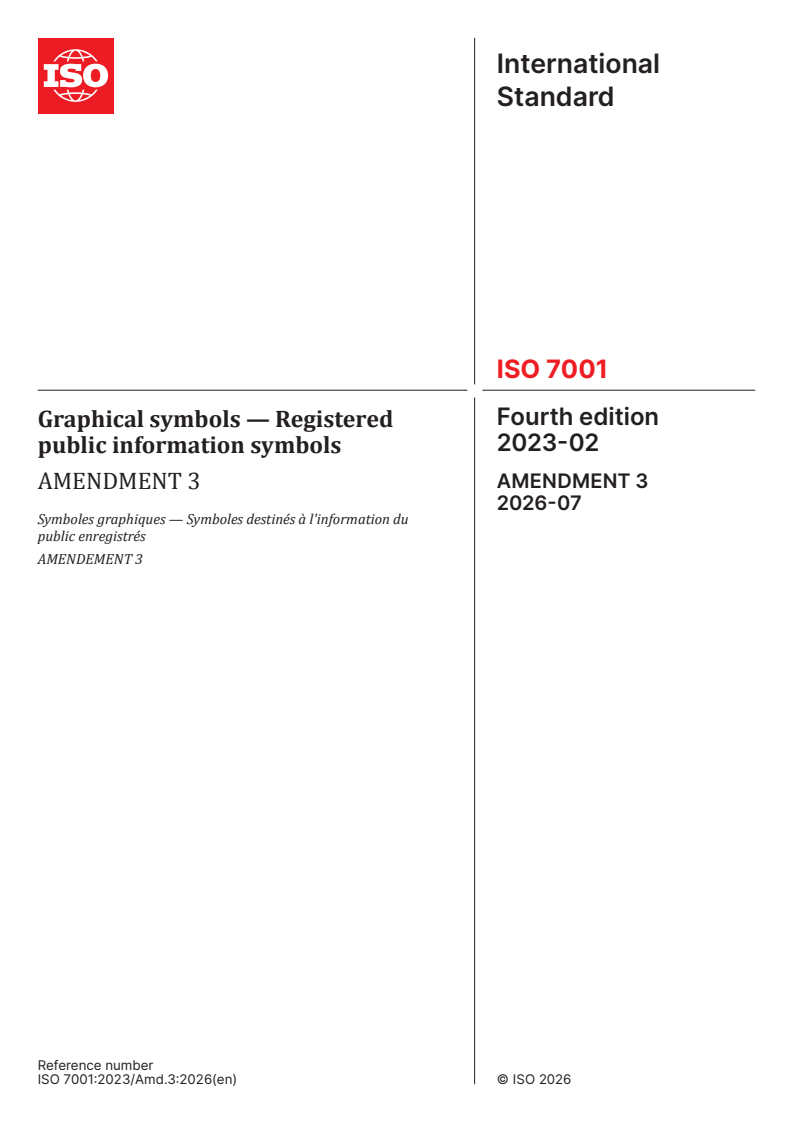

ISO 7001:2023/Amd 3:2026 is an ISO amendment to the registered public information symbols standard. It adds two public information symbols for products in containers or packages: one meaning do not flush down a toilet, and one meaning suitable to flush down a toilet. The symbols are intended for the general public, especially for bathroom-related packaging where disposal in a toilet may be a realistic issue.
What does ISO 7001:2023/Amd 3:2026 specify?
ISO 7001:2023/Amd 3:2026 specifies additions to ISO 7001:2023 rather than a full standalone symbol set. It instructs the reader to add two symbols to the alphabetical summary in Table 1, the summary of all symbols in Table 2, and Table 8.
The amendment is organized around two symbol entries. Each entry gives the reference number, meaning, function, image content, intended behavior, need, related meanings, field of application, context of use, intended user population, age of user, and additional information.
What are the key requirements of ISO 7001:2023/Amd 3:2026?
ISO 7001:2023/Amd 3:2026 adds two toilet-disposal symbols and defines how each one should be understood in use. In practice, these symbols are for packaging and other product communication where people need to know whether a product may be flushed.
The two symbols added
PI BP 022 - Do not flush down a toilet
- This symbol indicates that a product in a container or package is not suitable to be flushed down a toilet or water closet (W.C.).
- Its intended behavior is to prevent people from disposing of the product in a toilet.
- The stated need is to help prevent blockages in toilets and wastewater systems, avoid failure of wastewater treatment plants, and reduce environmental impacts.
PI BP 023 - Suitable to flush down a toilet
- This symbol indicates that a product in a container or package is suitable to be flushed down a toilet or W.C.
- Its intended behavior is to allow disposal of the product in a toilet.
- The stated need is the same disposal function in reverse: preventing blockages, avoiding wastewater treatment plant failures, and minimizing environmental impacts.
Where the symbols are meant to be used
- Both symbols apply to the behaviour of the public, excluding public safety.
- Both are intended for packaging for products used in a bathroom setting where there is a reasonable likelihood that the product may be flushed.
- The intended user population is the general population, and the age of user is any.
What the symbols mean in practice
- Do not flush helps a packager warn consumers before disposal creates plumbing or treatment problems.
- Suitable to flush helps a packager give permission for toilet disposal when that disposal is acceptable.
- The paired meanings reduce ambiguity at point of use, which matters when products look similar but have different disposal limits.
Administrative note in the amendment
- The additional information for both symbols says they have been agreed by the members of ISO/TC 224.
What terms does ISO 7001:2023/Amd 3:2026 define?
ISO 7001:2023/Amd 3:2026 uses several fields to describe each public information symbol.
- Public information symbol - A graphical symbol used to communicate practical information to the public.
- W.C. - Water closet, another term used here for a toilet.
- Field of application - The area of behavior the symbol addresses; here it is public behavior, excluding public safety.
- Context of use - The setting where the symbol is applied; here, packaging for bathroom-setting products.
- Intended user population - The group the symbol is designed for; here, the general population.
- Age of user - The age range the symbol is intended for; here, any age.
- ISO/TC 224 - The ISO technical committee named in the amendment as having agreed the symbols.
Who uses ISO 7001:2023/Amd 3:2026?
ISO 7001:2023/Amd 3:2026 is used by organizations that need clear disposal messaging on consumer packaging. That includes packaging designers, product manufacturers, labeling teams, and compliance staff working with bathroom-related products.
It is also relevant to standards professionals and buyers who specify public information symbols for products that may be flushed. Wastewater and environmental stakeholders may also use it when evaluating whether packaging communication supports correct disposal behavior.
What changed in ISO 7001:2023/Amd 3:2026 from the previous edition?
ISO 7001:2023/Amd 3:2026 adds two symbols to ISO 7001:2023.
- PI BP 022 - Do not flush down a toilet
- PI BP 023 - Suitable to flush down a toilet
The amendment also updates Table 1, Table 2 and Table 8 to include these symbols.
What does the ISO 7001:2023/Amd 3:2026 document contain?
ISO 7001:2023/Amd 3:2026 contains two symbol specifications with their reference numbers and meanings. For each symbol, it provides the intended function, a short description of the image content, the behavior the symbol is meant to cause, and the reason that behavior matters.
The document also records related meanings, the field of application, the context of use, the intended user population, and the age of user. In addition, it states that the symbols are to be added to the alphabetical summary, the full symbol summary, and Table 8.
Relations
- Effective Date
- 14-Mar-2026
Frequently Asked Questions
ISO 7001:2023/Amd 3:2026 is a standard published by the International Organization for Standardization (ISO). Its full title is "Graphical symbols — Registered public information symbols — Amendment 3". This standard covers: Graphical symbols — Registered public information symbols — Amendment 3
Graphical symbols — Registered public information symbols — Amendment 3
ISO 7001:2023/Amd 3:2026 is classified under the following ICS (International Classification for Standards) categories: 01.080.10 - Public information symbols. Signs. Plates. Labels. The ICS classification helps identify the subject area and facilitates finding related standards.
ISO 7001:2023/Amd 3:2026 has the following relationships with other standards: It is inter standard links to ISO 7001:2023. Understanding these relationships helps ensure you are using the most current and applicable version of the standard.
ISO 7001:2023/Amd 3:2026 is available in PDF format for immediate download after purchase. The document can be added to your cart and obtained through the secure checkout process. Digital delivery ensures instant access to the complete standard document.
Standards Content (Sample)
International
Standard
ISO 7001
Fourth edition
Graphical symbols — Registered
2023-02
public information symbols
AMENDMENT 3
AMENDMENT 3
2026-07
Symboles graphiques — Symboles destinés à l'information du
public enregistrés
AMENDEMENT 3
Reference number
ISO 7001:2023/Amd.3:2026(en) © ISO 2026
ISO 7001:2023/Amd.3:2026(en)
© ISO 2026
All rights reserved. Unless otherwise specified, or required in the context of its implementation, no part of this publication may
be reproduced or utilized otherwise in any form or by any means, electronic or mechanical, including photocopying, or posting on
the internet or an intranet, without prior written permission. Permission can be requested from either ISO at the address below
or ISO’s member body in the country of the requester.
ISO copyright office
CP 401 • Ch. de Blandonnet 8
CH-1214 Vernier, Geneva
Phone: +41 22 749 01 11
Email: copyright@iso.org
Website: www.iso.org
Published in Switzerland
ii
ISO 7001:2023/Amd.3:2026(en)
Foreword
ISO (the International Organization for Standardization) is a worldwide federation of national standards
bodies (ISO member bodies). The work of preparing International Standards is normally carried out through
ISO technical committees. Each member body interested in a subject for which a technical committee
has been established has the right to be represented on that committee. International organizations,
governmental and non-governmental, in liaison with ISO, also take part in the work. ISO collaborates closely
with the International Electrotechnical Commission (IEC) on all matters of electrotechnical standardization.
The procedures used to develop this document and those intended for its further maintenance are described
in the ISO/IEC Directives, Part 1. In particular, the different approval criteria needed for the different types
of ISO document should be noted. This document was drafted in accordance with the editorial rules of the
ISO/IEC Directives, Part 2 (see www.iso.org/directives).
ISO draws attention to the possibility that the implementation of this document may involve the use of (a)
patent(s). ISO takes no position concerning the evidence, validity or applicability of any claimed patent
rights in respect thereof. As of the date of publication of this document, ISO had not received notice of (a)
patent(s) which may be required to implement this document. However, implementers are cautioned that
this may not represent the latest information, which may be obtained from the patent database available at
www.iso.org/patents. ISO shall not be held responsible for identifying any or all such patent rights.
Any trade name used in this document is information given for the convenience of users and does not
constitute an endorsement.
For an explanation of the voluntary nature of standards, the meaning of ISO specific terms and expressions
related to conformity assessment, as well as information about ISO's adherence to the World Trade
Organization (WTO) principles in the Technical Barriers to Trade (TBT), see www.iso.org/iso/foreword.html.
This document was prepared by Technical Committee ISO/TC 145, Graphical symbols, Subcommittee SC 1,
Public information
...