


ISO 16373-2:2014
(Main)Textiles — Dyestuffs — Part 2: General method for the determination of extractable dyestuffs including allergenic and carcinogenic dyestuffs (method using pyridine-water)
Textiles — Dyestuffs — Part 2: General method for the determination of extractable dyestuffs including allergenic and carcinogenic dyestuffs (method using pyridine-water)
ISO 16373-2:2014 specifies the analyses used to detect extractable dyestuffs in textile products, with the extraction performed for all kind of fibres and types of dyestuffs using pyridine/water (1:1). It lists the allergenic and carcinogenic dyestuffs which can be analysed using this method; the lists of dyestuffs are expandable.
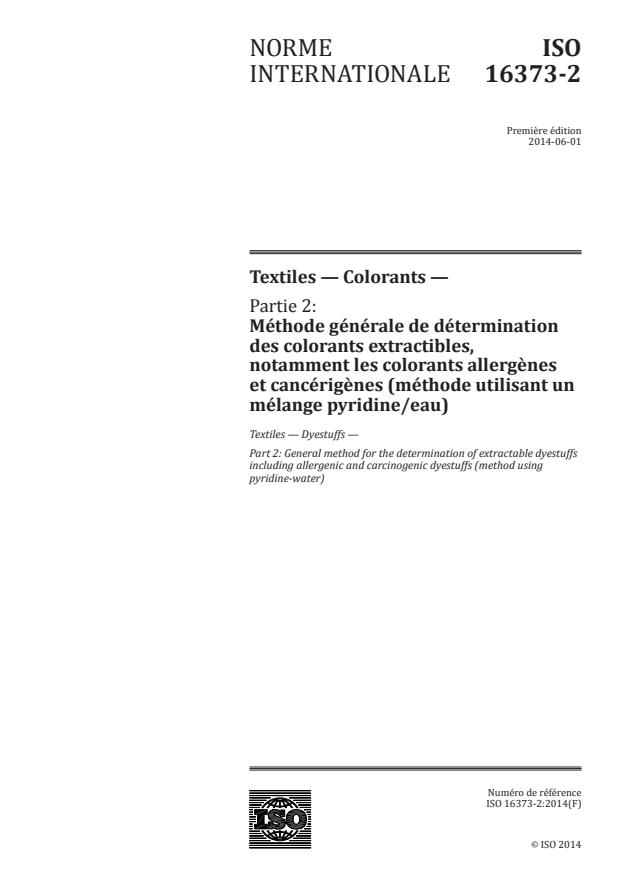
Textiles — Colorants — Partie 2: Méthode générale de détermination des colorants extractibles, notamment les colorants allergènes et cancérigènes (méthode utilisant un mélange pyridine/eau)
L'ISO 16373-2:2014 spécifie les analyses servant à détecter les colorants extractibles dans les produits textiles, l'extraction étant effectuée avec un mélange de pyridine/eau (1:1) pour tous les types de fibres et de colorants. Elle répertorie les colorants allergènes et cancérigènes pouvant être analysés avec cette méthode; ces listes de colorants ne sont pas exhaustives.
General Information
- Status
- Published
- Publication Date
- 10-Jun-2014
- Technical Committee
- ISO/TC 38 - Textiles
- Drafting Committee
- ISO/TC 38/WG 22 - Composition and chemical testing
- Current Stage
- 9093 - International Standard confirmed
- Start Date
- 07-Apr-2025
- Completion Date
- 12-Feb-2026
Relations
- Effective Date
- 12-Feb-2026
- Effective Date
- 06-Jun-2022
Overview - ISO 16373-2:2014 (Textiles - Dyestuffs)
ISO 16373-2:2014 defines a general laboratory method for the determination of extractable dyestuffs from textile materials using a pyridine/water (1:1) extraction. The standard targets a wide range of dye classes, explicitly listing allergenic and carcinogenic dyestuffs (Annexes A and B) that can be analysed by this procedure. The method is part of the ISO 16373 series on dyestuff identification and quantification and is intended for use with chromatographic detection (LC/DAD and/or LC/MS).
Key topics and technical requirements
- Scope: Extraction of dyestuffs from all fibre types using pyridine/water (1:1). Lists of target dyestuffs are provided and expandable.
- Sample preparation: Cut a representative specimen (max. 1.0 g, pieces ≤ 1 cm²) and record mass to 0.01 g.
- Extraction conditions: Add 7.5 ml pyridine/water (1:1) to the sample, heat to (100 ± 2) °C and hold for (35 ± 5) min, then cool to ≤ 40 °C before opening.
- Detection and quantification: Use HPLC with diode array detection (LC/DAD) and/or liquid chromatography–mass spectrometry (LC/MS). Some dyes may be quantified by LC/DAD alone.
- Calibration and reporting: Mixed standards in pyridine/water at 1, 5, 10 and 20 mg/L. Results expressed as mg dyestuff per kg textile (mg/kg). If >100 mg/kg is detected, the dye is considered to be used in the product.
- Reagents and apparatus: Analytical-grade pyridine, acetonitrile, ammonium acetate, tetrabutylammonium dihydrogen phosphate, ISO 3696-grade water; HPLC systems, DAD or MS detectors, appropriate columns and thermal block or sand bath capable of 100 °C.
- Safety: Many listed dyestuffs are allergenic or carcinogenic. Follow national health and safety regulations, MSDS guidance, and use PPE (safety glasses, respirator when handling powders).
Applications - who uses ISO 16373-2 and why
- Textile testing laboratories performing routine compliance and quality control for products (garments, home textiles).
- Manufacturers and dyers verifying extractable dye content and identifying hazardous dyes in supply chains.
- Regulatory and conformity bodies assessing consumer safety related to allergenic or carcinogenic dyestuffs.
- Importers, retailers, and certification bodies checking products against safety specifications and buyer requirements.
Practical benefits include standardized extraction and chromatographic protocols, harmonized reporting (mg/kg), and an extendable list of target dyes for consistent screening across labs.
Related standards
- ISO 16373-1 - General principles of testing coloured textiles for dyestuff identification
- ISO 16373-3 - Method using triethylamine/methanol for some carcinogenic dyestuffs
- ISO 3696 - Water for analytical laboratory use
Keywords: ISO 16373-2:2014, extractable dyestuffs, pyridine-water extraction, LC/DAD, LC/MS, textile dye analysis, allergenic dyes, carcinogenic dyes, HPLC.
Get Certified
Connect with accredited certification bodies for this standard

Control Union Certifications
Global certification for agriculture and sustainability.

Bureau Veritas Bangladesh
Bureau Veritas certification services in Bangladesh.

ECOCERT France
Leader in organic and sustainability certification worldwide.
Sponsored listings
Frequently Asked Questions
ISO 16373-2:2014 is a standard published by the International Organization for Standardization (ISO). Its full title is "Textiles — Dyestuffs — Part 2: General method for the determination of extractable dyestuffs including allergenic and carcinogenic dyestuffs (method using pyridine-water)". This standard covers: ISO 16373-2:2014 specifies the analyses used to detect extractable dyestuffs in textile products, with the extraction performed for all kind of fibres and types of dyestuffs using pyridine/water (1:1). It lists the allergenic and carcinogenic dyestuffs which can be analysed using this method; the lists of dyestuffs are expandable.
ISO 16373-2:2014 specifies the analyses used to detect extractable dyestuffs in textile products, with the extraction performed for all kind of fibres and types of dyestuffs using pyridine/water (1:1). It lists the allergenic and carcinogenic dyestuffs which can be analysed using this method; the lists of dyestuffs are expandable.
ISO 16373-2:2014 is classified under the following ICS (International Classification for Standards) categories: 59.080.01 - Textiles in general. The ICS classification helps identify the subject area and facilitates finding related standards.
ISO 16373-2:2014 has the following relationships with other standards: It is inter standard links to EN ISO 16373-2:2014, ISO 12097-1:2002. Understanding these relationships helps ensure you are using the most current and applicable version of the standard.
ISO 16373-2:2014 is available in PDF format for immediate download after purchase. The document can be added to your cart and obtained through the secure checkout process. Digital delivery ensures instant access to the complete standard document.
Standards Content (Sample)
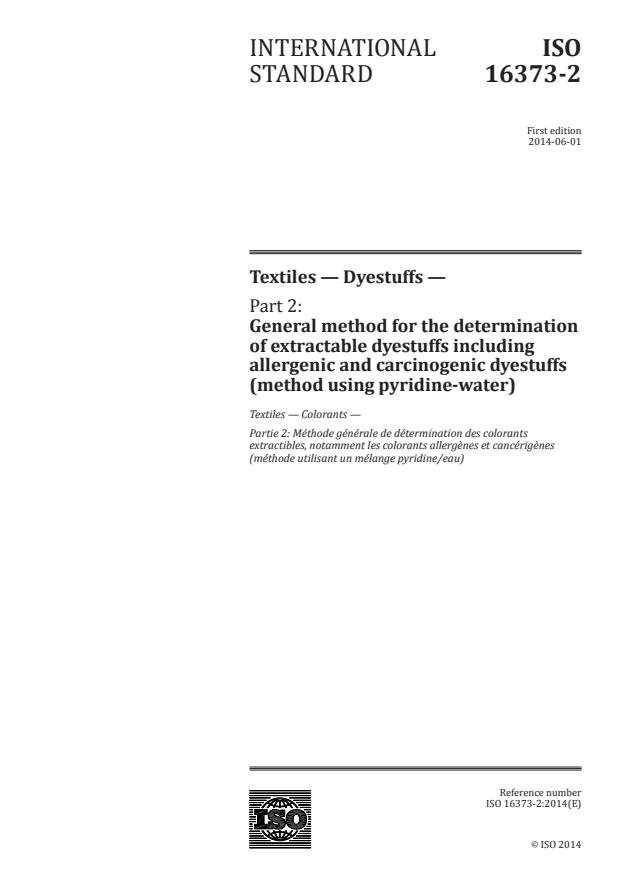
INTERNATIONAL ISO
STANDARD 16373-2
First edition
2014-06-01
Textiles — Dyestuffs —
Part 2:
General method for the determination
of extractable dyestuffs including
allergenic and carcinogenic dyestuffs
(method using pyridine-water)
Textiles — Colorants —
Partie 2: Méthode générale de détermination des colorants
extractibles, notamment les colorants allergènes et cancérigènes
(méthode utilisant un mélange pyridine/eau)
Reference number
©
ISO 2014
© ISO 2014
All rights reserved. Unless otherwise specified, no part of this publication may be reproduced or utilized otherwise in any form
or by any means, electronic or mechanical, including photocopying, or posting on the internet or an intranet, without prior
written permission. Permission can be requested from either ISO at the address below or ISO’s member body in the country of
the requester.
ISO copyright office
Case postale 56 • CH-1211 Geneva 20
Tel. + 41 22 749 01 11
Fax + 41 22 749 09 47
E-mail copyright@iso.org
Web www.iso.org
Published in Switzerland
ii © ISO 2014 – All rights reserved
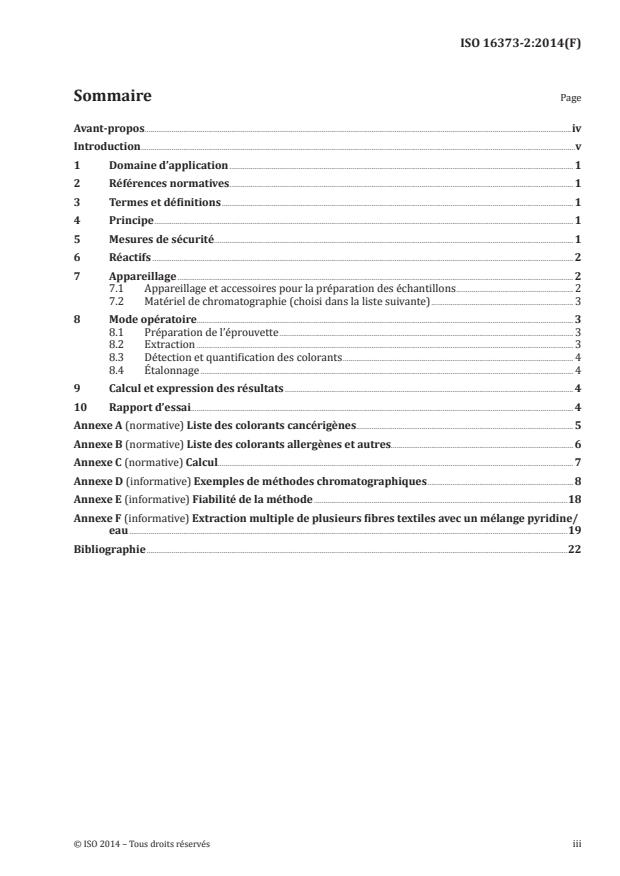
Contents Page
Foreword .iv
Introduction .v
1 Scope . 1
2 Normative references . 1
3 Terms and definitions . 1
4 Principle . 1
5 Safety precautions . 1
6 Reagents . 2
7 Apparatus . 2
7.1 Apparatus and auxiliaries for sample preparation . 2
7.2 Chromatographic equipment (selected from the following). 2
8 Procedure. 3
8.1 Preparation of test specimen . 3
8.2 Extraction . 3
8.3 Detection and quantification of dyestuff . 3
8.4 Calibration . 3
9 Calculation and expression of the results . 4
10 Test report . 4
Annex A (normative) List of carcinogenic dyestuffs . 5
Annex B (normative) List of allergenic and other dyestuffs . 6
Annex C (normative) Calculation . 7
Annex D (informative) Examples of chromatographic methods. 8
Annex E (informative) Reliability of the method .17
Annex F (informative) Multiple-extraction of several textile fibres with pyridine/water .18
Bibliography .20
Foreword
ISO (the International Organization for Standardization) is a worldwide federation of national standards
bodies (ISO member bodies). The work of preparing International Standards is normally carried out
through ISO technical committees. Each member body interested in a subject for which a technical
committee has been established has the right to be represented on that committee. International
organizations, governmental and non-governmental, in liaison with ISO, also take part in the work.
ISO collaborates closely with the International Electrotechnical Commission (IEC) on all matters of
electrotechnical standardization.
The procedures used to develop this document and those intended for its further maintenance are
described in the ISO/IEC Directives, Part 1. In particular the different approval criteria needed for the
different types of ISO documents should be noted. This document was drafted in accordance with the
editorial rules of the ISO/IEC Directives, Part 2. www.iso.org/directives
Attention is drawn to the possibility that some of the elements of this document may be the subject of
patent rights. ISO shall not be held responsible for identifying any or all such patent rights. Details of any
patent rights identified during the development of the document will be in the Introduction and/or on
the ISO list of patent declarations received. www.iso.org/patents
Any trade name used in this document is information given for the convenience of users and does not
constitute an endorsement.
For an explanation on the meaning of ISO specific terms and expressions related to conformity
assessment, as well as information about ISO’s adherence to the WTO principles in the Technical
Barriers to Trade (TBT) see the following URL: Foreword - Supplementary information
ISO 16373-2 was prepared by the European Committee for Standardization (CEN) Technical Committee
CEN/TC 248, Textiles and textile products, in collaboration with ISO Technical Committee TC 38, Textiles,
in accordance with the Agreement on technical cooperation between ISO and CEN (Vienna Agreement).
ISO 16373 consists of the following parts, under the general title Textiles — Dyestuffs:
— Part 1: General principles of testing coloured textiles for dyestuff identification
— Part 2: General method for the determination of extractable dyestuffs including allergenic and
carcinogenic (method using pyridine-water)
— Part 3: Method for determination of carcinogenic extractable dyestuffs (method using
triethylamine/methanol)
iv © ISO 2014 – All rights reserved
Introduction
The ISO 16373 series deals with dyestuffs used in textile for qualification and quantification.
1)
ISO 16373-1 includes the definition of the dyestuff classes and the description of some procedures to
identify qualitatively the dyestuff class used in textile material.
The other parts of ISO 16373 are related to the quantification of some dyestuffs.
In this part of ISO 16373, the principle of the test method is based on the extraction using pyridine-water
solution, which has been found to be the most efficient solution to extract a large range of dyestuffs,
including allergenic and carcinogenic dyestuffs.
In ISO 16373-3, the principle of the test method is based on extraction using triethylamine/methanol
solution. This solution has been found efficient to extract some dyestuffs in some cases.
Additional information related to the recovery rate (to characterize the extraction efficiency) obtained
from the application of ISO 16373-3 and this part of ISO 16373 will be summarized in ISO 16373-1.
It is important to note that other test methods exist related to azo dyes, for which a reduction of those
extracted azo dyes leads to the release of some aromatic amines, to be detected and determined using
chromatography.
The percentage of recovery using the method of this part of ISO 16373 is shown in Annex F for the
dyestuff classes (to be defined in ISO 16373-1) acid, basic, direct, disperse, solvent dyestuffs and
“mordant dyestuffs” on different textile fibres.
1) To be published.
INTERNATIONAL STANDARD ISO 16373-2:2014(E)
Textiles — Dyestuffs —
Part 2:
General method for the determination of extractable
dyestuffs including allergenic and carcinogenic dyestuffs
(method using pyridine-water)
1 Scope
This part of ISO 16373 specifies the analyses used to detect extractable dyestuffs in textile products,
with the extraction performed for all kind of fibres and types of dyestuffs using pyridine/water (1:1). It
lists (see Annexes A and B) the allergenic and carcinogenic dyestuffs which can be analysed using this
method; the lists of dyestuffs are expandable.
2 Normative references
The following documents, in whole or in part, are normatively referenced in this document and are
indispensable for its application. For dated references, only the edition cited applies. For undated
references, the latest edition of the referenced document (including any amendments) applies
ISO 3696, Water for analytical laboratory use — Specification and test methods
3 Terms and definitions
For the purposes of this document, the following terms and definitions apply.
3.1
allergenic dyestuff
dyestuff which may cause an allergic skin reaction
3.2
carcinogenic dyestuff
dyestuff which is classified as carcinogenic substance
Note 1 to entry: Harmonized classification according to the Globally harmonized system of classification and
[2] [3]
labelling of chemicals (GHS), incorporated in EU Regulation 1272/2008 (CLP) .
4 Principle
A coloured test specimen is selected from the textile article and extracted with pyridine/water at
100 °C. The extract is analysed by liquid chromatography/diode array detection (LC/DAD) and/or by
liquid chromatography/mass spectrometry (LC/MS).
5 Safety precautions
WARNING —The substances listed in Tables A.1, B.1 and B.2 are classified as substances known
to be or suspected to be human allergens or carcinogens.
Ensure that any handling and disposal of these substances is in strict accordance with the
appropriate national health and safety regulations.
It is the user’s responsibility to use safe and proper techniques in handling materials in this test
method. Consult manufacturers for specific details such as material safety data sheets and other
recommendations.
Good laboratory practice should be followed. Wear safety glasses in all laboratory areas and a
single use dust respirator while handling powder dyestuffs.
Attention is drawn to any national and local safety regulations.
6 Reagents
Unless otherwise specified, analytical grade chemicals shall be used.
6.1 Pyridine.
6.2 Acetonitrile, chromatographic grade.
6.3 Ammonium acetate.
6.4 Tetrabutylammonium dihydrogen phosphate.
6.5 Deionized water, grade 3 in accordance with ISO 3696.
6.6 Pyridine/water (1:1), prepared by mixing 500 ml pyridine (6.1) and 500 ml water (6.5).
Keep the solution in a brown glass bottle.
6.7 Individual stock solutions, prepared in pyridine-water 1:1, of all reference substances listed in
Annexes A and B
It is recommended that reference substances (including those listed in Annexes A and B) of the highest
purity grade available on the market be used. The given purity has to be considered for the calculation
(see Clause 9).
7 Apparatus
7.1 Apparatus and auxiliaries for sample preparation
7.1.1 Standard laboratory equipment.
7.1.2 Analytical balance, resolution at 0,01 g.
7.1.3 Glass vials (20 ml to 40 ml), with tight closure.
7.1.4 Heating source that generates heat at a temperature of (100 ± 2)°C (thermal block or laboratory
sand-bath, controllable).
7.1.5 Autosampler glass vials, with tight closure.
7.1.6 Thermo-sensing device, e.g. thermocouple, to measure at 100 °C with a resolution of 0,1 °C.
7.2 Chromatographic equipment (selected from the following)
7.2.1 Equipment for LC/DAD
— High performance liquid chromatograph (HPLC),
— DAD detector,
— separating column,
2 © ISO 2014 – All rights reserved
— guard column.
7.2.2 Equipment for LC/MS
— High performance liquid chromatograph (HPLC),
— electrospray ion source,
— MS detector,
— separating column,
— guard column.
8 Procedure
8.1 Preparation of test specimen
The test specimen shall be selected based on the following criteria:
— parts of the textile article;
— nature of the fibre component (fibre composition);
— colours.
Prepare a test specimen of 1,0 g max. by cutting the laboratory sample up into small pieces no larger
than 1 cm . Determine the mass of the test specimen to the nearest 0,01 g and record it as m (see 8.2).
E
8.2 Extraction
Add 7,5 ml of pyridine/water (1:1) (6.6) to the test specimen and close the vial tightly. Heat the vial in
the heating source until the temperature of the solvent reaches (100 ± 2) °C, and hold this temperature
for (35 ± 5) min.
Check the time taken for the temperature of the solvent to reach the required temperature using a glass
vial (see 8.1) containing 7,5 ml of pyridine/water (1:1)(6.6) with a thermo-sensing element (7.1.6), which
is plunged in the solvent and sealed with a septum.
Allow the vial to cool down to 40 °C or below before opening it.
Transfer approximately 1 ml of (test) liquid from the vial to a smaller vial for further analysis.
NOTE This step could be done with a syringe through the closed septum to minimize contact with pyridine.
8.3 Detection and quantification of dyestuff
Dyestuff detection can be performed using the above-specified chromatographic techniques (7.2). If
other analytical techniques are used it shall be reported.
Dyestuff quantification is performed by means of HPLC/DAD/MS.
NOTE Some dyes can be quantified with HPLC/DAD.
8.4 Calibration
For the calibration, the mixed standards of the reference substances listed in Table A.1 (and respectively
in Tables B.1 and B.2) are prepared in pyridine/water (1:1). The stock solutions are used to prepare
mixed standards with concentrations levels of 1 mg/l, 5 mg/l, 10 mg/l and 20 mg/l related to dyestuff
content.
9 Calculation and expression of the results
Amounts of dyestuff are usually calculated by means of a software program. The calculation can be
carried out manually as described in Annex C.
Amounts of dyestuff are expressed in mg dyestuff per kg of textile (mg/kg).
If the detected amount of a dye is over 100 mg/kg, it is certain that this dye is used – such as one of those
listed in Table A.1, B.1 or B.2.
10 Test report
The test report shall refer to this method and shall include at least the following:
a) reference to this part of ISO 16373, i.e. ISO 16373-2;
b) all information necessary for the identification of the test specimen;
c) date of sample receipt and date of analysis;
d) sampling procedure;
e) detection method and quantification method;
f) results reported as level and detection limit per dyestuff, in mg/kg;
g) any deviation from the given procedure.
4 © ISO 2014 – All rights reserved
Annex A
(normative)
List of carcinogenic dyestuffs
See Table A.1.
Table A.1 — Reference carcinogenic dyestuffs
a b c
Number Carcinogenic dyestuff C. I. Number CAS Number Molecular formula
1 Disperse Blue 1 64500 2475–45–8 C H N O
14 12 4 2
2 Solvent Yellow 1 11000 60–09–4 C H N
12 11 3
4-aminoazobenzene
3 Solvent Yellow 2 11020 60–11–7 C H N
14 15 3
4 Solvent Yellow 3 11160 97–56–3 C H N
14 15 3
o-aminoazotoluene
5 Basic Red 9 42500 569–61–9 C H N HCl
19 17 3
6 Basic Violet 14 42500 632–99–5 C H N HCl
20 19 3
7 Disperse Yellow 3 11855 2832–40–8 C H O N
15 15 2 3
8 Acid Red 26 16150 3761–53–3 C H N Na O S
18 14 2 2 7 2
9 Direct Black 38 30235 1937–37–1 C H N Na O S
34 25 9 2 7 2
10 Direct Blue 6 22610 2602–46–2 C H N O S Na
32 24 6 14 4 4
11 Direct Red 28 22120 573–58–0 C H N Na O S
32 22 6 2 6 2
12 Disperse Orange 11 60700 82–28–0 C H NO
15 11 2
13 Acid Red 114 23635 6459–9-5 C H N Na O S
37 28 4 2 10 3
a
Numbering used in Tables D.1, D.4, D.5.
b [2] [3]
Classified according to (GHS) (and to CLP).
c [4]
Colour index number.
Annex B
(normative)
List of allergenic and other dyestuffs
See Tables B.1 and B.2.
NOTE Not all dyestuffs in Table B.1 are clinically verified as allergenic.
Table B.1 — Reference disperse dyestuffs
a
Number Allergenic dyestuff C.I. Number CAS Number Molecular formula
A1 Disperse Blue 1 64500 2475–45–8 C H N O
14 12 4 2
A2 Disperse Blue 3 61505 2475–46–9 C H N O
17 16 2 3
A3 Disperse Blue 7 62500 3179–90–6 C H N O
18 18 2 6
A4 Disperse Blue 26 63305 3860–63–7 C H N O
16 14 2 4
A5 — 56524–77–7 C H N O
15 12 2 4
Disperse Blue 35
A6 — 56524–76–6 C H N O
16 14 2 4
A7 Disperse Blue 102 11945 12222–97–8 C H N O S
15 19 5 4
A8 Disperse Blue 106 111935 12223–01–7 C H N O S
14 17 5 3
A9 Disperse Blue 124 111938 61951–51–7 C H N O S
16 19 5 4
A10 Disperse Brown 1 11152 23355–64–8 C H N O Cl
16 15 4 4 3
A11 Disperse Orange 1 11080 2581–69–3 C H N O
18 14 4 2
A12 Disperse Orange 3 11005 730–40–5 C H N O
12 10 4 2
A13 Disperse Orange 37/76/59 11132 13301–61–6 C H N O Cl
17 15 5 2 2
A14 Disperse Red 1 11110 2872–52–8 C H N O
16 18 4 3
A15 Disperse Red 11 62015 2872–48–2 C H N O
15 12 2 3
A16 Disperse Red 17 11210 3179–89–3 C H N O
17 20 4 4
A17 Disperse Yellow 1 10345 119–15–3 C H N O
12 9 3 5
A18 Disperse Yellow 3 11855 2832–40–8 C H N O
15 15 3 2
A19 Disperse Yellow 9 10375 6373–73–5 C H N O
12 10 4 4
A20 Disperse Yellow 39 480095 12236–29–2 C H N O
17 16 2
A21 Disperse Yellow 49 — 54824–37–2 C H N O
22 22 4 2
a
Numbering used in Tables D.2 and D.3.
Table B.2 — Other reference dyestuffs
a
Number Other dyestuff CI Number CAS Number Molecular formula
O1 Disperse Yellow 23 26070 6250–22–3 C H N O
18 14 4
O Disperse Orange 149 — 85136–74–9 C H N O
2 25 26 6 3
— 118685–33–9 C H ClCrN O S Na
39 23 7 12 2
O3 Navy Blue 018112
— — C H CrN O S Na
46 30 10 20 2 3
O4 Disperse Orange 61 111355 55281–26–0 C H Br N O
17 15 2 5 2
a
Numbering used in Tables D.2 and D.3.
6 © ISO 2014 – All rights reserved
Annex C
(normative)
Calculation
Dyestuff levels are calculated from the peak areas of the individual dyestuff components.
The dyestuff level is calculated as a mass fraction, w, in mg/kg, of the extractable dyestuff in the test
solution, using Formula (1):
ρ ×V
c
w= (C.1)
m
E
where
w is the concentration of dyestuff, in mg/kg;
ρ is the concentration of the dyestuff in the test solution, in mg/l (
...
NORME ISO
INTERNATIONALE 16373-2
Première édition
2014-06-01
Textiles — Colorants —
Partie 2:
Méthode générale de détermination
des colorants extractibles,
notamment les colorants allergènes
et cancérigènes (méthode utilisant un
mélange pyridine/eau)
Textiles — Dyestuffs —
Part 2: General method for the determination of extractable dyestuffs
including allergenic and carcinogenic dyestuffs (method using
pyridine-water)
Numéro de référence
©
ISO 2014
DOCUMENT PROTÉGÉ PAR COPYRIGHT
© ISO 2014
Droits de reproduction réservés. Sauf indication contraire, aucune partie de cette publication ne peut être reproduite ni utilisée
sous quelque forme que ce soit et par aucun procédé, électronique ou mécanique, y compris la photocopie, l’affichage sur
l’internet ou sur un Intranet, sans autorisation écrite préalable. Les demandes d’autorisation peuvent être adressées à l’ISO à
l’adresse ci-après ou au comité membre de l’ISO dans le pays du demandeur.
ISO copyright office
Case postale 56 • CH-1211 Geneva 20
Tel. + 41 22 749 01 11
Fax + 41 22 749 09 47
E-mail copyright@iso.org
Web www.iso.org
Publié en Suisse
ii © ISO 2014 – Tous droits réservés
Sommaire Page
Avant-propos .iv
Introduction .v
1 Domaine d’application . 1
2 Références normatives . 1
3 Termes et définitions . 1
4 Principe . 1
5 Mesures de sécurité . 1
6 Réactifs . 2
7 Appareillage . 2
7.1 Appareillage et accessoires pour la préparation des échantillons . 2
7.2 Matériel de chromatographie (choisi dans la liste suivante) . 3
8 Mode opératoire. 3
8.1 Préparation de l’éprouvette . 3
8.2 Extraction . 3
8.3 Détection et quantification des colorants . 4
8.4 Étalonnage . 4
9 Calcul et expression des résultats . 4
10 Rapport d’essai . 4
Annexe A (normative) Liste des colorants cancérigènes . 5
Annexe B (normative) Liste des colorants allergènes et autres. 6
Annexe C (normative) Calcul . 7
Annexe D (informative) Exemples de méthodes chromatographiques . 8
Annexe E (informative) Fiabilité de la méthode .18
Annexe F (informative) Extraction multiple de plusieurs fibres textiles avec un mélange pyridine/
eau .19
Bibliographie .22
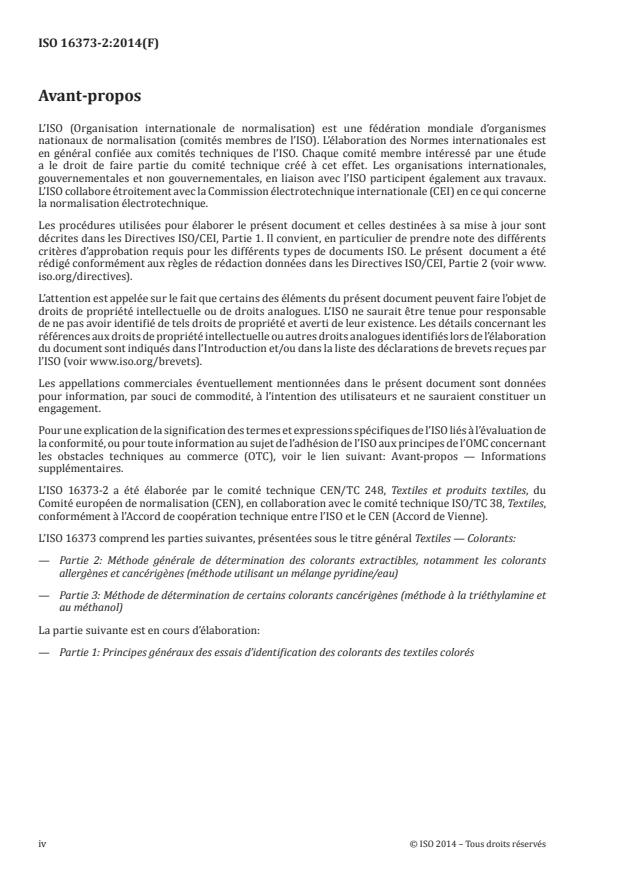
Avant-propos
L’ISO (Organisation internationale de normalisation) est une fédération mondiale d’organismes
nationaux de normalisation (comités membres de l’ISO). L’élaboration des Normes internationales est
en général confiée aux comités techniques de l’ISO. Chaque comité membre intéressé par une étude
a le droit de faire partie du comité technique créé à cet effet. Les organisations internationales,
gouvernementales et non gouvernementales, en liaison avec l’ISO participent également aux travaux.
L’ISO collabore étroitement avec la Commission électrotechnique internationale (CEI) en ce qui concerne
la normalisation électrotechnique.
Les procédures utilisées pour élaborer le présent document et celles destinées à sa mise à jour sont
décrites dans les Directives ISO/CEI, Partie 1. Il convient, en particulier de prendre note des différents
critères d’approbation requis pour les différents types de documents ISO. Le présent document a été
rédigé conformément aux règles de rédaction données dans les Directives ISO/CEI, Partie 2 (voir www.
iso.org/directives).
L’attention est appelée sur le fait que certains des éléments du présent document peuvent faire l’objet de
droits de propriété intellectuelle ou de droits analogues. L’ISO ne saurait être tenue pour responsable
de ne pas avoir identifié de tels droits de propriété et averti de leur existence. Les détails concernant les
références aux droits de propriété intellectuelle ou autres droits analogues identifiés lors de l’élaboration
du document sont indiqués dans l’Introduction et/ou dans la liste des déclarations de brevets reçues par
l’ISO (voir www.iso.org/brevets).
Les appellations commerciales éventuellement mentionnées dans le présent document sont données
pour information, par souci de commodité, à l’intention des utilisateurs et ne sauraient constituer un
engagement.
Pour une explication de la signification des termes et expressions spécifiques de l’ISO liés à l’évaluation de
la conformité, ou pour toute information au sujet de l’adhésion de l’ISO aux principes de l’OMC concernant
les obstacles techniques au commerce (OTC), voir le lien suivant: Avant-propos — Informations
supplémentaires.
L’ISO 16373-2 a été élaborée par le comité technique CEN/TC 248, Textiles et produits textiles, du
Comité européen de normalisation (CEN), en collaboration avec le comité technique ISO/TC 38, Textiles,
conformément à l’Accord de coopération technique entre l’ISO et le CEN (Accord de Vienne).
L’ISO 16373 comprend les parties suivantes, présentées sous le titre général Textiles — Colorants:
— Partie 2: Méthode générale de détermination des colorants extractibles, notamment les colorants
allergènes et cancérigènes (méthode utilisant un mélange pyridine/eau)
— Partie 3: Méthode de détermination de certains colorants cancérigènes (méthode à la triéthylamine et
au méthanol)
La partie suivante est en cours d’élaboration:
— Partie 1: Principes généraux des essais d’identification des colorants des textiles colorés
iv © ISO 2014 – Tous droits réservés
Introduction
La série ISO 16373 traite des colorants utilisés dans les textiles pour la qualification et la quantification.
L’ISO 16373-1 définit les classes de colorants et décrira certains modes opératoires permettant
d’identifier qualitativement la classe du colorant utilisé dans la matière textile.
Les autres parties de l’ISO 16373 portent sur la quantification de certains colorants.
Dans la présente partie de l’ISO 16373, le principe de la méthode d’essai repose sur l’extraction avec un
mélange pyridine/eau, qui s’est révélée la solution la plus efficace pour extraire une large gamme de
colorants, y compris des colorants allergènes et cancérigènes.
Dans l’ISO 16373-3, le principe de la méthode d’essai repose sur l’extraction avec une solution de
triéthylamine et de méthanol. Cette solution a été jugée efficace pour extraire certains colorants, dans
certains cas.
L’ISO 16373-1 fournira des informations complémentaires sur le taux de recouvrement (pour caractériser
le rendement d’extraction) obtenu en appliquant l’ISO 16373-3 et la présente partie de l’ISO 16373.
Il est important de noter qu’il existe d’autres méthodes d’essai en rapport avec les colorants azoïques,
pour lesquelles une réduction des colorants azoïques extraits conduit à la libération de certaines amines
aromatiques qui sont détectées et déterminées par chromatographie.
Le pourcentage de récupération avec la méthode décrite dans la présente partie de l’ISO 16373 est
indiqué dans l’Annexe F pour les classes de colorants (à définir dans l’ISO 16373-1) acides, basiques,
directs, dispersés, avec solvant et «à mordant» sur différentes fibres textiles.
NORME INTERNATIONALE ISO 16373-2:2014(F)
Textiles — Colorants —
Partie 2:
Méthode générale de détermination des colorants
extractibles, notamment les colorants allergènes et
cancérigènes (méthode utilisant un mélange pyridine/eau)
1 Domaine d’application
La présente partie de l’ISO 16373 spécifie les analyses servant à détecter les colorants extractibles
dans les produits textiles, l’extraction étant effectuée avec un mélange de pyridine/eau (1:1) pour tous
les types de fibres et de colorants. Elle répertorie (voir les Annexes A et B) les colorants allergènes et
cancérigènes pouvant être analysés avec cette méthode; ces listes de colorants ne sont pas exhaustives.
2 Références normatives
Les documents suivants, en totalité ou en partie, sont référencés de façon normative dans le présent
document et sont indispensables pour son application. Pour les références datées, seule l’édition citée
s’applique. Pour les références non datées, la dernière édition du document de référence s’applique (y
compris les éventuels amendements).
ISO 3696, Eau pour laboratoire à usage analytique — Spécification et méthodes d’essai
3 Termes et définitions
Pour les besoins du présent document, les termes et définitions suivants s’appliquent.
3.1
colorant allergène
colorant pouvant causer une réaction allergique cutanée
3.2
colorant cancérigène
colorant classé comme substance cancérigène
Note 1 à l’article: Classification harmonisée selon le Système général harmonisé de classification et d’étiquetage des
[2] [3]
produits chimiques (SGH) (incorporé dans le Règlement UE n° 1272/2008 (CLP) ).
4 Principe
Une éprouvette colorée est choisie dans l’article textile et extraite avec un mélange pyridine/eau à 100 °C.
L’extrait est analysé par chromatographie en phase liquide/détecteur à barrettes de diodes (LC/DAD)
et/ou par chromatographie en phase liquide/spectrométrie de masse (LC/MS).
5 Mesures de sécurité
AVERTISSEMENT — Les substances répertoriées dans les Tableaux A.1, B.1 et B.2 sont classées
dans la catégorie des substances connues pour être ou suspectées d’être allergènes ou
cancérigènes pour l’Homme.
S’assurer que la manipulation et la mise au rebut de ces substances se font en stricte conformité
avec les réglementations d’hygiène et de sécurité nationales appropriées.
Il incombe à l’utilisateur d’utiliser des techniques sûres et adéquates pour manipuler les matériaux
dans le cadre de cette méthode d’essai. Consulter les fabricants pour des détails spécifiques,
notamment pour les fiches de données de sécurité des produits et autres recommandations.
Il convient de suivre les bonnes pratiques de laboratoire. Porter des lunettes de sécurité dans
toutes les zones du laboratoire et un masque anti-poussières jetable pour manipuler les colorants
en poudre.
L’attention est attirée sur les réglementations nationales et locales de sécurité.
6 Réactifs
Sauf spécification contraire, des produits chimiques de qualité analytique doivent être utilisés.
6.1 Pyridine.
6.2 Acétonitrile, de qualité chromatographique.
6.3 Acétate d’ammonium.
6.4 Dihydrogénophosphate de tétrabutylammonium.
6.5 Eau déionisée, de qualité 3 conformément à l’ISO 3696.
6.6 Mélange pyridine/eau (1:1), préparé en mélangeant 500 ml de pyridine (6.1) et 500 ml d’eau
(6.5).
Conserver la solution dans un flacon en verre brun.
6.7 Solutions mères individuelles, préparées dans un mélange pyridine/eau (1:1), de toutes les
substances de référence répertoriées dans les Annexes A et B.
Il est recommandé d’utiliser des substances de référence (notamment celles répertoriées dans les
Annexes A et B) de la plus grande pureté disponible sur le marché. La pureté est à prendre en compte
pour le calcul (voir l’Article 9).
7 Appareillage
7.1 Appareillage et accessoires pour la préparation des échantillons
7.1.1 Matériel courant de laboratoire.
7.1.2 Balance analytique, avec une résolution de 0,01 g.
7.1.3 Flacons en verre (de 20 ml à 40 ml), avec bouchon étanche.
7.1.4 Source de chauffage produisant de la chaleur à une température de (100 ± 2) °C (bloc thermique
ou four à sable de laboratoire, contrôlable).
7.1.5 Flacons en verre pour passeur automatique, avec bouchon étanche.
2 © ISO 2014 – Tous droits réservés
7.1.6 Élément thermosensible.
7.2 Matériel de chromatographie (choisi dans la liste suivante)
7.2.1 Matériel de LC/DAD
— Chromatographe en phase liquide haute performance (HPLC);
— détecteur DAD;
— colonne de séparation;
— colonne de garde.
7.2.2 Matériel de LC/MS
— Chromatographe en phase liquide haute performance (HPLC);
— source d’ionisation par électronébulisation;
— détecteur MS;
— colonne de séparation;
— colonne de garde.
8 Mode opératoire
8.1 Préparation de l’éprouvette
L’éprouvette doit être choisie en fonction des critères suivants:
— parties de l’article textile;
— nature des fibres composantes (composition des fibres);
— couleurs.
Préparer une éprouvette de 1,0 g maximum en découpant l’échantillon de laboratoire en petits morceaux
au maximum. Déterminer la masse de l’éprouvette à 0,01 g près et l’enregistrer en tant que m
de 1 cm
E
(voir 8.2).
8.2 Extraction
Ajouter 7,5 ml de mélange pyridine/eau (1:1) (6.6) à l’éprouvette et boucher hermétiquement le flacon.
Chauffer le flacon dans la source de chauffage jusqu’à ce que le solvant atteigne une température de
(100 ± 2) °C, et maintenir cette température pendant (35 ± 5) min.
Vérifier le temps mis par le solvant pour atteindre la température requise en utilisant un flacon en verre
(voir 8.1) contenant 7,5 ml de mélange pyridine/eau (1:1)(6.6), avec un élément thermosensible (7.1.6),
plongé dans le solvant et scellé par un septum.
Laisser refroidir le flacon à 40 °C ou moins avant de l’ouvrir.
Transférer environ 1 ml de liquide (d’essai) du flacon dans un plus petit flacon en vue de l’analyse.
NOTE Cette étape peut se faire en introduisant une seringue dans le septum fermé afin de réduire au
maximum le contact avec la pyridine.
8.3 Détection et quantification des colorants
La détection des colorants peut être réalisée au moyen des techniques chromatographiques spécifiées
ci-dessus (7.2). Si d’autres techniques d’analyse sont employées, ceci doit être indiqué dans le rapport.
La quantification des colorants est réalisée par HPLC/DAD/MS.
NOTE Certains colorants peuvent être quantifiés par HPLC/DAD.
8.4 Étalonnage
Pour l’étalonnage, les étalons mixtes des substances de référence répertoriées dans le Tableau A.1 (et
respectivement dans les Tableaux B.1 et B.2) sont préparés dans un mélange pyridine/eau (1:1). Les
solutions mères sont utilisées pour préparer des étalons mixtes ayant des concentrations de 1 mg/l,
5 mg/l, 10 mg/l et 20 mg/l de colorant.
9 Calcul et expression des résultats
Les quantités de colorant sont généralement calculées au moyen d’un programme informatique. Le
calcul peut être effectué manuellement, comme décrit à l’Annexe C.
Les quantités de colorant sont exprimées en milligrammes de colorant par kilogramme de textile
(mg/kg).
Si la quantité détectée pour un colorant est supérieure à 100 mg/kg, il faut en conclure que ce colorant a
été utilisé – voir la liste des colorants répertoriés dans le Tableau A.1, B.1 ou B.2.
10 Rapport d’essai
Le rapport d’essai doit faire référence à cette méthode et mentionner au moins les détails suivants:
a) la référence à la présente partie de l’ISO 16373, c’est-à’dire l’ ISO 16373-2;
b) toutes les informations nécessaires à l’identification de l’éprouvette;
c) la date de réception de l’échantillon et la date d’analyse;
d) le mode opératoire d’échantillonnage;
e) la méthode de détection et la méthode de quantification;
f) les résultats consignés comme étant une limite de concentration et de détection par colorant, en
mg/kg;
g) tout écart par rapport au mode opératoire indiqué.
4 © ISO 2014 – Tous droits réservés
Annexe A
(normative)
Liste des colorants cancérigènes
Voir le Tableau A.1.
Tableau A.1 — Colorants cancérigènes de référence
a b c
Numéro Colorant cancérigène Numéro C.I. Numéro CAS Formule moléculaire
1 Bleu dispersé 1 64500 2475–45–8 C H N O
14 12 4 2
2 Solvant jaune 1 11000 60–09–4 C H N
12 11 3
4-aminoazobenzène
3 Solvant jaune 2 11020 60–11–7 C H N
14 15 3
4 Solvant jaune 3 11160 97–56–3 C H N
14 15 3
o-aminoazotoluène
5 Rouge basique 9 42500 569–61–9 C H N HCl
19 17 3
6 Violet basique 14 42500 632–99–5 C H N HCl
20 19 3
7 Jaune dispersé 3 11855 2832–40–8 C H O N
15 15 2 3
8 Rouge acide 26 16150 3761–53–3 C H N Na O S
18 14 2 2 7 2
9 Noir direct 38 30235 1937–37–1 C H N Na O S
34 25 9 2 7 2
10 Bleu direct 6 22610 2602–46–2 C H N O S Na
32 24 6 14 4 4
11 Rouge direct 28 22120 573–58–0 C H N Na O S
32 22 6 2 6 2
12 Orange dispersé 11 60700 82–28–0 C H NO
15 11 2
13 Rouge acide 114 23635 6459–9-5 C H N Na O S
37 28 4 2 10 3
a
Numérotation utilisée dans les Tableaux D.1, D.4 et D.5.
b [2] [3]
Classification selon le SGH (et pour le CLP ).
c [4]
Numéro de Colour Index .
Annexe B
(normative)
Liste des colorants allergènes et autres
Voir les Tableaux B.1 et B.2.
NOTE Il n’a pas été vérifié cliniquement que tous les colorants du Tableau B.1 sont allergènes.
Tableau B.1 — Colorants dispersés de référence
a
Numéro Colorant allergène Numéro C.I. Numéro CAS Formule moléculaire
A1 Bleu dispersé 1 64500 2475–45–8 C H N O
14 12 4 2
A2 Bleu dispersé 3 61505 2475–46–9 C H N O
17 16 2 3
A3 Bleu dispersé 7 62500 3179–90–6 C H N O
18 18 2 6
A4 Bleu dispersé 26 63305 3860–63–7 C H N O
16 14 2 4
A5 — 56524–77–7 C H N O
15 12 2 4
Bleu dispersé 35
A6 — 56524–76–6 C H N O
16 14 2 4
A7 Bleu dispersé 102 11945 12222–97–8 C H N O S
15 19 5 4
A8 Bleu dispersé 106 111935 12223–01–7 C H N O S
14 17 5 3
A9 Bleu dispersé 124 111938 61951–51–7 C H N O S
16 19 5 4
A10 Marron dispersé 1 11152 23355–64–8 C H N O Cl
16 15 4 4 3
A11 Orange dispersé 1 11080 2581–69–3 C H N O
18 14 4 2
A12 Orange dispersé 3 11005 730–40–5 C H N O
12 10 4 2
A13 Orange dispersé 37/76/59 11132 13301–61–6 C H N O Cl
17 15 5 2 2
A14 Rouge dispersé 1 11110 2872–52–8 C H N O
16 18 4 3
A15 Rouge dispersé 11 62015 2872–48–2 C H N O
15 12 2 3
A16 Rouge dispersé 17 11210 3179–89–3 C H N O
17 20 4 4
A17 Jaune dispersé 1 10345 119–15–3 C H N O
12 9 3 5
A18 Jaune dispersé 3 11855 2832–40–8 C H N O
15 15 3 2
A19 Jaune dispersé 9 10375 6373–73–5 C H N O
12 10 4 4
A20 Jaune dispersé 39 480095 12236–29–2 C H N O
17 16 2
A21 Jaune dispersé 49 — 54824–37–2 C H N O
22 22 4 2
a
Numérotation utilisée dans les Tableaux D.2 et D.3.
Tableau B.2 — Autres colorants de référence
a
Numéro Autre colorant Numéro C.I. Numéro CAS Formule moléculaire
O1 Jaune dispersé 23 26070 6250–22–3 C H N O
18 14 4
O2 Orange dispersé 149 — 85136–74–9 C H N O
25 26 6 3
— 118685–33–9 C H ClCrN O S Na
39 23 7 12 2
O3 Bleu marine 018112
— — C H CrN O S Na
46 30 10 20 2 3
O4 Orange dispersé 61 111355 55281–26–0 C H Br N O
17 15 2 5 2
a
Numérotation utilisée dans les Tableaux D.2 et D.3.
6 © ISO 2014 – Tous droits réservés
Annexe C
(normative)
Calcul
Les concentrations des colorants sont calculées à partir des aires de pics des composants individuels
des colorants.
La concentration du colorant est calculée sous forme de fraction massique w, en mg/kg, de colorant
extractible dans l’éprouvette, selon la Formule (1):
ρ ×V
c
w= (1)
m
E
où
w est la concentration du colorant, en mg/kg;
ρ est la concentration du colorant extractible dans l’éprouvette, en mg/l (à partir de la courbe
c
d’étalonnage);
V est le volume (volume final de l’éprouvette), en ml;
m est la masse de l’éprouvette de textile, en g.
E
Annexe D
(informative)
Exemples de méthodes chromatographiques
D.1 Méthode par chromatographie en phase liquide haute performance
(HPLC/DAD) pour les colorants dispersés et cancérigènes
1)
D.1.1 Système UHPLC à une pression supérieure à 400 bar
Éluant 1: Dih
...
Questions, Comments and Discussion
Ask us and Technical Secretary will try to provide an answer. You can facilitate discussion about the standard in here.
Loading comments...