

ISO/TS 23927:2024
(Main)Laminates and moulding compounds — Prepregs — Determination of tack
General Information
- Abstract
This document specifies the test method for determining the tack in prepregs under defined conditions. This document is applicable to but not limited to unidirectional and multidirectional thermoset based prepregs made with glass fibres, carbon fibres, aramid fibres and other similar fibres included.
- Status
- Published
- Publication Date
- 21-Mar-2024
- Technical Committee
- ISO/TC 61/SC 13 - Composites and reinforcement fibres
- Drafting Committee
- ISO/TC 61/SC 13/WG 2 - Laminates and moulding compounds
- Current Stage
- 6060 - International Standard published
- Start Date
- 22-Mar-2024
- Due Date
- 09-Dec-2023
- Completion Date
- 22-Mar-2024


Overview
ISO/TS 23927:2024 - "Laminates and moulding compounds - Prepregs - Determination of tack" is a Technical Specification that defines a reproducible, quantitative test method for measuring the tack of thermoset-based prepregs (unidirectional and multidirectional) made with glass, carbon, aramid and similar reinforcement fibres. Published in 2024, it provides apparatus, specimen, conditioning and procedural requirements to obtain consistent tack measurements suitable for quality control and automated production.
Key Topics and Requirements
- Definition of tack: Tack is the maximum retracting (separation) areal force measured when a defined probe is pulled away from the prepreg surface; expressed in Newtons (N).
- Apparatus:
- Probe: 304 stainless steel, 80 mm diameter, flat end machined at 90°, surface roughness ≤ 500 nm (≤ 250 nm RMS per ISO 21920-2), hardness ≥ 80 HRB; self-aligning probe recommended.
- Support platen: same material as probe, at least 1.5× specimen size (≥ 100 × 100 mm), flatness deviation ≤ 0.01 mm over 100 mm.
- Force measurement system: inertia-free, compliant with Class 1 of ISO 7500-1.
- Tension/compression testing machine: meet ISO 7500-1 requirements; data acquisition frequency sufficient for accurate force/time capture.
- Specimens and conditioning:
- Specimen size: 100 × 100 mm (±2 mm).
- Minimum five specimens from the same roll; more can be used for precision (95% confidence per ISO 2602).
- Condition per ISO 291; preferred atmosphere (23 ± 2) °C and (50 ± 10) % RH; conditioning time ≥ 4 h (or as agreed).
- Test cycle (compression/dwell/retraction):
- Compress to (900 ± 10) N at 1 mm/min.
- Hold compression for (100 ± 1) s (dwell).
- Retract at 25 mm/min and record force–time curve; maximum retracting force = tack.
- Specimen seating and cleanliness: use thin-film double-sided tape or equivalent; probe cleaned with a solvent that leaves no residue; protective film handling guidance included.
Applications and Users
- Practical use cases:
- Quality control of prepreg batches.
- Process control for automated layup, AFP/ATL, and automated manufacturing where tack affects placement and consolidation.
- R&D and material comparison for composite suppliers and OEMs (aerospace, automotive, wind energy, sporting goods).
- Typical users:
- Test laboratories, composite material suppliers, manufacturing engineers, and QA/QC teams involved in prepreg handling and assembly.
Related Standards
- ISO 291 - Standard atmospheres for conditioning and testing
- ISO 7500-1:2018 - Verification of static uniaxial testing machines (force measurement)
- ISO 21920-2 - Surface texture: profile method (surface roughness parameters)
ISO/TS 23927:2024 delivers a standardized, quantitative tack test that improves repeatability and supports both manual and automated prepreg manufacturing workflows.
Get Certified
Connect with accredited certification bodies for this standard

DIN CERTCO
DIN Group product certification.

Smithers Quality Assessments
US management systems and product certification.
Sponsored listings
Frequently Asked Questions
ISO/TS 23927:2024 is a technical specification published by the International Organization for Standardization (ISO). Its full title is "Laminates and moulding compounds — Prepregs — Determination of tack". This standard covers: This document specifies the test method for determining the tack in prepregs under defined conditions. This document is applicable to but not limited to unidirectional and multidirectional thermoset based prepregs made with glass fibres, carbon fibres, aramid fibres and other similar fibres included.
This document specifies the test method for determining the tack in prepregs under defined conditions. This document is applicable to but not limited to unidirectional and multidirectional thermoset based prepregs made with glass fibres, carbon fibres, aramid fibres and other similar fibres included.
ISO/TS 23927:2024 is classified under the following ICS (International Classification for Standards) categories: 83.120 - Reinforced plastics. The ICS classification helps identify the subject area and facilitates finding related standards.
ISO/TS 23927:2024 is available in PDF format for immediate download after purchase. The document can be added to your cart and obtained through the secure checkout process. Digital delivery ensures instant access to the complete standard document.
Standards Content (Sample)
Technical
Specification
ISO/TS 23927
First edition
Laminates and moulding
2024-03
compounds — Prepregs —
Determination of tack
Stratifiés et composés à mouler — Préimprégnés —
Détermination du tack
Reference number
© ISO 2024
All rights reserved. Unless otherwise specified, or required in the context of its implementation, no part of this publication may
be reproduced or utilized otherwise in any form or by any means, electronic or mechanical, including photocopying, or posting on
the internet or an intranet, without prior written permission. Permission can be requested from either ISO at the address below
or ISO’s member body in the country of the requester.
ISO copyright office
CP 401 • Ch. de Blandonnet 8
CH-1214 Vernier, Geneva
Phone: +41 22 749 01 11
Email: copyright@iso.org
Website: www.iso.org
Published in Switzerland
ii
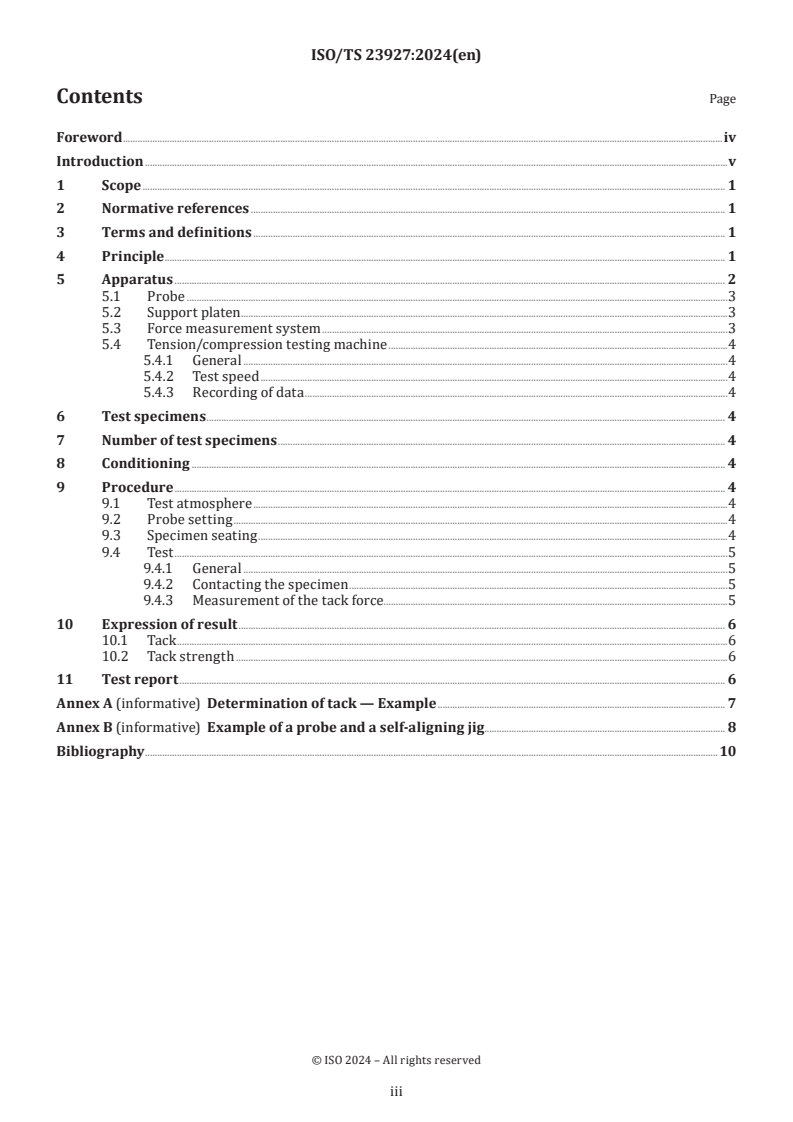
Contents Page
Foreword .iv
Introduction .v
1 Scope . 1
2 Normative references . 1
3 Terms and definitions . 1
4 Principle . 1
5 Apparatus . 2
5.1 Probe .3
5.2 Support platen .3
5.3 Force measurement system .3
5.4 Tension/compression testing machine .4
5.4.1 General .4
5.4.2 Test speed .4
5.4.3 Recording of data .4
6 Test specimens . 4
7 Number of test specimens . 4
8 Conditioning . 4
9 Procedure . 4
9.1 Test atmosphere .4
9.2 Probe setting .4
9.3 Specimen seating .4
9.4 Test .5
9.4.1 General .5
9.4.2 Contacting the specimen .5
9.4.3 Measurement of the tack force.5
10 Expression of result . 6
10.1 Tack .6
10.2 Tack strength .6
11 Test report . 6
Annex A (informative) Determination of tack — Example . 7
Annex B (informative) Example of a probe and a self-aligning jig. 8
Bibliography .10
iii
Foreword
ISO (the International Organization for Standardization) is a worldwide federation of national standards
bodies (ISO member bodies). The work of preparing International Standards is normally carried out through
ISO technical committees. Each member body interested in a subject for which a technical committee
has been established has the right to be represented on that committee. International organizations,
governmental and non-governmental, in liaison with ISO, also take part in the work. ISO collaborates closely
with the International Electrotechnical Commission (IEC) on all matters of electrotechnical standardization.
The procedures used to develop this document and those intended for its further maintenance are described
in the ISO/IEC Directives, Part 1. In particular, the different approval criteria needed for the different types
of ISO document should be noted. This document was drafted in accordance with the editorial rules of the
ISO/IEC Directives, Part 2 (see www.iso.org/directives).
ISO draws attention to the possibility that the implementation of this document may involve the use of (a)
patent(s). ISO takes no position concerning the evidence, validity or applicability of any claimed patent
rights in respect thereof. As of the date of publication of this document, ISO had not received notice of (a)
patent(s) which may be required to implement this document. However, implementers are cautioned that
this may not represent the latest information, which may be obtained from the patent database available at
www.iso.org/patents. ISO shall not be held responsible for identifying any or all such patent rights.
Any trade name used in this document is information given for the convenience of users and does not
constitute an endorsement.
For an explanation of the voluntary nature of standards, the meaning of ISO specific terms and expressions
related to conformity assessment, as well as information about ISO's adherence to the World Trade
Organization (WTO) principles in the Technical Barriers to Trade (TBT), see www.iso.org/iso/foreword.html.
This document was prepared by Technical Committee ISO/TC 61, Plastics, Subcommittee SC 13, Composites
and reinforcement fibres.
Any feedback or questions on this document should be directed to the user’s national standards body. A
complete listing of these bodies can be found at www.iso.org/members.html.
iv
Introduction
Tack is an important property of prepregs that relates to the integrity of the composite laminate being
produced. The practice of determining tack in prepregs is mostly qualitative as it is often done by the
experience of the personnel involved. On the other hand, in some automated manufacturing using prepregs,
tack needs to be measured as a part of the manufacturing process. This document is intended to provide
standing alone quantitative method for the measurement of tack in prepregs.
v
Technical Specification ISO/TS 23927:2024(en)
Laminates and moulding compounds — Prepregs —
Determination of tack
1 Scope
This document specifies the test method for determining the tack in prepregs under defined conditions.
This document is applicable to but not limited to unidirectional and multidirectional thermoset based
prepregs made with glass fibres, carbon fibres, aramid fibres and other similar fibres included.
2 Normative referenc
...