


ISO/FDIS 19743
(Main)Solid biofuels — Determination of content of heavy extraneous materials larger than 3,15 mm
Solid biofuels — Determination of content of heavy extraneous materials larger than 3,15 mm
ISO 19743:2017 specifies a method for the determination of content of heavy extraneous materials larger than 3,15 mm by the use of sink-and-float separation combined with elutriation. This document is applicable to woody biomass in accordance with ISO 17225‑1:2014, Table 1.
Biocombustibles solides — Détermination de la teneur en matériaux lourds exogènes de dimension supérieure à 3,15 mm
L'ISO 19743 :2017 spécifie une méthode de détermination de la teneur en matériaux lourds exogènes de dimension supérieure à 3,15 mm à l'aide d'une séparation par sédimentation et suspension avec élutriation. Le présent document est applicable à la biomasse ligneuse conformément à l'ISO 17225‑1:2014, Tableau 1. NOTE 1 Cette méthode est conçue pour déterminer la teneur en impuretés de dimension supérieure à 3,15 mm et avec une masse volumique spécifique supérieure à 1 g/cm3 comme les pierres, le verre, le caoutchouc, le métal et certains types de matières plastiques. NOTE 2 Lors du traitement de l'échantillon, un triage à la main des impuretés légères de masse volumique spécifique inférieure ou égale à 1 g/cm3 (par exemple une feuille plastique) peut également être effectué.
General Information
Relations
Standards Content (Sample)
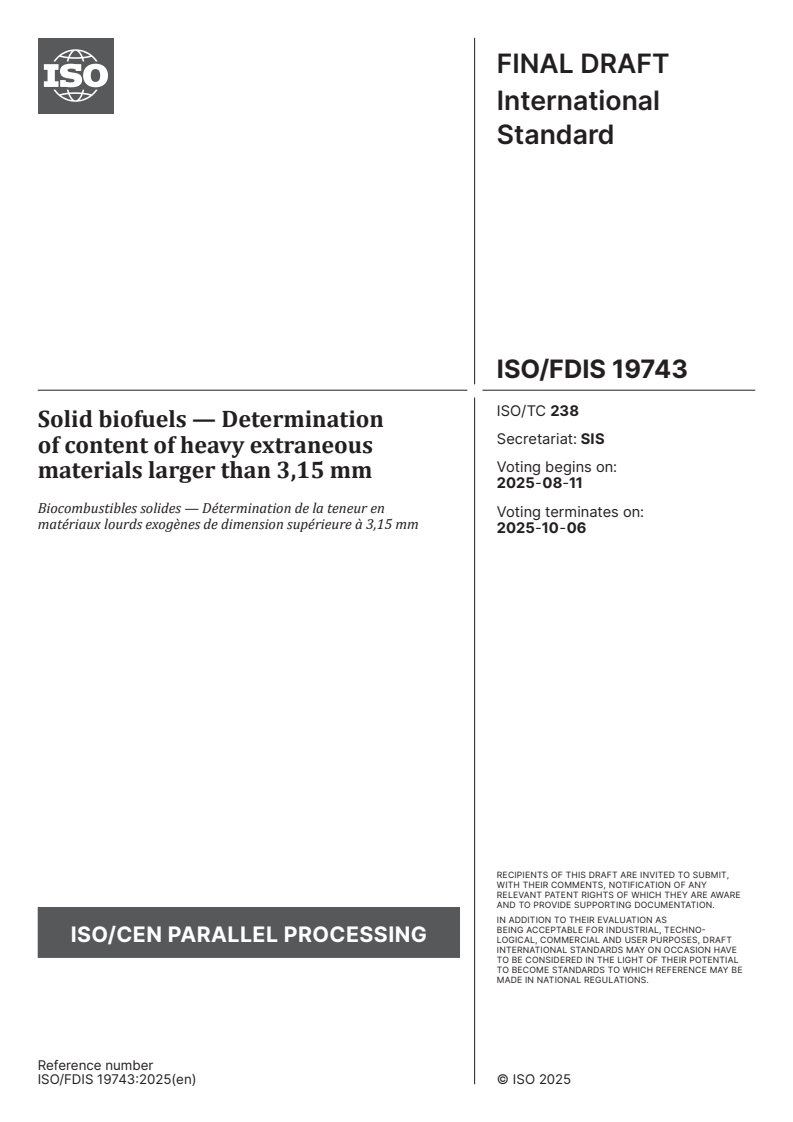
FINAL DRAFT
International
Standard
ISO/TC 238
Solid biofuels — Determination
Secretariat: SIS
of content of heavy extraneous
Voting begins on:
materials larger than 3,15 mm
2025-08-11
Biocombustibles solides — Détermination de la teneur en
Voting terminates on:
matériaux lourds exogènes de dimension supérieure à 3,15 mm
2025-10-06
RECIPIENTS OF THIS DRAFT ARE INVITED TO SUBMIT,
WITH THEIR COMMENTS, NOTIFICATION OF ANY
RELEVANT PATENT RIGHTS OF WHICH THEY ARE AWARE
AND TO PROVIDE SUPPOR TING DOCUMENTATION.
IN ADDITION TO THEIR EVALUATION AS
BEING ACCEPTABLE FOR INDUSTRIAL, TECHNO
ISO/CEN PARALLEL PROCESSING LOGICAL, COMMERCIAL AND USER PURPOSES, DRAFT
INTERNATIONAL STANDARDS MAY ON OCCASION HAVE
TO BE CONSIDERED IN THE LIGHT OF THEIR POTENTIAL
TO BECOME STAN DARDS TO WHICH REFERENCE MAY BE
MADE IN NATIONAL REGULATIONS.
Reference number
FINAL DRAFT
International
Standard
ISO/TC 238
Solid biofuels — Determination
Secretariat: SIS
of content of heavy extraneous
Voting begins on:
materials larger than 3,15 mm
Biocombustibles solides — Détermination de la teneur en
Voting terminates on:
matériaux lourds exogènes de dimension supérieure à 3,15 mm
RECIPIENTS OF THIS DRAFT ARE INVITED TO SUBMIT,
WITH THEIR COMMENTS, NOTIFICATION OF ANY
RELEVANT PATENT RIGHTS OF WHICH THEY ARE AWARE
AND TO PROVIDE SUPPOR TING DOCUMENTATION.
© ISO 2025
IN ADDITION TO THEIR EVALUATION AS
All rights reserved. Unless otherwise specified, or required in the context of its implementation, no part of this publication may
BEING ACCEPTABLE FOR INDUSTRIAL, TECHNO
ISO/CEN PARALLEL PROCESSING
LOGICAL, COMMERCIAL AND USER PURPOSES, DRAFT
be reproduced or utilized otherwise in any form or by any means, electronic or mechanical, including photocopying, or posting on
INTERNATIONAL STANDARDS MAY ON OCCASION HAVE
the internet or an intranet, without prior written permission. Permission can be requested from either ISO at the address below
TO BE CONSIDERED IN THE LIGHT OF THEIR POTENTIAL
or ISO’s member body in the country of the requester.
TO BECOME STAN DARDS TO WHICH REFERENCE MAY BE
MADE IN NATIONAL REGULATIONS.
ISO copyright office
CP 401 • Ch. de Blandonnet 8
CH-1214 Vernier, Geneva
Phone: +41 22 749 01 11
Email: copyright@iso.org
Website: www.iso.org
Published in Switzerland Reference number
ii
Contents Page
Foreword .iv
Introduction .v
1 Scope . 1
2 Normative references . 1
3 Terms and definitions . 1
4 Principle . 2
5 Apparatus . 2
5.1 Water container .2
5.2 Balances .2
5.3 Sieve .2
5.4 Drying oven .2
5.5 Dishes or trays .2
6 Sample preparation . 2
7 Procedure . 3
8 Calculation . 3
9 Performance characteristics . 4
10 Test report . 4
Bibliography . 5
iii
Foreword
ISO (the International Organization for Standardization) is a worldwide federation of national standards
bodies (ISO member bodies). The work of preparing International Standards is normally carried out through
ISO technical committees. Each member body interested in a subject for which a technical committee
has been established has the right to be represented on that committee. International organizations,
governmental and non-governmental, in liaison with ISO, also take part in the work. ISO collaborates closely
with the International Electrotechnical Commission (IEC) on all matters of electrotechnical standardization.
The procedures used to develop this document and those intended for its further maintenance are described
in the ISO/IEC Directives, Part 1. In particular, the different approval criteria needed for the different types
of ISO document should be noted. This document was drafted in accordance with the editorial rules of the
ISO/IEC Directives, Part 2 (see www.iso.org/directives).
ISO draws attention to the possibility that the implementation of this document may involve the use of (a)
patent(s). ISO takes no position concerning the evidence, validity or applicability of any claimed patent
rights in respect thereof. As of the date of publication of this document, ISO had not received notice of (a)
patent(s) which may be required to implement this document. However, implementers are cautioned that
this may not represent the latest information, which may be obtained from the patent database available at
www.iso.org/patents. ISO shall not be held responsible for identifying any or all such patent rights.
Any trade name used in this document is information given for the convenience of users and does not
constitute an endorsement.
For an explanation of the voluntary nature of standards, the meaning of ISO specific terms and expressions
related to conformity assessment, as well as information about ISO's adherence to the World Trade
Organization (WTO) principles in the Technical Barriers to Trade (TBT), see www.iso.org/iso/foreword.html.
This document was prepared by Technical Committee ISO/TC 238, Solid biofuels and pyrogenic biocarbon, in
collaboration with the European Committee for Standardization (CEN) Technical Committee CEN/TC 335,
Solid Biofuels and Pyrogenic Biocarbon, in accordance with the Agreement on technical cooperation between
ISO and CEN (Vienna Agreement).
This second edition cancels and replaces the first edition (ISO 19743:2017), which has been technically
revised.
The main changes are as follows:
— introduction has been extended with a specification of where heavy extraneous materials can enter the
fuel. It has also been elucidated that HEM most often are found in wood hogfuel;
— procedure has been updated and clarified;
— calculation has been updated.
Any feedback or questions on this document should be directed to the user’s national standards body. A
complete listing of these bodies can be found at www.iso.org/members.html.
iv
Introduction
Determination of the content of heavy extraneous materials larger than 3,15 mm is important when
evaluating the suitability of using biomass as biofuel. The presences of heavy extraneous materials lowers
the energetic value of the fuel and increases the residue after burning, thus increasing the costs of disposal.
Stones and other impurities contained in biomass from stumps, roots, mill residue and harvest and landscape
management residues can cause problems during size reduction, as well as during combustion.
Impurities smaller than 3,15 mm are not considered as part of this testing method but can still contribute to
the ash content.
The contents of heavy extraneous materials larger than 3,15 mm are not part of the ash content.
NOTE There are three main sources of heavy extraneous materials:
— they can be contained in the base material from which the biofuel (e.g. hog fuel) is produced;
— they can unintentionally be added to the fuel while loading from the ground, by digging too low;
— they can be residues from former loads in the transport vehicle.
The last two categories of heavy extraneous materials in the NOTE cannot be determined
...
Date: Revised 2025-05-17
ISO/TC 238
Secretariat: SIS
Date:
Solid Biofuels biofuels — Determination of content of heavy extraneous
materials larger than 3,15 mm
Biocombustibles solides — Dosage — Détermination de la teneur en matériaux lourds exogènes de dimension
supérieure à 3,15 mm
FDIS stage
All rights reserved. Unless otherwise specified, or required in the context of its implementation, no part of this publication
may be reproduced or utilized otherwise in any form or by any means, electronic or mechanical, including photocopying,
or posting on the internet or an intranet, without prior written permission. Permission can be requested from either ISO
at the address below or ISO’s member body in the country of the requester.
ISO copyright office
CP 401 • Ch. de Blandonnet 8
CH-1214 Vernier, Geneva
Phone: + 41 22 749 01 11
EmailE-mail: copyright@iso.org
Website: www.iso.orgwww.iso.org
Published in Switzerland
ii
Contents
Foreword . iv
Introduction . v
1 Scope . 1
2 Normative references . 1
3 Terms and definitions . 1
4 Principle . 2
5 Apparatus . 2
6 Sample preparation . 3
7 Procedure . 3
8 Calculation . 4
9 Performance characteristics. 4
10 Test report . 4
Bibliography . 5
Foreword . iv
Introduction . v
1 Scope . 1
2 Normative references . 1
3 Terms and definitions . 1
4 Principle . 2
5 Apparatus . 2
5.1 Water container . 2
5.2 Balances . 2
5.3 Sieve . 2
5.4 Drying oven . 2
5.5 Dishes or trays . 2
6 Sample preparation . 3
7 Procedure . 3
8 Calculation . 3
9 Performance characteristics. 4
10 Test report . 4
Bibliography . 5
iii
Foreword
ISO (the International Organization for Standardization) is a worldwide federation of national standards
bodies (ISO member bodies). The work of preparing International Standards is normally carried out through
ISO technical committees. Each member body interested in a subject for which a technical committee has been
established has the right to be represented on that committee. International organizations, governmental and
non-governmental, in liaison with ISO, also take part in the work. ISO collaborates closely with the
International Electrotechnical Commission (IEC) on all matters of electrotechnical standardization.
The procedures used to develop this document and those intended for its further maintenance are described
in the ISO/IEC Directives, Part 1. In particular, the different approval criteria needed for the different types of
ISO document should be noted. This document was drafted in accordance with the editorial rules of the
ISO/IEC Directives, Part 2 (see www.iso.org/directives).
ISO draws attention to the possibility that the implementation of this document may involve the use of (a)
patent(s). ISO takes no position concerning the evidence, validity or applicability of any claimed patent rights
in respect thereof. As of the date of publication of this document, ISO had not received notice of (a) patent(s)
which may be required to implement this document. However, implementers are cautioned that this may not
represent the latest information, which may be obtained from the patent database available at
www.iso.org/patents.www.iso.org/patents. ISO shall not be held responsible for identifying any or all such
patent rights.
Any trade name used in this document is information given for the convenience of users and does not
constitute an endorsement.
For an explanation of the voluntary nature of standards, the meaning of ISO specific terms and expressions
related to conformity assessment, as well as information about ISO's adherence to the World Trade
Organization (WTO) principles in the Technical Barriers to Trade (TBT), see
www.iso.org/iso/foreword.htmlwww.iso.org/iso/foreword.html.
This document was prepared by Technical Committee ISO/TC 238, Solid biofuels and pyrogenic biocarbon, in
collaboration with the European Committee for Standardization (CEN) Technical Committee CEN/TC 335,
Solid Biofuels and Pyrogenic Biocarbon, in accordance with the Agreement on technical cooperation between
ISO and CEN (Vienna Agreement).
This second edition cancels and replaces the first edition (ISO 19743:2017), which has been technically
revised.
The main changes are as follows:
— — introduction has been extended with a specification of where heavy extraneous materials can enter
the fuel. It has also been elucidated that HEM most often are found in wood hogfuel;
— — procedure has been updated and clarified;
— — calculation has been updated.
Any feedback or questions on this document should be directed to the user’s national standards body. A
complete listing of these bodies can be found at www.iso.org/members.html.
iv
Introduction
Determination of the content of heavy extraneous materials larger than 3,15 mm is important when evaluating
the suitability of using biomass as biofuel. The presences of heavy extraneous materials lowers the energetic
value of the fuel and increases the residue after burning, thus increasing the costs of disposal.
Stones and other impurities contained in biomass from stumps, roots, mill residue and harvest and landscape
management residues can cause problems during size reduction, as well as during combustion.
Impurities smaller than 3,15 mm are not considered as part of this testing method but can still contribute to
the ash content.
The contents of heavy extraneous materials larger than 3,15 mm are not part of the ash content.
NOTE There are three main sources of heavy extraneous materials:
— — they can be contained in the base material from which the biofuel (e.g. hog fuel) is produced;
— — they can unintentionally be added to the fuel while loading from the ground, by digging too low;
— — they can be residues from former loads in the transport vehicle.
The last two categories of heavy extraneous materials in the NOTE cannot be determined by the method
described in this document, because it is unlikely that the incidental impurities can be found in the random
sample on which this method is based. If such incidental impurities are found during visual inspection of the
delivered fuel, then this can be documented by pictures and contact can be sought with the supplier to make
sure that these incidents are avoided in the future.
...
Questions, Comments and Discussion
Ask us and Technical Secretary will try to provide an answer. You can facilitate discussion about the standard in here.
Loading comments...