


ISO 18319-1
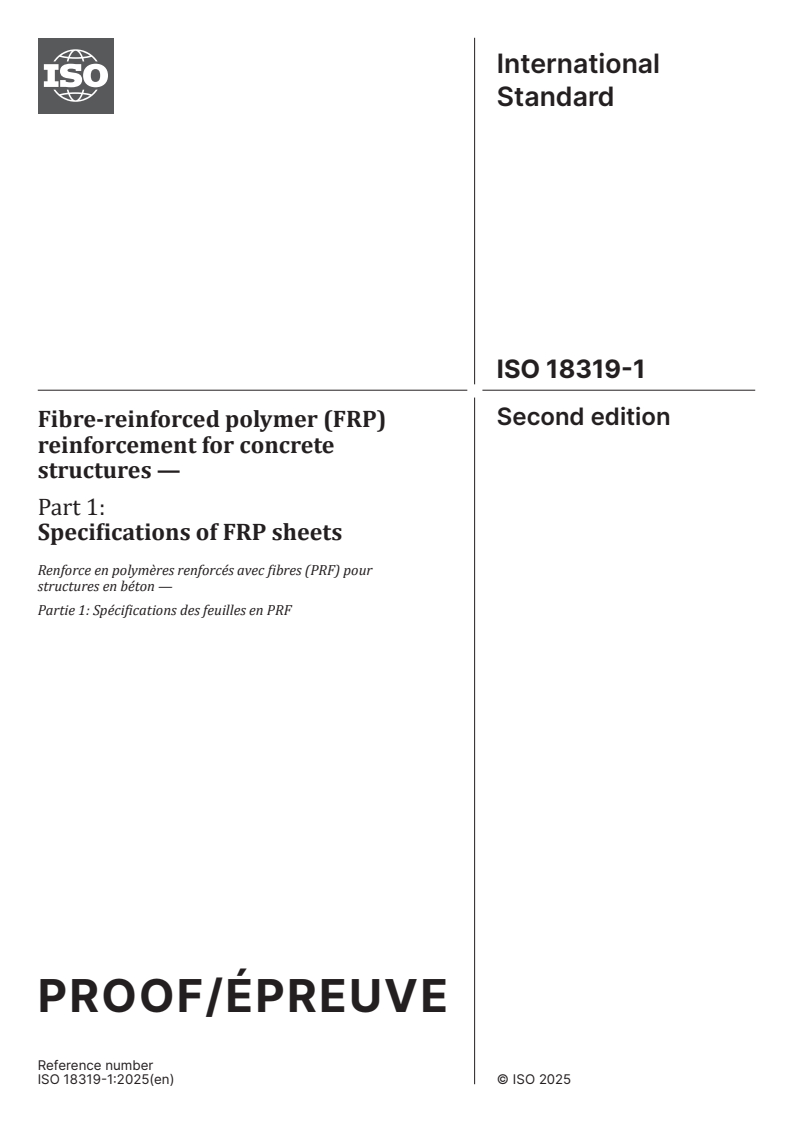
(Main)Fibre-reinforced polymer (FRP) reinforcement for concrete structures - Part 1: Specifications of FRP sheets
Fibre-reinforced polymer (FRP) reinforcement for concrete structures - Part 1: Specifications of FRP sheets
ISO 18319:2015 specifies requirements for fibre-reinforced polymer (FRP) sheets for upgrading of concrete members. The methodologies to express the mechanical properties as characteristic values, appearance and dimensions, and sampling test are specified in this International Standard. The properties for design are calculated from the characteristic values, as prescribed in an appropriate design code which is in accordance with ISO 14484. The fibre orientation of the FRP sheets covered by this International Standard is unidirectional.
Renforce en polymères renforcés avec fibres (PRF) pour structures en béton — Partie 1: Spécifications des feuilles en PRF
General Information
- Status
- Not Published
- Current Stage
- 6000 - International Standard under publication
- Start Date
- 05-Dec-2025
- Completion Date
- 27-Dec-2025
Relations
- Effective Date
- 06-Jun-2022
Overview
ISO 18319-1:2025 specifies requirements for fibre‑reinforced polymer (FRP) sheets used to upgrade concrete members. Focused on unidirectional FRP sheets, the standard defines how suppliers must report mechanical properties, appearance and dimensional criteria, and sampling/test procedures. It clarifies how values used for design are derived and referenced to appropriate design guidance such as ISO 14484.
Key Topics
- Mechanical properties
- Guaranteed tensile strength: supplied as mean minus three times the standard deviation (99.9 % reliability), replacing the previous characteristic tensile-value approach.
- Characteristic Young’s modulus: reported as the mean value (per ISO 10406‑2 definitions).
- Characteristic ultimate strain: calculated as guaranteed tensile strength divided by characteristic Young’s modulus.
- Tensile tests conducted in accordance with ISO 10406‑2.
- Appearance and dimensions
- Dry sheets must have a smooth surface without folds, waves or notable fibre breakage.
- Length and width agreed between parties; nominal thickness (t) is calculated from fibre mass per unit area and sheet density using the formula provided in the standard.
- Visual inspection under daylight or daylight‑type illumination (6 500 K ± 650 K).
- Sampling and testing
- Initial testing: at least 20 test pieces; periodic inspection: at least five.
- Dimensional measurements at room temperature or standard conditions (ISO 291). For warm climates, 27 °C ± 2 °C and 65 % ± 5 % RH are applicable.
- Annex A (normative) details determination of fibre mass per unit area (cut specimens, balance precision, sizing content adjustments).
- Terminology and symbols
- Defines terms such as dry sheet, sizing agent and weft, and lists symbols for parameters like t and ρ.
Applications and Users
ISO 18319-1 is practical for:
- FRP material suppliers - to declare consistent, reliable product data (tensile strength, modulus, dimensions).
- Structural engineers and designers - to select FRP sheets and derive design properties in accordance with ISO 14484 and national design codes.
- Contractors and installers - to verify appearance, dimensions and handling requirements on delivery.
- Testing laboratories and quality control teams - to perform sampling, tensile tests and fibre mass determinations per the standard. The standard helps manage the brittle behavior of FRP sheets and reduce risk of stress concentrations on concrete surfaces by ensuring accurate property reporting and consistent testing.
Related Standards
- ISO 10406‑2 - FRP sheets test methods (referenced for tensile testing and definitions)
- ISO 291 - Standard atmospheres for conditioning and testing
- ISO 14484 - Performance guidelines for design using FRP materials
Keywords: ISO 18319-1, FRP sheets, fibre-reinforced polymer, tensile strength, Young’s modulus, ultimate strain, sampling test, FRP reinforcement for concrete.
ISO/PRF 18319-1 - Fibre-reinforced polymer (FRP) reinforcement for concrete structures — Part 1: Specifications of FRP sheets Released:6. 11. 2025
REDLINE ISO/PRF 18319-1 - Fibre-reinforced polymer (FRP) reinforcement for concrete structures — Part 1: Specifications of FRP sheets Released:6. 11. 2025
Frequently Asked Questions
ISO 18319-1 is a draft published by the International Organization for Standardization (ISO). Its full title is "Fibre-reinforced polymer (FRP) reinforcement for concrete structures - Part 1: Specifications of FRP sheets". This standard covers: ISO 18319:2015 specifies requirements for fibre-reinforced polymer (FRP) sheets for upgrading of concrete members. The methodologies to express the mechanical properties as characteristic values, appearance and dimensions, and sampling test are specified in this International Standard. The properties for design are calculated from the characteristic values, as prescribed in an appropriate design code which is in accordance with ISO 14484. The fibre orientation of the FRP sheets covered by this International Standard is unidirectional.
ISO 18319:2015 specifies requirements for fibre-reinforced polymer (FRP) sheets for upgrading of concrete members. The methodologies to express the mechanical properties as characteristic values, appearance and dimensions, and sampling test are specified in this International Standard. The properties for design are calculated from the characteristic values, as prescribed in an appropriate design code which is in accordance with ISO 14484. The fibre orientation of the FRP sheets covered by this International Standard is unidirectional.
ISO 18319-1 is classified under the following ICS (International Classification for Standards) categories: 83.120 - Reinforced plastics; 91.080.40 - Concrete structures; 91.100.30 - Concrete and concrete products. The ICS classification helps identify the subject area and facilitates finding related standards.
ISO 18319-1 has the following relationships with other standards: It is inter standard links to ISO 18319:2015. Understanding these relationships helps ensure you are using the most current and applicable version of the standard.
You can purchase ISO 18319-1 directly from iTeh Standards. The document is available in PDF format and is delivered instantly after payment. Add the standard to your cart and complete the secure checkout process. iTeh Standards is an authorized distributor of ISO standards.
Standards Content (Sample)
International
Standard
Second edition
Fibre-reinforced polymer (FRP)
reinforcement for concrete
structures —
Part 1:
Specifications of FRP sheets
Renforce en polymères renforcés avec fibres (PRF) pour
structures en béton —
Partie 1: Spécifications des feuilles en PRF
PROOF/ÉPREUVE
Reference number
© ISO 2025
All rights reserved. Unless otherwise specified, or required in the context of its implementation, no part of this publication may
be reproduced or utilized otherwise in any form or by any means, electronic or mechanical, including photocopying, or posting on
the internet or an intranet, without prior written permission. Permission can be requested from either ISO at the address below
or ISO’s member body in the country of the requester.
ISO copyright office
CP 401 • Ch. de Blandonnet 8
CH-1214 Vernier, Geneva
Phone: +41 22 749 01 11
Email: copyright@iso.org
Website: www.iso.org
Published in Switzerland
PROOF/ÉPREUVE
ii
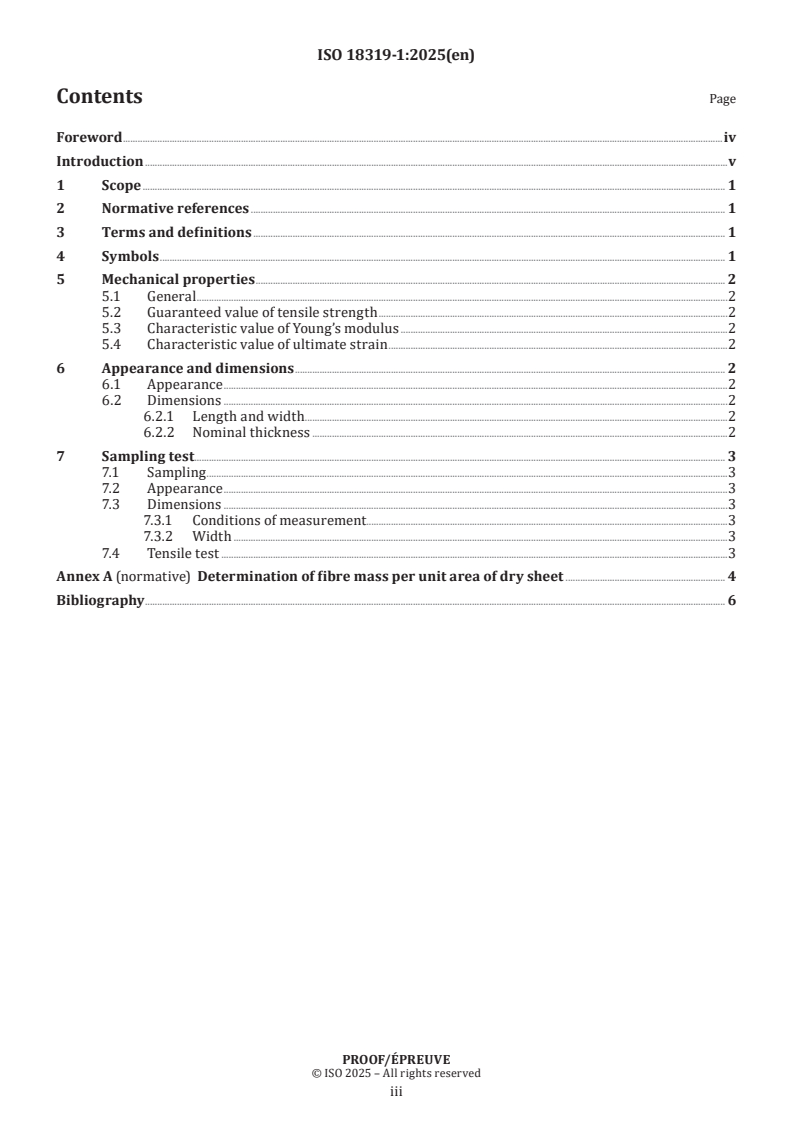
Contents Page
Foreword .iv
Introduction .v
1 Scope . 1
2 Normative references . 1
3 Terms and definitions . 1
4 Symbols . 1
5 Mechanical properties . 2
5.1 General .2
5.2 Guaranteed value of tensile strength .2
5.3 Characteristic value of Young’s modulus .2
5.4 Characteristic value of ultimate strain .2
6 Appearance and dimensions . 2
6.1 Appearance .2
6.2 Dimensions .2
6.2.1 Length and width .2
6.2.2 Nominal thickness .2
7 Sampling test. 3
7.1 Sampling .3
7.2 Appearance .3
7.3 Dimensions .3
7.3.1 Conditions of measurement . .3
7.3.2 Width .3
7.4 Tensile test .3
Annex A (normative) Determination of fibre mass per unit area of dry sheet . 4
Bibliography . 6
PROOF/ÉPREUVE
iii
Foreword
ISO (the International Organization for Standardization) is a worldwide federation of national standards
bodies (ISO member bodies). The work of preparing International Standards is normally carried out through
ISO technical committees. Each member body interested in a subject for which a technical committee
has been established has the right to be represented on that committee. International organizations,
governmental and non-governmental, in liaison with ISO, also take part in the work. ISO collaborates closely
with the International Electrotechnical Commission (IEC) on all matters of electrotechnical standardization.
The procedures used to develop this document and those intended for its further maintenance are described
in the ISO/IEC Directives, Part 1. In particular, the different approval criteria needed for the different types
of ISO document should be noted. This document was drafted in accordance with the editorial rules of the
ISO/IEC Directives, Part 2 (see www.iso.org/directives).
ISO draws attention to the possibility that the implementation of this document may involve the use of (a)
patent(s). ISO takes no position concerning the evidence, validity or applicability of any claimed patent
rights in respect thereof. As of the date of publication of this document, ISO had not received notice of (a)
patent(s) which may be required to implement this document. However, implementers are cautioned that
this may not represent the latest information, which may be obtained from the patent database available at
www.iso.org/patents. ISO shall not be held responsible for identifying any or all such patent rights.
Any trade name used in this document is information given for the convenience of users and does not
constitute an endorsement.
For an explanation of the voluntary nature of standards, the meaning of ISO specific terms and expressions
related to conformity assessment, as well as information about ISO's adherence to the World Trade
Organization (WTO) principles in the Technical Barriers to Trade (TBT), see www.iso.org/iso/foreword.html.
This document was prepared by Technical Committee ISO/TC 71, Concrete, reinforced concrete and pre-
stressed concrete, Subcommittee SC 6, Non-traditional reinforcing materials for concrete structures.
This second edition cancels and replaces the first edition (ISO 18319:2015) which has been technically
revised.
The main changes are as follows:
— Characteristic value of tensile strength in Clause 5 was replaced by guaranteed value of tensile strength
provided by the material supplier.
A list of all parts in the ISO 18319 series can be found on the ISO website.
Any feedback or questions on this document should be directed to the user’s national standards body. A
complete listing of these bodies can be found at www.iso.org/members.html.
PROOF/ÉPREUVE
iv
Intro
...
Date: 2025-04-23
ISO/DISPRF 18319-1:2025(en)
ISO TC71/SC6/WG /TC 71/SC 6
Secretariat: JISC
Date: 2025-11-06
Fibre-reinforced polymer (FRP) reinforcement for concrete
structures
- —
Part 1:
Specifications of FRP sheets -
Renforce en polymères renforcés avec fibres (PRF) pour structures en béton —
Partie 1: Spécifications des feuilles en PRF
PROOF
ISO/PRF 18319-1:2025(en)
All rights reserved. Unless otherwise specified, or required in the context of its implementation, no part of this publication
may be reproduced or utilized otherwise in any form or by any means, electronic or mechanical, including photocopying,
or posting on the internet or an intranet, without prior written permission. Permission can be requested from either ISO
at the address below or ISO'sISO’s member body in the country of the requester.
ISO Copyright Officecopyright office
CP 401 • Ch. de Blandonnet 8
CH-1214 Vernier, Geneva
Phone: + 41 22 749 01 11
Email: E-mail: copyright@iso.org
Website: www.iso.org
Published in Switzerland.
ii
ISO/DISPRF 18319-1:2025(en)
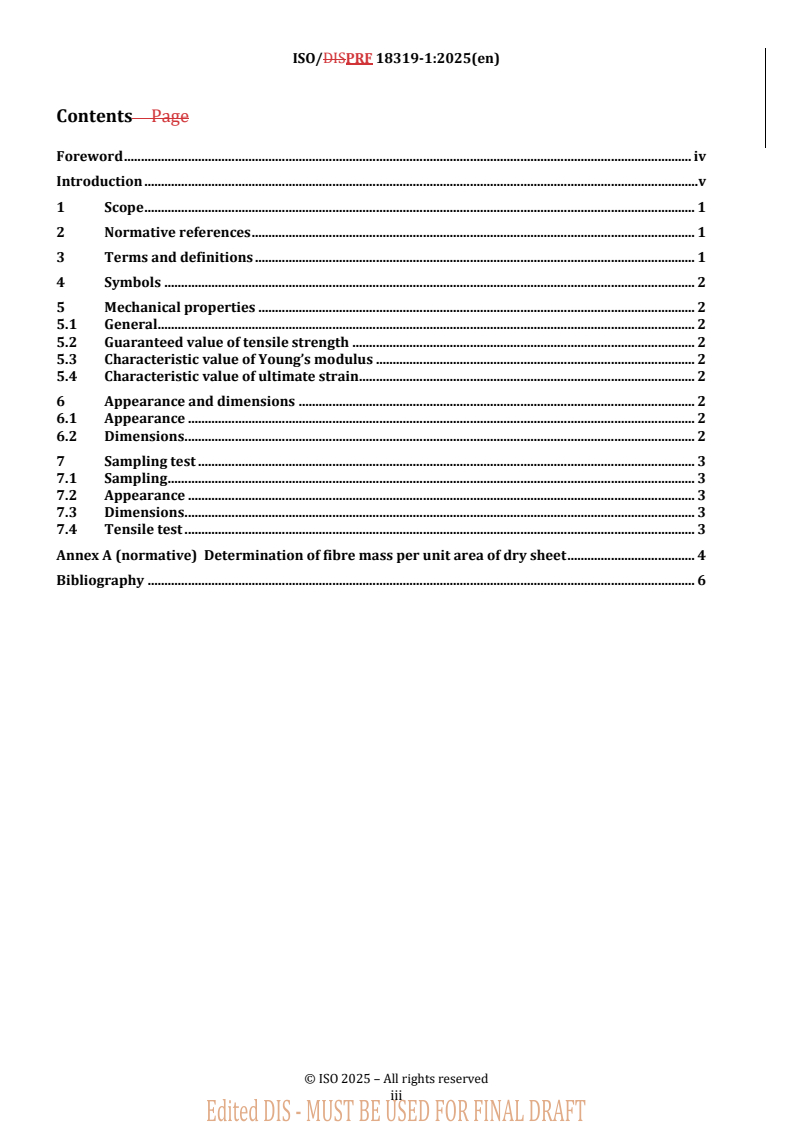
Contents Page
Foreword . iv
Introduction . v
1 Scope . 1
2 Normative references . 1
3 Terms and definitions . 1
4 Symbols . 2
5 Mechanical properties . 2
5.1 General . 2
5.2 Guaranteed value of tensile strength . 2
5.3 Characteristic value of Young’s modulus . 2
5.4 Characteristic value of ultimate strain . 2
6 Appearance and dimensions . 2
6.1 Appearance . 2
6.2 Dimensions . 2
7 Sampling test . 3
7.1 Sampling . 3
7.2 Appearance . 3
7.3 Dimensions . 3
7.4 Tensile test . 3
Annex A (normative) Determination of fibre mass per unit area of dry sheet . 4
Bibliography . 6
iii
ISO/PRF 18319-1:2025(en)
Foreword
ISO (the International Organization for Standardization) is a worldwide federation of national standards
bodies (ISO member bodies). The work of preparing International Standards is normally carried out through
ISO technical committees. Each member body interested in a subject for which a technical committee has been
established has the right to be represented on that committee. International organizations, governmental and
non-governmental, in liaison with ISO, also take part in the work. ISO collaborates closely with the
International Electrotechnical Commission (IEC) on all matters of electrotechnical standardization.
The procedures used to develop this document and those intended for its further maintenance are described
in the ISO/IEC Directives, Part 1. In particular, the different approval criteria needed for the different types of
ISO document should be noted. This document was drafted in accordance with the editorial rules of the
ISO/IEC Directives, Part 2 (see www.iso.org/directives).
ISO draws attention to the possibility that the implementation of this document may involve the use of (a)
patent(s). ISO takes no position concerning the evidence, validity or applicability of any claimed patent rights
in respect thereof. As of the date of publication of this document, ISO had not received notice of (a) patent(s)
which may be required to implement this document. However, implementers are cautioned that this may not
represent the latest information, which may be obtained from the patent database available at
www.iso.org/patents. ISO shall not be held responsible for identifying any or all such patent rights.
Any trade name used in this document is information given for the convenience of users and does not
constitute an endorsement.
For an explanation of the voluntary nature of standards, the meaning of ISO specific terms and expressions
related to conformity assessment, as well as information about ISO's adherence to the World Trade
Organization (WTO) principles in the Technical Barriers to Trade (TBT), see www.iso.org/iso/foreword.html.
This document was prepared by Technical Committee ISO/TC 71, Concrete, reinforced concrete and pre-
stressed concrete, Subcommittee SC 6, Non-traditional reinforcing materials for concrete structures.
This second edition cancels and replaces the first edition (ISO 18319:2015) which has been technically
revised.
The main changes are as follows:
— — Characteristic value of tensile strength in 5Clause 5 was replaced by guaranteed value of tensile
strength provided by the material supplier.
A list of all parts in the ISO 18319 series can be found on the ISO website.
Any feedback or questions on this document should be directed to the user’s national standards body. A
complete listing of these bodies can be found at www.iso.org/members.html.
iv
ISO/DISPRF 18319-1:2025(en)
Introduction
Fibre-reinforced polymer (FRP) sheets have been widely used for repairing and reinforcing existing concrete
structures because of their lightweight and high tensile strength. On the other hand, the sheets are also brittle
materials that break when they reach tensile strength. Their thickness is approximately 1 mm or less, which
is extremely thin compared to the thickness of structural members. Therefore, FRP sheets are likely to cause
stress concentration at convex or cracked areas on the concrete surface, so great care must be taken in design
and construction.
Additionally, since FRP sheets have many different types and mechanical properties, suppliers need to clearly
state their specifications so that users can appropriately and safely select their FRP sheets. This standard
specifies tensile strength, elastic modulus, ultimate strain, length, width, and thickness as information
provided by material suppliers to users and sp
...
Questions, Comments and Discussion
Ask us and Technical Secretary will try to provide an answer. You can facilitate discussion about the standard in here.
Loading comments...