

ISO 21763:2026
(Main)Guidelines for smart manufacturing in the iron and steel industry
- Abstract
This document specifies guidelines for smart manufacturing technologies applicable to smart plants in the iron and steel industry, together with the basic requirements for these technologies as defined in the application guidelines. This document covers three dimensions related to the steel production process: smart production process design, smart equipment, and smart production. This document provides an overview of the potential applications of smart manufacturing technology in these scenarios, as well as the specific technical requirements it needs to meet. This document provides reference guidelines for the iron and steel industry to formulate smart factory upgrading plans to improve productivity and product quality. It is intended for use by iron and steel manufacturing enterprises, smart manufacturing technology vendors, and relevant public sector organizations, and is applicable to steel plants regardless of manufacturing process route, equipment configuration, plant size, geographic location, or product type. This document is not intended to be used for any form of evaluation or grading of steel plants or companies.
- Status
- Published
- Publication Date
- 02-Aug-2026
- Technical Committee
- ISO/TC 17 - Steel
- Drafting Committee
- ISO/TC 17 - Steel
- Current Stage
- 6060 - International Standard published
- Start Date
- 03-Aug-2026
- Due Date
- 03-Aug-2026
- Completion Date
- 03-Aug-2026


ISO 21763:2026 is an International Standard from ISO that gives guidelines for smart manufacturing technologies for the iron and steel industry. It describes how smart plants can apply digital process design, smart equipment, and smart production methods to improve productivity and product quality. The standard is aimed at iron and steel manufacturing enterprises, smart manufacturing technology vendors, and relevant public sector organizations, and it is not intended for evaluating or grading plants or companies.
What does ISO 21763:2026 specify?
ISO 21763:2026 specifies guidelines for smart manufacturing technologies applicable to smart plants in the iron and steel industry, together with the basic requirements for those technologies. It covers the steel production process in three dimensions: smart production process design, smart equipment, and smart production.
The standard is organized into these main parts:
| Clause | Topic |
|---|---|
| 1 | Scope |
| 2 | Normative references |
| 3 | Terms and definitions |
| 4 | Key elements of smart manufacturing in the steel industry |
| 5 | Smart production process design |
| 6 | Smart production equipment |
| 7 | Smart production |
| Bibliography | Background references |
Clause 4 also highlights the operating environment of steel plants. It notes that noise, strong magnetic fields, dust, high temperatures, vibrations, and many dynamic machines place special demands on systems, equipment, and communications, so reliability matters in practice.
What are the key requirements of ISO 21763:2026?
ISO 21763:2026 is a guidelines document, so its technical content focuses on what smart manufacturing functions should cover in a steel plant and what data or controls those functions should support. The most important points are in Clauses 5 to 7.
Smart production process design
Clause 5 links product development to process capability. It says artificial intelligence, big data, and advanced databases can support product research and design, which means companies can use data-driven tools to match product targets with realistic process settings.
Clause 5.3.2 says production process design should use digital technologies to build digital process systems for stages such as raw material production, iron-making, and steel-making. In practice, that means the plant should be able to guide operations with digital process data rather than only with manual instructions.
Clause 5.3.2 also calls for process models and process databases to track execution, evaluate results, and trace the manufacturing process. This matters because stable production depends on seeing how the actual process compares with the planned one, and on identifying where a deviation started.
Clause 5.3.2 requires dynamic optimization and adjustment of process design when process parameters or equipment results change. In practice, the system should not just record data - it should help the plant adapt downstream settings when upstream conditions shift.
Clause 5.3.3 points to future features such as automated process models and real-time diagnosis and prediction. That means smart plants should be designed so process control can become more adaptive over time.
Smart production equipment
Clause 6.1 classifies production equipment into process equipment, inspection equipment, logistics equipment, energy equipment, and environmental protection equipment. This is important because smart manufacturing in steel is not limited to furnaces or rolling mills - it also depends on inspection, movement of materials, energy supply, and emissions handling.
Clause 6.2 says production equipment should support digitalization, interoperability, process visualization, reduced intervention, equipment monitoring, performance optimization, and information recording and transmission. In practice, equipment should provide usable data, accept commands from control systems, and support both operation and maintenance decisions.
Clause 6.3 adds specific functions for tooling, inspection equipment, logistics equipment, and energy and environmental protection equipment. For example, inspection equipment should self-check before and during testing and generate reports automatically, while logistics equipment should support positioning, path planning, collision avoidance, and overload protection. These functions matter because they reduce manual handling errors and improve safety and traceability.
Clause 6.4 recommends future features such as integrated operation and predictive maintenance. That means equipment should be connected enough to support remote or integrated operation where needed, and its maintenance should be based on condition data rather than fixed intervals alone.
Smart production
Clause 7.1 links production planning to product plans, equipment maintenance schedules, and resource consumption plans. In practice, production planning in a steel plant needs to coordinate demand, capacity, and downtime so the line keeps moving.
Clause 7.2.1 requires production coordination to collect data on raw materials, production, quality, equipment status, inventory, vehicles, energy, environment, and safety. This matters because dispatching and coordination depend on a single operational view across the plant.
Clause 7.2.3 says process control should support secure communication, operating modes such as automatic and manual, fine-grained control, process models, real-time parameter adjustment, and long-term storage of control data. In practice, control systems should be able to respond live to process changes while preserving data for later analysis.
Clause 7.3 focuses on quality control, including refined control, quality inspection and determination, quality monitoring, traceability, and future data alignment for defect analysis. This is important because quality in steel depends on data continuity from raw materials to final inspection.
Clause 7.4 covers equipment maintenance through maintenance strategy, spare parts planning, service coordination, maintenance standards, and digital records. The practical point is that maintenance should be tied to operating condition, production plans, and lifecycle data.
Clause 7.5 covers smart logistics, including transportation, storage, and loading and unloading. It emphasizes route optimization, inventory sharing, real-time monitoring, and automatic adjustment when conditions change. That helps prevent material shortages and avoid disruptions between process steps.
Clause 7.6 covers controls for sustainability in the value chain. It focuses on data collection for energy media, integrated supervision of plant networks, energy system functions, and forecasting and coordination. In practice, energy use should be managed as part of the production system, not as a separate utility task.
What terms does ISO 21763:2026 define?
ISO 21763:2026 defines the following key terms:
- Smart manufacturing - manufacturing that improves performance by integrated and smart use of processes and resources across cyber, physical, and human spheres.
- Enabler - a technology that provides the foundation for intelligent manufacturing, such as connectivity, cloud computing, robotics, or artificial intelligence.
- Enhancer - a tool that uses one or more enablers to create new opportunities and business solutions.
- Artificial intelligence (AI) - a set of methods or automated entities that build, optimize, and apply a model to produce predictions, recommendations, or decisions.
- Smart production - an integrated human-machine system that uses smart equipment, sensors, process control systems, smart logistics, manufacturing execution systems, and cyber-physical systems.
- Smart logistics - a logistics service system based on the Internet of Things, with big data, cloud computing, blockchain, and related information technologies.
- Process control - methods for describing and controlling the production process using mathematical models.
- Equipment maintenance - lifecycle management and optimization of equipment, tools, and spare parts from procurement to disposal.
Who uses ISO 21763:2026?
ISO 21763:2026 is intended for iron and steel manufacturing enterprises, smart manufacturing technology vendors, and relevant public sector organizations. In practice, that means it is useful for plant managers, process engineers, automation teams, quality managers, maintenance teams, logistics planners, and buyers or project teams that need to define smart factory upgrades.
It is relevant across different steel plants regardless of process route, equipment configuration, plant size, geographic location, or product type. That broad scope matters when a company wants a common framework for planning upgrades without tying the plan to one specific plant layout.
What does the ISO 21763:2026 document contain?
ISO 21763:2026 contains a structured set of guidelines rather than prescriptive limits. Clause 5 describes smart process design, Clause 6 covers equipment capabilities, and Clause 7 develops the operational side of smart manufacturing through planning, coordination, control, quality, maintenance, logistics, and sustainability.
The document includes many examples of data items and functions, such as process parameters, quality indicators, equipment status, energy data, logistics tracking, and environmental monitoring. It also describes future-oriented functions like predictive maintenance, automated scheduling, and integrated operation centers, which help readers understand where the standard is headed in practical plant design.
Get Certified
Connect with accredited certification bodies for this standard

BSI Group
BSI (British Standards Institution) is the business standards company that helps organizations make excellence a habit.

DVS-ZERT GmbH
German welding certification society.

Element Materials Technology
Materials testing and product certification.
Sponsored listings
Frequently Asked Questions
ISO 21763:2026 is a standard published by the International Organization for Standardization (ISO). Its full title is "Guidelines for smart manufacturing in the iron and steel industry". This standard covers: This document specifies guidelines for smart manufacturing technologies applicable to smart plants in the iron and steel industry, together with the basic requirements for these technologies as defined in the application guidelines. This document covers three dimensions related to the steel production process: smart production process design, smart equipment, and smart production. This document provides an overview of the potential applications of smart manufacturing technology in these scenarios, as well as the specific technical requirements it needs to meet. This document provides reference guidelines for the iron and steel industry to formulate smart factory upgrading plans to improve productivity and product quality. It is intended for use by iron and steel manufacturing enterprises, smart manufacturing technology vendors, and relevant public sector organizations, and is applicable to steel plants regardless of manufacturing process route, equipment configuration, plant size, geographic location, or product type. This document is not intended to be used for any form of evaluation or grading of steel plants or companies.
This document specifies guidelines for smart manufacturing technologies applicable to smart plants in the iron and steel industry, together with the basic requirements for these technologies as defined in the application guidelines. This document covers three dimensions related to the steel production process: smart production process design, smart equipment, and smart production. This document provides an overview of the potential applications of smart manufacturing technology in these scenarios, as well as the specific technical requirements it needs to meet. This document provides reference guidelines for the iron and steel industry to formulate smart factory upgrading plans to improve productivity and product quality. It is intended for use by iron and steel manufacturing enterprises, smart manufacturing technology vendors, and relevant public sector organizations, and is applicable to steel plants regardless of manufacturing process route, equipment configuration, plant size, geographic location, or product type. This document is not intended to be used for any form of evaluation or grading of steel plants or companies.
ISO 21763:2026 is classified under the following ICS (International Classification for Standards) categories: 25.040.01 - Industrial automation systems in general; 35.240.50 - IT applications in industry; 77.020 - Production of metals. The ICS classification helps identify the subject area and facilitates finding related standards.
ISO 21763:2026 is available in PDF format for immediate download after purchase. The document can be added to your cart and obtained through the secure checkout process. Digital delivery ensures instant access to the complete standard document.
Standards Content (Sample)
International
Standard
ISO 21763
First edition
Guidelines for smart manufacturing
2026-08
in the iron and steel industry
Lignes directrices pour la fabrication intelligente dans l'industrie
sidérurgique
Reference number
© ISO 2026
All rights reserved. Unless otherwise specified, or required in the context of its implementation, no part of this publication may
be reproduced or utilized otherwise in any form or by any means, electronic or mechanical, including photocopying, or posting on
the internet or an intranet, without prior written permission. Permission can be requested from either ISO at the address below
or ISO’s member body in the country of the requester.
ISO copyright office
CP 401 • Ch. de Blandonnet 8
CH-1214 Vernier, Geneva
Phone: +41 22 749 01 11
Email: copyright@iso.org
Website: www.iso.org
Published in Switzerland
ii
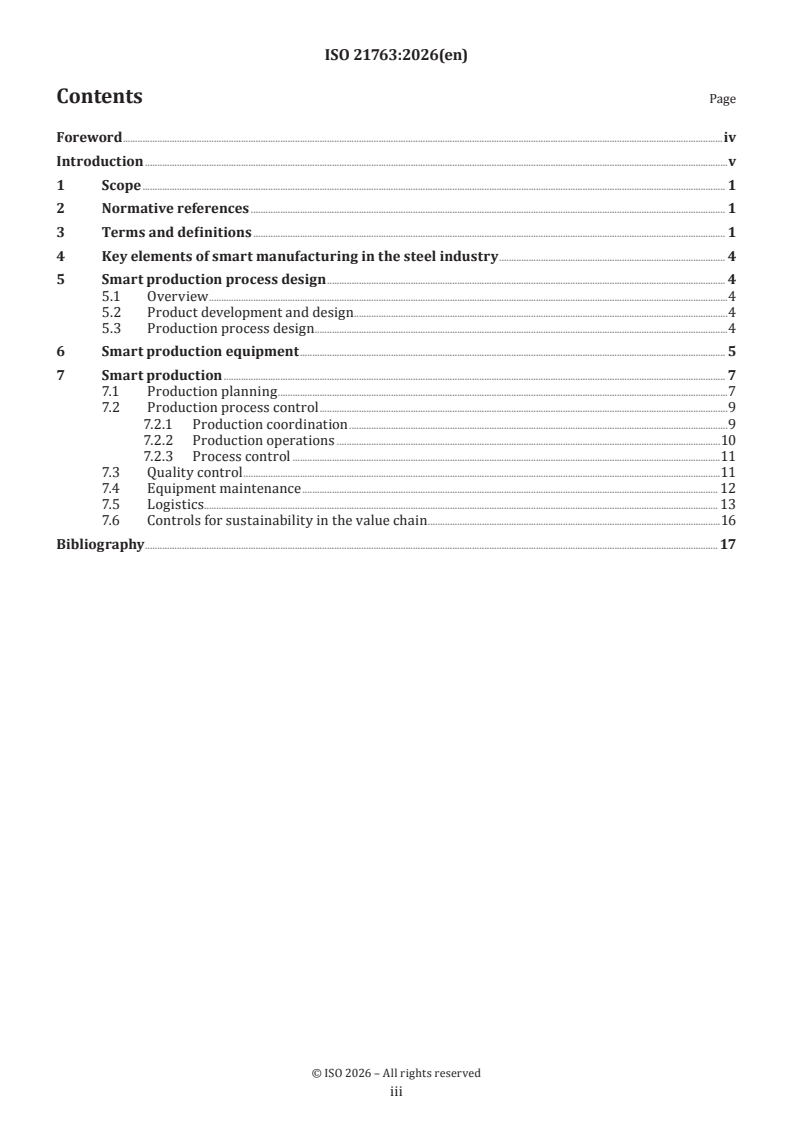
Contents Page
Foreword .iv
Introduction .v
1 Scope . 1
2 Normative references . 1
3 Terms and definitions . 1
4 Key elements of smart manufacturing in the steel industry . 4
5 Smart production process design . 4
5.1 Overview .4
5.2 Product development and design . .4
5.3 Production process design.4
6 Smart production equipment . 5
7 Smart production . 7
7.1 Production planning .7
7.2 Production process control .9
7.2.1 Production coordination .9
7.2.2 Production operations .10
7.2.3 Process control .11
7.3 Quality control .11
7.4 Equipment maintenance . 12
7.5 Logistics . . 13
7.6 Controls for sustainability in the value chain .16
Bibliography . 17
iii
Foreword
ISO (the International Organization for Standardization) is a worldwide federation of national standards
bodies (ISO member bodies). The work of preparing International Standards is normally carried out through
ISO technical committees. Each member body interested in a subject for which a technical committee
has been established has the right to be represented on that committee. International organizations,
governmental and non-governmental, in liaison with ISO, also take part in the work. ISO collaborates closely
with the International Electrotechnical Commission (IEC) on all matters of electrotechnical standardization.
The procedures used to develop this document and those intended for its further maintenance are described
in the ISO/IEC Directives, Part 1. In particular, the different approval criteria needed for the different types
of ISO documents should be noted. This document was drafted in accordance with the editorial rules of the
ISO/IEC Directives, Part 2 (see www.iso.org/directives).
ISO draws attention to the possibility that the implementation of this document may involve the use of (a)
patent(s). ISO takes no position concerning the evidence, validity or applicability of any claimed patent
rights in respect thereof. As of the date of publication of this document, ISO had not received notice of (a)
patent(s) which may be required to implement this document. However, implementers are cautioned that
this may not represent the latest information, which may be obtained from the patent database available at
www.iso.org/patents. ISO shall not be held responsible for identifying any or all such patent rights.
Any trade name used in this document is information given for the convenience of users and does not
constitute an endorsement.
For an explanation of the voluntary nature of standards, the meaning of ISO specific terms and expressions
related to conformity assessment, as well as information about ISO's adherence to the World Trade
Organization (WTO) principles in the Technical Barriers to Trade (TBT), see www.iso.org/iso/foreword.html.
This document was prepared by Technical Committee ISO/TC 17, Steel.
Any feedback or questions on this document should be directed to the user’s national standards body. A
complete listing of these bodies can be found at www.iso.org/members.html.
iv
Introduction
Smart manufacturing technologies have been playing increasingly pivotal roles across diverse industrial
sectors and daily life. In 2021, ISO released the "White Paper on Smart Manufacturing Standardization",
which defines smart manufacturing as the 4th industrial revolution. This foundational document
delineates strategic pathways for deploying smart technologies across multifarious industrial domains,
while establishing forward-looking standardization frameworks to guide technological convergence and
innovation trajectories over the next decade.
The iron and steel industry is one of the most critical industrial sectors. With the rapid development of
global smart manufacturing technologies, how new smart manufacturing technologies can be applied to the
iron and steel industry to improve production efficiency, enhance product quality, reduce production costs,
and ensure employee safety has become a topic of common concern.
Enhancers and enablers, as outlined in the ISO Smart Manufacturing Coordinating Committee (SMCC) "The
White Papers on Smart Manufacturing", are the basic requirements for achieving smart manufacturing in
the iron and steel industry. During production, using advanced algorithms, smart equipment, smart systems,
and other smart manufacturing technologies can be effective to reduce production costs, stable product
quality, worker’s safety, and the climate actions, which are important for every iron and steel enterprise.
While numerous iron and steel enterprises have initiated strategic adoption of smart manufacturing
systems, the operational frameworks for integrating these technologies into metallurgical processes remain
underdeveloped. Therefore, it is useful to provide guidelines for the application of smart manufacturing
technologies, which gives the outlines and common requirements for their implementation in the iron and
steel industry.
This document aims to support the promotion of smart manufacturing to upgrade steel plants and to guide
the development of the iron and steel industry by improving work environments, worker safety, and well-
being, as well as reducing carbon footprints. As a result, it contributes, directly or indirectly, to the UN
Sustainable Development Goals”.
v
International Standard ISO 21763:2026(en)
Guidelines for smart manufacturing in the iron and steel
industry
1 Scope
This document specifies guidelines for smart manufacturing technologies applicable to smart plants in
the iron and steel industry, together with the basic requirements for these technologies as defined in the
application guidelines.
This document covers three dimensions related to the steel production process:
— smart production process design,
— smart equipment, and
— smart production.
This document provides an overview of the potential applications of smart manufacturing technology in
these scenarios, as well as the specific technical requirements it needs to meet.
This document provides reference guidelines for the iron and steel industry to formulate smart factory
upgrading plans to improve productivity and product quality. It is intended for use by iron and steel
manufacturing enterprises, smart manufacturing technology vendors, and relevant public sector
organizations, and is applicable to steel plants regardless of manufacturing process route, equipment
configuration, plant size, geographic location, or product type.
This document is not intended to be used for any form of evaluation or grading of steel plants or companies.
2 Normative references
There are no normative references in this document.
3 Terms and definitions
For the purposes of this document, the following terms and definitions apply.
ISO and IEC maintain terminology databases for use in standardization at the following addresses:
— ISO Online browsing platform: available at https:// www .iso .org/ obp
— IEC Electropedia: available at https:// www .electropedia .org/
3.1
smart manufacturing
manufacturing that improves its performance aspects with integrated and smart use of processes and
resources in cyber, physical and human spheres to create and deliver products and services, which also
collaborates with other domains within enterprises’ value chains
[SOURCE: ISO/TR 22100-4:2018, 3.16]
3.2
enabler
technology that lays the foundation for intelligent manufacturing that can be used for the construction of
smart factories in the iron and steel industry
EXAMPLE Connectivity and cloud computing, industrial security, block chain, robotics, augmented reality and
visualization, additive manufacturing, simulation, Internet of Things, and artificial intelligence.
Note 1 to entry: Some of these technologies can be directly applied by the steel industry, while others need to be
combined with other enabling technologies.
[SOURCE: ISO, White paper on Smart Manufacturing, modified — Note 1 to entry has been added.]
3.3
enhancer
tools, that utilize one or more enablers to generate new opportunities and business solutions, iron and steel
companies can use these design principles to improve the level of industry intelligence
EXAMPLE Such as smart combustion control system for heating furnace, blast furnace digital twin system,
steelmaking smart ladle slagging robot, etc.
[SOURCE: ISO, White paper on Smart Manufacturing, modified]
3.4
artificial intelligence
AI
set of methods or automated entities that together build, optimize and apply a model so that the system can,
for a given set of predefined tasks, compute predictions, recommendations, or decisions
Note 1 to entry: AI systems are designed to operate with varying levels of automation.
Note 2 to entry: Predictions can refer to various kinds of data analysis or production (including translating text,
creating synthetic images or diagnosing a previous power failure). It does not imply anteriority.
[SOURCE: ISO/IEC 22989:2022, 3.1.2]
3.5
smart production
activities and processes that utilize an integrated human-machine system, comprising smart equipment,
sensors, process control systems, smart logistics, manufacturing execution systems (MES), and cyber-
physical systems (CPS), to enable smart manufacturing
Note 1 to entry: These systems support efficient scheduling, automated material transport, status tracking, optimized
control, smart dispatching, equipment monitoring, and quality management
3.6
smart production planning
activities and processes that employ advanced information technology, data analytic, and artificial
intelligence to enable smart prediction and decision-making, facilitating the decomposition of objectives
into sub-objectives and deriving actionable conclusions
3.7
smart dispatch
process of allocating, planning, or managing resources, tasks, or activities more efficiently and accurately
through automation and smart methods
3.8
production operation
series of specific operations and management activities performed during the manufacturing process to
produce a specific product.
Note 1 to entry: These activities span the entire production workflow, from raw material preparation to the final
product delivery, including but not limited to material preparation, processing, assembly, inspection, packaging, and
transportation
3.9
process control
methods for describing and controlling the production process using mathematical models
Note 1 to entry: It employs advanced models and control algorithms to monitor and adjust variables in real-time,
ensuring the stability and efficiency of the production process.
3.10
quality control
series of techniques and methods are employed to monitor, test, and adjust each stage of the production
process to ensure the final product meets quality standards and customer requirements
3.11
smart logistics
logistics service system based on IoT technology, integrating big data, cloud computing, blockchain, and
related information technologies
Note 1 to entry: It enables real-time responses and intelligent, optimized decision-making through comprehensive
sensing, identification, and tracking of logistics operations
3.12
product development and design
process of creating a new product and combining laboratory experiments with standardized product design
documents to fulfil personalized design requirements
3.13
production process design
workflow which begins with the digitalization of processes (including raw material production, ironmaking,
steelmaking, rolling, etc.), ensuring the adherence to process standards, and optimizing process design,
with a goal to create production processes for tailored product manufacturing
Note 1 to entry: This approach enables production automation, enhances efficiency, ensures product quality, and
controls production costs.
3.14
production equipment
mechanical equipment, electrical equipment, control systems, and supporting infrastructure for energy
supply, production, and pollutant treatment used in the manufacturing process to convert raw materials and
semi-finished products into finished products that meet contractual delivery requirements
3.15
equipment maintenance
effective management and optimization of the entire lifecycle of various equipment, tools, and spare parts
within the enterprise, including procurement, installation, maintenance, monitoring, and disposal
Note 1 to entry: This process balances opportunity value, maintenance costs, potential risks, and performance
throughout the lifecycle.
3.16
controls for sustainability in the value chain
series of technical and management measures are implemented to comprehensively monitor and manage
the production, distribution, use, and consumption of energy, ensuring efficient energy utilization, cost
reduction, improved production efficiency, and compliance with environmental requirements
3.17
real-time
ability of the system to provide the required results within a limited time to facilitate monitoring, control,
and decision-making
3.18
automatic
execution of the production process according to established or non-established procedures without human
intervention
4 Key elements of smart manufacturing in the steel industry
Smart production process design provides support for the design of steel products through data, statistics,
data mining information, etc.
Smart equipment ensures the basic guarantee for smart control and data collection, and it is also the most
direct part involved in steel production.
Smart production involves more coordination and control of various aspects of the production process
through the analysis of data and real-time communication with smart equipment.
It is worth noting that, due to the presence of high levels of noise, strong magnetic fields, dust, high
temperatures, and vibrations in the steel industry, and the abundance of dynamic equipment, special
requirements are placed on the systems, equipment, communication devices, etc., that are applied.
Additionally, the smart systems used (such as cloud computing, robotics, and the Internet of Things)
should ensure reliable continuous operation. These requirements should be taken into consideration when
designing the system.
5 Smart production process design
5.1 Overview
In general, the chemical composition and processing of metallic materials determines their microstructure,
and the microstructure governs their properties. In the production of steel materials, the selection of
manufacturing processes, plays a decisive role in achieving the desired product performance. Concurrently,
the target product specifications, including the required chemical composition and mechanical property
metrics, impose specific constraints on the determination and adjustment of production processes. These
two factors (manufacturing processes and product performance) complement each other in practical
production, enabling iterative collaborative optimization between product requirements and process
capabilities.
5.2 Product development and design
Smart manufacturing technologies such like AI, Big data, Advanced database, etc. can be applied in product
research and development design. Companies may select based on their own strategies.
5.3 Production process design
5.3.1 Production process design, including process flow planning, production equipment selection, raw
fuel and supplemental materials preparation, data analysis and collection, etc., is the core foundation for
improving production efficiency, controlling production costs, optimizing production operations, and
ensuring product quality.
5.3.2 The general functions that production process design should have included, but are not limited to:
a) Digital technologies — Digital technologies should be applied to establish a digital process system for
each production stage in the iron and steel plant (including raw material production, iron-making,
steel-making, steel mill, etc.), which is used to guide the production operations of each process and/
or equipment. For example, Manufacturing Execution System (MES) and Distributed Control System
(DCS) can be used to digitally control the iron-making and steel-making processes, which can ensure
full-process digital control from raw materials to finished products. Conformance to the process
specification is ensured.
b) Process model — The process design should be equipped with appropriate process control methods,
such as specific process models, to ensure precise execution of the process design system. At the same
time, the established process database should be used to track the implementation of the process design
system, evaluate the execution results, and trace the manufacturing process. Ultimately, this should
enable the ability to implement commercial production on a batch and stable basis based on process
design. For example, an automation control system based on process models can be used to monitor
production operations in real time and trace parameter fluctuations in the production process through
the process database. This allows a precise evaluation of production outcomes, which ensures product
quality stability and the continuity of production.
c) Dynamic optimization and adjustments of process design — Analytical methods should be established
to examine the relationship between product characteristics and process performance. Based on
process parameter fluctuations and the results of each process or equipment, necessary dynamic
optimization and adjustments should be made to the process design of downstream processes and/
or equipment. For example, a correlation model can be established between the changes in the mould
copper plate temperature and casting speed fluctuations in the continuous casting process. When
abnormal cooling strength or casting speed fluctuations are detected, the system can automatically
adjust the vibration frequency and cooling water flow to the mould of the continuous casting machine
Therefore, the casting speed of the liquid steel and the temperature control of the intermediate ladle
can be optimized. Meanwhile, information above is being fed back into steel-making process. Thereby
the smelting schedule can be synchronized and the production schedule deviations in upstream and
downstream processes caused by delayed and/or early adjustments can also be reduced.
5.3.3 To meet the potential needs for future smart manufacturing, process design may have the following
features:
a) Digital process system — All production process systems in the iron and steel plant may be digitized,
with comprehensive process data collection and monitoring capabilities, which can guide the
production operations of each process and/or equipment. For example, a smart production platform can
be established to achieve full-process data collection and monitoring, ensuring that operations can be
intelligently controlled and abnormal situations can be predicted and handled.
b) Automated process models — Process models can fully automated operate , this process models can
enable adaptive and self-executing manufacturing processes. For example, an smart rolling control
system can automatically adjust rolling parameters without human intervention. With adaptive and self-
executing rolling processes, the production efficiency and product quality can be improved significantly.
c) Dynamic optimization and adjustments of process design — Based on databases and big data analysis,
real-time diagnosis and prediction of changes in process design may be made during production, which
enables dynamic optimization and adjustment of process design for processes and/or equipment. For
example, a big data based process design control diagnostic system can be used to monitor changes
in process parameters in real time, providing smart diagnosis and predictions, thereby optimizing the
process design for each production stage and improving equipment utilization and production stability.
6 Smart production equipment
6.1 Based on their roles in the steel production process, production equipment can be categorized into
process equipment (e.g. blast furnace, converter furnace, casting machine, heating furnace, rolling mill,
and annealing furnace), inspection equipment (e.g. optical width gauge, X-ray thickness gauge, surface
quality inspection instrument, metal tensile testing machine, pendulum impact tester, component analysis
spectrometer, metallographic analyser, and spectrometer), logistics equipment [e.g. Automated Guided
Vehicle (AGV) and Autonomous Overhead Crane], energy equipment (e.g. power transformer, high- and
low-voltage power distribution equipment, gas storage tank, gas compressor, power generator, turbine
recuperation system, and air compressor), and environmental protection equipment (e.g. sewage treatment
system, dust collector, and flue gas treatment and purification system). These types of equipment are
directly influencing the quality of steel products, production efficiency, costs, and automation levels.
Additionally, process equipment includes tools, such as molten iron pots, steel tanks, continuous casting
tundishes, nozzles and rolls.
6.2 The following are general functions that production equipment should possess, including but not
limited to:
a) Digitalization of equipment — Refers to the digitization of production equipment's composition,
functional parameters, and maximum operating capabilities. This includes factors such as the
specifications, composition, surface hardness, and roughness of rolls; the refractory and corrosion
resistance of the converter's inner lining; the detection accuracy of inspection equipment; the three-
dimensional positioning accuracy, operational trajectory precision, braking distance, safety braking,
obstacle detection accuracy, and redundancy design of logistics equipment. The granularity of equipment
digitalization should meet requirements such as quality analysis and optimization, production
organization and scheduling, and equipment condition analysis, diagnostics, and maintenance.
b) Interoperability — Production equipment should support secure and highly available communication
requirements, such as fieldbus, industrial Ethernet, and industrial wireless. It should provide open data
interfaces or protocols and be capable of accepting parameter settings and operational commands (e.g.
automatic mode, manual mode, maintenance mode, emergency stop, normal stop, etc.) from process
control or upper-level systems. Additionally, the equipment should be capable of stable autonomous
operation and collect and upload real-time performance data as required.
c) Process visualization — Standardize the complete process of collecting, converting, aligning, and
storing process data, such as equipment operation, production processes, product quality, logistics
transportation, energy consumption, and pollutant emissions, while dynamically displaying this data.
The granularity of the collected data should meet the requirements for equipment safety operation
control, equipment operation monitoring and predictive maintenance, online analysis and optimization,
product quality assessment, and production cost control. Process data includes hot rolling mill strip
speed, roll gap, and rolling force; cold rolling mill emulsion spray pressure, flow rate, and temperature;
quality data such as strip width, thickness, shape, and surface roughness; logistics data including
positioning, operational trajectory, and environmental awareness of logistics equipment; equipment
operation data such as equipment speed, vibration, and temperature; energy consumption data including
pressure, flow, and composition; and pollutant emission data such as flow rate, pressure, temperature,
particulates, sulfur dioxide, and nitrogen oxides.
d) Reduction of intervention — Utilize robotic technology to minimize or eliminate human intervention
in the steel product production process, including material handling (lifting), sorting and packaging,
loading and unloading of steel billets and coils, welding, printing and labeling, inventory management
and storage; as well as quality control tasks such as sampling, sample delivery, sample preparation,
testing, and waste disposal.
e) Equipment monitoring — Construct mechanistic models for production equipment, such as fans, pumps,
gearboxes, etc., to analyse and diagnose operational conditions, deterioration trends, and provide early
fault warnings.
f) Performance optimization — Based on collected data, benchmark process control targets or upper-
level system parameter settings, and construct algorithmic models to optimize the dynamic response
characteristics of the control system in real-time. This includes optimizing processes such as roll gap
control, tension control, speed control, and combustion control in the heating furnace, with the aim of
enhancing the control system's dynamic response capability.
g) Information recording and transmission — Supports the recording of alarm information, operational
processes, and position-specific logs, as well as the transmission of this information. This supports the
preparation of production plans, work schedules, and dispatch decisions.
6.3 In addition to the general functions of production equipment, the following specific functions,
including but not limited to, should be possessed by tooling management and control, inspection equipment,
logistics equipment, and energy and environmental protection equipment:
a) Tooling management and control — Implement lifecycle management for tools, including installation,
online early warning, degradation trend prediction, post-operation repair, quality control, and disposal.
This process should share information with production plans and work schedules.
b) Inspection equipment — Before sample testing begins, the equipment should perform self-checks and
provide warnings of abnormalities. During the testing process, it should monitor its own status, issue
warnings for abnormalities, and lock data as necessary. The equipment should automatically generate
inspection reports, quality assessment reports, and other required documents based on the testing
order. It should also support historical data queries and comparison functions.
c) Logistics equipment — The equipment should be capable of indoor and outdoor three-dimensional
coordinate positioning, as well as relative positioning with respect to other moving devices or systems.
The positioning accuracy must meet the requirements for autonomous operation and safety control.
It should support multi-dimensional path planning functions, such as optimizing for the shortest time
or lowest cost between point A and point B. The equipment should be capable of automatic operation
driven by production schedules. Additionally, it should include functions such as collision avoidance,
overload protection, audible and visual alarms, and anti-sway control for overhead cranes. The audible
and visual alarms should be used to warn nearby traffic participants (including animals) to stay clear of
the logistics equipment operating area.
d) Energy and environmental protection equipment — The system should predict potential instability in
energy supply or abnormal fluctuations in emission indicators, and provide operational alerts to prompt
production operators to make timely adjustments.
6.4 To meet the future potential needs for smart construction, this document recommends that production
equipment may possess the following functions:
a) Supporting integrated operation — Utilizing technologies such as robotic arms and robots to integrate
discrete processes into continuous ones (e.g. sample preparation, sample transportation, tensile testing,
impact testing, extrusion, and other mechanical performance testing). This includes the integration of
operation panels, user interfaces, computer vision, and video linkage technologies, enabling the potential
for remote automation of individual production equipment or systems to improve human resource
efficiency. Examples include the integration of operations in inspection and logistics equipment areas.
b) Predictive maintenance — Integrating and analysing data from equipment operation, production
processes, and product quality to enhance the accuracy of operational alerts for production equipment
and optimize predictive maintenance strategies.
7 Smart production
7.1 Production planning
7.1.1 Iron and steel production planning is a comprehensive task that involves implementing the overall
production plan of the enterprise (including product plans, equipment maintenance schedules, and resource
consumption plans) into specific processes, workshops, or class set. It also involves breaking down and
connecting tasks between processes, workshops, and class set to ensure planned production and operation
activities. The goal is to arrange and deploy the enterprise's production activities rationally, ensuring
the smooth connection between various production processes and promoting mutual alignment, which
ultimately ensures product quality.
7.1.2 The general functions that smart production planning should have included, but are not limited to:
a) Plans for raw materials — Formulate long-term and short-term ingredient plans for raw materials to the
blast furnace process and supports planning requirements by year, quarter, month, or day. This includes
raw material proportioning plans, guiding processes such as mixing, ball regiment, sintering, coking,
coal injection, and blast furnace operations.
b) Mixing and ingredient planning — Based on the company's ingredient schemes and raw material
variety quality information, prepare the blending ingredients plan, and forecast the TFe, SiO , and
other components’ content of the blended ore. By having a reasonable ingredients, making sure carbon
coke has adequate mechanical strength and thermal stability. Through controlling ash, sulfur, and
volatile matter to ensure coke quality meets requirements. Based on the chemical composition and
metallurgical performance requirements of the sinter for the blast furnace, formulate the blending plan
to ensure that the sinter’s specifications and content are within the prescribed range. Finally improve
the permeability of the sinter, and obtain stable sinter quality. According to the properties of the raw
materials, precisely control the ratio of iron ore, coke, fluxes (such as limestone, dolomite), and additives
to ensure stable blast furnace operation. This ensures that the chemical composition of the hot metal
meets smelting requirements, with good fluidity and solidification characteristics. Additionally, adjust
the blending plan according to market demand to produce hot metal of different specifications.
c) Steel production planning in Converter/Electric Arc Furnace(EAF)/Hybrid Modes — This model-driven
framework integrates process constraints, equipment status limitations, maintenance schedules,
real-time operational data, and primary and/or secondary task states in steel production. It enables
intelligent scheduling for converter-based steel production, EAF processes, and hybrid converter-EAF
operations, while accommodating multiple refining types and parallel production paths. The system
provides decision guidance for production control through dynamic plan optimization and supports
rolling updates to predict anomalies in advance, triggering pre-alerts. When deviations occur between
planned and actual operations, the AI-driven scheduling model adjusts plans in real time and offers
auxiliary decision-making tools to achieve precise production coordination.
d) Continuous casting production planning — Based on the actual configuration of steel-making, combine
product variety, specification requirements, and capacity efficiency goals to create a production plan
for a specified period. The plan should be based on caster allocation, casting machine mixing and
casting rules, casting speed limits, strand width adjustment rules, and other critical factors, formulate a
continuous casting production plan within the specified timeframe.
e) Hot rolling production planning — Based on process constraints, achieve smooth transitions of
parameters such as width, thickness, hardness, and temperature to improve product quality and
enhance the efficiency of work schedule preparation. At the same time, the plan should be closely
integrated with the continuous casting process to improve the hot charging and hot delivery ratio, fully
utilizing the production capacity of key units.
f) Cold rolling production planning — Based on demand forecasts and order information, set production
targets, including total output and output by product type. Assess the availability of raw material
inventory, equipment, and other constraints, determine the start and end times for each production
batch. Allocate production tasks to different cold rolling units to ensure rational task distribution.
Adjust the priority of production tasks based on order urgency and customer requirements. Real-time
adjustments should be made to the production plan based on actual conditions at the production site,
ensuring continuity and balance in the production schedule.
7.1.3 To meet the potential demands of future smart manufacturing, production planning may have the
following features:
a) Blending ingredients — Based on the variety, quality, price, and blending structure requirements of
the raw materials, as well as the target composition of the blended ore, a model may be established to
automatically recommend the cost-optimal raw material blend.
b) Optimal single coal blending — With the goal of minimizing coal blending costs while ensuring
production technical requirements and coke quality, establish a relationship between carbon coke
quality and the quality of blended coal for different coal compositions. The model may recommend the
optimal single coal blend.
c) Sintering raw material blending with AI — Under the condition that the quality of sintered ore need to
be guaranteed, establish constraints on the upper and lower limits of various elements in the sintered
ore, the percentage of different raw material blends, and various sintering process conditions. Use
appropriate AI algorithms to achieve the cost-optimal raw material blending for sintered ore.
d) Blast furnace raw material blending with AI — Under the condition that the burden structure and
process requirements need to be satisfied, set the cost per ton of iron as the objective function. Consider
factors such as slag composition, hot metal quality, and charge material structure. Use suitable AI
optimization algorithms to determine the optimal raw material blend.
e) Integrated steelmaking-casting-hot rolling production planning — Achieve integrated management of
steel-making plans, casting plans, and hot rolling plans. Under the condition that production stability
and smooth operations are guaranteed, define constraints for each production unit, equipment, and
process, then use AI models and optimization algorithms to develop production plans for all three
stages. This will improve hot charging and hot delivery rates. Simultaneously, dynamically adjust the
production schedule based on actual production performance, production line equipment status, quality
fluctuations, and energy variations.
f) Cold rolling multi-unit scheduling — Utilize scheduling knowledge bases and process guidelines for
the equipment to create a multi-unit cold rolling schedule. The plan may take the actual production
conditions into account, arranging the processing sequence and timing for materials across different
units. Additionally, group materials with similar attributes for batch processing to ensure smooth
transitions in specifications and temperature parameters, improving the efficiency and flexibility of
scheduling.
7.2 Production process control
7.2.1 Production coordination
7.2.1.1 Iron and steel production scheduling refers to the process of reasonably organizing the production
tasks for each workshop based on market demand and production plans, ensuring the coordination of
production progress, quality, and quantity. The scheduler must constantly monitor the production progress,
promptly identify and resolve issues during the production process, communicate and coordinate closely
with all departments to ensure the rational allocation and effective use of production resources.
7.2.1.2 The general functions that production coordination should have included, but are not limited to:
a) Raw material data collection — Collect data on raw materials, which entering the factory, raw material’s
inventory (including in-transit, at the dock, and at the storage yard), and present comprehensive data on
raw material resources.
b) Production and quality data collection — Collect production plans, actual production data, real-time
inventory (including in-transit), and key quality indicators for each production unit on a daily basis.
Present this data in an intuitive graphical format and highlight any abnormal trends in the indicators.
c) Process equipment operating status data collection — Collect data on the operating status of key
equipment in each process, displaying the status of the main production lines, important lines, and
auxiliary lines (including normal operation, planned downtime, and breakdowns). Predict and alert the
status of critical equipment.
d) Inventory data collection — Collect and display current finished product inventory, shipping and
transportation operations, and cumulative information on receiving, sending, and storing materials.
e) Vehicle data collection — Collect and monitor data from all types of vehicles used in production,
engineering, and logistics operations, including dock work, railway transportation, and truck transport.
Track real-time vehicle location and provide alerts for overloads, and predict transportation logistics
loads.
f) Energy data collection — Collect and integrated monitor key data on the production, supply, and
consumption of energy across various processes, which should include, but is not limited to: main
energy production flow monitoring, energy supply and demand plans for major equipment, and energy
media consumption statistics with predictive analysis.
g) Environmental monitoring and equipment alerts — Real-time online monitoring of environmental
indicators, such as water and air quality, and
...