

ISO/IEC 8663:2025
(Main)Information technology — Brain-computer interfaces — Vocabulary
General Information
- Abstract
This document specifies the terms and definitions commonly used in the field of brain–computer interface (BCI), including basic concepts and classifications of BCI, hardware, experiment setups and protocols used in BCI, related neuroscience concepts of BCI (e.g. coding and decoding, feedback and stimulation), and its applications.
- Status
- Published
- Publication Date
- 29-Sep-2025
- Technical Committee
- ISO/IEC JTC 1 - Information technology
- Drafting Committee
- ISO/IEC JTC 1 - Information technology
- Current Stage
- 6060 - International Standard published
- Start Date
- 30-Sep-2025
- Due Date
- 05-Oct-2024
- Completion Date
- 30-Sep-2025


Overview
ISO/IEC 8663:2025 - Information technology - Brain‑computer interfaces - Vocabulary defines the accepted terms and definitions used across the brain–computer interface (BCI) domain. This first edition provides a standardized vocabulary for basic concepts and BCI classifications, system components and modalities, experiment setups and protocols, neuroscience concepts (e.g. coding/decoding, feedback, stimulation), signal processing, and application areas. The standard promotes clear communication among researchers, manufacturers, clinicians, regulators and end users working with invasive, non‑invasive and hybrid BCI technologies.
Key topics and requirements
ISO/IEC 8663:2025 is a vocabulary standard, so its principal requirement is consistent terminology. Key technical topics covered include:
- Basic BCI types and modes: active, passive, reactive; synchronous vs asynchronous; unidirectional vs bidirectional; independent vs dependent; multi‑user, collaborative and competitive BCIs; wearable and speech BCIs.
- System components: transducer, sensor, electrode, effector, channel - definitions that apply to EEG, fNIRS, MEG, intracortical electrodes and related hardware.
- Modalities and invasiveness: invasive, partially‑invasive (semi‑invasive), non‑invasive classifications.
- Experimental design and protocols: standardized language for experiment setups, paradigms and task timing to improve reproducibility.
- Feedback and stimulation: terms describing encoding/decoding, feedback loops and stimulation modalities used in bidirectional systems.
- Signal processing and analysis: standardized vocabulary for preprocessing, feature extraction, classification/decoding and evaluation metrics.
- Applications: medical, assistive technologies, neuroprosthetics, gaming, neuroergonomics, education, neuromarketing and research contexts.
Note: ISO/IEC 8663:2025 contains definitions and classifications rather than technical measurement limits or performance specifications. For authoritative, implementable requirements consult related technical standards and regulatory guidance.
Applications and who uses this standard
ISO/IEC 8663:2025 is useful for:
- Researchers and academics - ensuring consistent terminology in publications and collaborative projects.
- Device manufacturers and system integrators - aligning product documentation, interface definitions and interoperability.
- Clinical teams and trial designers - harmonizing protocol language for neurotechnology studies and regulatory submissions.
- Standards developers and regulators - creating or assessing normative documents and conformity frameworks.
- Educators and technical communicators - teaching BCI concepts using standardized vocabulary.
Adopting the vocabulary improves reproducibility, cross‑disciplinary understanding and interoperability in the fast‑growing BCI ecosystem.
Related resources
- ISO/IEC JTC 1 Subcommittee on Brain–computer interfaces (SC 43) publications.
- IEC Electropedia and ISO Online Browsing Platform for terminology lookup and translations.
For full, authoritative definitions and the complete entry list, obtain the official ISO/IEC 8663:2025 publication.
Get Certified
Connect with accredited certification bodies for this standard

BSI Group
BSI (British Standards Institution) is the business standards company that helps organizations make excellence a habit.

CIS Institut d.o.o.
Personal Protective Equipment (PPE) certification body. Notified Body NB-2890 for EU Regulation 2016/425 PPE.

Kiwa BDA Testing
Building and construction product certification.
Sponsored listings
Frequently Asked Questions
ISO/IEC 8663:2025 is a standard published by the International Organization for Standardization (ISO). Its full title is "Information technology — Brain-computer interfaces — Vocabulary". This standard covers: This document specifies the terms and definitions commonly used in the field of brain–computer interface (BCI), including basic concepts and classifications of BCI, hardware, experiment setups and protocols used in BCI, related neuroscience concepts of BCI (e.g. coding and decoding, feedback and stimulation), and its applications.
This document specifies the terms and definitions commonly used in the field of brain–computer interface (BCI), including basic concepts and classifications of BCI, hardware, experiment setups and protocols used in BCI, related neuroscience concepts of BCI (e.g. coding and decoding, feedback and stimulation), and its applications.
ISO/IEC 8663:2025 is classified under the following ICS (International Classification for Standards) categories: 01.040.35 - Information technology (Vocabularies); 13.180 - Ergonomics; 35.200 - Interface and interconnection equipment. The ICS classification helps identify the subject area and facilitates finding related standards.
ISO/IEC 8663:2025 is available in PDF format for immediate download after purchase. The document can be added to your cart and obtained through the secure checkout process. Digital delivery ensures instant access to the complete standard document.
Standards Content (Sample)
ISO/IEC 8663
Edition 1.0 2025-09
INTERNATIONAL
STANDARD
Information technology - Brain-computer interfaces - Vocabulary
ICS 35.020; 35.200 ISBN 978-2-8327-0723-4
All rights reserved. Unless otherwise specified, no part of this publication may be reproduced or utilized in any form or
by any means, electronic or mechanical, including photocopying and microfilm, without permission in writing from either
IEC or IEC's member National Committee in the country of the requester. If you have any questions about IEC copyright
or have an enquiry about obtaining additional rights to this publication, please contact the address below or your local
IEC member National Committee for further information.
IEC Secretariat Tel.: +41 22 919 02 11
3, rue de Varembé info@iec.ch
CH-1211 Geneva 20 www.iec.ch
Switzerland
About the IEC
The International Electrotechnical Commission (IEC) is the leading global organization that prepares and publishes
International Standards for all electrical, electronic and related technologies.
About IEC publications
The technical content of IEC publications is kept under constant review by the IEC. Please make sure that you have the
latest edition, a corrigendum or an amendment might have been published.
IEC publications search - IEC Products & Services Portal - products.iec.ch
webstore.iec.ch/advsearchform Discover our powerful search engine and read freely all the
The advanced search enables to find IEC publications by a
publications previews, graphical symbols and the glossary. With
variety of criteria (reference number, text, technical a subscription you will always have access to up to date content
committee, …). It also gives information on projects, replaced tailored to your needs.
and withdrawn publications.
Electropedia - www.electropedia.org
IEC Just Published - webstore.iec.ch/justpublished The world's leading online dictionary on electrotechnology,
Stay up to date on all new IEC publications. Just Published containing more than 22 500 terminological entries in English
details all new publications released. Available online and and French, with equivalent terms in 25 additional languages.
once a month by email. Also known as the International Electrotechnical Vocabulary
(IEV) online.
IEC Customer Service Centre - webstore.iec.ch/csc
If you wish to give us your feedback on this publication or need
further assistance, please contact the Customer Service
Centre: sales@iec.ch.
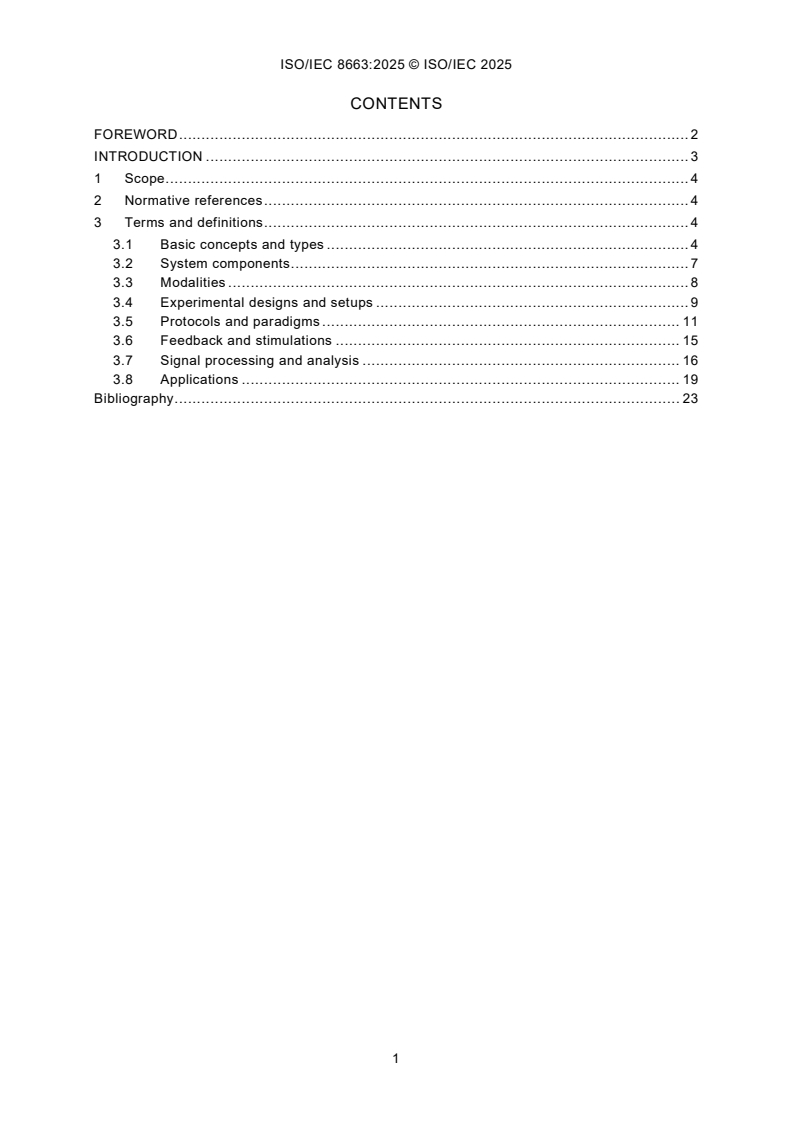
CONTENTS
FOREWORD . 2
INTRODUCTION . 3
1 Scope . 4
2 Normative references . 4
3 Terms and definitions . 4
3.1 Basic concepts and types . 4
3.2 System components . 7
3.3 Modalities . 8
3.4 Experimental designs and setups . 9
3.5 Protocols and paradigms . 11
3.6 Feedback and stimulations . 15
3.7 Signal processing and analysis . 16
3.8 Applications . 19
Bibliography . 23
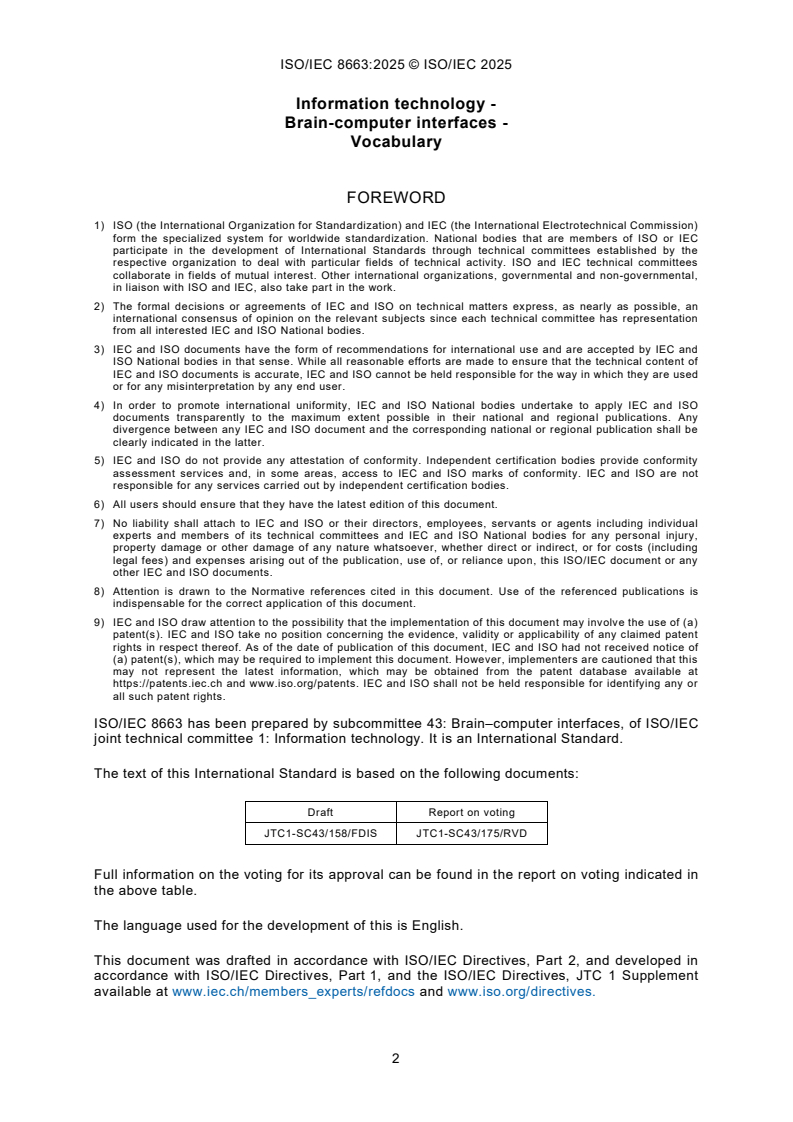
Information technology -
Brain-computer interfaces -
Vocabulary
FOREWORD
1) ISO (the International Organization for Standardization) and IEC (the International Electrotechnical Commission)
form the specialized system for worldwide standardization. National bodies that are members of ISO or IEC
participate in the development of International Standards through technical committees established by the
respective organization to deal with particular fields of technical activity. ISO and IEC technical committees
collaborate in fields of mutual interest. Other international organizations, governmental and non-governmental,
in liaison with ISO and IEC, also take part in the work.
2) The formal decisions or agreements of IEC and ISO on technical matters express, as nearly as possible, an
international consensus of opinion on the relevant subjects since each technical committee has representation
from all interested IEC and ISO National bodies.
3) IEC and ISO documents have the form of recommendations for international use and are accepted by IEC and
ISO National bodies in that sense. While all reasonable efforts are made to ensure that the technical content of
IEC and ISO documents is accurate, IEC and ISO cannot be held responsible for the way in which they are used
or for any misinterpretation by any end user.
4) In order to promote international uniformity, IEC and ISO National bodies undertake to apply IEC and ISO
documents transparently to the maximum extent possible in their national and regional publications. Any
divergence between any IEC and ISO document and the corresponding national or regional publication shall be
clearly indicated in the latter.
5) IEC and ISO do not provide any attestation of conformity. Independent certification bodies provide conformity
assessment services and, in some areas, access to IEC and ISO marks of conformity. IEC and ISO are not
responsible for any services carried out by independent certification bodies.
6) All users should ensure that they have the latest edition of this document.
7) No liability shall attach to IEC and ISO or their directors, employees, servants or agents including individual
experts and members of its technical committees and IEC and ISO National bodies for any personal injury,
property damage or other damage of any nature whatsoever, whether direct or indirect, or for costs (including
legal fees) and expenses arising out of the publication, use of, or reliance upon, this ISO/IEC document or any
other IEC and ISO documents.
8) Attention is drawn to the Normative references cited in this document. Use of the referenced publications is
indispensable for the correct application of this document.
9) IEC and ISO draw attention to the possibility that the implementation of this document may involve the use of (a)
patent(s). IEC and ISO take no position concerning the evidence, validity or applicability of any claimed patent
rights in respect thereof. As of the date of publication of this document, IEC and ISO had not received notice of
(a) patent(s), which may be required to implement this document. However, implementers are cautioned that this
may not represent the latest information, which may be obtained from the patent database available at
https://patents.iec.ch and www.iso.org/patents. IEC and ISO shall not be held responsible for identifying any or
all such patent rights.
ISO/IEC 8663 has been prepared by subcommittee 43: Brain–computer interfaces, of ISO/IEC
joint technical committee 1: Information technology. It is an International Standard.
The text of this International Standard is based on the following documents:
Draft Report on voting
JTC1-SC43/158/FDIS JTC1-SC43/175/RVD
Full information on the voting for its approval can be found in the report on voting indicated in
the above table.
The language used for the development of this is English.
This document was drafted in accordance with ISO/IEC Directives, Part 2, and developed in
accordance with ISO/IEC Directives, Part 1, and the ISO/IEC Directives, JTC 1 Supplement
available at www.iec.ch/members_experts/refdocs and www.iso.org/directives.
INTRODUCTION
Brain–computer interface (BCI) is an emerging technology that facilitates direct communication
between the brain and external devices, such as computers and robotic limbs. It links the brain's
neural activity with the external world to repair, replace, or enhance human capabilities in
interacting with the physical environment.
BCI has revolutionized and positively impacted several industries, including entertainment and
gaming, automation and control, education, neuromarketing, and neuroergonomics. It has
restored the capabilities of physically challenged people, improving the quality of their lives.
Researchers have demonstrated human neuroprosthetic control of computer cursors, robotic
limbs, and speech synthesizers.
Currently, the BCI represents a rapidly growing field of research, with a broad range of
application scenarios. Its contributions span across the medical and health industry to
entertainment and educational technology. For a more comprehensive and unified
understanding of BCI technology, there is a need for a vocabulary to ensure that contributions
can be understood and coordinated.
1 Scope
This document specifies the terms and definitions commonly used in the field of brain–computer
interface (BCI), including basic concepts and classifications of BCI, hardware, experiment
setups and protocols used in BCI, related neuroscience concepts of BCI (e.g. coding and
decoding, feedback and stimulation), and its applications.
2 Normative references
There are no normative references in this document.
3 Terms and definitions
ISO and IEC maintain terminology databases for use in standardization at the following
addresses:
• IEC Electropedia: available at https://www.electropedia.org/
• ISO Online browsing platform: available at https://www.iso.org/obp
3.1 Basic concepts and types
3.1.1
brain–computer interface
BCI
brain machine interface
BMI
study of theories, mechanisms, developments and applications related to
interfacing of engineered systems with the brain
Note 1 to entry: Non-invasive systems are often referred to as brain–computer interfaces; invasive systems using
implanted sensors are often referred to as brain machine interfaces.
3.1.2
brain–computer interface
BCI
brain machine interface
BMI
direct communication link between the activity of the central nervous
system of humans or other animals and an external software and hardware system
Note 1 to entry: A brain–computer interface allows a single or bi-directional communication between the brain and
external devices, enabling controlling or feedback capabilities or both.
Note 2 to entry: Non-invasive systems are often referred to as brain–computer interfaces; invasive systems using
implanted sensors are often referred to as brain machine interfaces.
3.1.3
active brain–computer interface
brain–computer interface (3.1.2) that requires a user to change brain activities intentionally
3.1.4
passive brain–computer interface
brain–computer interface (3.1.2) that does not require a user to change brain activities
intentionally
Note 1 to entry: A passive brain–computer interface monitors the user’s mental states and psychological activities.
3.1.5
reactive brain–computer interface
brain–computer interface (3.1.2) in which a user’s response to a specific stimulus is embedded
in the response signal to external stimulation
Note 1 to entry: A reactive brain–computer interface decodes specific neural response to environmental
stimulations.
3.1.6
affective brain–computer interface
brain–computer interface (3.1.2) that decodes emotional experience into corresponding states
3.1.7
synchronous brain–computer interface
brain–computer interface (3.1.2) that requires a synchronization stimulus given to the user to
start each task
Note 1 to entry: Information is presented to cue the user to elicit certain brain signal responses.
3.1.8
asynchronous brain–computer interface
self-paced brain–computer interface
brain–computer interface (3.1.2) that detects when the user intentionally changes brain activity
without any external stimuli
Note 1 to entry: An asynchronous brain–computer interface is continuously analysing the ongoing brain activity of
both intentional control states and non-control states (e.g. idling state).
3.1.9
bidirectional brain–computer interface
brain–computer interface (3.1.2) that both encodes and decodes neural activities
Note 1 to entry: A bidirectional brain–computer interface system can acquire and decode the neural activities, and
also encode stimuli to stimulate the central nervous system for specific responses.
3.1.10
unidirectional brain–computer interface
brain–computer interface (3.1.2) that decodes neural signals to control external devices
3.1.11
multi-user brain–computer interface
brain–computer interface (3.1.2) that allows multiple users to interact with the brain–computer
interface independently
Note 1 to entry: Tasks in a multi-user brain–computer interface system are typically performed in a digital or virtual
environment, such as controlling a cursor on a screen, manipulating a virtual object, or playing a video game.
3.1.12
collaborative brain–computer interface
brain–computer interface (3.1.2) that integrates and interprets brain signals from multiple
individuals to perform tasks or actions
Note 1 to entry: A collaborative brain–computer interface system uses brain signals from more than one person to
perform tasks or actions. Any conflicts result in no action being taken until the conflict is resolved.
3.1.13
competitive brain–computer interface
brain–computer interface (3.1.2) that incorporates brain activities from multiple tasks where
each set of users is competing with other users
3.1.14
independent brain–computer interface
brain–computer interface (3.1.2) that does not rely on the brain’s natural output pathways
Note 1 to entry: The brain signals used by an independent brain–computer interface are not dependent on muscle
activity.
EXAMPLE In brain–computer interfaces (3.1.2) based on electroencephalogram sensorimotor rhythms, mental
imagery can be employed to modify sensorimotor rhythms so as to control the brain–computer interface output.
3.1.15
dependent brain–computer interface
brain–computer interface (3.1.2) that uses brain signals that depend on muscle activity
EXAMPLE A brain–computer interface (3.1.2) that uses movement information from a user’s eyes, like muscle
activities to gaze at the visual stimuli, to determine what the user is looking at.
3.1.16
invasive brain–computer interface
brain–computer interface (3.1.2) in which neural activities are recorded using a surgically
implanted device
Note 1 to entry: To inject contrast medium into body or brain is neither invasive nor surgical implant.
EXAMPLE Brain–computer interfaces (3.1.2) using intracranial electroencephalography, electrocorticography,
stereotactic electroencephalography, intracortical microelectrodes and endovascular electrodes.
3.1.17
non-invasive brain–computer interface
brain–computer interface (3.1.2) in which neural activities are recorded using sensors that rest
outside the skull
Note 1 to entry: Non-invasive brain–computer interface does not require the surgical implantation of a device. For
example, it can involve the user wearing a device with electrical sensors that serve as two-way communication
channels between the user’s brain and a machine.
EXAMPLE Brain–computer interfaces (3.1.2) using scalp electroencephalography, functional near-infrared
spectroscopy, functional magnetic resonance imaging, and surface electromyography.
3.1.18
partially-invasive brain–computer interface
semi-invasive brain–computer interface
invasive brain–computer interface (3.1.16) in which neural activities are recorded by sensors
that are implanted inside the skull and rest outside the brain
3.1.19
hybrid brain–computer interface
combination of brain–computer interface (3.1.2) which incorporates multiple paradigms or
systems
3.1.20
human brain–computer interface
brain–computer interface (3.1.2) designed for human brain communication
3.1.21
speech brain–computer interface
brain–computer interface (3.1.2) that captures and decodes neural signals related to user
thoughts intended to be articulated but which cannot be vocalized
Note 1 to entry: Speech brain–computer interface can be utilized to assist individuals with speech impairments or
those who are unable to physically produce speech because of medical conditions.
3.1.22
wearable brain–computer interface
portable brain–computer interface
brain–computer interface (3.1.2) that is designed to be worn on the body to detect, analyse,
and utilize brain activity in near real time
Note 1 to entry: Wearable brain–computer interfaces are designed for convenience, mobility, and continuous or
prolonged use, and they can be used in a range of contexts from daily life to specific applications like gaming,
meditation, and therapeutic interventions.
3.2 System components
3.2.1
transducer
device that converts brain signals into electrical signals or vice versa
Note 1 to entry: Some transducers can be bidirectional.
Note 2 to entry: A transducer converts one form of energy into another, for example, from electrical energy into an
analogue signal.
3.2.2
sensor
specific type of transducer (3.2.1) that detects or measures a physical quantity of an object and
converts it into an electrical signal
Note 1 to entry: When the brain–computer interface (3.1.2) operates in the direction from external world to the
brain, the sensors can operate on the compromised sensory channels (visual, acoustic, etc.).
EXAMPLE A sensor can be an electrode in the case of electroencephalography, but also a Hall effect sensor in the
case of magnetoencephalography.
3.2.3
effector
specific type of transducer (3.2.1) that converts electrical signals into physical actions
3.2.4
electrode
specific type of transducer (3.2.1) that establishes electrical contact with a physical part of a
circuit
3.2.5
channel
pathway through which the brain signal is collected, transmitted, and processed
Note 1 to entry: Channel often refers to a specific electrode placed on the scalp in electroencephalogram-based
brain–computer interface (3.1.2) or an array of electrodes in invasive brain–computer interface (3.1.16).
Note 2 to entry: Each channel provides a time series of voltage measurements representing neural activity from a
particular region of the brain.
Note 3 to entry: Channel information indicates the locations of the recording electrodes, which is necessary for
estimating source locations of data components.
3.2.6
amplifier
specific type of transducer (3.2.1) that converts a small input signal into a larger output signal
EXAMPLE An electroencephalogram amplifier.
3.2.7
headset
wearable device equipped with sensors (3.2.2) to detect and record brain signals
Note 1 to entry: Headsets are used to read and interpret brain signals, not to control or manipulate the user.
3.2.8
EEG cap
device embedded with multiple electrodes to record electrical activity of the brain
Note 1 to entry: An EEG cap is a wearable device designed to fit on the head.
3.2.9
brain implant
neural implant
device that is surgically implanted into the brain
Note 1 to entry: Brain implants are made up of electrodes that capture electrical signals. A decoder system then
analyses these signals and translates them into commands or questions.
3.2.10
analogue-to-digital converter
component that receives analogue signals from a transducer (3.2.1) and converts them into
digital signals
3.2.11
processing unit
component that interprets signals received from the brain
Note 1 to entry: A processing unit can perform signal pre-processing.
Note 2 to entry: A processing unit analyses the ingested data to extract features and translates the extracted
features into commands.
3.3 Modalities
3.3.1
electroencephalogram
EEG
graphic record of the variation with time of voltages taken from electrodes on the scalp, whose
positions are specified
[SOURCE: IEC 60050-891:1998 [1], 891-04-23]
3.3.2
intracranial electroencephalogram
iEEG
graphic record of the variation with time of voltages taken from electrodes (3.2.4) placed onto
or deeply inserted into the brain to directly record electrical activities of the brain through
sensors (3.2.2)
Note 1 to entry: Intracranial electroencephalogram is known as electrocorticogram when using subdural grid
electrodes.
Note 2 to entry: Intracranial electroencephalogram is known as stereotactic electroencephalogram or local field
potential when using depth electrodes.
3.3.3
electromyogram
EMG
graphic record of the variation with time of voltages associated with the electrical activity of
skeletal muscle
[SOURCE: IEC 60050-891:1998 [1], 891-04-30]
3.3.4
functional magnetic resonance imaging
fMRI
magnetic resonance imaging technique on brain that registers blood flow to functioning areas
of the brain
Note 1 to entry: Functional magnetic resonance imaging relies on the fact that cerebral blood flow and neuronal
activation are coupled.
3.3.5
functional near-infrared spectroscopy
fNIRS
optical brain monitoring technique that uses near-infrared light for the purpose of functional
neuroimaging
Note 1 to entry: With functional near-infrared spectroscopy, brain activities are measured by using near-infrared
light to estimate cortical hemodynamic activities that occur in response to neural activities.
3.3.6
magnetoencephalogram
MEG
topographic record, or graphic record as a function of time, of magnetic fields associated with
the electrical activity of the brain
[SOURCE: IEC 60050-891:1998 [1], 891-04-27]
3.4 Experimental designs and setups
3.4.1
subject
person about whom an investigator obtains information for study and analysis
Note 1 to entry: A participant is a subject that gives voluntary consent to following a specific regimen or also
answering questions from the researcher or both.
3.4.2
user
person that is using a brain–computer interface (3.1.2) product or service
3.4.3
trial
specific instance of a procedure or task performed by a subject (3.4.1)
3.4.4
clinical trial
study involving multiple subjects (3.4.1) that assesses the efficacy of a proposed intervention
Note 1 to entry: A clinical trial can include alternatives, such as placebos.
3.4.5
trial session
specific period during which a subject (3.4.1) engages in study activities
Note 1 to entry: A trial session can include multiple trials if the study design requires repeating tasks.
3.4.6
clinical trial session
specific time period during which a subject (3.4.1) receives an intervention or undergoes an
assessment or both
Note 1 to entry: A clinical trial session does not include multiple clinical trials, since each clinical trial is its own
separate study, with separate enrolment and consenting processes.
3.4.7
epoch
single segment of time-series data
Note 1 to entry: An epoch is typically a part of a longer continuous signal that involves a specific event of interest.
Note 2 to entry: Epochs are used to isolate the brain’s response to specific events.
3.4.8
stimulus
event or signal presented to the subject (3.4.1) to elicit a specific response
Note 1 to entry: Stimuli are used to make inferences about various cognitive processes.
Note 2 to entry: These are tasks that the subject can be instructed to perform mentally, such as imagining moving
a limb, performing arithmetic calculations, or visualizing specific scenarios. The associated neural patterns resulting
from these tasks serve as the "stimulus" response.
EXAMPLE Stimulus can be visual, auditory, tactile, or somatosensory.
3.4.9
inter-stimulus interval
ISI
period of time between the end of one stimulus (3.4.8) and the start of the next stimulus (3.4.8)
3.4.10
inter-trial interval
ITI
period of time between separate trials (3.4.3)
3.4.11
sampling rate
sampling frequency
number of samples of a signal taken per unit time
[SOURCE: IEC 60050-704:1993 [2], 704-23-03]
3.4.12
bit rate
measurement of speed at which information is transferred from the subject (3.4.1) to the
processing unit (3.2.11)
Note 1 to entry: Bit rate depends on the accuracy of the brain–computer interface (3.1.2), the number of possible
selections (i.e. mental states) and the time required to make each selection.
Note 2 to entry: Bit rate is typically measured in either bits per minute, bits per second, or bits per symbol.
Note 3 to entry: Bit rate can be calculated by multiplying the classification speed in symbols per minute by the
information carried in one symbol in bits per symbol.
3.5 Protocols and paradigms
3.5.1
operating protocol
set of specific rules and procedures that define how the brain–computer interface (3.1.2)
interacts with the subject (3.4.1) and its environment
Note 1 to entry: Rules and procedures include methods for recording neural activity, algorithms for translating
neural activity into requests and commands, and how feedback mechanisms are used to enable the subject to learn
to control the brain–computer interface.
Note 2 to entry: Operating protocol is dependent on the goals of the study.
3.5.2
event
specific occurrence or change in the state of a system that is significant to the operation of the
brain–computer interface (3.1.2)
3.5.3
mental imagery
imagination of a specific scenario or action by the subject (3.4.1)
3.5.4
motor imagery
MI
generation of neural activity from the motor cortex by imagining movements without any physical
limb movement or external stimulus (3.4.8)
3.5.5
auditory imagery
imagination of the generation of sounds without any external auditory stimulus
3.5.6
action potential
AP
spike
sudden, fast, transitory and propagating change of electric polarization of the membrane of a
neuron, which is the result of a very rapid rise and fall in voltage across a cellular membrane
3.5.7
spike train
sequence of action potentials (3.5.6) that a single neuron produces
Note 1 to entry: Spike trains are important because they can be used to encode and transmit information from the
brain to an external device.
Note 2 to entry: Spike trains can be fed into machine learning algorithms, such as a spiking neural network.
3.5.8
local field potential
LFP
measure of brain activity recorded from a small group of neurons in a specific area of the brain
Note 1 to entry: Local field potential is measured within the brain, and it captures the electric potentials generated
by the collective activity of neurons in a local area.
Note 2 to entry: Local field potentials have a higher fidelity than electroencephalogram signals, and are more stable
than action potentials from individual neurons and cover a wider range of frequencies than electrocorticogram
signals.
...