


ISO/FDIS 7729
(Main)Typical vertical joints between two prefabricated ordinary concrete external wall components — Properties, characteristics and classification criteria
Typical vertical joints between two prefabricated ordinary concrete external wall components — Properties, characteristics and classification criteria
For the determination of the watertightness of a joint a method has still not been elaborated. Because of the fundamental importance of this property, solutions are proposed, by way of examples, that experiences and laboratory studies have shown to be satisfactory under the usual conditions. Is applicable to all public or private buildings, used as dwellings, offices, educational or hospital premises.
Assemblages verticaux courants entre deux composants de façade en béton ordinaire — Propriétés, caractéristiques et éléments de la classification
General Information
- Status
- Not Published
- Technical Committee
- ISO/TC 59/SC 19 - Prefabricated building
- Drafting Committee
- ISO/TC 59/SC 19 - Prefabricated building
- Current Stage
- 5020 - FDIS ballot initiated: 2 months. Proof sent to secretariat
- Start Date
- 26-Dec-2025
- Completion Date
- 26-Dec-2025
Relations
- Effective Date
- 23-Sep-2023
Overview
ISO/FDIS 7729:2025 defines properties, characteristics and classification criteria for typical vertical joints between two prefabricated ordinary concrete external wall components. It gives a design convention for jointing prefabricated concrete façades used in dwellings, offices, schools and hospitals. The document clarifies required and optional joint properties (thermal, acoustic, air and water tightness, fire resistance, durability, appearance, maintainability and replaceability) and proposes practical solutions where standardized test methods for some properties (notably watertightness) are not yet fully elaborated.
Key topics and technical requirements
- Scope and purpose: Applies to vertical joints between prefabricated concrete external wall components but excludes joints that govern global structural behaviour.
- Properties to consider: Necessary properties (thermal transmission, soundproofing, air-tightness, water & snow tightness, light blocking, non‑toxicity, anti‑condensation, stress transmission, fire resistance, durability, maintainability, replaceability, tolerance) and optional properties (external noise enclosure, insect/animal exclusion, wind‑induced quietness).
- Measurement and units:
- Thermal performance expressed as linear thermal transmittance (W·m⁻¹·K⁻¹), with reference to ISO 10211.
- Air permeability measured per ISO 6589: cubic metres per hour per metre (m³/h/m) at a given pressure.
- Acoustical performance evaluated per ISO 16283‑1 and ISO 717‑1; an R value >45 dB is indicated as a target for external wall joints.
- Water tightness: No single standardised test method is prescribed; the standard distinguishes two families of joint solutions and gives example configurations proven satisfactory in practice. Family I (“channel” joints) is described with geometric guidance for channels and jointing products.
- Additional characteristics: Addresses condensation, force transmission, fire emissions, aesthetics, dimensional coordination, maintenance and replacement of jointing materials, and classification criteria for specifying joints.
Practical applications and intended users
- Primary users: façade designers, architects, structural and building-services engineers, precast concrete manufacturers, façade contractors, testing laboratories and building code authorities.
- Use cases:
- Specifying joint types and performance attributes in contract documents and façades schedules.
- Guiding selection of jointing materials to meet air, acoustic, thermal and durability requirements.
- Informing laboratory or field testing strategies where standard methods exist (air permeability, acoustics) and applying proposed solutions where methods are not fully standardized (watertightness).
- Supporting maintenance, replacement and dimensional coordination planning for prefabricated façades.
Related standards
- ISO 2444 (vocabulary for joints in buildings)
- ISO 6589 (air permeability of joints - laboratory method)
- ISO 10211 (thermal bridges - heat flows)
- ISO 16283‑1 and ISO 717‑1 (acoustics - measurement and rating)
- ISO 12354‑3 (building acoustics - calculation of sound insulation)
- ISO 7728 (referenced for horizontal joint water tightness considerations)
Keywords: prefabricated concrete, vertical joints, watertightness solutions, air permeability, thermal transmission, acoustic insulation, ISO 7729, joint classification, façade jointing materials.


ISO/FDIS 7729 - Typical vertical joints between two prefabricated ordinary concrete external wall components — Properties, characteristics and classification criteria Released:12. 12. 2025
REDLINE ISO/FDIS 7729 - Typical vertical joints between two prefabricated ordinary concrete external wall components — Properties, characteristics and classification criteria Released:12. 12. 2025
Get Certified
Connect with accredited certification bodies for this standard

ICC Evaluation Service
Building products evaluation and certification.

QAI Laboratories
Building and construction product testing and certification.

Aboma Certification B.V.
Specialized in construction, metal, and transport sectors.
Sponsored listings
Frequently Asked Questions
ISO/FDIS 7729 is a draft published by the International Organization for Standardization (ISO). Its full title is "Typical vertical joints between two prefabricated ordinary concrete external wall components — Properties, characteristics and classification criteria". This standard covers: For the determination of the watertightness of a joint a method has still not been elaborated. Because of the fundamental importance of this property, solutions are proposed, by way of examples, that experiences and laboratory studies have shown to be satisfactory under the usual conditions. Is applicable to all public or private buildings, used as dwellings, offices, educational or hospital premises.
For the determination of the watertightness of a joint a method has still not been elaborated. Because of the fundamental importance of this property, solutions are proposed, by way of examples, that experiences and laboratory studies have shown to be satisfactory under the usual conditions. Is applicable to all public or private buildings, used as dwellings, offices, educational or hospital premises.
ISO/FDIS 7729 is classified under the following ICS (International Classification for Standards) categories: 91.080.40 - Concrete structures. The ICS classification helps identify the subject area and facilitates finding related standards.
ISO/FDIS 7729 has the following relationships with other standards: It is inter standard links to ISO 7729:1985. Understanding these relationships helps ensure you are using the most current and applicable version of the standard.
ISO/FDIS 7729 is available in PDF format for immediate download after purchase. The document can be added to your cart and obtained through the secure checkout process. Digital delivery ensures instant access to the complete standard document.
Standards Content (Sample)
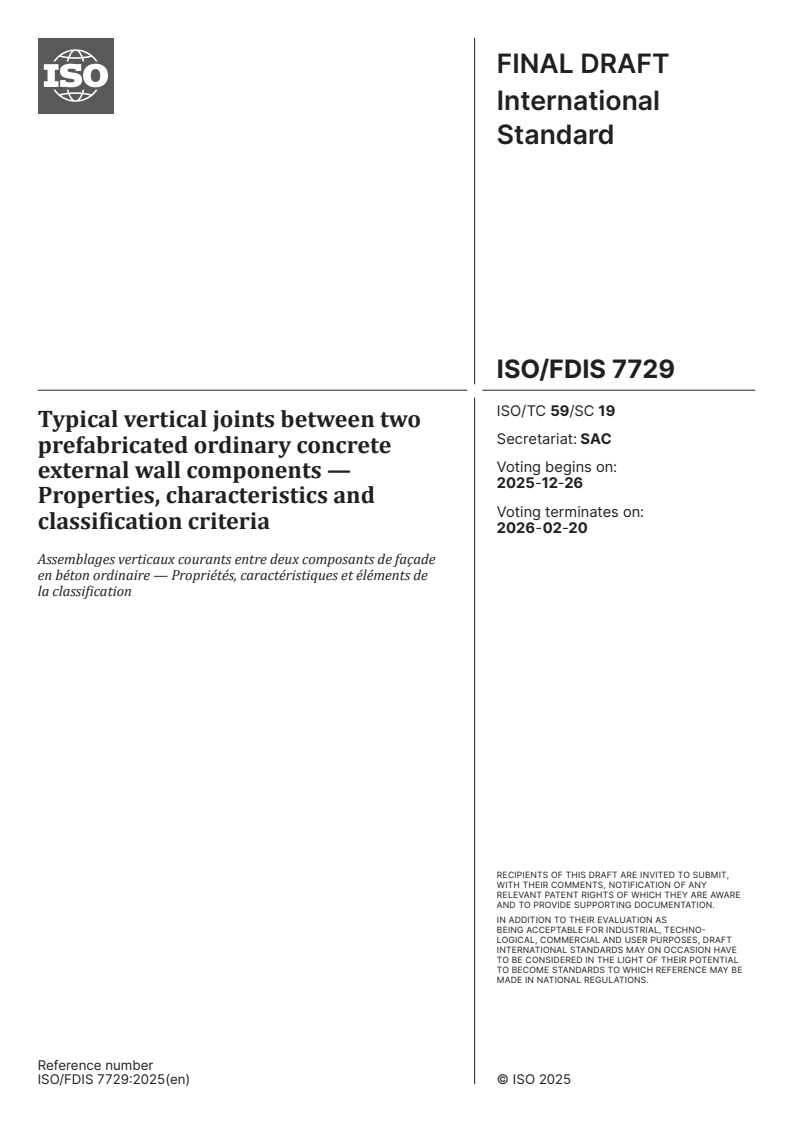
FINAL DRAFT
International
Standard
ISO/TC 59/SC 19
Typical vertical joints between two
Secretariat: SAC
prefabricated ordinary concrete
Voting begins on:
external wall components —
2025-12-26
Properties, characteristics and
Voting terminates on:
classification criteria
2026-02-20
Assemblages verticaux courants entre deux composants de façade
en béton ordinaire — Propriétés, caractéristiques et éléments de
la classification
RECIPIENTS OF THIS DRAFT ARE INVITED TO SUBMIT,
WITH THEIR COMMENTS, NOTIFICATION OF ANY
RELEVANT PATENT RIGHTS OF WHICH THEY ARE AWARE
AND TO PROVIDE SUPPOR TING DOCUMENTATION.
IN ADDITION TO THEIR EVALUATION AS
BEING ACCEPTABLE FOR INDUSTRIAL, TECHNO
LOGICAL, COMMERCIAL AND USER PURPOSES, DRAFT
INTERNATIONAL STANDARDS MAY ON OCCASION HAVE
TO BE CONSIDERED IN THE LIGHT OF THEIR POTENTIAL
TO BECOME STAN DARDS TO WHICH REFERENCE MAY BE
MADE IN NATIONAL REGULATIONS.
Reference number
FINAL DRAFT
International
Standard
ISO/TC 59/SC 19
Typical vertical joints between two
Secretariat: SAC
prefabricated ordinary concrete
Voting begins on:
external wall components —
Properties, characteristics and
Voting terminates on:
classification criteria
Assemblages verticaux courants entre deux composants de façade
en béton ordinaire — Propriétés, caractéristiques et éléments de
la classification
RECIPIENTS OF THIS DRAFT ARE INVITED TO SUBMIT,
WITH THEIR COMMENTS, NOTIFICATION OF ANY
RELEVANT PATENT RIGHTS OF WHICH THEY ARE AWARE
AND TO PROVIDE SUPPOR TING DOCUMENTATION.
© ISO 2025
IN ADDITION TO THEIR EVALUATION AS
All rights reserved. Unless otherwise specified, or required in the context of its implementation, no part of this publication may
BEING ACCEPTABLE FOR INDUSTRIAL, TECHNO
LOGICAL, COMMERCIAL AND USER PURPOSES, DRAFT
be reproduced or utilized otherwise in any form or by any means, electronic or mechanical, including photocopying, or posting on
INTERNATIONAL STANDARDS MAY ON OCCASION HAVE
the internet or an intranet, without prior written permission. Permission can be requested from either ISO at the address below
TO BE CONSIDERED IN THE LIGHT OF THEIR POTENTIAL
or ISO’s member body in the country of the requester.
TO BECOME STAN DARDS TO WHICH REFERENCE MAY BE
MADE IN NATIONAL REGULATIONS.
ISO copyright office
CP 401 • Ch. de Blandonnet 8
CH-1214 Vernier, Geneva
Phone: +41 22 749 01 11
Email: copyright@iso.org
Website: www.iso.org
Published in Switzerland Reference number
ii
Contents Page
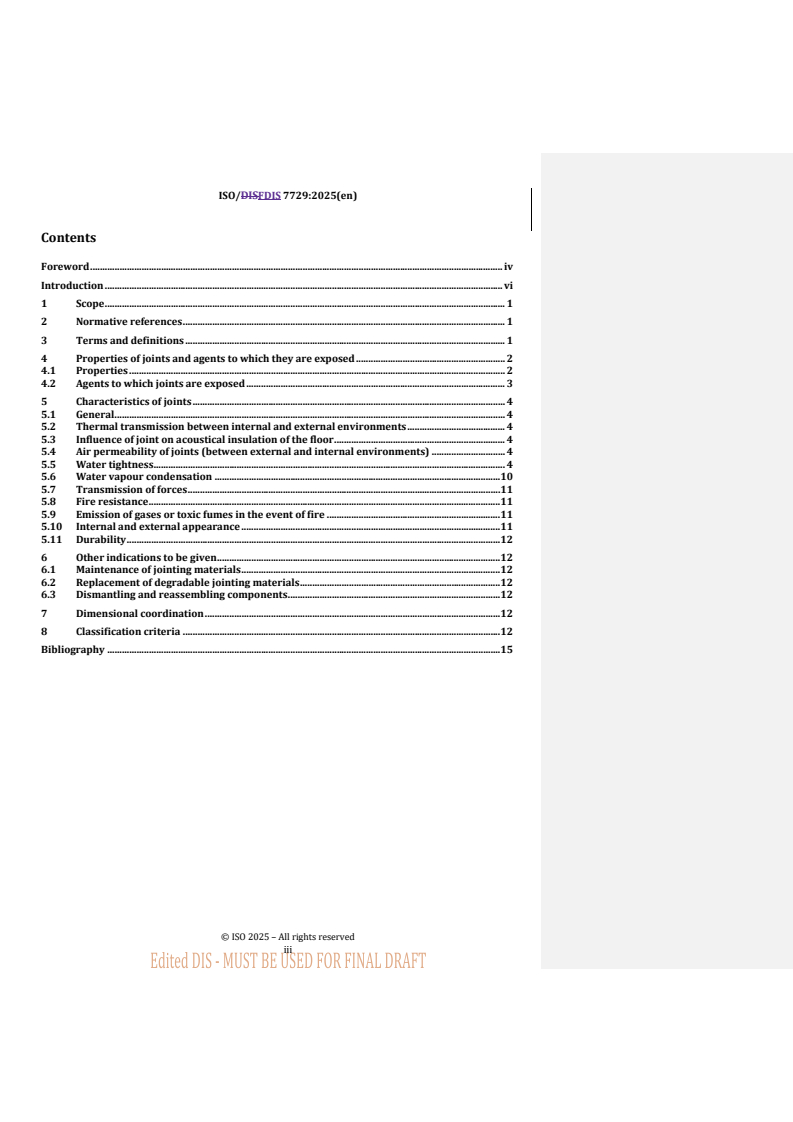
Foreword .iv
Introduction .v
1 Scope . 1
2 Normative references . 1
3 Terms and definitions . 1
4 Properties of joints and agents to which they are exposed . 2
4.1 Properties .2
4.2 Agents to which joints are exposed .3
5 Characteristics of joints . 4
5.1 General .4
5.2 Thermal transmission between internal and external environments .4
5.3 Influence of joint on acoustical insulation of the floor .4
5.4 Air permeability of joints (between external and internal environments) .4
5.5 Water tightness .4
5.5.1 Families of joint (solutions given by way of examples) .4
5.5.2 Supplementary arrangements.7
5.6 Water vapour condensation .7
5.6.1 On the internal face of the wall and/or floor in the vicinity of the joint .7
5.6.2 Inside the joints .8
5.7 Transmission of forces .8
5.7.1 Bracing wall .8
5.7.2 Supported external wall .8
5.8 Fire resistance .8
5.9 Emission of gases or toxic fumes in the event of fire.8
5.10 Internal and external appearance .9
5.11 Durability .9
6 Other indications to be given . 9
6.1 Maintenance of jointing materials .9
6.2 Replacement of degradable jointing materials .9
6.3 Dismantling and reassembling components .9
7 Dimensional coordination . 9
8 Classification criteria . 10
Bibliography .11
iii
Foreword
ISO (the International Organization for Standardization) is a worldwide federation of national standards
bodies (ISO member bodies). The work of preparing International Standards is normally carried out through
ISO technical committees. Each member body interested in a subject for which a technical committee
has been established has the right to be represented on that committee. International organizations,
governmental and non-governmental, in liaison with ISO, also take part in the work. ISO collaborates closely
with the International Electrotechnical Commission (IEC) on all matters of electrotechnical standardization.
The procedures used to develop this document and those intended for its further maintenance are described
in the ISO/IEC Directives, Part 1. In particular, the different approval criteria needed for the different types
of ISO documents should be noted. This document was drafted in accordance with the editorial rules of the
ISO/IEC Directives, Part 2 (see www.iso.org/directives).
ISO draws attention to the possibility that the implementation of this document may involve the use of (a)
patent(s). ISO takes no position concerning the evidence, validity or applicability of any claimed patent
rights in respect thereof. As of the date of publication of this document, ISO had not received notice of (a)
patent(s) which may be required to implement this document. However, implementers are cautioned that
this may not represent the latest information, which may be obtained from the patent database available at
www.iso.org/patents. ISO shall not be held responsible for identifying any or all such patent rights.
Any trade name used in this document is information given for the convenience of users and does not
constitute an endorsement.
For an explanation of the voluntary nature of standards, the meaning of ISO specific terms and expressions
related to conformity assessment, as well as information about ISO's adherence to the World Trade
Organization (WTO) principles in the Technical Barriers to Trade (TBT), see www.iso.org/iso/foreword.html.
This document was prepared by Technical Committee ISO/TC 59, Buildings and civil engineering works,
Subcommittee SC 19, Prefabricated building.
This second edition cancels and replaces the first edition (ISO 7729:1985), which has been technically
revised.
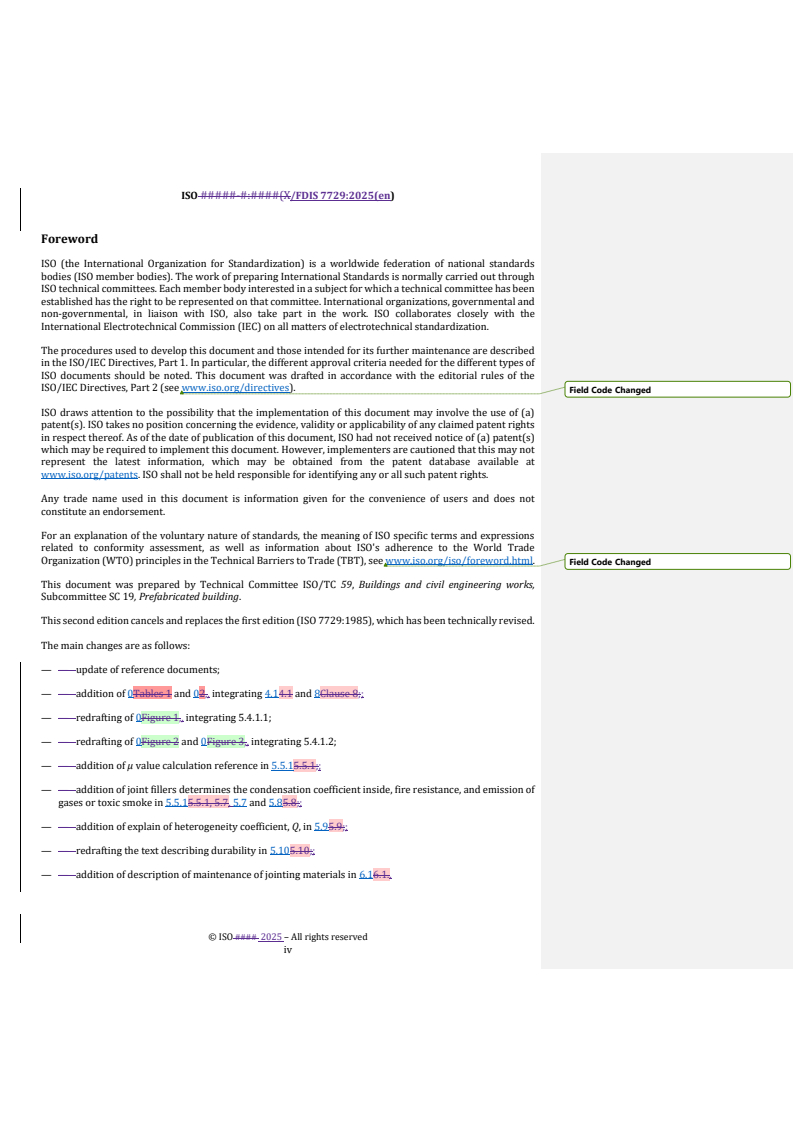
The main changes are as follows:
— update of reference documents;
— addition of Tables 1 and 2, integrating 4.1 and Clause 8;
— redrafting of Figure 1, integrating 5.4.1.1;
— redrafting of Figure 2 and Figure 3, integrating 5.4.1.2;
— addition of μ value calculation reference in 5.5.1;
— addition of joint fillers determines the condensation coefficient inside, fire resistance, and emission of
gases or toxic smoke in 5.5.1, 5.7 and 5.8;
— addition of explain of heterogeneity coefficient, Q, in 5.9;
— redrafting the text describing durability in 5.10;
— addition of description of maintenance of jointing materials in 6.1.
Any feedback or questions on this document should be directed to the user’s national standards body. A
complete listing of these bodies can be found at www.iso.org/members.html.
iv
Introduction
This document outlines a convention for designers about jointing two prefabricated ordinary concrete
external wall components.
This convention refers to standardized methods for the determining the properties of the joint. However, the
methods for some of these properties are not elaborated. Given the importance of these properties, solutions
are proposed and both experience and laboratory studies have shown to be satisfactory under the usual
conditions. It should be noted that these solutions are not the only viable option
v
FINAL DRAFT International Standard ISO/FDIS 7729:2025(en)
Typical vertical joints between two prefabricated ordinary
concrete external wall components — Properties,
characteristics and classification criteria
1 Scope
This document specifies the properties and characteristics of typical vertical joints between two
prefabricated concrete external wall components irrespective of whether these joints coincide with joints
between the external wall and an internal wall or column.
However, the characteristics of joints which are involved in the structural behaviour of buildings are not
specified in this document.
This document is applicable to all public or private buildings, used as dwellings, offices, educational or
hospital premises.
2 Normative references
The following documents are referred to in the text in such a way that some or all of their content constitutes
requirements of this document. For dated references, only the edition cited applies. For undated references,
the latest edition of the referenced document (including any amendments) applies.
ISO 2444, Joints in building - Vocabulary
ISO 6589, Joints in building — Laboratory method of test for air permeability of joints
ISO 717-1, Acoustics — Rating of sound insulation in buildings and of building elements — Part 1: Airborne
sound insulation
ISO 16283-1, Acoustics — Field measurement of sound insulation in buildings and of building elements — Part 1:
Airborne sound insulation
3 Terms and definitions
For the purposes of this document, the terms and definitions given in ISO 2444 and the following apply.
ISO and IEC maintain terminology databases for use in standardization at the following addresses:
— ISO Online browsing platform: available at https:// www .iso .org/ obp
— IEC Electropedia: available at https:// www .electropedia .org/
3.1
watertightness system with tongue and grooves
assembly made of two grooves and a tongue the shapes of which are such that the tongue can be inserted
longitudinally into the grooves through a slot in these grooves but cannot move transversely out of the
grooves without a significant effort
4 Properties of joints and agents to which they are exposed
4.1 Properties
For joints, the necessary properties listed in Table 1 shall be considered. The optional properties listed in
Table 2 should be considered.
Table 1 — Necessary properties of joints
Necessary properties
No. Property name Description Application environ-
ment
a Thermal conduc- To limit thermal losses (between the internal and external envi- Various climatic con-
tivity ronments). ditions
b Soundproofing To limit sound transmission (between the spaces separated by the Various indoor envi-
interior wall, if any). ronments
c Air-tightness To provide satisfactory resistance to air penetration. Various climatic con-
ditions
d Water and Snow To ensure water and snow tightness between the exterior and Various climatic con-
Tightness interior wall, and for water and other liquids, between the spaces ditions
separated by the floor.
e Light Blocking To prevent the passage of light (between spaces separated by the Various lighting con-
interior wall, if any). ditions
f Non-toxic and The joints should be non-toxic and not emit odours (odours emitted Various indoor envi-
odour-free by jointing products). ronments
g Anti-condensation Condensation of water vapour should not occur opposite the joints Various climatic con-
and in the joints on the internal face of the wall. ditions
h Stress resistance To resist stresses in one or more directions due to
...
ISO/DISFDIS 7729:2025(en)
ISO/TC 59/SC 19/WG 1
Secretariat: SAC
Date: 2025-10-3012-12
Typical vertical joints between two prefabricated ordinary concrete
external wall components - — Properties, characteristics and
classification criteria
Assemblages verticaux courants entre deux composants de façade en béton ordinaire — Propriétés,
caractéristiques et éléments de la classification
FDIS stage
ISO #####-#:####(X/FDIS 7729:2025(en)
All rights reserved. Unless otherwise specified, or required in the context of its implementation, no part of this publication
may be reproduced or utilized otherwise in any form or by any means, electronic or mechanical, including photocopying,
or posting on the internet or an intranet, without prior written permission. Permission can be requested from either ISO
at the address below or ISO’s member body in the country of the requester.
ISO copyright office
CP 401 • Ch. de Blandonnet 8
CH-1214 Vernier, Geneva
Phone: + 41 22 749 01 11
EmailE-mail: copyright@iso.org
Website: www.iso.org
Published in Switzerland
© ISO #### 2025 – All rights reserved
ii
ISO/DISFDIS 7729:2025(en)
Contents
Foreword . iv
Introduction . vi
1 Scope . 1
2 Normative references . 1
3 Terms and definitions . 1
4 Properties of joints and agents to which they are exposed . 2
4.1 Properties . 2
4.2 Agents to which joints are exposed . 3
5 Characteristics of joints . 4
5.1 General . 4
5.2 Thermal transmission between internal and external environments . 4
5.3 Influence of joint on acoustical insulation of the floor . 4
5.4 Air permeability of joints (between external and internal environments) . 4
5.5 Water tightness . 4
5.6 Water vapour condensation . 10
5.7 Transmission of forces . 11
5.8 Fire resistance . 11
5.9 Emission of gases or toxic fumes in the event of fire . 11
5.10 Internal and external appearance . 11
5.11 Durability . 12
6 Other indications to be given . 12
6.1 Maintenance of jointing materials . 12
6.2 Replacement of degradable jointing materials . 12
6.3 Dismantling and reassembling components . 12
7 Dimensional coordination . 12
8 Classification criteria . 12
Bibliography . 15
iii
ISO #####-#:####(X/FDIS 7729:2025(en)
Foreword
ISO (the International Organization for Standardization) is a worldwide federation of national standards
bodies (ISO member bodies). The work of preparing International Standards is normally carried out through
ISO technical committees. Each member body interested in a subject for which a technical committee has been
established has the right to be represented on that committee. International organizations, governmental and
non-governmental, in liaison with ISO, also take part in the work. ISO collaborates closely with the
International Electrotechnical Commission (IEC) on all matters of electrotechnical standardization.
The procedures used to develop this document and those intended for its further maintenance are described
in the ISO/IEC Directives, Part 1. In particular, the different approval criteria needed for the different types of
ISO documents should be noted. This document was drafted in accordance with the editorial rules of the
ISO/IEC Directives, Part 2 (see www.iso.org/directives).
Field Code Changed
ISO draws attention to the possibility that the implementation of this document may involve the use of (a)
patent(s). ISO takes no position concerning the evidence, validity or applicability of any claimed patent rights
in respect thereof. As of the date of publication of this document, ISO had not received notice of (a) patent(s)
which may be required to implement this document. However, implementers are cautioned that this may not
represent the latest information, which may be obtained from the patent database available at
www.iso.org/patents. ISO shall not be held responsible for identifying any or all such patent rights.
Any trade name used in this document is information given for the convenience of users and does not
constitute an endorsement.
For an explanation of the voluntary nature of standards, the meaning of ISO specific terms and expressions
related to conformity assessment, as well as information about ISO's adherence to the World Trade
Organization (WTO) principles in the Technical Barriers to Trade (TBT), see www.iso.org/iso/foreword.html.
Field Code Changed
This document was prepared by Technical Committee ISO/TC 59, Buildings and civil engineering works,
Subcommittee SC 19, Prefabricated building.
This second edition cancels and replaces the first edition (ISO 7729:1985), which has been technically revised.
The main changes are as follows:
— — update of reference documents;
— — addition of 0Tables 1 and 02,, integrating 4.14.1 and 8Clause 8;;
— — redrafting of 0Figure 1,, integrating 5.4.1.1;
— — redrafting of 0Figure 2 and 0Figure 3,, integrating 5.4.1.2;
— — addition of μ value calculation reference in 5.5.15.5.1;;
— — addition of joint fillers determines the condensation coefficient inside, fire resistance, and emission of
gases or toxic smoke in 5.5.15.5.1, 5.7, 5.7 and 5.85.8;;
— — addition of explain of heterogeneity coefficient, Q, in 5.95.9;;
— — redrafting the text describing durability in 5.105.10;;
— — addition of description of maintenance of jointing materials in 6.16.1.
© ISO #### 2025 – All rights reserved
iv
ISO/DISFDIS 7729:2025(en)
Any feedback or questions on this document should be directed to the user’s national standards body. A
complete listing of these bodies can be found at www.iso.org/members.html.
v
ISO #####-#:####(X/FDIS 7729:2025(en)
Introduction
This document outlines a convention for designers about jointing two prefabricated ordinary concrete
external wall components.
This convention refers to standardized methods for the determining the properties of the joint. However, the
methods for some of these properties are not elaborated. Given the importance of these properties, solutions
are proposed and both experience and laboratory studies have shown to be satisfactory under the usual
conditions. It should be noted that these solutions are not the only viable option
© ISO #### 2025 – All rights reserved
vi
DRAFT International Standard ISO/DIS 7729:2025(en)
Typical vertical joints between two prefabricated ordinary concrete
external wall components - — Properties, characteristics and
classification criteria
1 Scope
This document specifies the properties and characteristics of typical vertical joints between two prefabricated
concrete external wall components irrespective of whether these joints coincide with joints between the
external wall and an internal wall or column.
However, the characteristics of joints which are involved in the structural behaviour of buildings are not
specified in this document.
This document is applicable to all public or private buildings, used as dwellings, offices, educational or hospital
premises.
2 Normative references
The following documents are referred to in the text in such a way that some or all of their content constitutes
requirements of this document. For dated references, only the edition cited applies. For undated references,
the latest edition of the referenced document (including any amendments) applies.
ISO 2444, Joints in building - Vocabulary
ISO 6589, Joints in building — Laboratory method of test for air permeability of joints
ISO 717--1, Acoustics — Rating of sound insulation in buildings and of building elements — Part 1: Airborne
sound insulation
ISO 16283--1, Acoustics — Field measurement of sound insulation in buildings and of building elements — Part
1: Airborne sound insulation
3 Terms and definitions
For the purposes of this document, the terms and definitions given in ISO 2444 and the following apply.
ISO and IEC maintain terminology databases for use in standardization at the following addresses:
— — ISO Online browsing platform: available at https://www.iso.org/obp
— — IEC Electropedia: available at https://www.electropedia.org/
3.1 3.1
watertightness system with tongue and grooves
assembly made of two grooves and a tongue the shapes of which are such that the tongue can be inserted
longitudinally into the grooves through a slot in these grooves but cannot move transversely out of the grooves
without a significant effort
ISO #####-#:####(X/FDIS 7729:2025(en)
4 Properties of joints and agents to which they are exposed
4.1 Properties
For joints, the necessary properties listed in 0Table 1 shall be considered. The optional properties listed in
0Table 2 should be considered.
Table 1 — Necessary properties of joints
Necessary properties
No. Property name Description Application
environment
a Thermal To limit thermal losses (between the internal and external Various climatic
conductivity environments). conditions
b Soundproofing To limit sound transmission (between the spaces separated by Various indoor
the interior wall, if any). environments
c Air-tightness To provide satisfactory resistance to air penetration. Various climatic
conditions
d Water and Snow To ensure water and snow tightness between the exterior and Various climatic
Tightness interior wall, and for water and other liquids, between the spaces conditions
separated by the floor.
e Light Blocking To prevent the passage of light (between spaces separated by the Various lighting
interior wall, if any). conditions
f Non-toxic and The joints should be non-toxic and not emit odours (odours Various indoor
odour-free emitted by jointing products). environments
g Anti- Condensation of water vapour should not occur opposite the Various climatic
condensation joints and in the joints on the internal face of the wall. conditions
h Stress resistance To resist stresses in one or more directions due to the Various force
transmission of static or dynamic forces in the wall (forces conditions
inherent to the function, if any, of the external wall in the
stability of the construction), by impacts and vibrations of
various origins, by dimensional variations and deformations of
materials, components and parts of the construction (shrinkage
or expansion, creep, thermal dilation or contraction, etc.).
i Fire resistance To prevent the passage of flames, smoke and gases, between the Fire environments
spaces separated by the interior wall, if any.
j Non-toxic fumes The joints should not generate gases and toxic fumes in the event Fire environments
under of fire (for the part of the junctions in contact with or in the
combustion/high vicinity of the internal environment).
temperature
k Aesthetics To be of and to maintain an acceptable appearance on both Various indoor and
external and internal sides. outdoor
environments
l Durability To have a service life of a specified minimum duration and, in Various
particular, to withstand: environment factors
— reasonably foreseeable damage cause by human beings;
— the action of animals (mammals, birds, insects, etc.);
— the action of plants and micro-organisms;
— the action of water, water vapour or aqueous solutions and
suspensions;
© ISO #### 2025 – All rights reserved
ISO/DISFDIS 7729:2025(en)
Necessary properties
No. Property name Description Application
environment
— the action of air and wind;
— the action of various physico-chemical environmental agents
(acids, alkalis, oils, greases, solvents, etc.);
— the action of dust;
— the action of light and radiation;
— the action of freezing;
— the action of variations of temperature and humidity;
— the action of airborne or structure-borne vibrations;
— the action of extreme temperatures;
m Maintainability To allow maintenance of the jointing material, the durability of Various
which depends upon that maintenance. environment factors
n Replaceability To allow replacement of degradable jointing materials. Various
environment factors
o Tolerance To accommodate deviations in dimensions of the j
...
Questions, Comments and Discussion
Ask us and Technical Secretary will try to provide an answer. You can facilitate discussion about the standard in here.
Loading comments...