

ISO 1151-1:1988
(Main)Flight dynamics — Concepts, quantities and symbols — Part 1: Aircraft motion relative to the air
General Information
- Abstract
Gives basic definitions and deals with motion relative to the atmosphere, assumed to be at rest or in translational motion at constant velocity relative to the Earth. The aircraft is assumed to be rigid. However, most of the definitions can be applied to the case of a flexible aircraft. Describes axis systems, angles, velocities and angular velocities, aircraft inertia, forces, moments, coefficients and load factors, thrust, resultant moment of propulsive force, coefficients thereof, control forces and moments, motivators and their forces and moments.
- Status
- Published
- Publication Date
- 27-Apr-1988
- Technical Committee
- ISO/TC 20/SC 8 - Aerospace terminology
- Drafting Committee
- ISO/TC 20/SC 8 - Aerospace terminology
- Current Stage
- 9092 - International Standard to be revised
- Start Date
- 28-Sep-2026
- Completion Date
- 03-Oct-2026
Buy Documents


ISO 1151-1:1988 - Flight dynamics — Concepts, quantities and symbols — Part 1: Aircraft motion relative to the air Released:4/28/1988


ISO 1151-1:1988 - Mécanique du vol — Concepts, grandeurs et symboles — Partie 1: Mouvement de l'avion par rapport a l'air Released:4/28/1988

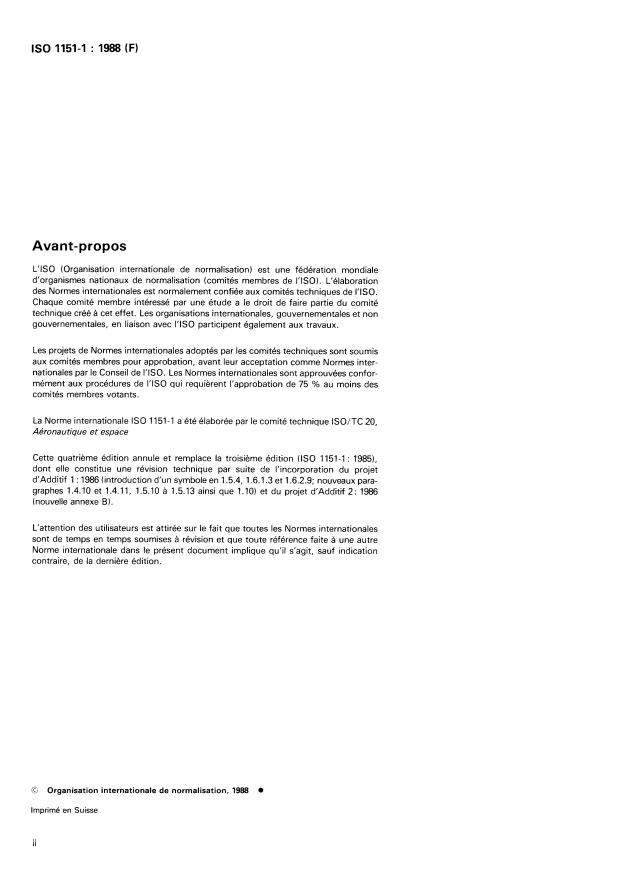

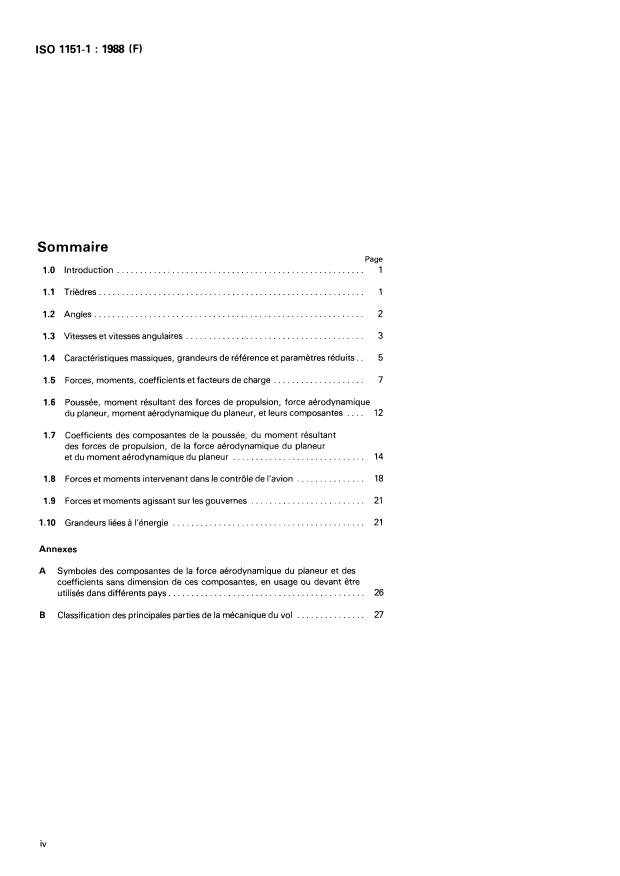
ISO 1151-1:1988 - Mécanique du vol — Concepts, grandeurs et symboles — Partie 1: Mouvement de l'avion par rapport a l'air Released:4/28/1988
Overview
ISO 1151-1:1988 - "Flight dynamics - Concepts, quantities and symbols - Part 1: Aircraft motion relative to the air" is an international standard that establishes basic definitions, symbols and conventions for describing an aircraft’s motion with respect to the atmosphere. It assumes the atmosphere is at rest or in translational motion at constant velocity relative to Earth and treats the aircraft as rigid (many definitions are applicable to flexible airframes). The document provides a consistent vocabulary and notation set for flight dynamics, aerodynamics and stability work.
Key topics
- Axis systems: clear definitions for earth-fixed, normal earth-fixed, aircraft-carried, body, air-path and intermediate axis systems used in flight-dynamics analysis.
- Orientation and angles: standardized terms and symbols for angle of attack, angle of sideslip, bank, azimuth/inclination (air-path) and related rotation sequences.
- Velocities and rates: definitions for aircraft velocity, airspeed, Mach number, components of translational velocity (u, v, w) and angular velocity components (p, q, r) plus normalized angular rates.
- Inertia and reference quantities: moments and products of inertia, radii of gyration, reference area and reference length, normalized mass and nondimensional time units used for scaling and normalization.
- Forces, moments and coefficients: conventions for resultant forces and moments (aerodynamic and propulsive), load factors, thrust and resultant propulsive moments, plus non-dimensional aerodynamic coefficients and component symbols.
- Control and motivator forces: definitions for control forces and moments and the loads/forces on actuators (motivators).
- Annexes: symbol lists for aerodynamic force components and a classification of main flight-dynamics topics.
Practical applications
- Producing consistent technical reports, flight-test data and simulation inputs/outputs by using standardized symbols and definitions.
- Developing flight-dynamics and flight-simulation models (aerodynamic coefficients, inertial models, normalized rates).
- Supporting aircraft stability and control analysis, control-law design, and system integration by providing common reference frames and angle conventions.
- Harmonizing documentation for regulatory submissions, certification evidence and international collaboration.
Who should use this standard
- Aerospace and flight-dynamics engineers
- Flight-test engineers and data analysts
- Simulation and flight-simulator developers
- Aerodynamicists, control-system designers and researchers
- Certification authorities and standards bodies
Related standards
ISO 1151 is a multi-part series; Part 1 is complemented by Parts 2–7 covering motions relative to Earth, derivatives, stability parameters, measurement quantities, geometry and flight envelopes - useful cross-references when performing comprehensive flight-dynamics work.
Relations
- Effective Date
- 15-Apr-2008
- Effective Date
- 15-Apr-2008
Buy Documents
ISO 1151-1:1988 - Flight dynamics — Concepts, quantities and symbols — Part 1: Aircraft motion relative to the air Released:4/28/1988
ISO 1151-1:1988 - Mécanique du vol — Concepts, grandeurs et symboles — Partie 1: Mouvement de l'avion par rapport a l'air Released:4/28/1988
ISO 1151-1:1988 - Mécanique du vol — Concepts, grandeurs et symboles — Partie 1: Mouvement de l'avion par rapport a l'air Released:4/28/1988
Get Certified
Connect with accredited certification bodies for this standard

BSI Group
BSI (British Standards Institution) is the business standards company that helps organizations make excellence a habit.

Bureau Veritas
Bureau Veritas is a world leader in laboratory testing, inspection and certification services.

DNV
DNV is an independent assurance and risk management provider.
Sponsored listings
Frequently Asked Questions
ISO 1151-1:1988 is a standard published by the International Organization for Standardization (ISO). Its full title is "Flight dynamics — Concepts, quantities and symbols — Part 1: Aircraft motion relative to the air". This standard covers: Gives basic definitions and deals with motion relative to the atmosphere, assumed to be at rest or in translational motion at constant velocity relative to the Earth. The aircraft is assumed to be rigid. However, most of the definitions can be applied to the case of a flexible aircraft. Describes axis systems, angles, velocities and angular velocities, aircraft inertia, forces, moments, coefficients and load factors, thrust, resultant moment of propulsive force, coefficients thereof, control forces and moments, motivators and their forces and moments.
Gives basic definitions and deals with motion relative to the atmosphere, assumed to be at rest or in translational motion at constant velocity relative to the Earth. The aircraft is assumed to be rigid. However, most of the definitions can be applied to the case of a flexible aircraft. Describes axis systems, angles, velocities and angular velocities, aircraft inertia, forces, moments, coefficients and load factors, thrust, resultant moment of propulsive force, coefficients thereof, control forces and moments, motivators and their forces and moments.
ISO 1151-1:1988 is classified under the following ICS (International Classification for Standards) categories: 01.060 - Quantities and units; 49.020 - Aircraft and space vehicles in general. The ICS classification helps identify the subject area and facilitates finding related standards.
ISO 1151-1:1988 has the following relationships with other standards: It is inter standard links to ISO 1151-1:1985, ISO 1151:1972. Understanding these relationships helps ensure you are using the most current and applicable version of the standard.
ISO 1151-1:1988 is available in PDF format for immediate download after purchase. The document can be added to your cart and obtained through the secure checkout process. Digital delivery ensures instant access to the complete standard document.
Standards Content (Sample)
INTERNATIONAL STANDARD
Fourth edition
1988-04-15
INTERNATIONAL ORGANKATION FOR STANDARDIZATION
ORGANISATION INTERNATIONALE DE NORMALISATION
MEXaYHAPOflHAfl OPI-AHM3AuMR fl0 CTAHfiAPTM3A~MM
Flight dynamics - Concepts, quantities and Symbols -
Part 1:
Aircraft motion relative to the air
Concepts, grandeurs et Symboles -
Mhcanigue du vol -
Partie 1: Mouvement de l ’avion par rapport 6 l ’air
Reference number
ISO 1151-1 : 1988 (EI
Foreword
ISO (the International Organization for Standardization) is a worldwide federation of
national standards bodies (ISO member bedies). The work of preparing International
Standards is normally carried out through ISO technical committees. Esch member
body interested in a subject for which a technical committee has been established has
the right to be represented on that committee. International organizations, govern-
mental and non-governmental, in Iiaison with ISO, also take part in the work.
Draft International Standards adopted by the technical committees are circulated to
the member bodies for approval before their acceptance as International Standards by
the ISO Council. They are approved in accordance with ISO procedures requiring at
least 75 % approval by the member bodies voting.
International Standard ISO 1151-1 was prepared by Technical Committee ISO/TC 20,
Aircraft and space vehicles.
This fourth edition cancels and replaces the third edition (ISO 1151-1 : 1985) of which it
this fourth edition includes Draft Addenda
constitutes a technical revision :
ISO/DIS 1151-l/DAD 1, circulated in 1986 (addition of a Symbol to 1.5.4, 1.6.1.3
and 1.6.2.9; new sub-clauses 1.4.10, 1.4.11, 1.5.10 to 1.5.13 and 1.10) and
ISO/DIS 1151-l/DAD 2, circulated in 1986 (addition of annex B).
Users should note that all International Standards undergo revision from time to time
and that any reference made herein to any other International Standard implies its
Jatest edition, unless otherwise stated.
0 International Organkation for Standardkation, 1988 0
Printed in Switzerland
ISO 1151-1 : 1988 (El
ISO 1151, Flight dynamics - Concepts, quantities and Symbols, comprises, at
present, seven Parts :
Part I : Aircraft motion relative to the air.
Part 2 : Motions of the aircraft and the atmosphere relative to the Earth.
Part 3 : Derivatives of forces, moments and their coefficients.
Part 4 : Parameters used in the study of aircraft stability and control.
Part 5 : Quan tities used in measurements.
Part 6 : Aircraft geometry.
Part 7: Flight Points and flight envelopes.
ISO 1151 is intended to introduce the main concepts, to include the more important
terms used in theoretical and experimental studies and, as far as possible, to give corre-
sponding Symbols.
In all the Parts comprising ISO 1151, the term “aircraft” denotes a vehicle intended for
atmosphere or space flight. Usually, it has an essentially port and starboard symmetry
with respect to a plane. That plane is determined by the geometric characteristics of
the aircraft. In that plane, two orthogonal directions are defined: fore-and-aft and
dorsal-ventral. The transverse direction, on the perpendicular to that plane, follows.
When there is a Single plane of symmetry, it is the reference plane of the aircraft. When
there is more than one plane of symmetry, or when there is none, it is necessary to
choose a reference plane. In the former case, the reference plane is one of the planes
of symmetry. In the latter case, the reference plane is arbitrary. In all cases, it is
necessary to specify the choice made.
Angles of rotation, angu lar velocities and moments abou t any axis are positive
the positive directi on of that axis.
clockwise when viewed in
All the axis Systems used are three-dimensional, orthogonal and right-handed, which
implies that a positive rotation through x/2 around the x-axis brings the y-axis into the
Position previously occupied by the z-axis.
The centre of gravity coincides with the centre of mass if the field of gravity is homo-
geneous. If this is not the case, the centre of gravity tan be replaced by the centre of
mass in the definitions of ISO 1151; in which case, this should be indicated.
Numbering of sections and clauses
With the aim of easing the indication of references from a section or a clause, a decimal
numbering System has been adopted such that the first figure is the number of the part
of ISO 1151 considered.
IsO1151-1 :1988 (El
Contents
Page
1.0 Introduction . 1
1.1 Axissystems . 1
1.2 Angles . 2
Velocities and angular velocities . 3
1.3
............. 5
1.4 Aircraft inertia, reference quantities and reduced Parameters
........................ 7
1.5 Fortes, moments, coefficients and load factors
1.6 Thrust, resultant moment of propulsive forces, airframe aerodynamic forte,
airframe aerodynamic moment, and their components . 12
1.7 Coefficients of the components of the thrust, of the resultant moment
of propulsive forces, of the airframe aerodynamic forte and of the
airframe aerodynamic moment . 14
1.8 Fortes and moments involved in the control of the aircraft . 18
1.9 Fortes and moments acting on the motivators . 21
1.10 Quantities related to energy . 21
Annexes
A Symbols of the components of the airframe aerodynamic forte and the non-
dimensional coefficients of these components in use, or coming into use,
in different countries. . . . . . . . . . . . . . . . . . . . . . . . . . . . . . . . . . . . . . . . . . . . . . . . . 26
B Classification of the main Parts of flight dynamics . . . . . . . . . . . . . . . . . . . . . . . . 27
iv
INTERNATIONAL STANDARD ISO 1151-1 : 1988 (E)
Concepts, quantities and Symbols -
Flight dynamics -
Part 1:
.
relative to the air
Aircraft motion
1 .O Introduction
This part of ISO 1151 gives basic definitions and deals with aircraft motion relative to the atmosphere, assumed to be at rest or in
translational motion at constant velocity relative to the Earth. 1)
The aircraft is assumed to be rigid. However, most of the definitions tan be applied to the case of a flexible aircraft.
When account is taken of the variations at the Earth ’s surface in the direction of the vertical (local direction of acceleration due to
gravity), the term given in the sub-clauses and figures in question is qualified by the term “local ”.
1.1 Axis Systems
\
No. Term Definition Symbol
1.1.1 Earth-f ixed A System with both the origin and axes fixed relative to the Earth, and
xoYo~o
axis System Chosen as appropriate.
1.1.2 Normal earth-fixed An earth-fixed axis System (1.1.1) in which the z,-axis is oriented ac-
*oYozo
cording to the downward vertical passing through the origin.
axis System
NOTE - However,
xg,z, is an
accepta ble
alternative.
1.1.3 Aircraft-carried A System in which each axis has the same direction as the correspond-
xoYo~o
ing earth-fixed axis, with the origin fixed in the aircraft, usually the
earth axis System
centre of gravity.
1.1.4 Aircraft-carried normal A System in which each axis has the same direction as the correspond-
xoYo~o
earth axis System ing normal earth-fixed axis, with the origin fixed in the aircraft, usually
NOTE - However,
the centre of gravity.
xsy,z, is an
acceptable
alternative.
1.1.5 Body axis system2) A System fixed in the aircraft, with the origin, usually the centre of XYZ
gravity, consisting of the following axes:
An axis in the reference plane (see foreword on p. iii) or, if the origin is
Longitudinal axis x
outside that plane, in the plane through the origin, parallel to the
reference plane.
An axis normal to the reference plane and positive to starboard.
Transverse axis Y
An axis completing the System. z
Normal axis
NOTE - This axis lies in the reference plane or is parallel to that plane. lt is
positive in the ventral sense.
1) The motions of the atmosphere for which this assumption does not hold true will be examined in another part of ISO 1151.
2) Usually, the origins of the axis Systems defined in 1 A.5, 1 .1.6 and 1 .1.7 coincide. If that is not the case, it is necessary to distinguish the different
origins by appropriate suffixes.
ISO 1151-1 : 1988 (El
Term Definition Symbol
No.
Air-path axis System 1) A System with the origin fixed in the aircraft, usually the centre of
1.1.6
gravity, consisting of the following axes:
An axis in the direction of the aircraft velocity (1.3.1).
x,-axis ;
xa
air-path axis
ya-axis ; An axis normal to the air-path axis and the z,-axis defined below; it is
Ya
lateral air-path axis; positive to starboard.
Cross-stream axis
z,-axis ; An axis
normal air-path axis
-
in the reference plane or, if the origin is outside that plane,
parallel to the reference plane, and
-
normal to the air-path axis.
The positive direction of this axis is Chosen so as to complete the
orthogonal, right-handed System x,y,za.
Intermediate axis A System with the origin fixed in the aircraft, usually the centre of
1.1.7
xeYeze
System 1) gravity, consisting of the following axes:
x,-axis The projection of the air-path axis on the reference plane, or, if the
xe
origin is outside that plane, on the plane through the origin, parallel to
the reference plane.
An axis normal to the reference plane and positive to starboard.
ye-axis
Ye
NOTE - This axis coincides with the transverse axis (1.1.5) or is parallel to it.
An axis completing the axis System.
z,-axis
NOTE - This axis coincides with the normal air-path axis (1.1.6) or is parallel
to it.
1) Usually, the origins of the axis Systems defined in 1.1.5, 1.1.6 and 1.1.7 coincide. If that is not the case, it is necessary to distinguish the different
origins by appropriate suffixes.
1.2 Angles
1.2.1 Orientation of the aircraft velocity with respect to the body axis System (sec figure 1)
No. Term Definition Symbol
1.2.1.1 Angle of sideslip The angle which the aircraft velocity (1.3.1) makes with the reference
ß
plane of the aircraft. lt is positive when the aircraft velocity compo-
nent along the transverse axis (1.1.5) is positive.
According to convention, it has the range:
a
1.2.1.2 Angle of attack The angle between the longitudinal axis (1 .1.5) and the projection of
the aircraft velocity (1.3.1) on the reference plane. lt is positive when
the aircraft velocity component along the normal axis (1.1.5) is
positive.
According to convention, it has the range:
ISO 1151-1 : 1988 (EI
1.2.2 Transition from the aircraft-carried normal earth axis System to the body axis System
This transition is achieved by three rotations, defined below, performed in the following Order: !P, 0, cib (see figure 2).
NOTE - Similar angles may be defined with respect to any aircraft-carried earth axis System. The same Symbols, Y, 0, @, with appropriate suffixes
as necessary, may then be used. However, the terms “azimuth angle ”, “inclination angle” and “back angle” refer only to the specific case where the
z,-axis is vertical.
Definition
No. Term Symbol
I
I
1.2.2.1 The rotation (positive, if clockwise) about the z,(z,)-axis which brings
Azimuth angle Y
the x,(x&axis into coincidence with the projection of the longitudinal
axis (1.1.5) on the horizontal plane through the origin.
The rotation in a vertical plane, following the !P rotation (1.2.2.11,
1.2.2.2 I nclination angle
which brings the displaced x,(x&axis into coincidence with the
longitudinal axis (1.1.5). lt is positive when the positive Portion of the
x-axis lies above the horizontal plane through the origin.
According to convention, it has the range:
n: n
--
1.2.2.3 The rotation (positive, if clockwise) about the longitudinal axis (1.1.5),
Bank angle
brings the displaced y,(y&axis into its final Position y from the posi-
tion it reached after the Y rotation (1.2.2.1).
1.2.3 Transition from the aircraft-carried normal earth axis System to the air-path axis System
This transition is achieved by three rotations, defined below, performed in the following Order: Xa, ya, pa (see figure 3).
No. Term Definition Symbol
The rotation (positive, if clockwise) about the z,(z,)-axis which brings
1.2.3.1 Air-path azimuth angle;
Xa
air-path track angle the x,(x&axis into coincidence with the projection of the air-path
x,-axis (1.1.6) on the horizontal plane through the origin.
1.2.3.2 Air-path inclination angle; The rotation in a vertical plane, following the Xa rotation (1.2.3.11,
Ya
which brings the displaced x,(x&axis into coincidence with the
air-path climb angle
air-path xa-axis (1.1.6). lt is positive when the positive Portion of the
x,-axis lies above the horizontal plane through the origin.
According to convention, it has the range:
n n:
--
G Ya < -
2 2
The rotation (positive, if clockwise) about the air-path x,-axis (1.1.6)
1.2.3.3 Air-path bank angle
which brings the displaced y,(y&axis into its final Position ya from
the Position it reached after the x, rotation (1.2.3.1).
1.3 Velocities and angular velocities
Term Definition Symbol 1
No. 1
1.3.1 Aircraft velocity The velocity of the origin of the body axis System (1 .1.5) (usually the
centre of gravity), relative to the air, unaffected by the aerodynamic
field of the aircraft.
Ai rspeed The magnitude of the aircraft velocity. V
1.3.2 Speed of Sound The velocity of propagation of a Sound wave in the ambient air, a
unaffected by the aerodynamic field of the aircraft.
I I 1
I I
ISO 1151-1 : 1988 (El
No. Term Definition Symbol
1.3.3 Mach number The ratio of the airspeed (1.3.1) to the Speed of Sound (1.3.2). Equal to 1M is recom-
Via.
mended. The
Symbols Ma and
*/may be used
if there is likely
to be any
confusion.
1.3.4 Aircraft velocity The components of the aircraft velocity (1.3.11, z for any of the axis
components Systems used. .
In the axis Systems 1.1.1 to 1.1.4:
component along the x,-axis
UO
component along the y,-axis
VO
component along the zo-axis
WO
In the body axis System (1.1.5) :
component along the longitudinal axis 24
component along the transverse axis V
component along the normal axis
W
NOTE - In the air-path axis System (1.1.61, the component along the x,-axis is The velocity
u, = v.
components may
be written Vi,
where i is a
number or letter
subscript.
1.3.5 Aircraft angular velocity The angular velocity of the body axis System (1.1.5) relative to the
Zr
Earth.
The magnitude of aircraft angular velocity.
Aircraft angular Speed 52
1.3.6 Angular velocity The components of the aircraft angular velocity (1.3.5),5, for any of
components the axis Systems used.
In the axis Systems 1.1.1 to 1.1.4:
component along the x,-axis
PO
component along the yo-axis
component along the z,-axis
To ’
In the body axis System (1.1.5) :
Rate of roll component along the longitudinal axis
P
component along the transverse axis
Rate of pitch
Rate of yaw component along the normal axis r
\
The angular
velocity compo-
nents may be
written Szi, where
i is a number or
letter su bscript.
ISO 1151-1 : 1988 (EI
Term Definition Symbol
No.
I
1.3.7 Normalized angular The normalized form of the components of the aircraft angular
velocity (1.3.51, defined as follows:
velocities
In the body axis System (1.1.5) :
Normalized rate of roll
P*
Normalized rate of pitch
4”
r*
Normalized rate of yaw
where
Similar quantities
using a constant
I is the reference length (1.4.6);
reference Speed
in place of V
V is the airspeed (1.3.1).
t 1.3.1) may also
be defined.
Similar normalized quantities tan be formed for the other axis
These require
Systems.
different
Symbols.
1.4 Aircraft inertia, reference quantities and reduced Parameters
Term Definition
Symbol
I
Aircraft mass The current mass of the aircraft.
Moments of inertia The moments of inertia of the aircraft with respect to the body axes
xyz (1.1.5).
Moment of inertia about the longitudinal axis:
j(v2 + z2)dm
*x
Moment of inertia about the transverse axis:
jk2 + x2)dm
I,
Moment of inertia about the normal axis:
Jh2 + $)dm 1
z
NOTE
- A, B, C
are acceptable
alternatives.
The products of inertia of the aircraft with respect to the body axes
Products of inertia
xyz (1.1.5). These are:
zm
SY d
jzxdm
S-XY d!-TZ
NOTE - D, E, F
are acceptable
alternatives.
ISO 11514 : 1988 (El
Definition
Term Symbol
No.
The Square root of the ratio of the moment of inertia to the aircraft
1.4.4 Radius of gyration
mass (1.4.1) :
for the longitudinal axis (1 .1.5) :
m
for the transverse axis (1 .1.5):
Jfyrlm
for the normal axis (1 .1.5) :
&iG
An area used to define the aerodynamic coefficients and various nor-
1.4.5 Reference area
malized quantities. In a given document, one Single reference area will
!
be ‘used the value of which shall be specified.
NOTE - Although hinge moment coefficients are usually defined usin,g
specific reference areas, it may be more appropriate, in somecases, to use the
Single reference area adopted for the aircraft.
A length used to define the aerodynamic moment coefficients and
1.4.6 Reference length /
various normalized quantities. lt is recommended, in a given docu-
ment, that one Single reference length be used the value of which shall
be specif ied .
NOTES
1 lt is, however, acceptable to introduce two different reference lengths as
regards the longitudinal motion and the lateral motion. These lengths shall also
be specif ied.
2 Although hinge moment coefficients are usually defined using specific
reference lengths, it may be more appropriate, in some cases, to use the Single
reference length adopted for the aircraft.
A non-dimensional coeff icient defined as follows :
1.4.7 Normalized mass
p or m*
m
2 e, s/
where
172 is the aircraft mass (1.4.1);
Q, is a datum (air) density (3.3.2);
S is the reference area (1.4.5);
I is the reference length (1.4.6).
1.4.8 Dynamit unit of time A quantity defined as follows:
m
Pl
3 e, &j s = ve
where
m is the aircraft mass (1.4.1);
Q, is a datum (air) density (3.3.2);
Ve is a datum Speed (3.3.1);
S is the reference area (1.4.5);
/ is the reference length (1.4.6);
,u is the normalized mass (1.4%
ISO 1151-1 : 1988 (El
Definition Symbol
Term
No.
A quantity defined as follows:
1.4.9 Aerodynamic unit
of time
I
Ve
where
I is the reference length (1.4.6);
Ve is a datum Speed (3.3.1).
A symmetrical matrix the structure of which is as follows:
1.4.10 Inertia matrix
The inverse of the inertia matrix (1.4.10).
1.4.11 Inverse inertia matrix J
A symmetrical matrix the structure of which is as follows:
where
J,, = U-I,- - l&,bl
J22 = Uz I, - I$xI/d
J33 = (IX 1’ - I&K4
J12 =
J23 =
J31 =
J21 = J12
J32 = J23
J13 = J31
1.5 Fortes, moments, coefficients and load factors
Term Definition Symbol
No.
Resultant forte The resultant vector of the System of forces acting on aircraft,
including the airframe aerodynamic forces and propulsion forces, but
excluding the gravitational, inertial and reaction forces due to contact
with the Earth ’s surface.
1.5.2 Components of the The components of the resultant forte vector, x
resultant forte
In the body axis System (1.1.5) :
component along the longitudinal axis x
Y
component along the transverse axis
component along the normal axis z
In the air-path axis System (1 .1.6) :
component along the X,-axis
component along the y,-axis
component along the z,-axis
ISO 1151-1 : 1988 (El
Definition
No. Term Symbol
Forte coeff icients Non-dimensional coefficients of the components of the resultant forte
1.5.3
(1.5.21, defined as follows:
In the body axis System (1 .1.5) :
X forte coeff icient :
X
+e VS
Y forte coefficient :
Y
;Q VS
2 forte coeff icient :
z
$Q VS
In the air-path axis System (1 .1.6) :
Xa forte coeff icient :
xa
$Q VS
Ya forte coefficient :
Ya
$Q VS
2, forte coeff icient :
2,
$@ VS
where
Q is the density (5.1.3) of the ambient air, unaffected by the
aerodynamic field of the the aircraft;
V is the airspeed (1.3.1);
S is the reference area (1.4.5).
NOTE - These definitions are not usually used in helicopter studies.
*
1.5.4
Resultant moment The resultant moment of the System of forces, forming the resultant
Q
forte (1.5.11, about a reference Point, usually the centre of gravity.
ISO 1151-1 : 1988 (E)
Definition Symbol
No. Term
The components of the resultant moment.
1.5.5 Components of the
resultant moment
In the body axis System (1.1.5) :
component about the longitudinal axis L
Rolling moment
Pitching moment component about the transverse axis M
N
Yawing moment component about the normal axis
In the air-path axis System (1.1.6) :
-
component about the x,-axis
La
-
component about the ya-axis
Ma
-
component about the z,-axis
Na
Moment coefficients Non-dimensional coefficients of the components of the resultant
1.5.6
moments (1.5.51, defined as follows:
In the body axis System (1.1.5) :
L
Rolling moment
Cl
;Q VW
coeff icient
M
Pitching moment
cm
$@ VW
coeff icient
N
Yawing moment
C”
$@ VW
coeff icient
In the air-path axis System (1 J.6) :
La
-
Ga
;Q VW
Ma
-
C
ma
$Q V2Sl
Na
-
c
na
;Q VW
where
Q is the density (5.1.3) of the ambient air, unaffected by the
aerodynamic field of the aircraft;
S is the reference area (1.4.5);
V is the airspeed (1.3.1);
I is the reference length (1.4.6).
NOTE - These definitions are not usually used in helicopter studies.
The ratio of the resultant forte (1.5.1) to the magnitude of the weight
1.5.7 Total load factor
T
vector of the aircraft, defined by the relationship:
li
yq= -
mg
where
is the aircraft mass (1.4.1);
m
is the acceleration due to gravity at the Point considered on the
g
trajectory.
NOTES
1 The qualification “total” and the suffix t tan be omitted, if there is not likely
to be any confusion with the load factor, defined in 1.5.9.
2 A similar load factor tan be defined for take-off and landing conditions, by
introducing in the numerator the sum of the resultant forte (1.5.1) and the
ground contact forces.
I l
I
ISO 1151-1 : 1988 (El
Definition Symbol
No. Term
Components of the total Components of the total load factor (1.5.7), G defined as follows:
1.5.8
load factor vector
In the body axis System (1 .1.5) :
component along the longitudinal axis :
X
ntx = ntx
mg
component along the transverse axis:
Y
nty =
%
mg
component along the normal axis:
z
ntz = ntz
mg
In the air-path axis System (1 .1.6) :
component along the x,-axis :
xa
ntxa = ntxa
mg
component along the y,-axis :
ya
ntya =
ntya
mg
component along the z,-axis :
Za
ntza =
ntza
mg
NOTES
1 The qualification “total” and the suffix t tan be omitted, if there is not likely
to be any confusion with the load factor, defined in 1.5.9.
2 The components of a similar load factor tan be defined for take-off and
landing conditions, by introducing in the numerator the appropriate com-
ponents of the sum of the resultant forte (1.5.1) and the ground contact
forces.
1.5.9 Load factor A quantity equal to the ratio n
-Za
mg
NOTE - Provided it is specified, the load factor tan be defined by the ratio
-2
mg
IO
ISO 11514 : 1988 (E)
Definition
No. Term Symbol
Ratio of the resultant forte (1.5.1), x to the aircraft mass (1.4.11, m,
1.5.10 Specific resultant 1) rr
defined by the following relationship :
NOTE - A similar specific resultant tan be defined for take-off and landing
conditions, by introducing in the numerator the sum of the resultant forte
(1.5.1) and the ground contact forces.
1.5.11 Components of the Components of the specific resultant (1.5.10),aefined as follows:
specific resultant
In the body axis System (1 .1.5) :
component along the longitudinal axis :
X
r, = -
rX
m
component along the transverse axis:
Y
rY
ry= Ti
component along the normal axis:
z
rz = -
m
In the air-path axis System (1 .1.6) :
component along the xa-axis :
xa
rxa = m rxa
component along the y,-axis :
ya
rya = i
5,
component along the z,-axis :
za
=-
r
za %a
m
NOTES - The components of a similar specific resultant tan be defined for
take-off and landing conditions, by introducing in the numerator the ap-
propriate components of the sum of the resultant forte (1.5.1) and the ground
contact forces.
1) The term “specific forte ”, sometimes used for this quantity, shall be avoided.
ISO 1151-1 : 1988 E)
No. Term Definition Symbol
1.5.12 Specific resultant + Product of the inverse inertia matrix, (1.4.1 l), J, by the resultant
moment moment (1.5.41, 5
NOTE - A similar specific resultant moment tan be defined for take-off and
landing conditions, by adding the resultant moment of the ground contact
forces to the resultant moment, 5
1.5.13 Components of the Components of the specific resultant moment (1.5.121, z defined as
specific resultant moment follows in the body axis System (1.1.5) :
= J,,-L + J12-M+ J13-N
qx qx
= J21 n L + JE l M + J23 9 N
4r
4r
= J3,-L + J32-M+ J33-N
NOTE - The components of a similar specific resultant moment tan be
defined for take-off and landing conditions, by adding the components of the
resultant moment of the ground contact forces to the components of the
resultant moment (1.5.4), g
1.6 Thrust, resultant moment of propulsive forces, airframe aerodynamic forte, airframe
aerodynamic moment, and their components
The System of forces acting on the aircraft, the resultant of which is defined in 1.5.1 and the resultant moment of which is defined in
1.5.4, excluding forces due to gravity, inertia and ground contact, may only be separated on an arbitrary basis into thrust forces due
to the propulsive System and aerodynamic forces due to the airframe. lt is impossible to define a general rule for the Separation. The
rule adopted shall be specified for each particular case.
In the following Paragraphs, definitions are given for:
-
the thrust (the resultant forte of the System attributed to the propulsive System) and its components, the resultant moment of
propulsive forces and its components.
-
the airframe aerodynamic forte and its components, the airframe aerodynamic moment and its components.
1.6.1 Thrust, resultant moment of propulsive forces, and their components
o account the indi-
In the body axis System (1.1.5) :
component along the longitudinal axis
FX
component along the transverse axis
FY
component along the normal axis F
In the air-path System (1 -1.6) :
component along the xa-axis F
xa
component along the ya-axis F
ya
component along the z,-axis
Ca
----------------
...
IS0
1151-1
NORME INTERNATIONALE
Quatrieme edition
1988-04-1 5
INTERNATIONAL ORGANIZATION FOR STANDARDIZATION
ORGANISATION INTERNATIONALE DE NORMALISATION
MEXAYHAPOAHAR OPTAHM3AuMR no CTAHAAPTM3AUMM
Mecanique du vol - Concepts, grandeurs et symboles -
Partie 1 :
Mouvement de I’avion par rapport a I‘air
Flight dynamics - Concepts, quantities and symbols -
Part I: Aircraft motion relative to the air
Numero de reference
IS0 1151-1 : 1988 (F)
IS0 1151-1 : 1988 (F)
Avant-propos
L‘ISO (Organisation internationale de normalisation) est une federation mondiale
d’organismes nationaux de normalisation (comites membres de I’ISO). L’elaboration
des Normes internationales est normalement confiee aux comites techniques de I’ISO.
Chaque comite membre interesse par une etude a le droit de faire partie du comite
technique Cree a cet effet. Les organisations internationales, gouvernementales et non
gouvernementales, en liaison avec I’ISO participent egalement aux travaux.
Les projets de Normes internationales adoptes par les comites techniques sont soumis
aux comites membres pour approbation, avant leur acceptation comme Normes inter-
nationales par le Conseil de I’ISO. Les Normes internationales sont approuvees confor-
mkment aux procedures de I’ISO qui requierent I‘approbation de 75 % au moins des
comites membres votants.
La Norme internationale IS0 1151-1 a ete elaboree par le comite technique ISOiTC 20,
Aeronautique et espace
Cette quatrieme edition annule et remplace la troisieme edition (IS0 1151-1 : 19851,
dont elle constitue une revision technique par suite de I’incorporation du projet
d’Additif 1 : 1986 (introduction d’un symbole en 1.5.4, 1.6.1.3 et 1.6.2.9; nouveaux para-
graphes 1.4.10 et 1.4.11, 1.5.10 a 1.5.13 ainsi que 1.10) et du projet d‘Additif 2: 1986
B).
(nouvelle annexe
L’attention des utilisateurs est attiree sur le fait que toutes les Normes internationales
sont de temps en temps soumises a revision et que toute reference faite a une autre
Norme internationale dans le present document implique qu‘il s’agit, sauf indication
contraire, de la derniere edition.
G Organisation internationale de normalisation, 1988 0
lmprime en Suisse
ii
IS0 1151-1 : 1988 (F)
L'ISO 1151, Mecanique du vol - Concepts, grandeurs et symboles, comprend actuel-
lement sept parties:
Partie I : Mouvement de I'avion par rapport a l'air.
Partie 2 : Mouvements de l'avion et de l'atmosphere par rapport a la Terre.
Partie 3 : Derivees des forces, des moments et de leurs coefficients.
Partie 4 : Parametres utilises dans l'etude de la stabilite et du pilotage des avions.
Partie 5 : Grandeurs utilisees dans les mesures.
Partie 6 : Geometric de I'avion.
Partie 7 : Points de vol et domaines de vol.
L'ISO 1151 est destinee a introduire les principaux concepts, definir les termes les
plus importants utilises dans les etudes theoriques et experimentales et, dans la mesure
du possible, a donner les symboles correspondants.
Dans toutes les parties de I'ISO 1151, le terme ccavionn designe un vehicule destine a
voler dans I'atmosphere ou dans I'espace. En general, il presente essentiellement une
symetrie gauche-droite par rapport a un plan. Ce plan est determine par les caracteristi-
ques geometriques de I'avion. Dans ce plan, on definit deux directions orthogonales :
arriere-avant et dessus-dessous. La direction transversale, sur la perpendiculaire a ce
plan, en resulte.
Lorsqu'il y a un seul plan de symetrie, c'est la plan de reference de I'avion. Lorsqu'il y a
plus d'un plan de symetrie, ou lorsqu'il n'y en a aucun, il est necessaire de choisir un
plan de reference. Dans le premier cas, le plan de reference est l'un des plans de syme-
trie. Dans le second cas, le plan de reference est arbitraire. Dans tous les cas, il est
necessaire d'en preciser le choix.
Les angles de rotation, les vitesses angulaires et les moments autour d'un axe sont
positifs dans le sens d'horloge, pour un observateur regardant dans la direction posi-
tive de cet axe.
Tous les triedres utilises sont trirectangles et directs, c'est-a-dire qu'une rotation posi-
tive de x/2 autour de I'axe x ambne I'axey dans la position precedemment occupee par
l'axe z.
Le centre de gravite coi'ncide avec le centre de masse si le champ de gravite est homo-
gbne. Si tel n'est pas le cas, le centre de gravite peut 6tre remplace par le centre de
masse dans les definitions de I'ISO 1151. Ceci devra alors 6tre specifie.
Numerotation des chapitres et paragraphes
Dans le but de faciliter I'indication des references d'un chapitre ou d'un paragraphe,
une numerotation decimale a &e adoptee telle que le premier chiffre soit le numero de
la partie consideree de I'ISO 1151.
iii
IS0 1151-1 : 1988 (F)
So m ma i re
Page
1.0 Introduction . 1
.......................................................... 1
1.1 Triedres
1.2 Angles . 2
1.3 Vitesses et vitesses angulaires . 3
1.4 Caracteristiques massiques. grandeurs de reference et parametres reduits . . 5
1.5 Forces. moments. coefficients et facteurs de charge . 7
1.6 Poussee. moment resultant des forces de propulsion. force aerodynamique
du planeur. moment aerodynamique du planeur. et leurs composantes . 12
1.7 Coefficients des composantes de la poussee. du moment resultant
des forces de propulsion. de la force aerodynamique du planeur
et du moment aerodynamique du planeur . 14
1.8 Forces et moments intervenant dans le contrtde de l'avion . 18
1.9 Forces et moments agissant sur les gouvernes . 21
1.10 Grandeurs liees A I'energie . 21
Annexes
A Symboles des composantes de la force aerodynamique du planeur et des
coefficients sans dimension de ces composantes. en usage ou devant 6tre
utilises dans differents pays . 26
B Classification des principales parties de la mecanique du vol . 27
iv
NORME INTERNATIONALE IS0 1151-1 : 1988 (F)
Mecanique du vol - Concepts, grandeurs et symboles -
Partie 1:
Mouvement de I’avion par rapport a I‘air
1 .O Introduction
La presente partie de I’ISO 1151 donne les definitions de base et traite du mouvement de I‘avion par rapport B I’atmosphere, supposee
immobile ou animee d’un mouvement de translation 8 vitesse constante par rapport B la Terre. 1)
L’avion est suppose rigide. Toutefois, la plupart des definitions peuvent etre appliquees au cas de l’avion deformable.
Dans le cas oh I‘on veut tenir compte des variations, a la surface de la Terre, de la direction de la verticale (direction locale de I‘accele-
ration due a la pesanteur), on utilise la denomination figurant aux paragraphes et figures concern&, avec le qualificatif ((local)).
1.1 Triedres
Dbnomination Definition Symbole
NO
Triedre terrestre Triedre dont I’origine et les axes sont lies B la Terre et choisis suivant
1.1.1
XOYOZO
les besoins.
Triedre terrestre (1.1.1) dont I’axe zo est oriente suivant la verticale
1.1.2 Triedre normal terrestre
XOYOZO
descendante passant par I’origine.
NOTE - Cepen-
dant, xgy,zg est
6galement adrnis.
Triedre terrestre porte Triedre equipollent au triedre terrestre, dont I’origine est un point lie B
1.1.3
XOYOZO
par I’avion I’avion, usuellement le centre de gravite.
1.1.4 Triedre normal terrestre Triedre equipollent au triedre normal terrestre, dont I’origine est un
point lie B I’avion, usuellement le centre de gravite.
porte par I’avion
NOTE - Cepen-
dant, xgygzg est
egalement admis
Triedre lie B I’avion, dont I‘origine est usuellement le centre de gravite,
1.1.5 Triedre avion2)
XYZ
et constitue par les axes suivants:
la page iii)
Axe longitudinal Axe situ6 dans le plan de reference (voir avant-propos de X
ou, si I’origine est en dehors de celui-ci, dans le plan passant par I‘ori-
gine et parallhle au plan de reference.
Axe transversal Axe normal au plan de reference et orient6 positivement vers le cBte
Y
droit de I’avion.
Z
Axe normal Axe completant le triedre.
NOTE - Cet axe est situ6 dans le plan de r6ference ou Iui est parallele. II est
dirig6 vers le dessous de l‘avion.
Les mouvernents de I’atmosphhre qui ne satisfont pas B cette hypothese seront pris en consideration dans une autre partie de I‘ISO 1151.
1)
Usuellernent, les origines des trihdres definis en 1.1.5, 1.1.6 et 1.1.7 coincident. Si ce n‘est pas le cas, il faut distinguer les differentes origines par
2)
des indices appropri6s.
IS0 1151-1 : 1988 (F)
Symbole
DBfinition
Denomination
Triedre dont I’origine est un point lie A I‘avion, usuellement le centre
1.1.6 Triedre aerodynarnique 1)
XaYaia
de gravite, et constitue par les axes suivants:
Axe x,; Axe de direction et de sens confondus avec le vecteur vitesse-air
Xa
axe aerodynarnique (1.3.1).
Axe normal B I‘axe aerodynarnique et a I‘axe i, defini ci-dessous,
Ya
Axe Ya;
orient6 positivernent vers le c6te droit de I’avion.
axe lateral aerodynamique
Axe i,; Axe
-
situe dans le plan de reference ou, si I’origine est en dehors de
axe normal aerodynarnique
celui-ci, axe parallele au plan de reference, et
- normal A I‘axe aerodynarnique.
La direction positive de cet axe est choisie de telle sorte que le triedre
xayaia soit trirectangle et direct.
1.1.7 Triedre interrnediairell Triedre dont I’origine est un point lie a I’avion, usuellement le centre
de gravite, et constitue par les axes suivants:
Axe xe Projection de I‘axe aerodynarnique sur le plan de reference ou, si l’ori-
gine est en dehors de celui-ci, sur le plan passant par I’origine et paral-
lele au plan de reference.
Axe normal au plan de reference et oriente positivernent vers le c6te
droit de I‘avion.
NOTE - Cet axe est confondu avec l’axe transversal (1.1.5) ou Iui est paral-
lele.
Axe ie Axe completant le triedre.
NOTE - Cet axe est confondu avec I‘axe normal aerodynamique (1.1.6) ou Iui
est parallele.
lent, les origines des triedres dc nis en 1.1.5, 1,1.6 et 1.1.7 co’incident. Si ce n’est pas le cas, il faut distinguer les differentes origines par
1 Usue
des indices appropries
1.2 Angles
Position angulaire du vecteur vitesse-air par rapport au triedre avion (voir figure 1)
1.2.1
No Denomination DBfinition Svmbole
Angle du vecteur vitesse-air (1.3.1) avec le plan de reference
1.2.1.1 Derapage B
de I’avion. II est positif lorsque la composante du vecteur vitesse-air
suivant l‘axe transversal (1 .I .5) est positive.
Par convention :
R R
_-
2 2
~
(1.1.5) et la projection du vecteur a
1.2.1.2 Incidence; Angle entre I’axe longitudinal
angle d’attaque vitesse-air (1.3.11 sur le plan de reference de I’avion. II est positif lors-
que la composante du vecteur vitesse-air suivant I‘axe normal (1 .I .5)
est positive.
Par convention :
-R
IS0 1151-1 : 1988 (F)
Passage du triedre normal terrestre porte par I‘avion au triedre avion
1.2.2
Ce passage est effectue par trois rotations, definies ci-dessous, dans I’ordre suivant: Y, 0, @ (voir figure 2)
NOTE - Des angles analogues peuvent &re definis a partir de tout triedre terrestre porte par I’avion. Les m6mes symboles Y, 0, @, avec des indices
appropries si necessaire, peuvent alors &re utilises. Par contre, les denominations ctazimutn, ccassiette longitudinale)) et ((angle de gite)) se rapportent
seulernent au cas particulier ou I‘axe z0 est vertical.
Syrnbole
NO Denomination Definition
Y
Rotation (positive si effectuee dans le sens d’horloge), autour de l’axe
1.2.2.1 Azirnut
zo(zg), qui arnene l’axe xo(xg) en coi’ncidence avec la projection de
I‘axe longitudinal (1.1.5) sur le plan horizontal passant par I’origine.
Rotation dans un plan vertical, faisant suite a la rotation Y (1.2.2.11, 0
Assiette longitudinale
1.2.2.2
xo(xg) deplace en coi’ncidence avec I’axe longitudinal
qui arnene l‘axe
(1.1.5). Elle est positive quand la partie positive de I‘axe x se trouve
1 au-dessus du plan horizontal passant par I’origine.
II I I
~ Par convention:
~
7[ 7[
_-
2 2
Rotation (positive si effectuee dans le sens d’horloge), autour de l’axe
I 1.2.2.3 Angle de gite
longitudinal (1.1.51, qui arnene l’axe yo(yg) deplace dans sa position
finale Y a oartir de la Dosition atteinte awes la rotation Y (1.2.2.1).
Passage du triedre normal terrestre porte par I‘avion au triedre aerodynamique
1.2.3
Ce passage est effectue par trois rotations, definies ci-dessous, dans I’ordre suivant: x,, y,, pa (voir figure 3).
Denomination DBf ini ti on Symbole
NO
Azirnut aerodynarnique Rotation (positive si effectuee dans le sens d‘horloge), autour de l‘axe
1.2.3.1
Xa
z0(zg), qui arnene l’axe xo(xg) en co’incidence avec la projection de
I‘axe x, du triedre aerodynarnique (1.1.6) sur le plan horizontal passant
par I’origine.
Rotation dans un plan vertical, faisant suite a la rotation za (1.2.3.11,
1.2.3.2 Pente aerodynarnique
Ya
qui arnene I‘axe xo(xg) deplace en co’incidence avec I’axe x, du triedre
aerodynarnique (1.1.6). Elle est positive quand la partie positive de
I‘axe x, se trouve au-dessus du plan horizontal passant par I’origine.
Par convention :
I I
~
Rotation (positive si effectuee dans le sens d’horloge), autour de l’axe
Angle de gite
1.2.3.3
Pa
x, du triedre aerodynarnique (1.1.61, qui arnene I’axe yo(yg) deplace
aerodynarnique
dans sa position finale ya a partir de la position atteinte apres la rota-
tion xa (1.2.3.1 ).
1.3 Vitesses et vitesses angulaires
Definition Syrnbole
I NO DBnomination
-
Vecteur vitesse-air Vecteur vitesse de I’origine du triedre avion (1.1.5) (usuellernent le V
1.3.1
centre de gravite), par rapport a l’air non influence par le champ
aerodynarnique de I‘avion.
Vitesse-air Module du vecteur vitesse-air. V
Vitesse de propagation d‘une onde sonore dans l‘air arnbiant non
1.3.2 Celerite du son a
influence par le champ aerodynarnique de I‘avion.
IS0 1151-1 : 1988 (F)
Syrnbole
NO Dhornination DBfinition
Rapport de la vitesse-air (1.3.1) 8 la celerite du son (1.3.2). II est Bgal Symbole recom-
1.3.3 Nombre de Mach
8 Vla. mand6: M.
Toutefois, les
symboles Ma et J
peuvent btre uti1
& s’il y a risque
de confusion.
1.3.4 Composantes du vecteur Composantes du vecteur vitesse-air (1.3.11, V, dans les differents trie-
vitesse-air dres utilis6s.
Dans les triedres 1.1.1 8 1.1.4:
composante suivant I’axe x,
composante suivant I’axe yo
composante suivant l’axe L,
Dans le triedre avion (1.1 -5) :
composante suivant I’axe longitudinal U
V
composante suivant I’axe transversal
W
composante suivant I’axe normal
NOTE - Dans le triedre aerodynamique (1 .I .6), la composante suivant I‘axex,
Les composantes
est U, = V.
du vecteur
vitesse-air
peuvent &re,
not&s vi, ou i est
un indice
numerique ou
litteral.
Vecteur vitesse angulaire Vecteur vitesse angulaire du triedre avion (1.1.5) par rapport 8 la
1.3.5
Terre.
Vitesse anaulaire Module du vecteur vitesse angulaire.
1.3.6 Composantes du vecteur (1.3.51, dans les diffe
Composantes du vecteur vitesse angulaire
vitesse angulaire rents triedres utilises.
1 .I .1 8 1 .I .4:
Dans les triedres
composante suivant I’axe x,
Po
composante suivant I’axe yo
composante suivant I’axe zo
TO
Dans le triedre avion (1.1.5) :
Vitesse de roulis composante suivant I’axe longitudinal
P
Vitesse de tangage composante suivant Ifaxe transversal
composante suivant I’axe normal r
Vitesse de lacet
Les composantes
du vecteur
vitesse angulaire
peuvent btre
notees Qi, oh
i est un indice
numerique ou
litteral.
IS0 1151-1 : 1988 (F)
Definition Symbole
Denomination
NO
1.3.7 Vitesses angulaires Formes sans dimension des composantes du vecteur vitesse angulaire
(1.3.51, definies de la facon suivante:
reduites
Dans le triedre avion (1 .I .5) :
Vitesse reduite de roulis P*
Vitesse reduite de
4*
tangage
r*
Vitesse reduite de lacet
Des grandeurs
OU
analogues
peuvent etre
I est la longueur de reference (1.4.6);
definies a partir
V est la vitesse-air (1.3.1).
d‘une vitesse de
reference cons-
Des grandeurs reduites similaires peuvent &re definies de facon analo-
tante et non de
gue pour les autres systemes d‘axes.
V (1.3.1). Elles
necessitent des
symboles
differents.
1.4 Caracteristiques massiques, grandeurs de reference et parametres reduits
Denomination Definition Symbole
NO
Masse de l’avion Masse instantanee de I’avion. m
1.4.1
~
1.4.2 Moments d’inertie Moments d‘inertie de I’avion par rapport aux axes du triedre avion xy;
(1.1.51,
Moment d’inertie par rapport a I‘axe longitudinal :
](y2 + ?)dm
Moment d’inertie par rapport a l’axe transversal :
j(z2 + x2)dm
I,.
Moment d‘inertie par rapport a I‘axe normal:
j(x2 + y2)dm
NOTE - A, B, C
sont egalement
admis.
1.4.3 Produits d’inertie Produits d’inertie de I’avion par rapport aux axes du triedre avion xy;
(1.1.5). Soit:
jyzdm
I,,
jzxdm
I;,
IXY dm
I, i
NOTE - D, E, F
sont egalement
admis.
IS0 1151-1 : 1988 (F)
DBfinition
NO DBnornination Syrnbole
Racine carree du quotient du moment d’inertie par la masse de I‘avion
1.4.4 Rayons de giration
(1.4.1) :
pour I’axe longitudinal (1.1.5) :
qm
pour I’axe transversal (1.1.5) :
*
pour I‘axe normal (1.1.5) :
J7z
r:
S
1.4.5 Surface de reference Surface utilisee pour definir les coefficients aerodynamiques et diffe-
rentes grandeurs reduites. Dans un document donne, on utilisera une
surface de reference unique dont la valeur doit etre precisee.
NOTE - Bien que les coefficients de moments de charniere soient generale-
ment definis en utilisant des surfaces de reference specifiques, il peut &re plus
approprie, dans certains problemes, d’utiliser la surface de reference unique
adoptee pour I’avion.
1.4.6 Longueur de reference Longueur utilisee pour definir les coefficients de moments aerodyna-
miques et differentes grandeurs reduites. II est recommand6 d’utiliser,
dans un document donne, une longueur de reference unique dont la
valeur doit etre precisee.
NOTES
1 It est toutefois admis d’introduire deux longueurs de reference differentes
interessant le rnouvernent longitudinal et le rnouvernent lateral. Ces longueurs
doivent etre egalement precisees.
2 Bien que les coefficients de moments de charniere soient generalernent
definis en utilisant des longueurs de reference specifiques, il peut &re plus
approprie, dans certains problemes, d’utiliser la longueur de reference adoptee
pour I’avion.
~
1.4.7 Masse reduite Coefficient sans dimension, defini de la facon suivante:
p ou m+
m
OU
m est la masse de I’avion (1.4.1);
e, est une masse volumique de reference (de I’air) (3.3.2);
S est la surface de reference (1.4.5);
I est la longueur de reference (1.4.6).
1.4.8 Temps dynamique
Grandeur definie de la facon suivante:
unitaire
m
PI
--
-
t Qe Ve S Ve
OU
m est la masse de I’avion (1.4.1);
est une masse volumique de reference (de I‘air) (3.3.2);
Ve est une vitesse de reference (3.3.1);
S est la surface de reference (1.4.5);
I est la longueur de reference (1.4.6);
p est la masse reduite (1.4.7).
IS0 1151-1 : 1988 (F)
Symbole
DBnomination DBfinition
NO
Temps aerodynamique Grandeur definie de la facon suivante:
1.4.9
unitaire
I
I est la longueur de reference (1.4.6);
V, est une vitesse de reference (3.3.11.
I
1.4.10 Matrice d’inertie Matrice symetrique, dont la structure est la suivante:
1, - Ixy - I,
- 1, - Iy,
1.4.11 Matrice inverse d’inertie Inverse de la matrice d’inertie (1.4.10).
J
C’est une matrice symetrique dont la structure est la suivante:
avec
1.5 Forces, moments, coefficients et facteurs de charge
NO DBnomination DBf in it ion Symbole
+
1.5.1 Force resultante Resultante generale d’un syst&me de forces agissant sur I’avion,
R
incluant les forces aerodynamiques du planeur et les forces de propul-
sion, mais excluant les forces de pesanteur et d‘inertie et les forces de
contact avec le sol.
1.5.2 Composantes de la Composantes de la force resultante ‘ii:
force resultante
Dans le triedre avion (1.1.5) :
composante suivant I’axe longitudinal X
composante suivant I’axe transversal Y
composante suivant I’axe normal Z
Dans le triedre aerodynarnique (1.1.6) :
composante suivant l‘axe x,
xa
composante suivant I‘axe ya
ya
composante suivant I‘axe z,
Z,
IS0 1151-1 : 1988 (F)
~
Symbole
Dhomination Dbfinition
~~ ~~
Coefficients de force Coefficients sans dimension des composantes de la force resultante
(1.5.21, definis de la facon suivante:
Dans le triedre avion (1.1.5) :
coefficient relatif a X:
X
CX
$e v2s
coefficient relatif 8 Y:
Y
$e v2s
coefficient relatif A Z:
Z
+e v2s
Dans le triedre aerodynamique (1.1.6):
coefficient relatif a X,:
Xa
+e v2s
coefficient relatif A Y,
Ya
$e v2s
coefficient relatif a 2, :
Za
$e v2s
e est la masse volumique (5.1.3) de I’air ambiant non influence
par le champ aerodynamique de I’avion;
V est la vitesse-air (1.3.1);
S est la surface de reference (1.4.5).
NOTE - Les definitions ci-dessus ne sont pas usuellernent utilisees pour les
etudes relatives aux helicopteres.
Moment resultant du systdme de forces, dont la resultante est definie
Moment resultant
Q’
en 1.5.1, par rapport a un point de rhference, usuellement le centre de
gravite.
IS0 1151-1 : 1988 (F)
Svmbole
DBfinition
NO Dhomination
Composantes du moment resultant.
1.5.5 Composantes du moment
resultant
Dans le triedre avion (1.1.5) :
L
composante suivant I'axe longitudinal
Moment de roulis
M
composante suivant I'axe transversal
Moment de tangage
N
Moment de lacet composante suivant I'axe normal
Dans le triedre aerodynamique (1.1.6) :
composante suivant I'axe xa
La
composante suivant I'axe ya
Ma
-
composante suivant I'axe ia
Na
Coefficients de moment Coefficients sans dimension des composantes du moment resultant
1.5.6
(1.5.51, definis de la facon suivante:
Dans le triedre avion (1 .I .5)
Coefficient de moment L
de roulis
$e V2SI
Coefficient de moment M
de tangage
te V2SI
Coefficient de moment N
de lacet
Dans le triedre aerodynamique (1 -1.6)
La
$e V2SI
Ma
;e V2SI
Na
$e V2SI
e est la masse volumique (5.1 -3) de I'air arnbiant non influence par
le champ aerodynamique de I'avion;
V est la vitesse-air (1.3.1);
S est la surface de reference (1.4.5);
I est la longueur de reference (1.4.6).
NOTE - Les definitions ci-dessus ne sont pas usuellement utilisees pour les
etudes relatives aux helicopteres.
IS0 1151-1 : 1988 (F)
DBfinition Symbole
DBnomination
NO
+
Rapport de la force resultante (1.5.1) au module du poids de I'avion,
1.5.7 Vecteur facteur
nt
defini par la relation:
de charge total
4z
nt = -
mg
OU
m est la masse de I'avion (1.4.1);
g est I'acc616ration due 8 la pesanteur au point considere de la
trajectoire.
NOTES
1 Le qualificatif ((total)) et I'indice t peuvent etre ornis s'il n'y a pas de risque
de confusion avec le facteur de charge defini en 1.5.9.
2 Un vecteur facteur de charge analogue peut &re defini pour les conditions
de decollage ou d'atterrissage, en introduisant au nurnerateur la somrne de la
force resultante (1.5.1) et des forces de contact avec le sol.
1.5.8 Cornposantes du vecteur Composantes du vecteur facteur de charge total (1.5.7),z, definies
facteur de charge total de la facon suivante:
Dans le triedre avion (1.1.5) :
cornposante suivant l'axe longitudinal :
X
n, = -
mg
cornposante suivant I'axe transversal :
Y
fl t.v = -
mg
cornposante suivant I'axe normal :
Z
n,, = -
mg
Dans le triedre aerodynarnique (1.1.61 :
cornposante suivant I'axe xa:
Xa
nwa = -
mg
cornposante suivant I'axe y,:
.I
composante suivant I'axe z,:
nGa = -
mg
NOTES
1 Le qualificatif ((total)) et I'indice t peuvent 6tre ornis s'il n'y a pas de risque
de confusion avec le facteur de charge defini en 1.5.9.
2 Les cornposantes d'un vecteur facteur de charge analogue peuvent &re
definies pour les conditions de d6collage ou d'atterrissage, en introduisant au
nurnerateur les cornposantes appropriees de la sornme de la force resultante
(1.5.1) et des forces de contact avec le sol.
IS0 1151-1 : 1988 (F)
NO Dhomination DBfinition Svmbole
n
1.5.9 Facteur de charge Grandeur Bgale au rapport
NOTE - A condition de le preciser, le facteur de charge peut &re defini par le
rapport
-Z
+
Resultante massiquel) Quotient de la force resultante x(1.5.1) B la masse de I'avion m r
1.5.10
(1.4.11, defini par la relation:
+R
r= -
m
NOTE - Une resultante rnassique analogue peut btre definie pour les condi-
tions de decollage ou d'atterrissage, en introduisant au numerateur la sornrne
de la force resultante (1.5.1) et des forces de contact avec le sol.
1.5.11 Composantes de la Composantes de la resultante massiqueT(l.5.10), definies de la facon
resultante massique suivante:
Dans le triedre avion (1.1.5) :
composante suivant I'axe longitudinal :
X
r=-
m
composante suivant axe transversal :
Y
r=-
'm
composante suivant axe normal:
Z
rz = -
m
Dans le triedre aerodynamique (1 .I .6) :
composante suivant l'axe x,:
Xa
rxa = -
m
composante suivant I'axe y,:
Ya
rya = -
m
composante suivant I'axe L,:
-3
La
rta = -
m
NOTES - Les cornposantes d'une resultante rnassique analogue peuvent btre
definies pour les conditions de decollage ou d'atterrissage, en introduisant au
nurnerateur les cornposantes approprihes de la sornrne de la force resultante
(1.5.1) et des forces de contact avec le sol.
La denomination ((force specifique)), quelquefois utilisde pour cette grandeur, est B prohiber.
1)
IS0 1151-1 : 1988 (F)
Definition Syrnbole
NO Denomination
____~
Moment resultant Produ2 de la matrice inverse d‘inertie J(1.4.11) et du moment resul-
1.5.12
massique tant Q (1.5.4) :
NOTE - Un moment resultant massique analogue peut etre defini, pour le5
conditions de decollage ou d’atterrissage, en ajoutant au moment resultant Q
le moment resultant des forces de contact avec le sol.
1.5.13 Composantes du moment Composantes du moment resultant massiqueT(l.5.12), definies de la
facon suivante, dans le triedre avion (1.1.5) :
resultant massique
qx = f11 L + J12 M + J13 N
4w
qy = J21 L + fz M + J23 N
4.V
4; J31 . L + J32. M + J33 * N
4;
NOTE - Les composantes d’un moment resultant massique analogue peu-
vent etre definies, pour les conditions de decolkge ou d‘atterrissage, en ajou-
tant aux composantes du moment resultant Q (1.5.4) les composantes du
moment resultant des forces de contact avec le sol.
1.6 Poussee, moment resultant des forces de propulsion, force aerodynamique du planeur,
moment aerodynamique du planeur, et leurs composantes
Le systeme de forces agissant sur I’avion, dont la force resultante est definie en 1.5.1 et dont le moment resultant est defini en 1.5.4, a
I’exclusion des forces de pesanteur, des forces d‘inertie et des forces de contact avec le sol, ne peut itre decompose que d‘une
maniere arbitraire, en separant les forces de poussee attribuees au systeme de propulsion et les forces aerodynamiques attribuees au
planeur. II est impossible de definir une regle generale de partition. La regle adoptee dans chaque cas particulier doit &tre precisee.
Dans les paragraphes qui suivent, ont ete definis:
-
la poussee (force resultante du systeme des forces attribuees au systeme de propulsion) et ses composantes, le moment resul-
tant des forces de propulsion et ses composantes;
-
la force aerodyn
...
IS0
NORME INTERNATIONALE
1151-1
Quatrieme edition
1988-04-15
-
INTERNATIONAL ORGANIZATION FOR STANDARDIZATION
ORGANISATION INTERNATIONALE DE NORMALISATION
MEX
Mecanique du vol - Concepts, grandeurs et symboles -
Partie 1 :
Mouvement de I’avion par rapport a I’air
Flight dynamics - Concepts, quantities and symbols -
Part I: Aircraft motion relative to the air
Nurnero de reference
IS0 1151-1 : 1988 (F)
IS0 1151-1 : 1988 (F)
Avant-propos
L‘ISO (Organisation internationale de normalisation) est une federation rnondiale
d’organisrnes nationaux de normalisation (comites rnernbres de I’ISO). L‘elaboration
I’ISO.
des Norrnes internationales est normalernent confiee aux comites techniques de
Chaque cornite rnernbre interesse par une etude a le droit de faire partie du comite
technique Cree a cet effet. Les organisations internationales, gouvernernentales et non
gouvernementales, en liaison avec I’ISO participent egalernent aux travaux.
Les projets de Norrnes internationales adoptes par les comites techniques sont sournis
aux comites rnernbres pour approbation, avant leur acceptation cornrne Norrnes inter-
nationales par le Conseil de I’ISO. Les Norrnes internationales sont approuvees confor-
rnernent aux procedures de I’ISO qui requierent I’approbation de 75 YO au rnoins des
comites rnernbres votants.
La Norrne internationale IS0 1151-1 a ete elaboree par le cornite technique ISO/TC 20,
Aeronautique et espace
Cette quatrierne edition annule et rernplace la troisierne edition (IS0 1151-1 : 1985),
dont elle constitue une revision technique par suite de I‘incorporation du projet
d’Additif 1 : 1986 (introduction d‘un syrnbole en 1.5.4, 1.6.1.3 et 1.6.2.9; nouveaux para-
graphes 1.4.10 et 1.4.11, 1.5.10 a 1.5.13 ainsi que 1.10) et du projet d‘Additif 2: 1986
B).
(nouvelle annexe
L‘attention des utilisateurs est attiree sur le fait que toutes les Norrnes internationales
a revision et que toute reference faite a une autre
sont de temps en temps sournises
Norrne internationale dans le present document irnplique qu‘il s‘agit, sauf indication
contraire, de la derniere edition.
0 Organisation internationale de normalisation, 1988 0
lmprime en Suisse
IS0 1151-1 : 1988 (F)
L'ISO 1151, Mecanique du vol - Concepts, grandeurs et symboles, comprend actuel-
lement sept parties:
Partie 1 : Mouvement de I'avion par rapport a l'air.
Partie 2 : Mouvements de I'avion et de I'atmosphere par rapport a la Terre.
Partie 3 : Derivees des forces, des moments et de leurs coefficients.
Partie 4 : Parametres utilises dans I'etude de la stabilite et du pilotage des avions.
Partie 5 : Grandeurs uti'isees dans les mesures.
Partie 6 : Gdometrie de I'avion.
Partie 7 : Points de vol et domaines de vol.
L'ISO 1151 est destinee a introduire les principaux concepts, a definir les termes les
plus importants utilises dans les etudes theoriques et experimentales et, dans la mesure
du possible, a donner les symboles correspondants.
Dans toutes les parties de I'ISO 1151, le terme ccavion)) designe un vehicule destine a
voler dans I'atmosphere ou dans I'espace. En general, il presente essentiellement une
symetrie gauche-droite par rapport a un plan. Ce plan est determine par les caracteristi-
ques geometriques de I'avion. Dans ce plan, on definit deux directions orthogonales :
arriere-avant et dessus-dessous. La direction transversale, sur la perpendiculaire a ce
plan, en resulte.
Lorsqu'il y a un seul plan de symetrie, c'est la plan de reference de I'avion. Lorsqu'il y a
plus d'un plan de symetrie, ou lorsqu'il n'y en a aucun, il est necessaire de choisir un
plan de reference. Dans le premier cas, le plan de reference est I'un des plans de syme-
trie. Dans le second cas, le plan de reference est arbitraire. Dans tous les cas, il est
necessaire d'en preciser le choix.
Les angles de rotation, les vitesses angulaires et les moments autour d'un axe sont
positifs dans le sens d'horloge, pour un observateur regardant dans la direction posi-
tive de cet axe.
Tous les triedres utilises sont trirectangles et directs, c'est-a-dire qu'une rotation posi-
tive de 7d2 autour de I'axex amene I'axey dans la position precedemment occupee par
I'axe z.
Le centre de gravite co'incide avec le centre de masse si le champ de gravite est homo-
gene. Si tel n'est pas le cas, le centre de gravite peut 6tre remplace par le centre de
masse dans les definitions de I'ISO 1151. Ceci devra alors 6tre specifie.
Numerotation des chapitres et paragraphes
Dans le but de faciliter I'indication des references d'un chapitre ou d'un paragraphe,
une numerotation decimale a ete adoptee telle que le premier chiffre soit le numero de
la partie consideree de I'ISO 1151.
iii
IS0 1151-1 1988 (F)
Sommaire
Page
1.0 Introduction . 1
1.1 Tri~dres . 1
1.2 Angles . 2
1.3 Vitesses et vitesses angulaires . 3
1.4 Caracteristiques massiques, grandeurs de reference et parametres reduits . .
1.5 Forces. moments. coefficients et facteurs de charge . 7
1.6 Poussee. moment resultant des forces de propulsion. force aerodynamique
du planeur. moment aerodynamique du planeur. et leurs composantes .
1.7 Coefficients des composantes de la poussee. du moment resultant
des forces de propulsion. de la force aerodynamique du planeur
et du moment aerodynarnique du planeur .
1.8 Forces et moments intervenant dans le contrdle de I'avion . 18
1.9 Forces et moments agissant sur les gouvernes . 21
1.10 Grandeurs bees a I'energie . 21
Annexes
A Symboles des composantes de la force aerodynamique du planeur et des
coefficients sans dimension de ces cornposantes. en usage ou devant etre
utilises dans differents pays . 26
B Classification des principales parties de la mecanique du vol .
iv
IS0 1151-1 : 1988 (F)
N 0 R ME I NTE R N AT1 ON ALE
Mecanique du vol - Concepts, grandeurs et symboles -
Partie I:
Mouvement de I'avion par rapport a I'air
1 .O Introduction
La presente partie de I'ISO 1151 donne les definitions de base et traite du mouvement de I'avion par rapport a I'atmosphere, supposee
immobile ou animee d'un mouvement de translation a vitesse constante par rapport B la Terre. 1)
L'avion est suppose rigide. Toutefois, la plupart des definitions peuvent &re appliquees au cas de I'avion deformable.
Dans le cas ou I'on veut tenir compte des variations, A la surface de la Terre, de la direction de la verticale (direction locale de I'accele-
ration due a la pesanteur), on utilise la denomination figurant aux paragraphes et figures concernes, avec le qualificatif ((local)).
1.1 Triedres
Symbole
NO Denomination Definition
Triedre dont I'origine et les axes sont lies a la Terre et choisis suivant
1.1.1 Triedre terrestre
XOYOZO
les besoins.
1.1.2 Triedre normal terrestre Triedre terrestre (1.1.1) dont l'axe zo est oriente suivant la verticale
XOYOZO
descendante passant par I'origine.
NOTE - Cepen-
dant, xgygzg est
egalement admis.
1.1.3 Triedre terrestre porte Triedre equipollent au triedre terrestre, dont I'origine est un point lie a
XOYOZO
par I'avion I'avion, usuellement le centre de gravite.
Triedre normal terrestre
1.1.4 Triedre equipollent au triedre normal terrestre, dont I'origine est un
XOYOZO
porte par I'avion point lie a I'avion, usuellement le centre de gravite.
NOTE - Cepen-
dant, xgy,zg est
egalement admis
Triedre avion2) Triedre lie B I'avion, dont I'origine est usuellement le centre de gravite,
1.1.5
XYZ
et constitue par les axes suivants:
Axe longitudinal Axe situ6 dans le plan de reference (voir avant-propos de la page iii) X
ou, si I'origine est en dehors de celui-ci, dans le plan passant par l'ori-
gine et parallele au plan de reference.
Axe transversal Axe normal au plan de reference et oriente positivement vers le c8te
Y
droit de I'avion.
Axe normal Axe completant le triedre.
NOTE - Cet axe est situ6 dans le plan de reference ou Iui est parallele. II est
dirige vers le dessous de I'avion.
Les rnouvements de I'atrnosphere qui ne satisfont pas B cette hypothese seront pris en consideration dans une autre partie de I'ISO 1151.
1)
Usuellement, les origines des triedres definis en 1.1.5, 1.1.6 et 1.1.7 cdncident. Si ce n'est pas le cas, il faut distinguer les differentes origines par
2)
des indices appropries.
IS0 1151-1 : 1988 (F)
Definition Svmbole
Denomination
NO
Triedre aerodynamique 1) Triedre dont I'origine est un point lie A I'avion, usuellement le centre
1.1.6
de gravite, et constitue par les axes suivants:
Axe xa; Axe de direction et de sens confondus avec le vecteur vitesse-air
(1.3.1).
axe aerodynamique
Axe normal a I'axe aerodynamique et A I'axe z, defini ci-dessous,
Axe Ya;
orient6 positivement vers le c6te droit de I'avion.
axe lateral aerodynamique
Axe
Axe za;
-
axe normal aerodynamique situe dans le plan de reference ou, si I'origine est en dehors de
celui-ci, axe parallele au plan de reference, et
- normal a I'axe aerodynamique.
La direction positive de cet axe est choisie de telle sorte que le triedre
xayaza soit trirectangle et direct.
Triedre dont I'origine est un point lie a I'avion, usuellement le centre
1.1.7 Triedre intermediaire')
de gravite, et constitue par les axes suivants:
Axe x, Projection de I'axe aerodynamique sur le plan de reference ou, si l'ori-
gine est en dehors de celui-ci, sur le plan passant par I'origine et paral-
lele au plan de reference.
Axe normal au plan de reference et oriente positivernent vers le c6te
droit de I'avion.
NOTE - Cet axe est confondu avec I'axe transversal (1.1.5) ou Iui est paral-
Iele.
Axe ze Axe completant le triedre.
NOTE - Cet axe est confondu avec I'axe normal aerodynamique (1.1.6) ou Iui
est parallele.
1 Usue nent, les origines des triedres d
des indices appropries.
1.2 Angles
1.2.1 Position angulaire du vecteur vitesse-air par rapport au triedre avion (voir figure 1)
NO Denomination Definition Symbole
1.2.1.1 Derapage Angle du vecteur vitesse-air (1.3.1) avec le plan de reference
P
de I'avion. II est positif lorsque la composante du vecteur vitesse-air
suivant l'axe transversal (1.1.5) est positive.
Par convention :
1.2.1.2 Incidence; Angle entre I'axe longitudinal (1.1.5) et la projection du vecteur
angle d'attaque vitesse-air (1.3.1) sur le plan de reference de I'avion. II est positif lors-
que la composante du vecteur vitesse-air suivant l'axe normal (1.1.5)
est positive.
Par convention :
-n
IS0 1151-1 1988 (F)
1.2.2 Passage du triedre normal terrestre porte par I'avion au triedre avion
Ce passage est effectue par trois rotations, definies ci-dessous, dans I'ordre suivant: Y, 0, @ (voir figure 2).
NOTE - Des angles analogues peuvent &re definis a partir de tout triedre terrestre porte par I'avion. Les mernes symboles Y, 0, @, avec des indices
appropries si necessaire, peuvent alors &tre utilises. Par contre. les denominations ctazimutn, ccassiette longitudinalen et (tangle de gite)) se rapportent
seulement au cas particulier ou I'axe zo est vertical
~~
No 1 Denomination Definition I Symbole
Y
Azirnut Rotation (positive si effectuee dans le sens d'horloge), autour de I'axe
1.2.2.1
zo(zg), qui arnene I'axe xo(xg) en co'incidence avec la projection de
I'axe longitudinal (1.1.5) sur le plan horizontal passant par I'origine.
1.2.2.2 Assiette longitudinale Rotation dans un plan vertical, faisant suite a la rotation Y (1.2.2.1),
qui arnene I'axe xo(xg) deplace en co'incidence avec I'axe longitudinal
(1.1.5). Elle est positive quand la partie positive de I'axe x se trouve
au-dessus du plan horizontal passant par I'origine.
Par convention :
7l 7l
_-
GO<-
2 2
1.2.2.3 Angle de gite Rotation (positive si effectuee dans le sens d'horloge), autour de I'axe
longitudinal (1.1.5). qui arnene I'axe y,(y,) deplace dans sa position
finale y a partir de la position atteinte apres la rotation Y (1.2.2.1).
Passage du triedre normal terrestre porte par I'avion au triedre aerodynamique
1.2.3
Ce passage est effectue par trois rotations, definies ci-dessous, dans I'ordre suivant: xa, ya, pa (voir figure 3).
Denomination Definition Svmbole
1.2.3.1 Azirnut aerodynamique Rotation (positive si effectuee dans le sens d'horloge), autour de I'axe
Xa
z,(;,), qui arnene I'axe x,(xs) en co'incidence avec la projection de
I'axe xa du triedre aerodynarnique (1.1.6) sur le plan horizontal passant
oar I'oriaine.
~
1.2.3.2 Pente aerodynarnique Rotation dans un plan vertical, faisant suite a la rotation xa (1.2.3.1),
Ya
qui arnene I'axe x,(xg) deplace en co'incidence avec I'axe x, du triedre
aerodynarnique (1.1.6). Elle est positive quand la partie positive de
I'axe x, se trouve au-dessus du plan horizontal passant par I'origine.
Par convention
1.2.3.3 Angle de gite Rotation (positive si effectuee dans le sens d'horloge), autour de I'axe
Pa
aerodynarnique x, du triedre aerodynarnique (1.1.61, qui arnene I'axe y,(y,) deplace
dans sa position finale ya a partir de la position atteinte apres la rota-
tion xa (1.2.3.1).
1.3 Vitesses et vitesses angulaires
NO Denomination Definition Symbole
--t
1.3.1 Vecteur vitesse-air Vecteur vitesse de I'origine du triedre avion (1.1.5) (usuellernent le 1 V
centre de gravite), par rapport a I'air non influence par le champ
aerodynarnique de I'avion.
I I Vitesse-air Module du vecteur vitesse-air. V
I 1.3.2 I Celerite du son Vitesse de propagation d'une onde sonore dans I'air arnbiant non
a
influence par le champ aerodvnarniaue de I'avion.
I I I I 1
IS0 1151-1 : 1988 (F)
DBnomination DBfinition
NO Symbole
1.3.3 Nornbre de Mach Rapport de la vitesse-air (1.3.1) B la celerite du son (1.3.2). II est egal Syrnbole recom-
8 Vla.
mande: M.
Toutefois, les
syrnboles Mu et .A
peuvent etre utili
s6s s'il y a risque
de confusion.
1.3.4 Cornposantes du vecteur Cornposantes du vecteur vitesse-air (1.3.1 1, V, dans les differents trie-
vitesse-air dres utilises.
Dans les triedres 1.1.1 B 1.1.4:
cornposante suivant l'axe xo
U0
composante suivant I'axe yo
VO
composante suivant l'axe io
WO
Dans le triedre avion (1.1.5) :
cornposante suivant I'axe longitudinal U
composante suivant l'axe transversal Y
cornposante suivant I'axe normal W
NOTE - Dans le triedre aerodynamique 1.1.61, la cornposante suivant I'axex,
Les composantes
est U, = V.
du vecteur
vitesse-air
peuvent &re.
not& Vi, 00 i est
un indice
numerique ou
litteral.
Vecteur vitesse angulaire du triedre avion (1.1.5) par rapport a la
1.3.5 Vecteur vitesse angulaire
3i'
Terre.
Vitesse angulaire Module du vecteur vitesse angulaire. 52
1.3.6 Composantes du vecteur
Cornposantes du vecteur vitesse angulaire (1.3.51, Q, dans les diffe
vitesse angulaire rents triedres utilises.
Dans les triedres 1.1.1 B 1.1.4:
cornposante suivant I'axe x,
Po
composante suivant I'axe yo
cornposante suivant l'axe io
r0
Dans le triedre avion (1.1.5) :
Vitesse de roulis cornposante suivant I'axe longitudinal
P
Vitesse de tangage composante suivant I'axe transversal
Q
Vitesse de lacet cornposante suivant I'axe normal r
Les composantes
du vecteur
vitesse angulaire
peuvent etre
notees Q,, 00
i est un indice
nurnerique ou
litteral.
IS0 1151-1 : 1988 (F)
-
Definition Svrnbole
NO Denomination
1.3.7 Vitesses angulaires Formes sans dimension des composantes du vecteur vitesse angulaire
red u ites (1.3.5), definies de la facon suivante:
Dans le triedre avion (1.1.5) :
Vitesse reduite de roulis
P"
Vitesse reduite de
4"
tangage
r*
Vitesse reduite de lacet
Des grandeurs
analogues
peuvent Gtre
I est la longueur de reference (1.4.6);
definies a partir
V est la vitesse-air (1.3.1).
d'une vitesse de
reference cons-
Des grandeurs reduites similaires peuvent 6tre definies de facon analo-
tante et non de
gue pour les autres systemes d'axes.
V (1.3.1). Elles
necessitent des
symboles
differents.
Caracteristiques massiques, grandeurs de reference et parametres reduits
1.4
NO Denomination Definition Svmbole
1.4.1 Masse de I'avion Masse instantanee de I'avion. 111
Moments d'inertie de I'avion par rapport aux axes du triedre avion xy;
1.4.2 Moments d'inertie
(1.1.5).
Moment d'inertie par rapport a I'axe longitudinal :
I(.$ + z2)dm
Moment d'inertie par rapport a I'axe transversal :
l(z2 + x2)dm
Moment d'inertie par rapport a I'axe normal:
((x* + y2)dm
NOTE ~ A, B, C'
sont egalement
adrnis.
1.4.3 Produits d'inertie Produits d'inertie de I'avion par rapport aux axes du triedre avion xyz
(1.1.5). Soit:
jyzdrn
I, -
j zxdm
I; \
Sxydm
I\ L
NOTE - D, E, k
sont egalement
admis.
IS0 1151-1 : 1988 (F)
Dhomination DBfinition Symbol
Rayons de giration Racine carree du quotient du moment d'inertie par la masse de I'avion
(1.4.1) :
pour I'axe longitudinal (1.1.5) :
mm
pour I'axe transversal (1.1.5) :
*
pour I'axe normal (1.1.5):
lj77z
r;
Surface utilisee pour definir les coefficients aerodynamiques et diffe- S
Surface de reference
rentes grandeurs reduites. Dans un document donne, on utilisera une
surface de reference unique dont la valeur doit etre precisee.
NOTE - Bien que les coefficients de moments de charniere soient generale-
ment definis en utilisant des surfaces de reference specifiques, il peut 6tre plus
approprie, dans certains problemes, d'utiliser la surface de reference unique
adoptee pour I'avion.
Longueur de reference Longueur utilisee pour definir les coefficients de moments aerodyna- I
11 est recommande d'utiliser,
miques et differentes grandeurs reduites.
dans un document donne, une longueur de reference unique dont la
valeur doit &re precisee.
NOTES
1 II est toutefois admis d'introduire deux longueurs de reference differentes
interessant le mouvement longitudinal et le mouvement lateral. Ces longueurs
doivent &re egalement precisees.
2 Bien que les coefficients de moments de charniere soient generalement
definis en utilisant des longueurs de reference specifiques, il peut 6tre plus
approprie, dans certains problemes, d'utiliser la longueur de reference adoptee
pour I'avion.
Coefficient sans dimension, defini de la facon suivante:
Masse reduite ,U ou m
m
+ ee SI
m est la masse de I'avion (1.4.1);
e, est une masse volumique de reference (de I'air) (3.3.2);
S est la surface de reference (1.4.5);
I est la longueur de reference (1.4.6).
Temps dynamique
Grandeur definie de la facon suivante:
u n itai re
m PI
--
-
t e, Ve S Ve
OU
m est la masse de I'avion (1.4.1);
e, est une masse volumique de reference (de I'air) (3.3.2);
Ve est une vitesse de reference (3.3.1);
S est la surface de reference (1.4.5);
I est la longueur de reference (1.4.6);
,U est la masse reduite (1.4.7).
IS0 1151-1 : 1988 (F)
NO DBnomination DBfinition Symbole
1.4.9 Temps aerodynamique Grandeur definie de la facon suivante:
‘A
unitaire
I
-
ve
Olj
I est la longueur de reference (1.4.6);
V, est une vitesse de reference (3.3.1).
I
1.4.10 Matrice d’inertie Matrice symetrique, dont la structure est la suivante:
1, - Ixy - I,
- I, - I,,
1.4.11 Matrice inverse d’inertie Inverse de la matrice d‘inertie (1.4.10).
J
C’est une matrice symetrique dont la structure est la suivante:
J1l J12 J13
I-’ = J=
J21 Jz J23
( J31 J32 J33 1
avec
1.5 Forces, moments, coefficients et facteurs de charge
NO DBnomination DBfinition Symbole
+
1.5.1 Force resultante Resultante gendrale d‘un systeme de forces agissant sur I’avion,
R
incluant les forces aerodynamiques du planeur et les forces de propul-
sion, mais excluant les forces de pesanteur et d‘inertie et les forces de
contact avec le sol.
1.5.2
Composantes de la Composantes de la force resultante
force resultante
Dans le triedre avion (1.1.5) :
cornposante suivant I’axe longitudinal
X
composante suivant I‘axe transversal Y
composante suivant I’axe normal Z
Dans le triedre aerodynamique (1.1.6) :
composante suivant l’axe x,
Xa
composante suivant I’axe ya
Ya
comDosante suivant I‘axe i,
Za
IS0 1151-1 : 1988 (F)
NO DBnornination DBfinition Syrnbole
1.5.3 Coefficients de force Coefficients sans dimension des composantes de laforce resultante
(1.5.21, definis de la facon suivante:
Dans le triedre avion (1 .I .5) :
coefficient relatif A X:
X
CX
;@ v2s
coefficient relatif Y:
Y
CY
;e v2s
coefficient relatif a Z:
Z
CZ
Dans le triedre aerodynamique (1.1.6) :
coefficient relatif a X,:
xa
;@ v2s
coefficient relatif a Y,:
ya
CY,
;@ v2s
coefficient relatif a Z,:
za
est la masse volumique (5.1.3) de I'air ambiant non influence
par le champ aerodynamique de I'avion;
V est la vitesse-air (1.3.1 1;
S est la surface de reference (1.4.5).
NOTE - Les definitions ci-dessus ne sont pas usuellement utilisees pour les
etudes relatives aux helicopteres.
1.5.4 Moment resultant Moment resultant du systeme de forces, dont la resultante est definie
Q'
en 1.5.1, par rapport a un point de reference, usuellement le centre de
gravite.
IS0 1151-1 : 1988 (F)
NO DBnomination DBfinition Svmbole
1.5.5 Composantes du moment Composantes du moment resultant.
resultant
Dans le triedre avion (1.1.5) :
Moment de roulis composante suivant I’axe longitudinal L
Moment de tangage composante suivant I’axe transversal M
Moment de lacet composante suivant I‘axe normal N
Dans le triedre aerodynamique (1.1.6) :
composante suivant I‘axe xa
La
composante suivant I’axe ya
Ma
composante suivant I’axe ia
Na
1.5.6 Coefficients de moment Coefficients sans dimension des composantes du moment resultant
(1.5.51, definis de la faqon suivante:
Dans le triedre avion (1.1.5)
Coefficient de moment L
de roulis
;e V2SI
Coefficient de moment M
de tangage
fe V2SI
Coefficient de moment
N
de lacet
fe V2SI
Dans le triedre aerodynamique (1.1.6) :
La
CI a
;e V2SI
Ma
Cma
Cna
OU
e est la masse volumique (5.1.3) de I‘air ambiant non influence par
le champ aerodynamique de I’avion;
V est la vitesse-air (1.3.1);
S est la surface de reference (1.4.5);
I est la longueur de reference (1.4.6).
NOTE - Les definitions ci-dessus ne sont pas usuellement utilisees pour les
etudes relatives aux helicopteres.
IS0 1151-1 : 1988 (F)
DBfinition Symbole
Dbnomination
--t
Vecteur facteur Rapport de la force resultante (1.5.1 1 au module du poids de I’avion,
“t
de charge total defini par la relation:
+
+R
nt = -
mg
Oh
m est la masse de I‘avion (1.4.1);
g est I’acceleration due B la pesanteur au point considere de la
trajectoire.
NOTES
1 Le qualificatif ((totals et I‘indice t peuvent &tre ornis s‘il n’y a pas de risque
de confusion avec le facteur de charge defini en 1.5.9.
2 Un vecteur facteur de charge analogue peut &tre defini pour les conditions
de decollage ou d’atterrissage, en introduisant au nurnerateur la sornrne de la
force resultante (1.5.11 et des forces de contact avec le sol.
Cornposantes du vecteur Composantes du vecteur facteur de charge total (1.5.7),<, definies
facteur de charge total de la facon suivante:
Dans le triedre avion (1.1.5) :
cornposante suivant I‘axe longitudinal :
X
n, = __
fltv
mg
cornposante suivant I‘axe transversal :
Y
n,, = __
mg
cornposante suivant I‘axe normal:
n,, = ~
nt,
mg
Dans le triedre aerodynarnique (1.1.6) :
cornposante suivant I’axe x,:
ntva = ~ ntva
mg
cornposante suivant I’axe ya:
- Ya
fltva fl t.va
mg
cornposante suivant I’axe ta:
nea = -
fl ta
*g
NOTES
1 Le qualificatif ((total)) et I’indice t peuvent &tre ornis s‘il n‘y a pas de risque
de confusion avec le facteur de charge defini en 1.5.9.
2 Les cornposantes d’un vecteur facteur de charge analogue peuvent etre
definies pour les conditions de decollage ou d’atterrissage, en introduisant au
nurnerateur les cornposantes appropriees de la sornrne de la force resultante
(1.5.1) et des forces de contact avec le sol.
IS0 1151-1 1988 (F)
DBfinition
NO DBnomination Svr
1.5.9 Facteur de charge Grandeur egale aurapport
NOTE - A condition de le preciser, le facteur de charge peut etre defini par le
rapport
-Z
~
mg
1.5.10 Resultante massique 1) Quotient de la force resultante F(l.5.1) a la masse de l'avion m
(1.4.1), defini par la relation:
&
-.R
r= -
rn
NOTE - Une resultante rnassique analogue peut btre definie pour les condi-
tions de decollage ou d'atterrissage, en introduisant au nurnerateur la sornrne
de la force resultante (1.5.1) et des forces de contact avec le sol.
1.5.11 Composantes de la Composantes de la resultante massique?(l.5.10), definies de la facon
resultante massique suivante :
Dans le triedre avion (1.1.5) :
cornposante suivant I'axe longitudinal:
cornposante suivant I'axe transversal :
Y
ry = -
.m
composante suivant l'axe normal :
Z
r; = -
m
Dans le trihdre aerodynamique (1.1.6) :
composante suivant I'axe x,:
Xa
rxa = -
m
cornposante suivant I'axe y,:
Ya
rva = -
rn
cornposante suivant I'axe z,:
r7
La
rza = -
m
NOTES - Les cornposantes d'une resultante rnassique analogue peuvent etre
definies pour les conditions de decollage ou d'atterrissage, en introduisant au
nurnerateur les cornposantes appropribes de la sornrne de la force resultante
(1.5.1) et des forces de contact avec le sol.
1 ) La dhornination ((force s@cifiquen, quelquefois utilisee pour cette grandeur, est B prohiber.
IS0 1151-1 : 1988 (F)
Definition Symbole
NO Denomination
+
Moment resultant
1.5.12 Produ2 de la matrice inverse d'inertie J(1.4.11) et du moment resul-
massique tant Q (1.5.4) :
NOTE - Un moment resultant massique analogue peut &re defini, pour Ies-
conditions de decollage ou d'atterrissage, en ajoutant au moment resultant Q
le moment resultant des forces de contact avec le sol.
1.5.13 Composantes du moment Composantes du moment resultant massiqueF(l.5.12), definies de la
resultant massique facon suivante, dans le triedre avion (1.1.5) :
NOTE - Les composantes d'un moment resultant rnassique analogue peu-
vent &re definies, pour les conditions de decolkge ou d'atterrissage, en ajou-
tant aux composantes du moment resultant Q (1.5.4) les composantes du
moment resultant des forces de contact avec le sol.
1.6 Poussee, moment resultant des forces de propulsion, force aerodynamique du planeur,
moment aerodynamique du planeur, et leurs composantes
Le systeme de forces agissant sur I'avion, dont la force resultante est definie en 1.5.1 et dont le moment resultant est defini en 1.5.4, a
I'exclusion des forces de pesanteur, des forces d'inertie et des forces de contact avec le sol, ne peut etre decompose que d'une
maniere arbitraire, en separant les forces de poussee attribuees au systeme de propulsion et les forces aerodynamiques attribuees au
planeur. II est impossible de definir une regle generale de partition. La regle adoptee dans chaque cas particulier doit etre precisee.
Dans les paragraphes qui suivent, ont et6 definis:
-
la poussee (force resultante du systeme des forces attribuees au systeme de propulsion) et ses composantes, le moment resul-
tant des forces de propulsion et ses composantes;
-
la force aerodynamique du planeur et ses composantes, le moment aerodynamique du planeur et ses composantes.
1.6.1 Poussee, moment resultant des f
...