

ISO 13741-2:2026
(Main)Plastics/rubber — Determination of residual monomers and other organic components by capillary-column gas chromatography — Part 2: Headspace method
- Abstract
This document specifies a method for the determination of residual monomers and other volatile organic components (unsaturated or saturated) in aqueous polymer dispersions and lattices, as well as in related products by headspace capillary-column gas chromatography (HS-GC). This document is applicable to the determination of residual monomers and other volatiles, include acrylic and methacrylic esters, butadiene, styrene vinyl acetate, as well as by-products such as ethylbenzene.
- Status
- Published
- Publication Date
- 30-Sep-2026
- Technical Committee
- ISO/TC 61/SC 9 - Thermoplastic materials
- Drafting Committee
- ISO/TC 61/SC 9/WG 14 - Polymer dispersions
- Current Stage
- 6060 - International Standard published
- Start Date
- 01-Oct-2026
- Due Date
- 28-Sep-2026
- Completion Date
- 01-Oct-2026
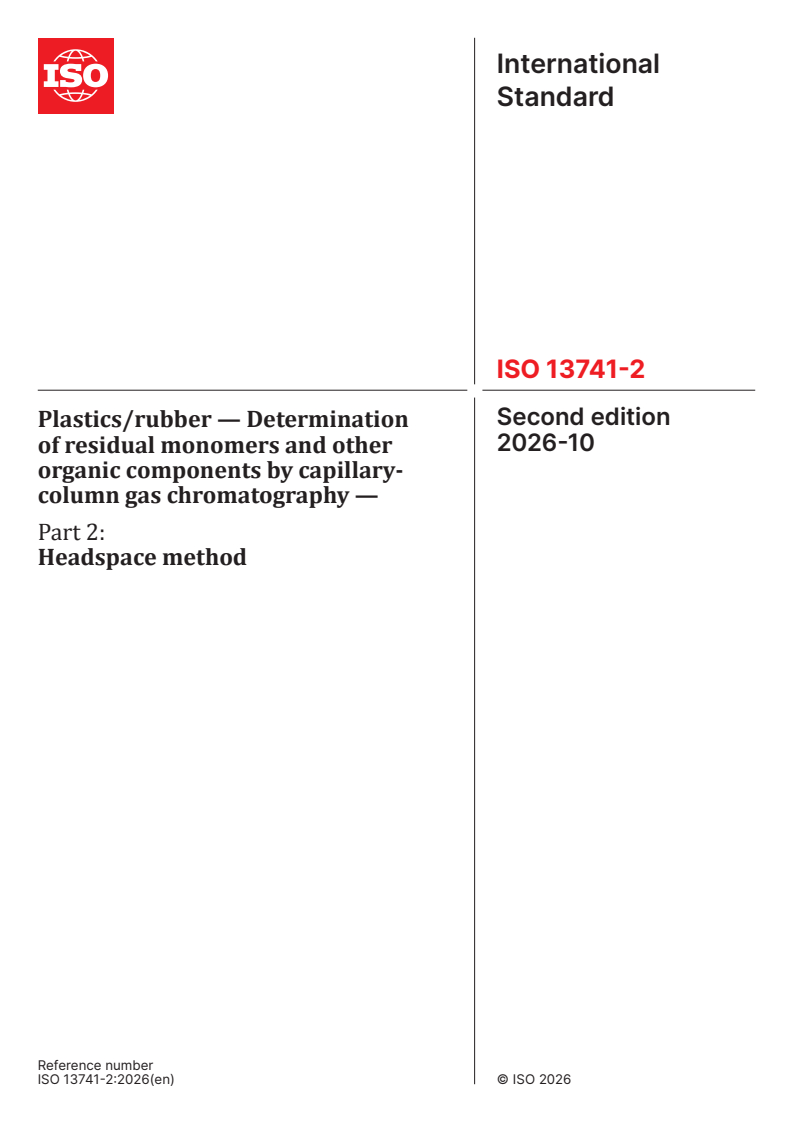
ISO 13741-2:2026 is an ISO International Standard for determining residual monomers and other volatile organic components in aqueous polymer dispersions and lattices by headspace capillary-column gas chromatography (HS-GC). It specifies how laboratories prepare the sample, calibrate the gas chromatograph, calculate the result, and report findings for compounds such as acrylic and methacrylic esters, butadiene, styrene, vinyl acetate, and ethylbenzene.
What does ISO 13741-2:2026 specify?
ISO 13741-2:2026 specifies a headspace GC method for residual monomers and other volatile organic components, whether unsaturated or saturated, in aqueous polymer dispersions, lattices, and related products. The method is aimed at volatile analytes that matter in practice for health and environmental assessment, including by-products as well as monomers.
The document is organized into clauses on scope, references, terms, principle, reagents, apparatus, apparatus preparation, calibration, procedure, calculation, and the test report. It also includes two informative annexes.
| Annex | What it covers |
|---|---|
| Annex A | Relative correction factors for selected compounds |
| Annex B | Typical gas chromatograms for standards and polymer dispersions/lattices |
What are the key requirements of ISO 13741-2:2026?
ISO 13741-2:2026 requires a diluted sample to be placed in a sealed headspace vial with water, a water-miscible solvent, an internal standard, and a polymerization inhibitor, then equilibrated before the headspace vapour is injected into the GC. In practice, this means the result comes from vapour above the liquid, not from direct injection of the bulk sample.
Sample preparation and calibration
Clause 8 requires calibration for each analysis with respect to sensitivity and retention time. The calibration sequence uses a defined internal standard solution, stock solution A, standard solutions S0 to S5, and calibration solutions made with diluted sample material. The practical point is that the laboratory must prepare these solutions carefully and refresh them on the stated schedule to keep the calibration valid.
Clause 8 also requires a linear regression for each compound, with a correlation coefficient above 0,995. The document then uses the response factor and a relative correction factor to relate each target compound to methyl iso-butyl ketone, which is the internal standard used in the method.
Instrument setup
Clauses 6 and 7 specify a gas chromatograph with a split injector, a flame ionization detector (FID), a fused-silica capillary column, and an automated headspace sampler. The detector temperature must remain stable, and the typical operating conditions are given in Table 1. In practice, these settings are what make the separation and peak measurement reproducible.
Sample handling and analysis
Clause 9 requires the sample to be adjusted to 20 % mass content solids using ISO 124, then weighed into the vial with the internal standard solution. The sample is homogenized before analysis, either by magnetic stirring or rolling, so the volatile compounds are evenly distributed and the headspace result is representative.
Calculation and reporting
Clause 10 gives the calculation of target compound concentration in the sample solution and the calculation of target compound content in polymer dispersions and lattices. Clause 11 then requires the report to identify the standard used, the result, the operating conditions if they differ from Table 1, the sample, the apparatus, the reference material, and any unusual observations. That matters because the result often has to be traceable for quality control or compliance work.
What terms does ISO 13741-2:2026 define?
- HS-GC - Headspace capillary-column gas chromatography; the method analyses vapours taken from the space above the sample.
- FID - Flame ionization detector; the GC detector used here to measure organic compounds.
- Internal standard - A compound added in known amount, here methyl iso-butyl ketone, used to correct for variation in injection and response.
- Calibration solution - A prepared vial used to build the calibration curve by combining sample, standard solution, and internal standard.
- Response factor - The factor derived from the calibration slope that links concentration to detector area.
- Relative correction factor - A factor used to relate a target compound’s response to methyl iso-butyl ketone.
- Polymerization inhibitor - A reagent added to limit unwanted polymerization during sample preparation.
Who uses ISO 13741-2:2026?
ISO 13741-2:2026 is used by laboratories testing plastics and rubber materials, especially aqueous polymer dispersions and lattices. It is relevant to analytical chemists, quality control staff, and manufacturers who need to measure residual monomers or other volatile organic components in routine production checks, product release testing, or investigations of composition.
It also supports buyers and compliance teams that need a standardized laboratory method for comparing results between suppliers, plants, or test houses.
What changed in ISO 13741-2:2026 from the previous edition?
ISO 13741-2:2026 cancels and replaces ISO 13741-2:1988. The foreword states that the main changes are:
- relative corrective factors in the quantitative method are now determined by a standard addition method instead of an external standard;
- more detail has been added for preparing standard solutions, calibration solutions, and sample solutions;
- an automated headspace sampler has been specified;
- Clause 3, Terms and definitions, has been added.
Which standards are used with ISO 13741-2:2026?
| Standard | Contribution |
|---|---|
| ISO 124 | Gives the method for determining total solids content, which this document uses before diluting samples to 20 % solids. |
| ISO 472 | Provides the terms and definitions applied in Clause 3. |
| ISO 3696 | Specifies the grade 1 water required for reagent and sample preparation. |
| ISO 3899 | Is named in the introduction as the earlier method that this document is intended to replace where precise volatile-matter measurements are needed. |
What does the ISO 13741-2:2026 document contain?
ISO 13741-2:2026 contains the full analytical workflow: principle, reagents, apparatus, apparatus preparation, calibration, procedure, calculation, and reporting. It gives the practical preparation steps for internal standard solution, stock solution A, standard solutions, calibration solutions, and test sample solutions.
The document also includes Table 1 for typical operating conditions, Table 2 for the added volumes used to make stock solution A, and Table 3 for the preparation of standard solutions. Annex A lists relative correction factors for selected compounds, and Annex B shows typical gas chromatograms for standards and for several polymer dispersion and latex examples.
Relations
- Effective Date
- 04-Nov-2023
Get Certified
Connect with accredited certification bodies for this standard

DIN CERTCO
DIN Group product certification.

Smithers Quality Assessments
US management systems and product certification.
Sponsored listings
Frequently Asked Questions
ISO 13741-2:2026 is a standard published by the International Organization for Standardization (ISO). Its full title is "Plastics/rubber — Determination of residual monomers and other organic components by capillary-column gas chromatography — Part 2: Headspace method". This standard covers: This document specifies a method for the determination of residual monomers and other volatile organic components (unsaturated or saturated) in aqueous polymer dispersions and lattices, as well as in related products by headspace capillary-column gas chromatography (HS-GC). This document is applicable to the determination of residual monomers and other volatiles, include acrylic and methacrylic esters, butadiene, styrene vinyl acetate, as well as by-products such as ethylbenzene.
This document specifies a method for the determination of residual monomers and other volatile organic components (unsaturated or saturated) in aqueous polymer dispersions and lattices, as well as in related products by headspace capillary-column gas chromatography (HS-GC). This document is applicable to the determination of residual monomers and other volatiles, include acrylic and methacrylic esters, butadiene, styrene vinyl acetate, as well as by-products such as ethylbenzene.
ISO 13741-2:2026 is classified under the following ICS (International Classification for Standards) categories: 83.040.10 - Latex and raw rubber; 83.080.01 - Plastics in general. The ICS classification helps identify the subject area and facilitates finding related standards.
ISO 13741-2:2026 has the following relationships with other standards: It is inter standard links to ISO 13741-2:1998. Understanding these relationships helps ensure you are using the most current and applicable version of the standard.
ISO 13741-2:2026 is available in PDF format for immediate download after purchase. The document can be added to your cart and obtained through the secure checkout process. Digital delivery ensures instant access to the complete standard document.
Standards Content (Sample)
International
Standard
ISO 13741-2
Second edition
Plastics/rubber — Determination
2026-10
of residual monomers and other
organic components by capillary-
column gas chromatography —
Part 2:
Headspace method
Reference number
© ISO 2026
All rights reserved. Unless otherwise specified, or required in the context of its implementation, no part of this publication may
be reproduced or utilized otherwise in any form or by any means, electronic or mechanical, including photocopying, or posting on
the internet or an intranet, without prior written permission. Permission can be requested from either ISO at the address below
or ISO’s member body in the country of the requester.
ISO copyright office
CP 401 • Ch. de Blandonnet 8
CH-1214 Vernier, Geneva
Phone: +41 22 749 01 11
Email: copyright@iso.org
Website: www.iso.org
Published in Switzerland
ii
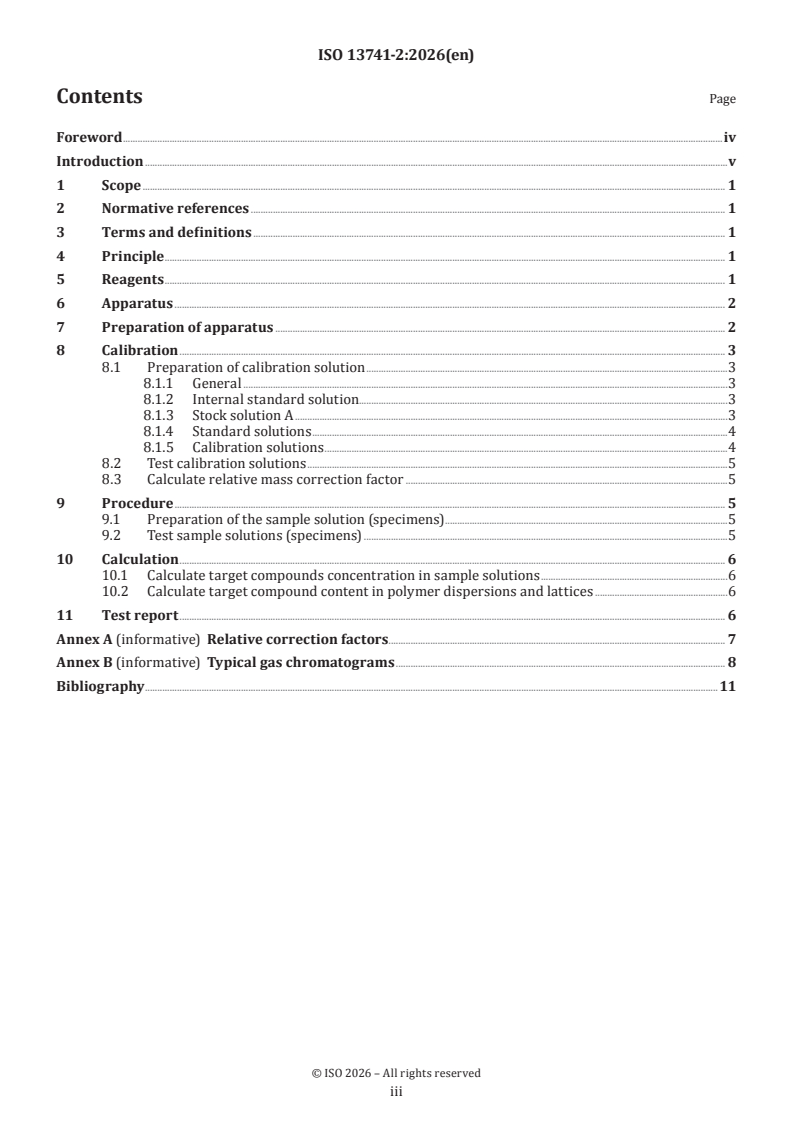
Contents Page
Foreword .iv
Introduction .v
1 Scope . 1
2 Normative references . 1
3 Terms and definitions . 1
4 Principle . 1
5 Reagents . 1
6 Apparatus . 2
7 Preparation of apparatus . 2
8 Calibration . 3
8.1 Preparation of calibration solution .3
8.1.1 General .3
8.1.2 Internal standard solution.3
8.1.3 Stock solution A .3
8.1.4 Standard solutions .4
8.1.5 Calibration solutions .4
8.2 Test calibration solutions .5
8.3 Calculate relative mass correction factor .5
9 Procedure . 5
9.1 Preparation of the sample solution (specimens) .5
9.2 Test sample solutions (specimens) .5
10 Calculation . 6
10.1 Calculate target compounds concentration in sample solutions .6
10.2 Calculate target compound content in polymer dispersions and lattices .6
11 Test report . 6
Annex A (informative) Relative correction factors. 7
Annex B (informative) Typical gas chromatograms . 8
Bibliography .11
iii
Foreword
ISO (the International Organization for Standardization) is a worldwide federation of national standards
bodies (ISO member bodies). The work of preparing International Standards is normally carried out through
ISO technical committees. Each member body interested in a subject for which a technical committee
has been established has the right to be represented on that committee. International organizations,
governmental and non-governmental, in liaison with ISO, also take part in the work. ISO collaborates closely
with the International Electrotechnical Commission (IEC) on all matters of electrotechnical standardization.
The procedures used to develop this document and those intended for its further maintenance are described
in the ISO/IEC Directives, Part 1. In particular, the different approval criteria needed for the different types
of ISO documents should be noted. This document was drafted in accordance with the editorial rules of the
ISO/IEC Directives, Part 2 (see www.iso.org/directives).
ISO draws attention to the possibility that the implementation of this document may involve the use of (a)
patent(s). ISO takes no position concerning the evidence, validity or applicability of any claimed patent
rights in respect thereof. As of the date of publication of this document, ISO had not received notice of (a)
patent(s) which may be required to implement this document. However, implementers are cautioned that
this may not represent the latest information, which may be obtained from the patent database available at
www.iso.org/patents. ISO shall not be held responsible for identifying any or all such patent rights.
Any trade name used in this document is information given for the convenience of users and does not
constitute an endorsement.
For an explanation of the voluntary nature of standards, the meaning of ISO specific terms and expressions
related to conformity assessment, as well as information about ISO's adherence to the World Trade
Organization (WTO) principles in the Technical Barriers to Trade (TBT), see www.iso.org/iso/foreword.html.
This document was prepared by Technical Committee ISO/TC 61, Plastics, Subcommittee SC 9, Thermoplastic
materials.
This second edition cancels and replaces the first edition (ISO 13741-2:1988), which has been technically
revised.
The main changes are as follows:
— the relative corrective factors for internal standard method in quantitative method are now determined
by standard addition method, rather than external standard in previous version;
— added details for the preparation of standard solutions, calibration solutions and sample solutions are
described;
— added the specification for automated headspace sampler;
— add Clause 3 Terms and definitions.
A list of all parts in the ISO 13741 series can be found on the ISO website.
Any feedback or questions on this document should be directed to the user’s national standards body. A
complete listing of these bodies can be found at www.iso.org/members.html.
iv
Introduction
The requirements imposed today by authorities include the assessment of the content of residual monomers
and organic volatiles, for health and environmental reasons sometimes down to minute traces.
This document presents a method for the determination by gas chromatography of residual monomers and
other organic components in polymer dispersions and lattices. This document provides a method that is
in line with present-day requirements for analytical methods and is intended for use instead of ISO 3899,
where precise measurements of volatile-matter content are needed. This document also expands the scope
to include other volatile organic components than residue monomers.
Since the chromatograms obtained normally contain a series of peaks, it is only possible to determine
the content of those volatiles for which response factors have been determined. For the identification of
unknown peaks, auxiliary methods like mass spectroscopy or the use of a second GC column with a different
polarity are advisable.
v
International Standard ISO 13741-2:2026(en)
Plastics/rubber — Determination of residual monomers
and other organic components by capillary-column gas
chromatography —
Part 2:
Headspace method
1 Scope
This document specifies a method for the determination of residual monomers and other volatile organic
components (unsaturated or saturated) in aqueous polymer dispersions and lattices, as well as in related
products by headspace capillary-column gas chromatography (HS-GC).
This document is applicable to the determination of residual monomers and other volatiles, include acrylic
and methacrylic esters, butadiene, styrene vinyl acetate, as well as by-products such as ethylbenzene.
2 Normative references
The following documents are referred to in the text in such a way that some or all of their content constitutes
requirements of this document. For dated references, only the edition cited applies. For undated references,
the latest edition of the referenced document (including any amendments) applies.
ISO 124, Latex, rubber — Determination of total solids content
ISO 472, Plastics — Vocabulary
ISO 3696, Water for analytical laboratory use — Specification and test methods
3 Terms and definitions
For the purposes of this document, the terms and definitions given in ISO 472 apply.
ISO and IEC maintain terminology databases for use in standardization at the following addresses:
— ISO Online browsing platform: available at https:// www .iso .org/ obp
— IEC Electropedia: available at https:// www .electropedia .org/
4 Principle
A suitable aliquot of the sample is diluted with water and water-miscible solvent containing internal
standard and polymerization inhibitor. The mixture is then introduced into a headspace vial. The vial is
allowed to come to thermal equilibrium before a measured quantity of the headspace vapours is introduced
into a gas chromatograph. The concentration of residual monomers and other volatiles are determined from
relative peak areas comparing to the peak area of the internal standard.
5 Reagents
Unless otherwise stated, use only reagents of recognized analytical grade and only grade 1 water as defined
in ISO 3696.
5.1 Carrier gas, helium or nitrogen.
5.2 Internal standard, methyl iso-butyl ketone. Other organic compounds not present in the sample
could also be used (e.g. dioxane). The
...