

ISO/PRF 21611
(Main)Dentistry — Vocabulary for source conclusion for human identification by dental evidence
- Abstract
This document is intended for forensic reporting on human identification by dental evidence.
- Status
- Not Published
- Technical Committee
- ISO/TC 106/SC 3 - Terminology
- Drafting Committee
- ISO/TC 106/SC 3 - Terminology
- Current Stage
- 5020 - FDIS ballot initiated: 2 months. Proof sent to secretariat
- Start Date
- 15-Sep-2026
- Completion Date
- 10-Oct-2026
Buy Documents
ISO/PRF 21611 - Dentistry — Vocabulary for source conclusion for human identification by dental evidence
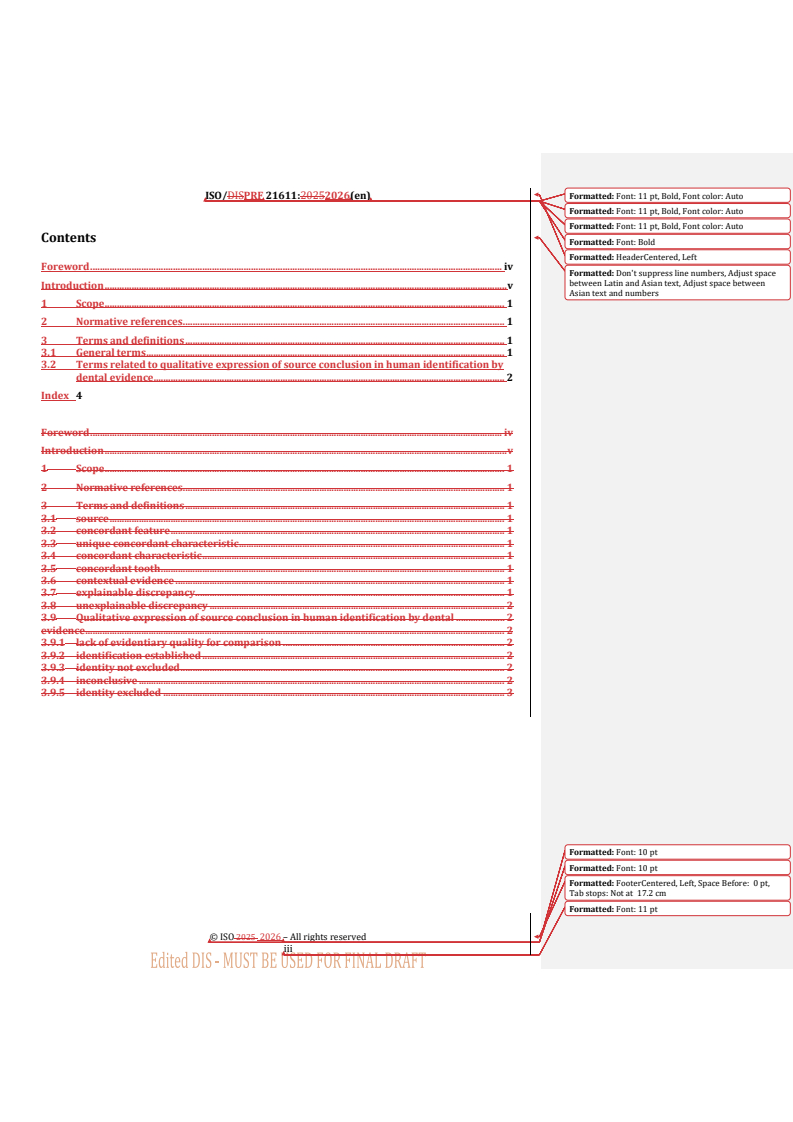
REDLINE ISO/PRF 21611 - Dentistry — Vocabulary for source conclusion for human identification by dental evidence
ISO/PRF 21611 is an ISO vocabulary standard for source conclusion in human identification by dental evidence. It gives the terms used in forensic reporting so dental comparisons can be described consistently and understood across legal authorities. Forensic odontologists and others who prepare or review these reports use it to name the comparison results and the evidence features behind them.
What does ISO/PRF 21611 specify?
ISO/PRF 21611 specifies the terms for forensic reporting on human identification by dental evidence. It is organized as a short terminology document with clause 1 Scope, clause 2 Normative references, clause 3 Terms and definitions, and an index.
Clause 1 limits the subject to human identification by dental evidence. Clause 2 states that there are no normative references. Clause 3 is the core of the document and divides the vocabulary into general terms and terms for qualitative source conclusions.
The introduction explains why the vocabulary matters in practice: forensic odontology relies on dental data as a major identifier, but the field needs a shared language for expressing the strength of a source conclusion.
What are the key requirements of ISO/PRF 21611?
ISO/PRF 21611 is mainly a definition standard, so its practical value is in how it frames comparison and reporting. The key point is to use the defined qualitative terms consistently when describing whether dental evidence supports identification, exclusion, or an inconclusive result.
- Clause 1 restricts use of the vocabulary to forensic reporting on human identification by dental evidence. In practice, the terms are meant for reports and conclusions, not for general dental wording.
- Clause 3.1.1, source defines the dental data set being compared. This matters because the comparison is between two sources, not between isolated observations.
- Clause 3.1.2, concordant feature and the note attached to it show that identification established is not tied to a fixed minimum number of concordant points. In practice, the conclusion depends on the overall agreement, not on counting to a threshold.
- Clause 3.1.7 and 3.1.8, explainable discrepancy and unexplainable discrepancy separate differences that can be justified from those that cannot. This is important because a difference is not automatically disqualifying if there is a reasonable explanation.
- Clause 3.1.6, contextual evidence allows information from the setting of an event or object to support the source conclusion. In practice, the report can consider background information alongside the dental comparison.
- Clause 3.2.1 to 3.2.5 define the qualitative conclusion terms used in reporting: lack of evidentiary quality for comparison, identification established, identity not excluded, inconclusive, and identity excluded. These are the outcome words a reader will see in a forensic report.
- Clause 3.2.2, 3.2.3, and 3.2.5 include US equivalents such as positive identification (US), possible identification (US), and exclusion (US). This helps readers understand how the same conclusion is named in different jurisdictions.
What terms does ISO/PRF 21611 define?
ISO/PRF 21611 defines the vocabulary that supports dental source conclusions. The most important terms are the ones that describe the evidence, the comparison, and the final conclusion.
- source - the collection of an individual's dental data used for identification.
- concordant feature - a unique oro-dental feature that can help establish identification.
- unique concordant characteristic - a distinctive or unusual feature shared by two sources.
- concordant tooth - a tooth or representation that matches another and has no unexplained discrepancies.
- contextual evidence - information from the setting that helps support the source conclusion.
- explainable discrepancy - a difference between two sources that can be justified by known factors.
- unexplainable discrepancy - a difference between two sources that cannot be justified.
- identity not excluded - a conclusion used when there are no unexplainable discrepancies, but the shared features are not distinctive enough to establish identity.
Who uses ISO/PRF 21611?
ISO/PRF 21611 is used in forensic odontology, especially by forensic odontologists who analyze dental evidence and write identification reports. It also supports people who review those reports, because it gives a shared vocabulary for expressing conclusions across different legal authorities.
What does the ISO/PRF 21611 document contain?
ISO/PRF 21611 contains the vocabulary for source conclusion in human identification by dental evidence. Its content focuses on definitions for source, concordant characteristics, discrepancies, and the qualitative conclusion terms used in reports.
The document includes both general terms and terms related to qualitative expression of source conclusion. It also includes an index that lists the defined terms for quick reference. The structure is compact, so readers can use it as a reporting and interpretation reference rather than a procedural manual.
Relations
- Effective Date
- 12-Feb-2026
- Consolidates
ISO 8549-4:2020 - Prosthetics and orthotics — Vocabulary — Part 4: Terms relating to limb amputation - Effective Date
- 07-Jan-2025
Buy Documents
ISO/PRF 21611 - Dentistry — Vocabulary for source conclusion for human identification by dental evidence
REDLINE ISO/PRF 21611 - Dentistry — Vocabulary for source conclusion for human identification by dental evidence
Get Certified
Connect with accredited certification bodies for this standard

BSI Group
BSI (British Standards Institution) is the business standards company that helps organizations make excellence a habit.

TÜV Rheinland
TÜV Rheinland is a leading international provider of technical services.

TÜV SÜD
TÜV SÜD is a trusted partner of choice for safety, security and sustainability solutions.
Sponsored listings
Frequently Asked Questions
ISO/PRF 21611 is a draft published by the International Organization for Standardization (ISO). Its full title is "Dentistry — Vocabulary for source conclusion for human identification by dental evidence". This standard covers: This document is intended for forensic reporting on human identification by dental evidence.
This document is intended for forensic reporting on human identification by dental evidence.
ISO/PRF 21611 is classified under the following ICS (International Classification for Standards) categories: 01.040.11 - Health care technology (Vocabularies); 11.060.01 - Dentistry in general. The ICS classification helps identify the subject area and facilitates finding related standards.
ISO/PRF 21611 has the following relationships with other standards: It is inter standard links to prEN ISO 21611, ISO 8549-4:2020. Understanding these relationships helps ensure you are using the most current and applicable version of the standard.
ISO/PRF 21611 is available in PDF format for immediate download after purchase. The document can be added to your cart and obtained through the secure checkout process. Digital delivery ensures instant access to the complete standard document.
Standards Content (Sample)
International
Standard
ISO 21611
First edition
Dentistry — Vocabulary for source
conclusion for human identification
by dental evidence
Médecine bucco-dentaire — Vocabulaire relatif aux conclusions
tirées de sources pour l'identification des personnes à l'aide de
preuves dentaires
PROOF/ÉPREUVE
Reference number
ISO 21611:2026(en) © ISO 2026
ISO 21611:2026(en)
© ISO 2026
All rights reserved. Unless otherwise specified, or required in the context of its implementation, no part of this publication may
be reproduced or utilized otherwise in any form or by any means, electronic or mechanical, including photocopying, or posting on
the internet or an intranet, without prior written permission. Permission can be requested from either ISO at the address below
or ISO’s member body in the country of the requester.
ISO copyright office
CP 401 • Ch. de Blandonnet 8
CH-1214 Vernier, Geneva
Phone: +41 22 749 01 11
Email: copyright@iso.org
Website: www.iso.org
Published in Switzerland
PROOF/ÉPREUVE
ii
ISO 21611:2026(en)
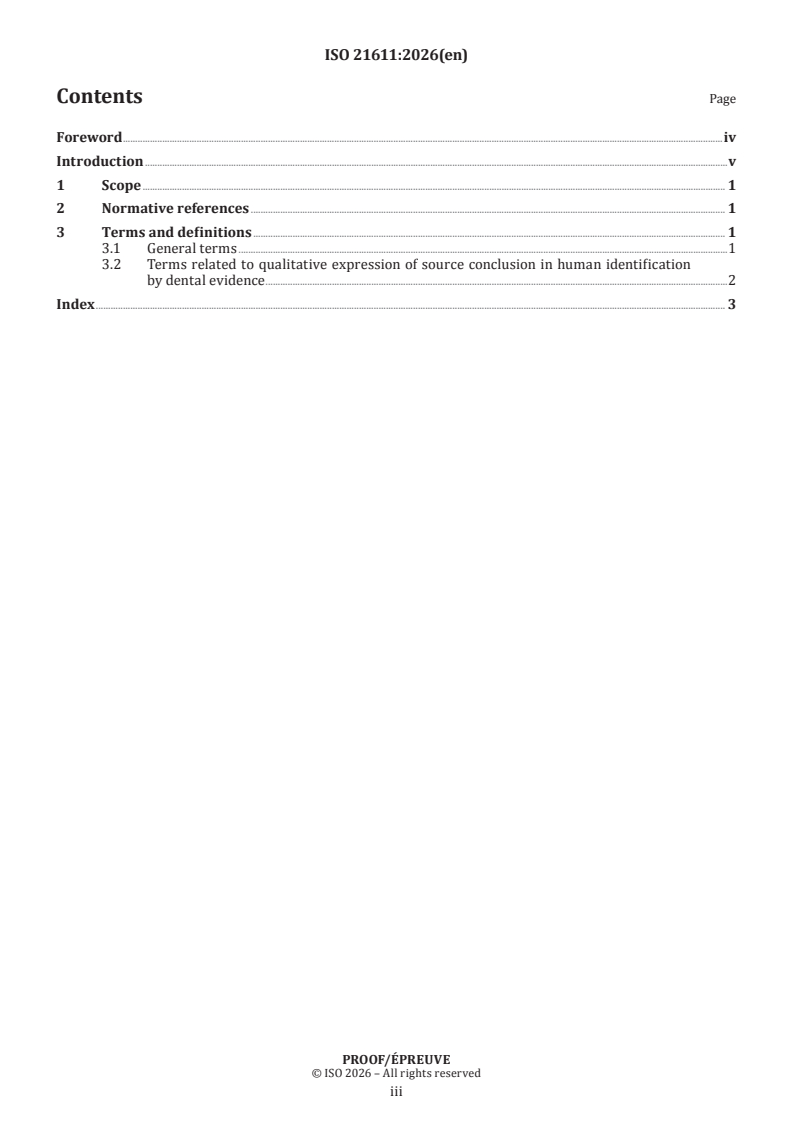
Contents Page
Foreword .iv
Introduction .v
1 Scope . 1
2 Normative references . 1
3 Terms and definitions . 1
3.1 General terms .1
3.2 Terms related to qualitative expression of source conclusion in human identification
by dental evidence .2
Index . 3
PROOF/ÉPREUVE
iii
ISO 21611:2026(en)
Foreword
ISO (the International Organization for Standardization) is a worldwide federation of national standards
bodies (ISO member bodies). The work of preparing International Standards is normally carried out through
ISO technical committees. Each member body interested in a subject for which a technical committee
has been established has the right to be represented on that committee. International organizations,
governmental and non-governmental, in liaison with ISO, also take part in the work. ISO collaborates closely
with the International Electrotechnical Commission (IEC) on all matters of electrotechnical standardization.
The procedures used to develop this document and those intended for its further maintenance are described
in the ISO/IEC Directives, Part 1. In particular, the different approval criteria needed for the different types
of ISO document should be noted. This document was drafted in accordance with the editorial rules of the
ISO/IEC Directives, Part 2 (see www.iso.org/directives).
ISO draws attention to the possibility that the implementation of this document may involve the use of (a)
patent(s). ISO takes no position concerning the evidence, validity or applicability of any claimed patent
rights in respect thereof. As of the date of publication of this document, ISO had not received notice of (a)
patent(s) which may be required to implement this document. However, implementers are cautioned that
this may not represent the latest information, which may be obtained from the patent database available at
www.iso.org/patents. ISO shall not be held responsible for identifying any or all such patent rights.
Any trade name used in this document is information given for the convenience of users and does not
constitute an endorsement.
For an explanation of the voluntary nature of standards, the meaning of ISO specific terms and expressions
related to conformity assessment, as well as information about ISO's adherence to the World Trade
Organization (WTO) principles in the Technical Barriers to Trade (TBT), see www.iso.org/iso/foreword.html.
This document was prepared by Technical Committee ISO/TC 106, Dentistry, Subcommittee SC 3,
Terminology, in collaboration with the European Committee for Standardization (CEN) Technical Committee
CEN/TC 55, Dentistry, in accordance with the Agreement on technical cooperation between ISO and CEN
(Vienna Agreement).
Any feedback or questions on this document should be directed to the user’s national standards body. A
complete listing of these bodies can be found at www.iso.org/members.html.
PROOF/ÉPREUVE
iv
ISO 21611:2026(en)
Introduction
Forensic odontology holds an indispensable role in the identification of human individuals. Dental data
serves as one of the primary identifiers and therefore assumes a position of
...
Formatted
...
Style Definition
...
Style Definition
...
Style Definition
...
Style Definition
...
ISO/DISPRF 21611:2025(en)
Style Definition
...
Style Definition
...
ISO/TC 106/SC 3
Style Definition
...
Style Definition
Secretariat: SCC
...
Style Definition
...
Date: 2025-10-172026-09-14
Style Definition
...
Style Definition
...
Style Definition
...
Style Definition
...
Style Definition
...
Style Definition
...
Dentistry — Vocabulary for source conclusion for human
Style Definition
...
identification by dental evidence
Style Definition
...
Style Definition
...
Médecine bucco-dentaire — Expression qualitative des — Vocabulaire relatif aux conclusions tirées de sources
Style Definition
...
en odontologie légalepour l'identification des personnes à l'aide de preuves dentaires
Style Definition
...
Style Definition
...
Style Definition
...
Style Definition
...
Style Definition
...
Style Definition
...
Style Definition
...
Style Definition
...
Style Definition
PROOF .
Style Definition
...
Style Definition
...
Style Definition
...
Style Definition
...
Style Definition
...
Style Definition
...
Style Definition
...
Style Definition
...
Style Definition
...
Style Definition
...
TThhiiss d drraftaft i iss s suubbmmiitttteded t too a pa pararallel vallel vootte e iinn I ISSOO,, C CEENN.
Style Definition
...
Style Definition
...
Style Definition
...
Style Definition
...
Style Definition
...
Style Definition
...
Style Definition
...
Style Definition
...
Style Definition
...
Style Definition
...
Style Definition
...
Style Definition
...
Style Definition
...
Style Definition
...
Style Definition
...
Style Definition
...
Style Definition
...
Style Definition
...
Style Definition
...
Style Definition
...
Style Definition
...
Style Definition
...
Style Definition
...
Style Definition
Formatted: Font: Bold
Formatted: HeaderCentered
Formatted: Default Paragraph Font
Formatted: Adjust space between Latin and Asian text,
All rights reserved. Unless otherwise specified, or required in the context of its implementation, no part of this publication
Adjust space between Asian text and numbers
may be reproduced or utilized otherwise in any form or by any means, electronic or mechanical, including photocopying,
Formatted: Top: 1.4 cm, Bottom: 1 cm, Header distance
or posting on the internet or an intranet, without prior written permission. Permission can be requested from either ISO
from edge: 1.27 cm, Footer distance from edge: 0.5 cm
at the address below or ISO’s member body in the country of the requester.
ISO copyright office
CP 401 • Ch. de Blandonnet 8
CH-1214 Vernier, Geneva
Phone: + 41 22 749 01 11
Formatted: French (Switzerland)
EmailE-mail: copyright@iso.org
Formatted: French (Switzerland)
Website: www.iso.orgwww.iso.org
Formatted: French (Switzerland)
Published in Switzerland
Formatted: English (United Kingdom)
Formatted: English (United Kingdom)
Formatted: Font: 10 pt
Formatted: Font: 10 pt
Formatted: Font: 11 pt
ii © ISO #### 2026 – All rights reserved
ii
ISO/DISPRF 21611:20252026(en) Formatted: Font: 11 pt, Bold, Font color: Auto
Formatted: Font: 11 pt, Bold, Font color: Auto
Formatted: Font: 11 pt, Bold, Font color: Auto
Contents
Formatted: Font: Bold
Formatted: HeaderCentered, Left
Foreword . iv
Formatted: Don't suppress line numbers, Adjust space
between Latin and Asian text, Adjust space between
Introduction . v
Asian text and numbers
1 Scope . 1
2 Normative references . 1
3 Terms and definitions . 1
3.1 General terms . 1
3.2 Terms related to qualitative expression of source conclusion in human identification by
dental evidence . 2
Index 4
Foreword . iv
Introduction . v
1 Scope . 1
2 Normative references . 1
3 Terms and definitions . 1
3.1 source . 1
3.2 concordant feature . 1
3.3 unique concordant characteristic . 1
3.4 concordant characteristic . 1
3.5 concordant tooth . 1
3.6 contextual evidence . 1
3.7 explainable discrepancy . 1
3.8 unexplainable discrepancy . 2
3.9 Qualitative expression of source conclusion in human identification by dental . 2
evidence . 2
3.9.1 lack of evidentiary quality for comparison . 2
3.9.2 identification established . 2
3.9.3 identity not excluded . 2
3.9.4 inconclusive . 2
3.9.5 identity excluded . 3
Formatted: Font: 10 pt
Formatted: Font: 10 pt
Formatted: FooterCentered, Left, Space Before: 0 pt,
Tab stops: Not at 17.2 cm
Formatted: Font: 11 pt
iii
Formatted: Font: Bold
Formatted: HeaderCentered
Formatted: Adjust space between Latin and Asian text,
Foreword
Adjust space between Asian text and numbers
ISO (the International Organization for Standardization) is a worldwide federation of national standards
bodies (ISO member bodies). The work of preparing International Standards is normally carried out through
ISO technical committees. Each member body interested in a subject for which a technical committee has been
established has the right to be represented on that committee. International organizations, governmental and
non-governmental, in liaison with ISO, also take part in the work. ISO collaborates closely with the
International Electrotechnical Commission (IEC) on all matters of electrotechnical standardization.
The procedures used to develop this document and those intended for its further maintenance are described
in the ISO/IEC Directives, Part 1. In particular, the different approval criteria needed for the different types of
ISO document should be noted. This document was drafted in accordance with the editorial rules of the
ISO/IEC Directives, Part 2 (see www.iso.org/directives).
Formatted: English (United Kingdom)
ISO draws attention to the possibility that the implementation of this document may involve the use of (a)
patent(s). ISO takes no position concerning the evidence, validity or applicability of any claimed patent rights
in respect thereof. As of the date of publication of this document, ISO had not received notice of (a) patent(s)
which may be required to implement this document. However, implementers are cautioned that this may not
represent the latest information, which may be obtained from the patent database available at
www.iso.org/patents.www.iso.org/patents. ISO shall not be held
...