

ISO 25166:2026
(Main)Zhacai (pickled and squeezed vegetables) — Specification and test methods
General Information
- Abstract
This document specifies the definitions of Zhacai (pickled and squeezed vegetables) and its requirements, including sensory, physical and chemical, contaminants, microorganisms, packaging, labelling, storage and transport. It also describes the corresponding test methods. This document is only applicable to Zhacai.
- Status
- Published
- Publication Date
- 12-May-2026
- Technical Committee
- ISO/TC 34/SC 3 - Fruits and vegetables and their derived products
- Drafting Committee
- ISO/TC 34/SC 3 - Fruits and vegetables and their derived products
- Current Stage
- 6060 - International Standard published
- Start Date
- 13-May-2026
- Due Date
- 19-Sep-2027
- Completion Date
- 13-May-2026
Overview
ISO 25166:2026 - Zhacai (pickled and squeezed vegetables) - Specification and test methods is the international standard that defines the requirements, product specifications, and test methods for Zhacai. Zhacai is a traditional processed vegetable product made from the expanded stem of Brassica juncea var. tumida through pickling and squeezing. ISO 25166:2026 facilitates consistency in product quality, safety, packaging, labelling, storage, and transportation for Zhacai, supporting international trade and ensuring consumer safety.
This standard covers all critical parameters, including sensory specifications, physical and chemical limits, contaminant thresholds, microbiological criteria, and guidance for hygienic handling, packaging, and documentation. It is only applicable to Zhacai and does not cover other pickled vegetable products.
Key Topics
- Product Definition: Zhacai is defined as the processed product from the expanded stem of a specific mustard vegetable, using pickling and mechanical squeezing techniques to achieve unique texture and flavor.
- Sensory Requirements:
- Colour: Inherent slight yellow or yellowish-green.
- Flavour: Characteristic taste and smell without foreign odours.
- Texture: Tender and crisp.
- Appearance: Various shapes such as oblate spherical, strips, or diced.
- Impurities: No visible external impurities.
- Physical and Chemical Specifications:
- Moisture content and salt content with defined maximum limits.
- Acid content (titration acidity) in line with standard methods.
- Contaminants and Microorganisms:
- Limits for lead and cadmium.
- Microbiological thresholds for coliform bacteria, salmonella, and staphylococcus aureus using established test methods.
- Packaging and Labelling:
- Use of food-grade materials for safety and integrity.
- Labelling requirements covering product name, manufacturer, batch, net/gross mass, origin, product class, expiry date, and storage information.
- Storage and Transport:
- Recommendations for cool, dry, ventilated storage.
- Guidance for contamination-free and damage-free transportation using designated vehicles.
Applications
ISO 25166:2026 is essential for:
- Producers and Processors: Ensures standardized product quality and safety during manufacture of Zhacai for both local and international markets.
- Exporters and Importers: Facilitates global trade by providing a unified specification, reducing trade barriers, and ensuring compliance with importing country regulations.
- Regulatory Authorities: Provides a benchmark for inspection, certification, and quality control of pickled and squeezed vegetables labelled as Zhacai.
- Quality Assurance and Food Safety Units: Employs robust test methods for routine quality checks to maintain food safety and regulatory compliance.
- Retailers and Distributors: Assures end-to-end product integrity during handling, storage, and distribution, protecting brand reputation and consumer health.
Related Standards
ISO 25166:2026 references and aligns with several other international standards to ensure comprehensive coverage and interoperability. Key related standards include:
- ISO 750: Determination of titratable acidity in fruit and vegetable products.
- ISO 874: Sampling methods for fresh fruits and vegetables.
- ISO 1026: Determination of dry matter and moisture content.
- ISO 2859-1: Sampling procedures for inspection by attributes.
- ISO 3634: Determination of chloride (salt) content in vegetable products.
- ISO 6633, ISO 6561-1: Methods for measuring lead and cadmium content.
- ISO 4832, ISO 6579-1, ISO 6888-1: Microbiological testing for coliforms, salmonella, and staphylococci.
- CXS 1-1985: Labelling of prepacked foods.
- CXS 192-1995: Standards for food additives.
These referenced documents help reinforce safety, quality, and compliance for all Zhacai products in global supply chains. For further detail, stakeholders are encouraged to consult the full list of normative references in ISO 25166:2026.
Keywords: ISO 25166, Zhacai standard, pickled vegetables, food safety, product specification, international trade, food packaging, microbiological limits, vegetable processing, food labelling.
Get Certified
Connect with accredited certification bodies for this standard

BSI Group
BSI (British Standards Institution) is the business standards company that helps organizations make excellence a habit.

Bureau Veritas
Bureau Veritas is a world leader in laboratory testing, inspection and certification services.

DNV
DNV is an independent assurance and risk management provider.
Sponsored listings
Frequently Asked Questions
ISO 25166:2026 is a standard published by the International Organization for Standardization (ISO). Its full title is "Zhacai (pickled and squeezed vegetables) — Specification and test methods". This standard covers: This document specifies the definitions of Zhacai (pickled and squeezed vegetables) and its requirements, including sensory, physical and chemical, contaminants, microorganisms, packaging, labelling, storage and transport. It also describes the corresponding test methods. This document is only applicable to Zhacai.
This document specifies the definitions of Zhacai (pickled and squeezed vegetables) and its requirements, including sensory, physical and chemical, contaminants, microorganisms, packaging, labelling, storage and transport. It also describes the corresponding test methods. This document is only applicable to Zhacai.
ISO 25166:2026 is classified under the following ICS (International Classification for Standards) categories: 67.080.20 - Vegetables and derived products. The ICS classification helps identify the subject area and facilitates finding related standards.
ISO 25166:2026 is available in PDF format for immediate download after purchase. The document can be added to your cart and obtained through the secure checkout process. Digital delivery ensures instant access to the complete standard document.
Standards Content (Sample)
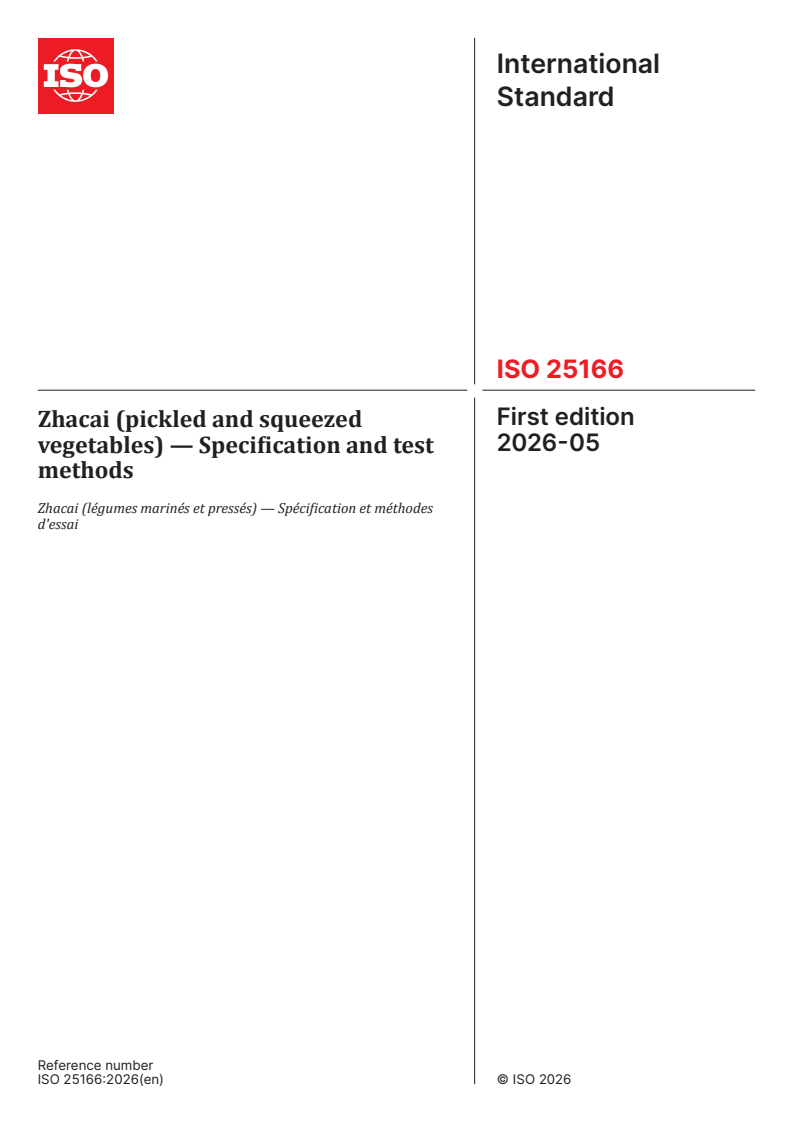
International
Standard
ISO 25166
First edition
Zhacai (pickled and squeezed
2026-05
vegetables) — Specification and test
methods
Zhacai (légumes marinés et pressés) — Spécification et méthodes
d'essai
Reference number
© ISO 2026
All rights reserved. Unless otherwise specified, or required in the context of its implementation, no part of this publication may
be reproduced or utilized otherwise in any form or by any means, electronic or mechanical, including photocopying, or posting on
the internet or an intranet, without prior written permission. Permission can be requested from either ISO at the address below
or ISO’s member body in the country of the requester.
ISO copyright office
CP 401 • Ch. de Blandonnet 8
CH-1214 Vernier, Geneva
Phone: +41 22 749 01 11
Email: copyright@iso.org
Website: www.iso.org
Published in Switzerland
ii
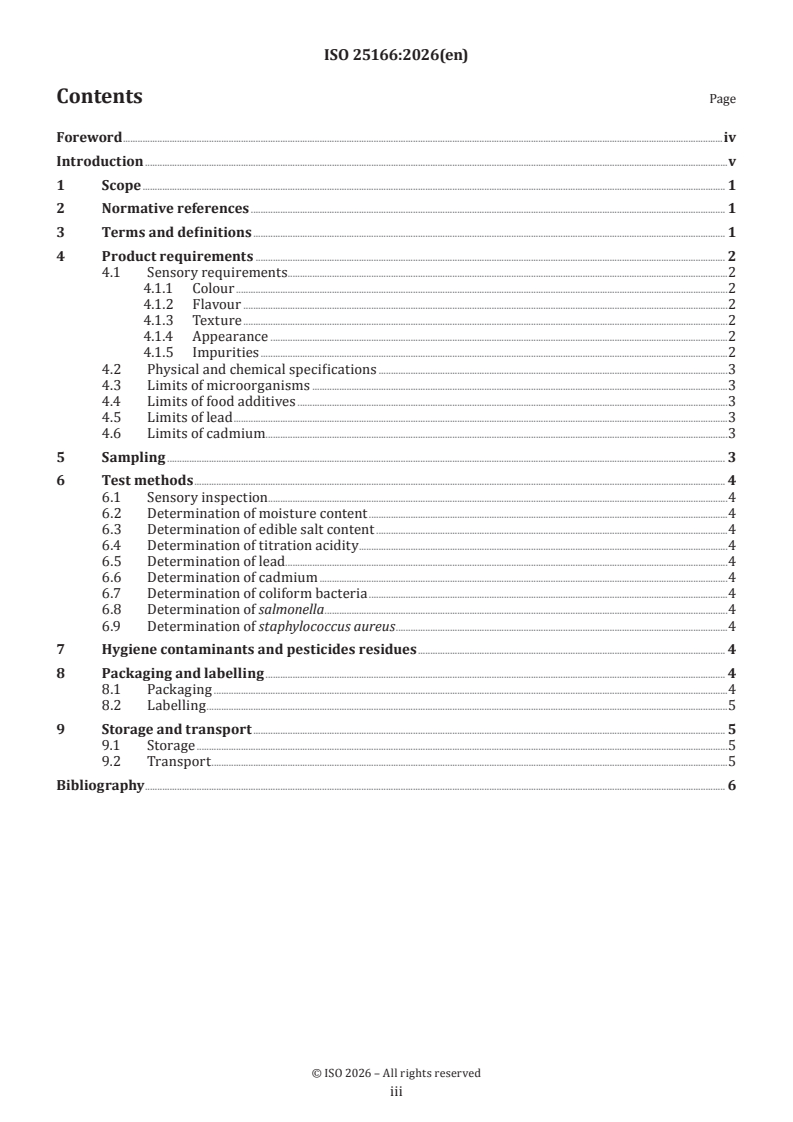
Contents Page
Foreword .iv
Introduction .v
1 Scope . 1
2 Normative references . 1
3 Terms and definitions . 1
4 Product requirements . 2
4.1 Sensory requirements.2
4.1.1 Colour .2
4.1.2 Flavour .2
4.1.3 Texture .2
4.1.4 Appearance .2
4.1.5 Impurities .2
4.2 Physical and chemical specifications .3
4.3 Limits of microorganisms .3
4.4 Limits of food additives .3
4.5 Limits of lead .3
4.6 Limits of cadmium . .3
5 Sampling . 3
6 Test methods . 4
6.1 Sensory inspection.4
6.2 Determination of moisture content .4
6.3 Determination of edible salt content .4
6.4 Determination of titration acidity . .4
6.5 Determination of lead . . .4
6.6 Determination of cadmium .4
6.7 Determination of coliform bacteria .4
6.8 Determination of salmonella . .4
6.9 Determination of staphylococcus aureus .4
7 Hygiene contaminants and pesticides residues . 4
8 Packaging and labelling . 4
8.1 Packaging .4
8.2 Labelling .5
9 Storage and transport . 5
9.1 Storage .5
9.2 Transport .5
Bibliography . 6
iii
Foreword
ISO (the International Organization for Standardization) is a worldwide federation of national standards
bodies (ISO member bodies). The work of preparing International Standards is normally carried out through
ISO technical committees. Each member body interested in a subject for which a technical committee
has been established has the right to be represented on that committee. International organizations,
governmental and non-governmental, in liaison with ISO, also take part in the work. ISO collaborates closely
with the International Electrotechnical Commission (IEC) on all matters of electrotechnical standardization.
The procedures used to develop this document and those intended for its further maintenance are described
in the ISO/IEC Directives, Part 1. In particular, the different approval criteria needed for the different types
of ISO document should be noted. This document was drafted in accordance with the editorial rules of the
ISO/IEC Directives, Part 2 (see www.iso.org/directives).
ISO draws attention to the possibility that the implementation of this document may involve the use of (a)
patent(s). ISO takes no position concerning the evidence, validity or applicability of any claimed patent
rights in respect thereof. As of the date of publication of this document, ISO had not received notice of (a)
patent(s) which may be required to implement this document. However, implementers are cautioned that
this may not represent the latest information, which may be obtained from the patent database available at
www.iso.org/patents. ISO shall not be held responsible for identifying any or all such patent rights.
Any trade name used in this document is information given for the convenience of users and does not
constitute an endorsement.
For an explanation of the voluntary nature of standards, the meaning of ISO specific terms and expressions
related to conformity assessment, as well as information about ISO’s adherence to the World Trade
Organization (WTO) principles in the Technical Barriers to Trade (TBT), see www.iso.org/iso/foreword.html.
This document was prepared by Technical Committee I
...