

ISO 24671:2024
(Main)Road vehicles — Qualification and certification of technical personnel dealing with natural gas vehicles (NGVs)
General Information
- Abstract
This document specifies requirements for the qualification and certification of personnel who perform operations on NGVs, according to the level of safety required by the role and/or position. NOTE 1 The certification is required for the level 3 and 4 of competence as defined in ISO 23684. NOTE 2 This document specifies requirements for what are, in effect, third-party conformity assessment schemes. These requirements do not directly apply to conformity assessment by second or first parties, but relevant parts of this document can be referred to in such arrangements.
- Status
- Published
- Publication Date
- 12-Jun-2024
- Technical Committee
- ISO/TC 22/SC 41 - Specific aspects for gaseous fuels
- Drafting Committee
- ISO/TC 22/SC 41/WG 9 - Training, competence and conformity assessment
- Current Stage
- 6060 - International Standard published
- Start Date
- 13-Jun-2024
- Due Date
- 13-Feb-2025
- Completion Date
- 13-Jun-2024

Overview
ISO 24671:2024 - Road vehicles - Qualification and certification of technical personnel dealing with natural gas vehicles (NGVs) - defines requirements for qualifying and certifying personnel who perform operations on natural gas vehicles and related fuelling systems. The standard targets the safety-driven competency levels required by different roles and specifies criteria for third‑party conformity assessment schemes. Certification at levels 3 and 4 is required (see ISO 23684 for the competence level definitions referenced in the standard).
Key topics and requirements
- Scope and responsibilities - Roles and duties for certification bodies, authorized qualification bodies, training providers, employers, applicants and examiners are defined.
- Qualification figures and levels - Classification of personnel roles and competency levels (Levels 1–4), with certification specifically required for Level 3 (fuelling station technical manager) and Level 4 (NGV technical manager).
- Eligibility and training - Requirements for eligibility, recognized training course formats, evidence of training, and minimum training duration (specified in the standard).
- Competence assessment - Combination of written theoretical exams, practical examinations and operational case assessments. Examinations include basic elements and role‑specific tests (e.g., fuelling station operations, NGV fuel-system tasks).
- Certification and recertification - Rules for certification administration, issuance, maintenance, renewal, suspension and withdrawal of certificates. The standard also sets out procedures for recertification and re‑examination.
- Record keeping and conformity assessment - Documentation requirements for certification bodies and employers; this document is oriented to third‑party schemes but can inform first‑ and second‑party arrangements.
Practical applications and who uses this standard
ISO 24671:2024 is used by organizations that need to ensure safe, standardized competence of NGV personnel:
- Certification bodies and conformity assessment organizations implementing third‑party NGV personnel certification schemes.
- Training providers designing NGV technician and manager courses to meet recognized competency criteria.
- NGV fleet operators, fuelling station owners, and maintenance workshops that employ or contract technicians for assembly, inspection, maintenance, repair and commissioning of NGVs and fuelling systems.
- Regulators and safety authorities adopting consistent competence requirements for NGV operations and infrastructure.
- Employers and HR teams using standardized certification to recruit, qualify and maintain a skilled NGV workforce.
Related standards
- ISO 23684 - Defines competence levels referenced by ISO 24671 for NGV personnel.
- ISO/IEC Directives are referenced for the development and maintenance approach of ISO documents.
Keywords: ISO 24671:2024, NGV certification, natural gas vehicles, technical personnel qualification, fuelling station technical manager, NGV technical manager, training and examination, competency standard.
Relations
- Effective Date
- 11-Mar-2026
Get Certified
Connect with accredited certification bodies for this standard

TÜV SÜD
TÜV SÜD is a trusted partner of choice for safety, security and sustainability solutions.

BSI Group
BSI (British Standards Institution) is the business standards company that helps organizations make excellence a habit.

Bureau Veritas
Bureau Veritas is a world leader in laboratory testing, inspection and certification services.
Sponsored listings
Frequently Asked Questions
ISO 24671:2024 is a standard published by the International Organization for Standardization (ISO). Its full title is "Road vehicles — Qualification and certification of technical personnel dealing with natural gas vehicles (NGVs)". This standard covers: This document specifies requirements for the qualification and certification of personnel who perform operations on NGVs, according to the level of safety required by the role and/or position. NOTE 1 The certification is required for the level 3 and 4 of competence as defined in ISO 23684. NOTE 2 This document specifies requirements for what are, in effect, third-party conformity assessment schemes. These requirements do not directly apply to conformity assessment by second or first parties, but relevant parts of this document can be referred to in such arrangements.
This document specifies requirements for the qualification and certification of personnel who perform operations on NGVs, according to the level of safety required by the role and/or position. NOTE 1 The certification is required for the level 3 and 4 of competence as defined in ISO 23684. NOTE 2 This document specifies requirements for what are, in effect, third-party conformity assessment schemes. These requirements do not directly apply to conformity assessment by second or first parties, but relevant parts of this document can be referred to in such arrangements.
ISO 24671:2024 is classified under the following ICS (International Classification for Standards) categories: 03.100.30 - Management of human resources; 43.020 - Road vehicles in general. The ICS classification helps identify the subject area and facilitates finding related standards.
ISO 24671:2024 has the following relationships with other standards: It is inter standard links to EN ISO 16923:2026. Understanding these relationships helps ensure you are using the most current and applicable version of the standard.
ISO 24671:2024 is available in PDF format for immediate download after purchase. The document can be added to your cart and obtained through the secure checkout process. Digital delivery ensures instant access to the complete standard document.
Standards Content (Sample)
International
Standard
ISO 24671
First edition
Road vehicles — Qualification
2024-06
and certification of technical
personnel dealing with natural
gas vehicles (NGVs)
Véhicules routiers — Qualification et certification du personnel
technique chargé des véhicules au gaz naturel
Reference number
© ISO 2024
All rights reserved. Unless otherwise specified, or required in the context of its implementation, no part of this publication may
be reproduced or utilized otherwise in any form or by any means, electronic or mechanical, including photocopying, or posting on
the internet or an intranet, without prior written permission. Permission can be requested from either ISO at the address below
or ISO’s member body in the country of the requester.
ISO copyright office
CP 401 • Ch. de Blandonnet 8
CH-1214 Vernier, Geneva
Phone: +41 22 749 01 11
Email: copyright@iso.org
Website: www.iso.org
Published in Switzerland
ii
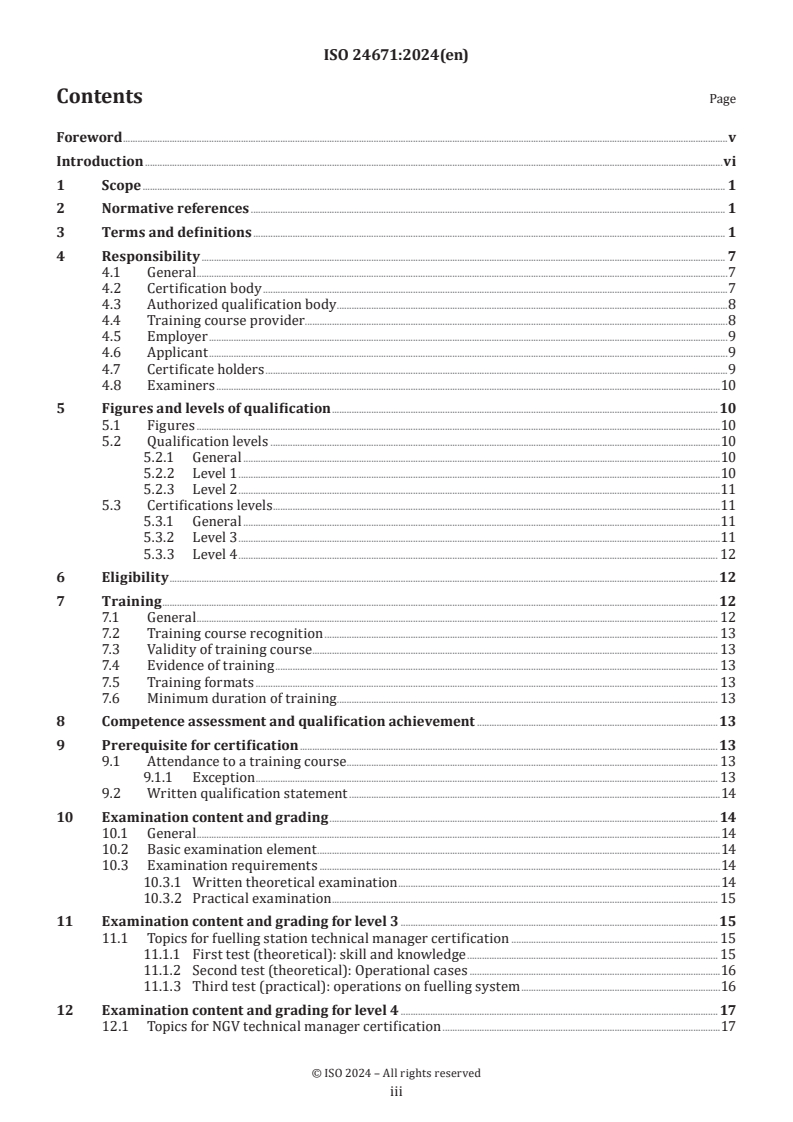
Contents Page
Foreword .v
Introduction .vi
1 Scope . 1
2 Normative references . 1
3 Terms and definitions . 1
4 Responsibility . 7
4.1 General .7
4.2 Certification body .7
4.3 Authorized qualification body .8
4.4 Training course provider . .8
4.5 Employer .9
4.6 Applicant .9
4.7 Certificate holders .9
4.8 Examiners .10
5 Figures and levels of qualification .10
5.1 Figures .10
5.2 Qualification levels .10
5.2.1 General .10
5.2.2 Level 1 .10
5.2.3 Level 2 .11
5.3 Certifications levels .11
5.3.1 General .11
5.3.2 Level 3 .11
5.3.3 Level 4 . 12
6 Eligibility .12
7 Training .12
7.1 General . 12
7.2 Training course recognition . 13
7.3 Validity of training course . . 13
7.4 Evidence of training . 13
7.5 Training formats . 13
7.6 Minimum duration of training . 13
8 Competence assessment and qualification achievement .13
9 Prerequisite for certification .13
9.1 Attendance to a training course . . 13
9.1.1 Exception . 13
9.2 Written qualification statement .14
10 Examination content and grading . 14
10.1 General .14
10.2 Basic examination element .14
10.3 Examination requirements .14
10.3.1 Written theoretical examination .14
10.3.2 Practical examination . 15
11 Examination content and grading for level 3 .15
11.1 Topics for fuelling station technical manager certification . 15
11.1.1 First test (theoretical): skill and knowledge . 15
11.1.2 Second test (theoretical): Operational cases .16
11.1.3 Third test (practical): operations on fuelling system .16
12 Examination content and grading for level 4 . 17
12.1 Topics for NGV technical manager certification .17
iii
12.1.1 First test (theoretical): skill and knowledge .17
12.1.2 Second test (theoretical): Operational cases .17
12.1.3 Third test (practical): operations on fuel system .18
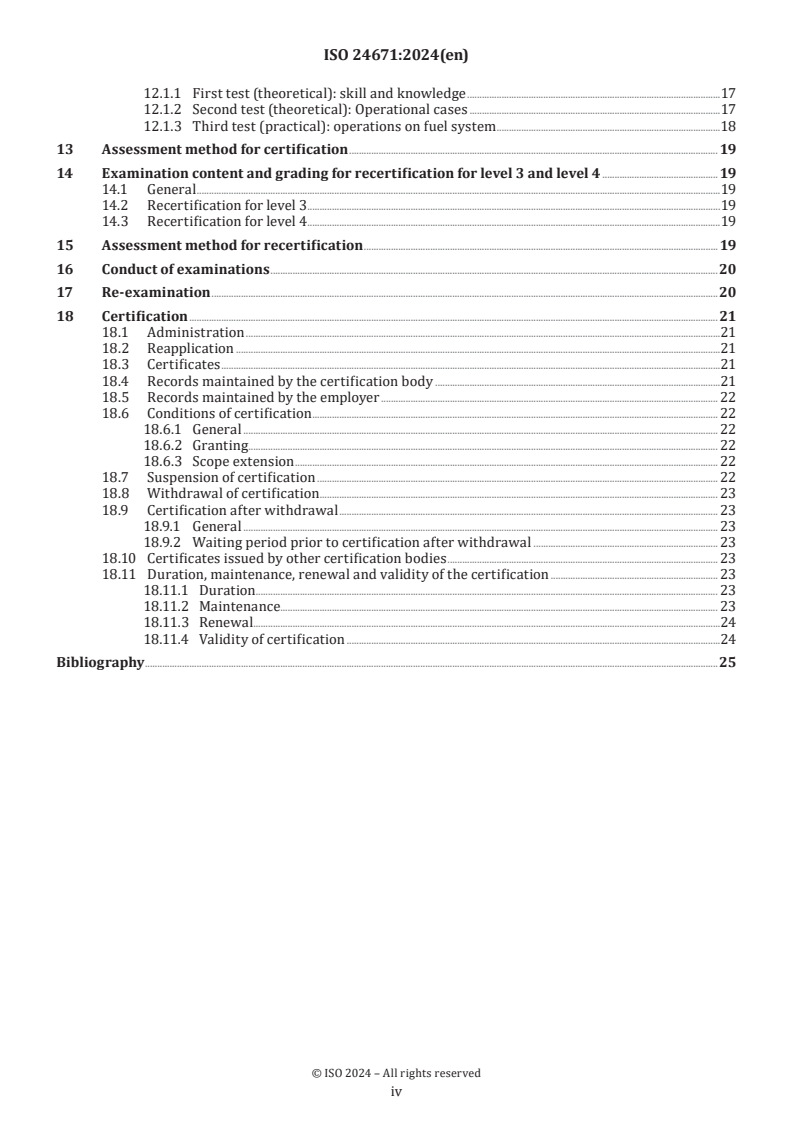
13 Assessment method for certification . 19
14 Examination content and grading for recertification for level 3 and level 4 . 19
14.1 General .19
14.2 Recertification for level 3 .19
14.3 Recertification for level 4 .19
15 Assessment method for recertification . 19
16 Conduct of examinations .20
17 Re-examination .20
18 Certification .21
18.1 Administration .21
18.2 Reapplication .21
18.3 Certificates .21
18.4 Records maintained by the certification body .21
18.5 Records maintained by the employer . 22
18.6 Conditions of certification . 22
18.6.1 General . 22
18.6.2 Granting. 22
18.6.3 Scope extension . 22
18.7 Suspension of certification . 22
18.8 Withdrawal of certification . . 23
18.9 Certification after withdrawal . 23
18.9.1 General . 23
18.9.2 Waiting period prior to certification after withdrawal . 23
18.10 Certificates issued by other certification bodies . 23
18.11 Duration, maintenance, renewal and validity of the certification . 23
18.11.1 Duration. 23
18.11.2 Maintenance. 23
18.11.3 Renewal.24
18.11.4 Validity of certification .24
Bibliography .25
iv
Foreword
ISO (the International Organization for Standardization) is a worldwide federation of national standards
bodies (ISO member bodies). The work of preparing International Standards is normally carried out through
ISO technical committees. Each member body interested in a subject for which a technical committee
has been established has the right to be represented on that committee. International organizations,
governmental and non-governmental, in liaison with ISO, also take part in the work. ISO collaborates closely
with the International Electrotechnical Commission (IEC) on all matters of electrotechnical standardization.
The procedures used to develop this document and those intended for its further maintenance are described
in the ISO/IEC Directives, Part 1. In particular, the different approval criteria needed for the different types
of ISO document should be noted. This document was drafted in accordance with the editorial rules of the
ISO/IEC Directives, Part 2 (see www.iso.org/directives).
ISO draws attention to the possibility that the implementation of this document may involve the use of (a)
patent(s). ISO takes no position concerning the evidence, validity or applicability of any claimed patent
rights in respect thereof. As of the date of publication of this document, ISO had not received notice of (a)
patent(s) which may be required to implement this document. However, implementers are cautioned that
this may not represent the latest information, which may be obtained from the patent database available at
www.iso.org/patents. ISO shall not be held responsible for identifying any or all such patent rights.
Any trade name used in this document is information given for the convenience of users and does not
constitute an endorsement.
For an explanation of the voluntary nature of standards, the meaning of ISO specific terms and expressions
related to conformity assessment, as well as information about ISO's adherence to the World Trade
Organization (WTO) principles in the Technical Barriers to Trade (TBT), see www.iso.org/iso/foreword.html.
This document was prepared by Technical Committee ISO/TC 22, Road vehicles, Subcommittee SC 41, Specific
aspects of gaseous fuels.
Any feedback or questions on this document should be directed to the user’s national standards body. A
complete listing of these bodies can be found at www.iso.org/members.html.
v
Introduction
The use of natural gas (NG) as compressed natural gas (CNG) or liquified natural gas (LNG) is considered
risky because of how the fuel is stored on board of vehicles (compressed at pressure higher than 200 bar or
cryogenic at a temperature of −160 °C). Furthermore, operations on systems subjected to very high pressure
or very low temperature can seriously injure or cause the death of persons not competent in activities dealing
with natural gas vehicles (NGVs). Also, users can be badly affected in the same manner as a consequence of
activities conducted by not competent persons.
Since the effectiveness of any application depends upon the competence of the persons who perform or
are responsible for the activities, a procedure has been developed to provide a means for qualifying the
competence of personnel involved with different levels of liability in the NGVs operations as well as a
certification scheme for those professional figures that are subjected to high risk activities.
Thus, this document, as well as other standards dealing with high risk activities associated with NGVs, also
aim to provide to the certification bodies precise requirements for a certification scheme when certification
is required to verify the competence of level 3 and 4 (see 5.3). On this matter, methods and techniques that
should be adopted for a standardized competence assessment of technicians involved with the operations
on NGVs are provided. This is to avoid discrepancies and different criteria in competence assessment. A
synthetic scheme on how this document shall be applied in conjunction with other standards covering
training and qualification of technical personnel dealing with natural gas vehicles is provided in Figure 1.
When certification of personnel working on NGVs is required in product standards, regulations, codes or
specifications, it is important to certify the personnel in accordance with this document.
When there is no requirement by legislation, standards or in certification of NGVs personnel, it is upon
employers of such personnel to decide how to assure themselves that they are competent to do the work
assignments. Thus, they may employ people who are already certified or they may apply their own expertise
so as to assure themselves that their employee has the necessary competence.
This document is mainly directed to:
— workshop personnel;
— CNG, LNG and L-CNG fuelling station owner/personnel;
— first responders;
— inspectors;
— training course providers;
— certification bodies;
— original equipment manufacturer (OEM);
— system manufacturer;
— workshop owner/personnel;
— CNG and L-CNG fuelling station owner/personnel.
vi
Key
mandatory path for qualification and certification
Figure 1 — Certification and qualification scheme of personnel dealing with NGVs activities
vii
International Standard ISO 24671:2024(en)
Road vehicles — Qualification and certification of technical
personnel dealing with natural gas vehicles (NGVs)
1 Scope
This document specifies requirements for the qualification and certification of personnel who perform
operations on NGVs, according to the level of safety required by the role and/or position.
NOTE 1 The certification is required for the level 3 and 4 of competence as defined in ISO 23684.
NOTE 2 This document specifies requirements for what are, in effect, third-party conformity assessment schemes.
These requirements do not directly apply to conformity assessment by second or first parties, but relevant parts of
this document can be referred to in such arrangements.
2 Normative references
The following documents are referred to in the text in such a way that some or all of their content constitutes
requirements of this document. For dated references, only the edition cited applies. For undated references,
the latest edition of the referenced document (including any amendments) applies.
ISO/IEC 17024, Conformity assessment — General requirements for bodies operating certification of persons
ISO 23684:2023, Road vehicles — Technical personnel dealing with natural gas vehicles (NGVs) — Training and
qualification
3 Terms and definitions
For the purposes of this document, the following terms and definitions apply.
ISO and IEC maintain terminology databases for use in standardization at the following addresses:
— IEC Electropedia: available at https:// www .electropedia .org/
— ISO Online browsing platform: available at https:// www .iso .org/ obp
3.1
ability
capacity and human attribute to perform an activity
[SOURCE: ISO/IEC TS 17027:2014, 2.1]
3.2
applicant
person who has submitted an application to be admitted into the certification process (3.8)
[SOURCE: ISO/IEC 17024:2012, 3.13]
3.3
authorized qualification body
body, independent of the NGV workshop, authorized by the certification body (3.10) to prepare and administer
qualification examinations
Note 1 to entry: Qualification examination is an activity administered by the certification body (3.10) or the authorized
qualification body, which assesses the general, specific and practical knowledge and the skill (3.40) of the candidate.
Note 2 to entry: The training course provider of a recognised training course can also operate as an authorized
qualification body if the requirements of impartiality are not compromised as well as the reduction of the assessment
and certification requirements.
[SOURCE: ISO 9712:2021, 3.2, modified — Note 1 to entry and Note 2 to entry have been added, and
"employer" has been changed to "NGV workshop".]
3.4
candidate
applicant (3.2) who has fulfilled specified prerequisites and has been admitted to the certification process (3.8)
3.5
certificate
document in the form of a letter, card or other medium (e.g. digital certificate) issued by a certification body
(3.10) under the provisions of this document, indicating that the named person has fulfilled the certification
requirements (3.9)
3.6
certification
third-party attestation related to products, processes, systems, or persons
3.7
certification cycle
maximum period of time permitted from the date of certification to the date of recertification (3.36) inclusive
of the renewal (3.37) period
3.8
certification process
activities by which a certification body (3.10) determines that a person fulfils certification requirements (3.9),
including application, assessment, decision on certification, renewal (3.37), recertification (3.36) and use of
certificates (3.5) and logos/marks
3.9
certification requirement
set of specified requirements, including requirements of the scheme to be fulfilled in order to establish or
maintain certification (3.6)
3.10
certification body
CB
third-party conformity assessment body operating certification schemes (3.12)
Note 1 to entry: A certification body can be non-governmental or governmental (with or without regulatory authority).
Note 2 to entry: A conformity assessment body is a body that performs conformity assessment activities and that can
be the object of accreditation.
Note 3 to entry: Third-party conformity assessment is the conformity assessment activity that is performed by a
person or body that is independent of the person being certified.
[SOURCE: ISO/IEC 17065:2012, 3.12, modified — Note 2 to entry and Note 3 to entry have been added.]
3.11
certified person
person whose competence is attested as the outcome of an assessment and validation process by a
certification body (3.10)
3.12
certification scheme
specific certification requirements (3.9) related to specified categories of persons to which the same
particular standards and rules, and the same procedures apply
3.13
competence
ability (3.1) to apply knowledge and skills to achieve intended results
[SOURCE: ISO/IEC 17024:2012, 3.6]
3.14
compressed natural gas
CNG
natural gas which has been compressed and stored for use as a vehicle fuel
[SOURCE: ISO 16923:2016, 3.12]
3.15
competence assessment
formal outcome of an evaluation process (e.g. examination) and validation by means of objective elements,
obtained when a competent body states that the learning outcomes of a person meet given standards and
safety regulations
3.16
competent person
person who has been assessed by means a competence assessment (3.15) and has been deemed to have the
knowledge and skills for competent performance
3.17
CNG cylinder
any container used for the storage of compressed natural gas according to the following classifications:
— CNG-1: an all metal cylinder
— CNG-2: a hoop wrapped cylinder with a load sharing metal liner and composite reinforcement on the
cylindrical part only
— CNG-3: a fully wrapped cylinder with a load sharing metal liner and composite reinforcement on both the
cylindrical part and dome ends
— CNG-4: a fully wrapped cylinder with a non-load sharing non-metallic liner and composite reinforcement
on both the cylindrical part and dome ends
3.18
employer
government, prime contractor, sub-contractor, supplier or outside agency employing or contracting the
services of one or more individuals who perform activities on NGVs
Note 1 to entry: Self-employed individuals are included in this definition.
3.19
examination
mechanism that is part of the assessment which measures a candidate's (3.4) competence (3.13) by one or
more means, such as written, oral, practical and observational, as defined in the certification scheme (3.12)
[SOURCE: ISO/IEC 17024:2012, 3.9]
3.20
examination centre
centre approved by the certification body (3.10) where examinations (3.19) are carried out
3.21
examination element
component of an examination (3.19)
3.22
examiner
person competent to conduct and score an examination (3.19), where the examination requires professional
judgement
[SOURCE: ISO/IEC 17024:2012, 3.10]
3.23
fuelling station
facility at which vehicle fuels are dispensed
3.24
learning outcome
what a person is expected to know, understand or be able to do at the end of a training programme, course
or module
[SOURCE: ISO/IEC TS 17027:2014, 2.57]
3.25
liquefied natural gas
LNG
natural gas which has been liquefied, after processing, for storage or transportation purposes
[SOURCE: ISO 16924:2016, 3.38]
3.26
multiple-choice examination question
wording of a question giving rise to potential replies, only one of which is correct, the remaining being
incorrect or incomplete
3.27
natural gas
complex gaseous mixture of hydrocarbons, primarily methane, but that generally includes ethane, propane
and higher hydrocarbons, and some non-combustible gases such as nitrogen and carbon dioxide
Note 1 to entry: The definition includes renewable natural gas (biogas, biomethane, etc.).
[SOURCE: ISO 14532:2014, 2.1.1.1, modified — Note 1 to entry has been replaced.]
3.28
NGV workshop
competent organization, appropriately equipped, that assumes technical responsibility for correct and safe
service, inspection, repair and retrofit on CNG or LNG vehicles
3.29
qualification
demonstrated education, training and work experience, where applicable, required to properly perform the
assigned task
[SOURCE: ISO/IEC 17024:2012, 3.7, modified — The following text has been added: "required to properly
perform the assigned task".]
3.30
depot
building used for the storage and servicing of NGVs
3.31
knowledge
facts, information, truths, principles or understanding acquired through experience or education
Note 1 to entry: An example of knowledge is the ability (3.1) to describe the various parts of an information assurance
standard.
[SOURCE: ISO/IEC TS 17027:2014, 2.56, modified — Note 1 to entry has been added, taken from
ISO/IEC 19896-1:2018, 3.7]
3.32
natural gas vehicle
NGV
road vehicle powered by natural gas (3.27)
[SOURCE: ISO 15500-1:2015, 3.9]
3.33
operation
procedures to use or tasks performed to control, refuel, install, repair or replace part of the system
3.34
practical examination
assessment of practical skills, in which the candidate (3.4) demonstrates familiarity with, and the ability
(3.1) to perform, the test
3.35
qualification examination
examination, administered by the authorized qualification body (3.3), which assesses the general outcome of
the training
3.36
recertification
process for revalidation of a certificate (3.5) by examination (3.19) or by otherwise satisfying the certification
body (3.10) that the published criteria for recertification have been met
3.37
renewal
process for revalidation of a certification at any time up to five years after success in an initial, supplementary
or recertification (3.36) examination (3.19)
3.38
recognised training course
training course whose contents (for instance: qualification (3.29) of teachers, training procedures,
documents, examination programme and procedures) are assessed against specific requirements
established and approved by a certification body (3.10)
3.39
second-party conformity assessment
conformity assessment activity that is performed by a person or organization that has a user interest in
the object
Note 1 to entry: Persons or organizations performing second-party conformity assessment activities include, for
example, purchasers or users of products, or potential customers seeking to rely on a supplier’s management system,
or organizations representing those interests.
[SOURCE: ISO/IEC 17000:2020, 4.4, modified — The term was originally "second-party conformity
assessment activity"; the example and Note 2 to entry were deleted.]
3.40
skill
ability (3.1) to perform a task or activity with a specific intended outcome acquired through education,
training, experience or other means
[SOURCE: ISO/IEC/TS 17027:2014, 2.74]
3.41
significant interruption
absence or change of work activity which prevents the certified individual from practising the duties
corresponding to the level in the method and the sector[s) within the certified scope, for either a continuous
period in excess of one year, or two or more periods for a total time exceeding two years
Note 1 to entry: Legal holidays or periods of sickness or training courses of less than 30 days are not taken into account
when calculating the interruption.
3.42
system manufacturer
company which can assume technical responsibility for the manufacturing or retrofitting of CNG system
and can demonstrate that it possesses the features required and the necessary means to provide quality
assessment and conformity of production of the CNG system
[SOURCE: Reference [11]]
3.43
technical manager
qualified person which takes responsibility for decisions relating to parking, fuelling, installation,
maintenance and repair of an NGV system
[SOURCE: adapted from EN 13423:2021, 3.27.]
3.44
third-party conformity assessment
conformity assessment activity that is performed by a person or body that is independent of the person or
organization that provides the object, and of user interests in that object
Note 1 to entry: Criteria for the independence of conformity assessment bodies and accreditation bodies are provided
in the international standards and guides applicable to their activities.
[SOURCE: ISO/IEC 17000:2020, 4.5, modified — The term was originally "third-party conformity assessment
activity" and Note 1 to entry was replaced.]
3.45
training
activities designed to facilitate the learning and development of knowledge (3.31), skills (3.40), and abilities
(3.1), and to improve the performance of specific tasks or roles
[SOURCE: ISO 22398:2013, 3.23]
3.46
training course provider
organization competent to administer a programme to train personnel operating on natural gas vehicles
(3.32) with specific courses
3.47
assessment
process that evaluates a person's fulfilment of the requirements of the certification scheme (3.12)
[SOURCE: ISO/IEC 17024:2012, 3.8]
3.48
code of conduct
document specifying the ethical or personal behaviour required by a certification scheme (3.12)
4 Responsibility
4.1 General
The qualification/certification system, which shall be controlled and administered by a certification body,
includes all procedures necessary to demonstrate the qualification and the competence of an individual to
carry out tasks in the NGV sector in leading to certification.
4.2 Certification body
4.2.1 The certification body shall fulfil the requirements of ISO/IEC 17024.
4.2.2 The certification body:
a) shall initiate, promote, maintain and administer the certification scheme according to ISO/IEC 17024
and this document;
b) shall be independent of any single interest;
c) shall publish information regarding the scope of the certification scheme and a general description of
the certification process;
d) shall establish examination questionnaires and specimens to be used for personnel qualification for
certification purposes;
e) shall provide information for training courses recognition as per ISO 23684:2023, 6.3.1;
f) shall conduct an initial audit and subsequent periodic surveillance audits of the authorized qualification
body(ies) to ensure their conformity to the specifications;
g) shall monitor and be responsible, in accordance with a documented procedure, for all delegated
functions;
h) shall bear full responsibilities for examinations conducted on temporary basis at external premises;
i) shall establish and/or approve examination questionnaires and specimens to be used for personnel
qualification by an authorized qualification body;
j) shall be responsible for ensuring the security of all examination materials (question banks, examination
papers, etc.) and shall ensure that these materials are not in use for training purposes;
k) shall be responsible for granting, extension, suspension, withdrawal or revalidation of certification;
l) shall establish an appropriate system for the maintenance of records, which shall be retained for at least
one certification cycle;
m) shall require all candidates and certificate holders to give a signed or stamped undertaking to abide by
a code of conduct which it shall develop for the purpose and publish;
n) shall approve training courses in accordance with ISO 23684;
o) may delegate, under its direct responsibility, the detailed administration of qualification to authorized
qualification bodies, to which it shall issue specifications and/or procedures covering facilities,
personnel, verification and control of equipment, examination materials, conduct of examinations,
examination grading, records, etc.;
p) shall establish a process to authorize examiners ensuring that personnel do not serve as an examiner of
a specific candidate they have trained until the certification body demonstrates it does not compromise
impartiality;
q) to standardize the qualification/certification process of NGVs technicians shall verify that every training
course meets the competence requirements defined in ISO 23684.
4.3 Authorized qualification body
Where established, the authorized qualification body shall:
a) work under the control of and apply the specifications issued by the certification body;
b) be independent of any single predominant interest;
c) ensure that it is impartial with respect to each candidate seeking qualification, bringing to the attention
of the certification body any actual or potential threat to its impartiality;
d) apply a documented quality management system approved by the certification body;
e) have the resources and expertise necessary to establish, monitor and control examinations centres,
including examinations and the verification and control of the equipment;
f) prepare, conduct and administer examinations under the responsibility of an examiner authorized by
the certification body;
g) apply a documented quality procedure for examinations approved by the certification body;
h) shall establish a process to authorize examiners ensuring that personnel do not serve as an examiner of
a specific candidate they have trained;
i) have adequate qualified staff, premises and equipment to ensure satisfactory examinations for the
levels, methods, and sectors concerned;
NOTE The use of external premises is allowed.
j) prepare and conduct examinations under the responsibility of an examiner authorized by the
certification body, using only examination questionnaires and specimens established or approved by
the certification body for that purpose as per 4.2.2 (g);
k) use only specimens approved by the certification body;
l) maintain appropriate examination documents according to the requirements of the certification body;
m) when more than one examination is conducted at the same time, different approved questionnaires and
examination specimens shall be used of comparable test difficulty and comparable test contents. Under
no circumstances shall specimens be used for training purposes;
n) when the examination activities are conducted at an employer's premises, the certification body shall
require controls to preserve impartiality and protect confidentiality of the examinations. The examinations
shall be maintained under the control of an authorized representative of the certification body.
4.4 Training course provider
The training course provider shall:
a) submit every training course designed in accordance with ISO 23684 to a training course recognition by
the certification body as per 7.2;
b) apply a documented quality procedure approved by the certification body;
c) have the resources needed to administer examinations;
d) have adequate qualified staff, premises and equipment to ensure satisfactory qualification examinations
for the levels, methods, and sectors concerned;
e) designate a teaching manager whose competence has been previously ascertained by the certification
institution. The qualification criteria adopted to establish his/her competence include:
i) analysis of curriculum vitae (engineering degree, technical-scientific publications, reports held at
conferences on course subjects, etc.)
ii) at least three years verifiable experience in the field of NGV activities resulting in documented
competence;
f) conform to the requirements of 4.3 when operating as an authorized qualification body.
4.5 Employer
4.5.1 The employer shall document the personnel information which shall include the declaration of
education, training and industrial experience to determine the eligibility of the candidate. If the candidate is
self-employed, the industrial experience shall be attested to by a referee.
4.5.2 All documentation obtained from the employer, as required by the appropriate qualification level,
shall be verified by the certification body.
4.5.3 In respect of certified personnel under their control, the employer shall be responsible for:
a) all that concerns the authorization to operate, i.e. providing job—specific training (if necessary);
b) issuing the written authorization to operate;
c) maintaining documentary evidence confirming the continuous activity in the relevant sector without
significant interruption, this action shall be done every 12 months;
d) ensuring that personnel hold valid certification relevant to their tasks within the organization;
e) maintaining appropriate records.
These responsibilities shall be described in a documented procedure.
4.5.4 A self-employed individual shall assume all respons
...