

ISO 5149-2:2026
(Main)Refrigerating systems and heat pumps — Safety and environmental requirements — Part 2: Design, construction, testing, marking and documentation
- Abstract
This document specifies the design, construction and installation of refrigerating systems, including piping, components, materials and ancillary equipment directly associated with such systems, which are not covered in ISO 5149-1, ISO 5149-3, or ISO 5149-4. It also specifies requirements for testing, commissioning, marking and documentation. Requirements for secondary heat-transfer circuits are excluded except for any safety devices associated with the refrigerating system. This document is applicable to new refrigerating systems, extensions or modifications of already existing systems, and for used systems, being transferred to and operated on another site. This document is applicable to: refrigerating systems, stationary or mobile, of all sizes, except vehicle air conditioning systems covered by a specific product standard; NOTE Example of specific product standard is ISO 13043 and SAE J 639. secondary cooling or heating systems; the location of the refrigerating systems; replaced parts and added components after the adoption of this document, if they are not identical in function and in capacity; the conversion of a system for another refrigerant. This document does not apply to goods in storage, with respect to spoilage or contamination.
- Status
- Published
- Publication Date
- 04-Nov-2026
- Current Stage
- 6060 - International Standard published - 60 Publication
- Start Date
- 05-Nov-2026
- Due Date
- 05-Nov-2026
- Completion Date
- 05-Nov-2026
ISO 5149-2:2026 is an International Standard from ISO for the design, construction, testing, marking and documentation of refrigerating systems and heat pumps. It sets safety and environmental requirements for the system itself, including piping, components, materials and ancillary equipment, and it is written for designers, manufacturers, installers, and people who commission or inspect these systems.
What does ISO 5149-2:2026 specify?
ISO 5149-2:2026 specifies how refrigerating systems and directly associated equipment are designed, built, installed, tested, marked and documented. It applies to new systems, extensions, modifications, used systems moved to another site, and systems converted for another refrigerant.
The scope covers stationary and mobile refrigerating systems of all sizes, secondary cooling or heating systems, the installation location, and replaced or added parts when they are not identical in function and capacity. It excludes secondary heat-transfer circuits except for safety devices associated with the refrigerating system, and it does not apply to goods in storage with respect to spoilage or contamination.
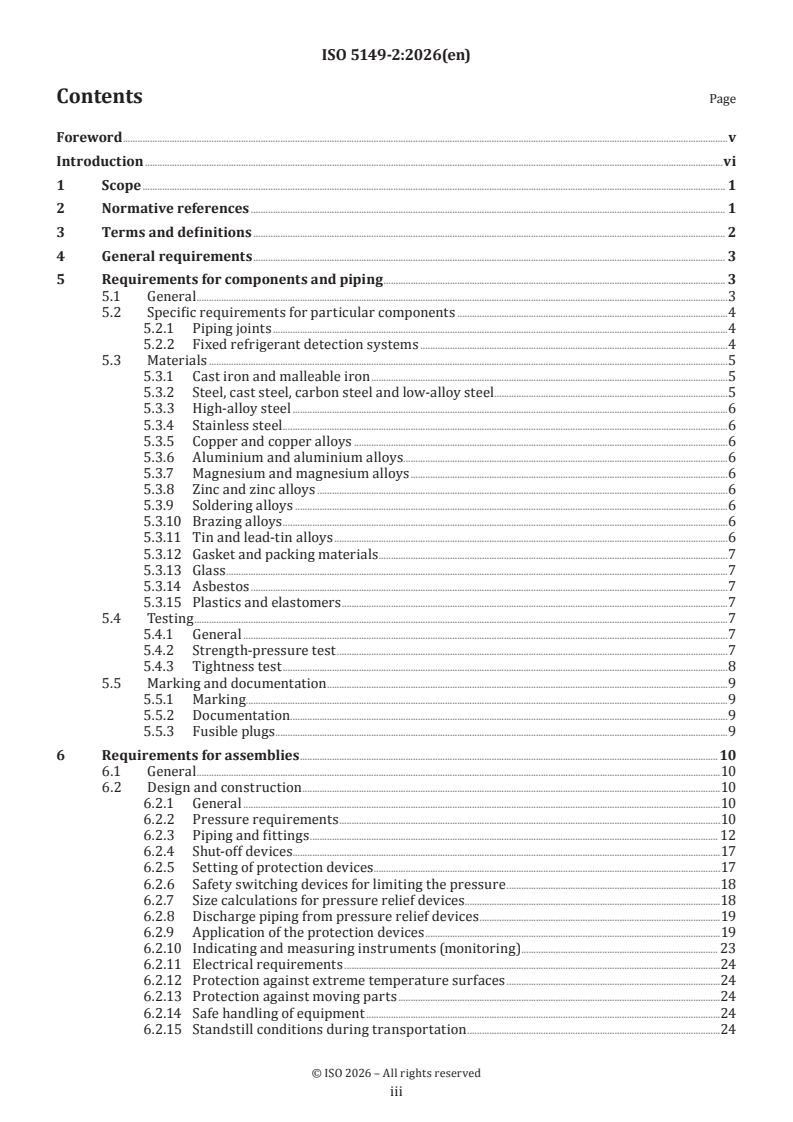
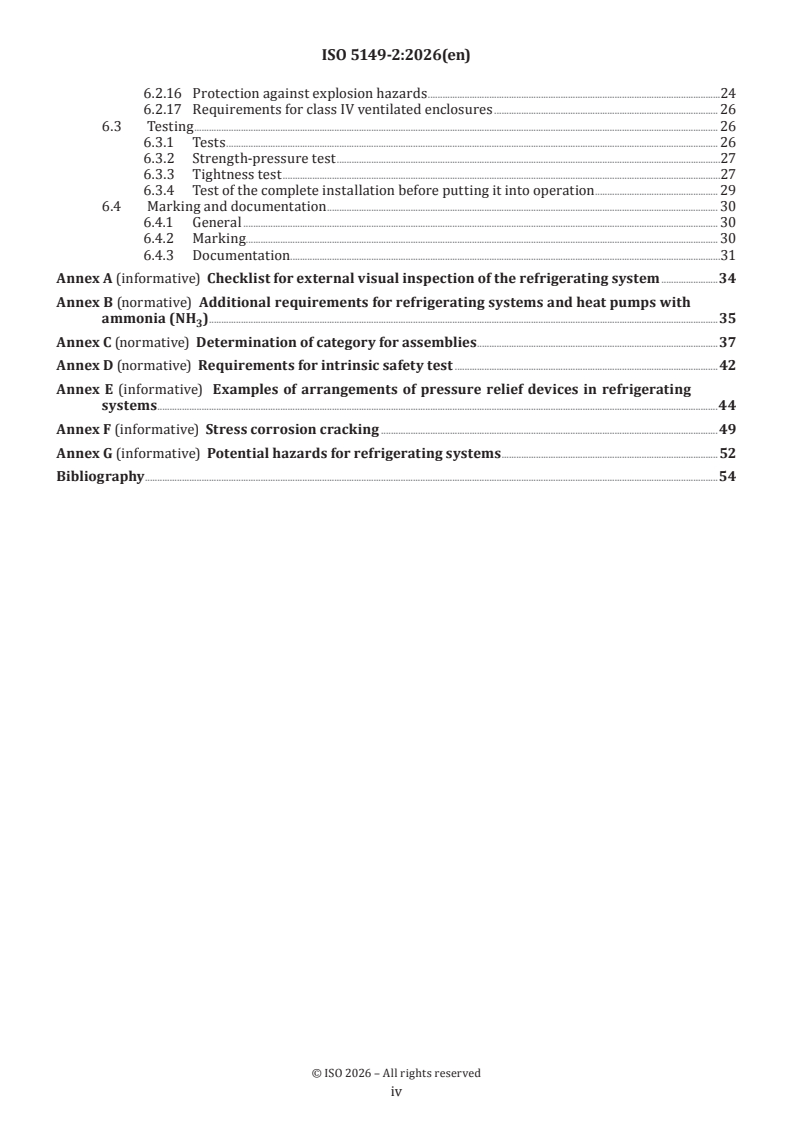
The document is organized into six clauses and seven annexes.
| Annex | What it covers |
|---|---|
| Annex A | Checklist for external visual inspection of the refrigerating system |
| Annex B | Additional requirements for refrigerating systems and heat pumps with ammonia (NH3) |
| Annex C | Determination of category for assemblies |
| Annex D | Requirements for intrinsic safety test |
| Annex E | Examples of arrangements of pressure relief devices in refrigerating systems |
| Annex F | Stress corrosion cracking |
| Annex G | Potential hazards for refrigerating systems |
What are the key requirements of ISO 5149-2:2026?
ISO 5149-2:2026 focuses on preventing hazards to people, property and the environment through design choices, component selection, testing and documentation. In practice, it tells the designer what to check, what to protect, and what to record before a system goes into service.
General safety intent and relation to product standards
Clause 4 requires refrigerating systems and components to be designed and constructed to eliminate possible hazards. Deliberate refrigerant discharge is only allowed in a way that is not harmful, so leak management and venting need to be planned, not improvised.
Clause 4 also recognizes conformity pathways through certain product standards. For equipment built to those standards, the practical point is to check which parts of ISO 5149-2 still apply, especially mechanical strength and pressure safety where IEC 60335-2-40 is involved.
Components, piping and materials
Clause 5 ties each component or piping item to the standard or requirement that applies to it. Table 1 is central here because it links items such as detectors, heat exchangers, compressors, valves, flexible piping, safety devices and gauges to either a related product standard or to the detailed requirements in Clauses 5.2 to 5.5.
Clause 5 also covers materials. The practical effect is that the material choice is not just a design preference - it has to suit the refrigerant, pressure, temperature and corrosion conditions, with special attention to combinations that can lead to stress corrosion cracking.
Testing, tightness and marking of components
Clause 5 requires strength-pressure testing and tightness testing for components and piping, together with marking and documentation. The important point for manufacturers is that the part must not only work in service, it must also be shown to be sound before it is put into the system.
Clause 5.5 also covers fusible plugs. That matters because pressure-protection elements need to be identified and documented like other safety-related parts.
Assembly design and pressure protection
Clause 6 is the core part for complete refrigerating system assemblies. It requires the whole assembly to be designed, constructed, tested, installed, documented and marked in accordance with Clause 6, and it adds special requirements for assemblies using ammonia in Annex B.
Pressure design is a major theme in Clause 6.2. The standard covers maximum allowable pressure, component pressure limits, damage limitation in external fire, piping and fittings, shut-off devices, protection-device settings, pressure-relief sizing, discharge piping and the application of protection devices. For the reader, this means the pressure path of the system must be planned as a complete chain, not as isolated parts.
Monitoring, electrical safety and hazards
Clause 6.2 also covers indicating and measuring instruments, electrical requirements, protection against hot or cold surfaces, moving parts, handling, transport standstill conditions, explosion hazards, and class IV ventilated enclosures. These requirements matter because refrigerating systems can create both mechanical and electrical risks in normal operation and during abnormal events.
Testing before putting the installation into operation
Clause 6.3 requires testing of the complete installation before operation. It includes inspection of the refrigerating system, verification of safety devices, refrigerant piping checks and visual inspection of the complete installation. The practical message is that commissioning is not just a functional run - the system has to be checked as a complete safety-relevant installation.
Marking and documentation for the assembly
Clause 6.4 requires marking and documentation for the finished system. This covers certificates, documentation at the operating site, the instruction manual, drawings and the logbook. In practice, the standard expects the system to be handed over with the information needed for safe use, maintenance and later changes.
Ammonia, categorization and intrinsic safety
Annex B adds extra requirements for refrigerating systems and heat pumps with ammonia (NH3), including shut-off devices, emergency stop arrangements and oil drain provisions for certain ammonia systems. Annex C gives the method for determining the category of an assembly, using refrigerant safety classification, pressure, refrigerant state and component category. Annex D gives the requirements for the intrinsic safety test when the decision path in Clause 6.2.9.2 leads to that option.
What terms does ISO 5149-2:2026 define?
Clause 3 adopts the definitions and abbreviations in ISO 5149-1, so the vocabulary is shared across the ISO 5149 series. These are some of the key terms and abbreviations used in this part:
- PS - maximum allowable pressure used as a key design basis for the refrigerating system assembly.
- HSIT - hot surface ignition temperature, introduced in this edition as a safety-related concept for ignition assessment.
- NH3 - ammonia, the refrigerant covered by the additional requirements in Annex B.
- GHS - Globally Harmonized System of Classification and Labelling of Chemicals, used in Annex C for refrigerant safety classification.
- Group 1 fluid - a refrigerant class covering explosive, highly flammable, highly toxic, toxic and oxidizing fluids, among others in Annex C.
- Group 2 fluid - all refrigerants not classified in Group 1 for the purposes of Annex C.
- Emergency stop system - a system that acts on drives and actuators to put the refrigerating system into a safe operating mode.
Who uses ISO 5149-2:2026?
ISO 5149-2:2026 is used by refrigeration and heat pump manufacturers, system designers, installers, commissioning engineers, service organizations and inspection teams. It is also relevant to buyers, project engineers and quality managers who need to specify safety-related design and documentation requirements for refrigerating systems.
It is especially relevant where refrigerant leakage, pressure safety, electrical equipment, detection systems, ammonia systems or hazardous locations have to be addressed. The document helps teams check what has to be designed, verified and recorded before a system is put into operation or modified.
What changed in ISO 5149-2:2026 from the previous edition?
ISO 5149-2:2026 is the second edition and it cancels and replaces ISO 5149-2:2014. It also incorporates Amendment 1:2020.
The foreword states two main changes: alignment with EN 378-2, with the future aim of merging the two documents, and the introduction of the hot surface ignition temperature (HSIT).
Which standards are used with ISO 5149-2:2026?
ISO 5149-2:2026 relies on several normative references and companion parts:
- ISO 817 - refrigerant designation and safety classification used in refrigerant identification and categorization.
- ISO 4126-1 and ISO 4126-2 - safety valves and bursting disc safety devices for protection against excessive pressure.
- ISO 5149-1 - vocabulary and abbreviations shared by the series.
- ISO 5149-3:2026 - installation site, classification and selection criteria.
- ISO 5149-4 - operation, maintenance, repair and recovery.
- ISO 12100 - general principles for risk assessment and risk reduction.
- ISO 13971 - requirements and classification for flexible pipe elements, vibration isolators, expansion joints and non-metallic tubes.
- ISO 14903 - qualification of tightness of components and joints.
- ISO 21922 - requirements, testing and marking for valves.
- ISO 24664 - calculation methods for pressure relief devices and associated piping.
- IEC 60079-10-1, IEC 60079-29-1 and IEC 62990-1 - area classification and detector performance for explosive or toxic gases.
- IEC 60204-1 and IEC 60730-2-6 - electrical equipment of machines and automatic electrical pressure-sensing controls.
- IEC/TS 63542 - refrigerant detection systems for flammable refrigerants.
- The listed IEC 60335 parts - appliance safety standards used where the refrigerating equipment falls under those product standards.
What does the ISO 5149-2:2026 document contain?
ISO 5149-2:2026 contains detailed requirements for components, piping, materials, testing, marking and documentation, together with assembly-level rules for pressure protection, safety switching devices, monitoring and electrical safety. It also includes annexes for ammonia systems, category determination, intrinsic safety testing and examples of pressure-relief arrangements.
The document uses tables, procedures and figures to support design and verification work. For example, Table 1 links component types to their applicable requirements, Clause 6 includes pipe support spacing and pressure-protection provisions, Annex C uses figures to show category determination examples, Annex D gives the intrinsic safety test path, and Annex E shows practical arrangements for pressure relief devices and their monitoring.
Relations
- Effective Date
- 19-Nov-2022
- Effective Date
- 19-Nov-2022
Get Certified
Connect with accredited certification bodies for this standard

DNV
DNV is an independent assurance and risk management provider.

Lloyd's Register
Lloyd's Register is a global professional services organisation specialising in engineering and technology.
DNV Energy Systems
Energy and renewable energy certification.
Sponsored listings
Frequently Asked Questions
ISO 5149-2:2026 is a standard published by the International Organization for Standardization (ISO). Its full title is "Refrigerating systems and heat pumps — Safety and environmental requirements — Part 2: Design, construction, testing, marking and documentation". This standard covers: This document specifies the design, construction and installation of refrigerating systems, including piping, components, materials and ancillary equipment directly associated with such systems, which are not covered in ISO 5149-1, ISO 5149-3, or ISO 5149-4. It also specifies requirements for testing, commissioning, marking and documentation. Requirements for secondary heat-transfer circuits are excluded except for any safety devices associated with the refrigerating system. This document is applicable to new refrigerating systems, extensions or modifications of already existing systems, and for used systems, being transferred to and operated on another site. This document is applicable to: refrigerating systems, stationary or mobile, of all sizes, except vehicle air conditioning systems covered by a specific product standard; NOTE Example of specific product standard is ISO 13043 and SAE J 639. secondary cooling or heating systems; the location of the refrigerating systems; replaced parts and added components after the adoption of this document, if they are not identical in function and in capacity; the conversion of a system for another refrigerant. This document does not apply to goods in storage, with respect to spoilage or contamination.
This document specifies the design, construction and installation of refrigerating systems, including piping, components, materials and ancillary equipment directly associated with such systems, which are not covered in ISO 5149-1, ISO 5149-3, or ISO 5149-4. It also specifies requirements for testing, commissioning, marking and documentation. Requirements for secondary heat-transfer circuits are excluded except for any safety devices associated with the refrigerating system. This document is applicable to new refrigerating systems, extensions or modifications of already existing systems, and for used systems, being transferred to and operated on another site. This document is applicable to: refrigerating systems, stationary or mobile, of all sizes, except vehicle air conditioning systems covered by a specific product standard; NOTE Example of specific product standard is ISO 13043 and SAE J 639. secondary cooling or heating systems; the location of the refrigerating systems; replaced parts and added components after the adoption of this document, if they are not identical in function and in capacity; the conversion of a system for another refrigerant. This document does not apply to goods in storage, with respect to spoilage or contamination.
ISO 5149-2:2026 is classified under the following ICS (International Classification for Standards) categories: 27.080 - Heat pumps; 27.200 - Refrigerating technology. The ICS classification helps identify the subject area and facilitates finding related standards.
ISO 5149-2:2026 has the following relationships with other standards: It is inter standard links to ISO 5149-2:2014, ISO 5149-2:2014/Amd 1:2020. Understanding these relationships helps ensure you are using the most current and applicable version of the standard.
ISO 5149-2:2026 is available in PDF format for immediate download after purchase. The document can be added to your cart and obtained through the secure checkout process. Digital delivery ensures instant access to the complete standard document.
Standards Content (Sample)
Contents
- Introduction
- 1 Scope
- 2 Normative references
- 3 Terms and definitions
- 4 General requirements
- 5 Requirements for components and piping
- 5.1 General
- 5.2 Specific requirements for particular components
- 5.3 Materials
- 5.4 Testing
- 5.5 Marking and documentation
- 6 Requirements for assemblies
- 6.1 General
- 6.2 Design and construction
- 6.3 Testing
- 6.4 Marking and documentation
- Annex A
- Annex B
- Annex C
- Annex D
- Annex E
- Annex F
- Annex G
- Bibliography
Introduction
The purpose of this document is to encourage the safe design, construction, installation, operation and disposal of refrigerating systems.
The industry response to environmental issues has accelerated the introduction of alternative refrigerants. The entry of new refrigerants and blends onto the market and the introduction of new safety classifications prompted the revision of this document.
This document is directed to the safety of persons and property on or near the premises where refrigeration facilities are located. It includes specifications for fabricating a tight system. This document is intended to minimize possible hazards to persons, property and the environment from refrigerating systems and refrigerants. These hazards are associated with the physical and chemical characteristics of refrigerants as well as the pressures and temperatures occurring in the refrigeration cycles (see Annex G).
Attention is drawn to hazards common to all compression systems, such as high temperature at discharge, liquid slugging, erroneous operation or reduction in mechanical strength caused by corrosion, erosion, thermal stress, fatigue stresses, liquid hammer or vibration.
Corrosion, however, should be given special consideration as conditions specific to refrigerating systems and heat pumps arise due to the alternate frosting and defrosting or the covering of equipment by insulation.
International Standard ISO 5149-2:2026(en) Refrigerating systems and heat pumps — Safety and environmental requirements — Part 2:
Design, construction, testing, marking and documentation
1 Scope
This document specifies the design, construction and installation of refrigerating systems, including piping, components, materials and ancillary equipment directly associated with such systems, which are not covered in ISO 5149-1, ISO 5149-3, or ISO 5149-4. It also specifies requirements for testing, commissioning, marking and documentation. Requirements for secondary heat-transfer circuits are excluded except for any safety devices associated with the refrigerating system.
This document is applicable to new refrigerating systems, extensions or modifications of already existing systems, and for used systems, being transferred to and operated on another site. This document is applicable to:
a) refrigerating systems, stationary or mobile, of all sizes, except vehicle air conditioning systems covered by a specific product standard; NOTE Example of specific product standard is ISO 13043 and SAE J 639. b) secondary cooling or heating systems; c) the location of the refrigerating systems; d) replaced parts and added components after the adoption of this document, if they are not identical in function and in capacity; e) the conversion of a system for another refrigerant.
This document does not apply to goods in storage, with respect to spoilage or contamination.
2 Normative references
The following documents are referred to in the text in such a way that some or all of their content constitutes requirements of this document. For dated references, only the edition cited applies. For undated references, the latest edition of the referenced document (including any amendments) applies. ISO 817, Refrigerants — Designation and safety classification ISO 4126-1, Safety devices for protection against excessive pressure — Part 1: Safety valves ISO 4126-2, Safety devices for protection against excessive pressure — Part 2: Bursting disc safety devices ISO 5149-1, Refrigerating systems and heat pumps — Safety and environmental requirements — Part 1:
Vocabulary ISO 5149-3:2026, Refrigerating systems and heat pumps — Safety and environmental requirements — Part 3:
Installation site, classification and selection criteria
ISO 5149-2:2026(en) ISO 5149-4, Refrigerating systems and heat pumps — Safety and environmental requirements — Part 4:
Operation, maintenance, repair and recovery ISO 7010, Graphical symbols — Safety colours and safety signs — Registered safety signs ISO 12100, Safety of machinery — General principles for design — Risk assessment and risk reduction ISO 13732-1, Ergonomics of the thermal environment — Methods for the assessment of human responses to contact with surfaces — Part 1: Hot surfaces ISO 13732-3, Ergonomics of the thermal environment — Methods for the assessment of human responses to contact with surfaces — Part 3: Cold surfaces ISO 13971, Refrigeration systems and heat pumps — Flexible pipe elements, vibration isolators, expansion joints and non-metallic tubes — Requirements and classification ISO 14903, Refrigerating systems and heat pumps — Qualification of tightness of components and joints ISO 21922, Refrigerating systems and heat pumps — Valves — Requirements, testing and marking ISO 24664, Refrigerating systems and heat pumps — Pressure relief devices and their associated piping — Methods for calculation IEC 60079-29-1, Explosive atmospheres — Part 29-1: Gas detectors — Performance requirements of detectors for flammable gases IEC 60204-1, Safety of machinery — Electrical equipment of machines — Part 1: General requirements IEC 60335-2-34, Household and similar electrical appliances — Safety — Part 2-34: Particular requirements for motor-compressors IEC 60335-2-40, Household and similar electrical appliances — Safety — Part 2-40: Particular requirements for electrical heat pumps, air-conditioners and dehumidifiers IEC 60335-2-75, Household and similar electrical appliances — Safety — Part 2-75: Particular requirements for commercial dispensing appliances and vending machines IEC 60335-2-89, Household and similar electrical appliances — Safety — Part 2-89: Particular requirements for commercial refrigerating appliances and ice-makers with an incorporated or remote refrigerant unit or motorcompressor IEC 60335-2-118, Household and similar electrical appliances — Safety — Part 2-118: Particular requirements for professional ice-cream makers IEC 60079-10-1:2020, Explosive atmospheres — Part 10-1: Classification of areas — Explosive gas atmospheres IEC 60730-2-6, Automatic electrical controls — Part 2-6: Particular requirements for automatic electrical pressure sensing controls including mechanical requirements IEC 62990-1, Workplace Atmospheres — Part 1: Gas detectors — Performance requirements of detectors for toxic gases IEC/TS 63542, Refrigerant detection systems for flammable refrigerants
3 Terms and definitions
For the purposes of this document, the definitions and abbreviations given in ISO 5149-1 apply. ISO and IEC maintain terminology databases for use in standardization at the following addresses:
- ISO Online browsing platform: available at https:// www .iso .org/ obp
- IEC Electropedia: available at https:// www .electropedia .org/
ISO 5149-2:2026(en)
4 General requirements
Refrigerating systems and components shall be designed and constructed with the intention to eliminate possible hazards to persons, property and the environment (see Annex G for potential hazards for refrigerating systems). Deliberate discharge of refrigerants shall only be permitted in a manner which is not harmful to persons, property and the environment.
Refrigerating appliances or systems constructed according to product standards such as IEC 60335-2-24 or IEC 60335-2-89 are presumed to be in conformity with this document. IEC 60335-2-40 requires appliances to conform to the requirements of this document with regard to mechanical strength and pressure safety. In all other respects, appliances constructed according to IEC 60335-2-40 are presumed to be in conformity with this document. NOTE Information for mechanical strength and pressure safety can be found in Clause 5 and Clause 6.
5 Requirements for components and piping
5.1 General
Components and piping shall conform to the related standards or requirements given in Table 1. Components not included in Table 1 shall conform to relevant national standards or codes. For components not listed in Table 1 and not covered by national standards or codes, the requirements of 5.2 to 5.5 shall apply. Table 1 — Components and piping requirements Components and piping Requirements Detector 5.2.2 Fired heat exchangers 5.2 to 5.5 Heat exchangers:
- pipe coil without air (tube in tube) 5.2 to 5.5
- multi-tubular (shell and tubes) Plate heat exchangers 5.2 to 5.5 Headers and coils with air as secondary fluid 5.2 to 5.5 Receiver/accumulator/economizer 5.2 to 5.5 Oil separator 5.2 to 5.5 Drier 5.2 to 5.5 Filter 5.2 to 5.5 Muffler 5.2 to 5.5 Hermetic positive displacement compressor IEC 60335-2-34 or IEC 60204–1 Semi-hermetic positive displacement compressor IEC 60335-2-34 or IEC 60204–1 Open positive displacement compressor 5.2 to 5.5 Non-positive displacement compressor IEC 60204–1 Pump IEC 60204–1 combined with 5.4.3 and 5.5.1 Piping 5.2 to 5.5 Piping joints 5.2 to 5.5 Permanent joints 5.2 to 5.5 Non-permanent joints 5.2 to 5.5 Flexible piping ISO 13971 Safety switching devices for limiting the pressure 5.2 to 5.5 Control pressure switch 5.2 to 5.5
ISO 5149-2:2026(en) TTabablele 1 1 ((ccoonnttiinnueuedd)) Components and piping Requirements Safety valve ISO 4126-1 or ISO 24664 combined with 5.4.3 Bursting disc ISO 4126-2 or ISO 24664 combined with 5.4.3 Valve ISO 21922 Isolating valves ISO 21922 Hand-operated valves ISO 21922 Capped valves ISO 21922 Liquid level indicators ISO 21922 Gauges 5.2 to 5.5 Soldering materials 5.3.9 Brazing materials 5.3.10 Welding materials 5.3 If the component contains electrical components and if the component standard does not cover electrical safety, then the component shall fulfil the electrical requirements of IEC 60335-2-40, IEC 60335-2-34, IEC 60335-2-89 or IEC 60204–1, as relevant.
Piping and vessels manufactured in copper or carbon steel can suffer from stress corrosion cracking. Guidance on design is given in Annex F.
5.2 Specific requirements for particular components
5.2.1 Piping joints
Joints shall be designed so that they are not damaged because of freezing of water on the outside. They shall be suitable for the pipe, the piping material and the pressure, temperature and fluid. Coated (e.g. galvanized) pipes shall not be welded unless all coating has been completely removed from the joint area. Welded joints shall be suitably protected.
5.2.2 Fixed refrigerant detection systems
5.2.2.1 General
The detector for the detection of refrigerant gases shall be a pre-set (indicating or alarm only) refrigerant detector/sensor or a proportional (transmitter or measuring) refrigerant detector. The refrigerant detection system shall be accurate at the pre-set alarm point and reliable according to the relevant standards, as specified below.
The detection system shall conform to one of the following standards, where applicable:
- For detection systems where sensors are incorporated in the control of the refrigerating system, IEC 60335-2-40 and IEC TS 63542 shall apply, where relevant.
- For detection systems separately installed at the installation site, such as a machinery room or other location, IEC 60079-29-1 and IEC 62990-1 shall apply, where relevant. An appropriate maintenance period shall be established for each type of detector used. The t response
time of the detector, including the optional delay time specified by the system manufacturer, shall be 30 s or less.
The detector shall be suitable for foreseeable variations in power supply voltage experienced at the installation site and shall be triggered at the set value within the tolerances defined in the listed standards, where specified.
ISO 5149-2:2026(en) Where vibration requirements are specified, they shall apply to the detection system and not to the entire refrigerating system.
5.2.2.2 Refrigerant detection system output and general performance
A refrigerant detector shall give at least one output signal at a pre-set alarm point set by the manufacturer of the detector. The pre-set alarm point shall not be adjustable on site. It should also have a separate output for the fault signal.
The refrigerant detection system shall maintain the same performance between 0 °C and 30 °C. For applications outside this temperature range, the detector shall be specified for safe operation at the temperature for the specific application.
The pre-set alarm point for the refrigerant detection system shall be set at no more than 25 % of the lower flammability limit (LFL) or 50 % of the acute toxicity exposure limit/oxygen deprivation limit (ATEL/ODL). The pre-set alarm value for the oxygen detector shall be 19,5 % by volume. The value shall be selected to ensure that the output signal is triggered at or below the alarm threshold value under all expected mains power voltage conditions.
The accuracy of the alarm threshold level and the long-term drift shall be recorded in the instruction manual specified in 6.4.3.3 in order to demonstrate that the alarm threshold level is within the limit specified and will be assured throughout the lifetime of the detector.
The refrigerant sensors or the parts containing the refrigerant sensors shall be marked or tagged with:
- year of manufacturing and where relevant, date of expiration;
- reference number or other means for identifying the refrigerant sensor.
5.2.2.3 Information on resistance to contaminants and high concentrations
The effect of contaminants or high concentrations of refrigerant gas on the accuracy, alarm threshold level and the performance of the sensor as stated by the detector manufacturer, and minimum requirements for maintenance, calibration and replacement shall be included in the instruction manual.
5.3 Materials
5.3.1 Cast iron and malleable iron
Cast iron and malleable iron shall only be used when suitable for the particular application, in accordance with the requirements of this document.
NOTE 1 Since some grades of cast iron are brittle, their application is dependent on temperature, stress and design considerations.
NOTE 2 Malleable iron has two general classifications with several different grades in each. These can have very different mechanical properties.
5.3.2 Steel, cast steel, carbon steel and low-alloy steel
Steel, cast steel, carbon steel and low-alloy steel can be used for all parts carrying refrigerant and also for heat-transfer medium circuits. Where there is a combination of low temperatures and high pressure or where corrosion risks or thermal stresses are present, steel with adequate impact strength shall be used, paying regard to thickness, the lowest operating temperature and its welding properties. NOTE Guidance on stress corrosion cracking in carbon steel vessels is given in Clause F.3.
ISO 5149-2:2026(en)
5.3.3 High-alloy steel
High-alloy steel can be required where there is a combination of low temperatures and high pressure or where corrosion risks or thermal stresses are present. The impact strength shall be adequate for the particular duty and the material suitable for welding, if required.
5.3.4 Stainless steel
When using stainless steel, the grade of stainless steel shall be compatible with the process fluids and possible atmospheric impurities, e.g. sodium chloride (NaCl) and sulphuric acid (H SO ). 2 4
5.3.5 Copper and copper alloys
Copper in contact with refrigerants shall be oxygen-free or de-oxidized. Copper and alloys with a high percentage of copper shall not be used for parts carrying ammonia unless their compatibility has been previously established.
NOTE Guidance on stress corrosion cracking in copper pipes is given in Clause F.2.
5.3.6 Aluminium and aluminium alloys
Aluminium and aluminium alloys may be used in any part of the refrigerant circuit provided that their strength is adequate and it is compatible with the refrigerants and the lubricants being used. Aluminium used for gaskets for use with ammonia shall be of at least 99,5 % purity. Aluminium alloys containing more than 2 % magnesium shall not be used with halogenated refrigerants unless their compatibility has been previously established.
Aluminium and its alloys shall not be used in contact with methyl chloride (CH Cl).
5.3.7 Magnesium and magnesium alloys
Magnesium and magnesium alloys shall not be used unless their compatibility with refrigerants has been previously established.
5.3.8 Zinc and zinc alloys
Zinc shall not be used in continuous contact with the refrigerants ammonia and methyl chloride (CH Cl).
External zinc coating of components is permissible.
Electro-zinc plating of components is permissible.
5.3.9 Soldering alloys
Soldering alloys shall not be used for refrigerant containment purposes.
5.3.10 Brazing alloys
Brazing alloys shall not be used unless their compatibility with refrigerants and lubricants has been established.
5.3.11 Tin and lead-tin alloys
Tin and lead-tin alloys can be corroded by halogenated refrigerants and shall not be used unless their compatibility has been previously established.
Copper-free lead antimony or lead-tin alloys may be used for valve seats.
ISO 5149-2:2026(en)
5.3.12 Gasket and packing materials
Gasket and packing materials for sealing joints and for sealing stuffing boxes on valves shall be resistant to the refrigerants, oil and lubricants used and shall be suitable for the expected range of pressures and temperatures.
5.3.13 Glass
Glass may be used in refrigerant circuits and for terminal insulators, indicators and sight glasses, but it shall be resistant to the pressures, temperatures and chemical actions which can occur.
5.3.14 Asbestos
Asbestos shall not be used.
5.3.15 Plastics and elastomers
When plastics or elastomers are used, they shall be:
- suitable for the mechanical, electrical, thermal, chemical and long-term creep stresses to which they are subjected;
- compatible with refrigerant or refrigerant-oil mixtures with which they are in contact.
5.4 Testing
5.4.1 General
All components, except type-approved components including piping consisting of type-tested components, shall undergo the following tests:
a) strength-pressure test (see 5.4.2); b) tightness test (see 5.4.3); c) functional test (see 6.3.1).
The results of these tests shall be recorded. Tests according to the relevant component standard are considered to satisfy these testing requirements. When agreed by the manufacturer of the refrigerating system assembly, some or all tests may be executed on the refrigerating system assembly (see 6.3).
5.4.2 Strength-pressure test
5.4.2.1 Individual strength-pressure test
Each component shall be strength-pressure-tested individually at a minimum of 1,43 × P (where P is the S S maximum allowable pressure). The individual strength-pressure test shall be carried out as a hydrostatic pressure test by means of water (under the condition that the refrigeration circuit shall not be contaminated when the test is complete) or some other liquid, except where a component cannot be pressure-tested with liquid for technical reasons. In that case, the component shall be tested by means of air or some other nonhazardous gas. Adequate precautions shall be taken to prevent danger to people and to minimize risk to property.
As an alternative, the components can be type-approved by testing at 3 × P or by testing according to the S fatigue test as described in 5.4.2.2.
If the maximum continuous operating temperature exceeds 125 °C for copper or aluminium, or 200 °C for steel, then the type-approved strength test pressure shall be increased according to the ratio of allowable stress at the test temperature and that at the maximum continuous operating temperature based on a known pressure vessel code or a published national or international standard. For example, if the material
...