

ISO 5149-1:2026
(Main)Refrigerating systems and heat pumps — Safety and environmental requirements — Part 1: Vocabulary
- Abstract
This document defines terms used in the specification, design, manufacture, construction, installation, commissioning, maintenance and decommissioning of refrigerating systems with regard to safety and environmental requirements. The term "refrigerating systems" includes heat pumps and air conditioners.
- Status
- Published
- Publication Date
- 04-Nov-2026
- Current Stage
- 6060 - International Standard published - 60 Publication
- Start Date
- 05-Nov-2026
- Due Date
- 05-Nov-2026
- Completion Date
- 05-Nov-2026
ISO 5149-1:2026 is an International Standard from ISO that defines the vocabulary used for the safety and environmental requirements of refrigerating systems, heat pumps and air conditioners. It supports the terms used in specification, design, manufacture, construction, installation, commissioning, maintenance and decommissioning, so everyone working on these systems uses the same meanings.
What does ISO 5149-1:2026 specify?
ISO 5149-1:2026 specifies the terms and abbreviated terms used across the ISO 5149 series. Its purpose is to align language for work on refrigerating systems with regard to safety and environmental requirements.
The document is organized as a short vocabulary standard:
- Clause 1 gives the scope.
- Clause 2 covers normative references.
- Clause 3 contains the definitions and abbreviated terms.
- The back matter includes a bibliography and an index.
The scope explicitly includes heat pumps and air conditioners within the meaning of “refrigerating systems”. That matters in practice because the same vocabulary is used for equipment selection, system design, installation work and later maintenance or dismantling.
What are the key requirements of ISO 5149-1:2026?
ISO 5149-1:2026 is a terminology document, so its main function is to define how words are to be understood across the series. It does not set design limits or test procedures itself; instead, it fixes the language that other parts of ISO 5149 use.
System and installation terms
Clause 3.1.1 defines the main system types, including sorption system, cascade system, indirect system, limit-charged system, self-contained system, hermetically sealed system, unit system, split system and multi-split system. This matters because safety decisions in practice depend on which system architecture is being described.
Clause 3.1.2 defines location terms such as machinery room, occupied space, open air, crawl space, hallway, exit passageway and class IV ventilated enclosure. These terms are important when deciding where a system may be installed and how people may be exposed to refrigerant leakage.
Pressure and component terminology
Clause 3.1.3 defines design pressure, maximum allowable pressure (PS) and strength test pressure. These terms are used when specifying the pressure basis for components and when checking whether equipment is suitable for its intended operating conditions.
Clause 3.1.4 defines core components such as compressor, condenser, evaporator, pressure vessel, liquid receiver, surge drum and refrigerating equipment. This helps engineers, manufacturers and inspectors describe the same physical item consistently during design, documentation and maintenance.
Piping, joints and safety devices
Clause 3.1.5 defines piping, joints and fittings, including welded joint, brazed joint, flanged joint, flared joint, isolating valve, shut-off device and quick-closing valve. In practice, these terms matter because leak tightness and service access often depend on how parts are joined and isolated.
Clause 3.1.6 defines safety devices such as bursting disc, pressure relief device, pressure relief valve, pressure limiter, pressure cutout, refrigerant detector, temperature limiting device and safety switching device for limiting the pressure. These definitions support selection and review of protection methods against overpressure and unsafe operating conditions.
Refrigerant quantities and disposal terms
Clause 3.1.7 defines refrigerant-related quantities and properties such as refrigerant charge, maximum refrigerant charge, charge limit, refrigerant quantity, refrigerant quantity limit, releasable charge, practical limit, toxicity, auto-ignition temperature and hot surface ignition temperature (HSIT). These terms are important when assessing leakage risk, charge limits and exposure in occupied spaces.
Clause 3.1.8 defines disposal-related terms including recover, reclaim, recycle and reuse. This supports end-of-life handling and helps distinguish recovery for storage from further processing or reuse.
Airflow, miscelleaneous terms and safety concept
Clause 3.1.9 defines circulation airflow and integral circulation airflow. Clause 3.1.10 adds terms such as factory-made, dilution transfer opening, concentration limit, heat-transfer circuit and safety concept. The safety concept is especially important because it frames the protective approach used across the ISO 5149 series.
What terms does ISO 5149-1:2026 define?
- Refrigerating system - A closed refrigerant circuit used to extract and reject heat; the document states that this includes heat pumps and air conditioners.
- Limit-charged system - A system designed so that, if the refrigerant fully evaporates while idle, pressure stays within the allowable limit.
- Machinery room - An enclosed, mechanically ventilated space reserved for system components and not open to the public.
- Maximum allowable pressure (PS) - The highest pressure a system or component is designed for, as specified by the manufacturer.
- Refrigerant charge (m) - The amount of refrigerant contained in the system, expressed in kilograms.
- Safety concept - The combination of safety measures used to protect people and property against refrigerant leakage.
- Hot surface ignition temperature (HSIT) - The lowest temperature at which a substance ignites when released onto a heated surface in normal atmosphere.
Who uses ISO 5149-1:2026?
ISO 5149-1:2026 is used by engineers, designers, manufacturers, installers, commissioning teams, maintenance personnel and decommissioning teams working on refrigerating systems, heat pumps and air conditioners. It is also useful for quality managers, specifiers and buyers who need shared terminology in contracts, technical files and safety reviews.
In practice, it helps people describe equipment, installation locations, pressure limits, safety devices and refrigerant quantities without ambiguity. That is useful when comparing designs, reviewing drawings, preparing service instructions or checking compliance documents for the ISO 5149 series.
What changed in ISO 5149-1:2026 from the previous edition?
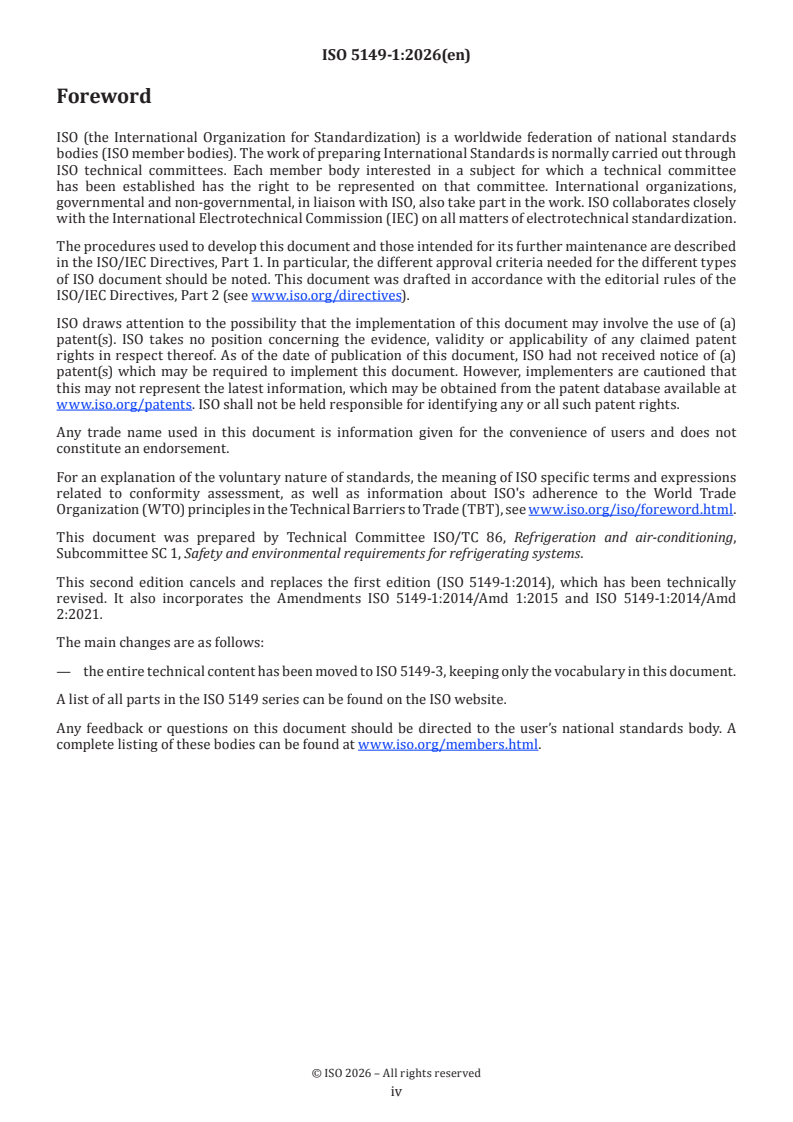
ISO 5149-1:2026 cancels and replaces ISO 5149-1:2014, including Amendments 1 and 2. The main change stated for this edition is that the technical content was moved to ISO 5149-3, leaving this part as the vocabulary document.
Which standards are used with ISO 5149-1:2026?
The bibliography names ISO 817 for refrigerant designation and safety classification, ISO 14903 for qualification of tightness of components and joints, ISO 13043 for mobile air-conditioning refrigerant systems in road vehicles, and SAE J 639 for motor vehicle refrigerant vapor-compression systems. The introduction also refers to the ISO 5149 series as the companion set of parts that carries the safety and environmental requirements.
What does the ISO 5149-1:2026 document contain?
ISO 5149-1:2026 contains a structured list of definitions grouped by topic: system types, locations, pressure, components, piping and joints, safety devices, fluids and safety characteristics, refrigerant disposal, airflow and miscellaneous terms. It also includes a table of additional abbreviated terms such as ATEL, CLAM, GWP, HSIT, LFL, ODL, ODP, ppm, RV, SDS and TF.
The back matter provides a bibliography and an index, which makes the vocabulary easier to navigate during design reviews, technical writing, audits and training.
Relations
- Effective Date
- 19-Nov-2022
- Effective Date
- 19-Nov-2022
- Effective Date
- 19-Nov-2022
Get Certified
Connect with accredited certification bodies for this standard

DNV
DNV is an independent assurance and risk management provider.

Lloyd's Register
Lloyd's Register is a global professional services organisation specialising in engineering and technology.
DNV Energy Systems
Energy and renewable energy certification.
Sponsored listings
Frequently Asked Questions
ISO 5149-1:2026 is a standard published by the International Organization for Standardization (ISO). Its full title is "Refrigerating systems and heat pumps — Safety and environmental requirements — Part 1: Vocabulary". This standard covers: This document defines terms used in the specification, design, manufacture, construction, installation, commissioning, maintenance and decommissioning of refrigerating systems with regard to safety and environmental requirements. The term "refrigerating systems" includes heat pumps and air conditioners.
This document defines terms used in the specification, design, manufacture, construction, installation, commissioning, maintenance and decommissioning of refrigerating systems with regard to safety and environmental requirements. The term "refrigerating systems" includes heat pumps and air conditioners.
ISO 5149-1:2026 is classified under the following ICS (International Classification for Standards) categories: 27.080 - Heat pumps; 27.200 - Refrigerating technology. The ICS classification helps identify the subject area and facilitates finding related standards.
ISO 5149-1:2026 has the following relationships with other standards: It is inter standard links to ISO 5149-1:2014, ISO 5149-1:2014/Amd 2:2021, ISO 5149-1:2014/Amd 1:2015. Understanding these relationships helps ensure you are using the most current and applicable version of the standard.
ISO 5149-1:2026 is available in PDF format for immediate download after purchase. The document can be added to your cart and obtained through the secure checkout process. Digital delivery ensures instant access to the complete standard document.
Standards Content (Sample)
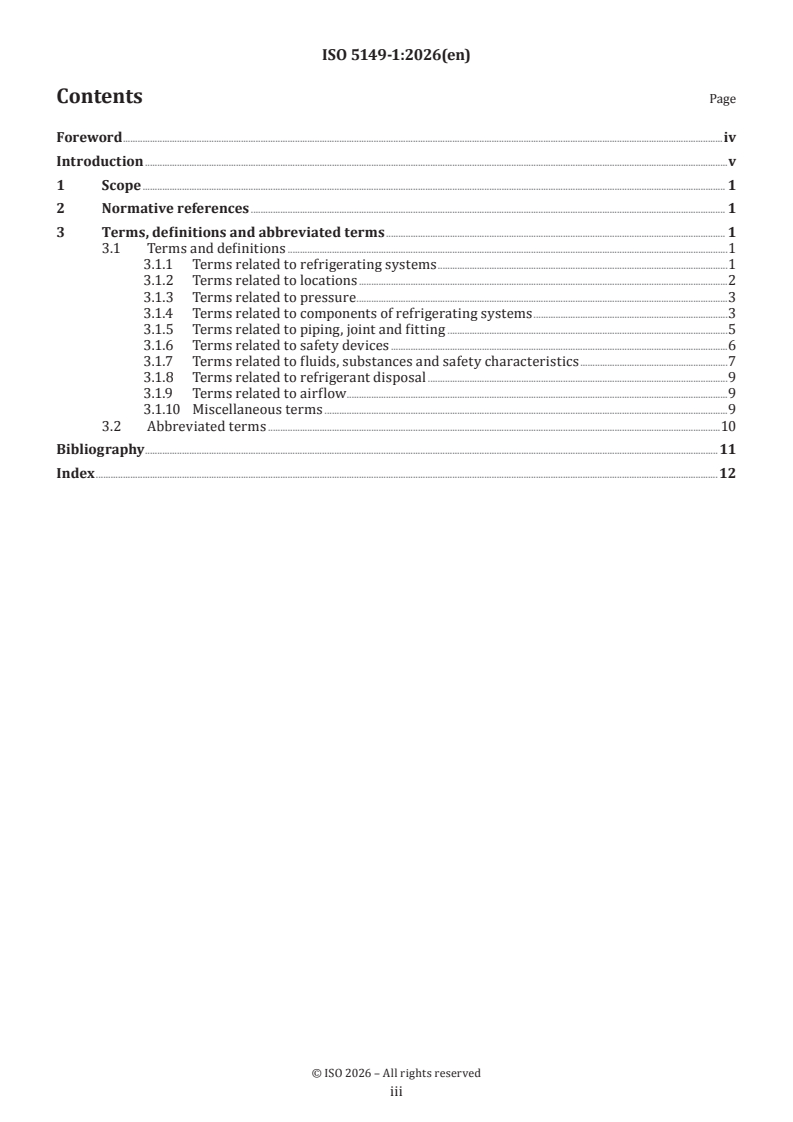
Contents
- Introduction
- 1 Scope
- 2 Normative references
- 3 Terms, definitions and abbreviated terms
- 3.1 Terms and definitions
- 3.1.1.1 sorption system
- 3.1.1.2 cascade system
- 3.1.1.3 indirect system
- 3.1.1.4 limit-charged system
- 3.1.1.5 high-pressure side
- 3.1.1.6 low-pressure side
- 3.1.1.7 refrigerating system
- 3.1.1.8 self-contained system
- 3.1.1.9 hermetically sealed system
- 3.1.1.10 unit system
- 3.1.1.11 split system
- 3.1.1.12 multi-split system
- 3.1.2.1 crawl space
- 3.1.2.2 exit passageway
- 3.1.2.3 hallway
- 3.1.2.4 machinery room
- 3.1.2.5 occupied space
- 3.1.2.6 open air
- 3.1.2.7 separate refrigeration machinery room
- 3.1.2.8 class IV ventilated enclosure
- 3.1.3.1 design pressure
- 3.1.3.2 maximum allowable pressure
- 3.1.3.3 strength test pressure
- 3.1.4.1 coil
- 3.1.4.2 compressor
- 3.1.4.3 heat exchanger
- 3.1.4.4 condenser
- 3.1.4.5 condensing unit
- 3.1.4.6 evaporator
- 3.1.4.7 pressure vessel
- 3.1.4.8 fade-out vessel
- 3.1.4.9 liquid receiver
- 3.1.4.10 internal net volume
- 3.1.4.11 refrigerating equipment
- 3.1.4.12 surge drum
- 3.1.5.1 companion valve
- 3.1.5.2 compression joint
- 3.1.5.3 flanged joint
- 3.1.5.4 flared joint
- 3.1.5.5 header
- 3.1.5.6 isolating valve
- 3.1.5.7 joint
- 3.1.5.8 piping
- 3.1.5.9 quick-closing valve
- 3.1.5.10 service duct
- 3.1.5.11 shut-off device
- 3.1.5.12 welded joint
- 3.1.5.13 brazed joint
- 3.1.6.1 bursting disc
- 3.1.6.2 changeover valve
- 3.1.6.3 fusible plug
- 3.1.6.4 overflow valve
- 3.1.6.5 pressure limiter
- 3.1.6.6 pressure relief device
- 3.1.6.7 pressure relief valve
- 3.1.6.8 refrigerant detector
- 3.1.6.9 safety switching device for limiting the pressure
- 3.1.6.10 self-closing valve
- 3.1.6.11 temperature limiting device
- 3.1.6.12 type-approved component
- 3.1.6.13 pressure cutout
- 3.1.6.14 safety pressure cutout
- 3.1.7.1 lubricant
- 3.1.7.2 halocarbon
- 3.1.7.3 hydrocarbon
- 3.1.7.4 heat-transfer fluid
- 3.1.7.5 auto-ignition temperature
- 3.1.7.6 outside air
- 3.1.7.7 refrigerant type
- 3.1.7.8 toxicity
- 3.1.7.9 practical limit
- 3.1.7.10 maximum refrigerant charge
- 3.1.7.11 charge limit
- 3.1.7.12 refrigerant quantity
- 3.1.7.13 refrigerant quantity limit
Introduction
This document defines terms for the ISO 5149 series, the purpose of which is to specify requirements for the safety of persons and property involved with refrigerating systems, heat pumps and the recovery of refrigerants. The ISO 5149 series also provides guidance for the protection of the environment. The series establishes procedures for the following items as regards refrigerating systems, heat pumps and the recovery of refrigerants:
- design;
- construction;
- testing;
- marking and documentation;
- installation;
- operation;
- maintenance;
- repair;
- refrigerating system disposal.
The ISO 5149 series is applicable to:
a) refrigerating systems, stationary or mobile, of all sizes, except vehicle air conditioning systems covered by a specific product standard, e.g. ISO 13043 and SAE J 639; b) secondary cooling or heating systems; c) the location of the refrigerating systems; d) parts replaced and components added if they are not identical in function and capacity.
International Standard ISO 5149-1:2026(en) Refrigerating systems and heat pumps — Safety and environmental requirements — Part 1:
Vocabulary
1 Scope
This document defines terms used in the specification, design, manufacture, construction, installation, commissioning, maintenance and decommissioning of refrigerating systems with regard to safety and environmental requirements.
The term "refrigerating systems" includes heat pumps and air conditioners.
2 Normative references
There are no normative references in this document.
3 Terms, definitions and abbreviated terms
ISO and IEC maintain terminology databases for use in standardization at the following addresses:
- ISO Online browsing platform: available at https:// www .iso .org/ obp
- IEC Electropedia: available at https:// www .electropedia .org/
3.1 Terms and definitions
3.1.1 Terms related to refrigerating systems
3.1.1.1 sorption system
refrigerating system in which refrigeration is achieved by evaporation of a refrigerant, the vapour then being absorbed or adsorbed by an absorbent or adsorbent medium respectively, from which it is subsequently expelled at a higher partial vapour pressure by heating and then liquefied by cooling Note 1 to entry: Absorption systems and adsorption systems are covered in this definition.
3.1.1.2 cascade system
two or more independent refrigerant circuits where the condenser of one system rejects heat directly to the evaporator of another
3.1.1.3 indirect system
system with more than one degree of separation from the occupied space
3.1.1.4 limit-charged system
refrigerating system in which the internal volume and total refrigerant charge are such that, with the system idle, the allowable pressure will not be exceeded if complete evaporation of the refrigerant charge occurs
ISO 5149-1:2026(en)
3.1.1.5 high-pressure side
part of a refrigerating system operating approximately at the condenser pressure
3.1.1.6 low-pressure side
part of a refrigerating system operating approximately at the evaporator pressure
3.1.1.7 refrigerating system
combination of interconnected refrigerant-containing parts constituting one closed circuit in which the refrigerant is circulated for the purpose of extracting and rejecting heat (i.e. cooling and heating) Note 1 to entry: "Refrigerating system" includes heat pumps and air conditioners.
3.1.1.8 self-contained system
complete factory-made refrigerating system in a suitable frame or enclosure, which is fabricated and transported as a complete unit system, or in two or more sections and in which no refrigerant-containing parts are connected on site other than by isolation valves, such as companion (block) valves
3.1.1.9 hermetically sealed system
refrigerating system in which all refrigerant containing parts are made tight by welding, brazing or a similar permanent connection, which may include capped valves and capped service ports that allow proper repair or disposal and which have a tested leakage rate of less than 3 g per year under a pressure of at least a quarter of the maximum allowable pressure Note 1 to entry: Permanent mechanical joints meeting the requirements of hermetically sealed joints in ISO 14903 are considered to be similar permanent connections.
3.1.1.10 unit system
self-contained system that is assembled, filled, ready for use and tested prior to its installation and is installed without the need for connecting any refrigerant-containing parts
3.1.1.11 split system
refrigerating system, comprising one or more factory-made indoor units in a space and one or more factorymade units which are located outside the space and which are connected on site by refrigerant piping to form a single functional system
3.1.1.12 multi-split system
split system with at least two indoor units
3.1.2 Terms related to locations
3.1.2.1 crawl space
space that is generally accessed for maintenance only and where it is not possible to walk or access by walking Note 1 to entry: The height of crawl spaces is usually less than 1 m.
3.1.2.2 exit passageway
passageway in the immediate vicinity of the exit through which people may leave the building
ISO 5149-1:2026(en)
3.1.2.3 hallway
corridor for the passage of people
3.1.2.4 machinery room
enclosed room or space, with mechanical ventilation, sealed from public areas and not accessible to the public, which is intended to contain components of the refrigerating system Note 1 to entry: A machinery room can contain other equipment provided that the design and its installation requirements are compatible with the requirements for the safety of the refrigerating system.
3.1.2.5 occupied space
space in a building which is bounded by walls, floors and ceilings and which is used and intended for human occupation or human activities or both
3.1.2.6 open air
unenclosed space, possibly but not necessarily roofed
3.1.2.7 separate refrigeration machinery room
machinery room intended to contain only components of the refrigerating system, accessible only to competent personnel for the purposes of inspection, maintenance and repair Note 1 to entry: The term "machinery room" includes separate refrigeration machinery rooms.
3.1.2.8 class IV ventilated enclosure
enclosure containing the refrigerating system that does not enable air to flow from the enclosure to the surrounding space and has a ventilation system that produces airflow from the enclosure to the open air or to a suitable indoor space through a ventilation duct
3.1.3 Terms related to pressure
3.1.3.1 design pressure
pressure chosen for the strength calculation of each component Note 1 to entry: The design pressure is used for determining the necessary materials, thickness and construction for components with regard to their ability to withstand pressure.
3.1.3.2 maximum allowable pressure
PS P S maximum pressure for which a system or component is designed, as specified by the manufacturer
3.1.3.3 strength test pressure
pressure that is applied to test the strength of a refrigerating system or any part of it
3.1.4 Terms related to components of refrigerating systems
3.1.4.1 coil
part of the refrigerating system constructed from pipes or tubes suitably connected and serving as a heat exchanger (evaporator or condenser) Note 1 to entry: A header connecting the tubes of the heat exchanger is part of the coil.
ISO 5149-1:2026(en)
...