

ISO 18243:2025
(Main)Electrically propelled mopeds and motorcycles — Test specifications and safety requirements for lithium-ion battery systems
General Information
- Abstract
This document specifies the test procedures for lithium-ion battery packs and systems used in electrically propelled mopeds and motorcycles. The specified test procedures enable the user of this document to determine the essential characteristics on performance and safety of lithium-ion battery packs and systems. It is also possible to compare the test results achieved for different battery packs or systems. This document enables setting up a dedicated test plan for an individual battery pack or system subject to an agreement between customer and supplier. If required, the relevant test procedures and/or test conditions of lithium-ion battery packs and systems are selected from the standard tests provided in this document to configure a dedicated test plan. NOTE 1 Electrically power-assisted cycles (EPAC) cannot be considered as mopeds. The definition of electrically power-assisted cycles can differ from country to country. An example of definition can be found in Reference [ REF Reference_ref_12 \r \h 7 08D0C9EA79F9BACE118C8200AA004BA90B0200000008000000110000005200650066006500720065006E00630065005F007200650066005F00310032000000 ]. NOTE 2 Testing on cell level is specified in the IEC 62660 series.
- Status
- Published
- Publication Date
- 11-Dec-2025
- Technical Committee
- ISO/TC 22/SC 38 - Motorcycles and mopeds
- Drafting Committee
- ISO/TC 22/SC 38 - Motorcycles and mopeds
- Current Stage
- 6060 - International Standard published
- Start Date
- 12-Dec-2025
- Due Date
- 27-Oct-2025
- Completion Date
- 12-Dec-2025
Overview
ISO 18243:2025 - Electrically propelled mopeds and motorcycles - Test specifications and safety requirements for lithium‑ion battery systems - defines standardized test procedures and safety requirements for lithium‑ion battery packs and systems used in electrically propelled mopeds and motorcycles. The standard enables objective determination and comparison of performance and safety characteristics, and supports configuring a dedicated test plan agreed between customer and supplier. Note: cell‑level testing is covered by the IEC 62660 series and electrically power‑assisted cycles (EPAC) are not considered mopeds under this document.
Key topics and technical requirements
ISO 18243 organizes requirements and test procedures across safety, mechanical, climatic, electrical, functional and performance domains:
- Safety and general requirements
- Evidence of leakage, rupture, fire or explosion; isolation resistance checks.
- Mechanical tests
- Vibration, mechanical shock and drop testing to assess structural integrity.
- Climatic tests
- Thermal shock, dewing (condensation) and salt‑spray exposure to verify environmental robustness.
- Simulated accident tests
- Immersion into water and exposure to fire to evaluate behavior under crash or post‑crash scenarios.
- Electrical tests
- Isolation resistance and short‑circuit protection to confirm electrical safety.
- Functional protection
- Overcharge, overdischarge, overcurrent, internal overheating and low‑temperature protections to ensure safe operation.
- Performance tests
- Energy/capacity at different temperatures and discharge rates, power and internal resistance (pulse power characterization), state‑of‑charge (SOC) loss at no load and storage, and cycle life measurement methodologies.
- Test plan and preconditioning
- Guidance on DUT (device under test) preparation, preconditioning cycles, standard cycle procedures and measurement accuracy.
ISO 18243 provides detailed test sequences and procedures rather than prescriptive numerical limits; it is intended to be used to set up tailored test plans.
Practical applications and users
Who benefits:
- EV motorcycle and moped manufacturers (OEMs) validating battery pack safety and performance
- Battery pack/system suppliers demonstrating compliance and supporting supplier‑customer agreements
- Independent test laboratories creating standardized test reports for comparative evaluation
- Regulatory bodies and certification agencies referencing harmonized test methods
- Safety and reliability engineers assessing failure modes and environmental resilience
Practical uses:
- Creating supplier acceptance test plans
- Comparing battery packs from different vendors under consistent conditions
- Supporting homologation, warranty and safety documentation
- Informing design changes to improve thermal, mechanical and electrical safety
Related standards
- IEC 62660 series - cell‑level testing for lithium‑ion cells
- Other ISO/IEC/UN regulations referenced in the normative references and national homologation requirements
Keywords: ISO 18243, lithium‑ion battery systems, mopeds, motorcycles, battery pack testing, safety requirements, performance testing, battery cycle life, thermal shock, short circuit protection, overcharge protection.
Relations
- Effective Date
- 12-Feb-2026
- Consolidates
ISO/IEC 21838-4:2023 - Information technology — Top-level ontologies (TLO) — Part 4: TUpper - Effective Date
- 11-Nov-2023
- Effective Date
- 28-Oct-2023
- Effective Date
- 28-Oct-2023
Get Certified
Connect with accredited certification bodies for this standard

TÜV Rheinland
TÜV Rheinland is a leading international provider of technical services.

TÜV SÜD
TÜV SÜD is a trusted partner of choice for safety, security and sustainability solutions.

DEKRA Certification Inc.
DEKRA US certification services.
Sponsored listings
Frequently Asked Questions
ISO 18243:2025 is a standard published by the International Organization for Standardization (ISO). Its full title is "Electrically propelled mopeds and motorcycles — Test specifications and safety requirements for lithium-ion battery systems". This standard covers: This document specifies the test procedures for lithium-ion battery packs and systems used in electrically propelled mopeds and motorcycles. The specified test procedures enable the user of this document to determine the essential characteristics on performance and safety of lithium-ion battery packs and systems. It is also possible to compare the test results achieved for different battery packs or systems. This document enables setting up a dedicated test plan for an individual battery pack or system subject to an agreement between customer and supplier. If required, the relevant test procedures and/or test conditions of lithium-ion battery packs and systems are selected from the standard tests provided in this document to configure a dedicated test plan. NOTE 1 Electrically power-assisted cycles (EPAC) cannot be considered as mopeds. The definition of electrically power-assisted cycles can differ from country to country. An example of definition can be found in Reference [ REF Reference_ref_12 \r \h 7 08D0C9EA79F9BACE118C8200AA004BA90B0200000008000000110000005200650066006500720065006E00630065005F007200650066005F00310032000000 ]. NOTE 2 Testing on cell level is specified in the IEC 62660 series.
This document specifies the test procedures for lithium-ion battery packs and systems used in electrically propelled mopeds and motorcycles. The specified test procedures enable the user of this document to determine the essential characteristics on performance and safety of lithium-ion battery packs and systems. It is also possible to compare the test results achieved for different battery packs or systems. This document enables setting up a dedicated test plan for an individual battery pack or system subject to an agreement between customer and supplier. If required, the relevant test procedures and/or test conditions of lithium-ion battery packs and systems are selected from the standard tests provided in this document to configure a dedicated test plan. NOTE 1 Electrically power-assisted cycles (EPAC) cannot be considered as mopeds. The definition of electrically power-assisted cycles can differ from country to country. An example of definition can be found in Reference [ REF Reference_ref_12 \r \h 7 08D0C9EA79F9BACE118C8200AA004BA90B0200000008000000110000005200650066006500720065006E00630065005F007200650066005F00310032000000 ]. NOTE 2 Testing on cell level is specified in the IEC 62660 series.
ISO 18243:2025 is classified under the following ICS (International Classification for Standards) categories: 43.140 - Motorcycles and mopeds. The ICS classification helps identify the subject area and facilitates finding related standards.
ISO 18243:2025 has the following relationships with other standards: It is inter standard links to EN ISO 18243:2025, ISO/IEC 21838-4:2023, ISO 18243:2017, ISO 18243:2017/Amd 1:2020. Understanding these relationships helps ensure you are using the most current and applicable version of the standard.
ISO 18243:2025 is available in PDF format for immediate download after purchase. The document can be added to your cart and obtained through the secure checkout process. Digital delivery ensures instant access to the complete standard document.
Standards Content (Sample)
International
Standard
ISO 18243
Second edition
Electrically propelled mopeds and
2025-12
motorcycles — Test specifications
and safety requirements for
lithium-ion battery systems
Cyclomoteurs et motocycles à propulsion électrique —
Spécifications d'essai et exigences de sécurité pour les systèmes de
batterie au lithium-ion
Reference number
© ISO 2025
All rights reserved. Unless otherwise specified, or required in the context of its implementation, no part of this publication may
be reproduced or utilized otherwise in any form or by any means, electronic or mechanical, including photocopying, or posting on
the internet or an intranet, without prior written permission. Permission can be requested from either ISO at the address below
or ISO’s member body in the country of the requester.
ISO copyright office
CP 401 • Ch. de Blandonnet 8
CH-1214 Vernier, Geneva
Phone: +41 22 749 01 11
Email: copyright@iso.org
Website: www.iso.org
Published in Switzerland
ii
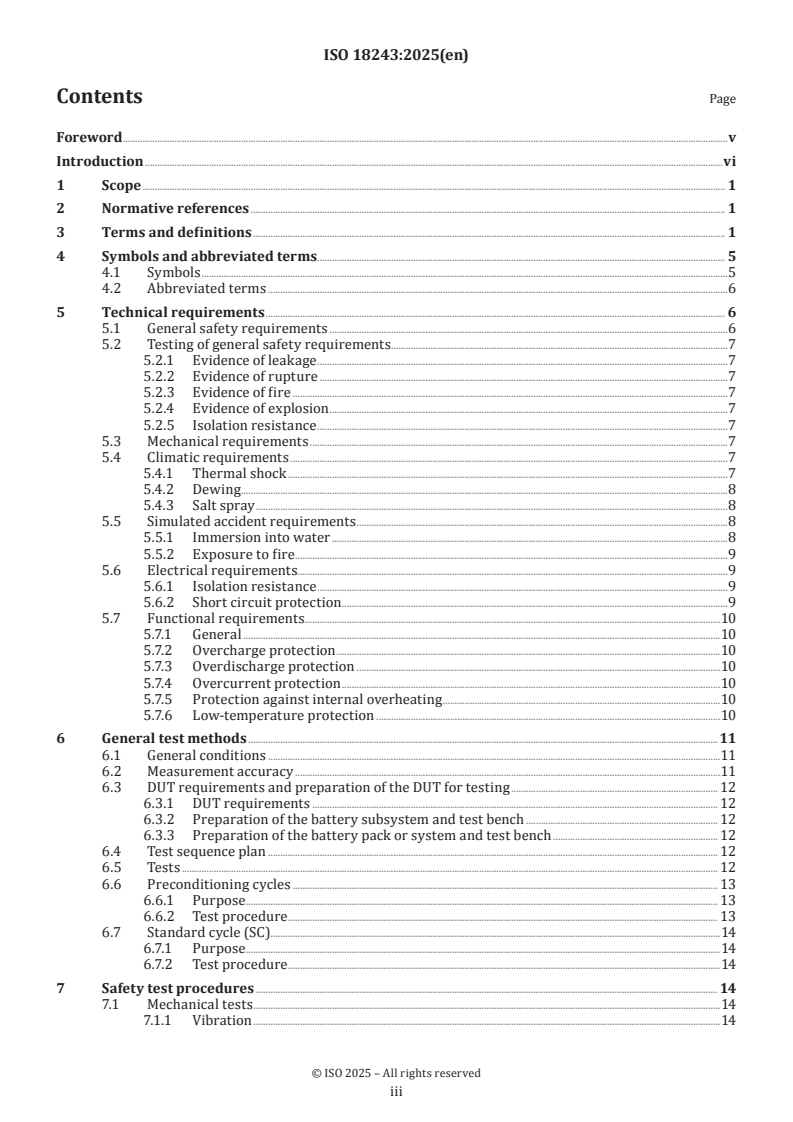
Contents Page
Foreword .v
Introduction .vi
1 Scope . 1
2 Normative references . 1
3 Terms and definitions . 1
4 Symbols and abbreviated terms. 5
4.1 Symbols .5
4.2 Abbreviated terms .6
5 Technical requirements . 6
5.1 General safety requirements .6
5.2 Testing of general safety requirements.7
5.2.1 Evidence of leakage .7
5.2.2 Evidence of rupture .7
5.2.3 Evidence of fire .7
5.2.4 Evidence of explosion .7
5.2.5 Isolation resistance .7
5.3 Mechanical requirements .7
5.4 Climatic requirements .7
5.4.1 Thermal shock .7
5.4.2 Dewing . .8
5.4.3 Salt spray .8
5.5 Simulated accident requirements .8
5.5.1 Immersion into water .8
5.5.2 Exposure to fire .9
5.6 Electrical requirements.9
5.6.1 Isolation resistance .9
5.6.2 Short circuit protection .9
5.7 Functional requirements . .10
5.7.1 General .10
5.7.2 Overcharge protection .10
5.7.3 Overdischarge protection .10
5.7.4 Overcurrent protection .10
5.7.5 Protection against internal overheating .10
5.7.6 Low-temperature protection .10
6 General test methods .11
6.1 General conditions .11
6.2 Measurement accuracy .11
6.3 DUT requirements and preparation of the DUT for testing . 12
6.3.1 DUT requirements . 12
6.3.2 Preparation of the battery subsystem and test bench . 12
6.3.3 Preparation of the battery pack or system and test bench . 12
6.4 Test sequence plan . 12
6.5 Tests . 12
6.6 Preconditioning cycles . 13
6.6.1 Purpose . 13
6.6.2 Test procedure. 13
6.7 Standard cycle (SC).14
6.7.1 Purpose .14
6.7.2 Test procedure.14
7 Safety test procedures . 14
7.1 Mechanical tests .14
7.1.1 Vibration .14
iii
7.1.2 Mechanical shock . 15
7.1.3 Drop . 15
7.2 Climatic tests . 15
7.2.1 Thermal shock . 15
7.2.2 Dewing . . .16
7.2.3 Salt spray .18
7.3 Simulated accident tests .18
7.3.1 Immersion into water .18
7.3.2 Exposure to fire . .18
7.4 Electrical test — Short circuit protection .19
7.5 Functional tests . 20
7.5.1 General procedures . 20
7.5.2 Overcharge protection . 20
7.5.3 Over discharge protection .21
7.5.4 Overcurrent protection .21
7.5.5 Protection against internal overheating . 22
8 Performance test methods .23
8.1 Energy and capacity at RT . 23
8.1.1 Purpose . 23
8.1.2 Test procedure. 23
8.1.3 Requirements . 23
8.2 Energy and capacity at different temperature and discharge rates .24
8.2.1 Purpose .24
8.2.2 Test procedure.24
8.2.3 Requirements . 26
8.3 Power and internal resistance . .27
8.3.1 Purpose .27
8.3.2 Pulse power characterization profile .27
8.3.3 Test procedure. 30
8.3.4 Requirements .32
8.4 No load SOC loss .32
8.4.1 Purpose .32
8.4.2 Test procedure.32
8.4.3 Test sequence. 33
8.4.4 Requirements . 34
8.5 SOC loss at storage . 34
8.5.1 Purpose . 34
8.5.2 Test procedure. 34
8.5.3 Test sequence. 35
8.5.4 Requirements . 35
8.6 Cycle life . 35
8.6.1 Purpose . 35
8.6.2 Preparation . 36
8.6.3 Test procedure. 36
8.6.4 Conditions.37
8.6.5 Monitoring and data logging .37
8.6.6 SOC determination.37
8.6.7 End of test criteria .37
8.6.8 Capacity fade . 38
8.6.9 Self-discharging rates . 38
8.6.10 Requirements . 38
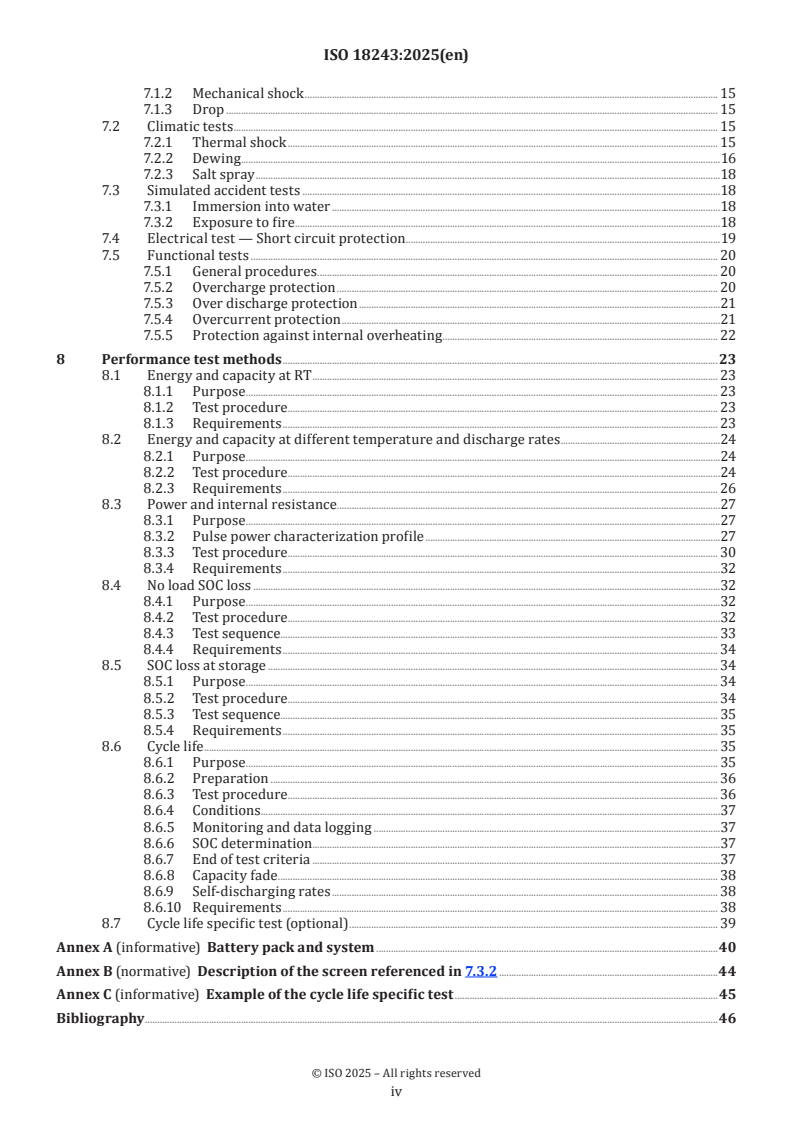
8.7 Cycle life specific test (optional) . 39
Annex A (informative) Battery pack and system .40
Annex B (normative) Description of the screen referenced in 7.3.2 .44
Annex C (informative) Example of the cycle life specific test .45
Bibliography .46
iv
Foreword
ISO (the International Organization for Standardization) is a worldwide federation of national standards
bodies (ISO member bodies). The work of preparing International Standards is normally carried out through
ISO technical committees. Each member body interested in a subject for which a technical committee
has been established has the right to be represented on that committee. International organizations,
governmental and non-governmental, in liaison with ISO, also take part in the work. ISO collaborates closely
with the International Electrotechnical Commission (IEC) on all matters of electrotechnical standardization.
The procedures used to develop this document and those intended for its further maintenance are described
in the ISO/IEC Directives, Part 1. In particular, the different approval criteria needed for the different types
of ISO documents should be noted. This document was drafted in accordance with the editorial rules of the
ISO/IEC Directives, Part 2 (see www.iso.org/directives).
ISO draws attention to the possibility that the implementation of this document may involve the use of (a)
patent(s). ISO takes no position concerning the evidence, validity or applicability of any claimed patent
rights in respect thereof. As of the date of publication of this document, ISO had not received notice of (a)
patent(s) which may be required to implement this document. However, implementers are cautioned that
this may not represent the latest information, which may be obtained from the patent database available at
www.iso.org/patents. ISO shall not be held responsible for identifying any or all such patent rights.
Any trade name used in this document is information given for the convenience of users and does not
constitute an endorsement.
For an explanation of the voluntary nature of standards, the meaning of ISO specific terms and expressions
related to conformity assessment, as well as information about ISO's adherence to the World Trade
Organization (WTO) principles in the Technical Barriers to Trade (TBT), see www.iso.org/iso/foreword.html.
This document was prepared by Technical Committee ISO/TC 22, Road vehicles, Subcommittee SC 38,
Motorcycles and mopeds, in collaboration with the European Committee for Standardization (CEN) Technical
Committee CEN/TC 301, Road vehicles, in accordance with the Agreement on technical cooperation between
ISO and CEN (Vienna Agreement).
This second edition cancels and replaces the first edition (ISO 18243:2017), which has been technically
revised. It also incorporates the Amendment ISO 18243:2017/Amd 1:2020.
The main changes are as follows:
— new safety requirement of undertemperature condition;
— new safety requirement of overcurrent protection;
— alignment with ISO 6469-1 and ISO 12405-4.
Any feedback or questions on this document should be directed to the user’s national standards body. A
complete listing of these bodies can be found at www.iso.org/members.html.
v
Introduction
Lithium-ion based battery systems are an efficient alternative energy storage system for electrically
propelled mopeds and motorcycles. The requirements for lithium-ion based battery systems to be used as
power source for the propulsion of electrically propelled mopeds and motorcycles are significantly different
to those batteries used for consumer electronics or stationary usage.
This document provides specific test procedures for lithium-ion battery packs and systems specifically
developed for propulsion of mopeds and motorcycles. This document specifies such tests and related
requirements to ensure that a battery pack or system is able to meet the specific needs of the mopeds and
motorcycles industry.
It enables mopeds and motorcycles manufacturers to choose test procedures to evaluate the characteristics
of a battery pack or system for their specific requirements.
vi
International Standard ISO 18243:2025(en)
Electrically propelled mopeds and motorcycles — Test
specifications and safety requirements for lithium-ion battery
systems
1 Scope
This document specifies the test procedures for lithium-ion battery packs and systems used in electrically
propelled mopeds and motorcycles.
The specified test procedures enable the user of this document to determine the essential characteristics
on performance and safety of lithium-ion battery packs and systems. It is also possible to compare the test
results achieved for different battery packs or systems.
This document enables setting up a dedicated test plan for an individual battery pack or system subject to an
agreement between customer and supplier. If required, the relevant test procedures and/or test conditions
of lithium-ion battery packs and systems are selected from the standard tests provided in this document to
configure a dedicated test plan.
NOTE 1 Electrically power-assisted cycles (EPAC) cannot be considered as mopeds. The definition of electrically
power-assisted cycles can differ from country to country. An example of definition can be found in Reference [7].
NOTE 2 Testing on cell level is specified in the IEC 62660 series.
2 Normative references
The following documents are referred to in the text in such a way that some or all of their content constitutes
requirements of this document. For dated references, only the edition cited applies. For undated references,
the latest edition of the referenced document (including any amendments) applies.
ISO 13063-3, Electrically propelled mopeds and motorcycles — Safety specifications — Part 3: Electrical safety
ISO 16750-1, Road vehicles — Environmental conditions and testing for electrical and electronic equipment —
Part 1: General
ISO 20653, Road vehicles — Degrees of protection (IP code) — Protection of electrical equipment against foreign
objects, water and access
IEC 60068-2-47, Environmental testing — Part 2-47: Tests – Mounting of specimens for vibration, impact and
similar dynamic tests
IEC 60068-2-52, Environmental testing — Part 2-52: Tests – Test Kb: Salt mist, cyclic (sodium, chloride solution).
3 Terms and definitions
For the purposes of this document, the following terms and definitions apply.
ISO and IEC maintain terminology databases for use in standardization at the following addresses:
— ISO Online browsing platform: available at https:// www .iso .org/ obp
— IEC Electropedia: available at https:// www .electropedia .org/
3.1
battery control unit
BCU
electronic device that controls, manages, detects, or calculates electric and thermal functions of the battery
system (3.4) and that provides communication between the battery system and other vehicle controllers
Note 1 to entry: See A.3.1, Annex A for further explanations.
[SOURCE: ISO 12405-4:2018, 3.1]
3.2
battery pack
energy storage device that includes cells or cell assemblies normally connected with cell electronics (3.6),
high voltage circuit and over current shut-off device including electrical interconnections, interfaces for
external systems (e.g. cooling, high voltage, auxiliary low voltage and communication)
Note 1 to entry: See A.2, Annex A for further explanations.
[SOURCE: ISO 12405-4:2018, 3.2]
3.3
battery pack subsystem
any assembly of components of the battery pack (3.2) which stores energy
[SOURCE: ISO 6469-1:2019, 3.24, modified — “RESS components” replaced by “components of the battery
pack”.]
3.4
battery system
energy storage device that includes cells or cell assemblies or battery pack(s) (3.2) as well as electrical
circuits and electronics (e.g. battery control unit (BCU) (3.1), contactors)
Note 1 to entry: See A.3.2 and A.3.3, Annex A for further explanations. Battery system components can also be
distributed in different devices within the vehicle.
[SOURCE: ISO 12405-4:2018, 3.3]
3.5
capacity
total number of ampere-hours that can be withdrawn from a fully charged battery under specified conditions
[SOURCE: ISO 12405-4:2018, 3.4]
3.6
cell electronics
electronic device that collects and possibly monitors thermal and electrical data of cells or cell assemblies
and contains electronic for cell balancing, if necessary
Note 1 to entry: The cell electronics can include a cell controller. The functionality of cell balancing can be controlled
by the cell electronics or it can be controlled by the battery control unit (BCU) (3.1).
[SOURCE: ISO 12405-4:2018, 3.5]
3.7
conductive part
part which can carry electric current
[SOURCE: ISO 13063-3:2022, 3.6]
3.8
customer
party interested in using the battery pack (3.2) or system and, therefore, orders or performs the test
EXAMPLE Vehicle manufacturer.
[SOURCE: ISO 6469-1:2019, 3.6]
3.9
electric chassis
conductive parts (3.7) of a vehicle that are electrically connected and whose potential is taken as reference
[SOURCE: ISO 13063-3:2022, 3.11]
3.10
energy round trip efficiency
ratio of the net DC energy (W·h discharge) delivered by a device under test (DUT) during a discharge test
to the total DC energy (W·h charge) required to restore the initial state of charge (SOC) (3.23) by a standard
charge
[SOURCE: ISO 12405-4:2018, 3.11]
3.11
explosion
sudden release of energy sufficient to cause pressure waves and/or projectiles that may cause structural
and/or physical damage to the surrounding area
[SOURCE: ISO 6469-1:2019, 3.10]
3.12
isolation resistance
resistance between live parts (3.14) of voltage class (3.27) B electric circuit and the electric chassis (3.9) as
well as the voltage class A system
[SOURCE: ISO 13063-3:2022, 3.18]
3.13
leakage
escape of liquid or gas except for venting (3.26)
[SOURCE: ISO 6469-1:2019, 3.15]
3.14
live part
conductor or conductive part (3.7) intended to be energized in normal use, but by convention, not the electric
chassis (3.9)
[SOURCE: ISO 13063-3:2022, 3.19]
3.15
maximum operating temperature
highest value of the temperature at which the systems/components can be operated continuously
[SOURCE: ISO 6469-1:2019, 3.17]
3.16
maximum working voltage
highest value of AC voltage (r.m.s.) or of DC voltage which may occur in an electrical system under any
normal operating conditions according to the manufacturer’s specifications, disregarding transients
[SOURCE: ISO 13063-3:2022, 3.20]
3.17
overcurrent protection
protection intended to operate when the current is in excess of a predetermined value
[SOURCE: ISO 6469-1:2019, 3.21]
3.18
passenger compartment
space for occupant accommodation, bounded by at least 4 of the following: the roof, floor, side walls, doors,
outside glazing, front bulkhead and rear bulkhead, or rear gate, as well as by the electrical protection
barriers and enclosures provided for protecting the occupants from direct contact with voltage class (3.27)
B live parts (3.14)
[SOURCE: Reference [8], modified — “high voltage” has been replaced by “voltage class B”.]
3.19
rated capacity
supplier’s (3.25) specification of the total number of ampere-hours that can be withdrawn from a fully
charged battery pack (3.2) or system for a specified set of test conditions such as discharge rate, temperature,
discharge cut-off voltage, etc
[SOURCE: ISO 12405-4:2018, 3.16]
3.20
removable battery pack
battery pack (3.2) that is designed to be taken out from the vehicle by the vehicle user
[SOURCE: ISO 13063-1:2022, 3.14, modified — “RESS” was replaced by “battery pack”, Note 1 to entry was
deleted.]
3.21
room temperature
RT
temperature of (25 ± 2) °C
[SOURCE: ISO 12405-4:2018, 3.17]
3.22
rupture
loss of mechanical integrity of the enclosure of the DUT resulting in openings that do not fulfil protection
degree IPXXB according to ISO 20653
Note 1 to entry: Predetermined openings for venting (3.26) are not considered as rupture.
[SOURCE: ISO 6469-1:2019 3.25]
3.23
state of charge
SOC
available capacity (3.5) in a battery pack (3.2) or system expressed as a percentage of rated capacity (3.19)
[SOURCE: ISO 12405-4:2018, 3.20]
3.24
standard charge for top off
SCH for top off
additional charge which eliminates possible state of charge (SOC) (3.23) reduction after standard charge
(SCH) at room temperature (RT) (3.21) followed by thermal equilibration at a different temperature
[SOURCE: ISO 12405-4:2018, 3.21]
3.25
supplier
party that provides battery systems (3.4) and packs
EXAMPLE A battery manufacturer.
[SOURCE: ISO 6469-1:2019, 3.27]
3.26
venting
release of excessive pressure intended by design
[SOURCE: ISO 6469-1:2019, 3.28]
3.27
voltage class
classification of an electric component or circuit with a maximum working voltage (3.16) of ≤30 V a.c. or
≤60 V d.c., respectively classification of an electric component or circuit according to its maximum working
voltage
Note 1 to entry: The classification to the voltage classes A and B is according to ISO 13063-3:2022.
[SOURCE: ISO 13063-3:2022, 3.36, modified — Note 1 to entry added.]
3.28
water depth
level of water a vehicle is designed for operation according to the vehicle manufacturer’s specification
Note 1 to entry: The vehicle manufacturer may consider the local environmental conditions where the vehicle is placed
on the market.
[SOURCE: ISO 6469-1:2019, 3.30]
3.31
internal resistance
opposition to the flow of current within a cell or a battery under reference conditions, that is, the sum
of electronic resistance and ionic resistance to the contribution to total effective resistance including
inductive/capacitive properties
[SOURCE: Reference [9]]
4 Symbols and abbreviated terms
4.1 Symbols
C capacity fade
fade
I charge pulse current specified by the supplier for power, internal resistance and energy efficiency
cp
testing
I maximum continuous discharge current specified by the supplier for energy and capacity testing
d,max
I maximum discharge pulse current specified by the supplier for power, internal resistance and
dp,max
energy efficiency testing
P power
R resistance
T maximum temperature
max
T minimum temperature
min
t time
U voltage
w water depth
4.2 Abbreviated terms
a.c. alternating current
BCU battery control unit
BOL beginning of life
C capacity, expressed in ampere-hours (A·h)
nC current rate equal to n times the 1 h discharge capacity expressed in ampere (e.g. 5 C is equal to
five times the 1 h current discharge rate, expressed in A)
d.c. direct current
DUT device under test
EODV end of discharge voltage
Li lithium
Li-ion lithium-ion
OCV open circuit voltage
r.m.s. root mean square
RT room temperature (25 ± 2) °C
SC standard cycle
SCH standard charge
SDCH standard discharge
SOC state of charge
5 Technical requirements
5.1 General safety requirements
The following requirements are general safety requirements, which apply when cited.
— The DUT shall not exhibit any evidence of leakage.
— The DUT shall not exhibit continuous emission of flames for more than 1 s or explosion.
— The DUT shall not exhibit any evidence of rupture.
— The voltage class B DUT shall maintain an isolation resistance according to 5.6.1.
Conformance shall be tested in accordance with 5.2.
5.2 Testing of general safety requirements
5.2.1 Evidence of leakage
The evidence of leakage shall be tested without disassembling any part of the DUT. Verification of electrolyte
may be determined by visual inspection, litmus paper testing, and/or chemical analysis of the fluid after the
observation period.
5.2.2 Evidence of rupture
The evidence of rupture shall be tested in accordance with ISO 20653 after the observation period.
5.2.3 Evidence of fire
The evidence of continuous emission of flames for more than 1 s shall be tested by visual inspection during
the test and during the observation period.
NOTE Sparks and arcing are not considered as flames.
5.2.4 Evidence of explosion
The evidence of explosion shall be tested by visual inspection or appropriate means for detection of
projectiles from the DUT during the test and during the observation period.
5.2.5 Isolation resistance
The isolation resistance shall be measured after the test and after the observation period. The measurement
shall be conducted according to the relevant test procedures in ISO 13063-3 but without preconditioning
and conditioning.
5.3 Mechanical requirements
The battery pack or system shall provide the safety performance as specified below under mechanical loads
due to vibration, mechanical shock and drop of the removable battery pack, which a battery pack or system
will likely experience during the normal operation of a vehicle over its lifetime.
The general safety requirements in accordance with 5.1 shall be fulfilled.
Conformance shall be tested in accordance with 7.1.
The drop test described in 7.1.3 shall apply to removable battery packs only.
A battery pack or system that passes the vibration test described in 7.1.1 in all three mutually perpendicular
X, Y and Z directions may be mounted in any orientation on the vehicle.
5.4 Climatic requirements
5.4.1 Thermal shock
The battery pack or system shall provide the safety performance as specified below under a climatic load
due to rapid temperature changes, which a battery pack or system will likely experience during the normal
operation of a vehicle.
The general safety requirements in accordance with 5.1 shall be fulfilled.
Conformance shall be tested in accordance with 7.2.1.
5.4.2 Dewing
The battery pack or system shall provide the safety performance as specified below under high ambient
humidity.
The failure modes of electrical malfunction(s) caused by moisture (e.g. leakage current caused by a printed
circuit board which is soaked with moisture) shall be addressed.
NOTE An additional failure mode can be a breathing effect which transports moisture inside the housing when
the air inside the system/components cools down and ambient air with high humidity is drawn into the system/
components.
This test shall apply to battery packs and systems.
All functions of the device/system shall perform as designed during and after the test.
For a voltage class B battery pack or system, measured data shall include the isolation resistance between
the DUT case and positive / negative terminals before and after the test.
The general safety requirements in accordance with 5.1 shall be fulfilled.
Conformance shall be tested in accordance with 7.2.2.
5.4.3 Salt spray
The battery pack or system shall provide the safety performance as specified below under anticipated
exposure to salt mist conditions due either to moped or motorcycle use near marine environments or to salt
de-icing utilized on roads during winter months.
All functions of the device/system shall perform as designed during and after the test.
For a voltage class B battery pack or system, measured data shall include the isolation resistance between
the DUT case and the positive and negative terminals before and after the test.
The general safety requirements in accordance with 5.1 shall be fulfilled.
Conformance shall be tested in accordance with 7.2.3.
5.5 Simulated accident requirements
5.5.1 Immersion into water
The battery pack or system shall provide the safety performance as specified below when it is exposed to
water due to water immersion.
NOTE This requirement does not cover incidents in which the primary hazard for persons is caused by the
presence of water, e.g. high flooding, flooded underground parking, flooded underpass.
The requirement is fulfilled if the battery pack, system or subsystem meets one of the following conditions:
— The battery pack, system or subsystem shall be tested in accordance with 7.3.1. During the test and
during the post-test observation period of 2 h, the battery pack, system or subsystem shall not exhibit
any evidence of continuous emission of flames for more than 1 s, or explosion.
— The battery pack, system or subsystem including all connectors, air ducts and connections for cooling
attached is water protected. It shall be tested in accordance with IPX7 in ISO 20653 and no occurrence of
water is allowed inside the battery pack, system or subsystem after the exposure to water. The test may
be conducted with only the housing of a battery pack, system or subsystem and all connectors, air ducts
and connections for cooling attached.
Minimal appearance of water due to the condensation of air humidity is possible and not considered as an
occurrence of water. In case of doubt the test may be performed with coloured water.
5.5.2 Exposure to fire
This requirement applies to battery packs or systems used on electric mopeds or motorcycles with a
passenger compartment only.
The battery pack or system shall provide the safety performance as specified below when it is exposed to
fire from outside of the vehicle. A thermal load can occur due to a fuel fire underneath the vehicle. Such a fire
can be caused by fire from ignited spilled fuel either from the vehicle itself or a nearby vehicle. The intention
is to provide time for the driver, passengers, and bystande
...