


ISO/IEC 30192:2016
(Main)Information technology — Digitally recorded media for information interchange and storage — 120 mm Single Layer (25,0 Gbytes per disk) and Dual Layer (50,0 Gbytes per disk) BD Rewritable disk
Information technology — Digitally recorded media for information interchange and storage — 120 mm Single Layer (25,0 Gbytes per disk) and Dual Layer (50,0 Gbytes per disk) BD Rewritable disk
ISO 30192:2016 specifies the mechanical, physical and optical characteristics of a 120 mm rewritable optical disk with a capacity of 25,0 Gbytes or 50,0 Gbytes. It specifies the quality of the recorded and unrecorded signals, the format of the data and the recording method, thereby allowing for information interchange by means of such disks. User data can be written, read and overwritten many times using a reversible method. A conforming disk is identified as a BD Rewritable disk. ISO 30192:2016 specifies the following: - two related but different Types of this disk; - conditions for conformance; - environments in which the disk is to be operated and stored; - mechanical and physical characteristics of the disk, which allow mechanical interchange between data processing systems; - format of the information on the disk, including the physical disposition of the Tracks and Sectors; - error-correcting codes and coding method used; - characteristics of the signals recorded on the disk, which enable data processing systems to read data from the disk. This International Standard provides for interchange of disks between drives. Together with a standard for volume and file structure, it provides for full data interchange between data processing systems.
Technologies de l'information — Supports enregistrés numériquement pour échange et stockage d'information — Disques BD réinscriptibles de 120 mm simple couche (25,0 Go par disque) et double couche (50,0 Go par disque)
General Information
- Status
- Withdrawn
- Publication Date
- 05-Jun-2016
- Withdrawal Date
- 05-Jun-2016
- Current Stage
- 9599 - Withdrawal of International Standard
- Start Date
- 26-Jan-2021
- Completion Date
- 12-Feb-2026
Relations
- Effective Date
- 06-Jun-2022
- Effective Date
- 23-Apr-2020
- Effective Date
- 05-Nov-2015



Get Certified
Connect with accredited certification bodies for this standard

BSI Group
BSI (British Standards Institution) is the business standards company that helps organizations make excellence a habit.

NYCE
Mexican standards and certification body.
Sponsored listings
Frequently Asked Questions
ISO/IEC 30192:2016 is a standard published by the International Organization for Standardization (ISO). Its full title is "Information technology — Digitally recorded media for information interchange and storage — 120 mm Single Layer (25,0 Gbytes per disk) and Dual Layer (50,0 Gbytes per disk) BD Rewritable disk". This standard covers: ISO 30192:2016 specifies the mechanical, physical and optical characteristics of a 120 mm rewritable optical disk with a capacity of 25,0 Gbytes or 50,0 Gbytes. It specifies the quality of the recorded and unrecorded signals, the format of the data and the recording method, thereby allowing for information interchange by means of such disks. User data can be written, read and overwritten many times using a reversible method. A conforming disk is identified as a BD Rewritable disk. ISO 30192:2016 specifies the following: - two related but different Types of this disk; - conditions for conformance; - environments in which the disk is to be operated and stored; - mechanical and physical characteristics of the disk, which allow mechanical interchange between data processing systems; - format of the information on the disk, including the physical disposition of the Tracks and Sectors; - error-correcting codes and coding method used; - characteristics of the signals recorded on the disk, which enable data processing systems to read data from the disk. This International Standard provides for interchange of disks between drives. Together with a standard for volume and file structure, it provides for full data interchange between data processing systems.
ISO 30192:2016 specifies the mechanical, physical and optical characteristics of a 120 mm rewritable optical disk with a capacity of 25,0 Gbytes or 50,0 Gbytes. It specifies the quality of the recorded and unrecorded signals, the format of the data and the recording method, thereby allowing for information interchange by means of such disks. User data can be written, read and overwritten many times using a reversible method. A conforming disk is identified as a BD Rewritable disk. ISO 30192:2016 specifies the following: - two related but different Types of this disk; - conditions for conformance; - environments in which the disk is to be operated and stored; - mechanical and physical characteristics of the disk, which allow mechanical interchange between data processing systems; - format of the information on the disk, including the physical disposition of the Tracks and Sectors; - error-correcting codes and coding method used; - characteristics of the signals recorded on the disk, which enable data processing systems to read data from the disk. This International Standard provides for interchange of disks between drives. Together with a standard for volume and file structure, it provides for full data interchange between data processing systems.
ISO/IEC 30192:2016 is classified under the following ICS (International Classification for Standards) categories: 35.220.30 - Optical storage devices. The ICS classification helps identify the subject area and facilitates finding related standards.
ISO/IEC 30192:2016 has the following relationships with other standards: It is inter standard links to ISO/IEC 30192:2016/Amd 1:2019, ISO/IEC 30192:2021, ISO/IEC 30192:2013. Understanding these relationships helps ensure you are using the most current and applicable version of the standard.
ISO/IEC 30192:2016 is available in PDF format for immediate download after purchase. The document can be added to your cart and obtained through the secure checkout process. Digital delivery ensures instant access to the complete standard document.
Standards Content (Sample)
ISO/IEC
INTERNATIONAL
STANDARD
Second edition
2016‐06‐15
Corrected version
2017‐01
Information technology — Digitally
recorded media for information
interchange and storage — 120 mm
Single Layer (25,0 Gbytes per disk)
and Dual Layer (50,0 Gbytes per disk)
BD Rewritable disk
Technologies de l’information — Supports enregistrés
numériquement pour échange et stockage d’information — Disques
BD réinscriptibles de 120 mm simple couche (25,0 Go par disque) et
double couche (50,0 Go par disque)
Reference number
ISO/IEC 30192:2016(E)
©
ISO/IEC 2016
© ISO/IEC 2016, Published in Switzerland
All rights reserved. Unless otherwise specified, no part of this publication may be reproduced or utilized otherwise in any
form or by any means, electronic or mechanical, including photocopying, or posting on the internet or an intranet, without
prior written permission. Permission can be requested from either ISO at the address below or ISO’s member body in the
country of the requester.
ISO copyright office
Ch. de Blandonnet 8 • CP 401
CH‐1214 Vernier, Geneva, Switzerland
Tel. +41 22 749 01 11
Fax +41 22 749 09 47
copyright@iso.org
www.iso.org
ii © ISO/IEC 2016 – All rights reserved
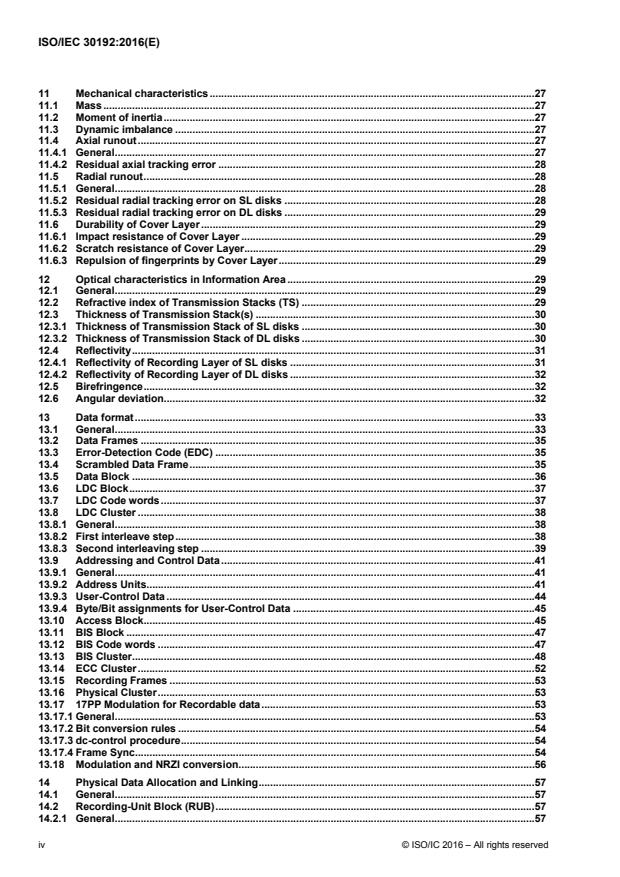
Contents Page
1 Scope . 1
2 Conformance . 2
2.1 Optical Disk . 2
2.2 Generating system . 2
2.3 Receiving system . 2
2.4 Compatibility statement . 2
3 Normative references . 2
4 Terms and definitions . 3
5 Conventions and notations . 7
5.1 Terminology . 7
5.1.1 Meaning of words . 7
5.1.2 Levels of grouping . 7
5.2 Representation of numbers . 7
5.3 Integer calculus . 8
5.4 Names . 8
6 List of acronyms . 8
7 General descriptions of disk . 11
8 General requirements . 13
8.1 Environments . 13
8.1.1 Test environment . 13
8.1.2 Operating environment . 13
8.1.3 Storage environment . 14
8.1.4 Transportation . 15
8.2 Safety requirements . 15
8.3 Flammability . 15
9 Reference drive . 15
9.1 General . 15
9.2 Environmental conditions . 15
9.3 Optical system . 15
9.4 Optical beam . 17
9.5 HF read channel . 17
9.6 Radial PP read channel . 18
9.7 Disk Clamping . 18
9.8 Rotation of the disk and Measurement Velocity . 18
9.9 Normalized servo transfer function . 19
9.10 Measurement Velocity and Reference servo for axial tracking . 20
9.11 Measurement Velocity and Reference servo for radial tracking . 21
10 Dimensional characteristics . 22
10.1 General . 22
10.2 Disk reference planes and reference axis. 22
10.3 Overall dimensions . 23
10.4 First transition Area . 24
10.5 Protection ring . 24
10.6 Clamping Zone . 24
10.7 Second transition Area . 24
10.8 Information Area . 25
10.8.1 General . 25
10.8.2 Subdivisions of Information Zone on SL disk . 25
10.8.3 Subdivisions of Information Zone on DL disks . 26
10.9 Rim Area . 27
© ISO/IEC 2016 – All rights reserved iii
11 Mechanical characteristics .27
11.1 Mass .27
11.2 Moment of inertia .27
11.3 Dynamic imbalance .27
11.4 Axial runout .27
11.4.1 General .27
11.4.2 Residual axial tracking error .28
11.5 Radial runout .28
11.5.1 General .28
11.5.2 Residual radial tracking error on SL disks .28
11.5.3 Residual radial tracking error on DL disks .29
11.6 Durability of Cover Layer .29
11.6.1 Impact resistance of Cover Layer .29
11.6.2 Scratch resistance of Cover Layer .29
11.6.3 Repulsion of fingerprints by Cover Layer .29
12 Optical characteristics in Information Area .29
12.1 General .29
12.2 Refractive index of Transmission Stacks (TS) .29
12.3 Thickness of Transmission Stack(s) .30
12.3.1 Thickness of Transmission Stack of SL disks .30
12.3.2 Thickness of Transmission Stack of DL disks .30
12.4 Reflectivity .31
12.4.1 Reflectivity of Recording Layer of SL disks .31
12.4.2 Reflectivity of Recording Layer of DL disks .32
12.5 Birefringence .32
12.6 Angular deviation .32
13 Data format .33
13.1 General .33
13.2 Data Frames .35
13.3 Error-Detection Code (EDC) .35
13.4 Scrambled Data Frame .35
13.5 Data Block .36
13.6 LDC Block .37
13.7 LDC Code words .37
13.8 LDC Cluster .38
13.8.1 General .38
13.8.2 First interleave step .38
13.8.3 Second interleaving step .39
13.9 Addressing and Control Data .41
13.9.1 General .41
13.9.2 Address Units .41
13.9.3 User-Control Data .44
13.9.4 Byte/Bit assignments for User-Control Data .45
13.10 Access Block .45
13.11 BIS Block .47
13.12 BIS Code words .47
13.13 BIS Cluster .48
13.14 ECC Cluster .52
13.15 Recording Frames .53
13.16 Physical Cluster .53
13.17 17PP Modulation for Recordable data .53
13.17.1 General .53
13.17.2 Bit conversion rules .54
13.17.3 dc-control procedure .54
13.17.4 Frame Sync .54
13.18 Modulation and NRZI conversion .56
14 Physical Data Allocation and Linking .57
14.1 General .57
14.2 Recording-Unit Block (RUB) .57
14.2.1 General .57
iv © ISO/IC 2016 – All rights reserved
14.2.2 Data Run-in . 57
14.2.3 Data Run-out . 58
14.2.4 Guard_3 field . 59
14.3 Locating data relative to wobble addresses . 60
14.3.1 General . 60
14.3.2 Start-Position Shift (SPS) . 60
15 Track format . 61
15.1 General . 61
15.2 Track shape . 62
15.3 Track Path . 64
15.4 Track Pitch . 64
15.4.1 Track Pitch in BCA Zone . 64
15.4.2 Track Pitch in Embossed HFM Areas . 64
15.4.3 Track Pitch in Rewritable Areas . 64
15.4.4 Track Pitch between Embossed HFM Area and Rewritable Area . 65
15.5 Track layout of HFM Groove . 65
15.5.1 General . 65
15.5.2 Data Format . 65
15.5.3 Addressing and Control Data . 66
15.5.4 Recording Frames . 69
15.6 Track layout of Wobbled Groove(s) . 71
15.6.1 General . 71
15.6.2 Modulation of wobbles . 72
15.7 ADIP Information . 73
15.7.1 General . 73
15.7.2 ADIP-Unit Types . 73
15.7.3 ADIP Word structure . 75
15.7.4 ADIP Data structure . 76
15.7.5 ADIP Error Correction . 78
15.8 Disk Information in ADIP Aux Frame . 80
15.8.1 General . 80
15.8.2 Error protection for Disk-Information Aux Frames . 80
15.8.3 Disk-Information Data structure . 81
16 General description of Information Zone . 112
16.1 General . 112
16.2 Format of Information Zone on Single-Layer disk . 112
16.3 Format of Information Zone on Dual-Layer disk . 112
17 Layout of Rewritable Area of Information Zone . 112
18 Inner Zone . 116
18.1 General . 116
18.2 Permanent Information & Control data (PIC) Zone . 118
18.2.1 General . 118
18.2.2 Content of PIC Zone . 118
18.2.3 Emergency Brake . 119
18.3 Rewritable Area of Inner Zone(s) . 121
18.3.1 Protection-Zone 2 . 121
18.3.2 INFO 2 / Reserved 8 . 121
18.3.3 INFO 2 / Reserved 7 . 121
18.3.4 INFO 2 / Reserved 6 . 121
18.3.5 INFO 2 / Reserved 5 . 122
18.3.6 INFO 2 / PAC 2 . 122
18.3.7 INFO 2 / DMA 2 . 122
18.3.8 INFO 2 / Control Data 2 . 122
18.3.9 INFO 2 / Buffer 2 . 122
18.3.10 OPC / Test Zone . 122
18.3.11 Reserved . 122
18.3.12 INFO1 / Buffer 1 . 122
18.3.13 INFO 1 / Drive Area (optional) . 122
18.3.14 INFO 1 / Reserved 3 . 124
18.3.15 INFO 1 / Reserved 2 . 124
© ISO/IEC 2016 – All rights reserved v
18.3.16 INFO 1 / Reserved 1 . 124
18.3.17 INFO 1 / DMA 1 . 124
18.3.18 INFO1 / Controle Data 1 . 124
18.3.19 INFO1 / PAC 1 . 124
19 Data Zone . 124
20 Outer Zone(s) . 125
20.1 General . 125
20.2 INFO 3 / Buffer 4 . 126
20.3 INFO 3 / DMA 3 . 126
20.4 INFO 3 / Control Data 4 . 126
20.5 Angular buffer . 126
20.6 INFO 4 / DMA 4 . 126
20.7 INFO 4 / Control Data 4 . 126
20.8 INFO 4 / Buffer 6 . 126
20.9 Protection-Zone 3 . 126
21 Physical-Access Control Clusters . 127
21.1 General . 127
21.2 Layout of PAC Zones . 127
21.3 General structure of PAC Clusters . 128
21.4 Primary PAC Cluster (mandatory) . 131
21.5 Disk Write-Protect PAC Cluster (optional) . 134
21.6 IS1 and IS2 PAC Clusters . 137
22 Disk Management . 138
22.1 General . 138
22.2 Disk-Management Structure (DMS) . 138
22.2.1 General . 138
22.2.2 Disk-Definition Structure (DDS) . 139
22.2.3 Defect List (DFL) . 143
22.2.4 Defect-List Header (DLH) . 143
22.2.5 List of Defects . 144
22.2.6 DFL Entries . 146
23 Assignment of Logical-Sector Numbers (LSNs) . 147
24 Characteristics of Grooved Areas . 148
25 Method of testing for Grooved Area . 148
25.1 General . 148
25.2 Environment . 148
25.3 Reference drive . 148
25.3.1 General . 148
25.3.2 Read power . 148
25.3.3 Read channels . 148
25.3.4 Tracking requirements . 149
25.3.5 Scanning velocity . 149
25.4 Definitions of signals . 149
26 Signals from HFM Grooves . 151
26.1 Push-Pull signal . 151
26.2 HFM Wobble signal . 151
26.3 Jitter of HFM signal. 151
27 Signals from Wobbled Groove(s) . 152
27.1 Phase depth . 152
27.2 Push-Pull signal . 152
27.3 Wobble signal . 152
27.3.1 General . 152
27.3.2 Measurement of NWS . 152
27.3.3 Measurement of wobble CNR . 152
27.3.4 Measurement of harmonic distortion requirements . 153
28 Characteristics of Recording Layer . 153
vi © ISO/IEC 2016 – All rights reserved
29 Method of testing for Recording Layer . 154
29.1 General . 154
29.2 Environment . 154
29.3 Reference drive . 154
29.3.1 General . 154
29.3.2 Read power . 154
29.3.3 Read channels . 154
29.3.4 Tracking requirements . 154
29.3.5 Scanning velocities . 154
29.4 Write conditions . 154
29.4.1 Write-pulse waveform . 154
29.4.2 Write powers . 155
29.4.3 Write conditions for jitter measurement . 155
29.4.4 Write conditions for cross-erase measurement . 155
29.4.5 Write conditions for inter-velocity overwrite measurements . 155
29.5 Definition of signals . 156
30 Signals from Recorded Areas . 156
30.1 HF signals . 156
30.2 Modulated amplitude . 156
30.3 Reflectivity-Modulation product . 157
30.4 Asymmetry . 157
30.5 Jitter . 157
30.6 Cross-erase . 158
30.7 Inter-velocity overwrite . 158
30.8 Read stability . 159
31 Local defects . 160
32 Characteristics of User Data . 160
33 Method of testing for User Data . 160
33.1 General . 160
33.2 Environment . 160
33.3 Reference drive . 161
33.3.1 General . 161
33.3.2 Read power . 161
33.3.3 Read channels . 161
33.3.4 Error Correction . 161
33.3.5 Tracking requirements . 161
33.3.6 Scanning velocities . 161
33.4 Definition of signals . 161
34 Minimum quality of recorded information . 163
34.1 Random Symbol Error Rate . 163
34.2 Maximum burst errors. 163
34.3 User-written Data . 163
35 BCA . 164
Annex A (normative) Thickness of Transmission Stacks in case of multiple layers . 165
A.1 General . 165
A.2 Refractive Index n of all layers in Cover Layer and Spacer Layer . 165
i
A.3 Thickness variation of the Transmission Stack . 165
A.4 Example of thickness calculation for SL . 165
Annex B (normative) Measurement of reflectivity . 166
B.1 General . 166
B.2 Calibration method . 167
B.3 Measuring method .
...
Questions, Comments and Discussion
Ask us and Technical Secretary will try to provide an answer. You can facilitate discussion about the standard in here.
Loading comments...