

ISO/DTR 7035-1
(Main)Design and asset management of ductile iron pipes (DIP) for water application — Part 1: Principles and objects of asset management
- Status
- Not Published
- Technical Committee
- ISO/TC 5/SC 2 - Cast iron pipes, fittings and their joints
- Drafting Committee
- ISO/TC 5/SC 2/WG 26 - Design and asset management
- Current Stage
- 5020 - Proof sent to secretariat or FDIS ballot initiated: 8 weeks - 50 Approval
- Start Date
- 19-Oct-2026
- Due Date
- 19-Oct-2026
- Completion Date
- 19-Oct-2026
Buy Documents
ISO/DTR 7035-1 - Design and asset management of ductile iron pipes (DIP) for water application — Part 1: Principles and objects of asset management
REDLINE ISO/DTR 7035-1 - Design and asset management of ductile iron pipes (DIP) for water application — Part 1: Principles and objects of asset management
ISO/DTR 7035-1 is an ISO draft technical report on the design and asset management of ductile iron pipes (DIP) for water application. It gives guidance for managing drinking water pipeline assets at strategic, tactical and operational levels, with emphasis on service levels, risk, life cycle cost, and long-term renovation decisions. The document is aimed at water utilities and others who need to select, operate, maintain and renew pipeline systems over long periods.
What does ISO/DTR 7035-1 specify?
ISO/DTR 7035-1 describes good practices for the asset management of ductile iron pipeline systems for drinking water. The document focuses on future selection of products and solutions that meet technical and economic needs over long, multi-generational periods.
ISO/DTR 7035-1 applies to pipeline assets, and its principles are presented in a way that can be used more broadly. It does not cover the many other waterworks components such as treatment, pumping and storage that also affect network management.
The document is organized into:
- Clause 1 - Scope
- Clause 2 - Normative references
- Clause 3 - Terms, definitions and abbreviated terms
- Clause 4 - Assets management of potable water networks
- Clause 5 - Practice of asset management for ductile iron pipeline systems
- Annex A - Reference documents for the functional requirements of ductile iron pipeline systems
- Annex B - Example of risk assessment for urban water pipe networks
| Annex | What it covers |
|---|---|
| Annex A | How ductile iron pipeline systems relate to functional requirements, with references to related ISO standards and design features |
| Annex B | A practical example of risk assessment, including occurrence and consequence scoring for urban water pipelines |
What are the key requirements of ISO/DTR 7035-1?
ISO/DTR 7035-1 is a guidance document, so its main value is in the management approach it sets out. It tells a water utility what information to gather, what decisions to structure, and how to connect technical choices with service and cost objectives.
Establish an asset management policy and plan
Clause 4.1 says utility managers generally need an asset management policy, implementation and monitoring plans, an understanding of asset condition, and identification of failure risks. In practice, that means the utility should know what it owns, how it is performing, and which assets matter most before it prioritizes work.
Define demand, service levels and performance indicators
Clause 4.2 links asset management to demand forecasting, agreed service levels and SMART service level indicators. ISO/DTR 7035-1 treats service level as a measurable description of availability, quality, pressure, flow, interruptions and response time. For the reader, this means targets should be written so they can be measured and reported, not just stated in general terms.
Connect functional requirements to water utility objectives
Clause 4.2.3 links functional requirements to objectives such as drinking water quality, continuity of supply, flow and pressure, maintainability, emergency service, sustainability, energy use, long design life, leakage reduction and protection of adjacent structures. Annex A shows how ductile iron pipes can meet those needs through pipe design, joints, linings and coatings. In practice, this helps a utility justify why one pipe solution fits a given service objective better than another.
Evaluate risk using occurrence and consequence
Clause 4.3 defines risk as failure rate multiplied by consequence in a given context. The document uses weighted indexes to estimate occurrence and consequence, then supports risk-level tables and matrices. For asset managers, this means prioritization is based on both probability and impact, not only on age or on the number of failures.
Use asset data and linked information systems
Clause 4.3 says asset management systems need good records and integration with financial, customer service, maintenance and GIS systems. That matters because decision-making depends on having the same asset seen through technical, financial and location data, not through isolated spreadsheets.
Use whole-of-life costing and renewal timing
Clause 4.4 and 4.5 place strong emphasis on life cycle cost (LCC) and the total cost of ownership (TCO). The document explains that renewal timing, maintenance timing and replacement timing should be studied as scenarios, because delay can increase service disruption and cost. In practice, this supports choosing the option with the best overall cost and risk profile over the full life of the asset.
Plan operations, capital works and finance together
Clause 4.4 groups asset management into operational, maintenance, capital works and financial strategies. It also points to emergency plans, operator training, long-term capital planning and financial forecasting. For users of the document, the message is that pipe decisions should be tied to budgets, staffing, financing and expected service needs.
Apply practical risk scoring and LCC methods for DIP
Clause 5.1 gives the main types of indexes used in risk assessment for water pipelines, and Annex B shows a worked example for urban water networks. Clause 5.2 states that LCC for ductile iron pipe is normally built from acquisition, operation, maintenance, and end-of-life cost or revenue. That gives asset managers a practical way to compare options on a common economic basis.
What terms does ISO/DTR 7035-1 define?
- Asset - A capital-forming good used to provide a service, such as pipes, wells, tanks, buildings or software.
- Asset management - The set of processes used to direct, control and optimize the provision, maintenance and disposal of infrastructure assets over their life cycle.
- Level of service - The service offered to users, expressed through factors such as quality, quantity, reliability, pressure, availability and cost.
- Life cycle cost (LCC) - The total cost of an asset through its service life, including planning, design, construction, operation, maintenance, rehabilitation and disposal.
- Performance indicator - A measure used to assess whether an objective is being achieved.
- Rehabilitation - Measures used to restore or upgrade an existing asset system, including renovation, repair and replacement.
- Service life - The period after installation during which an asset or asset system meets or exceeds the required functional performance.
- Ductile iron pipe (DIP) - The pipe type at the center of this document and the main example used for the guidance.
Who uses ISO/DTR 7035-1?
ISO/DTR 7035-1 is used by water utilities, municipal owners, asset managers, engineers, planners and maintenance teams responsible for drinking water networks. It is also relevant to finance and funding staff because the document links technical choices to life cycle cost, capital works planning and cash-flow forecasting.
Quality managers and decision-makers use it to set service levels, define performance indicators, rank risks and compare renewal options. Buyers and specifiers use it when they need to select pipe solutions that fit a long-term service objective, a maintenance strategy or a renovation plan.
Which standards are used with ISO/DTR 7035-1?
| Reference | What it contributes |
|---|---|
| ISO 2531 | Basic requirements for ductile iron pipes, fittings, accessories and joints for water applications |
| ISO 4179 | Cement mortar lining for ductile iron pipes and fittings |
| ISO 4370 | Environmental life cycle assessment and recycling of ductile iron pipes |
| ISO 8179-1 | External zinc-based coating for ductile iron pipes and fittings |
| ISO 10803 | Design method for ductile iron pipes |
| ISO 16631 | Compatibility with plastic piping systems and plastic pipeline connections, repair and replacement |
| ISO 18468 | Epoxy coating for ductile iron fittings, accessories, joints and valves |
| ISO 21051 | Construction and installation of ductile iron pipeline system |
| ISO 21053 | Life cycle analysis and recycling of ductile iron pipes, and detailed LCC definitions and formulas |
| ISO 24131-1 | Polyurethane internal lining requirements and test methods |
| ISO 24131-2 | Epoxy internal lining requirements and test methods |
| ISO/TR 7035-2 | Design, installation and operation of ductile iron pipes for water application |
What does the ISO/DTR 7035-1 document contain?
ISO/DTR 7035-1 contains a general framework for asset management of potable water networks, followed by practical guidance on principles, objectives, risk evaluation, implementation and renovation. It includes a table that links water utility objectives to functional requirements, and it shows how those requirements relate to ductile iron pipeline systems.
The document also includes formulas for risk occurrence and risk consequence, and it uses those ideas to support risk matrices and prioritization. Clause 5 adds practical index scoring for pipe material, diameter, age, surroundings, leakage and historic events, as well as consequence factors such as users affected, location and network reliability.
Annex A gives a structured link between functional requirements and related standards, such as lining, coating, joint performance, design and installation. Annex B provides a worked example for urban water pipe networks, including scenario-based assessment and selected scores for occurrence and consequence.
The figures support renewal timing, postponement effects and life cycle cost comparison. For a reader, that means the document is not only conceptual - it also shows the kinds of tables, scoring methods, cost breakdowns and planning tools that asset managers can use in practice.
Buy Documents
ISO/DTR 7035-1 - Design and asset management of ductile iron pipes (DIP) for water application — Part 1: Principles and objects of asset management
REDLINE ISO/DTR 7035-1 - Design and asset management of ductile iron pipes (DIP) for water application — Part 1: Principles and objects of asset management
Get Certified
Connect with accredited certification bodies for this standard

Institut za varilstvo d.o.o. (Welding Institute)
Slovenia's leading welding institute since 1952. ISO 3834, EN 1090, pressure equipment certification, NDT personnel, welder qualification. Only IIW Au
Sponsored listings
Frequently Asked Questions
ISO/DTR 7035-1 is a draft published by the International Organization for Standardization (ISO). Its full title is "Design and asset management of ductile iron pipes (DIP) for water application — Part 1: Principles and objects of asset management". This standard covers: Design and asset management of ductile iron pipes (DIP) for water application — Part 1: Principles and objects of asset management
Design and asset management of ductile iron pipes (DIP) for water application — Part 1: Principles and objects of asset management
ISO/DTR 7035-1 is classified under the following ICS (International Classification for Standards) categories: 23.040.10 - Iron and steel pipes. The ICS classification helps identify the subject area and facilitates finding related standards.
ISO/DTR 7035-1 is available in PDF format for immediate download after purchase. The document can be added to your cart and obtained through the secure checkout process. Digital delivery ensures instant access to the complete standard document.
Standards Content (Sample)
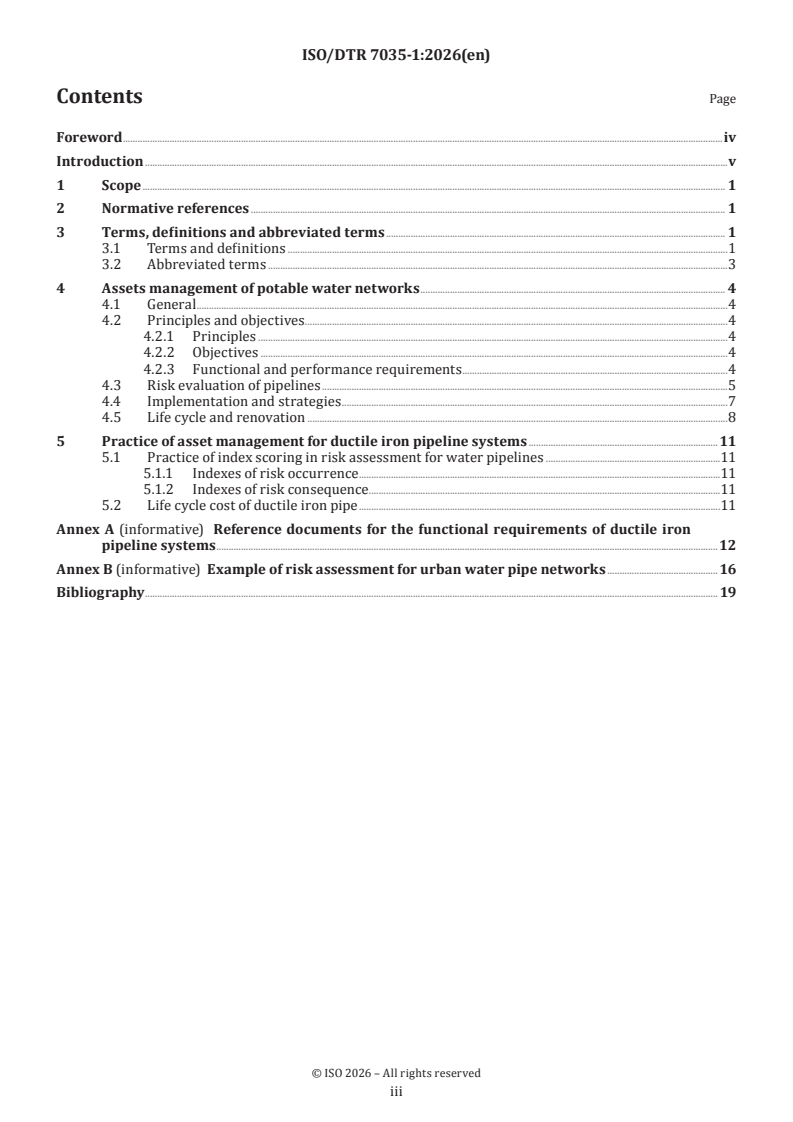
Contents
- Introduction
- 1 Scope
- 2 Normative references
- 3 Terms, definitions and abbreviated terms
- 3.1 Terms and definitions
- 3.1.1 asset
- 3.1.2 asset management
- 3.1.3 failure
- 3.1.4 level of service
- 3.1.5 life cycle cost
- 3.1.6 maintenance
- 3.1.7 management of assets
- 3.1.8 operation
- 3.1.9 performance indicator
- 3.1.10 rehabilitation
- 3.1.11 service life
- 3.2 Abbreviated terms
- 4 Assets management of potable water networks
- 4.1 General
- 4.2 Principles and objectives
- 4.3 Risk evaluation of pipelines
- 4.4 Implementation and strategies
- 4.5 Life cycle and renovation
- 5 Practice of asset management for ductile iron pipeline systems
- 5.1 Practice of index scoring in risk assessment for water pipelines
- 5.2 Life cycle cost of ductile iron pipe
- Annex A
- Annex B
- Bibliography
Introduction
According to the United Nations, since 2010, the majority of the world’s population lives in cities. By 2030, six out of every ten people will live in cities and, by 2050, this proportion will have increased to seven out of ten people. A medium-sized city (100 000 to 500 000 inhabitants) can require several thousand kilometres of buried water distribution pipes and a wastewater collection network of similar magnitude, depending on
urban density and network configuration. 18 19 A city’s water supply network is a complex infrastructure project that, if not planned and budgeted annually in municipal budgets, can become unaffordable, jeopardizing the city’s sustainability. The replacement value of these assets requires a very high economic effort for a city. However, without proper asset management, much of the available capital would already have gone into investing in the expansion of the infrastructure to meet growth, with the result that almost all cities face an ageing infrastructure in need of repair, rehabilitation or, more likely, the replacement of significant portions of them. The difference between available financial resources and the financial resources needed to maintain and improve the infrastructure is referred as the “infrastructure gap”, and in many countries a massive investment is needed. Asset management plays an important role in this sense, as follows:
- By applying tools that help make these processes effective, such as setting service levels, computing life cycle asset costs, maintaining an asset register, monitoring asset condition and performance, and carrying out risk analysis of possible asset failure.
- By achieving the least cost and least risk of owning and operating assets over their life cycle, while meeting service standards for customers. Consequently, water utility managers can put in place policies, plans and strategies.
Renovation and repair of pipelines is usually complicated, administratively and technically. In many cases, damage and service interruptions are created to other infrastructure networks (not knowing where these services run). Beyond the deterioration of roads and sidewalks, pipeline failures can adversely affect the city’s image and generate substantial indirect costs. For this reason, asset management tools that consider the full range of costs and performance criteria often identify durable and reliable solutions, such as ductile iron pipes, as the most cost-effective option over the asset’s lifetime. This document can help network owners to improve the asset management of water supply pipelines through optimal economic management. Although the principles presented in this document apply to all types of pipeline asset management, the examples, assessment parameters and methodologies are primarily based on ductile iron pipes.
FINAL DRAFT Technical Report ISO/DTR 7035-1:2026(en) Design and asset management of ductile iron pipes (DIP) for water application — Part 1:
Principles and objects of asset management
1 Scope
This document describes good practices for the asset management of ductile iron pipeline systems for drinking water at strategic, tactical and operational levels, including the future selection of products and solutions to meet customer technical and economic needs and expectations over long (multi-generational) periods.
This document does not apply to the management of assets of many components of the waterworks (e.g. treatment, pumping, storage, which are also physically part of the system) that usually influence the asset management of the water networks.
NOTE In many countries, water pipelines assets have been identified as critical infrastructures, and programmes are in place to ensure their renovation. Reliable failure statistics and the database description of the condition are of particular significance for establishing investigation, maintenance and renovation priorities.
2 Normative references
The following documents are referred to in the text in such a way that some or all of their content constitutes requirements of this document. For dated references, only the edition cited applies. For undated references, the latest edition of the referenced document (including any amendments) applies. ISO 2531, Ductile iron pipes, fittings, accessories and their joints for water applications ISO 16631, Ductile iron pipes, fittings, accessories and their joints compatible with plastic (PVC or PE) piping systems, for water applications and for plastic pipeline connections, repair and replacement
3 Terms, definitions and abbreviated terms
3.1 Terms and definitions
For the purposes of this document, the terms and definitions given in ISO 2531, ISO 16631 and the following apply.
ISO and IEC maintain terminology databases for use in standardization at the following addresses:
- ISO Online browsing platform: available at https:// www .iso .org/ obp
- IEC Electropedia: available at https:// www .electropedia .org/
3.1.1 asset
capital-forming goods used for the provision of the service Note 1 to entry: Assets can be tangible or intangible. Examples of tangible assets are: land, buildings, pipes, wells, tanks, treatment plants, equipment, hardware. Examples of intangible assets are: software, databases.
ISO/DTR 7035-1:2026(en) Note 2 to entry: Contrary to consumables, assets can be depreciated in accounting systems. [SOURCE: ISO 24516-1:2016, 3.1]
3.1.2 asset management
processes that enable a water utility to direct, control and optimize the provision, maintenance (3.1.6) and disposal of infrastructure asset (3.1.1), including the necessary costs for specified performances, over their life-cycle [SOURCE: ISO 24516-1:2016, 3.2]
3.1.3 failure
local inadmissible impairment of the operability of an asset (3.1.1) of a drinking water or wastewater system
3.1.4 level of service
service to users which reflects social and economic goals of the community safety, customer satisfaction, quality, quantity, capacity, reliability, responsiveness, environmental acceptability, cost and availability Note 1 to entry: A defined level of service can include any combination of the aforementioned parameters deemed important by the asset owner, users or relevant stakeholders.
3.1.5 life cycle cost
LCC total cost of an asset (3.1.1) throughout its service life (3.1.11), including planning, design, construction, acquisition, operation (3.1.8), maintenance (3.1.6), rehabilitation (3.1.10) and disposal costs
3.1.6 maintenance
combination of all technical, administrative and managerial actions during the life cycle of an asset (3.1.1) intended to retain it in, or restore it to, a state in which it can perform the required function [SOURCE: ISO 24513:2019, 3.5.9]
3.1.7 management of assets
operation (3.1.8), maintenance (3.1.6) and rehabilitation (3.1.10) of assets (3.1.1) of water supply and wastewater systems as a functional activity Note 1 to entry: This encompasses all necessary activities for sustainable operation and maintenance of the assets in drinking water and wastewater systems.
[SOURCE: ISO 24516-1:2016, 3.13]
3.1.8 operation
action taken in the course of normal functioning of drinking water or wastewater systems EXAMPLE Monitoring and regulation or diversion of drinking water or wastewater. [SOURCE: EN 752:2017/prA1, modified]
3.1.9 performance indicator
<general> metric or measure for assessing the achievement of an objective [SOURCE: ISO 19440:2020, 3.5.8]
ISO/DTR 7035-1:2026(en)
3.1.10 rehabilitation
measures for restoring or upgrading the performance of existing asset systems, including renovation, repair and replacement [SOURCE: EN 16323:2014, modified]
3.1.11 service life
period of time after installation during which an asset (3.1.1) or an asset system meets or exceeds the functional requirements necessary to meet the performance objectives of the water service [SOURCE: EN 15978:2026, modified]
3.2 Abbreviated terms
BC big contribution BD buried district of pipeline DIP ductile iron pipe GIS geographic information system LCC life cycle cost NC normal contribution NL number of leakages NR network reliability NU number of users PA pipeline age PD pipeline diameter PH pipeline historic event PM pipeline material QL quantity of water leaked RB road and surroundings with backwater RG road grade SD soil depth covering the pipeline SE regional environment SMART specific, measurable, achievable, relevant, and time bound ST stoppage duration of time TCO total cost of ownership VBC very big contribution
ISO/DTR 7035-1:2026(en)
4 Assets management of potable water networks
4.1 General
Asset management is a long-term commitment. Leading water utilities recognize that asset management is crucial to their results. As a basis for effective asset management, utility managers generally:
- put in place an asset management policy;
- develop implementation and monitoring plans to achieve the targeted service levels and demand forecast;
- obtain a good understanding of the condition of all their assets;
- identify the potential risks and consequences if they fail.
The condition of water infrastructures and the appropriate selection products greatly influence the adequacy of the water service from aspects of quality, quantity, pressure, safety, reliability and environmental impact, providing an appropriate service life while fulfilling given requirements in a cost-effective manner.
4.2 Principles and objectives
4.2.1 Principles
Predicting demand is of key importance for defining objectives and requirements. It enables managers to plan what assets will be needed for system expansion or upgrades to sustain agreed levels of service. The performance assessment, another key point, normally includes the evaluation of risks of failure to achieve the objectives and performance requirements.
For the purpose, statistics are used to describe and analyse data observed in the past or present (often using rates as key measure) and probabilities are used to model uncertainty and estimate what might happen in the future.
4.2.2 Objectives
The objective of the asset management is to ensure that the water utility complies with agreed levels of service, while also meeting economic performance objectives such as attaining the least possible overall life cycle cost. the customer service level is usually described in terms of availability (24/7, usually judged by the number of interruptions or cumulative period of interruptions), quality (odour flavour and taste), pressure, required flow, number of supply interruptions and response times to supply interruptions. Service level indicators are based on SMART (specific, measurable, achievable, relevant and time bound).
4.2.3 Functional and performance requirements
The functional requirements are normally established and obtained by the water utility objectives. An example of these requirements is shown in Table 1 with the ductile iron pipeline systems model. It takes into account also general aspects, such as sustainable development and total life costs, including indirect costs (e.g. traffic congestion, military aid provided by civil authorities) to ensure that drinking water networks do not cause unacceptable environmental nuisance, risk to public health or risk to personnel working therein. The way ductile iron pipes meet the functional requirements of water pipelines is detailed in Annex A. Each functional requirement can contribute to more than one objective. Table 1 provides “level” examples of the relevance of each of the pipeline functional requirement to achieve the performance objectives of the water utility (depending on the specificities of the water service).
ISO/DTR 7035-1:2026(en) Table 1 — Example of water utility objectives and functional requirements Water utility performance objectives Functional Health and safety User needs Service Sustainable development of the requirements and expecta- under of ductile iron Public Occupational Community Water Environment tions usual and pipeline sysutility emergency tems situations Drinking water BC NC VBC VBC VBC VBC quality Continuity of VBC VBC supply Flow and pres- VBC sure Maintainability VBC VBC Service under emergency situ- VBC VBC VBC ations Sustainability of VBC VBC VBC products Sustainable use NC BC BC BC of energy Long design life BC VBC VBC of assets Minimizing leak- VBC VBC VBC VBC ages Not endangering adjacent VBC BC VBC VBC structures and environment For each functional requirement, there can be legal requirements, public expectations and financial constraints.
Performance indicators are an essential tool to understand a utility’s infrastructure conditions and needs, and, in parallel, enable indicator-supported infrastructure planning and decision-making, as follows:
- Properly implemented, performance indicators provide information on the condition of the assets and the level of their contribution to the utility’s objectives.
- When defined at strategic, tactical and operational levels, they can clearly show how actions contribute to achieving all objectives.
4.3 Risk evaluation of pipelines
It is quite common for utilities of all sizes to identify and manage asset risks to enable them to achieve and sustain their objectives while operating within their budgets. Risk is the rate of failure multiplied by the consequence of failure in a given context. If both rate and consequence are high, the risk is extreme and then it becomes a target to be reduced to an acceptable level. Assets with a very high failure consequence and at least a moderate failure rate are termed “critical assets”.
Relationships can be established on a case-by-case basis, taking into account experience or estimated with formulas such as Formulae (1) and (2).
ISO/DTR 7035-1:2026(en) The rate of occurrence is practically estimated as shown by Formula (1):
n PP I (1) of ii
i 1 where P is the level of occurrence; of P is the value of an index in risk occurrence evaluation;
I is the weight corresponding to P ; i i n is the number of indexes in risk occurrence evaluation.
The risk consequence can be practically estimated as shown by Formula (2):
m CC I (2) of jj
...
Contents
- Introduction
- 1 Violators may be prosecuted.can help network owners to improve the Scope
- 1 Scope
- 2 Normative references
- 3 Terms, definitions and abbreviated terms
- 3.1 Terms and definitions
- 3.1.1 asset
- 3.1.2 asset management
- 3.1.3 failure
- 3.13 strategic plan
- 3.2 Abbreviated terms
- 4 Assets management of potable water networks
- 4.1 General
- 4.2 Principles and objectives
- 4.3 Risk evaluation of pipelines
- 4.4 Implementation and strategies
- 4.5 LifecycleLife cycle and renovation
- 5 Practice of asset management for ductile iron pipelinespipeline systems
- 5.1 Practice of indexes’index scoring in risk assessment for water pipelines
- 5.2 Life cycle cost of ductile iron pipe (LCC)
- Annex A
- Annex B
- Bibliography
Introduction
According to the World Health OrganizationUnited Nations, since 2010, the majority of the world'sworld’s population lives in cities. By 2030, six out of every 10ten people will live in cities and, by 2050, this proportion will have increased to seven out of 10ten people. TheA medium-sized city (100 000 to 500 000 inhabitants) can require several thousand kilometres of buried water and wastewater infrastructure of distribution pipes and a wastewater collection pipes may have between 5,000 km and 10,000 km network of underground piping for water distribution, and a similar network for wastewater collection, for a city of 100,000 to 500,000 people. [ [18] [19] magnitude, depending on urban density and network configuration. A city’s water supply network is a complex infrastructure project that, if not planned and budgeted annually in municipal budgets, can become unaffordable, jeopardizing the city’s sustainability. The replacement value of these assets requires a very high economic effort for a city. However, without proper asset management, much of the available capital would already have gone into investing in the expansion of the infrastructure to meet growth, with the result that almost all cities face an ageing infrastructure in need of repair, rehabilitation or, more likely, the replacement of significant portions of them. The difference between available financial resources and the financial resources needed to maintain and improve the infrastructure is referred as the “infrastructure gap,”, and in many countries a massive investment is needed. Asset management plays an important role in this sense, byas follows:
- By applying tools that help make these processes effective, such as setting service levels, computing life - cycle asset costs, maintaining an asset register, monitoring asset condition and performance, and carrying out risk analysis of possible asset failure.
- By achieving the least cost and least risk of owning and operating assets over their life cycle, while meeting service standards for customers. Consequently, water utility managers need tocan put in place policies, plans, and strategies.
Renovation and repair of pipelines is usually complicated, administratively and technically. In many cases, damage and service interruptions are created to other infrastructure networks (not knowing where these services run). Along withBeyond the deterioration of roads and sidewalks the perceived, pipeline failures can adversely affect the city’s image of the city worsens, increasing the great list ofand generate substantial indirect costs, which is why the long lasting. For this reason, asset management tools that consider the full range of costs and performance criteria often identify durable and reliable pipelines likesolutions, such as ductile iron pipes (offering excellent, as the most cost-effectiveness results), when taken all performances are into account byeffective option over the asset management toolsasset’s lifetime. Copyright notice This ISO document is a Draft International Standard and is copyright-protected by ISO. Except as permitted under the applicable laws of the user's country, neither this ISO draft nor any extract from it may be reproduced, stored in a retrieval system or transmitted in any form or by any means, electronic, photocopying, recording or otherwise, without prior written permission being secured. Requests for permission to reproduce should be addressed to either ISO at the address below or ISO's member body in the country of the requester.
ISO copyright office Case postal 56 • CH-1211 Geneva 20 Tel. + 41 22 749 01 11 Fax + 41 22 749 09 47
ISO/DTR 7035-1:(en) E-mail copyright@iso.org Web www.iso.org Reproduction may be subject to royalty payments or a licensing agreement.
1 Violators may be prosecuted.can help network owners to improve the Scope
The objective of this document is to assist the asset management of the water supply pipelines , so that to improve the service indicators of the network owners through optimal economic management. Although the principles presented in this document apply to all types of pipeline assetsasset management, the examples, assessment parameters, and methodologies provided in this document are primarily based on ductile iron pipes.
ISO/DTR 7035-1:(en) Design and asset management of ductile iron pipes (DIP) for water application — Part 1:
Principles and objects of asset management
1 Scope
This International document:
Describes describes good practices for the assetsasset management of ductile iron pipeline systems for drinking water atductile iron pipe networks on the strategic, tactical and operational levels, including the future selection of products and solutions to meet customer technical and economical (TCO)economic needs and expectations over long (multi-generational) periods.
DoesThis document does not apply forto the management of assets of many components of the waterworks (for examplee.g. treatment, pumping, storage, etc. which are also physically part of the system) that usually influence the asset management of the water networks.
NOTE: In many countries, water pipelines asset hasassets have been identified as critical infrastructures, and programmes are in place to assureensure their renovation. Reliable failure statistics and the database description of the condition are of particular significance for establishing investigation, maintenance and renovation priorities.
2 Normative references
The following referenced documents are indispensable forreferred to in the applicationtext in such a way that some or all of their content constitutes requirements of this document. For dated references, only the edition cited applies. For undated references, the latest edition of the referenced document (including any amendments) applies.
ISO 2531, Ductile iron pipes, fittings, accessories and their joints for water applications ISO 4179, Ductile iron pipes and fittings for pressure and non-pressure pipelines-Cement mortar lining ISO 4370, Environmental life cycle assessment and recycling of ductile iron pipes for water application ISO 8179-1, Ductile iron pipes, fittings, accessories and their joints-External zinc-based coating, Part1: Metallic zinc with finishing layer ISO 10803, Design method for ductile iron pipes ISO 16631, Ductile iron pipes, fittings, accessories and their joints compatible with plastic (PVC or PE) piping systems, for water applications and for plastic pipeline connections, repair and replacement ISO 18468, Ductile iron fittings, accessories and their joints and valves-Epoxy coating ISO 21051, Construction and installation of ductile iron pipeline system ISO 21053, Life cycle analysis and recycling of ductile iron pipes for water applications ISO 24131-1, Internal protection by polymeric lining for ductile iron pipes-Requirements and test methods-Part1:
Polyurethan lining
ISO/DTR 7035-1:(en) ISO 24131-2, Internal protection by polymeric lining for ductile iron pipes-Requirements and test methods-Part2:
Epoxy lining ISO/TR 7035-2, Design and asset management of DIP for water application-Part2: Design, installation and operation
3 Terms, definitions and abbreviated terms
3.1 Terms and definitions
For the purposes of this document, the terms and definitions given in ISO 2531 and, ISO 16631 definitions and the following apply. Addition definitions apply also.
ISO and IEC maintain terminology databases for use in standardization at the following addresses:
ISO Online browsing platform: available at https://www.iso.org/obp3.1
- IEC Electropedia: available at https://www.electropedia.org/
3.1.1 asset
capital-forming goods used for the provision of the service Note 1 to entry: Assets can be tangible or intangible. Examples of tangible assets are: land, buildings, pipes, wells, tanks, treatment plants, equipment, hardware. Examples of intangible assets are: software, databases. Note 2 to entry: Contrary to consumables, assets can be depreciated in accounting systems. [SOURCE: ISO 24510:2007, 2.4]24516-1:2016, 3.21]
3.1.2 asset management
processes that enable a water utility to direct, control and optimize the provision, maintenance (3.1.6) and disposal of infrastructure asset (3.1.1assets,), including the necessary costs for specified performances, over their life-cycle [SOURCE: ISO 24510:2007, 2.5]24516-1:2016, 3.32]
3.1.3 failure
local inadmissible impairment of the operability of an asset (3.1.1) of a drinking water or wastewater system 3.1.4 3.4 level of service service to users which reflects social and economic goals of the community safety, customer satisfaction, quality, quantity, capacity, reliability, responsiveness, environmental acceptability, cost and availability Note 1 to entry: A defined level of service can include any combination of the aforementioned parameters deemed important by the asset owner, users or relevant stakeholders.
3.1.5 3.5 life cycle cost (LCC) total cost of an asset (3.1.1(3.1)) throughout its service life (3.1.11,), including planning, design, construction, acquisition, operation (3.1.8,), maintenance (3.1.6,), rehabilitation (3.1.10) and disposal costs
ISO/DTR 7035-1:(en) 3.1.6 3.6 maintenance combination of all technical, administrative and managerial actions during the life cycle of an asset (3.1.1) intended to retain it in, or restore it to, a state in which it can perform the required function [SOURCE: ISO 24510:2007, 2.1924513:2019, 3.5.9] 3.1.7 3.7 management of assets operation (3.1.8,), maintenance (3.1.6) and rehabilitation (3.1.10) of assets (3.1.1) of water supply and wastewater systems as a functional activity Note 1 to entry: This encompasses all necessary activities for sustainable operation and maintenance of the assets in drinking water and wastewater systems.
[SOURCE: ISO 24516-1:2016, 3.13] 3.1.8 3.8 operation(s) action(s) taken in the course of normal functioning of drinking water or wastewater systems EXAMPLE Monitoring and regulation or diversion of drinking water or wastewater. [SOURCE: prENEN 752:20152017/prA1, modified] 3.1.9 3.9 performance indicator <general> metric or measure by whichfor assessing the achievement of an objective can be assessed [SOURCE: ISO 19440:20072020, 3.1.625.8] 3.1.10 3.10 rehabilitation measures for restoring or upgrading the performance of existing asset systems, including renovation, repair and replacement [SOURCE: EN 16323:2014, modified] 3.1.11 3.11 service life period of time after installation during which an asset (3.1.1) or an asset system meets or exceeds the functional requirements necessary to meet the performance objectives of the water service. [SOURCE: EN 15978:20112026, modified]
3.13 strategic plan
plan containing the long-term goals and strategies of an organization Note 1 to entry: Strategic plans have a strong external focus, cover major portions of the organization and identify major targets, actions and resource allocations relating to the long-term survival, value and adoption to ongoing changes of an organization.
3.2 Abbreviated terms
The following abbreviation are used in this document.
ISO/DTR 7035-1:(en) DIPBC big contributionDuctile iron pipe BDSMART Specific, measurable, achievable, relevant, and time boundburied district of pipeline LCCDIP Life cycle costductile iron pipe TCOGIS Total cost of ownershipgeographic information system BCLCC Big contributionlife cycle cost NC Normalnormal contribution VBCNL Very number of leakagesbig contribution GISNR Geographic information systemnetwork reliability PMNU Pipeline materialnumber of users PDPA Pipeline diameterpipeline age PAPD Pipeline agepipeline diameter RGPH Road gradepipeline historic event SDPM Soil depth covering the pipeline material SEQL Regional environmentquantity of water leaked NLRB Number of leakagesroad and surroundings with backwater PHRG Pipeline historic eventroad grade NUSD Number of userssoil depth covering the pipeline BDSE Buried district of pipelineregional environment SMARTNR Network reliabilityspecific, measurable, achievable, relevant, and time bound QLST Quantitystoppage duration of water leakedtime RBTCO Road and surroundings with backwatertotal cost of ownership STVBC Stoppage duration of timevery big contribution
4 Assets management of potable water networks
4.1 General
Asset management is a long-term commitment. Leading water utilities recognize that asset management is crucial to their results. As a basis for effective asset management, utility managers incline togenerally:
- put in place an asset management policy;
- develop implementation and monitoring plans to achieve the targeted service levels and demand forecast;
- obtain a good understanding of the condition of all their assets; and
- identify the potential risks and consequences if they fail.
The condition of water infrastructures and the appropriate selection products greatly influence the adequacy of the water service from aspects of quality, quantity, pressure, safety, reliability, and environmental impact, providing an appropriate service life while fulfilling given requirements in a cost-effective manner.
ISO/DTR 7035-1:(en)
4.2 Principles and objectives
4.2.1 Principles
Predicting demand is of key importance for defining objectives and requirements. It enables managers to plan what assets will be needed for system expansion or upgrades to sustain agreed levels of service. The performance assessment, another key point, normally includes the evaluation of risks of failure to achieve the objectives and performance requirements.
For the purpose, statistics are used to describe and analyse data observed in the past or present (often using rates as key measure) and probabilities are used to model uncertainty and estimate what might happen in the future.
4.2.2 Objectives
The objective of the asset management is to ensure that the water utility complies with agreed levels of service, while also meeting economic performance objectives such as attaining the least possible overall life cycle cost. the customer Service Levelservice level is usually described in terms of availability (24/7, usually judged by the number of interruptions or cumulative period of interruptions), quality (odour flavour and taste), pressure, required flow, number of supply interruptions and response times to supply interruptions. Service level indicators have to beare based on the SMART (specific, measurable, achievable, relevant, and time bound)).
4.2.3 Functional and performance requirements
The functional requirements are normally established and obtained by the Water Utilitywater utility objectives. An example of these requirements is shown in Table 1 with the ductile iron pipelines (DIP)pipeline systems model. It takes into account also general aspects, such as sustainable development and total life costs, including indirect costs (e.g.,. traffic congestion, military aid provided by civil authorities) to ensure that drinking water networks do not cause unacceptable environmental nuisance, risk to public health, or risk to personnel working therein.
The way ductile iron pipes meet the functional requirements of water pipelines is detailed in Annex A. Each functional requirement maycan contribute to more than one objective. Table 1 provides “level” examples of the relevance of each of the pipeline functional requirement to achieve the performance objectives of the water utility (depending on the specificities of the water service). Abbreviations in it mean different contributions to the objectives as following: NC, normal contribution; BC, big contribution; VBC, very big contribution (also see 3.2).
Table 1 — Example of Waterwater utility objectives and functional requirements Water Utilityutility performance Objectivesobjectives Functional Health and safety Users’User Service Sustainable developrequirements needs and under mentdevelopment of the of Ductile Iron expectations usual and Public Occupational Community water envi- Pipelinesductil emergency Water ronmentEnvir e iron pipeline situautility onment systems tionssituati ons Drinking water BC NC VBC VBC VBC VBC quality Continuity of VBC VBC supply
ISO/DTR 7035-1:(en) Water Utilityutility performance Objectivesobjectives Functional Health and safety Users’User Service Sustainable developrequirements needs and under mentdevelopment of the of Ductile Iron expectations usual and Public Occupational Community water envi- Pipelinesductil emergency Water ronmentEnvir e iron pipeline situautility onment systems tionssituati ons Flow and VBC pressure Maintainability VBC VBC Service under emergency VBC VBC VBC situations Sustainability of VBC VBC VBC products Sustainable use NC BC BC BC of energy Long design life BC VBC VBC of assets Minimizing of VBC VBC VBC VBC leakages Not endangering adjacent structuresendangeri VBC BC VBC VBC ng adjacent structures and environment It is important to know that forFor each functional requirement, there can be legal requirements, public expectations and financial constraints.
Performance indicators are an essential tool in understandingto understand a utility’s infrastructure conditions and needs, and, in parallel, enable indicator-supported infrastructure planning and decisionmaking, as follows:
- Properly implemented, performance indicators provide information on the condition of the assets and the level of their contribution to the utility’s objectives;.
- When defined at strategic, tactical and operational levels, they can be made clearly show how actions contribute to achieveachieving all objectives.
...