

ISO 24304
(Main)Textiles — Determination of the aerobic biodegradation of textile materials in seawater
General Information
- Abstract
This document specifies a laboratory test method for determining the aerobic biodegradability of fibres and textile materials in seawater by measuring the biochemical oxygen demand or the amount of carbon dioxide evolved. This method can be applied to fibres and textile materials (e.g. staples, tops, yarns and fabrics).
- Status
- Not Published
- Technical Committee
- ISO/TC 38 - Textiles
- Drafting Committee
- ISO/TC 38/WG 30 - Tests for Biodegradability
- Current Stage
- 6000 - International Standard under publication
- Start Date
- 03-Sep-2026
- Completion Date
- 19-Sep-2026
Buy Documents

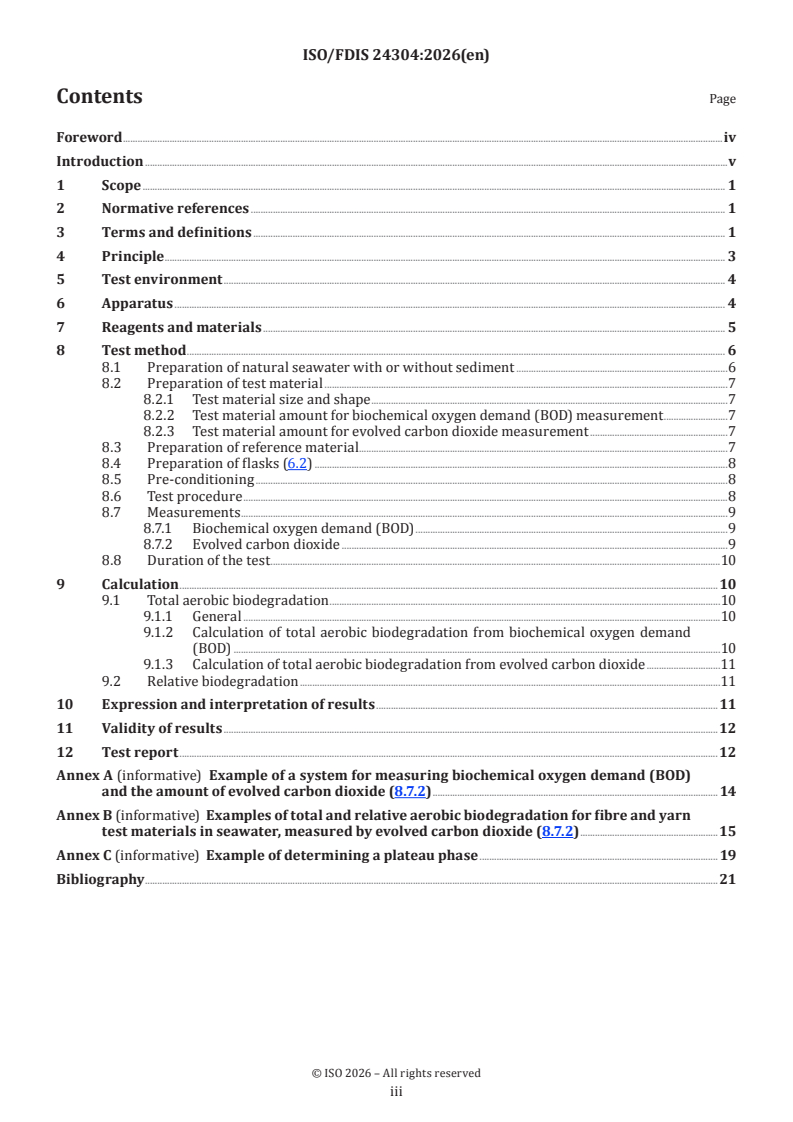
ISO/FDIS 24304 - Textiles — Determination of the aerobic biodegradation of textile materials in seawater
REDLINE ISO/FDIS 24304 - Textiles — Determination of the aerobic biodegradation of textile materials in seawater
Overview
ISO 24304: Textiles - Determination of the Aerobic Biodegradation of Textile Materials in Seawater is an international standard developed by ISO/TC 38, focusing on environmental testing of textile products. This document outlines a laboratory test method to assess the aerobic biodegradability of textile fibers and materials in marine environments, specifically seawater. By measuring either the biochemical oxygen demand (BOD) or the amount of carbon dioxide evolved during the decomposition process, this method helps to determine the extent to which textiles break down when exposed to natural seawater conditions.
With increasing global attention on marine pollution and the ecological impact of textile waste, ISO 24304 provides a scientifically robust process for quantifying biodegradability, supporting informed decisions in materials selection, product design, and environmental compliance.
Key Topics
- Purpose: Establishes a laboratory procedure for evaluating the aerobic biodegradability of textile materials in seawater, emphasizing both BOD and carbon dioxide evolution.
- Scope: Applicable to a wide range of textile forms-including staple fibers, tops, yarns, and fabrics-across natural and synthetic material types.
- Test Methods: Details laboratory techniques for preparing seawater samples, test specimens, and using appropriate analytic apparatus for measuring oxygen consumption and CO₂ evolution.
- Sample Preparation: Requires test materials to be cut to specified sizes, conditioned according to standard atmospheres, and measured for carbon content.
- Environmental Relevance: Focuses on aerobic conditions to simulate the marine surface environment (pelagic and littoral zones), not deep-sea or anaerobic processes.
- Analytical Parameters: The standard mandates the measurement of key factors such as total organic carbon (TOC), pH, total nitrogen, and appropriate temperature controls.
- Limitations: Not designed for product claims or labelling, but intended primarily for comparative laboratory studies.
Applications
ISO 24304 is valuable for organizations across the textile supply chain, research laboratories, and environmental assessment agencies seeking to:
- Compare Degradation Rates: Evaluate and compare the biodegradability of different textile materials under controlled marine conditions.
- Support Eco-Design Decisions: Inform product development with data on the environmental performance of new fibers, yarns, or fabrics.
- Meet Regulatory Requirements: Conform to environmental impact assessments related to marine biodegradation, increasingly relevant in regulatory and certification contexts.
- Advance Sustainability Claims: Generate reliable, laboratory-based data that supports sustainability initiatives and corporate social responsibility reporting.
- Monitor Microfibre Pollution: Assess the potential contribution of fibers shed from textiles to marine pollution, aiding in the development of better waste management and material innovation.
- Enhance Research: Provide a standardized test for academicians and industry scientists studying the fate of textile materials in marine environments.
Related Standards
Compliance and testing may refer to several related international standards, which complement ISO 24304 by providing methods for measuring environmental parameters and sample handling:
- ISO 139 - Textiles - Standard atmospheres for conditioning and testing
- ISO 3696 - Water for analytical laboratory use - Specification and test methods
- ISO 5667-3 - Water quality - Sampling - Part 3: Preservation and handling of water samples
- ISO 8245 - Water quality - Guidelines for the determination of total organic carbon (TOC) and dissolved organic carbon (DOC)
- ISO 10523 - Water quality - Determination of pH
- ISO 11261 - Soil quality - Determination of total nitrogen - Modified Kjeldahl method
- ISO 5815-1:2019 - Water quality - Determination of biochemical oxygen demand after n days (BODn)
- ISO 20743:2021 - Textiles - Determination of antibacterial activity of textile products
By referencing these standards, ISO 24304 ensures consistency and reliability in environmental biodegradation assessments for textiles in marine ecosystems.
ISO 24304 plays a critical role in supporting sustainable textiles, reducing ocean pollution, and advancing industry best practices through standardized biodegradability testing in seawater.
Buy Documents
ISO/FDIS 24304 - Textiles — Determination of the aerobic biodegradation of textile materials in seawater
REDLINE ISO/FDIS 24304 - Textiles — Determination of the aerobic biodegradation of textile materials in seawater
Get Certified
Connect with accredited certification bodies for this standard

Control Union Certifications
Global certification for agriculture and sustainability.

Hohenstein Institut
Textile testing and certification.

Bureau Veritas Bangladesh
Bureau Veritas certification services in Bangladesh.
Sponsored listings
Frequently Asked Questions
ISO 24304 is a draft published by the International Organization for Standardization (ISO). Its full title is "Textiles — Determination of the aerobic biodegradation of textile materials in seawater". This standard covers: This document specifies a laboratory test method for determining the aerobic biodegradability of fibres and textile materials in seawater by measuring the biochemical oxygen demand or the amount of carbon dioxide evolved. This method can be applied to fibres and textile materials (e.g. staples, tops, yarns and fabrics).
This document specifies a laboratory test method for determining the aerobic biodegradability of fibres and textile materials in seawater by measuring the biochemical oxygen demand or the amount of carbon dioxide evolved. This method can be applied to fibres and textile materials (e.g. staples, tops, yarns and fabrics).
ISO 24304 is classified under the following ICS (International Classification for Standards) categories: 59.080.01 - Textiles in general. The ICS classification helps identify the subject area and facilitates finding related standards.
ISO 24304 is available in PDF format for immediate download after purchase. The document can be added to your cart and obtained through the secure checkout process. Digital delivery ensures instant access to the complete standard document.
Standards Content (Sample)
FINAL DRAFT
International
Standard
ISO/FDIS 24304
ISO/TC 38
Textiles — Determination of the
Secretariat: SAC
aerobic biodegradation of textile
Voting begins on:
materials in seawater
2026-07-08
Voting terminates on:
2026-09-02
RECIPIENTS OF THIS DRAFT ARE INVITED TO SUBMIT,
WITH THEIR COMMENTS, NOTIFICATION OF ANY
RELEVANT PATENT RIGHTS OF WHICH THEY ARE AWARE
AND TO PROVIDE SUPPOR TING DOCUMENTATION.
IN ADDITION TO THEIR EVALUATION AS
BEING ACCEPTABLE FOR INDUSTRIAL, TECHNO
LOGICAL, COMMERCIAL AND USER PURPOSES, DRAFT
INTERNATIONAL STANDARDS MAY ON OCCASION HAVE
TO BE CONSIDERED IN THE LIGHT OF THEIR POTENTIAL
TO BECOME STAN DARDS TO WHICH REFERENCE MAY BE
MADE IN NATIONAL REGULATIONS.
Reference number
ISO/FDIS 24304:2026(en) © ISO 2026
FINAL DRAFT
ISO/FDIS 24304:2026(en)
International
Standard
ISO/FDIS 24304
ISO/TC 38
Textiles — Determination of the
Secretariat: SAC
aerobic biodegradation of textile
Voting begins on:
materials in seawater
Voting terminates on:
RECIPIENTS OF THIS DRAFT ARE INVITED TO SUBMIT,
WITH THEIR COMMENTS, NOTIFICATION OF ANY
RELEVANT PATENT RIGHTS OF WHICH THEY ARE AWARE
AND TO PROVIDE SUPPOR TING DOCUMENTATION.
© ISO 2026
IN ADDITION TO THEIR EVALUATION AS
All rights reserved. Unless otherwise specified, or required in the context of its implementation, no part of this publication may
BEING ACCEPTABLE FOR INDUSTRIAL, TECHNO
LOGICAL, COMMERCIAL AND USER PURPOSES, DRAFT
be reproduced or utilized otherwise in any form or by any means, electronic or mechanical, including photocopying, or posting on
INTERNATIONAL STANDARDS MAY ON OCCASION HAVE
the internet or an intranet, without prior written permission. Permission can be requested from either ISO at the address below
TO BE CONSIDERED IN THE LIGHT OF THEIR POTENTIAL
or ISO’s member body in the country of the requester.
TO BECOME STAN DARDS TO WHICH REFERENCE MAY BE
MADE IN NATIONAL REGULATIONS.
ISO copyright office
CP 401 • Ch. de Blandonnet 8
CH-1214 Vernier, Geneva
Phone: +41 22 749 01 11
Email: copyright@iso.org
Website: www.iso.org
Published in Switzerland Reference number
ISO/FDIS 24304:2026(en) © ISO 2026
ii
ISO/FDIS 24304:2026(en)
Contents Page
Foreword .iv
Introduction .v
1 Scope . 1
2 Normative references . 1
3 Terms and definitions . 1
4 Principle . 3
5 Test environment . 4
6 Apparatus . 4
7 Reagents and materials . 5
8 Test method . 6
8.1 Preparation of natural seawater with or without sediment .6
8.2 Preparation of test material .7
8.2.1 Test material size and shape .7
8.2.2 Test material amount for biochemical oxygen demand (BOD) measurement .7
8.2.3 Test material amount for evolved carbon dioxide measurement .7
8.3 Preparation of reference material . .7
8.4 Preparation of flasks (6.2) .8
8.5 Pre-conditioning .8
8.6 Test procedure .8
8.7 Measurements . .9
8.7.1 Biochemical oxygen demand (BOD) .9
8.7.2 Evolved carbon dioxide .9
8.8 Duration of the test .10
9 Calculation .10
9.1 Total aerobic biodegradation .10
9.1.1 General .10
9.1.2 Calculation of total aerobic biodegradation from biochemical oxygen demand
(BOD) .10
9.1.3 Calculation of total aerobic biodegradation from evolved carbon dioxide .11
9.2 Relative biodegradation .11
10 Expression and interpretation of results .11
11 Validity of results .12
12 Test report .12
Annex A (informative) Example of a system for measuring biochemical oxygen demand (BOD)
and the amount of evolved carbon dioxide (8.7.2) . 14
Annex B (informative) Examples of total and relative aerobic biodegradation for fibre and yarn
test materials in seawater, measured by evolved carbon dioxide (8.7.2) .15
Annex C (informative) Example of determining a plateau phase . 19
Bibliography .21
iii
ISO/FDIS 24304:2026(en)
Foreword
ISO (the International Organization for Standardization) is a worldwide federation of national standards
bodies (ISO member bodies). The work of preparing International Standards is normally carried out through
ISO technical committees. Each member body interested in a subject for which a technical committee
has been established has the right to be represented on that committee. International organizations,
governmental and non-governmental, in liaison with ISO, also take part in the work. ISO collaborates closely
with the International Electrotechnical Commission (IEC) on all matters of electrotechnical standardization.
The procedures used to develop this document and those intended for its further maintenance are described
in the ISO/IEC Directives, Part 1. In particular, the different approval criteria needed for the different types
of ISO documents should be noted. This document was drafted in accordance with the editorial rules of the
ISO/IEC Directives, Part 2 (see www.iso.org/directives).
ISO draws attention to the possibility that the implementation of this document may involve the use of (a)
patent(s). ISO takes no position concerning the evidence, validity or applicability of any claimed patent
rights in respect thereof. As of the date of publication of this document, ISO had not received notice of (a)
patent(s) which may be required to implement this document. However, implementers are cautioned that
this may not represent the latest information, which may be obtained from the patent database available at
www.iso.org/patents. ISO shall not be held responsible for identifying any or all such patent rights.
Any trade name used in this document is information given for the convenience of users and does not
constitute an endorsement.
For an explanation of the voluntary nature of standards, the meaning of ISO specific terms and expressions
related to conformity assessment, as well as information about ISO's adherence to the World Trade
Organization (WTO) principles in the Technical Barriers to Trade (TBT), see www.iso.org/iso/foreword.html.
This document was prepared by Technical Committee ISO/TC 38, Textiles.
Any feedback or questions on this document should be directed to the user’s national standards body. A
complete listing of these bodies can be found at www.iso.org/members.html.
iv
ISO/FDIS 24304:2026(en)
Introduction
This document was developed in response to worldwide demand for evaluation of biodegradability of
textile materials as these products release fibre fragments after washing and thus, contribute to pollution
of oceans. In addition to fibres shed from garments and home textiles, there are fibre fragments found in
marine environments released from textile bodies. In order to address the environmental impact of textile
and fibre fragments in marine environments and to carry out a proper product design, it is important to
know how a textile material biodegrades in a specified environment.
Test methods for measuring the level of marine biodegradation are available for plastic materials, however,
there is no standard test method available for the evaluation of marine biodegradability of textile materials.
This test method fills that knowledge gap and aims to analyse the biodegradation of textile materials based
on oxygen and carbon dioxide contents.
This test method is intended for comparative laboratory studies on textile materials and is not intended to
be used for product claims or labelling.
v
FINAL DRAFT International Standard ISO/FDIS 24304:2026(en)
Textiles — Determination of the aerobic biodegradation of
textile materials in seawater
1 Scope
This document specifies a laboratory test method for the determination of the aerobic biodegradability of
textile materials in seawater by measuring the biochemical oxygen demand (BOD) or the amount of evolved
carbon dioxide.
This method involves a test under an aerobic condition, which is intended to replicate the sea surface area
conditions. It applies to textile materials, such as staple fibres, tops, yarns and fabrics. This test method is not
intended for evaluating anaerobic biodegradation of textile materials, as simulating deep sea environments
is out of the scope of this document.
2 Normative references
The following documents are referred to in the text in such a way that some or all of their content constitutes
requirements of this document. For dated references, only the edition cited applies. For undated references,
the latest edition of the referenced document (including any amendments) applies.
ISO 139, Textiles — Standard atmospheres for conditioning and testing
ISO 3696, Water for analytical laboratory use — Specification and test methods
ISO 5667-3, Water quality — Sampling — Part 3: Preservation and handling of water samples
ISO 8245, Water quality — Guidelines for the determination of total organic carbon (TOC) and dissolved organic
carbon (DOC)
ISO 10523, Water quality — Determination of pH
ISO 11261, Soil quality — Determination of total nitrogen — Modified Kjeldahl method
ISO 20743:2021, Textiles — Determination of antibacterial activity of textile products
3 Terms and definitions
For the purposes of this document, the following terms and definitions apply.
ISO and IEC maintain terminology databases for use in standardization at the following addresses:
— ISO Online browsing platform: available at http:// www .iso .org/ obp
— IEC Electropedia: available at http:// www .electropedia .org/
3.1
pelagic zone
water body above the seafloor
Note 1 to entry: It is also referred to as the open water or the water column.
Note 2 to entry: The surface of the pelagic zone is moved by wind-driven waves, is in contact with the atmosphere and
exposed to sunlight. With increasing depth pressure increases, temperature decreases, and light and surface wave
energy are attenuated.
ISO/FDIS 24304:2026(en)
[1]
[SOURCE: ISO 22766:2020 , 3.4]
3.2
littoral zone
shallow marginal zone of a body of water where light penetrates to the bottom and is usually colonized by
rooted vegetation
[2]
[SOURCE: ISO 6107:2021 , 3.322]
3.3
biochemical oxygen demand
BOD, noun
mass concentration of the dissolved oxygen consumed under specified conditions by the aerobic biological
oxidation of a chemical compound or organic matter in water
Note 1 to entry: It is expressed as milligrams of oxygen uptake per milligram or gram of test compound.
[3]
[SOURCE: ISO 18830:2016 , 3.1]
3.4
theoretical oxygen demand
ThOD, noun
maximum theoretical amount of oxygen required to oxidise a chemical compound completely, calculated
from the molecular formula
Note 1 to entry: It is expressed as milligrams of oxygen uptake per milligram or gram of test compound.
[3]
[SOURCE: ISO 18830:2016 , 3.2]
3.5
theoretical amount of evolved carbon dioxide
ThCO , noun
maximum theoretical amount of evolved carbon dioxide after completely oxidizing a chemical compound,
calculated from the molecular formula
Note 1 to entry: It is calculated from the molecular formula.
Note 2 to entry: It is expressed as milligrams of carbon dioxide evolved per milligram or gram of test compound.
[4]
[SOURCE: ISO 14852:2021 , 3.5]
3.6
total organic carbon
TOC, noun
amount of carbon bound in an organic compound
Note 1 to entry: It is expressed as milligrams of carbon per 100 mg of the compound.
[5]
[SOURCE: ISO 17556:2019 , 3.14]
3.7
dissolved inorganic carbon
DIC, noun
part of the inorganic carbon in water which cannot be removed by specified phase separation
−2
Note 1 to entry: Phase separation can be achieved, for example, by centrifugation at 40 000 m⋅s for 15 min or by
membrane filtration using membranes with pores of 0,2 µm to 0,45 µm diameter.
[4]
[SOURCE: ISO 14852:2021 , 3.4]
ISO/FDIS 24304:2026(en)
3.8
lag phase
time from the start of a test until adaptation and/or selection of the degrading microorganisms is achieved
and the degree of biodegradation of a chemical compound or organic matter has increased to about 10 % of
the maximum level of biodegradation (3.11)
Note 1 to entry: It is measured in days.
[4]
[SOURCE: ISO 14852:2021 , 3.8]
3.9
biodegradation phase
time from the end of the lag phase (3.8) of a test until the plateau phase (3.10) has been reached
Note 1 to entry: It is measured in days.
[4]
[SOURCE: ISO 14852:2021 , 3.10]
3.10
plateau phase
time from the end of the biodegradation phase (3.9) until the end of a test
Note 1 to entry: It is measured in days.
[4]
[SOURCE: ISO 14852:2021 , 3.11]
3.11
maximum level of biodegradation
degree of biodegradation of a chemical compound or organic matter in a test, above which no further
biodegradation takes place during the test
Note 1 to entry: It is measured in percent.
[4]
[SOURCE: ISO 14852:2021 , 3.9]
3.12
total aerobic biodegradation
biodegradation value which is calculated by dividing the theoretical oxygen demand (ThOD) (3.4) with the
ratio of actual oxygen consumption when measuring biochemical oxygen demand (3.3) or by dividing the
theoretical amount of evolved carbon dioxide (ThCO ) (3.5)2) with the ratio of actual evolved carbon dioxide
when measuring evolved carbon dioxide
Note 1 to entry: It is expressed as percentage biodegradation.
3.13
relative aerobic biodegradation
biodegradation value of test material relative to the total aerobic biodegradation (3.12) of the reference
material
Note 1 to entry: It is expressed as percentage biodegradation.
4 Principle
This method primarily applies to untreated or uncoated textile materials; for finished products, results shall
be interpreted with caution.
A textile material (e.g. fibre, yarn, or textile) is used as a test material. The test material is cut and placed
in a flask (6.2) under mesophilic test conditions for up to one year by incubating test materials with either
seawater only (“pelagic seawater test”, also see pelagic zone or with seawater to which low amount of
sediment has been added (“suspended sediment seawater test”), coming from the same site as that from
which the seawater was taken.
ISO/FDIS 24304:2026(en)
Evaluation of biodegradation can be performed by two methods, biochemical oxygen demand (BOD) and the
amount of evolved carbon dioxide. The test material, which is the sole source of carbon and energy, is mixed
with seawater and/or suspended sediment seawater in a closed flask (6.2) and is allowed to stand over a
period of time. Microorganisms in the vessel consume oxygen and form carbon dioxide which is absorbed in
a suitable absorber in the headspace of the flask (6.2).
The consumption of oxygen biochemical oxygen demand (BOD) is determined, for example, by measuring
the amount of oxygen required to maintain a constant volume of gas in the respirometer flasks (6.2), or by
measuring the change in volume or pressure (or a combination of the two) either automatically or manually.
The level of biodegradation is determined by comparing the biochemical oxygen demand (BOD) with the
theoretical oxygen demand (ThOD) and expressed in percentage.
Measurement of the evolution of carbon dioxide is performed using a suitable, analytical method. The level
of biodegradation is determined by comparing the amount of evolved carbon dioxide with the theoretical
amount of evolved carbon dioxide (ThCO ) and expressed in percentage.
The test result is the maximum level of biodegradation, determined from the plateau phase of the
biodegradation curve.
This method is intended to compare the aerobic biodegradability potential between textile materials under
laboratory conditions. The test conditions described in this document may not always correspond to the
optimum conditions for maximum degree of aerobic biodegradation to occur, nor represent the actual
aerobic seawater environment conditions.
As this document relies on an aerobic principle, this test method is not intended to evaluate the
[6]
biodegradability potential under anaerobic sea environments , for example, in a mud on the sea floor,
which has relatively very low level of dissolved oxygen. Thus, the overall marine biodegradability potential
of a textile material or product cannot be evaluated by this method alone.
5 Test environment
Incubation shall take place in the dark or in diffused light, in an enclosure which is free from vapours
inhibitory to marine microorganisms and which is maintained at a constant mesophilic temperature. During
the test, the incubation temperature should be controlled under (20 ± 2 ) °C as a standard condition.
Temperature conditions between 15 °C to 25 °C is acceptable, as long as the selected condition is justified
and clearly indicated in the test report. Justification should be stated in consideration of actual marine
environment conditions, bridging the test conditions with other related standards for specific purposes, or
for the purpose of evaluating the effect of temperatures on the degradation process.
6 Apparatus
6.1 Plastic and glass vessels shall be carefully cleaned and, in particular, made free of absorbed toxic and
[7]
biodegradable compounds and shall be protected from contamination. Also see ISO 5815-1 .
6.2 Flask, made of glass with a volume approximately 300 ml. Flasks with higher or lower volumes can
be used, if environmental conditions are not affected. Ensure that all flasks are thoroughly cleaned and, in
particular, free from organic or toxic matter.
6.3 Biochemical oxygen demand (BOD) measurement system. Any closed respirometer with sufficient
accuracy to measure the biochemical oxygen demand (BOD), preferably a respirometer which can measure
and replace automatically and continuously the oxygen consumed so that no oxygen deficiency and no
inhibition of the microbial activity occurs during the degradation process. As carbon dioxide absorbers use
sodium hydroxide pellets or another suitable absorbent.
An example of the apparatus is shown in Annex A.
ISO/FDIS 24304:2026(en)
6.4 Apparatus for measuring nitrate and nitrite concentrations. At the end of the biodegradation
test, a qualitative test (for example test strips or photometric tests for nitrate and nitrite) is recommended
[7]
first to decide if any nitrification (seeISO 5815-1 ) has occurred. If there is evidence of nitrate/nitrite
in the medium, a quantitative determination of the oxygen demand due to nitrification is required (see
[8]
ISO 14851:2019 , Annex B).
6.5 Apparatus for measuring the amount of evolved carbon dioxide, with sufficient accuracy, such as
a carbon dioxide or dissolved inorganic carbon (DIC) analyser or apparatus for titrimetric determination
after complete absorption in a basic solution. Container for the carbon dioxide absorber (CO absorber), (e.g.
glass beaker) to be located in the headspace of a test flask (6.2) and filled with 10 ml of 0,0125 mol/l Ba(OH)
(7.3) or 3 ml of 0,5 mol/l KOH (7.4). As an alternative to Ba(OH) and KOH 5 ml of 1 mol/l NaOH (7.5) can be
used as a CO absorber in the case of 300 ml reaction vessel.
A suitable apparatus is shown in Annex A.
6.6 Analytical balance, which shall have a resolution of at least 0,1 mg.
6.7 pH-meter, which fulfils the requirements for the determination of pH, as specified in ISO 10523.
6.8 Magnetic stirrer and magnetic stirring bar, used for mixing the seawater with the sediment
(“suspended sediment seawater test”). It is recommended that either a PTFE-coated dumbbell shaped
magnetic stirring bar be used or a PTFE-coated magnetic bar equipped with a pivot ring in order to reduce
excessive abrasion of sediment during the test period. Other stirring systems can be used, too.
6.9 Automatic titrator.
6.10 Autoclave, capable of operating at a temperature of (121 ± 2) °C , in accordance with ISO 20743:2021,
5.28.
6.11 Filter, pore size of ≤ 200 μm.
7 Reagents and materials
All reagents and materials shall have the quality suitable for microbiological tests, i.e. free of toxic substances
for use with microorganisms.
7.1 Sterilized water, which shall be analytical-grade water for microbiological media preparation, which
is ion-exchanged and/or freshly distilled and/or ultra-filtered and/or filtered with reverse osmosis (RO) or
grade 3 water in accordance with ISO 3696. Sterilize by an autoclave (6.10) at a temperature of 121 °C for 15
minutes before use.
7.2 0,05 mol/l barium hydroxide solution (0,05 mol/l Ba(OH) ), analytical reagents grade (AR).
7.3 0,0125 mol/l barium hydroxide solution (0,0125 mol/l Ba(OH) ).
Prepare the solution at the concentration of 0,0125 mol/l by mixing 100 ml of 0,05 mol/l Ba(OH) (7.2) with
400 ml of sterilized water (7.1).
7.4 0,5 mol/l potassium hydroxide solution (0,5 mol/l KOH), analytical reagents grade (AR).
7.5 1 mol/l sodium hydroxide solution (1 mol/l NaOH), analytical reagents grade (AR).
7.6 1 mol/l hydrochloric acid solution (1 mol/l HCl), analytical reagents grade (AR).
ISO/FDIS 24304:2026(en)
7.7 0,05 mol/l hydrochloric acid solution (0,05 mol/l HCl), analytical reagents grade (AR).
7.8 Phenolphthalein, analytical reagents grade (AR).
7.9 Potassium dihydrogen phosphate (KH PO ), analytical reagents grade (AR).
2 4
7.10 Ammonium chloride (NH Cl), analytical reagents grade (AR).
7.11 Sodium nitrate (NaNO ), analytical reagents grade (AR).
1)
7.12 Microcrystalline cellulose powder, CAS RN® 9004-34-6, fine crystalline powder, purity not less
than 98 %.
8 Test method
8.1 Preparation of natural seawater with or without sediment
The natural seawater shall be collected from a littoral zone.
Sampling, preservation, handling, transport and storage of natural seawater, and, if applicable, sediment
collected from the same site as that from which the seawater is taken, shall be in accordance with ISO 5667-3.
Prior to use, remove coarse particles from the seawater and, if applicable, from the sediment by appropriate
means. The procedure used shall be reported.
Seawater can be filtered using a filter (6.11) in order to remove coarse particles while minimizing the
disturbance to microbial activities. Any kind of material is acceptable as long as the filter (6.11) is not
damaged by seawater. It is recommended to reduce the amount of coarse particles in sediment by means of
at least two washing steps using filtered seawater without coarse particles.
Measure total organic carbon (TOC), pH and total nitrogen content of seawater and, if applicable, of sediment
samples according to ISO 8245, ISO 10523 and ISO 11261, respectively.
If the total organic carbon (TOC) content of the seawater sample is found to be high, the seawater should be
pre-conditioned for about a week prior to use. If, for instance, the background concentration of total organic
carbon (TOC) exceeds about 20 % of the total total organic carbon (TOC) after addition of the test item, then
pre-condition the seawater and, if applicable, t
...
ISO/DISFDIS 24304
ISO/TC 38
Secretariat: SAC
Date: 2026-05-2106-24
Textiles — Determination of the aerobic biodegradation of textile
materials in seawater
DISFDIS stage
Voting begins on: 2025-08-25
Voting terminates on: 2025-11-17
ISO/DISFDIS 24304:2026(en)
All rights reserved. Unless otherwise specified, or required in the context of its implementation, no part of this publication
may be reproduced or utilized otherwise in any form or by any means, electronic or mechanical, including photocopying,
or posting on the internet or an intranet, without prior written permission. Permission can be requested from either ISO
at the address below or ISO’s member body in the country of the requester.
ISO copyright office
CP 401 • Ch. de Blandonnet 8
CH-1214 Vernier, Geneva
Phone: + 41 22 749 01 11
Formatted: French (France)
E-mail: copyright@iso.org
Website: www.iso.org
Published in Switzerland
ii
ISO/DISFDIS 24304:2026(en)
Contents
Foreword . iii
Introduction . iii
Scope . iii
Normative references . iii
Terms and definitions . iii
Principle. iii
Test environment . iii
Apparatus . iii
General . iii
Flask, . iii
Biochemical oxygen demand (BOD) measurement system. . iii
Apparatus for measuring nitrate and nitrite concentrations. . iii
Apparatus for measuring the amount of evolved carbon dioxide, . iii
Analytical balance, . iii
pH-meter. iii
Magnetic stirrer and magnetic stirring bar, . iii
Automatic titrator. . iii
Autoclave, . iii
Filter, . iii
Reagents and materials . iii
Sterilized water, . iii
0,05 mol/l barium hydroxide solution (0,05 mol/l Ba(OH)2 ), analytical reagents grade
(AR). . iii
0,0125 mol/l barium hydroxide solution (0,0125 mol/l Ba(OH)2 ). . iii
0,5 mol/l potassium hydroxide solution (0,5 mol/l KOH), analytical reagents grade (AR).iii
1 mol/l sodium hydroxide solution (1 mol/l NaOH), analytical reagents grade (AR). . iii
1 mol/l hydrochloric acid solution (1 mol/l HCl), analytical reagents grade (AR). . iii
0,05 mol/l hydrochloric acid solution (0,05 mol/l HCl), analytical reagents grade (AR). iii
Phenolphthalein, analytical reagents grade (AR). . iii
Potassium dihydrogen phosphate (KH 2 PO 4 ), analytical reagents grade (AR). . iii
Ammonium chloride (NH 4 Cl), analytical reagents grade (AR). . iii
Sodium nitrate (NaNO 3 ), analytical reagents grade (AR). . iii
Microcrystalline cellulose powder, . iii
Test method . iii
Preparation of natural seawater with or without sediment . iii
Preparation of test material . iii
Preparation of reference material . iii
Preparation of flasks( 6.2 ) . iii
Pre-conditioning . iii
Test procedure . iii
Measurements . iii
Duration of the test . iii
Calculation . iii
Total aerobic biodegradation . iii
Relative biodegradation . iii
Expression and interpretation of results . iii
iii
ISO/DISFDIS 24304:2026(en)
Validity of results . iv
Test report . iv
(informative) Example of a system for measuring biochemical oxygen demand (BOD) and the
amount of evolved carbon dioxide ( 8.7.2 ) . iv
(informative) Examples of total and relative aerobic biodegradation for fibre and yarn test
materials in seawater, measured by evolved carbon dioxide ( 8.7.2 ) . iv
(informative) Example of determining a plateau phase . iv
Bibliography . iv
Foreword . v
Introduction . vi
1 Scope . 1
2 Normative references . 1
3 Terms and definitions . 1
4 Principle . 4
5 Test environment . 5
6 Apparatus . 5
7 Reagents and materials . 6
8 Test method . 7
8.1 Preparation of natural seawater with or without sediment . 7
8.2 Preparation of test material . 8
8.3 Preparation of reference material . 9
8.4 Preparation of flasks (6.2) . 9
8.5 Pre-conditioning . 9
8.6 Test procedure . 10
8.7 Measurements . 11
8.8 Duration of the test . 11
9 Calculation . 11
9.1 Total aerobic biodegradation . 12
9.2 Relative biodegradation . 13
10 Expression and interpretation of results . 13
11 Validity of results . 14
12 Test report . 14
Annex A (informative) Example of a system for measuring biochemical oxygen demand (BOD)
and the amount of evolved carbon dioxide (8.7.2) . 16
Annex B (informative) Examples of total and relative aerobic biodegradation for fibre and yarn
test materials in seawater, measured by evolved carbon dioxide (8.7.2) . 18
Annex C (informative) Example of determining a plateau phase . 26
Bibliography . 29
iv
ISO/DISFDIS 24304:2026(en)
Foreword
ISO (the International Organization for Standardization) is a worldwide federation of national standards
bodies (ISO member bodies). The work of preparing International Standards is normally carried out through
ISO technical committees. Each member body interested in a subject for which a technical committee has been
established has the right to be represented on that committee. International organizations, governmental and
non-governmental, in liaison with ISO, also take part in the work. ISO collaborates closely with the
International Electrotechnical Commission (IEC) on all matters of electrotechnical standardization.
The procedures used to develop this document and those intended for its further maintenance are described
in the ISO/IEC Directives, Part 1. In particular, the different approval criteria needed for the different types of
ISO documents should be noted. This document was drafted in accordance with the editorial rules of the
ISO/IEC Directives, Part 2 (see www.iso.org/directives).
ISO draws attention to the possibility that the implementation of this document may involve the use of (a)
patent(s). ISO takes no position concerning the evidence, validity or applicability of any claimed patent rights
in respect thereof. As of the date of publication of this document, ISO had not received notice of (a) patent(s)
which may be required to implement this document. However, implementers are cautioned that this may not
represent the latest information, which may be obtained from the patent database available at
www.iso.org/patents. ISO shall not be held responsible for identifying any or all such patent rights.
Any trade name used in this document is information given for the convenience of users and does not
constitute an endorsement.
For an explanation of the voluntary nature of standards, the meaning of ISO specific terms and expressions
related to conformity assessment, as well as information about ISO's adherence to the World Trade
Organization (WTO) principles in the Technical Barriers to Trade (TBT), see www.iso.org/iso/foreword.html.
This document was prepared by Technical Committee ISO/TC 38, Textiles.
Any feedback or questions on this document should be directed to the user’s national standards body. A
complete listing of these bodies can be found at www.iso.org/members.html.
v
ISO/DISFDIS 24304:2026(en)
Introduction
This document was developed in response to worldwide demand for evaluation of biodegradability of textile
materials as these products release fibre fragments after washing and thus, contribute to pollution of oceans.
In addition to fibres shed from garments and home textiles, there are fibre fragments found in marine
environments released from textile bodies. In order to address the environmental impact of textile and fibre
fragments in marine environments and to carry out a proper product design, it is important to know how a
textile material biodegrades in a specified environment.
Test methods for measuring the level of marine biodegradation are available for plastic materials, however,
there is no standard test method available for the evaluation of marine biodegradability of textile materials.
This test method fills that knowledge gap and aims to analyse the biodegradation of textile materials based on
oxygen and carbon dioxide contents.
This test method is intended for comparative laboratory studies on textile materials and is not intended to be
Formatted: No underline
used for product claims or labelling.
vi
ISO/DISFDIS 24304:2026(en)
Textiles — Determination of the aerobic biodegradation of textile
materials in seawater
1 Scope
This document specifies a laboratory test method for the determination of the aerobic biodegradability of
textile materials in seawater by measuring the biochemical oxygen demand (BOD) or the amount of evolved
carbon dioxide.
This method involves a test under an aerobic condition, which is intended to replicate the sea surface area
conditions. It applies to textile materials, such as staple fibres, tops, yarns and fabrics. This test method is not
intended for evaluating anaerobic biodegradation of textile materials, as simulating deep sea environments is
out of the scope of this document.
2 Normative references
The following documents are referred to in the text in such a way that some or all of their content constitutes
requirements of this document. For dated references, only the edition cited applies. For undated references,
the latest edition of the referenced document (including any amendments) applies.
ISO 139, Textiles — Standard atmospheres for conditioning and testing
ISO 3696, Water for analytical laboratory use — Specification and test methods
ISO 5667-3, Water quality — Sampling — Part 3: Preservation and handling of water samples
ISO 5815-1:2019, Water quality — Determination of biochemical oxygen demand after n days (BODn) — Part
1: Dilution and seeding method with allylthiourea addition
ISO 8245, Water quality — Guidelines for the determination of total organic carbon (TOC) and dissolved organic
carbon (DOC)
ISO 10523, Water quality — Determination of pH
ISO 11261, Soil quality — Determination of total nitrogen — Modified Kjeldahl method
ISO 20743:2021, Textiles — Determination of antibacterial activity of textile products
3 Terms and definitions
For the purposes of this document, the following terms and definitions apply.
ISO and IEC maintain terminologicalterminology databases for use in standardization at the following
addresses:
— ISO Online browsing platform: available at http://www.iso.org/obp
Field Code Changed
— IEC Electropedia: available at http://www.electropedia.org/
— ISO Online browsing platform: available at http://www.iso.org/obp
Field Code Changed
3.1
pelagic zone
water body above the seafloor
ISO/DISFDIS 24304:2026(en)
Note 1 to entry: It is also referred to as the open water or the water column.
Note 2 to entry: The surface of the pelagic zone (3.1) is moved by wind-driven waves, is in contact with the atmosphere
Formatted: Font: Not Italic
and exposed to sunlight. With increasing depth pressure increases, temperature decreases, and light and surface wave
energy are attenuated.
[SOURCE: ISO 22766:2020, 3.4]
[SOURCE: ISO 22766:2020, 3.4]
3.2
littoral zone
shallow marginal zone of a body of water where light penetrates to the bottom and is usually colonized by
rooted vegetation
[SOURCE: ISO 6107:2021ISO 6107:2021, 3.322]
3.3
biochemical oxygen demand
BOD, noun
mass concentration of the dissolved oxygen consumed under specified conditions by the aerobic biological
oxidation of a chemical compound or organic matter in water
Note 1 to entry: It is expressed as milligrams of oxygen uptake per milligram or gram of test compound.
[SOURCE: ISO 18830:2016, 3.1]
[SOURCE: ISO 18830:2016, 3.1]
3.4
theoretical oxygen demand
ThOD, noun
maximum theoretical amount of oxygen required to oxidise a chemical compound completely, calculated from
the molecular formula
Note 1 to entry: It is expressed as milligrams of oxygen uptake per milligram or gram of test compound.
[SOURCE: ISO 18830:2016, 3.2]
[SOURCE: ISO 18830:2016, 3.2]
3.5
theoretical amount of evolved carbon dioxide
ThCO2, noun
maximum theoretical amount of evolved carbon dioxide after completely oxidizing a chemical compound,
calculated from the molecular formula
Note 1 to entry: It is calculated from the molecular formula.
Note 2 to entry: It is expressed as milligrams of carbon dioxide evolved per milligram or gram of test compound.
[SOURCE: ISO 14852:2021, 3.5]
[SOURCE: ISO 14852:2021, 3.5]
ISO/DISFDIS 24304:2026(en)
3.6
total organic carbon
TOC, noun
amount of carbon bound in an organic compound
Note 1 to entry: It is expressed as milligrams of carbon per 100 mg of the compound.
[SOURCE: ISO 17556:2019, 3.14]
[SOURCE: ISO 17556:2019, 3.14]
3.7
dissolved inorganic carbon
DIC, noun
part of the inorganic carbon in water which cannot be removed by specified phase separation
−2
Note 1 to entry: Phase separation can be achieved, for example, by centrifugation at 40 000 m⋅s for 15 min or by
membrane filtration using membranes with pores of 0,2 µm to 0,45 µm diameter.
[SOURCE: ISO 14852:2021, 3.4]
[SOURCE: ISO 14852:2021, 3.4]
3.8
lag phase
time from the start of a test until adaptation and/or selection of the degrading microorganisms is achieved
and the degree of biodegradation of a chemical compound or organic matter has increased to about 10 % of
the maximum level of biodegradation (3.11)
Note 1 to entry: It is measured in days.
[SOURCE: ISO 14852:2021, 3.8]
[SOURCE: ISO 14852:2021, 3.8]
3.9
biodegradation phase
time from the end of the lag phase (3.8) of a test until the plateau phase (3.10) has been reached
Note 1 to entry: It is measured in days.
[SOURCE: ISO 14852:2021, 3.10]
[SOURCE: ISO 14852:2021, 3.10]
3.10
plateau phase
time from the end of the biodegradation phase (3.9) until the end of a test
Note 1 to entry: It is measured in days.
[SOURCE: ISO 14852:2021, 3.11]
[SOURCE: ISO 14852:2021, 3.11]
ISO/DISFDIS 24304:2026(en)
3.11
maximum level of biodegradation
degree of biodegradation of a chemical compound or organic matter in a test, above which no further
biodegradation takes place during the test
Note 1 to entry: It is measured in percent.
[SOURCE: ISO 14852:2021, 3.9]
[SOURCE: ISO 14852:2021, 3.9]
3.12
total aerobic biodegradation
biodegradation value which is calculated by dividing the theoretical oxygen demand (ThOD) (3.4) with the ratio
of actual oxygen consumption when measuring biochemical oxygen demand (3.3) or by dividing the theoretical
amount of evolved carbon dioxide (ThCO ) (3.5)2) with the ratio of actual evolved carbon dioxide when
measuring evolved carbon dioxide
Note 1 to entry: It is expressed as percentage biodegradation.
3.13
relative aerobic biodegradation
biodegradation value of test material relative to the total aerobic biodegradation (3.12) of the reference
material
Note 1 to entry: It is expressed as percentage biodegradation.
4 Principle
This method primarily applies to untreated or uncoated textile materials; for finished products, results shall
be interpreted with caution.
A textile material (e.g. fibre, yarn, or textile) is used as a test material. The test material is cut and placed in a
flask (6.2) under mesophilic test conditions for up to one year by incubating test materials with either
seawater only (“pelagic seawater test”, also see pelagic zone or with seawater to which low amount of
sediment has been added (“suspended sediment seawater test”), coming from the same site as that from which
the seawater was taken.
Evaluation of biodegradation can be performed by two methods, biochemical oxygen demand (BOD) and the
amount of evolved carbon dioxide. The test material, which is the sole source of carbon and energy, is mixed
with seawater and/or suspended sediment seawater in a closed flask (6.2) and is allowed to stand over a
period of time. Microorganisms in the vessel consume oxygen and form carbon dioxide which is absorbed in
a suitable absorber in the headspace of the flask (6.2).
The consumption of oxygen biochemical oxygen demand (BOD) is determined, for example, by measuring the
amount of oxygen required to maintain a constant volume of gas in the respirometer flasks (6.2) ,), or by
measuring the change in volume or pressure (or a combination of the two) either automatically or manually.
The level of biodegradation is determined by comparing the biochemical oxygen demand (BOD) with the
theoretical oxygen demand (ThOD) and expressed in percentage.
Measurement of the evolution of carbon dioxide is performed using a suitable, analytical method. The level of
biodegradation is determined by comparing the amount of evolved carbon dioxide with the theoretical
amount of evolved carbon dioxide (ThCO ) and expressed in percentage.
ISO/DISFDIS 24304:2026(en)
The test result is the maximum level of biodegradation, determined from the plateau phase of the
biodegradation curve.
This method is intended to compare the aerobic biodegradability potential between textile materials under
laboratory conditions. The test conditions described in this document may not always correspond to the
optimum conditions for maximum degree of aerobic biodegradation to occur, nor represent the actual aerobic
seawater environment conditions.
As this document relies on an aerobic principle, this test method is not intended to evaluate the
[6]
biodegradability potential under anaerobic sea environments , for example, in a mud on the sea floor, which
has relatively very low level of dissolved oxygen. Thus, the overall marine biodegradability potential of a
textile material or product cannot be evaluated by this method alone.
5 Test environment
Incubation shall take place in the dark or in diffused light, in an enclosure which is free from vapours inhibitory
to marine microorganisms and which is maintained at a constant mesophilic temperature. During the test, the
incubation temperature should be controlled under (20 ± 2 ) °C as a standard condition.
Temperature conditions between 15 °C to 25 °C is acceptable, as long as the selected condition is justified and
clearly indicated in the test report. Justification should be stated in consideration of actual marine
environment conditions, bridging the test conditions with other related standards for specific purposes, or for
the purpose of evaluating the effect of temperatures on the degradation process.
6 Apparatus
6.1 General
6.1 Plastic and glass vessels shall be carefully cleaned and, in particular, made free of absorbed toxic and
Formatted: Font: 11 pt, Not Bold
biodegradable compounds and shall be protected from contamination. Also see ISO 5815-1:2019.Also see
Formatted: p2
ISO 5815-1.
6.2 Flask,
Formatted: Font: 11 pt
6.2 made of glass with a volume approximately 300 ml. Flasks with higher or lower volumes can be used, if
Formatted: Font: 11 pt, Not Bold
environmental conditions are not affected. Ensure that all flasks are thoroughly cleaned and, in particular, free
Formatted: p2
from organic or toxic matter.
6.3 Biochemical oxygen demand (BOD) measurement system.
Formatted: Font: 11 pt
6.3 Any closed respirometer with sufficient accuracy to measure the biochemical oxygen demand (BOD),
Formatted: Font: 11 pt, Not Bold
preferably a respirometer which can measure and replace automatically and continuously the oxygen
Formatted: Font: 11 pt, Not Bold
consumed so that no oxygen deficiency and no inhibition of the microbial activity occurs during the
Formatted: p2
degradation process. As carbon dioxide absorbers use sodium hydroxide pellets or another suitable
absorbent.
An example of the apparatus is shown in Annex A.
Formatted: Font: 11 pt
6.4 Apparatus for measuring nitrate and nitrite concentrations.
Formatted: Font: 11 pt, Not Bold
6.4 At the end of the biodegradation test, a qualitative test (for example test strips or photometric tests for
Formatted: p2
nitrate and nitrite) is recommended first to decide if any nitrification (see ISO 5815-1:2019)ISO 5815-1)
Formatted: Font: 11 pt, Not Bold
has occurred. If there is evidence of nitrate/nitrite in the medium, a quantitative determination of the oxygen
demand due to nitrification is required (see ISO 14851:2019 ,ISO 14851:2019, Annex B).
Formatted: Font: 11 pt, Not Bold
ISO/DISFDIS 24304:2026(en)
6.5 Apparatus for measuring the amount of evolved carbon dioxide,
Formatted: Font: 11 pt
6.5 with sufficient accuracy, such as a carbon dioxide or dissolved inorganic carbon (DIC) analyser or
Formatted: Font: 11 pt, Not Bold
apparatus for titrimetric determination after complete absorption in a basic solution. Container for the carbon
Formatted: p2
dioxide absorber (CO absorber), (e.g. glass beaker) to be located in the headspace of a test flask (6.2) and
filled with 10 ml of 0,0125 mol/l Ba(OH) (7.3) or 3 ml of 0,5 mol/l KOH (7.4). As an alternative to Ba(OH) Formatted: Font: 11 pt, Not Bold
2 2
and KOH 5 ml of 1 mol/l NaOH (7.5) can be used as a CO absorber in the case of 300 ml reaction vessel.
Field Code Changed
Formatted: Font: 11 pt, Not Bold
A suitable apparatus is shown in Annex A.
Formatted: Font: 11 pt, Not Bold
6.6 Analytical balance,
Field Code Changed
6.6 which shall have a resolution of at least 0,1 mg. Field Code Changed
Formatted: Font: 11 pt, Not Bold
6.7 pH-meter.
Field Code Changed
6.7 , which fulfils the requirements for the determination of pH, as specified in ISO 10523.
Formatted: Font: 11 pt
Formatted: Font: 11 pt, Not Bold
6.8 Magnetic stirrer and magnetic stirring bar,
Formatted: p2
6.8 used for mixing the seawater with the sediment (“suspended sediment seawater test”). It is
Formatted: Font: 11 pt, Not Bold
recommended that either a PTFE-coated dumbbell shaped magnetic stirring bar be used or a PTFE-coated
Formatted: p2
magnetic bar equipped with a pivot ring in order to reduce excessive abrasion of sediment during the test
period. Other stirring systems can be used, too.
Formatted: Font: 11 pt
Formatted: Font: 11 pt, Not Bold
6.9 Automatic titrator.
Formatted: p2
6.10 Autoclave,
Formatted: Font: 11 pt, Not Bold
Formatted: Font: Not Bold
6.10 capable of operating at a temperature of (121 ± 2) °C , in accordance with ISO 20743:2021, 5.28.
Formatted: Font: 11 pt
6.11 Filter,
Formatted: Font: 11 pt, Not Bold
6.11 pore size of ≤ 200 μm.
Formatted: p2
Formatted: Font: 11 pt
7 Reagents and materials
Formatted: Font: 11 pt, Not Bold
All reagents and materials shall have the quality suitable for microbiological tests, i.e. free of toxic substances
Formatted: p2
for use with microorganisms.
7.1 Sterilized water,
Formatted: Font: 11 pt
7.1 which shall be analytical-grade water for microbiological media preparation, which is ion-exchanged Formatted: Font: 11 pt, Not Bold
and/or freshly distilled and/or ultra-filtered and/or filtered with RO (reverse osmosis (RO) or grade 3 water
Formatted: p2
in accordance with ISO 3696. Sterilize by an autoclave (6.10) at a temperature of 121 °C for 15 minutes before
Formatted: Font: 11 pt, Not Bold
use.
Formatted: Font: 11 pt, Not Bold
7.2 0,05 mol/l barium hydroxide solution (0,05 mol/l Ba(OH) ), analytical reagents grade (AR).
Formatted: Font: 11 pt, Not Bold
Field Code Changed
Formatted: Font: 11 pt, Not Bold
7.3 0,0125 mol/l barium hydroxide solution (0,0125 mol/l Ba(OH) ).
Formatted: Font: Not Bold
Prepare the solution at the concentration of 0,0125 mol/l by mixing 100 ml of 0,05 mol/l Ba(OH) (7.2) with
Formatted: Font: 11 pt, Not Bold
400 ml of sterilized water (7.1).
Formatted: Font: Not Bold
Formatted: p2
ISO/DISFDIS 24304:2026(en)
7.4 0,5 mol/l potassium hydroxide solution (0,5 mol/l KOH), analytical reagents grade (AR).
Formatted: Font: 11 pt, Not Bold
Formatted: Font: Not Bold
Formatted: p2
7.5 1 mol/l sodium hydroxide solution (1 mol/l NaOH), analytical reagents grade (AR).
Formatted: Font: 11 pt, Not Bold
Formatted: Font: Not Bold
Formatted: p2
7.6 1 mol/l hydrochloric acid solution (1 mol/l HCl), analytical reagents grade (AR).
Formatted: Font: 11 pt, Not Bold
Formatted: Font: Not Bold
Formatted: p2
7.7 0,05 mol/l hydrochloric acid solution (0,05 mol/l HCl), analytical reagents grade (AR).
Formatted: Font: 11 pt, Not Bold
Formatted: Font: Not Bold
Formatted: p2
7.8 Phenolphthalein, analytical reagents grade (AR).
Formatted: Font: 11 pt, Not Bold
Formatted: Font: Not Bold
Formatted: p2
7.9 Potassium dihydrogen phosphate (KH2PO4), analytical reagents grade (AR).
Formatted: Font: 11 pt, Not Bold
Formatted: Font: Not Bold
7.10 Ammonium chloride (NH Cl), analytical reagents grade (AR).
4 Formatted: p2
Formatted: Font: 11 pt, Not Bold
Formatted: Font: Not Bold
7.11 Sodium nitrate (NaNO ), analytical reagents grade (AR).
Formatted: p2
Formatted: Font: 11 pt, Not Bold
Formatted: Font: Not Bold
7.12 Microcrystalline cellulose powder,
Formatted: p2
1)
7.12 CAS RN® 9004-34-6, fine crystalline powder, purity not less than 98 %%. Formatted: Font: 11 pt
Formatted: Font: 11 pt, Not Bold
8 Test method
Formatted: Font: 11 pt, Not Bold
Formatted: p2
8.1 Preparation of natural seawater with or without sediment
The natural seawater shall be collected from a littoral zone.
Sampling, preservation, handling, transport and storage of natural seawater, and, if applicable, sediment
collected from the same site as that from which the seawater is taken, shall be in accordance with ISO 5667-3.
Prior to use, remove coarse particles from the seawater and, if applicable, from the sediment by appropriate
means. The procedure used shall be reported.
1)
CAS Registry Number® is a trademark of the American Chemical Society (ACS). This information is given for the
convenience of users of this document and does not constitute an endorsement by ISO of the product named. Equivalent
products may be used if they can be shown to lead to the same results.
ISO/DISFDIS 24304:2026(en)
Seawater can be filtered using a filter (6.11) in order to remove coarse particles while minimizing the
disturbance to microbial activities. Any kind of material is acceptable as long as the filter (6.11) is not damaged
by seawater. It is recommended to reduce the amount of coarse particles in sediment by means of at least two
washing steps using filtered seawater without coarse particles.
Measure total organic carbon (TOC), pH and total nitrogen content of seawater and, if applicable, of sediment
samples according to ISO 8245, ISO 10523 and ISO 11261, respectively.
If the total organic carbon (TOC) content of the seawater sample is found to be high, the seawater should be
pre-conditioned for about a week prior to use. If, for instance, the background concentration of total organic
carbon (TOC) exceeds about 20 % of the total total organic carbon (TOC) after addition of the test item, then
pre-condition the seawater and, if applicable, the sediment by stirring under aerobic conditions at the test
temperature and in the dark or in diffuse light in order to reduce the content of easily degradable organic
material.
Provide the following information on the seawater, and, if applicable, on the sediment sample itself:
— date of collection;
— site location (name of location);
— depth of collection (m);
— appearance of sample - turbid, clear, etc.;
— temperature at the time of collection (°C);
— salinity (PSU);
— total organic carbon (TOC; mg/l);
— nitrogen (total-N; mg/l);
— pH;
— description of the pre-conditioning process, if applicable.
In case multiple natural seawater is mixed prior to the test, provide the above information for all the seawater
sample used.
8.2 Preparation of test material
8.2.1 Test material size and shape
Fibre and/or yarn materials shall be cut to a length between 5 mm to 10 mm by means of machine cutting and
/ or manual cutting (e.g. laboratory blade).
Textile materials having shape other than strand shall be reduced into 5 mm to 10 mm size for any side of
dimensions, by means of machine cutting and / or manual cutting.
The form and shape of the test material can influence its biodegradability. Similar length of sample should
preferably be used in the test for better comparison.
ISO/DISFDIS 24304:2026(en)
Test materials shall be then condition in a standard atmosphere in accordance with ISO 139.
8.2.2 Test material amount for biochemical oxygen demand (BOD) measurement
The test material shall be of known mass and contain sufficient carbon to yield a biochemical oxygen demand
(BOD) that can be adequately measured by the biochemical oxygen demand (BOD) measurement system (6.3).
Use a test material concentration of at least 100 mg/l of seawater plus sediment. The mass of the test materials
should correspond to a theoretical oxygen demand (ThOD) of about 170 mg/l or a total organic carbon (TOC)
of about 60 mg/l. The maximum mass of test material per flask (
(6.2) is limited by the oxygen supply to the respirometer and should not exceed 30 mg per flask (6.2) of
recommended volume. The theoretical oxygen demand (ThOD) (see ISO 14851:2019 ,ISO 14851:2019, Annex
A) and the total organic carbon (TOC) (using ISO 8245 or from the chemical formula or determined by
elemental analysis) shall be calculated.
8.2.3 Test material amount for evolved carbon dioxide measurement
The test material shall be of known mass and contain enough carbon to yield carbon dioxide that can be
adequately measured by the chosen system. Use a test material concentration of at least 100 mg/l of seawater.
This mass of the test material shall correspond to total organic carbon (TOC) of about 60 mg/l. The maximum
mass of test material per flask (6.2) is limited by the oxygen supply in the flask (6.2) and shall not exceed 30
mg per flask (6.2) .). Calculate the total organic carbon (TOC) from the chemical formula or determine it by
means of a suitable analytical technique (e.g. elemental analysis or measurement in accordance with ISO 8245)
and calculate the theoretical amount of evolved carbon dioxide (ThCO2).
Mass of test material above 30 mg per flask (6.2) is possible when larger volume flask(6.2) ,), rather than 300
ml, and the sufficient oxygen amount is ensured by having an appropriate ratio of gas to liquid volume in a
biochemical oxygen demand (BOD) measurement system (6.3) or a evolved carbon dioxide system (see 6.5
and Annex A).
8.3 Preparation of reference material
Use microcrystalline cellulose powder (7.12) as a reference material.
A negative control can be included for an optional sample, which a non-marine biodegradable polymer (e.g.
polyethylene) in the form of fibre can also be used.
8.4 Preparation of flasks (6.2)
Provide 12 flasks (6.2), so that the test includes at least the following:
— three flasks (6.2) for the test material (symbol F );
T
— three flasks (6.2) for the blank (symbol F );
B
— three flasks (6.2) for reference material (symbol F ).);
C
— (optional) three flasks (6.2) for negative control (symbol FN).
8.5 Pre-conditioning
Incubate the test materials in batches with either 90 ml of natural seawater only (“pelagic seawater test” ,”,
also see pelagic zone) or with 90 ml of natural seawater with the sediment of 0,1 g/l to 1,0 g/l (wet weight)
(“suspended sediment seawater test”).
ISO/DISFDIS 24304:2026(en)
Pre-condition each flask (6.2) ,), before adding the test sample, to verify that the endogenous respiration is
similar in the different vessels. Reduce the background concentration of easily degradable organic material in
natural seawater and, if applicable, in sediment is reduced following the pre-conditioning procedure given in
(8.1).
Add carbon dioxide absorber to the absorber compartments of the test flask (6.2) .). Place the sealed flasks
(6.2) on a magnetic stirrer (6.8) in a constant-temperature environment and allow all vessels to reach the
desired temperature. Agitation shall be continuous (e.g. 100 /min agitation) in order to maintain
microorganisms and, if applicable, sediment in suspension.
In the case of biochemical oxygen demand (BOD) measurement (see 6.3 and 8.7.1), take the necessary readings
on the manometers (if manual) and verify that the recorder of oxygen consumption is functioning properly
(automatic respirometer).
In the case of an evolved carbon dioxide method, take the necessary readings and monitor the amount of
evolved carbon dioxide (see 6.5 and 8.7.2).
8.6 Test procedure
After the preconditioning phase (8.5), open the flask (6.2) and add the test material (see 8.2.1).
Repeat the procedure for the reference material and, if applicable, for the material of the negative control.
Record the mass of the test material, the volume of seawater and, if applicable, the mass of the sediment which
has been added to each flask (6.2) .).
It is recommended to add KH PO (7.9) (0,1 g/l) and NH Cl (7.10) (0,05 g/l) to seawater samples at the
2 4 4
beginning of a test for maintaining viability and activeness of the microbes included in the seawater sample.
Measure the pH of the seawater using a pH meter (6.7, refer to ISO 10523 for measurement procedures), and,
if necessary, adjust the pH to a range of between pH 6,0 and pH 8,0 using 1 mol/l HCl (7.6) or 1mol/l NaOH
(7.5).
During the test period nutrients may be supplemented as needed to support microbial diversity and to
maintain the capacity of biodegrading the test material. Calculate the ratio of carbon and nitrogen of the test
sample CN r using Formula (1):(1):
ratio CN
𝐶𝐶
𝐶𝐶𝐶𝐶 𝑟𝑟 = (1)
𝑟𝑟𝑟𝑟𝑟𝑟𝑟𝑟𝑟𝑟 CN
𝑁𝑁
where
C is the amount of carbon included in the test material (or reference material or, if applicable, negative control
material), expressed in mol;
N is the amount of nitrogen included in the test material (or reference material or, if applicable, negative control
material), expressed in mol;.
Make sure that the CN r in the test, reference, and if included, the negative control material is at most
ratio CN
about 40. Add nitrogen such as NH Cl (7.10) or NaNO (7.11)(7.10) or NaNO (7.11) if required.
4 3 3
If a long lag phase is expected before a significant biodegradation of the test material can be measured, part of
the seawater (e.g. about 20 %) and, if applicable, of the sediment (e.g. about 20 %) may be periodically
replaced with fresh seawater and sediment, in order to reduce possible depletion of essential nutrients and to
maintain the diversity of the microbial community. If seawater and, if applicable, sediment is replaced it shall
be replaced in all test material, reference material and blank flasks (6.2). Take appropriate measures to ensure
that the test and reference materials remain in the test and refrence flasks (6.2) during the exchange of
I
...