


ISO/IEC 2382-7:1989
(Main)Information technology — Vocabulary — Part 7: Computer programming
Information technology — Vocabulary — Part 7: Computer programming
Technologies de l'information — Vocabulaire — Partie 7: Programmation des ordinateurs
General Information
- Status
- Withdrawn
- Publication Date
- 25-Oct-1989
- Withdrawal Date
- 25-Oct-1989
- Technical Committee
- ISO/IEC JTC 1 - Information technology
- Drafting Committee
- ISO/IEC JTC 1 - Information technology
- Current Stage
- 9599 - Withdrawal of International Standard
- Start Date
- 06-Apr-2000
- Completion Date
- 14-Feb-2026
Relations
- Effective Date
- 15-Apr-2008
- Effective Date
- 15-Apr-2008
Get Certified
Connect with accredited certification bodies for this standard

BSI Group
BSI (British Standards Institution) is the business standards company that helps organizations make excellence a habit.

BSCIC Certifications Pvt. Ltd.
Established 2006, accredited by NABCB, JAS-ANZ, EIAC, IAS. CDSCO Notified Body.

Intertek India Pvt. Ltd.
Delivers Assurance, Testing, Inspection & Certification since 1993 with 26 labs and 32 offices.
Sponsored listings
Frequently Asked Questions
ISO/IEC 2382-7:1989 is a standard published by the International Organization for Standardization (ISO). Its full title is "Information technology — Vocabulary — Part 7: Computer programming". This standard covers: Information technology — Vocabulary — Part 7: Computer programming
Information technology — Vocabulary — Part 7: Computer programming
ISO/IEC 2382-7:1989 is classified under the following ICS (International Classification for Standards) categories: 01.040.35 - Information technology (Vocabularies); 35.080 - Software. The ICS classification helps identify the subject area and facilitates finding related standards.
ISO/IEC 2382-7:1989 has the following relationships with other standards: It is inter standard links to ISO 2382-7:1977, ISO/IEC 2382-7:2000. Understanding these relationships helps ensure you are using the most current and applicable version of the standard.
ISO/IEC 2382-7:1989 is available in PDF format for immediate download after purchase. The document can be added to your cart and obtained through the secure checkout process. Digital delivery ensures instant access to the complete standard document.
Standards Content (Sample)
INTERNATIONAL
OIIEC
STANDARD
2382-7
Second edition
Deuxieme edition
NORME
1989-10-15
INTERNATIONALE
Information technology - Vocabulary -
Part 07:
Computer programming
Technologies de I’information - Vocabulaire -
Partie 07 :
Programmation des ordinateurs
Reference number
Num&o de &f&ence
ISOAEC 2382-7 : 1989 (E/F)
ISO/IEC 2382-7 : 1989 (E/F)
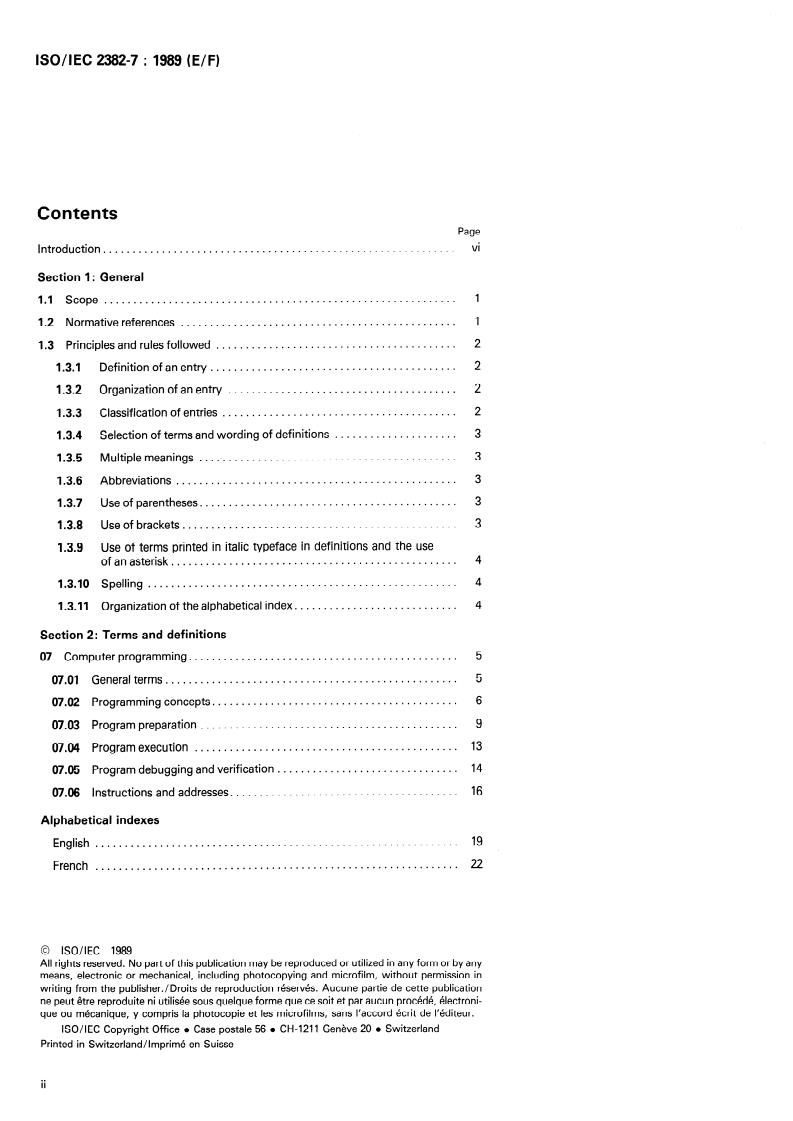
Contents
Page
vi
Introduction .
Section I : General
1.1 Scope .
............................................... 1
1.2 Normative references
......................................... 2
1.3 Principles and rules followed
..........................................
Definition of an entry 2
1.3.1
....................................... 2
1.3.2 Organization of an entry
........................................ 2
Classification of entries
1.3.3
..................... 3
1.3.4 Selection of terms and wording of definitions
............................................ 3
1.3.5 Multiple meanings
................................................ 3
1.3.6 Abbreviations
Useofparentheses . 3
1.3.7
1.3.8 Useofbrackets .
1.3.9 Use of terms printed in italic typeface in definitions and the use
ofanasterisk .
1.3.10 Spelling. .
...........................
1.3.11 Organization of the alphabetical index.
Section 2: Terms and definitions
............................................. 5
07 Computer programming.
.................................................. 5
07.01 General terms
......................................... 6
07.02 Programming concepts.
............................................ 9
07.03 Program preparation
............................................. 13
07.04 Program execution
............................... 14
07.05 Program debugging and verification
......................................
07.06 Instructions and addresses.
Alphabetical indexes
English . . . . . . . . . . . . . . . . . . . . . . . . . . . . . . . . . . . . . . . . . . . . . . . . . . . . . . . . . . . . . .
French . . . . . . . . . . . . . . . . . . . . . . . . . . . . . . . . . . . . . . . . . . . . . . . . . . . . . . . . . . . . . .
0 ISO/IEC 1989
All rights reserved. No part of this publication may be reproduced or utilized in any form or by any
means, electronic or mechanical, including photocopying and microfilm, without permission in
writing from the publisher./Droits de reproduction reserves. Aucune partie de cette publication
ne peut etre reproduite ni utilisee sous quelque forme que ce soit et par aucun procede, electroni-
que ou mecanique, y compris la photocopie et les microfilms, sans I’accord ecrit de I’editeur.
ISO/IEC Copyright Office l Case postale 56 l CH-1211 Geneve 20 l Switzerland
Printed in Switzerland/lmprime en Suisse
ii
ISOAEC 2382-7 : 1989 (E/F)
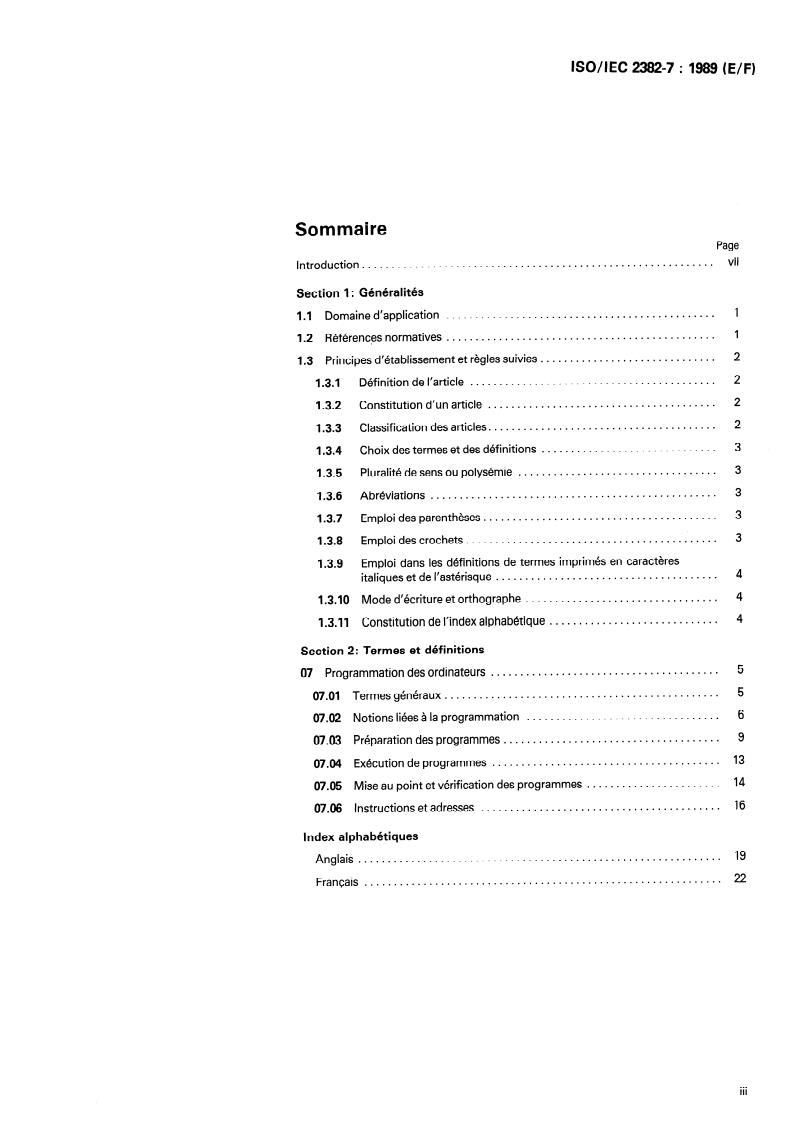
Sommaire
Page
vii
Introduction. . . . . . . . . . . . . . . . . . . . . . . . . . . . . . . . . . . . . . . . . . . . . . . . . . . . . . . . . . .
Section 1: G6nkalitbs
1 .I Domaine d’application . . . . . . . . . . . . . . . . . . . . . . . . . . . . . . . . . . . . . . . . . . . . . .
.............................................. 1
1.2 References normatives
.............................. 2
1.3 Principes d’etablissement et regles suivies
.......................................... 2
Definition de I’article
I .3.1
....................................... 2
Constitution d’un article
1.3.2
...................................... 2
1.3.3 Classification des articles.
.............................. 3
I .3.4 Choix des termes et des definitions
..................................
1.3.5 Pluralite de sens ou polysemie
Abreviations .
1.3.6
....................................... 3
Emploi des parentheses.
1.3.7
........................................... 3
Emploi des crochets
1.3.8
1.3.9 Emploi dans les definitions de termes imprimes en caracteres
...................................... 4
italiques et de I’asterisque
................................. 4
1.3.10 Mode d’ecriture et orthographe
............................. 4
1.3.11 Constitution de I’index alphabetique
Section 2: Termes et definitions
....................................... 5
07 Programmation des ordinateurs
............................................... 5
07.01 Termes generaux
................................. 6
07.02 Notions liees a la programmation
..................................... 9
07.03 Preparation des programmes
....................................... 13
07.04 Execution de programmes
....................... 14
07.05 Mise au point et verification des programmes
......................................... 16
07.06 Instructions et adresses
Index alphabetiques
Anglais. 19
Francais . . . . . . . . . . . . . . . . . . . . . . . . . . . . . . . . . . . . . . . . . . . . . . . . . . . . . . . . . . . . .
,
. . .
III
ISO/IEC 2382-7 : 1989 (E/F)
Foreword
IS0 (the International Organization for Standardization) and IEC (the International
Electrotechnical Commission) together form a system for worldwide standardization as
a whole. National bodies that are members of IS0 or IEC participate in the devleop-
ment of International Standards through technical committees established by the
respective organization to deal with particular fields of technical activity. IS0 and IEC
technical committees collaborate in fields of mutual interest. Other international
organizations, governmental and non-governmental, in liaison with IS0 and IEC, also
take part in the work.
In the field of information technology, IS0 and IEC have established a joint technical
committee, ISOAEC JTC 1. Draft International Standards adopted by the joint
technical committee are circulated to national bodies for approval before their accep-
tance as International Standards. They are approved in accordance with procedures re-
quiring at least 75 % approval by the national bodies voting.
International Standard ISO/IEC 2382-7 was prepared by Joint Technical Committee
ISO/IEC JTC 1, Information technology.
This second edition cancels and replaces the first edition (IS0 2382-7 : 19771, of which
it constitutes a technical revision.
ISOAEC 2382 will consist of some twenty-eight parts, under the general title lnfor-
ma tion technology - Vocabulary.
iv
ISO/lEC 2382-7 : 1989 (E/F)
Avant-propos
L’ISO (Organisation internationale de normalisation) et la CEI (Commission electro--
technique internationale) forment ensemble un systeme consacre a la normalisation
internationale consideree comme un tout. Les organismes nationaux membres de I’ISO
ou de la CEI participent au developpement de Normes internationales par I’interme-
diaire des comites techniques c&es par I’organisation concernee afin de s’occuper des
differents domaines particuliers de I’activite technique. Les comites techniques de
I’ISO et de la CEI collaborent dans des domaines d’interet commun. D’autres organisa-
tions internationales, gouvernementales ou non gouvernementales, en liaison avec
I’ISO et la CEI participent egalement aux travaux.
Dans le domaine des technologies de I’information, I’ISO et la CEI ont tree un comite
technique mixte, I’ISOKEI JTC 1. Les projets de Normes internationales adopt& par
le comite technique mixte sont soumis aux organismes nationaux pour approbation,
avant leur acceptation comme Normes internationales. Les Normes internationales
sont approuvees conformement aux procedures qui requierent I’approbation de 75 %
au moins des organismes nationaux votants.
La Norme internationale ISOKEI 2382-7 a et6 elaboree par le comite technique mixte
ISOKEI JTC 1, Technologies de l’information.
Cette deuxieme edition annule et remplace la premiere edition (IS0 2382-7 : 19771, dont
elle constitue une revision technique.
ISOKEI 2382 comprendra une trentaine de parties, presentees sous le titre general
Technologies de l’in forma tion - Vocabulaire.
V
ISO/IEC 2382-7 : 1989 (E/F)
Introduction
Information processing gives rise to numerous international exchanges of both an
intellectual and a material nature. These exchanges often become difficult, either
because of the great variety of terms used in various fields or languages to express the
same concept, or because of the absence or imprecision of the definitions of useful
concepts.
To avoid misunderstandings and to facilitate such exchanges it is essential to clarify the
concepts, to select terms to be used in various languages or in various countries to ex-
press the same concept, and to establish definitions providing satisfactory equivalents
for the various terms in different languages.
IS0 2382 was initially based mainly on the usage to be found in the Vocabulary of lnfor-
mation Processing which was established and published by the International Feder-
ation for Information Processing and the International Computation Centre, and in the
American National Dictionary for Information Processing Systems and its earlier
editions published by the American National Standards Institute (formerly known as
the American Standards Association). Published and draft International Standards
relating to information processing of other international organizations (such as the
International Telecommunication Union and the International Electrotechnical Com-
mission) as well as published and draft national standards have also been considered.
The purpose of ISO/IEC 2382 is to provide definitions that are rigorous, uncomplicated
and which can be understood by all concerned. The scope of each concept defined has
been chosen to provide a definition that is suitable for general application. In those cir-
cumstances where a restricted application is concerned, the definition may need to be
more specific.
However, while it is possible to maintain the self-consistency of individual parts, the
reader is warned that the dynamics of language and the problems associated with the
standardization and maintenance of vocabularies may introduce duplications and
inconsistencies between parts.
VI
ISO/IEC 2382-7 : 1989 (E/F)
Introduction
Le traitement de I’information est a I’origine de multiples echanges intellectuels et
materiels sur le plan international. Ceux-ci souffrent souvent des difficult& provoquees
par la diversite des termes utilises pour exprimer la meme notion dans des langues ou
dans des domaines differents, ou encore de I’absence ou de I’imprecision des defini-
tions pour les notions les plus utiles.
Pour eviter des malentendus et faciliter de tels echanges, il parait essentiel de preciser
les notions, de choisir les termes a employer dans les differentes langues et dans les
divers pays pour exprimer la meme notion, et d’etablir pour ces termes des definitions
equivalentes dans chaque langue.
L’ISO 2382 a et6 basee a I’origine principalement sur I’usage tel qu’il a ete releve, d’une
part, dans le Vocabulary of Information Processing etabli et publie par I’lnternational
Federation for Information Processing et le Centre International de Calcul et, d’autre
part, dans I’American National Dictionary for Information Processing systems y com-
pris ses editions precedentes publiees par I’American National Standards Institute
(connu auparavant sous I’appellation d’American Standards Association). Les Normes
internationales publiees ou au stade de projets concernant le traitement de I’informa-
tion emanant d’autres organisations internationales (telles que I’Union inte,rnationale
des telecommunications et la Commission electrotechnique internationale) ainsi que
les normes nationales publiees ou au stade de projets, ont egalement ete prises en
compte.
Le but de I’ISOKEI 2382 est de procurer des definitions rigoureuses, simples et com-
prehensibles pour tous les interesses. La portee de chaque notion a et6 choisie de
facon que sa definition puisse avoir la valeur la plus g&Wale. Cependant, il est parfois
necessaire de restreindre une notion 8 un domaine plus etroit et de lui donner alors une
definition plus specifique.
D’autre part, si I’on peut assurer la coherence interne de chaque partie prise individuel-
lement, la coherence des diverses parties entre elles est plus difficile a atteindre. Le lec-
teur ne doit pas s’en etonner : la dynamique des langues et les problemes de I’etablisse-
ment et de la revision des normes de vocabulaires peuvent etre a I’origine de quelques
repetitions ou contradictions entre des parties qui ne sont pas toutes preparees et
publiees simultanement.
vii
This page intentionally left blank
INTERNATIONAL STANDARD
ISO/IEC2382-7 : 1989 (E/F)
NORME INTERNATIONALE
Information technology - Technologies de
I’information -
Vocabulary -
Vocabulaire -
Part 07:
Partie 07:
Computer programming
Programmation des
ordinateurs
Section 1: Gh6ralit6s
Section 1: General
1 .I Domaine &application
1.1 Scope
La presente par-tie de I’ISOICEI 2382 a pour objet de faciliter les
This part of ISO/IEC 2382 is intended to facilitate international
communication in information processing. It presents, in two echanges internationaux dans le domaine des systemes de trai-
tement de I’information. A cet effet, elle presente un ensemble
languages, terms and definitions of selected concepts relevant
bilingue de termes et de definitions ayant trait a des notions
to the field of information processing and identifies relation-
choisies dans ce domaine, et definit les relations pouvant exis-
ships between the entries.
ter entre les differentes notions.
In order to facilitate their translation into other languages, the
Les definitions ont et6 etablies de maniere a eviter les particula-
definitions are drafted so as to avoid, as far as possible, any
rismes propres a une langue donnee, en vue de faciliter leur
peculiarity attached to a language.
transposition dans les langues autres que celles ayant servi a la
This part of ISO/IEC 2382 defines concepts relating to pro- redaction initiale.
gramming context and some programming languages, to
La presente partie de I’ISOKEI 2382 definit les notions relatives
preparation, execution, debugging and verification of pro-
a la programmation et a certains langages de programmation, a
grams.
la preparation, a I’execution, a la mise au point et a la verifica-
tion de programmes.
1.2 References normatives
1.2 Normative references
The following standards contain provisions which, through Les normes suivantes contiennent des dispositions qui, par
suite de la reference qui en est faite, constituent des disposi-
reference in this text, constitute provisions of this part of
tions valables pour la presente par-tie de I’ISOKEI 2382. Au
ISO/IEC 2382. At the time of publication, the editions indicated
were valid. All standards are subject to revision, and parties to moment de la publication, les editions indiquees etaient en
vigueur. Toute norme est sujette 8 revision et les parties pre-
agreements based on this part of ISO/IEC 2382 are encouraged
to investigate the possibility of applying the most recent nantes des accords fond& sur la presente par-tie de
I’ISOKEI 2332 sont invitees a rechercher la possibilite d’appli-
editions of the standards indicated below. Members of IEC and
IS0 maintain registers of currently valid International Stan- quer les editions les plus recentes des normes indiquees
ci-apres. Les membres de la CEI et de I’ISO possedent le regis-
dards.
tre des Normes internationales en vigueur a un moment donne.
IS0 1087 : - I), Terminology - Vocabulary.
- 1 ), Terminologie - Vocabulaire.
IS0 1087 :
IS0 3166 : 1988, Codes for the representation of names of
IS0 3166 : 1988, Codes pour la repr&entation des noms de
countries.
pays=
1) To be published.
I) A publier.
ISOAEC 2382-7 : 1989 (E/F)
I .3 Principes d’6tablissement et r&gles suivies
1.3 Principles and rules followed
1.3.1 Definition de l’article
1.3.1 Definition of an entry
La section 2 est composee d’un certain nombre d/articles. Cha-
Section 2 comprises a number of entries. Each entry consists of a
que article est compose d’un ensemble d’elements essentiels
set of essential elements that includes an index number, one
comprenant le numero de reference, le terme ou plusieurs ter-
term or several synonymous terms, and a phrase defining one
mes synonymes et la definition d’une notion couverte par ces
concept. In addition, an entry may include examples, notes or il-
termes. Cet ensemble peut etre complete par des exemples,
lustrations to facilitate understanding of the concept.
des notes, des schemas ou des tableaux destines a faciliter la
comprehension de la notion.
Occasionally, the same term may be defined in different entries,
or two or more concepts may be covered by one entry, as
Parfois, le meme terme peut etre defini dans des articles diffe-
described in 1.3.5 and 1.3.8 respectively.
rents, ou bien deux notions ou davantage peuvent etre couver-
tes par un seul article : voir respectivement en 1.3.5 et 1.3.8.
Other terms such as vocabulary, concept, term and defini-
tion, are used in this part of ISO/IEC 2382 with the meaning de-
D’autres termes tels que vocabulaire, notion, terme, defini-
fined in IS0 1087.
tion sont employ& dans la presente partie de I’ISOKEI 2382
avec le sens qui leur est donne dans I’ISO 1087.
1.3.2 Constitution d’un article
1.3.2 Organization of an entry
Chaque article contient les elements essentiels definis en 1.3.1
Each entry contains the essential elements defined in 1.3.1 and, if
et, si necessaire, des elements supplementaires. L’article peut
necessary, additional elements. The entry may contain the
done comprendre dans I’ordre les elements suivants:
following elements in the following order:
a) un numero de reference (le meme, quelle que soit la lan-
a) an index number (common for all languages in which this
gue de publication de la presente partie de I’ISOKEI 2382);
part of ISO/IEC 2382 is published);
b) le terme, ou le terme prefere en general dans la langue.
b) the term or the generally preferred term in the language.
L’absence, dans une langue, de terme consacre ou a conseil-
The absence of a generally accepted term for the concept in
ler pour exprimer une notion est indiquee par un symbole
the language is indicated by a symbol consisting of five points
consistant en cinq points de suspension (. . . . . ); les points de
(. ); a row of dots may be used to indicate, in a term, a
suspension peuvent etre employ& pour designer, dans un
word to be chosen in each particular case;
terme, un mot a choisir dans chaque cas particulier;
c) the preferred term in a particular country (identified
c) le terme prefere dans un certain pays (identifie selon les
according to the rules of IS0 3166);
regles de I’ISO 3166);
d) the abbreviation for the term;
d) I’abreviation pouvant etre employee a la place du terme;
e) permitted synonymous term(s);
e) le terme ou les termes admis comme synonymes;
f) the text of the definition (see 1.3.4);
f) le texte de la definition (voir 1.3.4);
g) one or more examples with the heading “Example(s)“;
g) un ou plusieurs exemples precedes du titre ((Exemple(s)));
h) one or more notes specifying particular cases in the field
h) une ou plusieurs notes precisant le domaine d’application
of application of the concepts, with the heading “NOTE(S)“;
de la notion, precedees du titre ((NOTE(S)));
a picture, a diagram , or a which could be common
i)
i) une figure, un schema ou un tableau, pouvant
to several entries. etre com-
muns a plusieu rs articles.
1.3.3 Classification of entries 1.3.3 Classification des articles
Chaque partie de la presente Norme internationale recoit un
A two-digit serial number is assigned to each part of this Inter-
numero d’ordre a deux chiffres, en commencant pas 01 ‘pour le
national Standard, beginning with 01 for “fundamental
terms”. chapitre (ttermes fondamentauxlj.
Les articles sont repartis en groupes qui recoivent chacun un
The entries are classified in groups to each of which is assigned a
numero d’ordre a quatre chiff res, les deux premiers chiff res etant
four-digit serial number, the first two digits being those of the
ceux du numero de par-tie de la presente Norme internationale.
part of this International Standard.
ISO/IEC 2382-7 : 1989 (E/F)
Each entry is assigned a six-digit index number, the first four Chaque article est rep&e par un numero de reference a six chif-
fres, les quatre premiers chiffres &ant ceux du numero de par-
digits being those of the part of this International Standard and
the group. tie de la presente Norme internationale et de groupe.
In order that versions of this International Standard in various Les numeros des parties, des groupes et des articles sont les
memes pour toutes les langues, afin de mettre en evidence les
languages are related, the numbers assigned to parts, groups
and entries are the same for all languages. correspondances des versions de la presente Norme interna-
tionale.
1.3.4 Choix des termes et des definitions
1.3.4 Selection of terms and wording of definitions
Les choix qui ont et6 faits pour les termes et leurs definitions
The selection of terms and the wording of definitions have, as
far as possible, followed established usage. When there were sont, dans toute la mesure du possible, compatibles avec les
usages etablis. Lorsque certains usages apparaissent contradic-
contradictions, solutions agreeable to the majority have been
toires, des solutions de compromis ont et6 retenues.
sought.
1.3.5 Multiple meanings 1.3.5 Pluralite de sens ou polysemie
Lorsque, dans I’une des langues de travail, un meme terme
When, in one of the working languages, a given term has
peut prendre plusieurs sens, ces sens sont definis dans des arti-
several meanings, each meaning is given a separate entry in
order to facilitate translation into other languages. cles differents, pour faciliter I’adaptation du vocabulaire dans
d’autres langues.
1.3.6 Abbreviations 1.3.6 Abrgviations
As indicated in 1.3.2, abbreviations in current use are given for Comme indique en 1.3.2, des abreviations litterales d’usage
courant, au moins en anglais, sont indiquees pour certains ter-
some terms. Such abbreviations are not used in the texts of the
definitions, examples or notes. mes. De telles abreviations ne sont pas employees dans le corps
des definitions, exemples ou notes.
1.3.7 Emploi des parenth&ses
1.3.7 Use of parentheses
In some terms, a word or words printed in bold typeface are Dans certains termes, un ou plusieurs mots imprimes en carac-
t&es gras sont places entre parentheses. Ces mots font partie
placed between parentheses. These words are part of the com-
plete term, but they may be omitted when use of the abridged integrante du terme complet, mais peuvent etre omis lorsque le
term in a technical context does not introduce ambiguity. In the terme ainsi abrege peut etre employ6 dans un contexte tech-
nique determine sans que cette omission introduise d’ambi-
text of another definition, example, or note of ISO/IEC 2332,
such a term is used only in its complete form. guite. Un tel terme n’est employ6 dans le texte d’une autre defi-
nition, d’un exemple ou d’une note, de I’ISOKEI 2332, que
In some entries, the terms are followed by words in paren- sous sa forme complete.
theses in normal typeface. These words are not a part of the
term but indicate directives for the use of the term, its particular Dans certains articles, les termes definis sont suivis par des
expressions imprimees en caracteres normaux et placees entre
field of application, or its grammatical form.
parentheses. Ces expressions ne font pas partie du terme mais
indiquent des prescriptions d’emploi, precisent un domaine
d’application particulier ou indiquent une forme grammaticale.
1.3.8 Use of brackets 1.3.8 Emploi des crochets
When several closely related terms can be defined by texts that Lorsque plusieurs termes etroitement apparent& peuvent etre
differ only in a few words, the terms and their definitions are definis par des textes presque identiques, a quelques mots
grouped in a single entry. The words to be substituted in order pres, les termes et leurs definitions ont et6 group& en un seul
article. Les mots a substituer a ceux qui les precedent pour
to obtain the different meanings are placed in brackets, i.e.
[ I, in the same order in the term and in the definition. In obtenir les differents sens sont places entre crochets (c’est-a-
dire [
order to avoid uncertainty regarding the words to be sub- I) dans le meme ordre dans le terme et dans la defi-
stituted, the last word that according to the above rule could be nition. En vue d’eviter toute incertitude sur les mots a rempla-
cer, le dernier mot qui, suivant la regle ci-dessus pourrait etre
placed in front of the opening bracket is, wherever possible,
placed inside the bracket and repeated for each alternative. place devant le crochet d’ouverture, est place, si possible, a
I’interieur des crochets et rep& a chaque occasion.
ISO/IEC 2382-7 : 1989 (E/F)
1.3.9 Emploi dans les definitions de termes
1.3.9 Use of terms printed in italic typeface in
imprimes en caracteres italiques et de I’asterisque
definitions and the use of an asterisk
A term printed in italic typeface in a definition, an example, or a Dans le texte d’une definition, d’un exemple ou d’une note,
tout terme imprime en caracteres italiques a le sens defini dans
note is defined in another entry in this International Standard,
un autre article de la presente Norme internationale, qui peut se
which may be in another part. However, the term is printed in
trouver dans une autre partie. Cependant, le terme est imprime
italic typeface only the first time it occurs in each entry.
en caracteres italiques uniquement la premiere fois qu’il appa-
forms of a rait dans chaque article.
Italic typeface is also used for other grammatical
term, for example, plurals of nouns and participles of verbs.
Les caracteres italiques sont egalement utilises pour les autres
formes grammaticales du terme, par exemple, les noms au plu-
The basic forms of terms printed in italic typeface which are de-
fined in this part of ISO/IEC 2382 are listed in the index at the riel et les verbes au participe.
end of the part (see 1.3.11).
La liste des formes de base des termes imprimes en caracteres
italiques qui sont definis dans la presente partie de
An asterisk is used to separate terms printed in italic typeface
when two such terms are referred to in separate entries and I’ISOKEI 2382 est fournie dans I’index a la fin de la partie (voir
1.3.11).
directly follow each other (or are separated only by a punctu-
ation sign).
L’asterisque sert a &parer les termes imprimes en caracteres
italiques quand deux termes se rapportent a des articles &pares
Words or terms that are printed in normal typeface are to be
et se suivent directement (ou bien sont &pares simplement par
understood as defined in current dictionaries or authoritative
un signe de ponctuation).
technical vocabularies.
Les mots ou termes imprimes en caracteres normaux doivent
etre compris dans le sens qui leur est donne dans les dictionnai-
res courants ou vocabulaires techniques faisant autorite.
1.3.10 Spelling 1.3.10 Mode d’ecriture et orthographe
In the English language version of this part of ISO/IEC 2382, Dans la version anglaise de la presente partie de I’ISOKEI 2382,
les termes, definitions, exemples et notes sont ecrits suivant
terms, definitions, examples, and notes are given in the spelling
preferred in the USA. Other correct spellings may be used I’orthographe prevalant aux Stats-Unis. D’autres orthographes
correctes peuvent etre utilisees sans violer la presente partie de
without violating this part of ISO/IEC 2382.
I’ISOKEI 2382.
1.3.11 Organization of the alphabetical index 1.3.11 Constitution de I’index alphabetique
For each language used, an alphabetical index is provided at Pour chaque langue de travail, un index alphabetique est fourni
a la fin de chaque partie. L’index comprend tous les termes
the end of each part. The index includes all terms defined in the
definis dans la partie. Les termes composes de plusieurs mots
part. Multiple-word terms appear in alphabetical order under
sont repertories alphabetiquement suivant chacun des mots
each of their key words.
constituants caracteristiques ou mots cles.
ISOAEC 2382-7 : 1989 (E/F)
Section 2: Termes et definitions
Section 2: Terms and definitions
07 Programmation des ordinateurs
07 Computer programming
07.01 Termes gh6raux
07.01 General terms
07.01 .Ol
07.01 .Ol
programming environment contexte de programmation
environnement de programmation
An integrated collection of software and hardware to support
the development of computer programs. Ensemble integre de mat&ie/ et de /ogicie/ permettant le deve-
loppement de programmes d’ordinateur.
07.01.02 07.01.02
systeme de programmation
programming system
In a programming environment, the software required for the Dans un contexte de programmation, “fogiciel necessaire au
developpement et a l’utilisation de programmes d’ordinateur.
development and use of computer programs.
07.01.03
07.01.03
bibliotheque (de programmes)
(program) library
An organized collection of computer programs, or parts of programmatheque
Ensemble organise de programmes d’ordinateur ou de parties
computer programs, and possibly information pertaining to
de programmes d’ordinateur, associes eventuellement a toute
their use.
information relative a leur utilisation.
NOTE - A program library is often called according to the
characteristic of its elements, for example, a procedure library, a NOTE - Une bibliotheque de programmes est souvent qualifiee par la
source program library.
caracteristique de ses Mments, par exemple une bibliotheque de pro-
cbdures, une bibliothhque de prugrammes d’origine.
07.01.04
07.01.04
utility routine [program] routine [programmel de service
routine [programmel utilitaire
service routine [program]
A routine [A computer program3 that provides general, fre- Routine [Programme d’ordinateurl mettant a la disposition des
utilisateurs d’ordinateurs et du personnel informatique des
quently needed services for computer users and service per-
sonnel. fonctions generales utilisees frequemment.
Examples : A ,n input routine; a diagnostic program; a trace pro- Exemples : Programme d’entrhe, “programme de diagnostic,
*programme de traqage, *programme de tri.
gram; a sort program.
07.01.05 07.01 AK
algorithmic language langage algorithmique
An artificial language for expressing algorithms. Langage artificiel permettant d’exprimer des algorithmes.
07.01.06 07.01.06
programming language langage de programmation
An artificial language for expressing computer programs. Langage artificiel permettant d’exprimer des programmes
d ‘ordina teur.
07.01.07 07.01.07
problem-oriented language langage adapt6 aux problemes
A programming language that reflects the concepts of a par- langage orient6 (vers les) problemes
Langage de programmation qui convient pour rep&enter un
titular application area.
domaine d’application particulier.
Examples : SQL for database applications, COBOL for business
applications. Exemples: SQL pour les applications de bases de don&es,
COBOL pour les applications de gestion.
07.01.08 07.01.08
machine language langage-machine
An artificial language composed of the machine instructions of Langage artificiel dont les elements sont des instructions-
a computer. machine.
ISO/IEC 2382-7 : 1989 (E/F)
07.01.09
07.01.09
langage d’assemblage
assembly language
Langage de programmation permettant de disposer
A programming language that provides symbolic forms for
d’instructions-machine sous forme symbolique.
machine ins true tions.
peut egalement comprendre des
NOTE - Un langage d’assem blage
NOTE - Assembly languages usually also provide macro calls.
macro-instructions.
07.01 .I0
07.01.10
langage 6volu6
high-level language
Langage de programmation dont les concepts et les structures
A programming language whose concepts and structures are
sont relativement proches du raisonnement humain.
convenient for human reasoning.
-
independent of the structures of NOTE Les langages evolues sont independa nts de la structure des
NOTE - High-level languages are
calcula teurs et des systkmes d’exploitation.
computers and operating systems.
Example : Pascal. Exemple : Pascal.
07.01.11
07.01.11
declarative language langage declaratif
Langage de programmation concu pour exprimer des dklara-
A programming language for expressing declarations.
I
tions.
Example: A data description language.
Exemple: Un langage de description de donnbes.
07.01 .I2
07.01.12
procedural language langage de procedure
langage procedural
A programming language in which computations are expressed
in terms of statement *sequences. Langage de programmation dans lequel les calculs sont expri-
mes sous forme de sequences d’instructions.
Example : Pascal.
Exemple : Pascal.
07.01 .I3
07.01 .I3
functional language langage fonctionnel
Langage de programmation dans lequel les calculs sont expri-
A programming /anguage in which computations are expressed
in terms of function procedure *calls. mes sous forme d’appels de fonctions.
Exemple: LISP.
Example: LISP.
07.01 .I4 07.01 .I4
langage adapt6 g I’objet
object-oriented language
A programming language that reflects the concepts of object- langage orient6 (vers I’)objet
Langage de programmation base sur les concepts de la pro-
oriented programming.
gramma tion adapt&e ;i l’obj’e t.
Example: SMALLTALK.
Exemple: SMALLTALK.
07.01.15
microprogram
A sequence of microinstructions.
mainly used to implement machine NOTE - Un microprogramme s’ essentiellement pour mettre en
NOTE - Microprograms are
ceuvre des instructions-machine.
ins true tions.
07.02 Notions lihes 6 la programmation
07.02 Programming concepts
07.02.01
07.02.01
structured programming programmation structuree
Methode permettant de construire des programmes en n’utili-
A method for constructing programs using only hierarchically
nested constructs each having a single entry and a single exit sant que des constructions hierarchiquement emboSes ayant
chacune un seul point d’entree et un seul point de sortie.
point.
-
in stru ctured program- NOTE - La programmation structuree emploie trois de flux
NOTE Three types of control flow are used de
types
ming : commande : sequentiel, conditionnel et iteratif.
sequential, conditional, and iterative.
ISOAEC 2382-7 : 1989 (E/F)
07.02.02
07.02.02
affinement progressif
stepwise refinement
Methode permettant de construire des programmes par &apes
A method for constructing programs in successive steps such
successives, de telle sorte qu’a chaque &ape on exprime une
that at each step an action is expressed in terms of more
action sous la forme d’actions plus elementaires.
primitive actions.
07.02.03
07.02.03
em baiter
to nest
lncorporer plusieurs structures d’un certain type a I’interieur
To incorporate one or more structures of one kind into a strut
d’une structure du meme type.
ture of the same kind.
Exemples : Placer une boucle (boucle emboitee ou interne) a
Examples: To nest one loop (the nested or inner loop) within
I’interieur d’une autre boucle (boucle emboitante ou externe);
another loop (the nesting or outer loop); to nest one subroutine
placer un sous-programme a l’interieur d’un autre sous-
within another subroutine.
programme.
07.02.04
07.02.04
programmation fonctionnelle
functional programming
Methode utilisee pour structurer les programmes en les ecri-
A method for structuring programs mainly as sequences of
vant, pour la plus grande part, sous la forme de suites d’appels
possibly nested *function procedure *calls.
de fonctions, eventuellement emboWs.
07.02.05
07.02.05
object-oriented programming programmation adapthe & I’objet
programmation orienthe hers I’Iobjet
A method for structuring programs as hierarchically organized
Methode utilisee pour structurer les programmes sous la forme
classes describing the data and operations of objects that may
de classes organisees hierarchiquement et decrivant les don-
interact with other objects.
&es et les ophrations portant sur des objets qui peuvent inter-
agir avec d’autres objets.
07.02.06 07.02.06
programmation en logique
logic programming
Methode utilisee pour structurer les programmes sous la forme
A method for structuring programs as sets of logical rules with
d’ensembles de regles logiques munis d’algorithmes predefinis
predefined algorithms for the processing of input data to a pro-
permettant de traiter, selon ces regles, les don&es d’entrde
gram according to the rules of that program.
d’un programme.
07.02.07
07.02.07
1. microprogrammation
1. microprogramming
Preparation de microprogrammes.
The preparation of microprograms.
07.02.08 07.02.08
2. microprogrammation
2. microprogramming
Technique utilisee dans la conception du matkriel command6
The technique used in the design of hardware that is to be con
par microprogramme.
trolled by microprograms.
07.02.09 07.0249
subroutine sous-programme
Shquence d’instructions dont I’exkution est Ian&e par un
A sequence of instructions whose execution is invoked by a
call. appel.
07.02.10 07.02.10
recursive subroutine sous-programme rkursif
A subroutine that may invoke itself. Sous-programme qui peut s’appeler lui-meme.
NOTE - Un sous-programme r6cursif contient normalement un appel
contains a call that invokes
NOTE - A recursive subroutine normally
qui lance I’exhcution de ce sous-programme, directement ou indirecte-
this subroutine directly or indirectly.
ment.
07.02.11 07.02.11
coroutine
coroutine
A subroutine which, when called again after an execution, Sous-programme qui, Iorsqu’il est rappel6 apres une exkution,
resumes at the return point of its previous execution. reprend au point de retour de sa precedente execution.
lSO/IEC 2382-7 : 1989 (E/F)
07.02.13 07.02.13
infinite loop boucle fermee
closed loop /US/ Boucle dont on ne peut sortir que par une intervention exte-
A loop whose execution can be terminated only by intervention rieure au programme d’ordinateur contenant cette boucle.
from outside the computer program in which the loop is in-
cluded.
07.02.14
07.02.14
saut
jump
Deviation par rapport ZI I’execution sequentielle des instruc-
A departure from the sequential execution of instructions.
tions.
07.02.15 07.02.15
flag drapeau
indicateur d’aiguillage
A variable indicating that a certain condition holds.
Variable indiquant qu’une condition determinee est verifiee ou
non.
07.02.16
07.02.16
switch aiguillage
A choice of one jump from a selection of jumps, controlled by a Choix, command6 par un drapeau, d’un saut parmi plusieurs
sauts possibles.
flag.
07.02.17 07.02.17
work(ing) space espace de travail
work(ing) area zone de manceuvre
zone de travail
A portion of storage used by a computer program to hold data
temporarily. Partie de memoire utilisee par un programme d’ordinateur pour
y ranger temporairement des don&es.
07.02.18
07.02.18
adressage calcule
hashing
A method of transforming a search key into an address for the tronconnage
purpose of storing and retrieving items of data. . Methode utilisee pour transformer une c/e de recherche en une
adresse, en vue de ranger ou de retrouver des don&es.
NOTE - The method is often designed to minimize the search time.
NOTE - Cette methode vise 5 minimiser le temps d’exploration.
07.02.19 07.02.19
synchronization synchronisation
Action de forcer certains points dans les sequences d’execution
The action of forcing certain points in the execution sequences
of two or more asynchronous procedures to coincide in time. de plusieurs procedures asynchrones, pour qu’ils coincident
dans le temps.
0792.20 07.02.20
mutual exclusion exclusion mutuelle
Principe selon lequel une seule procedure asynchrone 3 la fois
A principle requiring that, at a given time, only one asyn-
chronous procedure may access the same shared variable or accede 3 une variable partagee ou execute des membres d’un
execute members of a group of critical sections. groupe de sections critiques.
07.02.21 07.02.21
semaphore
semaphore
A variable that is used to enforce mutual exclusion, Variable employee pour imposer Bane exclusion mutuelle.
ISO/IEC 2382-7 : 1989 (E/F)
07.0222
07.0222
producteur
producer
Procedure asynchrone qui fournit des don&es pour utilisation
An asynchronous procedure that provides data to be used by
par d’autres procedures asynchrones.
other asynchronous procedures.
07.02.23 07.02.23
consommateur
consumer
An asynchronous procedure that uses data provided by other Procedure asynchrone qui utilise des don&es fournies par
d’autres procedures asynchrones.
asynchronous procedures.
07.02.24 07.02.24
variable partagee
shared variable
A variable that can be accessed by two or more asynchronous Variable a laquelle peuvent acceder plusieurs procedures
asynchrones, ou bien plusieurs programmes d’ordinateur
procedures or concurrently executed *computer programs.
*executes concurremment.
07.02.25
07.02.25
to bind relier
Rattacher un identificateur a un autre objet de programme.
To relate an identifier to another object in a program.
Exemples: Relier un identificateur 8 une valeur, 3 une adresse
Examples: To relate an identifier to a value, an address or
another identifier, or to associate formalparameters and actual ou a un autre identificateur ou bien relier des parametres for-
mels A des parametres reels.
pararne ters.
07.02.26 07.02.26
macro-instruction
macro call
Dans un langage dorigine,
A statement, embedded in a source language, that is to be *instruction destinee a etre rempla-
same source tee par une sequence d’instructions dans le meme langage
replaced by a defined statement sequence in the
language. d’origine.
NOTE - The macro call will also specify th e actual parameters for any NOTE - La macro-instruction specific egalement un paramktre r&e/
pour chacun des param&tres formels de la macrod&hition.
formal parameters in the macrodefinition.
07.02.27 07.02.27
macrodefinition macrodefinition
A possibly parameterized specification for a statement *se- Specification, Bventuellement parametree, d’une sequence
quence to replace a macro call.
d’instructions destinee a remplacer une macro-instruction.
NOTE - A macrodefinition may be considered as a procedure to be Une macrodefinition peut 6tre consideree comme une pro&
NOTE -
executed by a macrogenerator yielding the statement sequence. dure qu’un macrogthkateur doit exhcuter pour produire la sequence
d’instructions.
07.03 Program preparation 07.03 Prhparation des programmes
07.03.01
07.03.01
to translate (in programming languages) traduire (en langages de programmation)
To transform all or part of a program expressed in oneprogram- Transformer tout ou partie d’un programme ecrit dans un lan-
ming language, into another programming language or into a gage deprogrammation, pour I’exprimer dans un autre langage
machine language suitable for execution. de programmation ou dans un langage-machine convenant a
I’execution.
07.03.02
07.03.02
to assemble assembler
To translate an assembly language *program into an object
Traduire un programme ecrit
...
Questions, Comments and Discussion
Ask us and Technical Secretary will try to provide an answer. You can facilitate discussion about the standard in here.
Loading comments...