


ISO 11865:1995
(Main)Instant whole milk powder — Determination of white flecks number
Instant whole milk powder — Determination of white flecks number
Describes a method for the determination of the white flecks number in instant whole milk powder.
Lait entier instantané en poudre — Détermination du nombre de taches blanches
General Information
- Status
- Withdrawn
- Publication Date
- 08-Nov-1995
- Withdrawal Date
- 08-Nov-1995
- Technical Committee
- ISO/TC 34/SC 5 - Milk and milk products
- Drafting Committee
- ISO/TC 34/SC 5 - Milk and milk products
- Current Stage
- 9599 - Withdrawal of International Standard
- Start Date
- 24-Sep-2009
- Completion Date
- 12-Feb-2026
Relations
- Effective Date
- 28-Feb-2009
ISO 11865:1995 - Instant whole milk powder -- Determination of white flecks number
ISO 11865:1995 - Lait entier instantané en poudre -- Détermination du nombre de taches blanches
ISO 11865:1995 - Lait entier instantané en poudre -- Détermination du nombre de taches blanches
Get Certified
Connect with accredited certification bodies for this standard

BSI Group
BSI (British Standards Institution) is the business standards company that helps organizations make excellence a habit.

Bureau Veritas
Bureau Veritas is a world leader in laboratory testing, inspection and certification services.

DNV
DNV is an independent assurance and risk management provider.
Sponsored listings
Frequently Asked Questions
ISO 11865:1995 is a standard published by the International Organization for Standardization (ISO). Its full title is "Instant whole milk powder — Determination of white flecks number". This standard covers: Describes a method for the determination of the white flecks number in instant whole milk powder.
Describes a method for the determination of the white flecks number in instant whole milk powder.
ISO 11865:1995 is classified under the following ICS (International Classification for Standards) categories: 67.100.10 - Milk and processed milk products. The ICS classification helps identify the subject area and facilitates finding related standards.
ISO 11865:1995 has the following relationships with other standards: It is inter standard links to ISO 11865:2009. Understanding these relationships helps ensure you are using the most current and applicable version of the standard.
ISO 11865:1995 is available in PDF format for immediate download after purchase. The document can be added to your cart and obtained through the secure checkout process. Digital delivery ensures instant access to the complete standard document.
Standards Content (Sample)
INTERNATIONAL
ISO
STANDARD
First edition
1995-11-15
Instant whole milk powder -
Determination of white flecks number
Lait en tier instan tan6 en poudre
- Determination du nombre de taches
blanches
Reference number
Foreword
ISO (the International Organization for Standardization) is a worldwide
federation of national Standards bodies (ISO member bodies). The work
of preparing International Standards is normally carried out through ISO
technical committees. Esch member body interested in a subject for
which a technical committee has been established has the right to be
represented on that committee. International organizations, governmental
and non-governmental, in liaison with ISO, also take part in the work. ISO
collaborates closely with the International Electrotechnical Commission
(IEC) on all matters of electrotechnical standardization.
Draft International Standards adopted by the technical committees are
circulated to the member bodies for voting. Publication as an International
Standard requires approval by at least 75 % of the member bodies casting
a vote.
International Standard ISO 11865 was prepared by Technical Committee
lSO/TC 34, Agricultural food products, Subcommittee SC 5, Milk and milk
products, in collaboration with the International Dairy Federation (IDF) and
the Association of Official Analytical Chemists (AOAC) International, and
will also be published by these organizations.
Annex A of this International Standard is for information only.
0 ISO 1995
All rights reserved. Unless otherwise specified, no part of this publication may be reproduced
or utilized in any form or by any means, electronie or mechanical, including photocopying and
microfilm, without Permission in writing from the publisher.
International Organization for Standardization
Case Postale 56 l CH-l 211 Geneve 20 l Switzerland
Printed in Switzerland
ii
INTERNATIONAL STANDARD 0 ISO ISO 11865:1995(E)
- Determination of white
Instant whole milk powder
flecks number
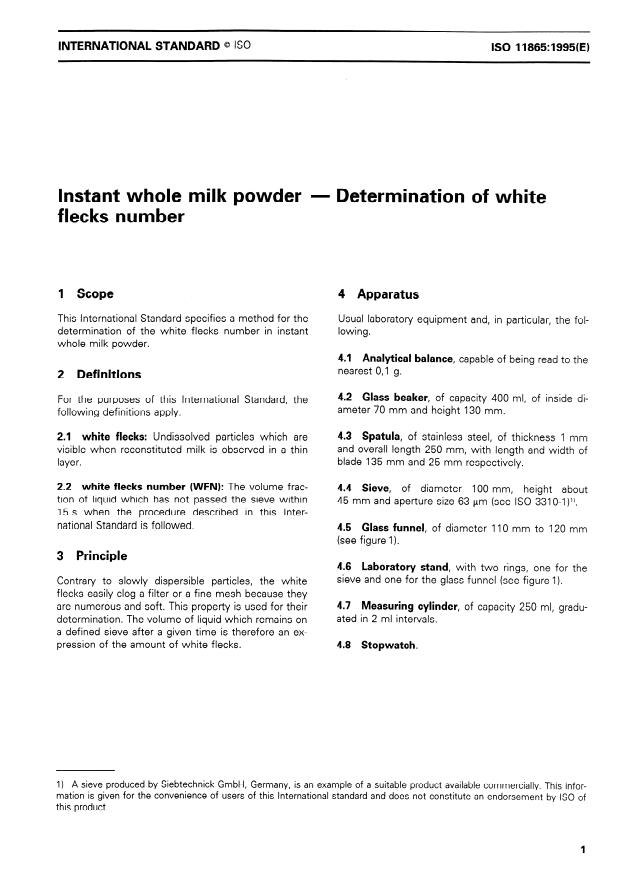
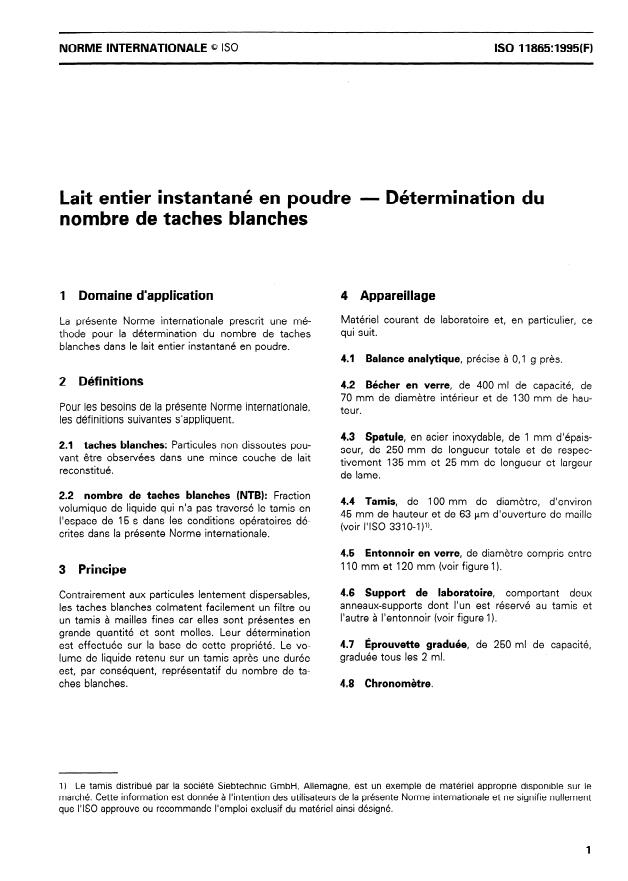
1 Scope 4 Apparatus
Usual laboratory equipment and, in particular, the fol-
This International Standard specifies a method for the
lowing.
determination of the white flecks number in instant
whole milk powder.
4.1 Analytical balance, capable of being read to the
nearest 0,l g.
2 Definitions
4.2 Glass beaker, of capacity 400 ml, of inside di-
For the purposes of this International Standard, the
ameter 70 mm and height 130 mm.
following definitions apply.
4.3 Spatula, of stainless steel, of thickness 1 mm
2.1 white flecks: Undissolved particles which are
and Overall length 250 mm, with length and width of
visible when reconstituted milk is observed in a thin
blade 135 mm and 25 mm respectively.
layer.
2.2 white flecks number (WFN): The volume frac- 4.4 Sieve, of diameter 100 mm, height about
tion of liquid which has not passed the sieve within
45 mm and aperture size 63 Pm (see ISO 3310-l)?
15 s when the procedure described in this Inter-
national Standard is followed.
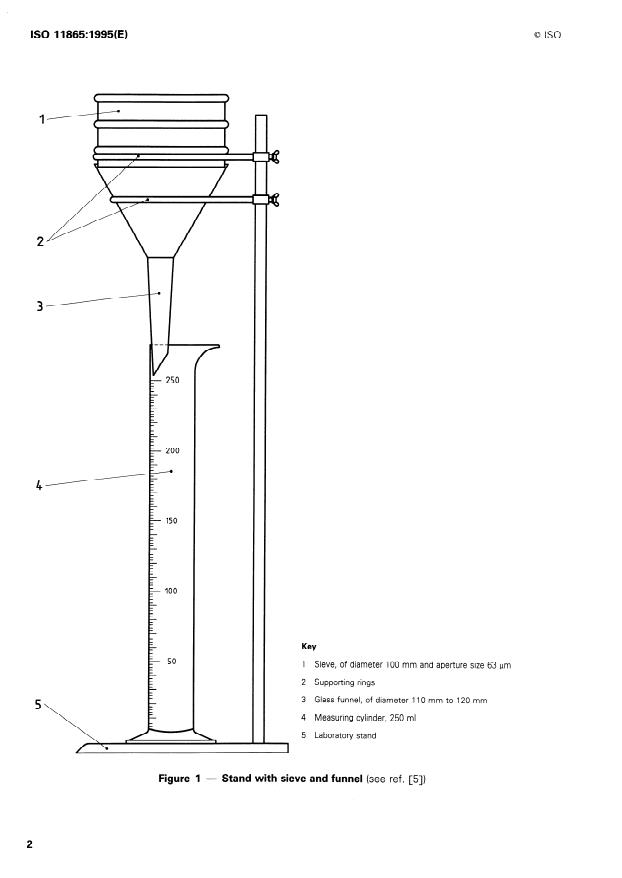
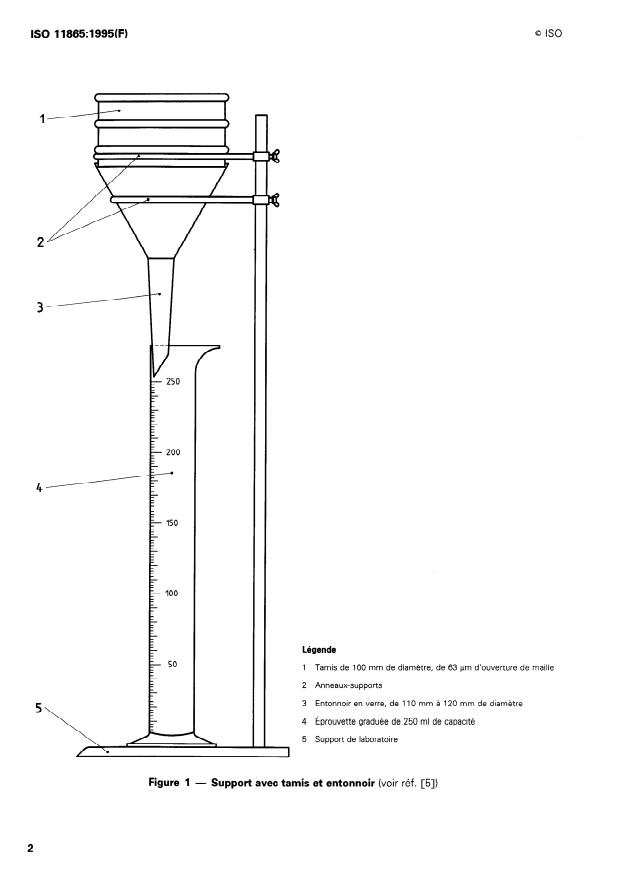
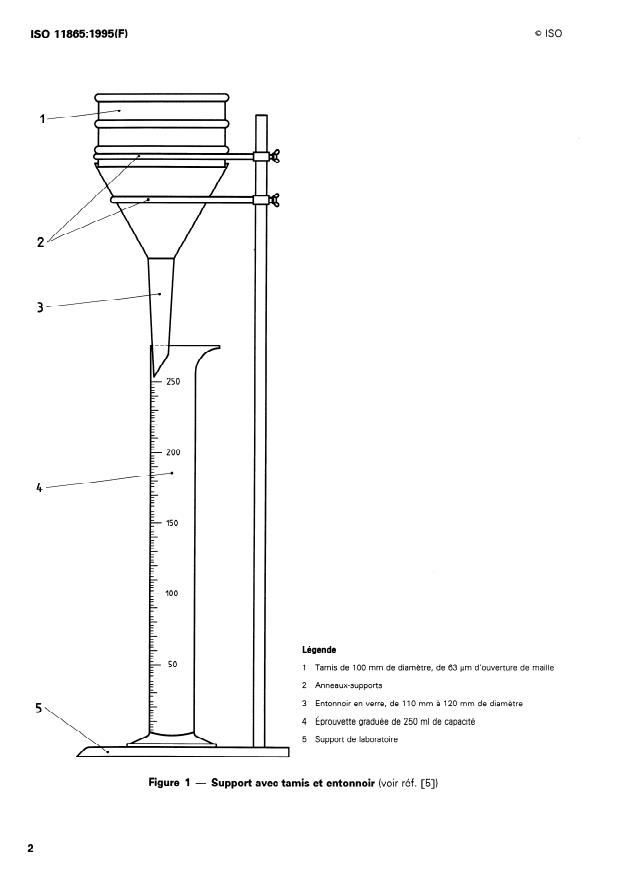
4.5 Glass funnel, of diameter 110 mm to 120 mm
(see figure 1).
3 Principle
4.6 Laboratory stand, with two rings, one for the
sieve and one for the glass funnel (see figure 1).
Contrary to slowly dispersible particles, the white
flecks easily Clog a filter or a fine mesh because they
4.7 Measuring cylinder, of capacity 250 ml, gradu-
are numerous and soft. This proper-ty is used for their
ated in 2 ml intervals.
determination. The volume of liquid which remains on
a defined sieve after a given time is therefore an ex-
4.8 Stopwatch.
Pression of the amount of white flecks.
1) A sieve produced by Siebtechnick GmbH, Germany, is an example of a suitable product available commercially. This infor-
mation is given for the convenience of users of this International Standard and does not constitute an endorsement by ISO of
this product.
A
3- -
-- 250
fi 200
4-
,- 150
,- 100
KW
+ 50
1 Sieve, of diameter 100 mm and aperture
size 63 Pm
2 Supporting rings
3 Glass funnel, of diameter 110 mm to 120
mm
4 Measuring cylinder, 250 ml
Laboratory stand
Figure 1 - Stand with sieve and funnel (see ref. [5])
0 ISO
7.4 After completion of the stirring, allow the con-
5 Sampling
tents of the beaker to stand for 30 s, i.e. until the
stopwatch indicates 55 s, then add a further
It is important that the laboratory receive a Sample
100 ml + 1 ml of water at 20 “C + 1 “C. When the
which is truly representative and has not been dam- -
-
stopwatch indicates 60 s, repeat the stirring making
aged or changed during transport or storage.
20 complete stirring movements in 20 s, continuously
Sampling is not patt of the method specified in this
rotating the beaker as described in 7.3. Stop the
International Standard. A recommended sampling
stopwatch.
method is given in ISO 707.
7.5 Within about 5 s, po
...
ISO
NORME
INTERNATIONALE
Premiere édition
1995-11-15
Lait entier instantané en poudre -
Détermination du nombre de taches
blanches
Determination of white flecks number
Instant whole milk powder -
Numéro de référence
Avant-propos
L’ISO (Organisation internationale de normalisation) est une fédération
mondiale d’organismes nationaux de normalisation (comités membres de
I’ISO). L’élaboration des Normes internationales est en général confiée aux
comités techniques de I’ISO. Chaque comité membre intéressé par une
étude a le droit de faire partie du comité technique créé à cet effet. Les
organisations internationales, gouvernementales et non gouvernemen-
tales, en liaison avec NS0 participent également aux travaux. L’ISO colla-
bore étroitement avec la Commission électrotechnique internationale (CEI)
en ce qui concerne la normalisation électrotechnique.
Les projets de Normes internationales adoptés par les comités techniques
sont soumis aux comités membres pour vote. Leur publication comme
Normes internationales requiert l’approbation de 75 % au moins des co-
mités membres votants.
La Norme internationale ISO 11865 a été élaborée par le comité technique
lSO/TC 34, Produits agricoles alimentaires, sous-comité SC 5, Lait et
produits laitiers, en collaboration avec la Fédération internationale de lai-
terie (FIL) et l’Association des chimistes analytiques officiels (AOAC). Elle
sera également publiée par ces organismes.
L’annexe A de la présente Norme internationale est donnée uniquement
à titre d’information.
0 ISO 1995
Droits de reproduction réservés. Sauf prescription différente, aucune partie de cette publi-
cation ne peut être reproduite ni utilisée sous quelque forme que ce soit et par aucun pro-
cédé, électronique ou mécanique, y compris la photocopie et les microfilms, sans l’accord
écrit de l’éditeur.
Organisation internationale de normalisation
Case Postale 56 l CH-1 211 Genève 20 l Suisse
Imprimé en Suisse
ii
NORME INTERNATIONALE 0 ISO ISO 11865:1995(F)
Lait entier instantané en poudre - Détermination du
nombre de taches blanches
1 Domaine d’application 4 Appareillage
Matériel courant de laboratoire et, en particulier, ce
La présente Norme internationale prescrit une mé-
qui suit.
thode pour la détermination du nombre de taches
blanches dans le lait entier instantané en poudre.
4.1 Balance analytique, précise à 0,l g près.
2 Définitions
4.2 Bécher en verre, de 400 ml de capacité, de
70 mm de diamètre intérieur et de 130 mm de hau-
Pour les besoins de la présente Norme internationale,
teur.
les définitions suivantes s’appliquent.
4.3 Spatule, en acier inoxydable, de 1 mm d’épais-
2.1 taches blanches: Particules non dissoutes pou-
seur, de 250 mm de longueur totale et de respec-
vant être observées dans une mince couche de lait
tivement 135 mm et 25 mm de longueur et largeur
reconstitué.
de lame.
2.2 nombre de taches blanches (NTB): Fraction
4.4 Tamis, de 100 mm de diamètre, d’environ
volumique de liquide qui n’a pas traversé le tamis en
45 mm de hauteur et de 63 Frn d’ouverture de maille
l’espace de 15 s dans les conditions opératoires dé-
(voir I’ISO 3310-1)‘) .
crites dans la présente Norme internationale.
4.5 Entonnoir en verre, de diamètre compris entre
110 mm et 120 mm (voir figure 1).
3 Principe
4.6 Support de laboratoire, comportant deux
Contrairement aux particules lentement dispersables,
anneaux-supports dont l’un est réservé au tamis et
les taches blanches colmatent facilement un filtre ou
l’autre à l’entonnoir (voir figure 1).
un tamis à mailles fines car elles sont présentes en
grande quantité et sont molles. Leur détermination
4.7 Éprouvette graduée, de 250 ml de capacité,
est effectuée sur la base de cette propriété. Le vo-
lume de liquide retenu sur un tamis après une durée graduée tous les 2 ml.
est, par conséquent, représentatif du nombre de ta-
ches blanches. 4.8 Chronomètre.
1) Le tamis distribue par la société Siebtechnic GmbH, Allemagne, est un exemple de matériel approprié disponible sur le
marche. Cette information est donnée à l’intention des utilisateurs de la présente Norme internationale et ne signifie nullement
que I’ISO approuve ou recommande l’emploi exclusif du matériel ainsi désigné.
- 250
- 200
- ISO
Légende
1 Tamis de 100 mm de diamètre, de 63 prn d’ouverture de maille
2 Anneaux-supports
3 Entonnoir en verre, de 110 mm à 120 mm de diamètre
4 Éprouvette graduée de 250 ml de capacité
5 Support de laboratoire
Figure 1 - Support avec tamis et entonnoir (voir réf. [S])
0 ISO
ments complets en 20 s tout en faisant tourner en
5 Échantillonnage
continu le bécher sur sa base de façon à exécuter
approximativement un tour complet (360”) pendant le
II est important que le laboratoire reçoive un échan-
processus d’agitation.
tillon réellement représentatif, non endommagé ou
modifié lors du transport et de l’entreposage.
7.4 Une fois cette opération terminée, laisser repo-
L’échantillonnage ne fait pas partie de la méthode
ser le contenu du bécher pendant 30 s, c’est-à-dire
spécifiée dans la présente Norme internationale. Une
jusqu’à ce que le chronomètre indique 55 s, puis
méthode d’échantillonnage recommandée est donnée
ajouter de nouveau 100 ml + lml d’eau à
dans I’ISO 707.
20 “C + 1 “C. Lorsque le chronom%tre indique 60 s,
répéter le pro
...
ISO
NORME
INTERNATIONALE
Premiere édition
1995-11-15
Lait entier instantané en poudre -
Détermination du nombre de taches
blanches
Determination of white flecks number
Instant whole milk powder -
Numéro de référence
Avant-propos
L’ISO (Organisation internationale de normalisation) est une fédération
mondiale d’organismes nationaux de normalisation (comités membres de
I’ISO). L’élaboration des Normes internationales est en général confiée aux
comités techniques de I’ISO. Chaque comité membre intéressé par une
étude a le droit de faire partie du comité technique créé à cet effet. Les
organisations internationales, gouvernementales et non gouvernemen-
tales, en liaison avec NS0 participent également aux travaux. L’ISO colla-
bore étroitement avec la Commission électrotechnique internationale (CEI)
en ce qui concerne la normalisation électrotechnique.
Les projets de Normes internationales adoptés par les comités techniques
sont soumis aux comités membres pour vote. Leur publication comme
Normes internationales requiert l’approbation de 75 % au moins des co-
mités membres votants.
La Norme internationale ISO 11865 a été élaborée par le comité technique
lSO/TC 34, Produits agricoles alimentaires, sous-comité SC 5, Lait et
produits laitiers, en collaboration avec la Fédération internationale de lai-
terie (FIL) et l’Association des chimistes analytiques officiels (AOAC). Elle
sera également publiée par ces organismes.
L’annexe A de la présente Norme internationale est donnée uniquement
à titre d’information.
0 ISO 1995
Droits de reproduction réservés. Sauf prescription différente, aucune partie de cette publi-
cation ne peut être reproduite ni utilisée sous quelque forme que ce soit et par aucun pro-
cédé, électronique ou mécanique, y compris la photocopie et les microfilms, sans l’accord
écrit de l’éditeur.
Organisation internationale de normalisation
Case Postale 56 l CH-1 211 Genève 20 l Suisse
Imprimé en Suisse
ii
NORME INTERNATIONALE 0 ISO ISO 11865:1995(F)
Lait entier instantané en poudre - Détermination du
nombre de taches blanches
1 Domaine d’application 4 Appareillage
Matériel courant de laboratoire et, en particulier, ce
La présente Norme internationale prescrit une mé-
qui suit.
thode pour la détermination du nombre de taches
blanches dans le lait entier instantané en poudre.
4.1 Balance analytique, précise à 0,l g près.
2 Définitions
4.2 Bécher en verre, de 400 ml de capacité, de
70 mm de diamètre intérieur et de 130 mm de hau-
Pour les besoins de la présente Norme internationale,
teur.
les définitions suivantes s’appliquent.
4.3 Spatule, en acier inoxydable, de 1 mm d’épais-
2.1 taches blanches: Particules non dissoutes pou-
seur, de 250 mm de longueur totale et de respec-
vant être observées dans une mince couche de lait
tivement 135 mm et 25 mm de longueur et largeur
reconstitué.
de lame.
2.2 nombre de taches blanches (NTB): Fraction
4.4 Tamis, de 100 mm de diamètre, d’environ
volumique de liquide qui n’a pas traversé le tamis en
45 mm de hauteur et de 63 Frn d’ouverture de maille
l’espace de 15 s dans les conditions opératoires dé-
(voir I’ISO 3310-1)‘) .
crites dans la présente Norme internationale.
4.5 Entonnoir en verre, de diamètre compris entre
110 mm et 120 mm (voir figure 1).
3 Principe
4.6 Support de laboratoire, comportant deux
Contrairement aux particules lentement dispersables,
anneaux-supports dont l’un est réservé au tamis et
les taches blanches colmatent facilement un filtre ou
l’autre à l’entonnoir (voir figure 1).
un tamis à mailles fines car elles sont présentes en
grande quantité et sont molles. Leur détermination
4.7 Éprouvette graduée, de 250 ml de capacité,
est effectuée sur la base de cette propriété. Le vo-
lume de liquide retenu sur un tamis après une durée graduée tous les 2 ml.
est, par conséquent, représentatif du nombre de ta-
ches blanches. 4.8 Chronomètre.
1) Le tamis distribue par la société Siebtechnic GmbH, Allemagne, est un exemple de matériel approprié disponible sur le
marche. Cette information est donnée à l’intention des utilisateurs de la présente Norme internationale et ne signifie nullement
que I’ISO approuve ou recommande l’emploi exclusif du matériel ainsi désigné.
- 250
- 200
- ISO
Légende
1 Tamis de 100 mm de diamètre, de 63 prn d’ouverture de maille
2 Anneaux-supports
3 Entonnoir en verre, de 110 mm à 120 mm de diamètre
4 Éprouvette graduée de 250 ml de capacité
5 Support de laboratoire
Figure 1 - Support avec tamis et entonnoir (voir réf. [S])
0 ISO
ments complets en 20 s tout en faisant tourner en
5 Échantillonnage
continu le bécher sur sa base de façon à exécuter
approximativement un tour complet (360”) pendant le
II est important que le laboratoire reçoive un échan-
processus d’agitation.
tillon réellement représentatif, non endommagé ou
modifié lors du transport et de l’entreposage.
7.4 Une fois cette opération terminée, laisser repo-
L’échantillonnage ne fait pas partie de la méthode
ser le contenu du bécher pendant 30 s, c’est-à-dire
spécifiée dans la présente Norme internationale. Une
jusqu’à ce que le chronomètre indique 55 s, puis
méthode d’échantillonnage recommandée est donnée
ajouter de nouveau 100 ml + lml d’eau à
dans I’ISO 707.
20 “C + 1 “C. Lorsque le chronom%tre indique 60 s,
répéter le pro
...
Questions, Comments and Discussion
Ask us and Technical Secretary will try to provide an answer. You can facilitate discussion about the standard in here.
Loading comments...