


ISO 4000-1:2024
(Main)Passenger car tyres and rims - Part 1: Tyres (metric series)
Passenger car tyres and rims - Part 1: Tyres (metric series)
This document specifies the designation, dimensions and load ratings of metric-series tyres primarily intended for passenger cars.
Pneumatiques et jantes pour voitures particulières — Partie 1: Pneumatiques (série millimétrique)
Le présent document spécifie la désignation, les cotes, et les indices de charge des pneumatiques de la série millimétrique destinés en priorité aux voitures particulières.
General Information
Relations
Overview
ISO 4000-1:2024 - "Passenger car tyres and rims - Part 1: Tyres (metric series)" is the thirteenth edition of the International Standard that defines how metric-series passenger car tyres are designated, dimensioned and rated for load and speed. The standard establishes consistent rules for tyre size notation, construction codes, rim diameter coding, marking and key performance indicators (load index, speed symbol), plus procedures for dimension measurement and inflation guidance. This edition updates the 2021 version and adds provisions for high load capacity tyres and new harmonized load indices.
Key topics and requirements
- Designation and size format: Specifies the structure of tyre markings (e.g., nominal section width / aspect ratio / construction code / nominal rim diameter) and rules for section width and aspect ratio values.
- Construction codes: Standardized codes for tyre construction such as B (bias-belted), D (diagonal), R (radial), RF (radial run-flat) and the ZR/ZRF variants for high-speed tyres.
- Rim diameter coding: Nominal rim diameter codes and guidance for new-concept rims to avoid mis-mounting.
- Service description and markings: Rules for indicating load index, speed symbol (and speed category), and additional markings (TUBELESS, XL/REINFORCED/EXTRA LOAD, HL for high‑load tyres, LL for light‑load, T for temporary spare, P for passenger car designation).
- Dimensions and measurement: Methods to calculate design tyre section width, height, overall diameter, and maximum/minimum grown dimensions when mounted on measuring rims; rounding rules and measuring rim codes.
- Performance parameters: Load-carrying capacities (see Annex B load indices), minimum inflation pressure guidance (Annex C), and inflation pressure procedures.
- Supporting material: Informative and normative annexes with guideline values, load index tables, and other size-marking systems.
Applications and users
ISO 4000-1:2024 is essential for:
- Tyre manufacturers - to mark products correctly, define dimensions and certify load/speed ratings.
- Rim and wheel designers - to match tyre/rim interfaces and avoid mounting errors.
- Vehicle OEMs and aftermarket installers - for correct tyre selection, replacement and spare tyre specification.
- Testing laboratories and certification bodies - to measure tyre dimensions, validate load indices and verify conformity.
- Regulators and marketers - to harmonize labelling, safety information and technical documentation.
Using ISO 4000-1 helps ensure interchangeability, safety, global compliance and clearer tyre sizing information across markets.
Related standards
- ISO 3877-1 - Tyre terminology (equivalent terms)
- ISO 4223-1 - Definitions of tyre industry terms
- ISO 16992 - Spare unit substitutive equipment (SUSE) and run-flat definitions
Keywords: ISO 4000-1:2024, passenger car tyres, metric series, tyre dimensions, load index, speed symbol, tyre marking, rim diameter, tyre standards.
Frequently Asked Questions
ISO 4000-1:2024 is a standard published by the International Organization for Standardization (ISO). Its full title is "Passenger car tyres and rims - Part 1: Tyres (metric series)". This standard covers: This document specifies the designation, dimensions and load ratings of metric-series tyres primarily intended for passenger cars.
This document specifies the designation, dimensions and load ratings of metric-series tyres primarily intended for passenger cars.
ISO 4000-1:2024 is classified under the following ICS (International Classification for Standards) categories: 83.160.10 - Road vehicle tyres. The ICS classification helps identify the subject area and facilitates finding related standards.
ISO 4000-1:2024 has the following relationships with other standards: It is inter standard links to ISO 4000-1:2021. Understanding these relationships helps ensure you are using the most current and applicable version of the standard.
You can purchase ISO 4000-1:2024 directly from iTeh Standards. The document is available in PDF format and is delivered instantly after payment. Add the standard to your cart and complete the secure checkout process. iTeh Standards is an authorized distributor of ISO standards.
Standards Content (Sample)
International
Standard
ISO 4000-1
Thirteenth edition
Passenger car tyres and rims —
2024-03
Part 1:
Tyres (metric series)
Pneumatiques et jantes pour voitures particulières —
Partie 1: Pneumatiques (série millimétrique)
Reference number
© ISO 2024
All rights reserved. Unless otherwise specified, or required in the context of its implementation, no part of this publication may
be reproduced or utilized otherwise in any form or by any means, electronic or mechanical, including photocopying, or posting on
the internet or an intranet, without prior written permission. Permission can be requested from either ISO at the address below
or ISO’s member body in the country of the requester.
ISO copyright office
CP 401 • Ch. de Blandonnet 8
CH-1214 Vernier, Geneva
Phone: +41 22 749 01 11
Email: copyright@iso.org
Website: www.iso.org
Published in Switzerland
ii
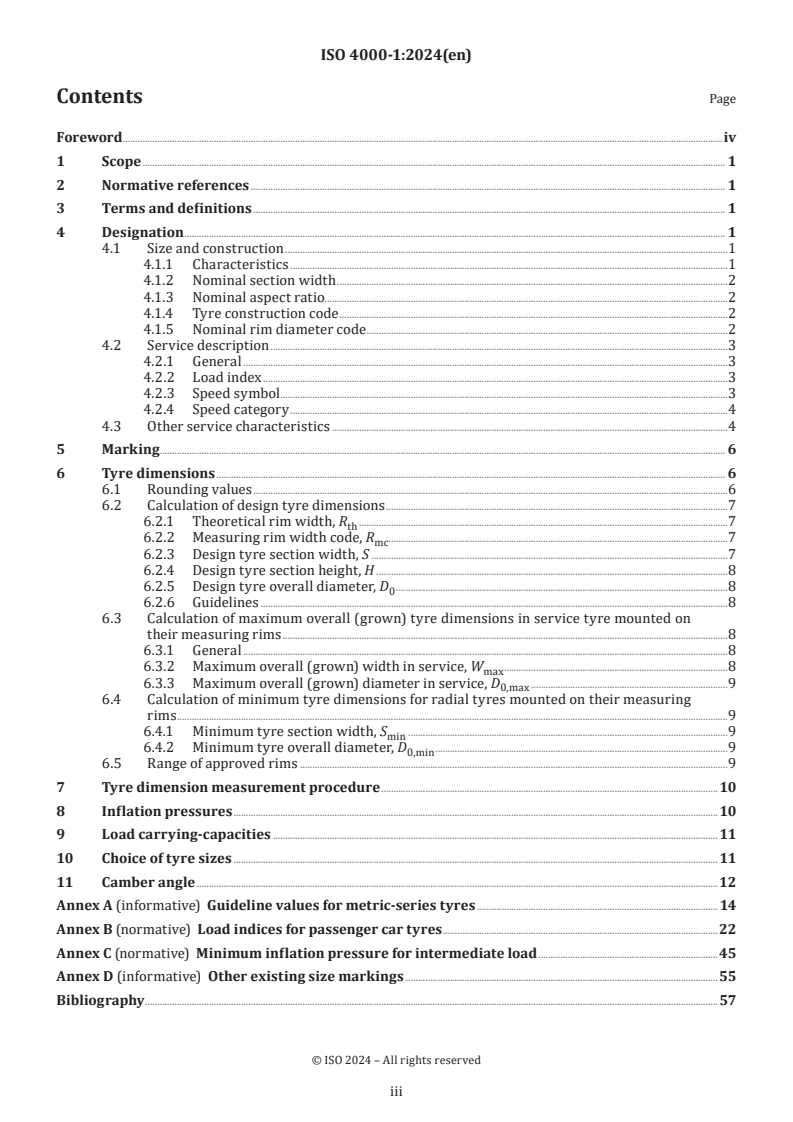
Contents Page
Foreword .iv
1 Scope . 1
2 Normative references . 1
3 Terms and definitions . 1
4 Designation . 1
4.1 Size and construction .1
4.1.1 Characteristics .1
4.1.2 Nominal section width .2
4.1.3 Nominal aspect ratio.2
4.1.4 Tyre construction code .2
4.1.5 Nominal rim diameter code .2
4.2 Service description .3
4.2.1 General .3
4.2.2 Load index .3
4.2.3 Speed symbol .3
4.2.4 Speed category .4
4.3 Other service characteristics .4
5 Marking . . 6
6 Tyre dimensions . 6
6.1 Rounding values .6
6.2 Calculation of design tyre dimensions .7
6.2.1 Theoretical rim width, R .7
th
6.2.2 Measuring rim width code, R .7
mc
6.2.3 Design tyre section width, S .7
6.2.4 Design tyre section height, H .8
6.2.5 Design tyre overall diameter, D .8
6.2.6 Guidelines .8
6.3 Calculation of maximum overall (grown) tyre dimensions in service tyre mounted on
their measuring rims .8
6.3.1 General .8
6.3.2 Maximum overall (grown) width in service, W .8
max
6.3.3 Maximum overall (grown) diameter in service, D .9
0,max
6.4 Calculation of minimum tyre dimensions for radial tyres mounted on their measuring
rims .9
6.4.1 Minimum tyre section width, S .9
min
6.4.2 Minimum tyre overall diameter, D .9
0,min
6.5 Range of approved rims .9
7 Tyre dimension measurement procedure . 10
8 Inflation pressures .10
9 Load carrying-capacities .11
10 Choice of tyre sizes .11
11 Camber angle .12
Annex A (informative) Guideline values for metric-series tyres . 14
Annex B (normative) Load indices for passenger car tyres .22
Annex C (normative) Minimum inflation pressure for intermediate load .45
Annex D (informative) Other existing size markings .55
Bibliography .57
iii
Foreword
ISO (the International Organization for Standardization) is a worldwide federation of national standards
bodies (ISO member bodies). The work of preparing International Standards is normally carried out through
ISO technical committees. Each member body interested in a subject for which a technical committee
has been established has the right to be represented on that committee. International organizations,
governmental and non-governmental, in liaison with ISO, also take part in the work. ISO collaborates closely
with the International Electrotechnical Commission (IEC) on all matters of electrotechnical standardization.
The procedures used to develop this document and those intended for its further maintenance are described
in the ISO/IEC Directives, Part 1. In particular, the different approval criteria needed for the different types
of ISO document should be noted. This document was drafted in accordance with the editorial rules of the
ISO/IEC Directives, Part 2 (see www.iso.org/directives).
ISO draws attention to the possibility that the implementation of this document may involve the use of (a)
patent(s). ISO takes no position concerning the evidence, validity or applicability of any claimed patent
rights in respect thereof. As of the date of publication of this document, ISO had not received notice of (a)
patent(s) which may be required to implement this document. However, implementers are cautioned that
this may not represent the latest information, which may be obtained from the patent database available at
www.iso.org/patents. ISO shall not be held responsible for identifying any or all such patent rights.
Any trade name used in this document is information given for the convenience of users and does not
constitute an endorsement.
For an explanation of the voluntary nature of standards, the meaning of ISO specific terms and expressions
related to conformity assessment, as well as information about ISO's adherence to the World Trade
Organization (WTO) principles in the Technical Barriers to Trade (TBT), see www.iso.org/iso/foreword.html.
This document was prepared by Technical Committee ISO/TC 31, Tyres, rims and valves, Subcommittee SC 3,
Passenger car tyres and rims.
This thirteenth edition cancels and replaces the twelfth edition (ISO 4000-1:2021), which has been
technically revised.
The main changes are as follows:
— high load capacity tyres have been added to facilitate their worldwide harmonized introduction;
— design section widths greater than 405 have been removed from load indices Tables B.1 and B.3;
— new internationally harmonized load indices have been added in Annex B.
A list of all parts in the ISO 4000 series can be found on the ISO website.
Any feedback or questions on this document should be directed to the user’s national standards body. A
complete listing of these bodies can be found at www.iso.org/members.html.
iv
International Standard ISO 4000-1:2024(en)
Passenger car tyres and rims —
Part 1:
Tyres (metric series)
1 Scope
This document specifies the designation, dimensions and load ratings of metric-series tyres primarily
intended for passenger cars.
2 Normative references
The following documents are referred to in the text in such a way that some or all of their content constitutes
requirements of this document. For dated references, only the edition cited applies. For undated references,
the latest edition of the referenced document (including any amendments) applies.
ISO 3877-1, Tyres, valves and tubes — List of equivalent terms — Part 1: Tyres
ISO 4223-1, Definitions of some terms used in the tyre industry — Part 1: Pneumatic tyres
ISO 16992, Passenger car tyres — Spare unit substitutive equipment (SUSE)
3 Terms and definitions
For the purposes of this document, the terms and definitions given in ISO 3877-1, ISO 4223-1 and the
following apply.
ISO and IEC maintain terminology databases for use in standardization at the following addresses:
— ISO Online browsing platform: available at https:// www .iso .org/ obp
— IEC Electropedia: available at https:// www .electropedia .org/
3.1
rim protector
feature incorporated into the lower sidewall area of the tyre which is intended to protect the rim flange
from damage
EXAMPLE Protruding circumferential rubber rib.
3.2
high load capacity tyre
extra load tyre that is designed to carry a higher load at the same reference pressure
4 Designation
4.1 Size and construction
4.1.1 Characteristics
The tyre characteristics shall be designated:
Nominal section width / Nominal aspect ratio Tyre construction code Nominal rim diameter code
EXAMPLE 235/45 R 17.
4.1.2 Nominal section width
The nominal section width of the tyre shall be indicated in millimetres, and this part of the designation shall
end in either the numeral of zero or five, so that in any single series of tyres with the same nominal aspect
ratio, the values shall all end in 0 or all end in 5.
For sizes mounted on 5° tapered (code-designated) rims, the nominal section width shall end in 5.
4.1.3 Nominal aspect ratio
The nominal aspect ratio (H/S, where H is the design tyre section height and S is the design tyre section
width) shall be expressed as a percentage and shall be a multiple of 5.
4.1.4 Tyre construction code
The tyre construction code shall be:
— B for bias-belted construction;
— D for diagonal construction;
— R for radial construction;
— RF for radial run-flat construction (only applicable to run-flat or self-supporting tyres as defined in
ISO 16992; radial extended mobility tyres as defined in ISO 16992 shall have the construction code R).
In the case of tyres having a maximum speed capability exceeding 240 km/h, the tyre construction code R
can be replaced by ZR and the tyre construction code RF can be replaced by ZRF.
In the case of tyres having a maximum speed capability exceeding 300 km/h, the tyre construction code R
shall be replaced by ZR and the tyre construction code RF shall be replaced by ZRF.
Use of any other code-letter (e.g. in the case of a new construction type) should first be submitted to ISO for
acceptance.
4.1.5 Nominal rim diameter code
For tyres mounted on 5° tapered (code-designated) rims, the code shall be as given in Table 1.
Table 1 — Nominal rim diameter code
Nominal rim diameter
Nominal rim diameter code D
r
mm
10 254
12 305
13 330
14 356
15 381
16 406
17 432
18 457
19 483
20 508
21 533
22 559
23 584
24 610
25 635
26 660
28 711
30 762
In the case of tyres designed for new-concept rims, the code-number shall be equal to the nominal rim
diameter (D ) expressed as a whole number in millimetres to avoid mis-mounting.
r
4.2 Service description
4.2.1 General
The service description shall be:
Load index Speed symbol
In the case of tyres having a maximum speed capability exceeding 300 km/h, the load index and the speed
symbol Y shall be both placed within parentheses, to identify performance up to 300 km/h.
EXAMPLE 235/45 ZR 17 (97Y).
For maximum speed capability and load carrying capacity of the tyre over 300 km/h, consult the
manufacturer.
4.2.2 Load index
The maximum tyre load-carrying capacity (TLCC) corresponding to the service conditions specified by the
tyre manufacturer shall be indicated by a load index (LI) taken from Table 2, per tyre for a single mounting.
4.2.3 Speed symbol
The speed symbol is an alpha or alpha-numeric code which indicates the speed category (4.2.4) of the tyre.
4.2.4 Speed category
A speed category is assigned to a tyre according to the maximum speed which the tyre can sustain. It is
expressed by the speed symbol according to Table 3.
4.3 Other service characteristics
4.3.1 The word “TUBELESS” shall appear on the sidewalls of tyres without tubes.
4.3.2 The letters “XL”, close to the tyre size designation, or the words “REINFORCED” or “EXTRA LOAD”
shall appear on the sidewalls of tyres designed for loads and inflation pressures higher than the standard
version.
4.3.2.1 Additionally, the letters “HL”, immediately preceding the tyre size designation, shall be used to
identify high load capacity tyres.
4.3.3 The letters “LL”, close to the tyre size designation, or the words “LIGHT LOAD” shall appear on the
sidewalls of tyres designed for loads lower than the standard version.
4.3.4 The letter “T”, immediately preceding the tyre size designation, shall be used to identify T-type
temporary-use spare tyres.
4.3.5 Specific indications, if required, can be added to indicate:
— the type of vehicle for which the tyre is primarily designed, using the symbol “P” for passenger cars
(see 4.3.6);
— temporary use of certain spare tyres, using indications such as “TEMPORARY USE ONLY”;
— bias-belted construction, with the words “BIAS-BELTED”;
— radial construction, with the word “RADIAL”;
— intended inboard or outboard side for mounting;
— direction of rotation;
— type of tread pattern;
— other characteristics.
4.3.6 The optional marking “P”, immediately preceding the tyre size designation, can be used where there
can be ambiguity regarding the tyre type.
EXAMPLE P295/45 R 17.
Table 2 — Equivalence between LI and TLCC
LI TLCC LI TLCC LI TLCC LI TLCC
kg kg kg kg
50 190 70 335 90 600 110 1 060
51 195 71 345 91 615 111 1 090
52 200 72 355 92 630 112 1 120
53 206 73 365 93 650 113 1 150
54 212 74 375 94 670 114 1 180
55 218 75 387 95 690 115 1 215
56 224 76 400 96 710 116 1 250
a
57 230 77 412 97 730 117 1 285
a
58 236 78 425 98 750 118 1 320
a
59 243 79 437 99 775 119 1 360
a
60 250 80 450 100 800 120 1 400
61 257 81 462 101 825 — —
62 265 82 475 102 850 — —
63 272 83 487 103 875 — —
64 280 84 500 104 900 — —
65 290 85 515 105 925 — —
66 300 86 530 106 950 — —
67 307 87 545 107 975 — —
68 315 88 560 108 1 000 — —
69 325 89 580 109 1 030 — —
a
ISO tyre load carrying capacities according to this document have a 116 load index maximum: some existing tyres can have a
higher load index number.
The maximum tyre load carrying capacity corresponding to the load index shall apply for speeds up to and including 210 km/h.
For tyres with the speed symbol V (between 210 km/h and 240 km/h), the maximum load carrying capacity per tyre shall be
reduced to 100 % at 210 km/h, 97 % at 220 km/h, 94 % at 230 km/h and 91 % at 240 km/h; linear interpolation is permitted.
In the case of speed symbols W and Y, the maximum load carrying capacity per tyre corresponding to the load index shall apply
for speeds up to and including 240 km/h for W and 270 km/h for Y.
For tyres with the speed symbol W (between 240 km/h and 270 km/h), the maximum load carrying capacity per tyre shall be
reduced to 100 % at 240 km/h, 95 % at 250 km/h, 90 % at 260 km/h and 85 % at 270 km/h; linear interpolation is permitted.
For tyres with the speed symbol Y (between 270 km/h and 300 km/h), the maximum load carrying capacity per tyre shall be
reduced to 100 % at 270 km/h, 95 % at 280 km/h, 90 % at 290 km/h and 85 % at 300 km/h; linear interpolation is permitted.
See 4.2.3, 4.2.4 and Table 3 for speed categories and their symbols.
For speeds of over 300 km/h or ZR-marked tyres or both, consult the tyre manufacturer for the maximum tyre load carrying
capacity permitted in relation to the maximum speed allowed for the tyre.
For vehicles with a design maximum speed capability of up to 60 km/h, the maximum load carrying capacity corresponding to
the load index can be exceeded, as shown below. However, an increase in the reference inflation pressure is necessary and should
be determined in consultation with the tyre manufacturer. In the absence of such agreement, the following pressure increases
are recommended:
— for 60 km/h, a 10 % load increase with a 10 kPa inflation pressure increase;
— for 50 km/h, a 15 % load increase with a 20 kPa inflation pressure increase;
— for 40 km/h, a 25 % load increase with a 30 kPa inflation pressure increase;
— for 30 km/h, a 35 % load increase with a 40 kPa inflation pressure increase;
— for 25 km/h, a 42 % load increase with a 50 kPa inflation pressure increase.
Table 3 — Speed symbols and corresponding speed
Speed
Speed symbol
km/h
J 100
K 110
L 120
M 130
N 140
P 150
Q 160
R 170
S 180
T 190
U 200
H 210
V 240
W 270
a
Y 300
NOTE This list is not exhaustive, and other categories and symbols can be added later.
a
For tyres designed for speeds exceeding 300 km/h, see 4.2.1.
5 Marking
The marking shall include designations of the following:
a) size and construction;
b) service description (see 4.2.1);
c) any other service characteristics.
The location of the marking of the load index and speed category shall be distinct, but near the marking of
the size and construction.
No location is specified for the markings related to other service characteristics (see 4.3).
EXAMPLE A tubeless tyre having a nominal section width of 165 mm, a nominal aspect ratio of 80, a radial
construction and a nominal rim diameter code of 15, whose service description consists of a load index of 87,
corresponding to a tyre load-carrying capacity of 545 kg, and a speed symbol H (210 km/h), is marked:
165/80 R 15 87 H TUBELESS
NOTE See Annex D for other existing size markings.
6 Tyre dimensions
6.1 Rounding values
Except in the cases given in 6.2.1 and 6.2.2, round the formula-derived values for tyre dimensions to the
nearest millimetre (see ISO 80000-1:2022, B.3, rule B).
6.2 Calculation of design tyre dimensions
6.2.1 Theoretical rim width, R
th
For the theoretical rim width, see Formula (1):
R = K × S (1)
th 1 N
where
R is the theoretical rim width, expressed in millimetres;
th
K is the theoretical rim/section width ratio coefficient;
S is the nominal section width.
N
For tyres mounted on 5° rims (code-designated) with nominal rim diameter expressed by a two-figure code:
— K = 0,7 where the tyres have a nominal aspect ratio of 50 to 95;
— K = 0,85 where this ratio is 20 to 45.
NOTE K values for other tyre and rim types will be defined in a future revision.
6.2.2 Measuring rim width code, R
mc
For the measuring rim width code, see Formula (2), where R is rounded to the nearest 0,5:
mc
KS×
2 N
R = (2)
mc
25,4
where K is the measuring rim/section width ratio coefficient.
For tyres mounted on 5° drop-centre rims with a nominal diameter expressed by a two-figure code:
— K = 0,7 for nominal aspect ratios 95 to 75;
— K = 0,75 for nominal aspect ratios 70 to 60;
— K = 0,8 for nominal aspect ratios 55 and 50;
— K = 0,85 for nominal aspect ratio 45;
— K = 0,9 for nominal aspect ratios 40 to 30;
— K = 0,92 for nominal aspect ratios 20 and 25.
NOTE Other values of K for other tyre and rim types will be defined in a future revision.
6.2.3 Design tyre section width, S
The design tyre section width, S, is the nominal section width, S , transferred from the theoretical rim, R ,
N th
to the measuring rim width code, R , as shown in Formula (3):
mc
S = S + 0,4 × (25,4 × R – R ) (3)
N mc th
EXAMPLE 265/40 R17.
K = 0,85 (see 6.2.1) and K = 0,9 (see 6.2.2).
1 2
R = K × S = 265 × 0,85 = 225,25 mm.
th 1 N
R = K × S /25,4 = 0,9 × 265/25,4 = 9,39, rounded to 9,5.
mc 2 N
25,4 × R = 25,4 × 9,5 = 241,3 mm.
mc
S = S + 0,4 (25,4 R − R ) = 265 + 0,4 (241,3 − 225,25) = 271,42 mm, rounded to 271 mm.
N mc th
6.2.4 Design tyre section height, H
The design tyre section height, H, is calculated using Formula (4):
HS/
HS =× (4)
N
where H/S is the nominal aspect ratio.
6.2.5 Design tyre overall diameter, D
The design tyre overall diameter, D , is calculated using Formula (5):
D = D + 2 × H (5)
0 r
Use the corresponding value of D given in Table 1.
r
6.2.6 Guidelines
See Annex A for general guidelines on the tyre design dimensions for the metric series of passenger car tyres
mounted on 5° rims (code-designated).
6.3 Calculation of maximum overall (grown) tyre dimensions in service tyre mounted on
their measuring rims
6.3.1 General
The calculation of maximum overall (grown) tyre dimensions in service for tyres mounted on their
measuring rims is for use by vehicle manufacturers in designing for tyre clearance.
Calculate these dimensions based on design section width and design section height with the coefficient
appropriate to the construction (see Table 4).
Table 4 — Coefficients for calculation of tyre dimensions
Coefficient
Construction Construction code
a b c d
Diagonal D — —
1,1 1,08
Bias-belted B — —
Radial R
1,04 1,04 0,96 0,97
Radial run-flat RF
6.3.2 Maximum overall (grown) width in service, W
max
The maximum overall (grown) width in service, W , includes elevation due to labelling, decorations,
max
protective ribs or bands and rim protectors and is equal to the greater of the following values:
— the product of the design tyre section width, S, and the appropriate coefficient, a (see Table 4), see
Formula (6):
W = S × a (6)
max
— the addition of 8 mm to the design tyre section width, S, see Formula (7):
W = S + 8 (7)
max
If the overall (grown) width is measured at the rim protectors, an additional 8 mm is allowed. In this case,
W equals to the greater of the following values (S × a + 8) or (S + 16).
max
6.3.3 Maximum overall (grown) diameter in service, D
0,max
For the maximum overall (grown) diameter in service, see Formula (8):
D = D + 2 × H × b (8)
0,max r
See Table 4 for the value of coefficient b. H × b shall be first rounded to the nearest integer before calculating
the maximum overall diameter in service.
6.4 Calculation of minimum tyre dimensions for radial tyres mounted on their measuring rims
6.4.1 Minimum tyre section width, S
min
For the minimum tyre section width, see Formula (9):
S = S × c (9)
min
See Table 4 for the value of coefficient c.
6.4.2 Minimum tyre overall diameter, D
0,min
For the minimum tyre overall diameter, see Formula (10):
D = D + 2 × H × d (10)
0,min r
See Table 4 for the value of coefficient d. H × d shall be first rounded to the nearest integer before calculating
the minimum overall diameter.
6.5 Range of approved rims
The range of approved rim width codes for the nominal aspect ratio of 35 and above is calculated as the
product of the nominal section width, S , and the coefficients shown in Table 5, divided by 25,4. Round the
N
values obtained to the nearest 0,5 rim width code. For tyre sizes with a nominal aspect ratio of 30 and
below, the range of approved rim width codes is the measuring rim width code ±0,5.
For high load capacity tyres, the minimum rim width and the maximum rim width shall be calculated
according to Table 5 but, in any case, the minimum rim width shall be greater than or equal to the measuring
rim width code minus 0,5, and the maximum rim width shall be less than or equal to the measuring rim
width code plus 0,5, regardless of the nominal aspect ratio.
The maximum overall (grown) width in service, W , and the minimum tyre section width, S , will change
max min
by 40 % of the change in rim width code multiplied by 25,4, rounded to the nearest millimetre. However, this
is not applicable to tyres whose overall width is measured at the rim protectors, in which case, the change
will be greater than 40 %.
Table 5 — Approved rim width codes for passenger car tyres as a function of nominal aspect ratio
Coefficients for calculation of approved rim width
Nominal aspect ratio
H/S
min. max.
70 ≤ H / S ≤ 95 0,65 0,85
50 ≤ H / S ≤ 65 0,7 0,9
H / S = 45 0,8 0,95
35 ≤ H / S ≤ 40 0,85 1
H / S ≤ 30 measuring rim width code −0,5 measuring rim width code +0,5
7 Tyre dimension measurement procedure
The tyre dimension measurement procedure shall be as follows.
a) Prior to measurement, mount the tyre on an approved rim using a width code as defined in 6.5, inflated
to the recommended pressure given in Table 6, and allow it to stand for a minimum of 24 h at normal
room temperature.
b) Readjust the inflation pressure to the original value.
c) Measure the section width and the overall width of the tyre at six points approximately equally spaced
around the tyre circumference. Record the average of these measurements as section width and
overall width.
d) Determine the tyre overall diameter by measuring its maximum circumference and dividing this by π
(where π = 3,141 6).
Table 6 — Recommended inflation pressures for measurement of tyre dimensions
Tyre Pressure
kPa
Standard load and P-type light load (LL) version 180
Extra load/reinforced version, including high load capacity (HL) version 220
T-type temporary-use spare type 420
8 Inflation pressures
Correct inflation pressures are of the highest importance for driving safety.
Over-inflation causes the tyre to be more susceptible to impact damage.
Under-inflation causes over-heating and can greatly shorten the life of a tyre. It affects vehicle stability and
can cause irregular wear, internal damage and, ultimately, even tyre disablement.
The effects of under-inflation are not necessarily immediate. It can be a considerable time before they occur.
The pressures (cold) recommended by the tyre manufacturers in their technical documents should be
regarded as minima.
The recommended cold tyre inflation pressure for each tyre position specified by the vehicle and/or the
tyre manufacturer for the intended service condition of the given vehicle shall be equal or higher than the
minimum cold tyre inflation pressure, given by the tyre manufacturer or the tyre standardization body for
the given service conditions.
The recommended cold tyre inflation pressure should take into account not only the tyre load-carrying
capacity (see Annex C) and the high speed capability, but also the operating conditions such as maximum
speed capability of the vehicle, camber angle, as well as the construction and characteristics of the vehicle.
Unless otherwise specified by the tyre manufacturer, it is recommended that the cold inflation pressure of
radial tyres be limited in normal application to 350 kPa except for T-type temporary-use spare tyres where
it shall be 415 kPa or 420 kPa.
For normal road applications, the specified inflation pressure shall not be less than:
— 140 kPa for vehicle operating speeds ≤160 km/h;
— 180 kPa for vehicle operating speeds >160 km/h;
— 200 kPa for high load capacity tyres, regardless of operating speeds.
For special applications, consult the tyre manufacturer.
NOTE Cold inflation pressure is the pressure of the tyre at ambient temperature and does not include pressure
build-up due to tyre usage.
9 Load carrying-capacities
Use the load indices for passenger car tyres given in Annex B.
For sizes not included in Annex B, consult the national standards body.
The tyre load-carrying capacity at various inflation pressures given in Annex C shall be used.
10 Choice of tyre sizes
In selecting tyres for a vehicle, the vehicle maximum load on the tyre shall not be greater than the applicable
maximum load-carrying capacity of the tyre. Vehicle maximum load on the tyre is the load on an individual
tyre that is determined by distributing to each axle its share of the maximum loaded vehicle mass and
dividing by the number of tyres on the axle.
The vehicle normal load on the tyre shall not be greater than 88 % of the maximum load-carrying capacity of
the tyre. Vehicle normal load on the tyre is the load on an individual tyre that is determined by distributing (in
accordance with Table 7) to each axle its share of the curb mass, accessory mass and normal occupant mass
and dividing by the number of tyres on the axle. These, and other relevant masses, are defined in this clause.
The vehicle normal load on the tyre shall not be greater than 94 % of the load rating at the vehicle
manufacturer's recommended cold inflation pressure for the tyre.
The vehicle manufacturer can specify an inflation pressure less than that corresponding to the maximum
tyre load. In this case, the load on the tyre (at the corresponding vehicle loading condition) shall not exceed
the tyre load carrying capacity at the specified inflation pressure.
Maximum loaded vehicle mass is the sum of:
a) curb mass;
b) accessory mass;
c) vehicle capacity mass;
d) production option mass.
Curb mass is the mass of a motor vehicle with standard equipment, including the maximum capacity of fuel,
oil and coolant, and, if so equipped, of air conditioning and the additional mass of an optional engine.
Accessory mass is the combined mass (in excess of those standard items that can be replaced) of automatic
transmission, power steering, power brakes, power windows, power seats, radio and heater, to the extent
that these items are available as factory-installed equipment (whether installed or not).
Normal occupant mass is equivalent to 68 kg multiplied by the number of occupants, as specified in
Table 7. When local regulation includes a luggage mass, a mass of 7 kg per occupant, located in the luggage
compartment, shall be used. Occupant distribution is the distribution of occupants in a vehicle as specified
in Table 7.
Table 7 — Occupant loading and distribution for vehicle normal load for various designated seating
capacities
Designated seating capacity, num- Vehicle normal load, number of Occupant distribution in a
ber of occupants occupants normally loaded vehicle
2 to 4 2 2 in front
5 and above 3 2 in front, 1 in second seat
Vehicle capacity mass is the rated cargo and luggage load plus 68 kg multiplied by the vehicle designated
seating capacity.
Production option mass is the combined mass of those installed regular production options, weighing over
2,3 kg in excess of those standard items they replace, not previously considered in curb mass or accessory
mass, and including heavy duty brakes, ride levellers, roof rack, heavy duty battery and special trim.
11 Camber angle
Vehicle camber angles, especially under severe driving conditions, have an influence on tyre performance.
For low aspect ratio tyres, increasing the camber angle above 2° makes constraints on the tyre performance,
e.g. mileage, uneven wear and other criteria. Consult the tyre manufacturer for more information.
Generally, it is recommended that the camber angles of vehicles should not be greater than 4° including any
tolerance.
On vehicles with speeds in excess of 270 km/h, it is recommended that the camber angle should not be
greater than 3° including any tolerance.
Vehicle camber angles on a passenger car should not exceed the values for different aspect ratios in Table 8.
Table 8 — Maximum camber angle for different aspect ratios
Maximum camber angle
Aspect ratio
H/S
up to 270 km/h above 270 km/h
80 to 25 4° 3°
20 3° 3°
The only way to compensate for camber angle is by increasing the inflation pressure by multiplying it with
the camber factor as shown in Table 9. This shall be applied to tyres for all speeds.
The maximum inflation pressure of 350 kPa shall be observed. For a given size, if the calculated pressure
exceeds the maximum, then this size is not suitable for this application.
For static camber angle, γ, between 2° and 4°, the camber factor, K , is calculated as follows:
S
— for aspect ratio 50 and above, see Formula (11):
12, 5
K =−11/,()10,05×γ (11)
s
— for aspect ratio, H/S, 45 to 25, see Formula (12):
12, 5
KH=+11/,()()0 262 50−×,/00325 S ×−()12γ / (12)
s
— for aspect ratio 20, see Formula (13):
12, 5
K =+11/,()03×−()12γ / (13)
s
See Table 9.
Table 9 — Compensation of camber angle by camber factor
Camber factor
Camber
K
s
γ
H/S ≥ 50 H/S = 45 H/S = 40 H/S = 35 H/S = 30 H/S = 25 H/S = 20
2° 1 1 1 1 1 1 1
2° 15′ 1,015 8 1,018 5 1,021 1 1,023 7 1,026 4 1,029 1 1,048 9
2° 30′ 1,032 2 1,037 6 1,043 0 1,048 5 1,054 1 1,059 7 1,102 4
2° 45′ 1,048 9 1,057 3 1,065 8 1,074 4 1,083 1 1,092 0 1,160 9
3° 1,066 2 1,077 7 1,089 5 1,101 4 1,113 6 1,126 1 1,225 3
3° 15′ 1,084 0 1,098 9 1,114 1 1,129 7 1,145 7 1,162 2 —
3° 30′ 1,102 4 1,120 8 1,139 8 1,159 4 1,179 5 1,200 4 —
3° 45′ 1,121 3 1,143 5 1,166 5 1,190 4 1,215 2 1,240 9 —
4° 1,140 8 1,167 0 1,194 4 1,223 0 1,252 8 1,284 0 —
Annex A
(informative)
Guideline values for metric-series tyres
Guidelines for design dimensions for metric-series tyres mounted on 5° rims (code-designated), with a
nominal rim diameter expressed by a two-figure code, are given in Tables A.1 to A.9 as a function of the
nominal aspect ratio.
These tables are provided for convenience. The values shown are calculated from the formulae given in
Clause 6. The formulae always prevail in the case of a contradiction.
Table A.1 — Nominal aspect ratio (H/S) of 95 to 75 (K = 0,7; K = 0,7)
1 2
Nominal Design tyre dimensions
Measuring
Approved rim width
section mm
rim width
codes for all tyres
width
Section height H at H/S (%) of
code
Section width
S
N
R
S
mc
95 90 85 80 75 min. max.
mm
95 2,5 94 90 86 81 76 71 2,5 3,0
105 3,0 106 100 95 89 84 79 2,5 3,5
115 3,0 113 109 104 98 92 86 3,0 4,0
125 3,5 126 119 113 106 100 94 3,0 4,0
135 3,5 133 128 122 115 108 101 3,5 4,5
145 4,0 145 138 131 123 116 109 3,5 5,0
155 4,5 157 147 140 132 124 116 4,0 5,0
165 4,5 165 157 149 140 132 124 4,0 5,5
175 5,0 177 166 158 149 140 131 4,5 6,0
185 5,0 184 176 167 157 148 139 4,5 6,0
195 5,5 196 185 176 166 156 146 5,0 6,5
205 5,5 203 195 185 174 164 154 5,0 7,0
215 6,0 216 204 194 183 172 161 5,5 7,0
225 6,0 223 — 203 191 180 169 6,0 7,5
235 6,5 235 — — 200 188 176 6,0 8,0
245 7,0 248 — — 208 196 184 6,5 8,0
255 7,0 255 — — 217 204 191 6,5 8,5
265 7,5 267 — — 225 212 199 7,0 9,0
275 7,5 274 — — 234 220 206 7,0 9,0
285 8,0 286 — — 242 228 214 7,5 9,5
295 8,0 294 — — — — 221 7,5 10,0
305 8,5 306 — — — — 229 8,0 10,0
315 8,5 313 — — — — 236 8,0 10,5
NOTE Rims outside the approved range in use from previous designs are not approved for new designs.
Table A.2 — Nominal aspect ratio (H/S) of 70 (K = 0,7; K = 0,75)
1 2
Design tyre dimensions
Nominal
Approved rim width codes
mm
section Measuring rim
width width code
All tyres except high High load capacity
Section width Section height
S R
load capacity tyres tyres
N mc
S H
mm
min. max. min. max.
95 3,0 99 67 2,5 3,0 2,5 3,0
105 3,0 106 74 2,5 3,5 2,5 3,5
115 3,5 118 81 3,0 4,0 3,0 4,0
125 3,5 126 88 3,0 4,0 3,0 4,0
135 4,0 138 95 3,5 4,5 3,5 4,5
145 4,5 150 102 3,5 5,0 4,0 5,0
155 4,5 157 109 4,0 5,0 4,0 5,0
165 5,0 170 116 4,0 5,5 4,5 5,5
175 5,0 177 123 4,5 6,0 4,5 5,5
185 5,5 189 130 4,5 6,0 5,0 6,0
195 6,0 201 137 5,0 6,5 5,5 6,5
205 6,0 209 144 5,0 7,0 5,5 6,5
215 6,5 221 151 5,5 7,0 6,0 7,0
225 6,5 228 158 6,0 7,5 6,0 7,0
235 7,0 240 165 6,0 8,0 6,5 7,5
245 7,0 248 172 6,5 8,0 6,5 7,5
255 7,5 260 179 6,5 8,5 7,0 8,0
265 8,0 272 186 7,0 9,0 7,5 8,5
275 8,0 279 193 7,0 9,0 7,5 8,5
285 8,5 292 200 7,5 9,5 8,0 9,0
295 8,5 299 207 7,5 10,0 8,0 9,0
305 9,0 311 214 8,0 10,0 8,5 9,5
NOTE Rims outside the approved range in use from previous designs are not approved for new designs.
Table A.3 — Nominal aspect ratio (H/S) of 65 and 60 (K = 0,7; K = 0,75)
1 2
Design tyre dimensions
Nominal
Approved rim width codes
Measuring
mm
section
rim width
width
Section height All tyres except high High load
code
Section width
S
N H at H/S (%) of load capacity tyres capacity tyres
R
mc S
mm
65 60 min. max. min. max.
105 3,0 106 68 — 3,0 3,5 3,0 3,5
115 3,5 118 75 69 3,0 4,0 3,0 4,0
125 3,5 126 81 75 3,5 4,5 3,5 4,0
135 4,0 138 88 81 3,5 5,0 3,5 4,5
145 4,5 150 94 87 4,0 5,0 4,0 5,0
155 4,5 157 101 93 4,5 5,5 4,5 5,0
165 5,0 170 107 99 4,5 6,0 4,5 5,5
175 5,0 177 114 105 5,0 6,0 5,0 5,5
185 5,5 189 120 111 5,0 6,5 5,0 6,0
195 6,0 201 127 117 5,5 7,0 5,5 6,5
205 6,0 209 133 123 5,5 7,5 5,5 6,5
215 6,5 221 140 129 6,0 7,5 6,0 7,0
225 6,5 228 146 135 6,0 8,0 6,0 7,0
235 7,0 240 153 141 6,5 8,5 6,5 7,5
245 7,0 248 159 147 7,0 8,5 6,5 7,5
255 7,5 260 166 153 7,0 9,0 7,0 8,0
265 8,0 272 172 159 7,5 9,5 7,5 8,5
275 8,0 279 179 165 7,5 9,5 7,5 8,5
285 8,5 292 185 171 8,0 10,0 8,0 9,0
295 8,5 299 192 177 8,0 10,5 8,0 9,0
305 9,0 311 198 183 8,5 11,0 8,5 9,5
315 9,5 323 205 189 8,5 11,0 9,0 10,0
325 9,5 331 — 195 9,0 11,5 9,0 10,0
335 10,0 343 — 201 9,0 12,0 9,5 10,5
345 10,0 350 — 207 9,5 12,0 9,5 10,5
NOTE Rims outside the approved range in use from previous designs are not approved for new designs.
Table A.4 — Nominal aspect ratio (H/S) of 55 and 50 (K = 0,7; K = 0,8)
1 2
Design tyre dimensions
Nominal
Approved rim width codes
Measuring
mm
section
rim width
width
Section height All tyres except high High load capacity
code
Section width
S
N H at H/S (%) of load capacity tyres tyres
R
mc S
mm
55 50 min. max. min. max.
125 4,0 131 69 63 3,5 4,5 3,5 4,5
135 4,5 143 74 68 3,5 5,0 4,0 5,0
145 4,5 150 80 73 4,0 5,0 4,0 5,0
155 5,0 162 85 78 4,5 5,5 4,5 5,5
165 5,0 170 91 83 4,5 6,0 4,5 5,5
175 5,5 182 96 88 5,0 6,0 5,0 6,0
185 6,0 194 1
...
Questions, Comments and Discussion
Ask us and Technical Secretary will try to provide an answer. You can facilitate discussion about the standard in here.
Loading comments...