

ISO 21844:2018
(Main)Cellular plastic — Cellulose foam thermal insulation — Material specification
General Information
- Abstract
ISO 21844:2018 specifies material requirements and identifies the test methods to be used to determine these requirements for cellulose foam for thermal insulation for buildings and other applications. There are four categories of material characterized by the density of the material.
- Status
- Published
- Publication Date
- 24-Apr-2018
- Technical Committee
- ISO/TC 61/SC 10 - Cellular plastics
- Drafting Committee
- ISO/TC 61/SC 10/WG 10 - Plastic insulation
- Current Stage
- 9093 - International Standard confirmed
- Start Date
- 25-Sep-2023
- Completion Date
- 29-Aug-2026
Buy Documents


ISO 21844:2018 - Cellular plastic -- Cellulose foam thermal insulation -- Material specification
ISO 21844:2018 - Cellular plastic — Cellulose foam thermal insulation — Material specification/25/2018
Overview
ISO 21844:2018 - Cellular plastic - Cellulose foam - Material specification defines material requirements and test methods for cellulose-based foam used as thermal insulation in buildings and other applications. The standard covers four material categories differentiated by density, and sets limits for mechanical, thermal and emission properties, plus manufacturing, sampling, conformity and labelling requirements.
Key topics and technical requirements
- Material composition & manufacture
- Cellulose foam contains at least 50% paper by weight, expanded with a starch mixture.
- Restrictions on dyes (only water‑soluble, non‑harmful dyes allowed) and prohibition of fluorescent whitening agents.
- Removal of foreign matter (films, laminates) during pulping; control of hazardous discharges, odour, noise and water pollution.
- Mandatory retention of Safety Data Sheets (SDS) for chemical inputs.
- Performance limits (representative values from the standard)
- Four density categories with minimum densities: 20, 25, 30, 35 kg/m³.
- Minimum compressive strength (at 10% deformation): 7–13 kPa depending on category.
- Maximum initial thermal conductivity: 32–38 mW/(m·K) depending on category.
- Long‑term thermal resistance and dimensional stability requirements (tested per ISO 11561 and ISO 2796).
- Water vapour permeability, water absorption (max 5% by volume), bending load at break and emission limits for formaldehyde and VOCs (measured after 7 days per ISO 16000 series).
- Testing, sampling and conditioning
- Test methods referenced: ISO 844, 845, 1209‑1, 1663, 2796, 2896, 8301, 11561, 16000‑4 and 16000‑9.
- Specimen conditioning at 23 ±2 °C and specified relative humidity; laboratory environment requirements also defined.
- Conformity, marking and reporting
- Manufacturer declares conformity control system per ISO 12576‑1.
- Labelling must include product name, dimensions, manufacturer, lot or batch ID and ISO 21844 reference.
- Detailed test reporting requirements and recommendation for ISO/IEC 17025 accreditation of testing labs.
Applications and users
- Who uses ISO 21844:2018
- Insulation manufacturers (product specification and quality control).
- Testing laboratories (methodology and reporting).
- Architects, specifiers and contractors selecting cellulose foam insulation for building envelopes.
- Product certifiers and regulators verifying safety, emissions and performance.
- Practical uses
- Specifying compliant cellulose foam products for energy‑efficient buildings.
- Establishing production quality control, sampling procedures and acceptance criteria.
- Ensuring low emissions (formaldehyde/VOCs) and documented test evidence for procurement and certification.
Related standards
- ISO 844, 845, 1209‑1, 1663, 2796, 2896, 8301, 11561, 12576‑1, ISO 16000‑4, ISO 16000‑9 and ISO/IEC 17025 (testing accreditation).
Buy Documents
ISO 21844:2018 - Cellular plastic -- Cellulose foam thermal insulation -- Material specification
ISO 21844:2018 - Cellular plastic — Cellulose foam thermal insulation — Material specification/25/2018
Get Certified
Connect with accredited certification bodies for this standard

DIN CERTCO
DIN Group product certification.

Smithers Quality Assessments
US management systems and product certification.
Sponsored listings
Frequently Asked Questions
ISO 21844:2018 is a standard published by the International Organization for Standardization (ISO). Its full title is "Cellular plastic — Cellulose foam thermal insulation — Material specification". This standard covers: ISO 21844:2018 specifies material requirements and identifies the test methods to be used to determine these requirements for cellulose foam for thermal insulation for buildings and other applications. There are four categories of material characterized by the density of the material.
ISO 21844:2018 specifies material requirements and identifies the test methods to be used to determine these requirements for cellulose foam for thermal insulation for buildings and other applications. There are four categories of material characterized by the density of the material.
ISO 21844:2018 is classified under the following ICS (International Classification for Standards) categories: 83.100 - Cellular materials. The ICS classification helps identify the subject area and facilitates finding related standards.
ISO 21844:2018 is available in PDF format for immediate download after purchase. The document can be added to your cart and obtained through the secure checkout process. Digital delivery ensures instant access to the complete standard document.
Standards Content (Sample)
INTERNATIONAL ISO
STANDARD 21844
First edition
2018-04
Cellular plastic — Cellulose foam
thermal insulation — Material
specification
Plastiques alvéolaires — Matériau d'isolation à base de mousse de
cellulose — Spécifications
Reference number
©
ISO 2018
© ISO 2018
All rights reserved. Unless otherwise specified, or required in the context of its implementation, no part of this publication may
be reproduced or utilized otherwise in any form or by any means, electronic or mechanical, including photocopying, or posting
on the internet or an intranet, without prior written permission. Permission can be requested from either ISO at the address
below or ISO’s member body in the country of the requester.
ISO copyright office
CP 401 • Ch. de Blandonnet 8
CH-1214 Vernier, Geneva
Phone: +41 22 749 01 11
Fax: +41 22 749 09 47
Email: copyright@iso.org
Website: www.iso.org
Published in Switzerland
ii © ISO 2018 – All rights reserved
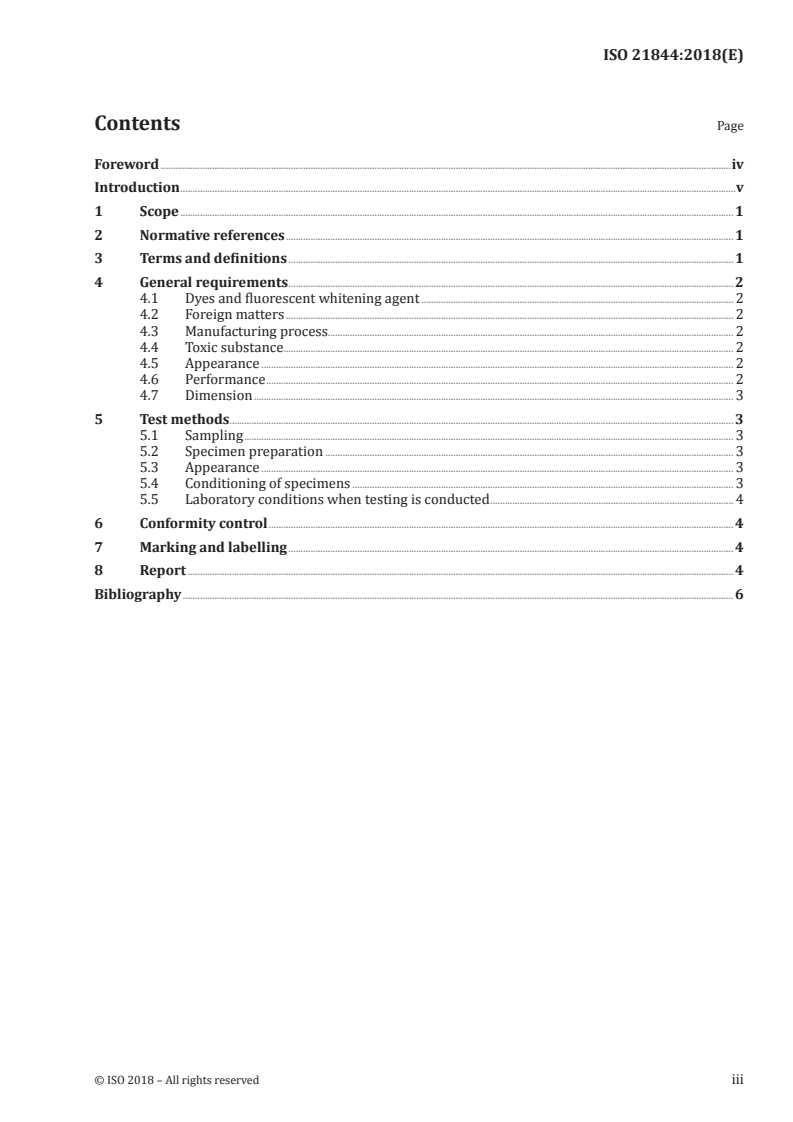
Contents Page
Foreword .iv
Introduction .v
1 Scope . 1
2 Normative references . 1
3 Terms and definitions . 1
4 General requirements . 2
4.1 Dyes and fluorescent whitening agent . 2
4.2 Foreign matters . 2
4.3 Manufacturing process. 2
4.4 Toxic substance . 2
4.5 Appearance . 2
4.6 Performance . 2
4.7 Dimension . 3
5 Test methods . 3
5.1 Sampling . 3
5.2 Specimen preparation . 3
5.3 Appearance . 3
5.4 Conditioning of specimens . 3
5.5 Laboratory conditions when testing is conducted . 4
6 Conformity control . 4
7 Marking and labelling . 4
8 Report . 4
Bibliography . 6
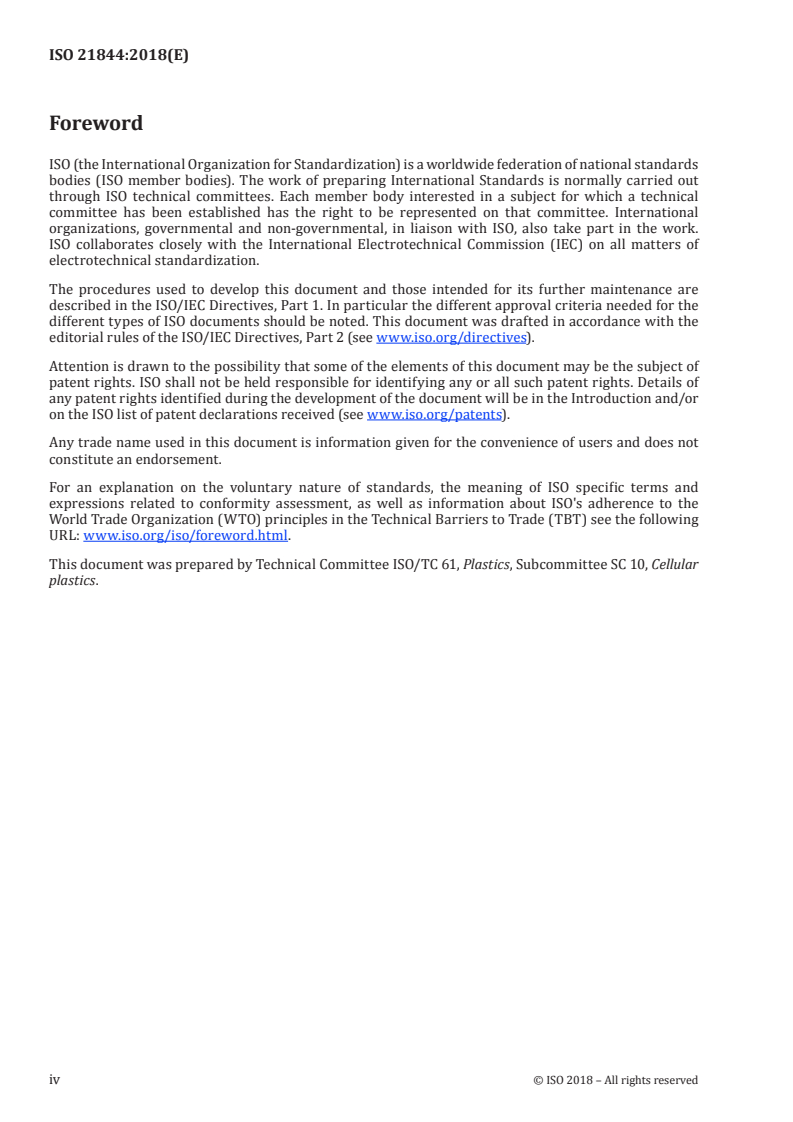
Foreword
ISO (the International Organization for Standardization) is a worldwide federation of national standards
bodies (ISO member bodies). The work of preparing International Standards is normally carried out
through ISO technical committees. Each member body interested in a subject for which a technical
committee has been established has the right to be represented on that committee. International
organizations, governmental and non-governmental, in liaison with ISO, also take part in the work.
ISO collaborates closely with the International Electrotechnical Commission (IEC) on all matters of
electrotechnical standardization.
The procedures used to develop this document and those intended for its further maintenance are
described in the ISO/IEC Directives, Part 1. In particular the different approval criteria needed for the
different types of ISO documents should be noted. This document was drafted in accordance with the
editorial rules of the ISO/IEC Directives, Part 2 (see www .iso .org/directives).
Attention is drawn to the possibility that some of the elements of this document may be the subject of
patent rights. ISO shall not be held responsible for identifying any or all such patent rights. Details of
any patent rights identified during the development of the document will be in the Introduction and/or
on the ISO list of patent declarations received (see www .iso .org/patents).
Any trade name used in this document is information given for the convenience of users and does not
constitute an endorsement.
For an explanation on the voluntary nature of standards, the meaning of ISO specific terms and
expressions related to conformity assessment, as well as information about ISO's adherence to the
World Trade Organization (WTO) principles in the Technical Barriers to Trade (TBT) see the following
URL: www .iso .org/iso/foreword .html.
This document was prepared by Technical Committee ISO/TC 61, Plastics, Subcommittee SC 10, Cellular
plastics.
iv © ISO 2018 – All rights reserved
Introduction
The cellulose foam contains at least 50 % of paper by weight as the raw material, which is expanded
with a starch mixture.
INTERNATIONAL STANDARD ISO 21844:2018(E)
Cellular plastic — Cellulose foam thermal insulation —
Material specification
1 Scope
This document specifies material requirements and identifies the test methods to be used to determine
these require
...
INTERNATIONAL ISO
STANDARD 21844
First edition
2018-04
Cellular plastic — Cellulose foam
thermal insulation — Material
specification
Plastiques alvéolaires — Matériau d'isolation à base de mousse de
cellulose — Spécifications
Reference number
©
ISO 2018
© ISO 2018
All rights reserved. Unless otherwise specified, or required in the context of its implementation, no part of this publication may
be reproduced or utilized otherwise in any form or by any means, electronic or mechanical, including photocopying, or posting
on the internet or an intranet, without prior written permission. Permission can be requested from either ISO at the address
below or ISO’s member body in the country of the requester.
ISO copyright office
CP 401 • Ch. de Blandonnet 8
CH-1214 Vernier, Geneva
Phone: +41 22 749 01 11
Fax: +41 22 749 09 47
Email: copyright@iso.org
Website: www.iso.org
Published in Switzerland
ii © ISO 2018 – All rights reserved
Contents Page
Foreword .iv
Introduction .v
1 Scope . 1
2 Normative references . 1
3 Terms and definitions . 1
4 General requirements . 2
4.1 Dyes and fluorescent whitening agent . 2
4.2 Foreign matters . 2
4.3 Manufacturing process. 2
4.4 Toxic substance . 2
4.5 Appearance . 2
4.6 Performance . 2
4.7 Dimension . 3
5 Test methods . 3
5.1 Sampling . 3
5.2 Specimen preparation . 3
5.3 Appearance . 3
5.4 Conditioning of specimens . 3
5.5 Laboratory conditions when testing is conducted . 4
6 Conformity control . 4
7 Marking and labelling . 4
8 Report . 4
Bibliography . 6
Foreword
ISO (the International Organization for Standardization) is a worldwide federation of national standards
bodies (ISO member bodies). The work of preparing International Standards is normally carried out
through ISO technical committees. Each member body interested in a subject for which a technical
committee has been established has the right to be represented on that committee. International
organizations, governmental and non-governmental, in liaison with ISO, also take part in the work.
ISO collaborates closely with the International Electrotechnical Commission (IEC) on all matters of
electrotechnical standardization.
The procedures used to develop this document and those intended for its further maintenance are
described in the ISO/IEC Directives, Part 1. In particular the different approval criteria needed for the
different types of ISO documents should be noted. This document was drafted in accordance with the
editorial rules of the ISO/IEC Directives, Part 2 (see www .iso .org/directives).
Attention is drawn to the possibility that some of the elements of this document may be the subject of
patent rights. ISO shall not be held responsible for identifying any or all such patent rights. Details of
any patent rights identified during the development of the document will be in the Introduction and/or
on the ISO list of patent declarations received (see www .iso .org/patents).
Any trade name used in this document is information given for the convenience of users and does not
constitute an endorsement.
For an explanation on the voluntary nature of standards, the meaning of ISO specific terms and
expressions related to conformity assessment, as well as information about ISO's adherence to the
World Trade Organization (WTO) principles in the Technical Barriers to Trade (TBT) see the following
URL: www .iso .org/iso/foreword .html.
This document was prepared by Technical Committee ISO/TC 61, Plastics, Subcommittee SC 10, Cellular
plastics.
iv © ISO 2018 – All rights reserved
Introduction
The cellulose foam contains at least 50 % of paper by weight as the raw material, which is expanded
with a starch mixture.
INTERNATIONAL STANDARD ISO 21844:2018(E)
Cellular plastic — Cellulose foam thermal insulation —
Material specification
1 Scope
This document specifies material requirements and identifies the test methods to be used to determine
these require
...