


ISO 12620:1999
(Main)Computer applications in terminology — Data categories
Computer applications in terminology — Data categories
Aides informatiques en terminologie — Catégories de données
General Information
- Status
- Withdrawn
- Publication Date
- 20-Oct-1999
- Withdrawal Date
- 20-Oct-1999
- Technical Committee
- ISO/TC 37/SC 3 - Management of terminology resources
- Drafting Committee
- ISO/TC 37/SC 3/WG 1 - Data categories
- Current Stage
- 9599 - Withdrawal of International Standard
- Start Date
- 10-Dec-2009
- Completion Date
- 14-Feb-2026
Relations
- Effective Date
- 15-Apr-2008
Buy Documents
ISO 12620:1999 - Computer applications in terminology -- Data categories
ISO 12620:1999 - Aides informatiques en terminologie -- Catégories de données
Get Certified
Connect with accredited certification bodies for this standard

BSI Group
BSI (British Standards Institution) is the business standards company that helps organizations make excellence a habit.

NYCE
Mexican standards and certification body.
Sponsored listings
Frequently Asked Questions
ISO 12620:1999 is a standard published by the International Organization for Standardization (ISO). Its full title is "Computer applications in terminology — Data categories". This standard covers: Computer applications in terminology — Data categories
Computer applications in terminology — Data categories
ISO 12620:1999 is classified under the following ICS (International Classification for Standards) categories: 01.020 - Terminology (principles and coordination); 35.240.30 - IT applications in information, documentation and publishing. The ICS classification helps identify the subject area and facilitates finding related standards.
ISO 12620:1999 has the following relationships with other standards: It is inter standard links to ISO 12620:2009. Understanding these relationships helps ensure you are using the most current and applicable version of the standard.
ISO 12620:1999 is available in PDF format for immediate download after purchase. The document can be added to your cart and obtained through the secure checkout process. Digital delivery ensures instant access to the complete standard document.
Standards Content (Sample)
INTERNATIONAL ISO
STANDARD 12620
First edition
1999-10-01
Computer applications in terminology —
Data categories
Aides informatiques en terminologie — Catégories de données
A
Reference number
© ISO 1999
All rights reserved. Unless otherwise specified, no part of this publication may be reproduced or utilized in any form or by any
means, electronic or mechanical, including photocopying and microfilm, without permission in writing from the publisher.
International Organization for Standardization
Case postale 56 • CH-1211 Genève 20 • Switzerland
Internet iso@iso.ch
Printed in Switzerland
ii
© ISO ISO 12620:1999(E)
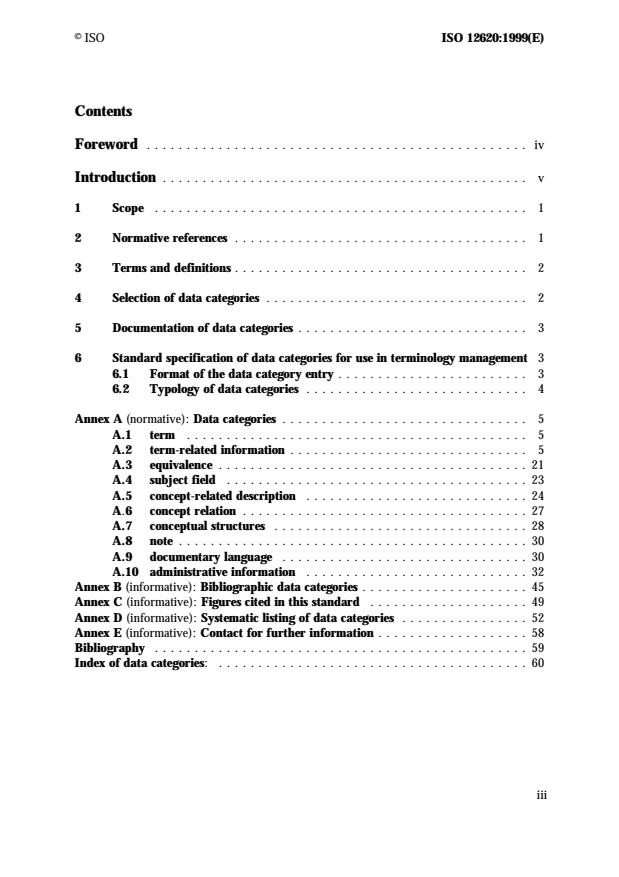
Contents
Foreword . iv
Introduction . v
1 Scope . 1
2 Normative references . 1
3 Terms and definitions . 2
4 Selection of data categories . 2
5 Documentation of data categories . 3
6 Standard specification of data categories for use in terminology management 3
6.1 Format of the data category entry . 3
6.2 Typology of data categories . 4
Annex A (normative): Data categories . 5
A.1 term . 5
A.2 term-related information . 5
A.3 equivalence . 21
A.4 subject field . 23
A.5 concept-related description . 24
A.6 concept relation . 27
A.7 conceptual structures . 28
A.8 note . 30
A.9 documentary language . 30
A.10 administrative information . 32
Annex B (informative): Bibliographic data categories . 45
Annex C (informative): Figures cited in this standard . 49
Annex D (informative): Systematic listing of data categories . 52
Annex E (informative): Contact for further information . 58
Bibliography . 59
Index of data categories: . 60
iii
Foreword
ISO (the International Organization for Standardization) is a worldwide federation of national
standards bodies (ISO member bodies). The work of preparing International Standards is
normally carried out through ISO technical committees. Each member body interested in a
subject for which a technical committee has been established has the right to be represented
on that committee. International organizations, governmental and non-governmental, in liaison
with ISO, also take part in the work. ISO collaborates closely with the International
Electrotechnical Commission (IEC) on all matters of electrotechnical standardization.
Draft International Standards adopted by the technical committees are circulated to the member
bodies for voting. Publication as an International Standard requires approval by at least 75 %
of the member bodies casting a vote.
International Standard ISO 12620 was prepared by Technical Committee ISO/TC 37,
Terminology (principles and coordination), Subcommittee SC 3, Computer applications.
Annex A forms an integral part of this International Standard. Annexes B, C, D and E are for
information only.
iv
© ISO ISO 12620:1999(E)
Introduction
Terminological data are collected, managed, and stored ina wide variety of environments. For
purposes of storage and retrieval, these data are organized into terminological entries, each of
which traditionally treats information associated with a single concept. Data items appearing
in individual terminological entries are themselves identified according to data category.
Differences in approach and individual system objectives inevitably lead to variations in data
category definition and in the assignment of data category names. The use of uniform data
category names and definitions, at least at the interchange level, contributes to system
coherence and enhances the reusability of data.
For terminology work in general, the following International Standards are relevant: ISO 704,
ISO 860, ISO 1087, ISO 10241.
v v
INTERNATIONAL STANDARD © ISO ISO 12620:1999(E)
Computer applications in terminology — Data categories
1 Scope
This International Standard specifies data categories for recording terminological information
in both computerized and non-computerized environments and for the interchange and retrieval
of terminological information independent of the local software applications or hardware
environments in which these data categories are used.
Some of the data categories specified in this International Standard derive requirements from
definitions taken from other ISO terminology standards, e.g., ISO 1087 and ISO 5127, so as
to harmonize the content of data categories across systems and to facilitate data interchange.
The systematic arrangement of data categories in this International Standard is determined by
database management considerations and does not reflect any theoretical arrangement of related
terms and concepts used in other standards.
If applied for the purpose of interchanging machine-readable terminology, it is recommended
that this International Standard be used in conjunction with ISO 12200, although it can also
be used for modeling terminological information independent of computer applications.
It is not the purpose of this International Standard to specify actual data categories used in local
database applications, because translation routines can be employed to convert application data
categories to the universal categories specified here, provided that the values of the data
associated with these categories are harmonized according to the relevant data category defini-
tions.
It is also not the purpose of this International Standard to specify precise relationships among
data categories, such as repeatability and combinability. These features remain the province
of the individual database application and of ISO 12200. Nor does this International Standard
prescribe a mandatory base set of data categories for local applications.
This International Standard does not specify data categories for the markup of bibliographic
data entries. ISO 12083:1994, annex B, includes bibliographic elements among other elements
cited as useful in the preparation and markup of machine-readable documents. Annex B of this
International Standard lists data categories that correspond to elements cited in ISO 12083 and
that are appropriate for the documentation of bibliographic citations in terminological entries.
NOTE – ISO 12200:1999, annex B, provides additional information on the application of the
bibliographic elements in ISO 12083 to the documentation of bibliographic information in
terminological entries for those cases involving exchange of machine-readable terminology.
2 Normative references
The following standards contain provisions which, through reference in this text, constitute
provisions of this International Standard. At the time of publication, the editions indicated
were valid. All standards are subject to revision, and parties to agreements based on this
International Standard are encouraged to investigate the possibility of applying the most recent
editions of the standards indicated below. Members of IEC and ISO maintain registers of
currently valid International Standards.
ISO 639:1988, Code for the representation of names of languages.
ISO 639-2:1998, Code for the representation of names of languages — Part 2: Alpha-3 code.
ISO 1087:1990, Terminology – Vocabulary.
ISO 1087-2:- , Terminology – Vocabulary – Part 2: Computer applications
ISO 3166-1: 1997, Codes for the representation of names of countries and their subdivisions
– Part 1: Country codes.
ISO 3166-2:1998, Codes for the representation of names of countries and their subdivisions
– Part 2: Country subdivision code.
ISO 3166-3:1999, Code for the representation of names of countries and their subdivisions –
Part 3: Codes for formerly used names of countries.
ISO 5127-2:1983, Documentation and information – Vocabulary – Part 2: Traditional
documents.
ISO 5127-6:1983, Documentation and information – Vocabulary – Part 6: Documentary
languages.
ISO 8601:1988, Data elements and interchange formats – Information interchange —
Representation of dates and times.
ISO 12200:1999, Computer applications in terminology – Machine-readable terminology
interchange format (MARTIF) – Negotiated interchange.
ISO 12083:1994, Information and documentation – Electronic manuscript preparation and
markup.
3 Terms and definitions
For the purpose of this International Standard, the terms and definitions given in ISO 1087-2
apply.
4 Selection of data categories
The categories employed in any given environment shall be carefully selected to meet the
needs of those who create and use the terminology resource in question. For this purpose, an
appropriate subset of the data categories specified in annex A shall be selected for application
in the individual system.
1)To be published.
© ISO ISO 12620:1999(E)
It is recommended that designers of terminology databases and other collections ensure that
the content of data categories used in their systems conform to the content defined in these data
category specifications. Terminological data prepared for interchange shall conform to the data
category names and descriptions specified in annex A.
5 Documentation of data categories
The documentation of a data category for any terminological data collection shall enable the
user to unambiguously interpret the content of the data category. The specification shall permit
the user to differentiate the content of the data category from the content of other data
categories used within the terminological data collection and the data categories used by
interchange partners.
The standard specifications of data categories in annex A are based on standardized concepts
for terminology management defined in ISO 1087 and ISO 5127-2 and 5127-6. If a data cate-
gory required in a local application is not found in annex A, it shall be based on a well-
established and documented concept in the field treated by a specific application. In any case,
system designers shall notify the agency listed in annex E whenever they intend to create new
data categories for use with the interchange format specified in ISO 12200.
If codes or representations other than those used in natural languages are used in conjunction
with a data category, appropriate information for unambiguous interpretation shall be included
in the specification of that data category. The specifications in annex A provide coding options
wherever standardized codes are available.
6 Standard specification of data categories for use in terminology management
6.1 Format of the data category entry
The data category specifications included in annex A conform to the following format. (Not
all categories appear in every specification.)
Specification category Representation
Notation number: boldface number
Preferred data category name: boldface
Admitted name: ADMITTED NAME: boldface [repeatable]
Full form: FULL FORM: boldface
Related name: RELATED NAME: boldface [repeatable]
Nonadmitted name: NONADMITTED NAME: boldface [repeatable]
Data category description: DESCRIPTION:
Note: NOTE: [repeatable]
Permissible instances: PERMISSIBLE INSTANCES: italics
Example: EXAMPLE: [repeatable]
6.2 Typology of data categories
The data category specifications in annex A are divided into three major groups: data
categories for terms and term-related information, descriptive data, and administrative data.
The groups are further subdivided into ten sub-groups.
Term and term-related data categories:
Subgroup 1 consists of the data category term and contains a term or other information treated
as if it were a term (e.g., phraseological units and standard text).
Subgroup 2 specifies data categories for term-related information.
Subgroup 3 specifies data categories for information relating to equivalence between or among
terms assigned to the same or very similar concepts.
Descriptive data categories:
Subgroup 4 specifies data categories for the classification of concepts into subject fields and
subfields, along with other classification-related information.
Subgroup 5 specifies data categories for concept-related description, i.e., different kinds of
definitions, explanations and contextual material provided to define or otherwise determine the
subject field and concept to which a term is assigned.
Subgroup 6 specifies data categories for indicating relations between pairs of concepts.
Subgroup 7 specifies data categories used to express the position of concepts within concept
systems.
Subgroup 8 specifies the data category note. This category stands alone because it can be
associated with any one of the other categories and therefore cannot be subordinated to any
other specific subgroup.
Administrative data categories:
Subgroup 9 specifies data categories for documentary languages and thesauri.
Subgroup 10 specifies data categories for all other strictly administrative information.
© ISO ISO 12620:1999(E)
Annex A
(normative)
Data categories
A.1 term
DESCRIPTION: A designation of a defined concept in a special language by a linguistic
expression.
NOTE: For definition of related term, see ISO 1087:1990, 5.3.1.2
EXAMPLE: “radix” in annex C, figure C.1.
NOTE: Terms can consist of single words or be composed of multiword strings. The
distinguishing characteristic of a term is that it is assigned to a single concept, as opposed to
a phraseological unit, which combines more than one concept in a lexicalized fashion to
express complex situations. Quality assurance system is a term, whereas satisfy quality require-
ments is a phraseological unit, specifically a collocation.
A.2 term-related information
A.2.1 term type
DESCRIPTION: An attribute assigned to a term.
NOTE: Term types can include:
A.2.1.1 main entry term
ADMITTED NAME: head term
DESCRIPTION: The concept designation that has been chosen to head a terminological record.
EXAMPLE: “radix” in annex C, figure C.1
A.2.1.2 synonym
DESCRIPTION: Any term that represents the same or a very similar concept as the main entry
term in a term entry.
EXAMPLE: “dynamicizer” in annex C, figure C.2
NOTE: Synonymy is generally relative, i.e., synonyms rarely cover all aspects of the same
concept in all instances. The resulting degree of synonymy (A.2.10) is treated using the
conventions defined for degree of equivalence (see A.3.1)
A.2.1.3 quasi-synonym
ADMITTED NAME: near synonym
DESCRIPTION: A term that represents the same or a very similar concept as another term in the
same language, but for which interchangeability is limited to some contexts and inapplicable
in others.
EXAMPLE: The distinction between synonyms and quasi-synonyms can be subjective or strongly
context-oriented. For instance, some can designate “domain” and “subject field” as synonyms,
whereas others would argue that “domain” is broader, but is usable in many of the same
contexts and is therefore a quasi-synonym.
A.2.1.4 international scientific term
DESCRIPTION: A term that is part of an international scientific nomenclature as adopted by an
appropriate scientific body.
EXAMPLE: Homo sapiens
A.2.1.5 common name
DESCRIPTION: A synonym for an international scientific term that is used in general discourse
in a given language.
NOTE: Common names are generally formed based on metaphor, analogy, and function without
reference to the classification rules applied to scientific nomenclatures. Although common
names are widely used in general language, they are used in technical and scientific writing
as well. Common names vary from language to language and frequently regionally within
languages.
EXAMPLE: Kalmia latifolia is commonly called “mountain laurel” in the northern United
States, and “calico bush” or “sheep's bane” in the south.
A.2.1.6 internationalism
DESCRIPTION: A term that has the same or nearly identical orthographic or phonemic form in
many languages.
NOTE: Internationalisms frequently reflect Latin, Greek or English origins, but other
languages, such as Arabic, French, Russian, Chinese and Japanese, have also contributed to
the creation of internationalisms.
.
EXAMPLE: en alcohol, fr alcool, de Alkohol [from Arabic al kuhl]
A.2.1.7 full form
ADMITTED NAME1: expanded form
ADMITTED NAME2: expansion
DESCRIPTION: The complete representation of a term for which there is an abbreviated form.
EXAMPLE: See the examples of full forms in A.2.1.8, ff.
A.2.1.8 abbreviated form of term
ADMITTED NAME: abbreviated form
DESCRIPTION: A term resulting from the omission of any part of the full term while designating
the same concept.
NOTE 1: For definition of related term, see ISO 1087:1990, 5.5.2.
EXAMPLE: See individual abbreviation types listed below.
NOTE 2: Types of abbreviated form can include:
abbreviation
short form
initialism
acronym
clipped term
NOTE 3: Each abbreviated form is derived from the full form of the term.
A.2.1.8.1 abbreviation
DESCRIPTION: An abbreviated form of a simple term resulting from the omission of some of
its letters.
NOTE: For definition of related term, see ISO 1087:1990, 5.5.2.1.
EXAMPLE: full form: adjective
abbreviation: adj.
© ISO ISO 12620:1999(E)
A.2.1.8.2 short form of term
ADMITTED NAME: short form
DESCRIPTION: A variant of a multiword term that includes fewer words than the full form of
the term.
EXAMPLES: full form: Intergovernmental Group of Twenty-four on International Monetary
Affairs
short form: Group of Twenty-four
NOTE: Many short forms are associated with long proper nouns, such as the names of
governmental agencies, chemical compounds, and the like.
A.2.1.8.3 initialism
DESCRIPTION: An abbreviated form of a term consisting of some of the initial letters of the
words making up a multiword term or the term elements making up a compound term when
these letters are pronounced individually.
EXAMPLE: full form: bovine spongiform encephalopathy
initialism: BSE
NOTE: The distinction between acronyms and initialisms can vary from language to language.
The description given here applies to English.
A.2.1.8.4 acronym
DESCRIPTION: An abbreviated form of a term made up of letters from the full form of a
multiword term strung together into a sequence pronounced only syllabically.
NOTE 1: An acronym can be so widely accepted that it becomes a term in its own right (e.g.,
radar in the following example).
NOTE 2: For definition of related term, see ISO 1087:1990, 5.5.2.1.2.
EXAMPLE: radar = radio detecting and ranging
A.2.1.8.5 clipped term
ADMITTED NAME: truncated term
DESCRIPTION: An abbreviated form of a term resulting from the omission of one or more term
elements or syllables.
NOTE: For definition of related term, see ISO 1087:1990, 5.7.1.
EXAMPLE: full form: influenza
clipped term: flu
A.2.1.9 variant
DESCRIPTION: One of the alternate forms of a term.
EXAMPLE: spelling variants: catalogue (GB), catalog (US)
A.2.1.10 transliterated form
DESCRIPTION: A form of a term resulting from an operation whereby the characters of an
alphabetic writing system are represented by characters from another alphabetic writing
system.
EXAMPLE: Cyrillic script: @8DJ0"`V"b FD,*"
Latin script: okruz9aû×aâ sreda (environment)
(Transliteration according to ISO 9:1995)
okruzhayushchaya sreda
(Transliteration according to BS 2979:1958)
A.2.1.11 transcribed form
DESCRIPTION: A form of a term resulting from an operation whereby the characters of one
writing system are represented by characters from another writing system, taking into account
the pronunciation of the characters converted.
EXAMPLE: Japanese:
Hiragana syllabary transcription:
Romanization according to ISO 3602:1989: taihuu
English transcription: typhoon
Russian transcription: H"6LJ>
Definition: a tropical storm in the western area of the Pacific Ocean in late summer
and autumn
Chinese:
Romanization according to ISO 7098:1991: gongfu
English transcription: kung fu
Russian transcription: 8J> LJ
Definition: one of the Chinese martial arts
A.2.1.12 romanized form
DESCRIPTION: A form of a term resulting from an operation whereby non-Latin writing systems
are converted to the Latin alphabet.
NOTE: Romanization is a specific form of transcription.
EXAMPLE: See example in A.2.1.10 and A.2.1.11.
A.2.1.13 symbol
DESCRIPTION: A designation of a concept by letters, numerals, pictograms or any combination
thereof.
NOTE: For definition of related term, see ISO 1087:1990, 5.3.1.1
EXAMPLE: The symbol § can be used to represent a clause or subclause in a legal document.
A.2.1.14 formula
DESCRIPTION: Figures, symbols or the like used to express a concept briefly, such as a
mathematical or chemical formula.
NOTE: A formula can function as a term representing the concept. In some cases, no other
representation exists.
EXAMPLE: H O is the chemical formula for water.
A.2.1.15 equation
DESCRIPTION: An expression used to represent a concept based on a statement that two
mathematical expressions are, for instance, equal as identified by the equal sign (=), or
assigned to one another by a similar sign.
EXAMPLE: E=mc
NOTE: Such statements are sometimes documented in terminology databases.
© ISO ISO 12620:1999(E)
A.2.1.16 logical expression
DESCRIPTION: An expression used to represent a concept based on mathematical or logical
relations, such as statements of inequality, set relationships, boolean operations, and the like.
EXAMPLE: x =/ y , x 0 y , x NOT y , etc.
A.2.1.17 materials management categories
A.2.1.17.1 sku
FULLFORM: stockkeeping unit
DESCRIPTION: An inventory item identified by a unique alphanumeric designation assigned to
an object in an inventory control system.
EXAMPLE: For the catalog entry: “PLAID FLANNEL PANTS #5193 Sizes 3, 4, 6, 7, 10,
12”, “#5193-6” represents a sku for the item: Style number #5193, size 6.
NOTE: Terminology databases that are linked to inventory control systems and manufacturing
logistical systems include skus and part numbers, which act as designations within the system
representing the object in question. Hence they function much like terms and even take on the
character of terms in common discourse and text creation.
A.2.1.17.2 part number
DESCRIPTION: A unique alphanumeric designation assigned to an object in a manufacturing
system.
EXAMPLE: Sample part numbers from a automotive power train manufacturing system, where
each segment of the number represents a different classification level within the system:
clutch cover 1 110 036 00 a
driven disk flange 3 125 125 04 b
driven disk retainer plate 3 124 119 01 a
driven disk cover plate 3 122 234 00 c
diaphragm spring 4 220 100 00 g
NOTE: Terminology databases that are linked to inventory control systems and manufacturing
logistical systems include skus and part numbers, which function as designations within the
system representing the object in question. Hence they function much like terms and even take
on the character of terms in common discourse and text creation.
A.2.1.18 phraseological unit
DESCRIPTION: Any group of two or more words that form a unit, the meaning of which
frequently cannot be deduced based on the combined sense of the words making up the phrase.
NOTE: Although they are made up of more than one word and frequently contain more than
one concept, phraseological units can be treated as individual terminological units in
terminology databases. In this sense they are grouped together with “terms”. They can,
however, also be treated as contextual material in some databases.
EXAMPLES: See examples in A.2.1.18.1-A.2.1.18.3.
A.2.1.18.1 collocation
DESCRIPTION: A recurrent word combination characterized by cohesion in that the components
of the collocation must co-occur within an utterance or series of utterances, even though they
do not necessarily have to maintain immediate proximity to one another.
EXAMPLE: immunization against [measles], not with or about
in or during [someone]'s absence, not while
submit or hand in an application, not hand up or pass out
NOTE: Collocations differ from set or fixed phrases in that the components of the latter must
generally appear in a fixed sequence. Recurrent word combinations that form a multiword term
(e.g., adjective + noun, noun + noun, etc.) and that represent a single concept are not
collocations.
A.2.1.18.2 set phrase
ADMITTED NAME: fixed phrase
DESCRIPTION: A fixed, lexicalized phrase.
EXAMPLE: fragile; handle with care; this end up
A.2.1.18.3 synonymous phrase
DESCRIPTION: Phraseological unit in a language that expresses the same semantic content as
another phrase in that same language.
EXAMPLE: The phrases response to open flame exposure and effect of open flame exposure are
treated as synonymous phrases in some fire standards.
A.2.1.19 standard text
DESCRIPTION: A fixed chunk of recurring text.
EXAMPLE: the force majeure clause of a standard contract
terms and conditions of sale
warranty disclaimers
NOTE: Although they are made up of more than one word and generally contain more than one
concept, standard text units can be treated as individual terminological units in terminology
databases. These text chunks, as they are called in discourse analysis, are frequently called
boiler plate in North American English.
A.2.2 grammar
DESCRIPTION: Grammatical information about a term.
NOTE: Depending on language-specific conventions, grammatical categories can include:
part of speech
grammatical gender
grammatical number
animacy
noun class
adjective class
A.2.2.1 part of speech
NONADMITTED NAME 1: grammatical category
NONADMITTED NAME 2: word class
DESCRIPTION: A category assigned to a word based on its grammatical and semantic properties.
PERMISSIBLE INSTANCES: Examples of parts of speech commonly documented in terminology
databases can include:
© ISO ISO 12620:1999(E)
a) noun
b) verb
c) adjective
A.2.2.2 grammatical gender
DESCRIPTION: A grammatical category that indicates grammatical relationships between words
in sentences.
NOTE: The concept of gender varies from language to language and is not a universal feature
of all languages.
EXAMPLE: In French, vie (life) is feminine and is used with feminine articles such as la, the
feminine pronoun elle, and feminine adjective endings, e.g., une vie longue.
PERMISSIBLE INSTANCES: Types of grammatical gender commonly documented in terminology
databases include:
a) masculine
b) feminine
c) neuter
d) other
A.2.2.3 grammatical number
DESCRIPTION: In many languages, the grammatical distinction that indicates the number of
objects referred to by the term.
EXAMPLE 1: The child eats his dinner. The children eat their dinner.
singular — child is a singular noun
eats is a third person singular verb
plural — children is a plural noun
eat is a third person plural verb
EXAMPLE 2: mass noun — smoke, water, food
PERMISSIBLE INSTANCES: Types of grammatical number designations commonly documented
in terminology databases include:
a) singular
DESCRIPTION: The form of a term (usually of a noun) used to designate one object.
b) plural
DESCRIPTION: The form of a term (usually of a noun) used to designate more than one
object.
c) dual
DESCRIPTION: The form used in some languages to designate two persons or things.
d) mass noun
DESCRIPTION: Designation of a term that is not countable and cannot generally be used with
the indefinite article or in the plural (e.g., bread).
e) other
DESCRIPTION: Designation used to classify number-related grammatical information that
can differ from the standard European classifications cited above.
NOTE: In situations where the singular and the plural of a term do not necessarily designate the
same concept, the singular and plural should be reported in separate entries in order to retain
the concept-orientation of the database.
A.2.2.4 animacy
DESCRIPTION: The characteristic of a word indicating that in a given discourse community, its
referent is considered to be alive or to possess a quality of volition or consciousness.
PERMISSIBLE INSTANCES: Types of designations related to animacy can include:
a) animate
DESCRIPTION: Perceived as alive.
b) inanimate
DESCRIPTION: Perceived as not living.
c) other
DESCRIPTION: Perceived as related to animacy, but without specific reference to the
previous items.
A.2.2.5 noun class
DESCRIPTION: The categorization of a noun indicating whether it names a specific object or a
class of objects.
NOTE: Proper nouns are capitalized in English. Common nouns are not.
PERMISSIBLE INSTANCES: Types of noun classes are:
a) proper noun
DESCRIPTION: A noun or adjective denoting a single object.
EXAMPLE: Europe
b) common noun
DESCRIPTION: A noun or adjective denoting a class of objects.
EXAMPLE: continent
A.2.2.6 adjective class
DESCRIPTION: A categorization of an adjective indicating whether it pertains to a single object
or to a class of objects
NOTE: Proper adjectives are capitalized in English. Common adjectives are not.
PERMISSIBLE INSTANCES: Types of adjective classes are:
a) proper adjective
DESCRIPTION: An adjective formed on the base of a proper noun.
EXAMPLE: Arabian stallion
b) common adjective
DESCRIPTION: An adjective pertaining to a generic class of objects.
EXAMPLE: thoroughbred horse
© ISO ISO 12620:1999(E)
A.2.3 usage
A.2.3.1 usage note
DESCRIPTION: A note containing information on the usage of the associated term.
A.2.3.2 geographical usage
DESCRIPTION: Term usage reflecting regional differences.
EXAMPLE 1: term: windshield geographical usage: US
term: windscreen geographical usage: GB
NOTE 1: Language and country symbols can be combined.
EXAMPLE 2: term: windshield geographical usage: en US
term: windscreen geographical usage: en GB
Note 2: If available and relevant, the content of geographical usage should be a country
symbol as specified in ISO 3166-1 or one of the continent names. In more granular systems,
specific regional names can be used, but should be declared elsewhere in the system for user
understanding and coherence in the event of data exchange. The country symbol can optionally
be preceded by a NOT operator to negate the content:
Example 3: geographical usage: USA
geographical usage: NOT AUS
A.2.3.3 register
DESCRIPTION: Classification indicating the relative level of language individually assigned to
a lexeme or term or to a text type.
NOTE: In some regions and terminology management environments (for instance, family-
planning medicine), the categorization of terms according to register can be critical.
PERMISSIBLE INSTANCES: Types of register qualifiers that can be relevant in terminology work
include:
a) neutral register
ADMITTED NAME: standard register
DESCRIPTION: The register appropriate to general texts or discourse.
b) technical register
DESCRIPTION: The register appropriate to scientific texts or special languages.
c) in-house register
DESCRIPTION: The register of terms that are company-specific and not readily recognized
outside this environment.
EXAMPLE: In-house usage at one automotive company for the automotive tuning
characteristic gear rattle is crowds.
NOTE: In-house terminology is not necessarily equivalent to bench-level terminology,
inasmuch as the former can thrive at very high levels of research and development. In-
house terminology is frequently the source of new technical terminology that eventually
gains widespread acceptance on a broader scale.
d) bench-level register
ADMITTED NAME: shop term
DESCRIPTION: The register of terms used in applications-oriented as opposed to theoretical
or academic levels of language.
EXAMPLE: The retrieval end of a broach is commonly called a puller in bench-level usage.
e) slang register
DESCRIPTION: An extremely informal register of a word, term, or text that is used in
spoken and everyday language and less commonly in documents.
EXAMPLE: In aviation, the phrase fly by the seat of your pants is slang for the more formal
fly without instruments.
f) vulgar register
DESCRIPTION: The register of a term or text type that can be characterized as profane or
socially unacceptable.
NOTE: Although vulgar register is avoided in formal technical terminology, languages with
broad distribution such as English or Spanish can require the documentation of problematic
terms that vary in register from region to region.
A.2.3.4 frequency
DESCRIPTION: The relative commonness with which a term occurs.
PERMISSIBLE INSTANCES: Degrees of frequency can be expressed as:
a) commonly used
b) infrequently used
c) rarely used
NOTE: The definitions of these items are self-explanatory. Designation of a term with respect
to frequency can be based on subjective criteria, or it can reflect computer analysis of text
corpora, in which case it can also be expressed as a ratio of occurrences per a set number of
words in the text corpus.
EXAMPLE: In the field of automotive drive train technology, the terms Belleville spring and
diaphragm spring are commonly used to refer to the principal component in a clutch
mechanism. The standardized term conical disk spring is infrequently used outside the
standards environment, and the generic term disk spring is rarely used.
A.2.3.5 temporal qualifier
DESCRIPTION: An attribution of a term with respect to its use over time.
NOTE: Temporal qualification involves fine distinctions that can be subjective in nature.
PERMISSIBLE INSTANCES: Common temporal qualifiers include:
a) archaic term
DESCRIPTION: A term no longer in ordinary use, though retained for special purposes.
EXAMPLE: donjon [archaic form of the modern word dungeon]; tetters [eczema]
b) outdated term
DESCRIPTION: A term that has fallen from fashion, but the meaning of which is readily
recognizable.
EXAMPLE: horseless carriage; ague [malarial fever]
© ISO ISO 12620:1999(E)
c) obsolete term
DESCRIPTION: A term that is no longer in use as a result of changing views of scientific
knowledge.
NOTE 1: For definition of related term, see ISO 1087:1990, 5.6.4
EXAMPLE: spiraeic acid (old name for salicylic acid)
Note 2: The difference between a superseded term and an obsolete term is that a
superseded term has changed its status as defined by a normative body, but can indeed still
be used in older standards or in nonstandardized environments. In contrast, an obsolete
term has truly fallen out of common usage. Some obsolete terms are also archaic, i.e., of
very ancient etymological origin, but this does not have to be the case. By the same token,
many terms in current usage are nonetheless archaic in origin. Outdated terms are similar
to superseded terms, but they are not subject to normative classification.
A.2.3.6 time restriction
DESCRIPTION: The indication of a period of time during or since which a term was or has been
subject to specified usage.
EXAMPLE: Several European countries have redefined the requirements for certain university
degrees in recent years. If, for instance, the requirements for a baccalaureate degree changed
from three to four years in 1993, then any terminology file defining the term used to designate
this degree would have to specify the time restriction affecting the degree.
A.2.3.7 proprietary restriction
DESCRIPTION: A restriction placed on a term for the purpose of protecting the right of a
company to the exclusive use of the term.
PERMISSIBLE INSTANCES: Types of proprietary restriction can include:
a) trademark
DESCRIPTION: A restriction on term usage based on the fact that the term is a device (such
as a brand name) pointing distinctly to the origin or ownership of merchandise to which
it is applied and legally reserved for the exclusive use of the owner as maker or seller.
NOTE: For definition of related term, see ASTM Compilation.
EXAMPLE: term: facial tissue
trademark: Kleenex
b) trade name
DESCRIPTION: The name or style under which a concern does business.
NOTE 1: For definition of related term, see ASTM Compilation.
EXAMPLE: “Du Pont” for “E. I. du Pont de Nemours & Co.”
NOTE 2: The distinction between trademark and trade name is standardized in American
standards and included in terminology collections.
A.2.4 term formation
A.2.4.1 term provenance
DESCRIPTION: Classification of a term according to the methodology employed in creating the
term.
PERMISSIBLE INSTANCES: Types of term provenance are:
a) transdisciplinary borrowing
DESCRIPTION: A term taken from another subject field.
EXAMPLE:
term = ram:
Y animal
Y battering ram
Y press ram
NOTE: The source discipline, subject field, or domain can be indicated as an extension of
the data category content: transdisciplinary borrowing from metallurgy.
b) translingual borrowing
ADMITTED NAME: loan word
DESCRIPTION: A term taken from a foreign language and perhaps naturalized.
EXAMPLE:
de Raster Y en raster [no change in meaning: grid used for digitizing data]
en handy Y de Handy
[change in meaning: en adjective referring to anything that is convenient to use Y de
cellular phone]
NOTE: The source language can be indicated as an extension of the data category content;
e.g., translingual borrowing from English. The relation between loan words in the target
language and the original in the source language can be either one of identity (Raster-
raster) or of semantic change (handy-Handy).
c) loan translation
NONADMITTED NAME: calque (deprecated)
DESCRIPTION: A term whose elements have been literally translated from the elements of
a term in a foreign language.
EXAMPLE: Definition: viewing area on a computer display screen
en window Y de Fenster Y es ventana
NOTE 1: A translingual borrowing (loan word) involves the direct acceptance of a term
from one language into another, whereas loan translation involves the translation of term
elements based on componential analysis. The source language can be indicated as an
extension of the data category content: loan translation from English.
NOTE 2: The French term calque is frequently misused in English to designate an incorrect
or undesired loan translation, whereas its meaning in French is strictly that of loan
translation. See also false friend A.3.2.
© ISO ISO 12620:1999(E)
d) neologism
DESCRIPTION: A newly coined term.
EXAMPLE: immunosuppressant
Definition: a substance administered for the purpose of suppressing the rejection of
transplanted tissue
A.2.4.2 etymology
DESCRIPTION: Information on the origin of a word and the development of its meaning.
NOTE: Detailed etymology is primarily a concern of lexicology, although terminology is in
some instances concerned with these features, particularly with respect to the coining of
neologisms in language planning and term formation environments.
EXAMPLE: term: aspirin
etymology: from acetyl + spiraeic acid (old name for salicylic acid)
A.2.5 pronunciation
DESCRIPTION: The representation of the manner by which a term is articulated.
NOTE: Pronunciation is typically indicated using the International Phonetic Alphabet. A given
term can have more than one pronunciation, in which case it can be highly desirable to link
the variant pronunciations to an indication of geographical usage.
EXAMPLE: thermoplastic /12f:mc0plæstwk /
A.2.6 syllabification
DESCRIPTION: The division of a word reflecting its articulation by syllables, i.e., by uninter-
rupted units of pronunciation.
EXAMPLE: ther mo plas tic
NOTE: Syllabification is frequently indicated in dictionary entries and pertains to spoken
language.
A.2.7 hyphenation
DESCRIPTION: The division of a word in writing, such as at the end of a line, according to a
given set of rules.
EXAMPLE: pho-ne-ti-cian
NOTE: Words are hyphenated in order to block text efficiently and attractively for printing.
Rules for syllabification and hyphenation can differ in some languages and in some situations.
A.2.8 morphology
A.2.8.1 morphological element
DESCRIPTION: Unit resulting from the division of words into their smallest meaningful parts.
EXAMPLE: The morphological elements in + com + ing combine to create the word incoming.
A.2.8.2 term element
DESCRIPTION: Any logically significant portion of a larger term.
NOTE: In terminology databases, nondiscrete term elements can be separated by special symbol
combinations or other conventions in order to access them for formation of all-word indexes
or semi-automatic secondary keys. Such division can be arbitrary to some degree, depending
on the elements that need to be searched. The data category can recur as needed.
EXAMPLE: immuno suppressant
A.2.9 term status
DESCRIPTION: A qualifier of a term indicating such aspects as approval, acceptability, or
applicability in a given context.
EXAMPLE: See "base (deprecated)" in annex C, figure C.1
NOTE: This International Standard treats term status qualifiers as permissible instances that
serve as the content of one of the data categories associated with term status. Some databases
treat these categories as elements in their own right that feature terms as their data content.
This phenomenon is known as bimodality or data modeling variance and is treated in detail in
ISO 12200, annex D.
Data categories associated with term status include:
normative authorization
administrative status
process status
language-planning qualifier
A.2.9.1 normative authorization
DESCRIPTION: A term status qualifier assigned by an authoritative body, such as a standards
body or a governmental entity with a regulatory function.
NOTE: This category should be accompanied by or linked to a reference to the normative
organization in question.
PERMISSIBLE INSTANCES: Normative authorization qualifiers can include:
a) standardized term
ADMITTED NAME: standard term
DESCRIPTION: A term that has been standardized by a standardizing body.
NOTE: Most standardized terms are also preferred terms, but admitted terms can also be
included in this category.
EXAMPLE: All three terms, “serializer”, “parallel-serial converter” and “dynamicizer” are
standardized terms in annex C, figure C.2.
b) preferred term
DESCRIPTION: A term recommended by an authoritative body.
NOTE: For definition of related term, see ISO 1087:1990, 5.6.1
EXAMPLE: “Serializer” is the preferred term in annex C, figure C.2.
c) admitted term
DESCRIPTION: A term accepted as a synonym for a preferred term by an authoritative body.
NOTE: For definition of related term, see ISO 1087:1990, 5.6.2
EXAMPLE: “Parallel-serial converter” and “dynamicizer” are admitted terms in annex C,
figure C.2.
d) deprecated term
ADMITTED NAME: rejected term
DESCRIPTION: A term rejected by an authoritative body.
© ISO ISO 12620:1999(E)
NOTE: For definition of related term, see ISO 1087:1990, 5.6.3
EXAMPLE: “Base” is a deprecated term in annex C, figure C.1.
e) superseded term
DESCRIPTION: A term that is no longer preferred or admitted.
EXAMPLE: In plastics terminology, the generic term reformulated plastic has been
superseded by the more precise terms recycled plastic, reprocessed plastic, and reworked
plastic.
f) legal term
DESCRIPTION: A term that is legally defined and used in legally binding documents.
EXAMPLE: force majeure, designating the title of a standard claus
...
NORME ISO
INTERNATIONALE 12620
Première édition
1999-10-01
Aides informatiques en terminologie —
Catégories de données
Computer applications in terminology — Data categories
A
Numéro de référence
Sommaire Page
1 Domaine d’application .1
2 Références normatives .1
3 Termes et définitions.2
4 Sélection des catégories de données.2
5 Documentation des catégories de données .2
6 Spécifications normalisées des catégories de données en vue d'une gestion terminologique .3
6.1 Modèle de l'entrée concernant les catégories de données .3
6.2 Typologie des catégories de données.3
Annexe A (normative) Catégories de données .5
Annexe B (informative) Données bibliographiques.45
Annexe C (informative) Exemples d'éléments terminologiques cités dans la présente Norme
internationale .50
Annexe D (informative) Liste systématique des catégories de données .53
Annexe E (informative) Contact pour toute information supplémentaire.57
Bibliographie.58
© ISO 1999
Droits de reproduction réservés. Sauf prescription différente, aucune partie de cette publication ne peut être reproduite ni utilisée sous quelque
forme que ce soit et par aucun procédé, électronique ou mécanique, y compris la photocopie et les microfilms, sans l'accord écrit de l'éditeur.
Organisation internationale de normalisation
Case postale 56 • CH-1211 Genève 20 • Suisse
Internet iso@iso.ch
Imprimé en Suisse
ii
© ISO
Avant-propos
L'ISO (Organisation internationale de normalisation) est une fédération mondiale d'organismes nationaux de
normalisation (comités membres de l'ISO). L'élaboration des Normes internationales est en général confiée aux
comités techniques de l'ISO. Chaque comité membre intéressé par une étude a le droit de faire partie du comité
technique créé à cet effet. Les organisations internationales, gouvernementales et non gouvernementales, en
liaison avec l'ISO participent également aux travaux. L'ISO collabore étroitement avec la Commission
électrotechnique internationale (CEI) en ce qui concerne la normalisation électrotechnique.
Les projets de Normes internationales adoptés par les comités techniques sont soumis aux comités membres pour
vote. Leur publication comme Normes internationales requiert l'approbation de 75 % au moins des comités
membres votants.
La Norme internationale ISO 12620 a été élaborée par le comité technique ISO/TC 37, Terminologie (principes et
coordination), sous-comité SC 3, Terminotique.
L'annexe A fait partie intégrante de la présente Norme internationale. Les annexes B, C, D et E sont données
uniquement à titre d'information.
iii
© ISO
Introduction
Les données terminologiques sont recueillies, exploitées et stockées dans divers contextes. Pour pouvoir être
stockées et traitées, ces données sont organisées en entrées terminologiques traitant chacune une information
associée à un concept unique. Les éléments de données apparaissant dans une entrée terminologique sont eux-
mêmes identifiés d’après une catégorie de données. Les divergences des approches et des objectifs de chaque
système occasionnent inévitablement des variations dans la description des catégories de données ainsi que dans
leur désignation. Une harmonisation dans l’emploi des noms et descriptions de catégories de données, ne serait-ce
qu’au niveau de l’échange, contribue à créer un système cohérent et améliore la réutilisation possible des données.
Les Normes internationales indiquées ci-après concernent le travail terminologique en général: ISO 704, ISO 860,
ISO 1087, ISO 10241.
iv
NORME INTERNATIONALE © ISO ISO 12620:1999(F)
Aides informatiques en terminologie — Catégories de données
1 Domaine d’application
La présente Norme internationale spécifie les catégories de données utilisées pour l'enregistrement de l'information
terminologique sur fichier informatisé et manuel, ainsi que pour l'échange et la recherche d'information
terminologique, indépendamment des applications locales et des environnements dans lesquels ces catégories de
données peuvent être utilisées.
Certaines des catégories de données spécifiées dans la présente Norme internationale dérivent d'autres Normes
internationales terminologiques, par exemple l’ISO 1087 et l’ISO 5127, cela permettant d’harmoniser le contenu des
catégories de données utilisées dans les différents systèmes et de faciliter l’échange de données. Le classement
systématique des catégories de données qui font l'objet de la présente Norme internationale est établi en fonction
de la gestion des bases de données et ne reflète pas le classement théorique utilisé dans les autres normes.
Si la présente Norme internationale est destinée au transfert de données terminologiques exploitables par la
machine, il est recommandé de l’utiliser de pair avec l’ISO 12200, mais elle peut aussi être utilisée à des fins de
modélisation de l’information terminologique, indépendamment des applications informatiques.
La présente Norme internationale ne vise pas à établir les catégories de données utilisées dans les applications
locales relatives aux bases de données, parce que des programmes de traduction peuvent être utilisés pour
convertir les catégories particulières de données en catégories universelles comme celles indiquées ici, à condition
que les valeurs des données relatives à ces catégories soient harmonisées en fonction des définitions des
catégories de données pertinentes.
La présente Norme internationale n'a pas pour objectif de spécifier les relations précises existant entre les
catégories de données, telles que la répétabilité et la combinabilité. Ces caractéristiques sont propres aux
applications de chaque base de données et à l’ISO 12200. La présente Norme internationale ne prescrit pas une
base obligatoire de catégories de données pour les applications locales.
La présente Norme internationale ne spécifie pas de catégories de données pour le balisage des entrées de
données bibliographiques. L’annexe B de l’ISO 12083 :1994 comprend, outre les éléments considérés utiles à la
préparation et au balisage des documents interprétables par la machine, des éléments bibliographiques.
L’annexe B de la présente Norme internationale énumère les catégories de données qui correspondent aux
éléments dont il est question dans l’ISO 12083 et qui conviennent comme citations bibliographiques pour les
entrées terminologiques.
NOTE L’annexe B de l’ISO 12200:1998 fournit des informations supplémentaires sur les éléments bibliographiques de
l’ISO 12083 s’appliquant aux informations bibliographiques choisies pour les entrées terminologiques, dans le cas de transfert
de données terminologiques exploitable par la machine.
2 Références normatives
Les normes suivantes contiennent des dispositions qui, par suite de la référence qui en est faite, constituent des
dispositions valables pour la présente Norme internationale. Au moment de la publication, les éditions indiquées
étaient en vigueur. Toute norme est sujette à révision et les parties prenantes des accords fondés sur la présente
Norme internationale sont invitées à rechercher la possibilité d’appliquer les éditions les plus récentes des normes
indiquées ci-après. Les membres de la CEI et de l'ISO possèdent le registre des Normes internationales en vigueur
à un moment donné.
ISO 639:1988, Code pour la représentation des noms de langue.
© ISO
ISO 639-2:1998, Codes pour la représentation des noms de langue — Partie 2: Code alpha-3.
ISO 1087:1990, Terminologie — Vocabulaire.
ISO 1087-2: — , Travaux terminologiques — Vocabulaire — Partie 2: Applications informatiques.
ISO 3166-1:1997, Codes pour la représentation des noms de pays et de leurs subdivisions — Partie 1: Codes pays.
ISO 3166-2:1998, Codes pour la représentation des noms de pays et de leurs subdivisions — Partie 2: Code pour
les subdivisions de pays.
ISO 3166-3:1999, Codes pour la représentation des noms de pays et de leurs subdivisions — Partie 3: Code pour
les noms de pays antérieurement utilisés.
ISO 5127-2:1983, Documentation et information — Vocabulaire — Partie 2: Documents de type traditionnel.
ISO 5127-6:1983, Documentation et information — Vocabulaire — Partie 6: Langages documentaires.
ISO 8601:1988,
Éléments de données et formats d'échange — Échange d'information — Représentation de la date
et de l'heure.
ISO 12200:1999, Applications informatiques en terminologie — Format de transfert de données terminologiques
exploitables par la machine (MARTIF) — Transfert négocié.
ISO 12083:1994, Information et documentation — Préparation et balisage de manuscrits électroniques.
3 Termes et définitions
Pour les besoins de la présente Norme internationale, les termes et les définitions donnés dans l'ISO 1087-2
s'appliquent.
4 Sélection des catégories de données
Les catégories utilisées dans un environnement donné doivent être choisies avec soin, afin de répondre aux
besoins des personnes qui élaborent et utilisent les ressources terminologiques en question. A cet effet, il doit être
sélectionné, parmi les catégories de données spécifiées dans l'annexe A, un sous-ensemble approprié qui
s'appliquera au système considéré.
Il est recommandé aux concepteurs de bases de données et de fonds terminologiques de s’assurer que le contenu
des catégories de données utilisées dans leur système correspond à celui qui est défini dans les présentes
spécifications. Les données terminologiques destinées à l’échange doivent être rendues conformes aux
dénominations et descriptions des catégories de données spécifiées dans l'annexe A.
5 Documentation des catégories de données
La documentation d'une catégorie de données doit permettre à l'utilisateur d'un fonds terminologique quelconque
d'identifier sans équivoque le contenu de la catégorie de données. La spécification doit permettre à l'utilisateur de
différencier le contenu de la catégorie de données du contenu des autres catégories de données utilisées à
l'intérieur du fonds terminologique, et du contenu des catégories de données employées par les partenaires avec
lesquels sont réalisés les échanges.
Les spécifications standard des catégories de données de l’annexe A sont fondées sur les notions normalisées de
gestion terminologique définies dans l’ISO 1087, l’ISO 5127-2 et l’ISO 5127-6. Si une catégorie de données requise
À publier.
© ISO
dans une application locale ne figure pas dans l’annexe A, elle doit être fondée sur une notion reconnue et
documentée dans le domaine traité par une application précise. Dans tous les cas, les concepteurs du système
doivent notifier à l’organisme indiqué dans l’annexe E leur intention de créer de nouvelles catégories de données à
utiliser avec le format d’échange spécifié dans l’ISO 12200.
Si des codes ou représentations différents de ceux utilisés dans le langage naturel sont employés de pair avec une
catégorie de données, la spécification de cette catégorie de données doit inclure toute information permettant leur
interprétation univoque. Les spécifications de l’annexe A fournissent des options de codage là où des codes
normalisés sont disponibles.
6 Spécifications normalisées des catégories de données en vue d'une gestion
terminologique
6.1 Modèle de l'entrée concernant les catégories de données
Les spécifications concernant les catégories de données incluses dans l'annexe A sont conformes au modèle
suivant. (Les catégories n’apparaissent pas toutes dans chaque spécification.)
Spécification des catégories Représentation
Numéro de notation Numéro en caractères gras
Nom privilégié de la catégorie de données Caractères gras
Nom toléré NOM TOLÉRÉ: [peut être répété au
caractères gras
besoin]
Forme intégrale FORME INTÉGRALE: caractère gras
Nom connexe NOM CONNEXE: caractères gras [peut être répété
au besoin]
Nom rejeté NOM REJETÉ: caractères gras [peut être répété au
besoin]
Description de la catégorie de données DESCRIPTION:
Note NOTE: [peut être répété au besoin]
Instances possibles INSTANCES POSSIBLES: en italiques
Exemple EXEMPLE: [peut être répété au besoin]
6.2 Typologie des catégories de données
Les spécifications des catégories de données figurant dans l’annexe A sont divisées en trois groupes principaux:
catégorie de données concernant le terme et l'information liée au terme, catégorie de données descriptives,
catégorie de données administratives. Ces groupes sont ensuite divisés en dix sous-groupes.
Catégories de données concernant le terme et l'information liée au terme
Le sous-groupe 1 est composé du terme de la catégorie de données et contient un terme ou une autre information
traitée en tant que terme (par exemple les syntagmes ou le texte normalisé).
Le sous-groupe 2 porte sur les catégories de données qui fournissent de l'information liée au terme.
Le porte sur les catégories de données concernant l'équivalence entre les termes affectés aux
sous-groupe 3
mêmes notions ou à des notions très proches.
Catégories de données descriptives
Le sous-groupe 4 porte sur les catégories de données concernant la classification des notions en domaines et en
sous-domaines et sur d'autres informations touchant à la classification.
© ISO
Le sous-groupe 5 porte sur les catégories de données qui donnent une description de la notion, c'est-à-dire les
différents types de définitions, d'explications et de contextes fournis pour définir ou déterminer le domaine et la
notion à laquelle un terme est affecté.
Le sous-groupe 6 porte sur les catégories de données qui indiquent les relations entre des notions.
Le sous-groupe 7 porte sur les catégories de données qui indiquent les structures notionnelles.
Le sous-groupe 8 porte sur la catégorie de données qui présente les notes. Cette catégorie est à part, car on peut
l’associer à n’importe quelle autre. Elle ne peut donc pas être subordonnée à aucun autre sous-groupe.
Catégories de données administratives
Le sous-groupe 9 porte sur les catégories de données utilisées dans la création de langages documentaires et de
thésauri.
Le sous-groupe 10 porte sur toutes les autres catégories de données strictement administratives.
© ISO
Annexe A
(normative)
Catégories de données
A.1 terme
DESCRIPTION: Désignation, au moyen d'une expression linguistique, d'une notion définie dans une langue de
spécialité.
NOTE: Pour la définition du terme concerné, voir l'ISO 1087:1990, 5.3.1.2.
EXEMPLE: «base» dans l'annexe C, figure C.1.
NOTE: Les termes peuvent être composés de termes simples ou de termes complexes. Le caractère distinctif d’un terme fait
qu’il est associé à une seule notion contrairement au syntagme qui allie plusieurs notions au plan lexical, afin d’exprimer des
situations complexes. Système d’assurance qualité est un terme, alors que satisfaire aux exigences de qualité est un
syntagme, plus précisément un cooccurrent.
A.2 informations concernant le terme
A.2.1 type de terme
DESCRIPTION: Attribut affectée à la notion.
NOTE: Par types de terme, on peut entendre les éléments suivants.
A.2.1.1 entrée principale
NOM TOLÉRÉ: vedette
DESCRIPTION: Désignation d'une notion figurant en tête d'une fiche terminologique.
EXEMPLE: «base» dans l'annexe C, figure C.1.
A.2.1.2 synonyme
DESCRIPTION: Terme qui représente la même notion que l'entrée principale ou une notion très proche.
EXEMPLE: «numéroteur» dans l'annexe C, figure C.2.
NOTE: La synonymie est généralement relative, c’est-à-dire que les synonymes couvrent rarement dans tous les cas tous les
aspects d'une même notion. Le degré de synonymie (A.2.10) qui en résulte est établi à l'aide des conventions définies pour le
degré d'équivalence (voir A.3.1).
A.2.1.3 quasi-synonyme
DESCRIPTION: Terme qui représente la même notion qu'un autre terme ou une notion très proche dans la même
langue, mais interchangeable que dans certains contextes seulement et inapplicable dans d'autres.
EXEMPLE: La distinction entre un synonyme et un quasi-synonyme peut être de nature subjective ou fortement
axée sur le contexte. Par exemple en anglais, certains estiment que les termes «domain» et «subject field» sont
synonymes, alors que d'autres soutiennent que le terme «domain» est plus vaste, mais qu'il peut être utilisé dans
de nombreux contextes identiques et qu'il constitue par conséquent un quasi-synonyme.
© ISO
A.2.1.4 terme scientifique international
DESCRIPTION: Terme inclus dans une nomenclature scientifique internationale adoptée par un organisme
scientifique qui fait autorité.
EXEMPLE: Homo sapiens.
A.2.1.5 nom usuel
DESCRIPTION: Synonyme d'un terme scientifique international utilisé dans la langue courante.
NOTE: Les noms usuels sont généralement formés à partir de métaphores, d’analogies, et fonctionnent indépendamment des
règles de classification qui s’appliquent aux nomenclatures scientifiques. Bien que les noms usuels soient souvent utilisés
dans la langue courante, on les emploie également en rédaction technique et scientifique. Ils varient selon les langues et,
souvent pour une langue donnée, selon les régions.
EXEMPLE: Hypericum perforatum ou millepertuis, appelé herbe-à-mille-trous, «herbe de la Saint-Jean» ou «sang
de Saint-Jean».
A.2.1.6 internationalisme
DESCRIPTION: Terme qui a la même forme orthographique ou phonémique ou une forme presque identique dans
de nombreuses langues.
NOTE: Les internationalismes traduisent souvent une origine latine, grecque ou anglaise, mais d’autres langues telles que
l’arabe, le français, le russe, le chinois ou le japonais ont également contribué à la création d’internationalismes.
EXEMPLE: en alcohol, fr alcool, de Alkohol [de l'arabe al⋅kuhl].
A.2.1.7 forme intégrale
NOM TOLÉRÉ 1: forme complète
NOM TOLÉRÉ 2: expansion
DESCRIPTION: Représentation complète d'une désignation.
EXEMPLE: Voir formes abrégées en A.2.1.8.
A.2.1.8 forme abrégée d'un terme
NOM TOLÉRÉ: forme abrégée
DESCRIPTION: Terme qui résulte de la suppression d'une partie d'un terme préexistant, mais qui désigne la même
notion.
NOTE 1: Pour la définition du terme concerné, voir l'ISO 1087:1990, 5.5.2.
EXEMPLE: Voir les types d'abréviations indiquées ci-après.
NOTE 2: Parmi les types de forme abrégée, on retrouve
l'abréviation;
la forme courte;
le sigle;
l'acronyme;
le terme tronqué.
NOTE 3: Chaque forme abrégée dérive d'une forme intégrale.
© ISO
A.2.1.8.1 abréviation
DESCRIPTION: Terme simple abrégé qui résulte de la suppression d'une partie des lettres qui le composent.
NOTE: Pour la définition du terme concerné, voir l'ISO 1087:1990, 5.5.2.1.
EXEMPLE: forme intégrale: adjectif
abréviation: adj.
A.2.1.8.2 forme courte du terme
NOM TOLÉRÉ: forme courte
DESCRIPTION: Forme raccourcie d'un terme complexe extrêmement long qui utilise moins de mots.
EXEMPLE: forme intégrale: Groupe intergouvernemental des vingt-quatre pour les questions monétaires
internationales
forme courte: Groupe des vingt-quatre
NOTE: De nombreuses formes courtes sont associées à des noms propres longs, tels que les noms d'institutions
gouvernementales, de composés chimiques, et autres éléments semblables.
A.2.1.8.3 sigle
DESCRIPTION: Abréviation, formée des premières lettres d'un terme complexe ou d'éléments de terme qui forment
un terme composé, prononcée lettre par lettre.
EXEMPLE: forme intégrale: Encéphalopathie bovine spongiforme
sigle: EBS
NOTE: Certaines formes abrégées peuvent être considérées comme étant à la fois des acronymes et des sigles, par exemple
ONU prononcé O.N.U ou ONU.
A.2.1.8.4 acronyme
DESCRIPTION: Terme complexe abrégé formé de plusieurs groupes de lettres d'un terme et dont la prononciation
est exclusivement syllabique.
NOTE 1: Un acronyme peut être bien accepté, au point de devenir un terme de plein droit (par exemple radar dans l'exemple
suivant).
NOTE 2: Pour la définition du terme concerné, voir l'ISO 1087:1990, 5.5.2.1.2.
EXEMPLE: Radar = radio detecting and ranging
A.2.1.8.5 terme tronqué
DESCRIPTION: Terme abrégé formé par l'omission d'un ou de plusieurs éléments ou syllabes du terme.
NOTE: Pour la définition du terme concerné, voir l'ISO 1087:1990, 5.7.1.
EXEMPLE: forme intégrale: introduction
terme tronqué: intro (fam.)
A.2.1.9 variante
DESCRIPTION: Chacune des formes existantes d'un terme.
EXEMPLE: Variantes orthographiques: clé et clef
© ISO
A.2.1.10 forme translittérée
DESCRIPTION: Forme résultant de la représentation des caractères d'un système d'écriture alphabétique par les
caractères d'un autre système.
EXEMPLE: cyrillique:
latin: (environnement)
[Translittération effectuée conformément à l’ISO 9:1995]
A.2.1.11 forme transcrite
DESCRIPTION: Forme résultant de la représentation des caractères d'un système d'écriture par ceux d'un autre
système d'écriture, tenant compte de la prononciation des caractères à transcrire.
EXEMPLE: japonais:
transcription syllabique hiragana:
transcrit (romanisé) conformément à l’ISO 3602:1989: taihuu
français: typhon
définition: tempête tropicale qui sévit dans l'Ouest du Pacifique à la fin de l'été et à l'automne
chinois:
transcrit (romanisé) conformément à l’ISO 7098:1991: gongfu
français: kung fu
définition: un des arts martiaux de la Chine
A.2.1.12 forme romanisée
DESCRIPTION: Forme résultant de la représentation d'un système d'écriture non latin par l'alphabet latin.
NOTE: La romanisation est une forme spécifique de transcription.
EXEMPLE: Voir exemple en A.2.1.10 et A.2.1.11.
A.2.1.13 symbole
DESCRIPTION: Désignation d'une notion sous forme de lettres, de chiffres, de pictogrammes ou d'une
combinaison quelconque de ces éléments.
NOTE: Pour la définition du terme concerné, voir l'ISO 1087:1990, 5.3.1.1.
EXEMPLE: Le symbole § peut être utilisé dans la représentation d’un article ou paragraphe d'un document
juridique.
A.2.1.14 formule
DESCRIPTION: Chiffres, symboles ou autres éléments semblables, servant à exprimer une notion de façon
concise, par exemple une formule de mathématique ou de chimie.
NOTE: La formule peut être considérée comme un terme représentant une notion. Dans certains cas, il n'existe pas d'autre
représentation.
© ISO
EXEMPLE: H O est la représentation chimique de l'eau.
A.2.1.15 équation
DESCRIPTION: Expression servant à représenter une notion fondée sur l'énoncé que deux expressions
mathématiques sont par exemple égales, définie à l'aide du signe = , ou associées l'une à l'autre par un signe
semblable.
EXEMPLE: E = mc
NOTE: De tels énoncés sont parfois répertoriées dans les bases de données terminologiques.
A.2.1.16 expression logique
DESCRIPTION: Expression servant à représenter une notion fondée sur une relation mathématique ou logique,
telles que les énoncés d'inégalité, les relations d'appartenance, les opérations booléennes et d'autres éléments
semblables.
EXEMPLE: x „ y, x ˛ y, x sauf y.
A.2.1.17 catégorie de gestion du matériel
A.2.1.17.1 ugs
FORME INTÉGRALE: unité de gestion de stock
DESCRIPTION: Elément d'inventaire identifié à l'aide de la désignation alphanumérique unique attribuée à un objet
dans un système de contrôle d'inventaire.
EXEMPLE: Dans l'entrée anglaise intitulée «PANTALON EN FLANELLE #5193 tailles 3, 4, 6, 7, 10, 12», «#5193-6»
représente ce que l'on appelle l'ugs de l'élément suivant: Style numéro #5193, taille 6.
NOTE: Les bases de données terminologiques liées à des systèmes de contrôle de l'inventaire ainsi qu'à des systèmes
logistiques de fabrication incluent des ugs et des numéros de pièces, qui servent de désignations dans le système
représentant l'objet en question. Ils fonctionnent donc en gros comme s'ils étaient des termes et empruntent même les
caractéristiques des termes dans le discours commun et la création des textes.
A.2.1.17.2 numéro de pièce
DESCRIPTION: Désignation alphanumérique unique attribuée à un objet dans un système de fabrication.
EXEMPLE: Numéros de pièces échantillons d'un système de fabrication de groupes motopropulseurs, où chaque
segment du numéro représente un niveau de classification différent dans le système:
couvercle d'embrayage 1 110 036 00 a
flasque à disque 3 125 125 04 b
pièce de retenue à disque 3 124 119 01 a
couvercle à disque 3 122 234 00 c
ressort de membrane 4 220 100 00 g
NOTE: Les bases de données terminologiques liées à des systèmes de contrôle de l'inventaire ainsi qu'à des systèmes
logistiques de fabrication incluent des ugs et des numéros de pièces, qui servent de désignations dans le système
représentant l'objet en question. Ils fonctionnent donc en gros comme s'ils étaient des termes et empruntent même les
caractéristiques des termes dans le discours commun et la création des textes.
© ISO
A.2.1.18 syntagme
DESCRIPTION: Groupe de deux mots ou plus qui forment une unité de sens, dont la signification ne peut souvent
pas être déduite en s'appuyant sur la signification littérale des mots utilisés.
NOTE: Bien qu'ils soient composés de plusieurs mots et contiennent souvent plusieurs notions, les syntagmes peuvent être
considérés comme des unités terminologiques individuelles dans les bases de données terminologiques. En ce sens, ils sont
groupés avec les «termes». Ils peuvent toutefois être considérés comme du matériel contextuel dans certaines BDT.
EXEMPLES: Voir exemples en A.2.1.18.1 à A.2.1.18.3.
A.2.1.18.1 cooccurrent
NOM TOLÉRÉ: collocation
DESCRIPTION: Combinaison récurrente de mots caractérisée par la cohésion, caractéristique qui fait que ses
composantes doivent être présentes dans un énoncé ou une série d'énoncés, même si elles ne sont pas très
proches les unes des autres.
EXEMPLE: Sirop contre [le rhume], et non pas pour le rhume
Faute de documentation et non pas en l'absence de documentation
NOTE: Les cooccurrents se distinguent des syntagmes lexicalisés par le fait que leurs composantes doivent généralement
apparaître dans une séquence fixe. Les combinaisons récurrentes de mots formant un terme complexe ( par exemple adjectif +
nom, nom + nom, etc…) et représentant une notion unique ne sont pas des cooccurrents.
A.2.1.18.2 syntagme lexicalisé
DESCRIPTION: Syntagme fixe et idiomatique.
EXEMPLE: chemin de fer
A.2.1.18.3 syntagme synonyme
DESCRIPTION: Unité syntagmatique dans une langue qui renferme le même contenu sémantique qu'une autre
unité syntagmatique dans la même langue.
EXEMPLE: Les syntagmes et
réaction à une exposition à une flamme nue effet de l'exposition à une flamme nue
sont considérés comme des syntagmes synonymes dans certaines normes incendie.
A.2.1.19 texte normalisé
DESCRIPTION: Partie figée d'un texte répétitif.
EXEMPLE: Clause de force majeure d'un contrat standard:
les modalités de vente;
la renonciation à la garantie.
NOTE: Bien qu'elles comprennent plus d'un mot et généralement plus d'une notion, les unités de texte normalisé sont
considérées comme des unités terminologiques individuelles dans les bases de données terminologiques.
A.2.2 grammaire
DESCRIPTION: Information grammaticale sur un terme.
NOTE: Selon les conventions propres à une langue, les informations grammaticales peuvent comprendre
la catégorie grammaticale;
© ISO
le genre;
le nombre;
l'animé;
la catégorie du nom;
la catégorie de l'adjectif.
A.2.2.1 catégorie grammaticale
NOM TOLÉRÉ: catégorie du mot
DESCRIPTION: Catégorie appropriée à un mot en fonction de ses propriétés grammaticales et sémantiques.
EXEMPLE: Les exemples de catégorie grammaticale communément répertoriés dans les bases de données
terminologiques sont
a) le nom;
b) le verbe;
c) l'adjectif.
A.2.2.2 genre
DESCRIPTION: Catégorie grammaticale qui indique les relations grammaticales qu'entretiennent les mots entre
eux dans la phrase.
NOTE: La notion de genre, telle qu'elle est définie plus haut, varie d'une langue à l'autre et n'est pas une caractéristique de
toutes les langues.
EXEMPLE: En français, vie est féminin et s'emploie avec l'article féminin tel que la, le pronom féminin elle, et des
adjectifs féminins, par exemple une longue vie.
INSTANCES POSSIBLES: Les types de genre grammatical communément répertoriés dans les bases de données
terminologiques sont
a) le masculin;
b) le féminin;
c) le neutre;
d) les autres types.
A.2.2.3 nombre
DESCRIPTION: Dans de nombreuses langues, distinction grammaticale indiquant le nombre d'objets auquel le
terme se réfère.
EXEMPLE 1: L’enfant mange son dîner. Les enfants mangent leur dîner.
singulier l'enfant (nom singulier)
mange (verbe à la troisième personne du singulier)
pluriel les enfants (nom pluriel)
mangent (verbe à la troisième personne du pluriel)
© ISO
EXEMPLE 2: indénombrables du sable, de l'eau
INSTANCES POSSIBLES: Les types de nombre communément répertoriés dans les bases de données
terminologiques sont
a) le singulier
DESCRIPTION: Forme d'un terme (habituellement un nom) servant à désigner un objet.
b) le pluriel
DESCRIPTION: Forme d'un terme (habituellement un nom) servant à désigner plusieurs objets.
c) le duel
DESCRIPTION: Forme servant dans certaines langues à désigner deux personnes ou deux choses.
d) les indénombrables
DESCRIPTION: Désignation d'un genre non comptable en français pour les substances continues, c'est-à-dire
des matières ou des abstractions qui n'apparaissent qu'au singulier (par exemple l'utile et l'agréable, la bonté).
e) un autre genre
DESCRIPTION: Désignation servant à classer les informations grammaticales concernant le nombre qui se
distinguent des classifications européennes classiques citées ci-dessus.
NOTE: Dans le cas où le singulier et le pluriel d'un terme ne désignent pas forcément la même notion, chaque nombre doit
faire l'objet d'une entrée séparée afin de conserver une base de données terminologiques axée sur la notion.
A.2.2.4 animé
DESCRIPTION: Caractéristique d'un mot (principalement un nom) indiquant que son référent est considéré comme
vivant, ou doté de volition ou de conscience dans une communauté linguistique donnée.
INSTANCES POSSIBLES: Les types de désignation concernant les animés comprennent
a) l'animé
DESCRIPTION: Considéré comme vivant.
b) l'inanimé
DESCRIPTION: Considéré comme non vivant.
c) un autre type
DESCRIPTION: Considéré comme apparenté aux animés mais sans référence précise aux éléments
précédents.
A.2.2.5 catégorie du nom
DESCRIPTION: Catégorisation d'un nom indiquant s'il se rapporte à un seul objet ou à une classe d'objets.
NOTE: En français, les noms propres prennent une majuscule alors que les noms communs n'en prennent pas.
INSTANCES POSSIBLES: Les types de catégories du nom sont
a) le nom propre
DESCRIPTION: Nom ou adjectif désignant un objet unique.
© ISO
EXEMPLE: Europe
b) le nom commun
DESCRIPTION: Nom ou adjectif désignant une classe d'objets.
EXEMPLE: continent
A.2.2.6 catégorie de l'adjectif
DESCRIPTION : Catégorisation d'un adjectif indiquant s'il se rapporte à un seul objet ou à une classe d'objets.
NOTE: Lorsqu’ils désignent une personne, en français les adjectifs substantivés prennent une majuscule, les autres pas.
a) l'adjectif substantivé
DESCRIPTION : Adjectif qui se comporte comme un nom dans le texte.
EXEMPLE: Un Français
b) l'adjectif commun
DESCRIPTION : Adjectif désignant une classe d'objets.
EXEMPLE: français
A.2.3 usage
A.2.3.1 note d'usage
DESCRIPTION : Note contenant des informations sur l'usage du terme associé.
A.2.3.2 usage géographique
DESCRIPTION : Usage d'un terme reflétant des différences régionales.
EXEMPLE 1: terme congère usage géographique: France
terme banc de neige usage géographique: Québec
NOTE 1: Les symboles de langue et de pays peuvent être combinés.
EXEMPLE 2: terme congère usage géographique: fr France
terme banc de neige usage géographique: fr Québec
NOTE 2: S'il est disponible et pertinent, il convient que l'identifiant de l'usage géographique soit un symbole de pays spécifié
dans l'ISO 3166 ou un nom de continent. Dans des systèmes plus précis, des noms propres aux régions sont utilisés mais il
convient de les mentionner ailleurs dans le système pour que l'utilisateur en comprenne le fonctionnement ainsi qu'à des fins
de cohérence dans l'éventualité d'un échange de données. Le symbole du pays est précédé, de manière optionnelle, de
l'opérateur SAUF afin d'en nier le contenu.
EXEMPLE 3: usage géographique et France;
usage géographique et sauf Québec.
© ISO
A.2.3.3 registre
DESCRIPTION: Classification indiquant le niveau relatif de langue attribué individuellement à chaque lexème, terme
ou type de texte.
NOTE: Dans certaines régions et dans des environnements de gestion terminologique (par exemple, la médecine du planning
familial), il peut être crucial de catégoriser des termes selon le registre.
INSTANCES POSSIBLES: Parmi les types de registres qui peuvent être pertinents dans les travaux
terminologiques, on peut citer
a) la langue neutre
NOM TOLÉRÉ: langue courante
DESCRIPTION: Registre propre aux textes ou au discours de la langue courante.
b) la langue technique
DESCRIPTION: Registre propre aux textes scientifiques ou aux langages spéciaux.
c) la langue interne
DESCRIPTION: Registre de termes propres à une entreprise et qui n'est pas facilement reconnu à l'extérieur
de celle-ci.
EXEMPLE: Le DP pour le département production de l'AFNOR.
NOTE: La terminologie interne n'équivaut pas forcément à la terminologie pratique. La terminologie peut atteindre à un
niveau très poussé d'élaboration. La terminologie interne est souvent à l'origine d'une nouvelle terminologie technique
finalement acceptée à une plus large échelle.
d) la langue pratique
DESCRIPTION: Registre des termes reflétant une orientation pratique par opposition à un niveau de langue
théorique ou abstrait.
EXEMPLE: Dans le service traduction de l'AFNOR, regarder dans la corbeille signifie choisir une traduction
dans un casier regroupant au secrétariat toutes les demandes de traduction.
e) la langue familière
DESCRIPTION: Registre extrêmement informel d'un mot, d'un terme ou d'un texte que l'on trouve
habituellement dans le langage parlé très familier et plus rarement dans les documents.
EXEMPLE: En aviation, naviguer à vue équivaut en langue populaire à calculer au pif, à vue de nez.
f) la langue vulgaire
DESCRIPTION: Registre d'un terme ou d'un type de textes que l'on peut décrire comme inconvenant ou
socialement inacceptable.
NOTE: Bien que la langue vulgaire soit évitée en terminologie technique formelle, des langues à large distribution telles
que l'anglais ou l'espagnol nécessitent un inventaire des termes problématiques qui changent de registre selon les
régions.
A.2.3.4 fréquence
DESCRIPTION: Nombre relatif d'occurrences d'un terme.
INSTANCES POSSIBLES: Les degrés de fréquence sont
© ISO
a) usage fréquent;
b) usage peu fréquent;
c) usage rare.
NOTE: Les définitions de ces degrés sont évidentes. Des critères subjectifs ou une analyse informatique de corpus de textes
peuvent définir le degré de fréquence d'un terme. Dans le deuxième cas, ce degré peut s'exprimer par le nombre
d'occurrences défini pour un nombre fixé de mots d'un corpus de textes.
EXEMPLE: Dans le domaine concernant la technologie des groupes motopropulseurs, les termes ressort Belleville
et ressort d'embrayage sont fréquemment employés en référence au composant de base d'un embrayage. Le
terme normalisé est peu employé hors du milieu des normes, et le terme générique ressort à disques l'est rarement.
A.2.3.5 marque chronologique
DESCRIPTION: Désignation en rapport avec l'emploi d'un terme dans le temps.
NOTE: La marque chronologique implique de subtiles distinctions qui peuvent être de nature subjective.
INSTANCES POSSIBLES: Les marques chronologiques courantes comprennent
a) l'archaïsme
DESCRIPTION: Terme sorti de l'usage quotidien, mais qui subsiste pour des emplois spécifiques.
EXEMPLE: partir (dans avoir maille à partir) au sens de partager
b) le terme vieilli
DESCRIPTION: Terme tombé en désuétude mais dont la signification est aisément identifiable.
EXEMPLE: Sur son séant au sens de en position assise; «les commodités de la conversation» (Molière) pour
les fauteuils
c) le terme désuet
DESCRIPTION: Terme sorti de l'usage en raison d'une évolution du savoir scientifique.
NOTE 1: Pour la définition du terme concerné, voir l'ISO 1087:1990, 5.6.4.
EXEMPLE: Le terme «dépense» utilisé au sens de «garde-manger» est un terme désuet.
NOTE 2: La différence entre un terme remplacé et un terme désuet, c'est que le terme remplacé a changé de statut, mais
peut quand même être utilisé dans d'anciennes normes ou dans des environnements non normalisés. Par contre, un
terme désuet est complètement sorti de l'usage. Certains termes désuets sont aussi des archaïsmes, c'est-à-dire des
termes dont l'origine étymologique est parfois très ancienne, mais cela n'est pas nécessairement le cas. Par ailleurs, de
nombreux termes utilisés à l'heure actuelle ont quand même une origine archaïque. Les termes vieillis sont identiques
aux termes remplacés, mais ils ne font pas l'objet d'une classification normalisée.
A.2.3.6 restriction temporelle
DESCRIPTION: Indication d'une période durant laquelle un terme a fait l'objet d'un usage spécial.
EXEMPLE: Plusieurs pays européens ont dernièrement redéfini les conditions requises pour l'obtention de certains
diplômes universitaires. Si, par exemple, les conditions requises d'études pour le diplôme du baccalauréat sont
passées de trois à quatre ans en 1993, tout fichier terminologique qui définit le terme employé pour décrire ce
diplôme devra préciser la restriction temporelle s'y appliquant.
© ISO
A.2.3.7 restriction de propriété
DESCRIPTION: Restriction appliquée au terme afin de protéger les droits que possède une entreprise sur l'usage
exclusif de ce terme.
INSTANCES POSSIBLES: Les types de restriction de propriété sont
a) la marque de commerce
DESCRIPTION: Restriction imposée à l'utilisation d'un terme, parce qu'il désigne un élément (par exemple,
une marque de fabrique) qui indique clairement l'origine ou la propriété d'une marchandise et qui est
juridiquement réservé à l'usage exclusif du propriétaire à titre de fabricant ou de vendeur.
NOTE: Pour la définition du terme concerné, voir le catalogue ASTM.
EXEMPLE: Terme : mouchoir en papier
marque de commerce: Kleenex
b) l'appellation commerciale
DESCRIPTION: Nom ou style sous lequel une entreprise fait des affaires.
NOTE: Pour la définition du terme concerné, voir le catalogue ASTM.
EXEMPLE: «Du Pont» pour «E. I. du Pont de Nemours & Co.»
A.2.4 formation du terme
A.2.4.1 mode de formation du terme
DESCRIPTION: Classification d'un terme selon la méthodologie employée pour sa création.
INSTANCES POSSIBLES: Les types de formation de terme sont
l'emprunt transdisciplinaire;
l'emprunt translinguistique;
le néologisme.
a) l'emprunt transdisciplinaire
DESCRIPTION: Terme tiré d'un autre domaine.
EXEMPLE: Terme = bélier
=> animal
=> poutre servant à faire des brèches
=> barre métallique
NOTE: La discipline source ou le domaine doit être indiqué dans le contenu de la catégorie de données: emprunt
transdisciplinaire à la métallurgie.
b) emprunt translinguistique
DESCRIPTION: Terme tiré d'une langue étrangère et naturalisé, au moins en partie.
© ISO
EXEMPLE: de Raster => en raster [pas de changement de signification: grille utilisée pour la numérisation des
données]
en mask => de Maske [changement de signification: en filtre pour logiciel => de affichage sur
écran, gabarit ou forme]
NOTE: La langue source peut être indiquée dans le contenu de la catégorie de données, par exemple emprunté de
l'allemand. La relation entre les mots d'emprunt dans la langue d'arrivée et les mots originaux dans la langue source peut
être une relation de similitude (Raster-raster) ou de changement sémantique (mask-Maske).
c) calque
NOM REJETÉ: traduction d'emprunt (à éviter)
DESCRIPTION: Terme dont des éléments ont été traduits librement à partir des éléments d'un terme d'une
langue étrangère.
EXEMPLE 1: Définition : Aire de visualisation séparée sur l'écran d'un ordinateur.
en window ⇒ de Fenster ⇒ es ventana ⇒ fr fenêtre
NOTE: L'emprunt translinguistique implique l'acception directe d'un terme d'une langue par une autre, alors que la
traduction d'emprunt implique une traduction des éléments du terme fondée sur une analyse componentielle. La langue
source peut être indiquée dans le contenu de la catégorie de données, par exemple traduction d'emprunt tirée de
l'anglais.
d) néologisme
DESCRIPTION: Terme nouvellement formé
EXEMPLE: immunosuppresseur
Définition: Médicament utilisé pour supprimer le rejet des transplantations de tissus.
A.2.4.2 étymologie
DESCRIPTION: Sources sur la formation d'un mot et l'évolution de sa signification.
NOTE: L'étymologie relève principalement de la lexicologie, bien que dans certains cas la terminologie y soit aussi rattachée,
particulièrement en ce qui a trait à la formation de néologismes dans la planification linguistique et dans le contexte de la
formation des termes.
EXEMPLE: Terme: aspirine
étymologie: acétyle + acide (ancien nom de l'acide salicylique)
spiraea
A.2.5 prononciation
DESCRIPTION: Représentation de la manière d'articuler les mots.
NOTE: La prononciation est traditionnellement indiquée à l'aide de l'alphabet phonétique international. Un terme donné peut se
prononcer de plusieurs manières, il est alors vivement conseillé d'associer chaque prononciation à un usage géographique.
EXEMPLE: aggiornamento
A.2.6 syllabification
DESCRIPTION: Division d'un mot en articulation par syllabes, c'est à dire par unités de prononciation
ininterrompues.
EXEMPLE: ther mo plas tique
© ISO
NOTE: La syllabification est souvent indiquée dans les entrées de dictionnaires et appartient à l'oral.
A.2.7 césure
DESCRIPTION: Division d'un mot à l'écrit, à la fin d'une ligne notamment, soumise à un ensemble de règles
établies.
EXEMPLE: pho-né-ti-cien
NOTE: Les mots sont césurés afin de décomposer le texte de manière efficace et attrayante à l'impression. Les règles de
syllabification et de mise en trait d'union peuvent varier selon les langues et les situations.
A.2.8 morphologie
A.2.8.1 morphème
DESCRIPTION: Plus
...
Questions, Comments and Discussion
Ask us and Technical Secretary will try to provide an answer. You can facilitate discussion about the standard in here.
Loading comments...