

ISO 7986:2026
(Main)Hydraulic fluid power — Sealing devices — Standard test methods to assess the performance of rod seals used in oil hydraulic reciprocating applications
- Abstract
This document defines the test conditions and methods for assessing the performance of seals used in oil hydraulic reciprocating applications.
- Status
- Published
- Publication Date
- 06-Oct-2026
- Technical Committee
- ISO/TC 131/SC 7 - Sealing devices
- Drafting Committee
- ISO/TC 131/SC 7 - Sealing devices
- Current Stage
- 6060 - International Standard published
- Start Date
- 07-Oct-2026
- Completion Date
- 07-Oct-2026
ISO 7986:2026 is an International Standard from ISO for hydraulic fluid power sealing devices. It specifies standard test methods for assessing the performance of rod seals used in oil hydraulic reciprocating applications, so users can compare seal designs under controlled conditions.
What does ISO 7986:2026 specify?
ISO 7986:2026 defines the test conditions, test rig arrangement, measurement methods and reporting format for rod seal performance testing in oil hydraulic reciprocating service. The document is organized into clauses on scope, references, terms, symbols, installation, parameters, measurement, calibration, procedure, results and identification, followed by three normative annexes.
| Annex | What it covers |
|---|---|
| Annex A | Seal and seal housing dimension data forms |
| Annex B | Test results log |
| Annex C | Seal performance report |
The scope is deliberately focused on comparative testing. The standard is meant to support direct comparison of seal designs and preliminary selection based on relative performance, not to represent every possible field condition.
What are the key requirements of ISO 7986:2026?
ISO 7986:2026 is centered on tightly controlled installation, operating conditions and measurement so that test results can be compared from one seal to another. The practical message for users is that the rig, the rod, the fluid, the temperature, the pressure cycle and the reporting all have to be set up in a prescribed way.
Test installation and rig design
Clause 5 requires a test rig with the features shown in the figures, including a linear actuator, load cell, leakage collection zone and pressure instrumentation. The test rod is specified as 36 mm diameter with a tolerance of f8, and the stroke is 500 mm ± 20 mm. In practice, this means a laboratory cannot substitute an arbitrary cylinder arrangement if it wants results that fit the standard.
The rod bearings and housings are also controlled. The bearing housing is recommended to be a hard material such as steel, while the housing spacer and seal housing are to be made from a material significantly softer than the rod, such as phosphor bronze, to avoid rod damage during assembly. The bearing material is specified as polyester fabric/polyester and is not to contain abrasive fillers.
Test fluid, temperature, pressure and speed
Clause 6 fixes the test fluid as synthetic hydrocarbon hydraulic oil, poly-alpha-olefin ISO-L-HEPR 32 in accordance with ISO 6743-4. The test fluid temperature is to be held at 60 °C to 65 °C, and the selected test pressure is one of 6,3 MPa, 16 MPa or 31,5 MPa, each with a tolerance of ±2 %. The reciprocating speed is one of 0,05 m/s, 0,15 m/s or 0,5 m/s with a tolerance of ±5 %.
These fixed settings matter because speed, pressure and temperature change leakage, friction and wear. The standard also defines a pressure and stroke cycle, with a forward stroke at test pressure and a return stroke at return pressure, so the test can reflect the dynamic behavior of a seal rather than only a static hold condition.
Rod surface and housing details
Clause 5 and Clause 10 link performance to the rod finish and housing geometry. The rod surface texture is controlled to Ra 0,08 µm to 0,15 µm, Rz 0,6 µm to 1,2 µm and Rt less than 1,5 µm, with relative material ratio also specified. Clause 10 requires the rod roughness to be measured axially using ISO 21920-3 procedures.
For the reader, this means the rod finish is not a background detail - it is part of the test condition. Small changes in surface texture can change seal friction and leakage enough to alter the comparison between products.
Assembly and leakage collection
Clause 7 says the test seals are to be installed as prescribed by the seal manufacturer, with light oil applied before assembly and excess oil wiped off afterward. Clause 5.2.4 adds a leakage collection zone and drain arrangement, and requires new leakage collection seals for each test.
This matters because installation and leakage handling can distort the measurement. The standard tries to separate seal performance from artifacts caused by poor assembly or uncontrolled leakage paths.
Measurement methods and calibration
Clause 8 covers leakage, friction, pressure, surface roughness and temperature measurement. Leakage is measured with graduated cylinders of defined capacity and accuracy, friction is measured with a load cell and chart recorder, pressure is monitored with a gauge and transducer, surface roughness is measured with an instrument complying with ISO 3274, and temperature is measured with a calibrated thermocouple.
Clause 9 requires annual calibration against a traceable national standard for the temperature thermocouple, pressure gauge, pressure transducer, friction load cell and surface texture measurement equipment. In practice, the test data are only as credible as the calibration records behind them.
Test sequence and repetition
Clause 10 defines a stepped test programme: initial measurements, installation of new seals, warm-up to test temperature, a constant-pressure friction run, a 16 h static period, breakout friction measurement, dynamic cycling, leakage recording during the test, and final friction and breakout checks. The procedure continues to 200 000 cycles and then to 300 000 cycles, with a shorter total for the lowest speed.
The same clause requires at least six tests for each seal type to obtain acceptable data. That repetition is important because the document notes that seal behavior can be erratic, so one test is not enough for comparison.
What terms does ISO 7986:2026 define?
ISO 7986:2026 uses the terms and definitions of ISO 5598, and it also defines letter symbols for the test data. A few of the most important are:
- p test pressure - the pressure applied on the forward stroke; it is one of the main operating conditions being compared.
- p return - the pressure on the return stroke; this helps create the defined pressure cycle during dynamic testing.
- v - the test speed of the reciprocating rod; this controls how fast the seal slides and therefore affects friction and wear.
- F s - the mean friction force of a seal under test; this is the key result for comparing running friction.
- F T - the sum of friction at mid-stroke for two test seals on the forward and return strokes; it supports the friction calculation used in the procedure.
- l - leakage measured in millilitres; this is the basic output for seal tightness.
- R a, R z and R t - rod surface texture parameters used to control and report the rod finish.
- Rmr(p,d c) - relative material ratio at a specified profile depth; this helps describe the load-bearing character of the rod surface.
Who uses ISO 7986:2026?
ISO 7986:2026 is used by seal manufacturers, hydraulic component manufacturers, test laboratories and technical teams that need repeatable comparison data for rod seals. Quality managers and buyers can use it when they need a common test basis for product qualification, supplier comparison or performance reporting.
It is especially relevant in hydraulic cylinder and fluid power work where reciprocating rod seals are exposed to pressure cycling, stick-slip risk, leakage control and friction measurement. The standard also supports product literature claims, because it provides a defined way to generate comparable performance figures.
What changed in ISO 7986:2026 from the previous edition?
ISO 7986:2026 cancels and replaces ISO 7986:1997, and the foreword says the edition has been technically revised. The stated changes are:
- reference documents for surface roughness were updated to the latest edition
- key names were changed to make them clearer
- the minimum pressure at return stroke changed from 3 MPa to 5 % of test pressure
- a cross-sectional view was added to Figure 3
Which standards are used with ISO 7986:2026?
ISO 7986:2026 relies on several ISO standards to define the test setup and data handling:
- ISO 286-2 - gives the tolerance class used for the rod diameter.
- ISO 683-2 - specifies the steel condition for the rod material and heat treatment.
- ISO 1629 - identifies the rubber type used for leakage collection seals.
- ISO 21920-2 and ISO 21920-3 - provide the surface texture terms, parameters and measurement operators used for rod finish.
- ISO 5598 - supplies the fluid power vocabulary used for terms and definitions.
- ISO 6743-4 - classifies the hydraulic oil used as test fluid.
- ISO 10766 - gives the housing dimensions for the bearing rings used with the test rig.
- ISO 2944 - is used in the introduction as the basis for the selected standard working pressures.
What does the ISO 7986:2026 document contain?
ISO 7986:2026 includes figures of the test seal, test arrangement, seal housing assembly, bearing assembly and leakage collection zone, plus tables for the test circuit, rod specification, test log and performance report. It also provides the calculation and measurement procedures for leakage, dynamic friction and breakout friction, along with the sequence for the static and cycling parts of the test.
Annex A supplies the before-and-after dimension forms for seals and housings, Annex B provides the test result record, and Annex C sets out the seal performance report format with friction and dimension summaries. For users, these annexes are the practical paperwork needed to run the test, record the data and present results in a consistent way.
Relations
- Effective Date
- 11-Nov-2023
Get Certified
Connect with accredited certification bodies for this standard

DIN CERTCO
DIN Group product certification.
Institut za varilstvo d.o.o. (Welding Institute)
Slovenia's leading welding institute since 1952. ISO 3834, EN 1090, pressure equipment certification, NDT personnel, welder qualification. Only IIW Au

Smithers Quality Assessments
US management systems and product certification.
Sponsored listings
Frequently Asked Questions
ISO 7986:2026 is a standard published by the International Organization for Standardization (ISO). Its full title is "Hydraulic fluid power — Sealing devices — Standard test methods to assess the performance of rod seals used in oil hydraulic reciprocating applications". This standard covers: This document defines the test conditions and methods for assessing the performance of seals used in oil hydraulic reciprocating applications.
This document defines the test conditions and methods for assessing the performance of seals used in oil hydraulic reciprocating applications.
ISO 7986:2026 is classified under the following ICS (International Classification for Standards) categories: 23.100.60 - Filters, seals and contamination of fluids; 83.140.50 - Seals. The ICS classification helps identify the subject area and facilitates finding related standards.
ISO 7986:2026 has the following relationships with other standards: It is inter standard links to ISO 7986:1997. Understanding these relationships helps ensure you are using the most current and applicable version of the standard.
ISO 7986:2026 is available in PDF format for immediate download after purchase. The document can be added to your cart and obtained through the secure checkout process. Digital delivery ensures instant access to the complete standard document.
Standards Content (Sample)
International
Standard
ISO 7986
Second edition
Hydraulic fluid power — Sealing
2026-10
devices — Standard test methods to
assess the performance of rod seals
used in oil hydraulic reciprocating
applications
Transmissions hydrauliques — Dispositifs d'étanchéité —
Méthodes d'essai normalisées d'évaluation des performances
des joints utilisés dans des applications alternatives à l'huile
hydraulique
Reference number
© ISO 2026
All rights reserved.
This ISO publication is protected by copyright and is owned by ISO and/or its licensors.
The content of this ISO publication is provided under licence, not sold. Use is subject to the applicable licence terms issued by ISO,
an ISO member body, or an authorized third-party distributor.
Except as required for implementation or expressly permitted by a separate licence, no part of this ISO publication may be
reproduced, distributed, modified, used, or made available in any form or by any means – electronic or mechanical, including
photocopying, scanning, recording, or posting on internal or external digital platforms.
Any use beyond the scope of the granted rights is prohibited and may result in legal action.
ISO copyright office
CP 401 • CH-1214 Vernier, Geneva
Phone: +41 22 749 01 11
Email: copyright@iso.org
Website: www.iso.org
Published in Switzerland
ii
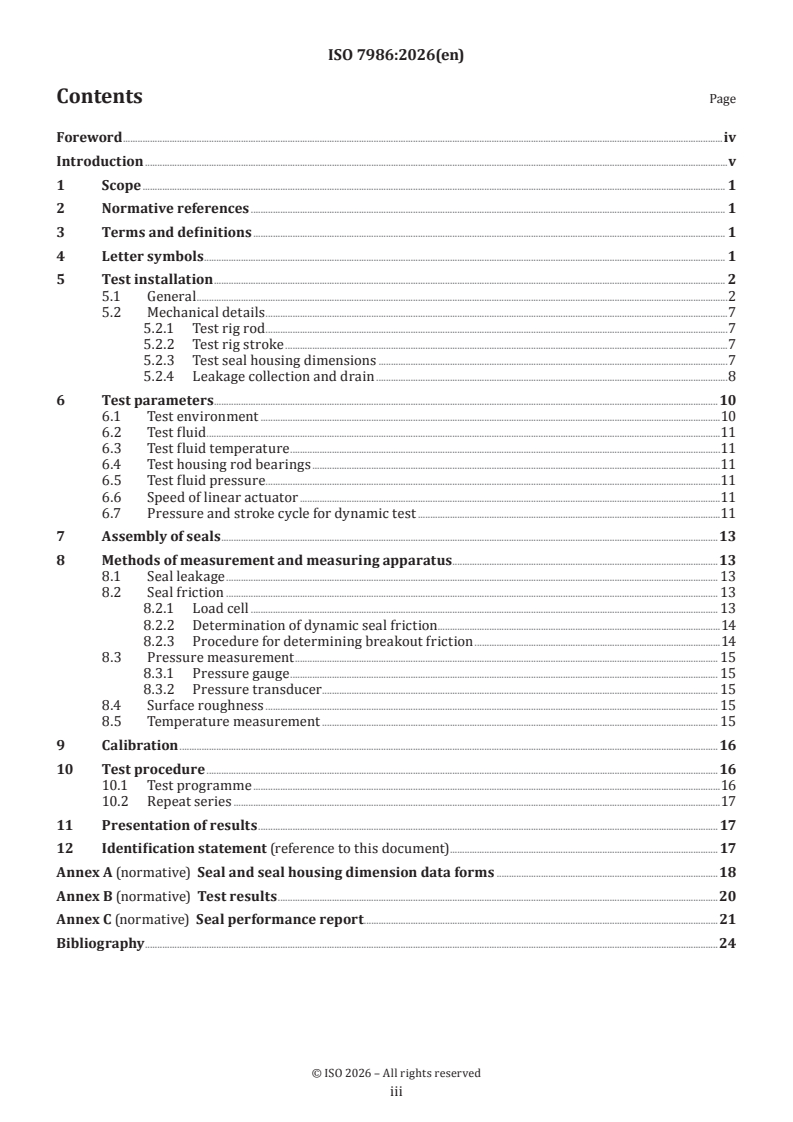
Contents Page
Foreword .iv
Introduction .v
1 Scope . 1
2 Normative references . 1
3 Terms and definitions . 1
4 Letter symbols . 1
5 Test installation . 2
5.1 General .2
5.2 Mechanical details .7
5.2.1 Test rig rod .7
5.2.2 Test rig stroke .7
5.2.3 Test seal housing dimensions .7
5.2.4 Leakage collection and drain .8
6 Test parameters . 10
6.1 Test environment .10
6.2 Test fluid .11
6.3 Test fluid temperature .11
6.4 Test housing rod bearings .11
6.5 Test fluid pressure.11
6.6 Speed of linear actuator .11
6.7 Pressure and stroke cycle for dynamic test .11
7 Assembly of seals .13
8 Methods of measurement and measuring apparatus .13
8.1 Seal leakage . 13
8.2 Seal friction . 13
8.2.1 Load cell . 13
8.2.2 Determination of dynamic seal friction.14
8.2.3 Procedure for determining breakout friction .14
8.3 Pressure measurement . 15
8.3.1 Pressure gauge . 15
8.3.2 Pressure transducer . 15
8.4 Surface roughness . 15
8.5 Temperature measurement . 15
9 Calibration .16
10 Test procedure .16
10.1 Test programme .16
10.2 Repeat series .17
11 Presentation of results . 17
12 Identification statement (reference to this document) . 17
Annex A (normative) Seal and seal housing dimension data forms .18
Annex B (normative) Test results .20
Annex C (normative) Seal performance report . .21
Bibliography .24
iii
Foreword
ISO (the International Organization for Standardization) is a worldwide federation of national standards
bodies (ISO member bodies). The work of preparing International Standards are normally carried out
through ISO technical committees. Each member body interested in a subject for which a technical
committee has been established has the right to be represented on that committee. International
organizations, governmental and non-governmental, in liaison with ISO, also take part in the work. ISO
collaborates closely with the International Electro-technical Commission (IEC) on all matters of electro-
technical standardization.
The procedures used to develop this document and those intended for its further maintenance are described
in the ISO/IEC Directives, Part 1. In particular, the different approval criteria needed for the different types
of ISO documents should be noted. This document is drafted in accordance with the editorial rules of the
ISO/IEC Directives, Part 2 (see www.iso.org/directives).
ISO draws attention to the possibility that the implementation of this document may involve the use of (a)
patent(s). ISO takes no position concerning the evidence, validity or applicability of any claimed patent
rights in respect thereof. As of the date of publication of this document, ISO had not received notice of (a)
patent(s) which may be required to implement this document. However, implementers are cautioned that
this may not represent the latest information, which may be obtained from the patent database available at
www.iso.org/patents. ISO shall not be held responsible for identifying any or all such patent rights.
Any trade name used in this document is information given for the convenience of users and does not
constitute an endorsement.
For an explanation on the voluntary nature of standards, the meaning of ISO specific terms and expressions
related to conformity assessment, as well as information about ISO's adherence to the World Trade
Organization (WTO) principles in the technical barriers to Trade (TBT), see www.iso.org/iso/foreword.html.
This document was prepared by Technical Committee ISO/TC 131, Fluid power systems, Subcommittee SC 7,
Sealing devices.
This second edition cancels and replaces the first edition (ISO 7986:1997), which has been technically
revised.
The main changes are as follows:
— change the reference documents for the surface roughness to the latest edition;
— change key names to be clear;
— change the minimum pressure at return stroke 3 MPa to 5 % of test pressure;
— add the cross-sectional view of Figure 3.
Any feedback or questions on this document should be directed to the user’s national standards body. A
complete listing of these bodies can be found at www.iso.org/members.html.
iv
Introduction
0.1 General
It is widely recognised that the results from reciprocating seal testing can be unpredictable. The background
research carried out in support of the preparation of document has demonstrated that this unpredictability
is primarily a function of lack of control of critical variables affecting seal installation and operation.
In order to carry out direct comparisons of seal performance, it is necessary to control these variables to
closer limits than may be normal in industrial practice. The major variables that can affect seal performance,
often even within normal manufacturing tolerance ranges, are listed in Clause 3.
0.2 Purpose
The purpose of the test is to provide comparative data on individual reciprocating rod seal designs and to
provide a basis for the preliminary selection of seals based upon their relative performance. To achieve this,
it is necessary to carry out the tests under strictly defined operating conditions. This document, therefore,
defines standard values of speed, pressure, temperature and surface finish. The resulting specified
characteristics are applicable to be published in manufacturer’s literature to enable a direct comparison of
seal performance.
The seal test is applicable to a single seal or a combination seal package.
To make the test results as useful as possible, a range of operating conditions has been provided so that the
most appropriate conditions can be selected as a basis for comparison for initial seal selection.
The pressures are standard working pressures, selected from ISO 2944:
— 6,3 MPa (63 bar);
— 16 MPa (160 bar);
— 31,5 MPa (315 bar).
The speeds have been selected to include slow speed (where stick-slip and high wear may be issues), medium
speed for general purpose hydraulics and a representative high speed.
The constraints on installation and operation in this procedure have been proved by research, primarily
carried out at BHR Group in the United Kingdom, under sponsorship from European companies and
1)
international round robin seal tests to be necessary to achieve repeatable results . Any departure from the
standard operating condition and installation criteria cannot be considered a standard test.
0.3 Factors affecting seal performance
a) Installation:
— sealing system, i.e. design of bearing(s), seal(s) and leakage collection seal;
— installation tolerances including seal groove, rod and bearings, extrusion gap;
— rod material and hardness;
— surface finish of the rod, variations of surface finish outside the range of Ra 0,08 µm to Ra 0,15 µm, or
greater than Rz 1,2 µm or greater than Rt 1,5 µm, can significantly affect seal performance. Different seal
materials also have significantly varying requirements for the optimum surface finish;
1) This research report is reported by the following.
— Performance Variation in Reciprocating Rubber Seals', R.K.Flitney and B.S.
Nau, Lubrication Engineering, VR44, 12, 993-1000, December 1988.
— Factors affecting Reciprocating Seal Performance', R.K.Flitney, 10th
International Conference on Fluid Power, BHR Group, April 1993.
v
— surface finish of the groove surfaces must be less than Ra 0,8 µm, or Rz 3,2 µm, to avoid static leakage
and wear of the seal during pressure cycles;
— bearing material including its effects on rod texture and boundary layer;
— assembly cleanliness;
b) Operation:
— fluid, i.e. viscosity, lubricity, compatibility with seal material including additives and contamination
level;
— pressure including pressure cycle;
— speed, especially speed cycle;
— speed/pressure cycle, i.e. stop-start conditions;
— stroke, especially short strokes (2 × the seal contact widths or less) which prevent formation of a lubricant
film;
— temperature, i.e. its effect on viscosity and seal material properties;
— external environment.
It is necessary to consider all the above factors and their potential effect on seal performance when
comparing potential seal performance in an actual application to results obtained from the standard test
vi
International Standard ISO 7986:2026(en)
Hydraulic fluid power — Sealing devices — Standard test
methods to assess the performance of rod seals used in oil
hydraulic reciprocating applications
1 Scope
This document defines the test conditions and methods for assessing the performance of seals used in oil
hydraulic reciprocating applications.
2 Normative references
The following documents are referred to in the text in such a way that some or all of their content constitutes
requirements of this document. For dated references, only the edition cited applies. For undated references,
the latest edition of the referenced document (including any amendments) applies.
ISO 286-2, Geometrical product specifications (GPS) — ISO code system for tolerances on linear sizes — Part 2:
Tables of standard tolerance classes and limit deviations for holes and shafts
ISO 683-2, Heat-treatable steels, alloy steels and free-cutting steels — Part 2: Alloy steels for quenching and
tempering
ISO 1629, Rubber and latices — Nomenclature
ISO 21920-2, Geometrical product specifications (GPS) — Surface texture: Profile — Part 2: Terms, definitions
and surface texture parameters
ISO 21920-3, Geometrical product specifications (GPS) — Surface texture: Profile — Part 3: Specification
operators
ISO 5598, Fluid power systems and components — Vocabulary
ISO 6743-4, Lubricants, industrial oils and related products (class L) — Classification — Part 4: Family H
(Hydraulic systems)
ISO 10766, Hydraulic fluid power — Cylinders — Housing dimensions for rectangular-section-cut bearing rings
for pistons and rods
3 Terms and definitions
For the purpose of this document, the terms and definitions given in ISO 5598 apply.
ISO and IEC maintain terminology databases for use in standardization at the following addresses:
— ISO Online browsing platform: available at https:// www .iso .org/ obp
— IEC Electropedia: available at https:// www .electropedia .org/
4 Letter symbols
Letter symbols used in this document are as follows:
Symbol Quantity Unit
d rod diameter mm
d relative level of intersection (see ISO 21920-2, ISO 21920-3)
c
d seal heel inside diameter mm
h
d seal lip inside diameter mm
l
D bore diameter (outside diameter of the seal housing) mm
E seal length mm
F friction force N
F the inherent total friction at mid-stroke of the test rig only (see 8.2.2.1) N
i
the mean mid-stroke value of forward stroke and return stroke friction forces of
F N
s
each seal under test
the sum of the friction at mid-stroke of the test rig for two test seals on the for-
F N
T
ward and return strokes
l leakage ml
L seal housing length mm
p return pressure (return stroke) MPa
...