

ISO 1029:1974
(Main)Coniferous sawn timber — Defects — Classification
General Information
- Abstract
Covers unplaned sawn timber and such surfaced to size or planed but without profiling. Related terms and definitions are specified in ISO 1031. Replaces R 1029 and is a trilingual edition.
- Status
- Published
- Publication Date
- 30-Nov-1974
- Technical Committee
- ISO/TC 218 - Timber
- Drafting Committee
- ISO/TC 218/WG 3 - Sawn and processed timber
- Current Stage
- 9093 - International Standard confirmed
- Start Date
- 17-Jan-2024
- Completion Date
- 29-Aug-2026

Overview
ISO 1029:1974 - "Coniferous sawn timber - Defects - Classification" is an international standard that defines a systematic classification of defects found in coniferous (softwood) sawn timber. It applies to unplaned sawn timber and timber surfaced to size or planed but without profiling. The standard is trilingual (English/French/Russian) and relies on terminology defined in ISO 1031. ISO 1029 replaces the earlier ISO Recommendation R 1029.
Key topics
The standard organizes timber defects into clear categories and sub‑types to support consistent inspection, grading and specification. Major defect groups covered include:
Knots
- Classification by shape (round, oval, splay/spike), position (face, edge, arris), mutual arrangement (scattered, clustered, branched) and degree of intergrowth (intergrown, partially intergrown, non‑adherent/dead).
- Condition of knots (sound, resinous, unsound, rotten; light vs dark resinous).
Shakes and checks
- Types (heart shakes, ring shakes, shrinkage checks) and their location (face, edge, end) and depth (shallow, deep, through).
Grain and structural irregularities
- Slope of grain, compression wood, pitch pockets and bark inclusions (one‑sided or through).
Fungal and colour defects
- Heartwood rot, mould, sapstain (blue stain and other sapstains) classified by colour, intensity and depth (surface, deep, hidden), and sap rot (hard/soft).
Insect damage
- Wormholes: shallow or deep, and by size (small, large).
Sawing and surface defects
- Saw marks, snaking (waviness), rough or fuzzy sawn surfaces.
Deformation (warp)
- Longitudinal and transverse warps including bow, spring (edge bow), cup and twist; simple and compound forms.
Applications
ISO 1029 is practical for:
- Timber mills and sawyers to classify and document defects at the point of production.
- Inspectors, graders and quality control teams for consistent grading, sorting and acceptance criteria in trade and procurement.
- Specification writers, engineers and architects who need accurate defect terminology for contract documents and structural assessments.
- Timber merchants and buyers to communicate quality and price differentials tied to defect types.
- Standards developers and testing bodies using a standardized taxonomy for reporting and comparative studies.
Using ISO 1029 helps reduce ambiguity in timber quality, supports consistent wood grading, and streamlines trade and specification processes for coniferous sawn timber.
Related standards
- ISO 1031 - Terms and definitions for sawn timber (reference for terminology used in ISO 1029).
- ISO 1029 replaces ISO Recommendation R 1029 (1969).
Get Certified
Connect with accredited certification bodies for this standard

Gozdarski inštitut Slovenije
Slovenian Forestry Institute. Forest management certification support, timber testing.
Sponsored listings
Frequently Asked Questions
ISO 1029:1974 is a standard published by the International Organization for Standardization (ISO). Its full title is "Coniferous sawn timber — Defects — Classification". This standard covers: Covers unplaned sawn timber and such surfaced to size or planed but without profiling. Related terms and definitions are specified in ISO 1031. Replaces R 1029 and is a trilingual edition.
Covers unplaned sawn timber and such surfaced to size or planed but without profiling. Related terms and definitions are specified in ISO 1031. Replaces R 1029 and is a trilingual edition.
ISO 1029:1974 is classified under the following ICS (International Classification for Standards) categories: 79.040 - Wood, sawlogs and sawn timber. The ICS classification helps identify the subject area and facilitates finding related standards.
ISO 1029:1974 is available in PDF format for immediate download after purchase. The document can be added to your cart and obtained through the secure checkout process. Digital delivery ensures instant access to the complete standard document.
Standards Content (Sample)
INTERNATIONAL STANDARD
NORME INTERNATIONALE
MEXAYHAPOflHbItti CTAHAAPT
INTERNATIONAL ORGANIZATION FOR STANDARDIZATION l MEXflYHAPO.qHAtI OPrAHM3AUMfl I-IO CTAHJAPTM3AUMM -ORGANISATION INTERNATIONALE DE NORMALISATION
Coniferous sawn timber - Defects - Classification
First edition - 1974-12-15
Sciages de bois rhineux - Defauts - Classification
Premiere Edition - 1974-12-15
~WIOMZlTepkWIbI XBOiiHbIX IIOpOa - ~OpOIckl - &IlW!@HKa~HH
IIepBoe wqaiwe - 1974-12-15
rte
UDC/CDU/YAK : 674.032 : 674.038.15.001.33 Ref. No./Rtif. No: ISO 1029-1974 (E/F/R)
&G
FF
8 I Ccbmca JVx HC0 1029-1974 (A/cr>/P)
Descriptors: wood, softwoods, structural timber, sawn timber, defects, classifying / Descripteurs: bois, bois tendre, bois de construction, bois sc%, defaut,
Fr
classement / AecKpmTopbI: ,qpeBecma,bm-Ka53 npesecma,crpomenbHax npesecma, rrmoMaTepzsanb1, nopo~a,~nacc~i@~~~posaa~e
ou
e
SS
Price based on 6 pages / Prix base sur 6 pages / IJeHa paccnmrrarra aa 6 CTII.
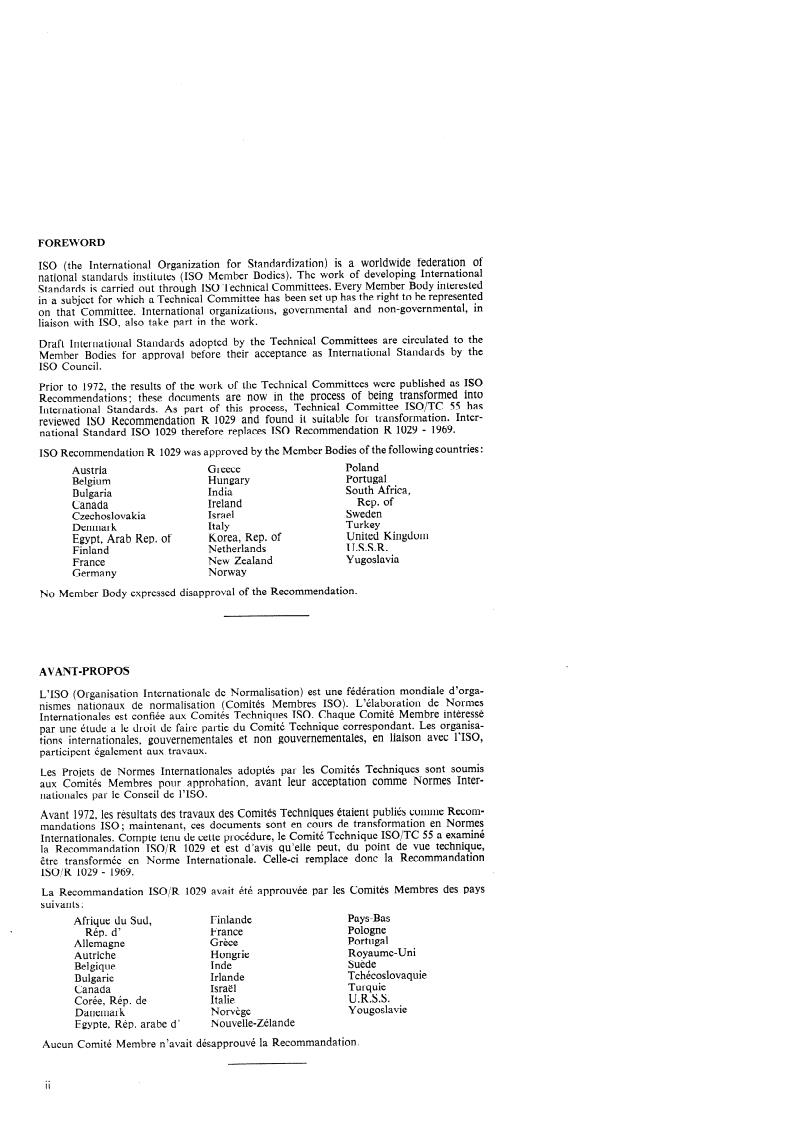
FOREWORD
ISO (the International Organization for Standardization) is a worldwide federation of
national Standards institutes (ISO Member Bodies). The work of developing International
Standards is carried out through ISO Technical Committees. Every Member Body interested
in a subject for which a Technical Committee has been set up has the right to be represented
on that Committee. International organizations, governmental and non-governmental, in
liaison with ISO, also take part in the work.
Draft International Standards adopted by the Technical Committees are circulated to the
Member Bodies for approval before their acceptance as International Standards by the
ISO Council.
Prior to 1972, the results of the work of the Technical Committees were published as ISO
Recommendations; these documents are now in the process of being transformed into
Technical Committee ISO/TC 55 has
International Standards. As part of this process,
reviewed ISO Recommendation R 1029 and found it suitable for transformation. Inter-
national Standard ISO 1029 therefore replaces ISO Recommendation R 1029 - 1969.
ISO Recommendation R 1029 was approved by the Member Bodies of the following countries:
Austria Greece Poland
Belgium Hungary Portugal
South Africa,
Bulgaria India
Canada Ireland Rep. of
Sweden
Czechoslovakia Israel
Denmark Italy Turkey
United Kingdom
Egypt, Arab Rep. of Korea, Rep. of
Netherlands U.S.S.R.
Finland
France New Zealand Y ugoslavia
Germany Norway
No Member Body expressed disapproval of the Recommendation.
AVANT-PROPOS
L ’ISO (Organisation Internationale de Normalisation) est une federation mondiale d ’orga-
nismes nationaux de normalisation (Comites Membres ISO). L ’elaboration de Normes
Internationales est confiee aux Comites Techniques ISO. Chaque Comite Membre interesse
par une etude a le droit de faire Partie du Comite Technique correspondant. Les organisa-
tions internationales, gouvernementales et non gouvernementales, en liaison avec I ’ISO,
participent egalement aux travaux.
Les Projets de Normes Internationales adoptes par les Comites Techniques sont soumis
aux Comites Membres pour approbation, avant leur acceptation comme Normes Inter-
nationales par ie Conseil de I ’ISO.
Avant 1972, les resultats des travaux des Comites Techniques etaient publies comme Recom-
mandations ISO; maintenant, ces documents sont en cours de transformation en Normes
Internationales. Compte tenu de cette procedure, le Comite Technique ISO/TC 55 a examine
la Recommandation ISO/R 1029 et est d ’avis quelle peut, du Point de vue technique,
etre transformee en Norme Internationale. Celle-ci remplace donc la Recommandation
ISOIR 1029 - 1969.
La Recommandation 1029 avait etc approuvee par les Comites Membres des pays
ISO/R
suivants :
Pays-Bas
Afrique du Sud, Finlande
Rep. d’ France Pologne
Allemagne Grete Portugal
Autriche Royaume-Uni
Hongrie
Belgique Inde Suede
Tchecoslovaquie
Bulgarie Irlande
Canada Israel Turquie
U.R.S.S.
Corde, Rep. de Italie
Danemark Norvege Y ougoslavie
Egypte, Rep. arabe d Nouvelle-Zelande
Aucun Comite Membre n ’avait desapprouve la Recommandation.
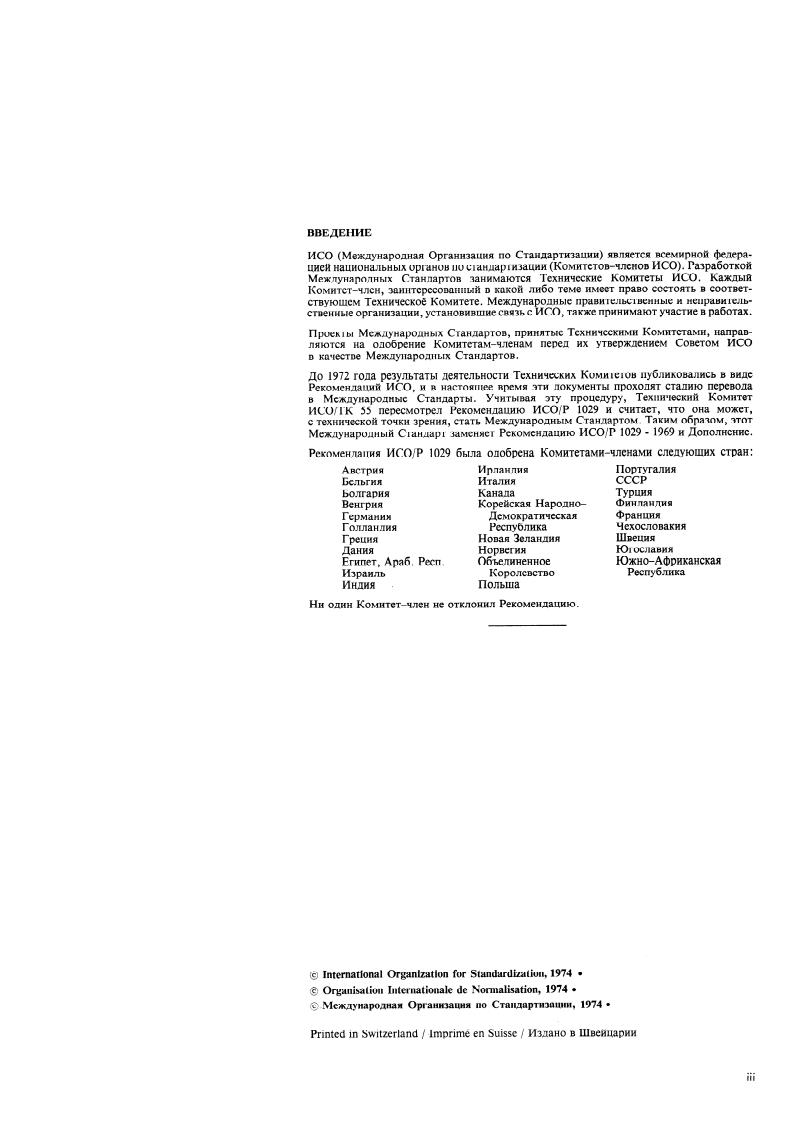
BBEAEHME
l?lCO (MeWlyHapOJWa5I OpraHmaIuiR no CTaH~apTH3aWiR) RBJIHeTC5I BCeMHpHOii @eAepa-
~~eijrHa~HOHa~bHbIXOpraHOB~OCTaH~apT~3a~~Yr(~OMkITeTOB-YJIeHOB~~~).~a3pa6OTKOii
MelKAyHapOAHbIX CTaHAapTOB 3aHklMaFOTCR TexI-UiYeCKEie KOMHTeTbI MCO. KaxAbI&i
KOMHTeT-WeH, 3aEiHTepeCOBaHHbIii B KaKofi-m6o TeMe HMeeT IIpaBO COCTORTb B COOTBeT-
CTByIOIUeM TexHWieCKOe KOMHTeTe. MeHcAyHapOAHbIe IIpaBHTeJIbCTBeHHbIe EI HeIIpaBHTeJIb-
CTBeHHbIeOpraHE13aq~kI,yCTaHOBEiBrrrMeCB~3bC~CO,TaK~enp~HHMa~Ty~aCTEIeBpa6oTax.
npOeKTb1 MelKAyHapOJ.JHbIX CTaHAapTOB, IIpkIHIITbIe TeXHWIeCKklMEI KOMFITeTaMkI, HaIIpaB-
JUIIOTC5I Ha oAo6peHne KOMEITeTaM-WeHaM l-IepeA HX YTBepWIeHEieM COBeTOM MC0
B KaYeCTBe MemAyHapOAHbIX CTaHAapTOB.
AO 1972 rOAa pe3yJlbTaTbI Ae5ITeJIbHOCTH TexHkiYeCKHX KOMIITeTOB rIy6nHKOBaJniCb B BHAe
PeKOMeHAaL&i nco, EI B HaCTOSfLWe BpeMR 3Tki AOKyMeHTbI l-IpOXOART CTaAFiIO IlepeBOAa
B MexAyHapOAHbIe CTaHAapTbI. YYHTbIBaR 3Ty IIpOLleAypy, TexHaneCKafi KOMEITeT
HCO/TK 55 nepecMoTpen PeKoMeHAauMIo l?iCO/P 1029 EI cYkl ’raeT, YTO oHa MoxeT,
CTeXHHYeCKOtiTOYKH 3peH&UI,CTaTb MexAyHapOAHbIM CTaHAapTOM.TaKIIM o6pa3oM,3TOT
MelKAyHapOAHbIti CTaHAapT 3aMeHfleT PeKOMeHAaLWO klco/P 1029 - 1969 EI $(OnOnHeHHe.
PeKoMeHAa4m lXO/P 1029 6bIna oao6peHa KoMmeTaMM-YJIeHami CneAymIWIx CTpaH:
ABCTPEIH rIopTyranm
k3[pJIaHAEiR
E;enbrm l4TaJIm CCCP
E;onrapm KaHaAa Typum
BeHrp%m KopeMcKaa HapOAHO- @HHJ-IaHAEirr.
l?epMaHm ~eMoKpaTEirecKafl QpaHLwR
rOJIJ-IaHAWl Pecny6mKa YexocnoBaKH5l
rpeum HoBaR 3enaHj?m ILIseI.Jm
K)rocnaBm
JJaHEIR Hopsenirr
ErkzneT, Apa6. Pecn. 06%eAaHeHHOe K)mO-Ad>pEIKaHCKaa
Pecrry6mKa
Mspamb KOpOJIeBCTBO
I/IHAMH . rIonbIua
HEI OAHH KOMaTeT-YJIeH He OTKJIOHEIJl PeKOMeHJJaIUiK,.
@ International Organization for Standardization, 1974 l
@ Organisation Internationale de Normalisation, 1974 l
@.h'kxAyHapOJJHaR o~I-aHH3aIJBiR I-IO CTaHJJaPTH32WH, 1974 l
Printed in Switzerland / ,Imprimk en Suisse / k!k%AaHo B W[sei%qapaa
This page intentionally left blank
INTERNATIONAL STANDARD
ISO 1029 - 1974 (E/F/R)
NORME INTERNATIONALE
MC0 1029 - 1974 (A/@/P)
MEX~YHAPO~HbI~ CTAHAAPT
Sciages de bois resineux - IIunoMaTepHanb~ xBoiisbIx nopoa -
Coniferous sawn timber -
Defects- Defauts - IIopoKa -
Classification ICnaccu@ircaqufl
Classification
1 OBJET ET DOMAINE D ’APPLICATION 1 yE.Rb kl OWIACTH IIPMMEHEHkIII
1 SCOPE AND FIELD OF APPLICATION
1.1 This International Standard specifies the inter- P. 1 La presente Norme Internationale etablit la 1.1 f-hCTOmIJEiii h!fex,qWipo~HbIii CTaH,&lpT yCTa-
HaBJIMBaeT MWK~YHaPOfiHYK) KJlaCCI4@4KaIJI3Kl
national classification of defects of coniferous classification internationale des defauts des
IIOPOKOB IIEiJIOMaTepkiUlOB XBOiiHbIX IIOpO,Q,
sawn timber, for which the terms and defini- sciages de bois resineux, dont les termes et
TepMHHbI II OIIpeJJeJIeHH5l KOTOpbIX IIpHBe~eHbI
tions are specified in ISO 103 1. definitions sont specifies dans I ’ISO 1031.
B l/ico 1031.
1.2 This International Standard covers unplaned 1.2 Cette Norme Internationale s ’applique aux
sciages de bois resineux non rabotes, ainsi 1.2 Mem~yHapo~HbIii CTaHaapT pZWIpOCTpa-
sawn timber and sawn timber surfaced to size
or planed but without profiling. qu ’aux bois scies calibres
...