

ISO 12480-5:2026
(Main)Cranes — Safe use — Part 5: Bridge and gantry cranes
- Abstract
This document establishes required practices for the safe use of bridge and gantry cranes. It is intended to be used in conjunction with ISO 12480-1. This document applies to the bridge and gantry cranes as defined in ISO 4306-1 and ISO 4306-5.
- Status
- Published
- Publication Date
- 11-Jun-2026
- Technical Committee
- ISO/TC 96/SC 9 - Bridge and gantry cranes
- Drafting Committee
- ISO/TC 96/SC 9 - Bridge and gantry cranes
- Current Stage
- 6060 - International Standard published
- Start Date
- 12-Jun-2026
- Due Date
- 23-Nov-2027
- Completion Date
- 12-Jun-2026
ISO 12480-5:2026 is an ISO standard for the safe use of bridge and gantry cranes. It specifies required practices for installation, operation, maintenance, inspection, condition monitoring and load-lifting attachment use, and it is intended to be used together with ISO 12480-1.
What does ISO 12480-5:2026 specify?
ISO 12480-5:2026 specifies safe-use practices for bridge and gantry cranes as defined in ISO 4306-1 and ISO 4306-5. The document is built around six clauses: Scope, Normative references, Terms and definitions, Crane activities, Maintenance, inspection and condition monitoring, and Load-lifting attachments applications.
In practice, that means the standard is aimed at day-to-day and planned work on these cranes, not at the crane design itself. It points users to ISO 12480-1 for the general safe-use framework and then adds bridge-and-gantry-crane-specific requirements.
What are the key requirements of ISO 12480-5:2026?
ISO 12480-5:2026 adds practical controls to the general safe-use rules in ISO 12480-1. The most important points are about who may work on the crane, how lifting is carried out, and how the crane is secured and monitored.
- Installation and relocation - Clause 4.1 requires safe working procedures, a safe working area, competent persons, and measures to prevent permanent deformation of structural parts such as the main girder. This matters because these operations involve high loads, temporary disassembly, and damage risk.
- Operation - Clause 4.2 requires container handling operations to wait until the container spreader twistlocks are fully locked or fully unlocked. It also requires only one control station to be operational when a crane has more than one, so operators do not issue conflicting commands.
- Thunderstorm precautions - Clause 4.3 requires outdoor crane use to stop during thunderstorms, prohibits the crew from walking on the crane, and requires the operator to remain in the cabin. This reduces exposure to lightning and unstable conditions.
- Maintenance, inspection and condition monitoring - Clause 5.1 ties these tasks to ISO 12480-1, ISO 12482 and ISO 9927-5, and requires measures against unexpected start-up and motion. It also calls for warning indications such as signs during the work, which helps protect maintenance personnel and nearby workers.
- Leaving the crane unattended - Clause 5.2 requires the crane and trolley to be parked in designated positions, the load-lifting attachment to be raised clear of the ground and surrounding equipment, and cabin controls to be set to the predefined positions in the instructions for use. Outdoor cranes and trolleys may also need to be anchored when out of service, and cableless transmitters must be stored in the designated location.
- Load-lifting attachments - Clause 6 requires the safe working load markings on attachments to remain visible and prohibits lowering the hook into a slack rope so the rope does not come out of the pulley groove. In practice, this is about keeping the attachment readable and preventing rope damage or loss of control.
What terms does ISO 12480-5:2026 define?
ISO 12480-5:2026 gives one explicit term and relies on related vocabulary from ISO 4306-1, ISO 4306-5 and ISO 12480-1.
- Relocation - transfer of a crane from one place to another, either dismantled or as a whole.
- Bridge and gantry cranes - the crane types covered by this part, identified through the ISO crane vocabulary standards.
- Container handling crane - a crane type singled out in the operation requirements because its spreader twistlocks must be confirmed before lifting.
- Control station - an operating position on the crane; where there is more than one, only one may be active at a time.
- Load-lifting attachment - the lifting accessory addressed in Clause 6, where marking visibility and safe rope engagement matter.
- Trolley - the moving unit associated with the crane that must be parked when the crane is left unattended.
Who uses ISO 12480-5:2026?
ISO 12480-5:2026 is used by crane operators, installation and relocation crews, maintenance and inspection personnel, supervisors, and safety or quality managers responsible for bridge and gantry cranes. It is also useful for buyers and site managers who need to specify safe-use rules for industrial plants, warehouses, yards, ports, terminals and other places that use these cranes.
Which standards are used with ISO 12480-5:2026?
ISO 12480-5:2026 is intended to be read with the following documents:
- ISO 12480-1:2024 - the general safe-use standard that provides the base requirements for installation, operation, maintenance, thunderstorm precautions and unattended crane conditions.
- ISO 4306-1 - general crane vocabulary used for the terms and definitions in this part.
- ISO 4306-5 - bridge and gantry crane vocabulary used for the terms and definitions in this part.
- ISO 9927-5 - inspection guidance for bridge and gantry cranes, including portal and semi-portal cranes and their supporting structures.
- ISO 12482 - monitoring for crane design working period, used with the maintenance, inspection and condition-monitoring requirements.
What does the ISO 12480-5:2026 document contain?
ISO 12480-5:2026 contains clause-based requirements for safe crane use, starting with general scope and references and then moving into crane activities, maintenance, and load-lifting attachments. It gives the working rules for installation and relocation, operating controls, thunderstorm response, unattended parking, and attachment handling.
The document also cross-references the general safe-use clauses in ISO 12480-1 and the inspection and monitoring documents used alongside it. For users, that means the standard is a practical operating reference for procedures, checks and control measures, not a design specification.
Frequently Asked Questions
ISO 12480-5:2026 is a standard published by the International Organization for Standardization (ISO). Its full title is "Cranes — Safe use — Part 5: Bridge and gantry cranes". This standard covers: This document establishes required practices for the safe use of bridge and gantry cranes. It is intended to be used in conjunction with ISO 12480-1. This document applies to the bridge and gantry cranes as defined in ISO 4306-1 and ISO 4306-5.
This document establishes required practices for the safe use of bridge and gantry cranes. It is intended to be used in conjunction with ISO 12480-1. This document applies to the bridge and gantry cranes as defined in ISO 4306-1 and ISO 4306-5.
ISO 12480-5:2026 is classified under the following ICS (International Classification for Standards) categories: 53.020.20 - Cranes. The ICS classification helps identify the subject area and facilitates finding related standards.
ISO 12480-5:2026 is available in PDF format for immediate download after purchase. The document can be added to your cart and obtained through the secure checkout process. Digital delivery ensures instant access to the complete standard document.
Standards Content (Sample)
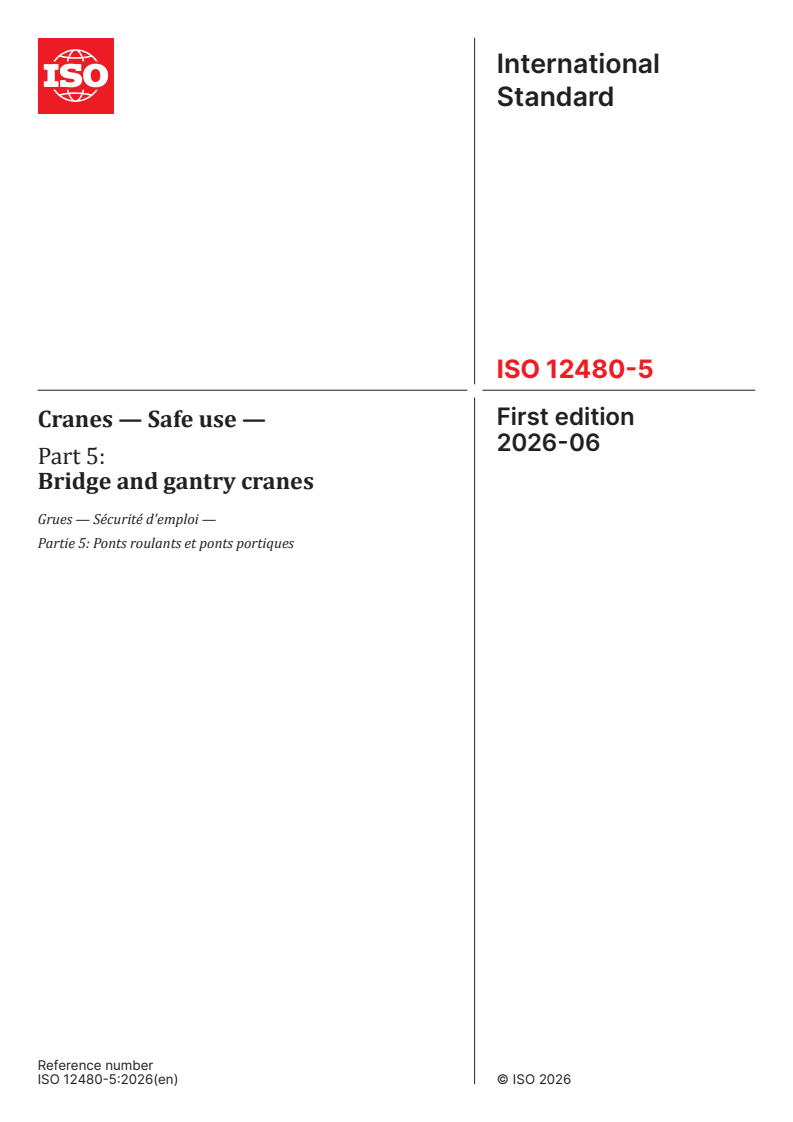
International
Standard
ISO 12480-5
First edition
Cranes — Safe use —
2026-06
Part 5:
Bridge and gantry cranes
Grues — Sécurité d'emploi —
Partie 5: Ponts roulants et ponts portiques
Reference number
© ISO 2026
All rights reserved. Unless otherwise specified, or required in the context of its implementation, no part of this publication may
be reproduced or utilized otherwise in any form or by any means, electronic or mechanical, including photocopying, or posting on
the internet or an intranet, without prior written permission. Permission can be requested from either ISO at the address below
or ISO’s member body in the country of the requester.
ISO copyright office
CP 401 • Ch. de Blandonnet 8
CH-1214 Vernier, Geneva
Phone: +41 22 749 01 11
Email: copyright@iso.org
Website: www.iso.org
Published in Switzerland
ii
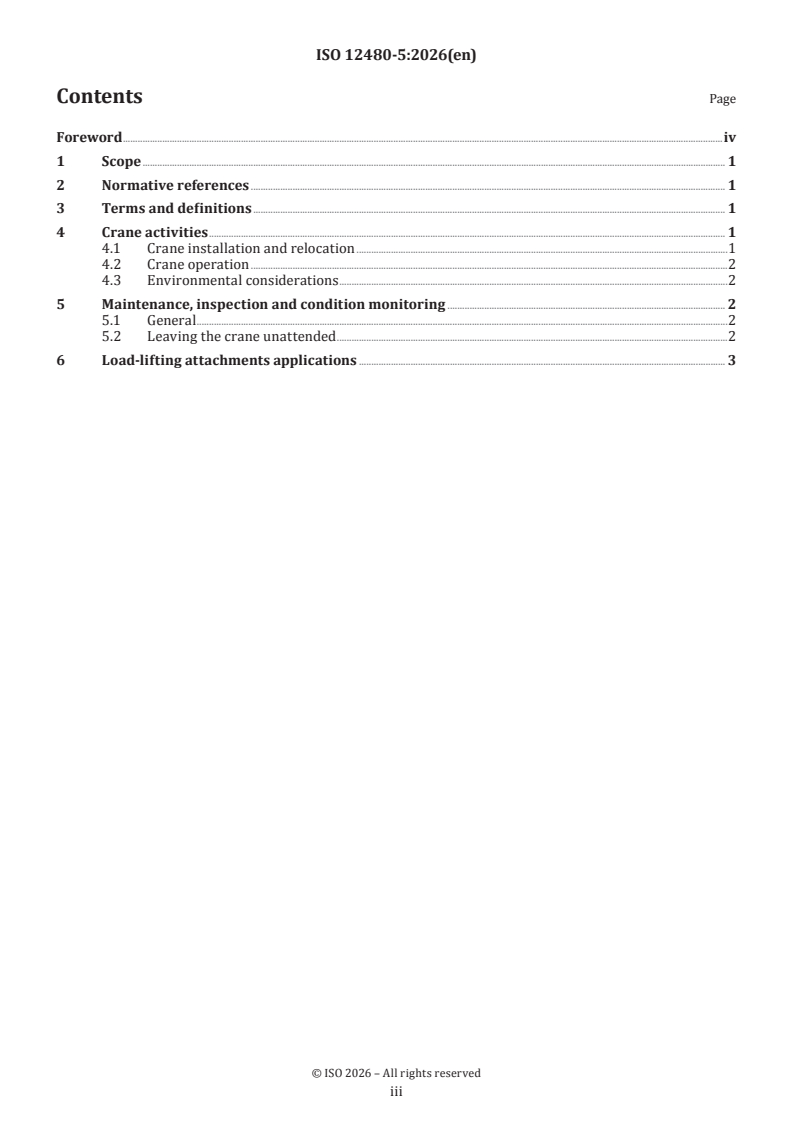
Contents Page
Foreword .iv
1 Scope . 1
2 Normative references . 1
3 Terms and definitions . 1
4 Crane activities . 1
4.1 Crane installation and relocation .1
4.2 Crane operation .2
4.3 Environmental considerations .2
5 Maintenance, inspection and condition monitoring . 2
5.1 General .2
5.2 Leaving the crane unattended .2
6 Load-lifting attachments applications . 3
iii
Foreword
ISO (the International Organization for Standardization) is a worldwide federation of national standards
bodies (ISO member bodies). The work of preparing International Standards is normally carried out through
ISO technical committees. Each member body interested in a subject for which a technical committee
has been established has the right to be represented on that committee. International organizations,
governmental and non-governmental, in liaison with ISO, also take part in the work. ISO collaborates closely
with the International Electrotechnical Commission (IEC) on all matters of electrotechnical standardization.
The procedures used to develop this document and those intended for its further maintenance are described
in the ISO/IEC Directives, Part 1. In particular, the different approval criteria needed for the different types
of ISO document should be noted. This document was drafted in accordance with the editorial rules of the
ISO/IEC Directives, Part 2 (see www.iso.org/directives).
ISO draws attention to the possibility that the implementation of this document may involve the use of (a)
patent(s). ISO takes no position concerning the evidence, validity or applicability of any claimed patent
rights in respect thereof. As of the date of publication of this document, ISO had not received notice of (a)
patent(s) which may be required to implement this document. However, implementers are cautioned that
this may not represent the latest information, which may be obtained from the patent database available at
www.iso.org/patents. ISO shall not be held responsible for identifying any or all such patent rights.
Any trade name used in this document is information given for the convenience of users and does not
constitute an endorsement.
For an explanation of the voluntary nature of standards, the meaning of ISO specific terms and expressions
relate
...