

ISO 10245-5:2026
(Main)Cranes — Limiting and indicating devices — Part 5: Bridge and gantry cranes
- Abstract
This document specifies the requirements for devices that either limit or indicate the loads, motions, performance and environment of bridge and gantry cranes. The general requirements for limiting and indicating devices for cranes are given in ISO 10245-1.
- Status
- Published
- Publication Date
- 27-Jul-2026
- Technical Committee
- ISO/TC 96/SC 9 - Bridge and gantry cranes
- Drafting Committee
- ISO/TC 96/SC 9 - Bridge and gantry cranes
- Current Stage
- 6060 - International Standard published
- Start Date
- 28-Jul-2026
- Due Date
- 16-Apr-2027
- Completion Date
- 28-Jul-2026

ISO 10245-5:2026 is an International Standard from ISO for bridge and gantry cranes. It specifies requirements for devices that limit or indicate loads, motions, performance and environment, and it is used together with ISO 10245-1 for the general crane requirements.
What does ISO 10245-5:2026 specify?
ISO 10245-5:2026 sets out how limiting and indicating devices are to be applied to bridge and gantry cranes. It covers the device requirements for loads, motion, performance and warnings, while the general requirements for all crane limiting and indicating devices are taken from ISO 10245-1.
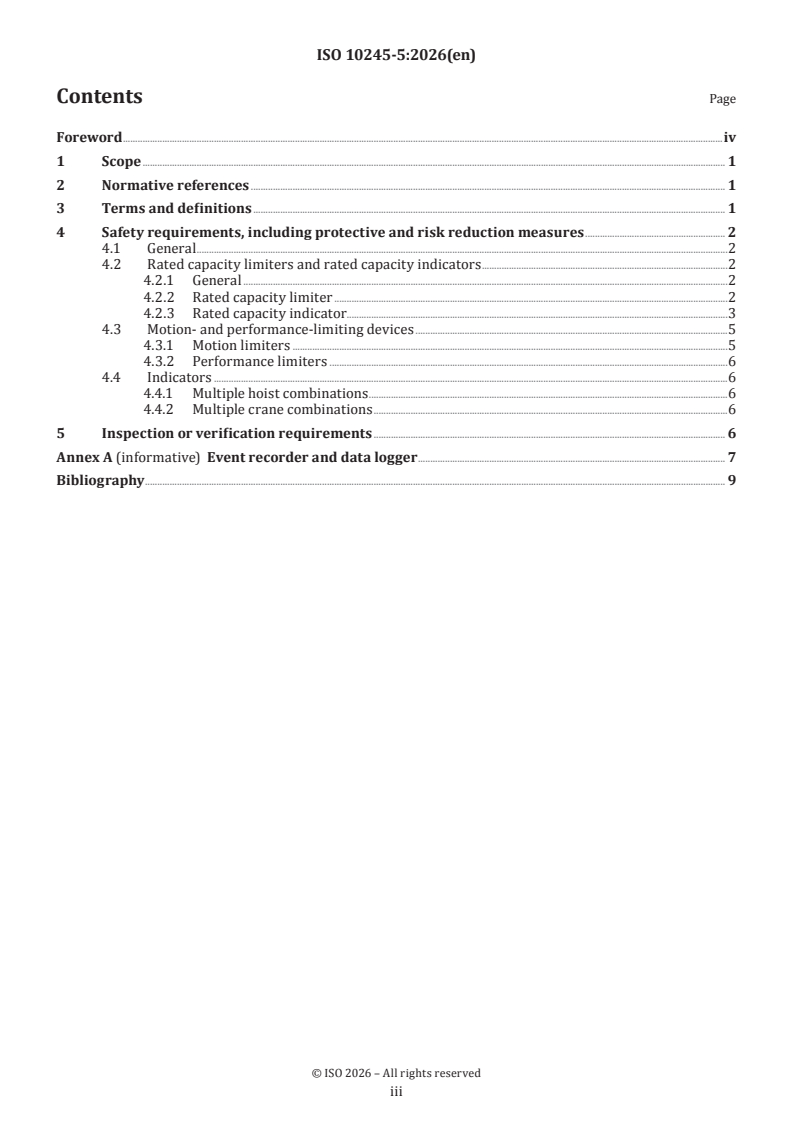
The document is organized into five clauses and one informative annex:
- Clause 1 Scope
- Clause 2 Normative references
- Clause 3 Terms and definitions
- Clause 4 Safety requirements, including protective and risk reduction measures
- Clause 5 Inspection or verification requirements
- Annex A - Event recorder and data logger
What are the key requirements of ISO 10245-5:2026?
Rated capacity control
ISO 10245-5:2026 requires rated capacity limiters to keep each lifting mechanism within its rated capacity. In practice, that means the crane control system must prevent overload, even when several hoists or lifting mechanisms are used together.
For cranes whose rated capacity changes with load position, the standard also requires a rated capacity indicator. This matters because the operator must be told when the allowed load has been reached or when the limiter has acted.
Motion and performance limiting
ISO 10245-5:2026 requires motion limiters for the crane motions listed in Table 1, with the exact combination depending on the motion and the crane speed. For example, the table distinguishes between slow down limiters, stop limiters, backup limiters and mechanical end stops, so the designer has to select the right mix for each motion.
The standard also covers high-risk applications and collision situations. It calls for anti-collision considerations where two cranes or crane parts may collide, and it requires extra care where one motion limiter must also stop other linked motions.
Performance limiters are to be provided according to the application, and vertical motions with variable speed control need overspeed detection. In practice, this means the crane must not rely only on the operator to avoid unsafe speed or movement.
Indicators and combined controls
ISO 10245-5:2026 requires visual indicators when multiple hoists can be selected and operated from one control device. The operator must be able to see which hoist or which crane has been selected, so the wrong unit is not moved by mistake.
Where several cranes are designed to work in combination, the same principle applies. If one limiting device is activated in a common-control arrangement, the resulting motion must stop for all linked cranes.
Inspection and optional recording
ISO 10245-5:2026 links inspection and verification to the manufacturer’s or supplier’s information for use. That gives users a clear reference for planning checks on limiting and indicating devices.
Annex A adds optional guidance on an event recorder and a data logger. This is useful where owners want recorded evidence of overloads, bypasses, configuration changes or maintenance-related data.
What terms does ISO 10245-5:2026 define?
- Mechanical end stop - a physical barrier that restricts the range of motion.
- Buffer - a shock-absorbing device that can be fitted to a mechanical end stop or the moving counterpart.
- Slow down limiter - a device that initiates speed reduction and limits the speed to the desired level.
- Stop limiter - a device that initiates stopping and motion limitation.
- Backup limiter - a limiter that acts only if the primary limiting means fail.
- High-risk application - an application where possible harm is more severe, for example because of chain reaction, thermal energy or hazardous substances.
- Event recorder - a device that monitors and records load-related and geometric data when defined events occur.
- Data logger - a device that records data automatically, including data beyond event-triggered records.
Who uses ISO 10245-5:2026?
ISO 10245-5:2026 is used by crane manufacturers, control-system designers, suppliers of limiting and indicating devices, inspection personnel, and crane owners or operators. It is especially relevant for bridge and gantry cranes in settings where load control, motion control, coordinated crane operation and recorded event data matter.
What changed in ISO 10245-5:2026 from the previous edition?
ISO 10245-5:2026 cancels and replaces ISO 10245-5:1995. The stated changes are:
- alignment with ISO 10245-1
- rearranged structure and headings to match ISO Guide 78 and ISO 10245-2, ISO 10245-3 and ISO 10245-4
- updated Figure 1 for clarification
- updated Table 1 for clarification
- added 4.4.1 and 4.4.2 on indicators for multiple hoists and multiple crane combinations
- added Clause 5 on inspection or verification
- added Annex A on event recorder and data logger
Which standards are used with ISO 10245-5:2026?
| Standard | What it contributes |
|---|---|
| ISO 10245-1:2021 | General requirements for limiting and indicating devices for cranes |
| ISO 4306-1 | General crane vocabulary |
| ISO 4306-5 | Vocabulary for bridge and gantry cranes |
| ISO 8686-1:2012 | Design principles for loads and load combinations, used in capacity-related provisions |
| IEC 60204-32:2023 | Signal and electrical equipment references used in notes and the annex |
| IEC 61310-1 | Requirements for visual, acoustic and tactile signals |
| IEC 62745:2017 | Coordinated control systems for linked crane motions |
| ISO 10245-2, ISO 10245-3, ISO 10245-4 | Companion parts covering mobile cranes, tower cranes and jib cranes |
What does the ISO 10245-5:2026 document contain?
The document includes a capacity-setting relationship in Clause 4.2.2.3, a selection table for motion limiters in Table 1, and examples of rated-capacity limitation in Figure 1. These parts are used when designing or checking how the crane reacts to overload, speed reduction, stopping and restricted movement.
It also contains practical requirements for warning signals, coordinated stopping of multiple hoists or cranes, and the reset behavior of backup limiters. Annex A gives optional guidance on event recorders and data loggers for recording operational and configuration data.
Relations
- Effective Date
- 20-Apr-2024
Frequently Asked Questions
ISO 10245-5:2026 is a standard published by the International Organization for Standardization (ISO). Its full title is "Cranes — Limiting and indicating devices — Part 5: Bridge and gantry cranes". This standard covers: This document specifies the requirements for devices that either limit or indicate the loads, motions, performance and environment of bridge and gantry cranes. The general requirements for limiting and indicating devices for cranes are given in ISO 10245-1.
This document specifies the requirements for devices that either limit or indicate the loads, motions, performance and environment of bridge and gantry cranes. The general requirements for limiting and indicating devices for cranes are given in ISO 10245-1.
ISO 10245-5:2026 is classified under the following ICS (International Classification for Standards) categories: 53.020.20 - Cranes. The ICS classification helps identify the subject area and facilitates finding related standards.
ISO 10245-5:2026 has the following relationships with other standards: It is inter standard links to ISO 10245-5:1995. Understanding these relationships helps ensure you are using the most current and applicable version of the standard.
ISO 10245-5:2026 is available in PDF format for immediate download after purchase. The document can be added to your cart and obtained through the secure checkout process. Digital delivery ensures instant access to the complete standard document.
Standards Content (Sample)
International
Standard
ISO 10245-5
Second edition
Cranes — Limiting and indicating
2026-07
devices —
Part 5:
Bridge and gantry cranes
Appareils de levage à charge suspendue — Limiteurs et
indicateurs —
Partie 5: Ponts roulants et portiques
Reference number
© ISO 2026
All rights reserved. Unless otherwise specified, or required in the context of its implementation, no part of this publication may
be reproduced or utilized otherwise in any form or by any means, electronic or mechanical, including photocopying, or posting on
the internet or an intranet, without prior written permission. Permission can be requested from either ISO at the address below
or ISO’s member body in the country of the requester.
ISO copyright office
CP 401 • Ch. de Blandonnet 8
CH-1214 Vernier, Geneva
Phone: +41 22 749 01 11
Email: copyright@iso.org
Website: www.iso.org
Published in Switzerland
ii
Contents Page
Foreword .iv
1 Scope . 1
2 Normative references . 1
3 Terms and definitions . 1
4 Safety requirements, including protective and risk reduction measures . 2
4.1 General .2
4.2 Rated capacity limiters and rated capacity indicators .2
4.2.1 General .2
4.2.2 Rated capacity limiter .2
4.2.3 Rated capacity indicator.3
4.3 Motion- and performance-limiting devices .5
4.3.1 Motion limiters .5
4.3.2 Performance limiters .6
4.4 Indicators .6
4.4.1 Multiple hoist combinations .6
4.4.2 Multiple crane combinations .6
5 Inspection or verification requirements . 6
Annex A (informative) Event recorder and data logger . 7
Bibliography . 9
iii
Foreword
ISO (the International Organization for Standardization) is a worldwide federation of national standards
bodies (ISO member bodies). The work of preparing International Standards is normally carried out through
ISO technical committees. Each member body interested in a subject for which a technical committee
has been established has the right to be represented on that committee. International organizations,
governmental and non-governmental, in liaison with ISO, also take part in the work. ISO collaborates closely
with the International Electrotechnical Commission (IEC) on all matters of electrotechnical standardization.
The procedures used to develop this document and those intended for its further maintenance are described
in the ISO/IEC Directives, Part 1. In particular, the different approval criteria needed for the different types
of ISO documents should be noted. This document was drafted in accordance with the editorial rules of the
ISO/IEC Directives, Part 2 (see www.iso.org/directives).
ISO draws attention to the possibility that the implementation of this document may involve the use of (a)
patent(s). ISO takes no position concerning the evidence, validity or applicability of any claimed patent
rights in respect thereof. As of the date of publication of this document, ISO had not received notice of (a)
patent(s) which may be required to implement this document. However, implementers are cautioned that
this may not represent the latest information, which may be obtained from the patent database available at
www.iso.org/patents. ISO shall not be held responsible for identifying any or all such patent rights.
Any trade name used in this document is information given for the convenience of users and does not
constitute an endorsement.
For an explanation of the voluntary nature of standards, the meaning of ISO specific terms and expressions
related to conformity assessment, as well as information about ISO's adherence to the World Trade
Organization (WTO) principles in the Technical Barriers to Trade (TBT), see www.iso.org/iso/foreword.html.
This document was prepared by Technical Committee ISO/TC 96, Cranes, Subcommittee SC 9, Bridge and
gantry cranes.
This second edition cancels and replaces the first edition (ISO 10245-5:1995), which has been technically
revised.
The main changes are as follows:
— this document has been updated to be consistent with ISO 10245-1;
— the document structure and headers have been rearranged to align with ISO Guide 78 and to be consistent
with ISO 10245-2, ISO 10245-3 and ISO 10245-4;
— Figure 1 has been updated to provide more clarification;
— Table 1 has been updated to provide more clarification;
— subclauses 4.4.1 and 4.4.2 have been added;
— Clause 5 has been added;
— Annex A has been added.
A list of all parts in the ISO 10245 series can be found on the ISO website.
Any feedback or questions on this document should be directed to the user’s national standards body. A
complete listing of these bodies can be found at www.iso.org/members.html.
iv
International Standard ISO 10245-5:2026(en)
Cranes — Limiting and indicating devices —
Part 5:
Bridge and gantry cranes
1 Scope
This document specifies the requirements for devices that either limit or indicate the loads, motions,
performance and environment of bridge and gantry cranes.
The general requirements for limiting and indicating devices for cranes are given in ISO 10245-1.
2 Normative references
The following documents are referred to in the text in such a way that some or all of their content constitutes
requirements of this document. For dated references, only the edition cited applies. For undated references,
the latest edition of the referenced document (including any amendments) applies.
ISO 4306-1, Cranes — Vocabulary — Part 1: General
ISO 4306-5, Cranes — Vocabulary — Part 5: Bridge and gantry cranes
ISO 8686-1:2012, Cranes — Design principles for loads and load combinations — Part 1: General
ISO 10245-1:2021, Cranes — Limiting and indicating devices — Part 1: General
3 Terms and definitions
For the purposes of this document, the definitions given in ISO 4306-1, ISO 4306-5 and ISO 10245-1 apply.
ISO and IEC maintain terminology databases for use in standardization at the following addresses:
— ISO Online browsing platform: available at https:// www .iso .org/ obp
— IEC Electropedia: available at https:// www .electropedia .org/
3.1
mechanical end stop
physical barrier to restrict the range of motion
3.2
buffer
shock-absorbing device
Note 1 to entry: A buffer can be attached to a mechanical end stop (3.1) or a moving counterpart or both.
[SOURCE: ISO 4306-1:2026, 8.1.3, modified —Note 1 to entry has been added.]
3.3
slow down limiter
device used to initiate the speed reduction and limit the speed to the desired level
Note 1 to entry: Slow down limiter can consist of either a physical device or a programmable function.
3.4
stop limiter
device used to initiate motion stop and motion limitation
Note 1 to entry: Stop limiter can consist of either a physical device or a programmable function.
3.5
backup limiter
limiter that is only activated if other (primary) limiting means fail to operate as intended
3.6
high-risk application
application with increased severity of possible harm
Note 1 to entry: Increased severity of possible harm can be due to, among other things, danger to cause a chain
reaction, release of a large amount of thermal energy, or release of hazardous substances. See ISO 8686-1.
4 Safety requirements, including protective and risk reduction measures
4.1 General
The general requirements of limiters and indicators for bridge and gantry cranes shall be in accordance
with ISO 10245-1. Activating one rated capacity, motion or performance limiter shall have the same effect on
all corresponding movements controlled simultaneously from the same control station.
NOTE Annex A provides additional information on event recorders and data loggers.
4.2 Rated capacity limiters and rated capacity indicators
4.2.1 General
Limiting and indicating devices are applicable to loads, motions and performance and shall be in accordance
with ISO 10245-1.
4.2.2 Rated capacity limiter
4.2.2.1 The rated capacity limiter shall ensure that the load of each lifting mechanism shall not exceed its
rated capacity.
4.2.2.2 The rated capacity limiter shall allow the rated load and lifting devices to be accelerated upwards
with the design mean acceleration. Where necessary, implement a method for the limiter to prevent it from
sensing dynamic effects during operation.
ISO 10245-5
...