


ISO 15590-1:2024
(Main)Oil and gas industries including lower carbon energy - Factory bends, fittings and flanges for pipeline transportation systems - Part 1: Induction bends
Oil and gas industries including lower carbon energy - Factory bends, fittings and flanges for pipeline transportation systems - Part 1: Induction bends
This document specifies the technical delivery conditions for bends made by the induction bending process for use in pipeline transportation systems for the petroleum and natural gas industries as defined in ISO 13623. This document is applicable to induction bends made from seamless and welded pipe of unalloyed or low-alloy steels. NOTE These are typically C-Mn steels or low-alloy steels that are appropriate for the corresponding level and grade of line pipe in accordance with ISO 3183. This document specifies the requirements for the manufacture of two product specification levels (PSLs) of induction bends corresponding to product specification levels given for pipe in ISO 3183. This document is not applicable to the selection of the induction bend PSL. This document is not applicable to pipeline bends made by other manufacturing processes.
Industries du pétrole et du gaz, y compris les énergies à faible teneur en carbone — Coudes d'usine, raccords et brides pour systèmes de transport par conduites — Partie 1: Coudes fabriqués par induction
Le présent document spécifie les conditions techniques de livraison des coudes fabriqués par le procédé de cintrage par induction et destinés aux systèmes de transport par conduites des industries du pétrole et du gaz naturel définis dans l'ISO 13623. Le présent document est applicable aux coudes cintrés par induction, fabriqués à partir de tubes soudés et non soudés, en aciers non alliés ou faiblement alliés. NOTE Il s'agit généralement d'aciers C-Mn ou d'aciers faiblement alliés adaptés au niveau et à la nuance correspondant au tube de conduite, conformément à l'ISO 3183. Le présent document spécifie les exigences de fabrication de deux niveaux de spécification de produit (PSL) des coudes cintrés par induction, correspondant aux niveaux de spécification indiqués pour les tubes dans l'ISO 3183. Le présent document n'est pas applicable à la sélection du niveau de spécification des produits (PSL) cintrés par induction. Le présent document n'est pas applicable aux coudes de conduites fabriqués par d'autres procédés.
General Information
Relations
Overview
ISO 15590-1:2024 - "Oil and gas industries including lower carbon energy - Factory bends, fittings and flanges for pipeline transportation systems - Part 1: Induction bends" specifies technical delivery conditions for induction bends used in pipeline transportation systems for petroleum and natural gas industries (as defined in ISO 13623). It applies to bends manufactured by the induction bending process from seamless or welded unalloyed or low-alloy steels (typically C‑Mn and line‑pipe compatible grades per ISO 3183). The standard defines requirements for two product specification levels (PSLs) corresponding to those in ISO 3183, but it does not prescribe PSL selection and does not cover bends made by other manufacturing processes.
Key topics and technical requirements
Manufacturing controls
- Requirements for the mother pipe, qualification test bends and production bending.
- Post-bending heat treatment, forming/sizing, end preparation and welds (strip/plate end welds, jointers and girth welds).
- Normative Manufacturing Procedure Specification (MPS) in Annex A.
Testing and inspection
- Chemical composition and mechanical testing (tensile testing, Charpy V‑notch impact tests).
- Hardness testing (through‑thickness and surface), metallographic examination and CTOD where required.
- Mechanical integrity checks: guided bend tests, flattening tests and retesting provisions.
- Non-destructive testing (NDT): visual inspection, magnetic particle or liquid‑penetrant testing, ultrasonic testing, weld seam testing and control of residual magnetism.
- Hydrostatic testing, dimensional gauging and inspection documentation requirements.
Classification & controls
- Two PSLs aligned to ISO 3183 requirements.
- Classification of induction bending into local heating and global heating processes depending on steel grade (new in this edition).
- Additional provisions added for sampling from the bend neutral axis, delaminated test pieces and NDT conditions related to copper contamination.
Practical applications
- Use for specifying, manufacturing, inspecting and accepting factory-made induction bends for onshore and offshore pipeline systems.
- Ensures consistent mechanical performance, material traceability and NDT integrity for pipeline bends used in crude oil, natural gas and lower‑carbon energy transport systems.
Who should use this standard
- Pipeline designers and engineers specifying bend components.
- Manufacturers and fabricators of induction bends and fittings.
- Quality assurance / NDT inspectors and test laboratories.
- Procurement teams, project owners and pipeline operators requiring compliant components.
Related standards
- ISO 3183 - Steel pipe for pipeline transportation systems (PSLs)
- ISO 13623 - Pipeline transportation systems in the petroleum and natural gas industries
- Mechanical and test standards cited (ISO 6892, ISO 148‑1, ISO 6507/6508, ISO 7438, etc.)
Keywords: ISO 15590-1:2024, induction bends, pipeline transportation systems, factory bends, oil and gas, ISO 3183, PSL, NDT, Charpy, tensile testing.
Frequently Asked Questions
ISO 15590-1:2024 is a standard published by the International Organization for Standardization (ISO). Its full title is "Oil and gas industries including lower carbon energy - Factory bends, fittings and flanges for pipeline transportation systems - Part 1: Induction bends". This standard covers: This document specifies the technical delivery conditions for bends made by the induction bending process for use in pipeline transportation systems for the petroleum and natural gas industries as defined in ISO 13623. This document is applicable to induction bends made from seamless and welded pipe of unalloyed or low-alloy steels. NOTE These are typically C-Mn steels or low-alloy steels that are appropriate for the corresponding level and grade of line pipe in accordance with ISO 3183. This document specifies the requirements for the manufacture of two product specification levels (PSLs) of induction bends corresponding to product specification levels given for pipe in ISO 3183. This document is not applicable to the selection of the induction bend PSL. This document is not applicable to pipeline bends made by other manufacturing processes.
This document specifies the technical delivery conditions for bends made by the induction bending process for use in pipeline transportation systems for the petroleum and natural gas industries as defined in ISO 13623. This document is applicable to induction bends made from seamless and welded pipe of unalloyed or low-alloy steels. NOTE These are typically C-Mn steels or low-alloy steels that are appropriate for the corresponding level and grade of line pipe in accordance with ISO 3183. This document specifies the requirements for the manufacture of two product specification levels (PSLs) of induction bends corresponding to product specification levels given for pipe in ISO 3183. This document is not applicable to the selection of the induction bend PSL. This document is not applicable to pipeline bends made by other manufacturing processes.
ISO 15590-1:2024 is classified under the following ICS (International Classification for Standards) categories: 75.200 - Petroleum products and natural gas handling equipment. The ICS classification helps identify the subject area and facilitates finding related standards.
ISO 15590-1:2024 has the following relationships with other standards: It is inter standard links to ISO 15590-1:2018. Understanding these relationships helps ensure you are using the most current and applicable version of the standard.
You can purchase ISO 15590-1:2024 directly from iTeh Standards. The document is available in PDF format and is delivered instantly after payment. Add the standard to your cart and complete the secure checkout process. iTeh Standards is an authorized distributor of ISO standards.
Standards Content (Sample)
International
Standard
ISO 15590-1
Fourth edition
Oil and gas industries including
2024-07
lower carbon energy — Factory
bends, fittings and flanges for
pipeline transportation systems —
Part 1:
Induction bends
Industries du pétrole et du gaz, y compris les énergies à faible
teneur en carbone — Coudes d'usine, raccords et brides pour
systèmes de transport par conduites —
Partie 1: Coudes fabriqués par induction
Reference number
© ISO 2024
All rights reserved. Unless otherwise specified, or required in the context of its implementation, no part of this publication may
be reproduced or utilized otherwise in any form or by any means, electronic or mechanical, including photocopying, or posting on
the internet or an intranet, without prior written permission. Permission can be requested from either ISO at the address below
or ISO’s member body in the country of the requester.
ISO copyright office
CP 401 • Ch. de Blandonnet 8
CH-1214 Vernier, Geneva
Phone: +41 22 749 01 11
Email: copyright@iso.org
Website: www.iso.org
Published in Switzerland
ii
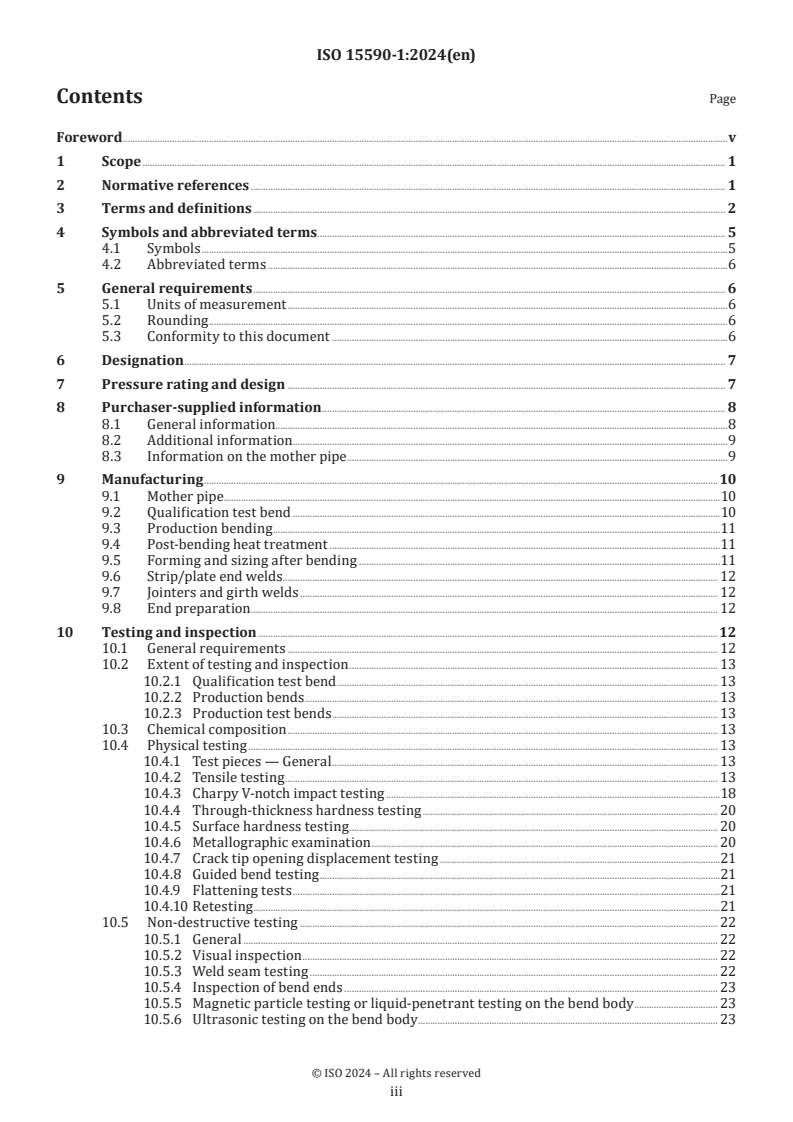
Contents Page
Foreword .v
1 Scope . 1
2 Normative references . 1
3 Terms and definitions . 2
4 Symbols and abbreviated terms. 5
4.1 Symbols .5
4.2 Abbreviated terms .6
5 General requirements . 6
5.1 Units of measurement .6
5.2 Rounding .6
5.3 Conformity to this document .6
6 Designation . 7
7 Pressure rating and design . 7
8 Purchaser-supplied information . 8
8.1 General information.8
8.2 Additional information.9
8.3 Information on the mother pipe . .9
9 Manufacturing . 10
9.1 Mother pipe.10
9.2 Qualification test bend .10
9.3 Production bending .11
9.4 Post-bending heat treatment .11
9.5 Forming and sizing after bending .11
9.6 Strip/plate end welds . 12
9.7 Jointers and girth welds . 12
9.8 End preparation . . 12
10 Testing and inspection .12
10.1 General requirements . 12
10.2 Extent of testing and inspection . 13
10.2.1 Qualification test bend . 13
10.2.2 Production bends . 13
10.2.3 Production test bends . 13
10.3 Chemical composition . 13
10.4 Physical testing . 13
10.4.1 Test pieces — General . 13
10.4.2 Tensile testing . 13
10.4.3 Charpy V-notch impact testing .18
10.4.4 Through-thickness hardness testing . 20
10.4.5 Surface hardness testing . 20
10.4.6 Metallographic examination . 20
10.4.7 Crack tip opening displacement testing .21
10.4.8 Guided bend testing .21
10.4.9 Flattening tests .21
10.4.10 Retesting .21
10.5 Non-destructive testing . 22
10.5.1 General . 22
10.5.2 Visual inspection . 22
10.5.3 Weld seam testing . 22
10.5.4 Inspection of bend ends . 23
10.5.5 Magnetic particle testing or liquid-penetrant testing on the bend body . 23
10.5.6 Ultrasonic testing on the bend body . 23
iii
10.5.7 Level of residual magnetism . 23
10.5.8 Repairs . 23
10.5.9 NDT personnel . 23
10.6 Dimensions . 23
10.7 Gauging . 28
10.8 Hydrostatic testing . 28
11 Inspection document .28
12 Marking . .28
Annex A (normative) Manufacturing procedure specification (MPS) .29
Annex B (normative) PSL 2S bends ordered for sour service .31
Bibliography .35
iv
Foreword
ISO (the International Organization for Standardization) is a worldwide federation of national standards
bodies (ISO member bodies). The work of preparing International Standards is normally carried out through
ISO technical committees. Each member body interested in a subject for which a technical committee
has been established has the right to be represented on that committee. International organizations,
governmental and non-governmental, in liaison with ISO, also take part in the work. ISO collaborates closely
with the International Electrotechnical Commission (IEC) on all matters of electrotechnical standardization.
The procedures used to develop this document and those intended for its further maintenance are described
in the ISO/IEC Directives, Part 1. In particular, the different approval criteria needed for the different types
of ISO document should be noted. This document was drafted in accordance with the editorial rules of the
ISO/IEC Directives, Part 2 (see www.iso.org/directives).
ISO draws attention to the possibility that the implementation of this document may involve the use of (a)
patent(s). ISO takes no position concerning the evidence, validity or applicability of any claimed patent
rights in respect thereof. As of the date of publication of this document, ISO had not received notice of (a)
patent(s) which may be required to implement this document. However, implementers are cautioned that
this may not represent the latest information, which may be obtained from the patent database available at
www.iso.org/patents. ISO shall not be held responsible for identifying any or all such patent rights.
Any trade name used in this document is information given for the convenience of users and does not
constitute an endorsement.
For an explanation of the voluntary nature of standards, the meaning of ISO specific terms and expressions
related to conformity assessment, as well as information about ISO's adherence to the World Trade
Organization (WTO) principles in the Technical Barriers to Trade (TBT), see www.iso.org/iso/foreword.html.
This document was prepared by Technical Committee ISO/TC 67, Oil and gas industries including lower carbon
energy, Subcommittee SC 2, Pipeline transportation systems.
This fourth edition cancels and replaces the third edition (ISO 15590-1:2018), which has been technically
revised.
The main changes are as follows:
— changed the title to be consistent with the new title of ISO/TC 67 in response to the green and lower
carbon development;
— classified the induction bending process into local heating process and global heating process according
to the steel grade;
— removed the testing requirements of welds in transition zone;
— added a testing requirement for extracting samples from the bend neutral axis base metal;
— added the delaminated test pieces with reduced thickness for tensile testing;
— added requirements for retesting;
— added an additional condition for non-destructive testing in regards of copper pollution.
A list of all parts in the ISO 15590 series can be found on the ISO website.
Any feedback or questions on this document should be directed to the user’s national standards body. A
complete listing of these bodies can be found at www.iso.org/members.html.
v
International Standard ISO 15590-1:2024(en)
Oil and gas industries including lower carbon energy —
Factory bends, fittings and flanges for pipeline transportation
systems —
Part 1:
Induction bends
1 Scope
This document specifies the technical delivery conditions for bends made by the induction bending process
for use in pipeline transportation systems for the petroleum and natural gas industries as defined in
ISO 13623.
This document is applicable to induction bends made from seamless and welded pipe of unalloyed or low-
alloy steels.
NOTE These are typically C-Mn steels or low-alloy steels that are appropriate for the corresponding level and
grade of line pipe in accordance with ISO 3183.
This document specifies the requirements for the manufacture of two product specification levels (PSLs) of
induction bends corresponding to product specification levels given for pipe in ISO 3183.
This document is not applicable to the selection of the induction bend PSL.
This document is not applicable to pipeline bends made by other manufacturing processes.
2 Normative references
The following documents are referred to in the text in such a way that some or all of their content constitutes
requirements of this document. For dated references, only the edition cited applies. For undated references,
the latest edition of the referenced document (including any amendments) applies.
ISO 80000-1:2022, Quantities and units — Part 1: General
ISO 148-1, Metallic materials — Charpy pendulum impact test — Part 1: Test method
ISO 3183, Petroleum and natural gas industries — Steel pipe for pipeline transportation systems
ISO 6507 (all parts), Metallic materials — Vickers hardness test
ISO 6508 (all parts), Metallic materials — Rockwell hardness test
ISO 6892-1, Metallic materials — Tensile testing — Part 1: Method of test at room temperature
ISO 6892-2, Metallic materials — Tensile testing — Part 2: Method of test at elevated temperature
ISO 7438, Metallic materials — Bend test
ISO 7539-2, Corrosion of metals and alloys — Stress corrosion testing — Part 2: Preparation and use of bent-
beam specimens
ISO 8501-1, Preparation of steel substrates before application of paints and related products — Visual
assessment of surface cleanliness — Part 1: Rust grades and preparation grades of uncoated steel substrates and
of steel substrates after overall removal of previous coatings
ISO 10474, Steel and steel products — Inspection documents
ISO 10893-4, Non-destructive testing of steel tubes — Part 4: Liquid penetrant inspection of seamless and
welded steel tubes for the detection of surface imperfections
ISO 10893-5, Non-destructive testing of steel tubes — Part 5: Magnetic particle inspection of seamless and
welded ferromagnetic steel tubes for the detection of surface imperfections
ISO 10893-8, Non-destructive testing of steel tubes — Part 8: Automated ultrasonic testing of seamless and
welded steel tubes for the detection of laminar imperfections
ISO 10893-9, Non-destructive testing of steel tubes — Part 9: Automated ultrasonic testing for the detection of
laminar imperfections in strip/plate used for the manufacture of welded steel tubes
ISO 10893-10:2011, Non-destructive testing of steel tubes — Part 10: Automated full peripheral ultrasonic
testing of seamless and welded (except submerged arc-welded) steel tubes for the detection of longitudinal and/
or transverse imperfections
ISO 10893-11:2011, Non-destructive testing of steel tubes — Part 11: Automated ultrasonic testing of the weld
seam of welded steel tubes for the detection of longitudinal and/or transverse imperfections
ISO 13623, Petroleum and natural gas industries — Pipeline transportation systems
ISO 17640, Non-destructive testing of welds — Ultrasonic testing — Techniques, testing levels, and assessment
ASTM E112, Standard Test Methods for Determining Average Grain Size
ASTM E214, Standard Practice for Ultrasonic Pulse-Echo Straight-Beam Contact Testing
ASTM E340, Standard Test Method for Macroetching Metals and Alloys
ASTM E797, Standard Practice for Measuring Thickness by Manual Ultrasonic Pulse-Echo Contact Method
NACE TM0177: 2016, Standard Test Method — Laboratory Testing of Metals for Resistance to Sulfide Stress
Cracking and Stress Corrosion Cracking in H S Environments
NACE TM0284: 2016, Test Method — Evaluation of Pipeline and Pressure Vessel Steels for Resistance to
Hydrogen-Induced Cracking
3 Terms and definitions
For the purposes of this document, the following terms and definitions apply.
ISO and IEC maintain terminology databases for use in standardization at the following addresses:
— ISO Online browsing platform: available at https:// www .iso .org/ obp
— IEC Electropedia: available at https:// www .electropedia .org/
3.1
arc
curved portion of a bend
3.2
bend angle
amount of directional change through the bend
3.3
bend qualification test
BQT
qualification test that produces a bend in accordance with the MPS (3.20) and demonstrates that bends that
meet the specified requirements can be produced
Note 1 to entry: Clause 10 specifies requirements for bends.
3.4
bend radius
distance from the centre of curvature to the centreline axis of the bent pipe
3.5
by agreement
agreed between the manufacturer (3.19) and the purchaser (3.23)
[SOURCE: ISO 15590-2:2021, 3.1]
3.6
chord
line segment connecting start and stop points of the bend zone measured at the centreline axis
3.7
defect
imperfection (3.12) of a size and/or population density greater than the specified acceptance criteria
Note 1 to entry: 10.5 and Clause B.7 specify the acceptance criteria.
3.8
extrados
outer curved section of the bend arc (3.1)
3.9
global heating technology
induction bending (3.14) process in which the entire bend including arc (3.1) and tangent (3.27) sections is
pushed through the induction heating coil and heated to the full bending temperature
3.10
heat
batch of steel prepared in one steel-making operation
3.11
if agreed
as prescribed, or more stringent than is prescribed, if achieved consensus by the manufacturer (3.19) and
the purchaser (3.23) and specified in the purchase order
[SOURCE: ISO 24139-2:2023, 3.1.5]
3.12
imperfection
discontinuity or irregularity in the product wall or on the product surface that is detectable by inspection
(3.15) methods outlined in this document
3.13
indication
evidence obtained by non-destructive inspection (3.22)
3.14
induction bending
continuous bending process that utilizes induction heating to create a narrow, circumferential, heated band
around the material being bent
3.15
inspection
activities, such as measuring, examining, testing, weighing or gauging one or more characteristics of a
product and comparing the results of such activities with the specified requirements in order to determine
conformity
3.16
intrados
inner curved section of the bend arc (3.1)
3.17
lamination
internal metal separation that creates layers, generally parallel to the pipe/bend surface
3.18
local heating technology
induction bending (3.14) process in which only the arc (3.1) of a bend is pushed through the induction heating
coil and heated to the full bending temperature
3.19
manufacturer
firm, company, or corporation responsible for making and marking the product in accordance with the
specified requirements
Note 1 to entry: Clauses 9 and 10 specify requirements for manufacturers.
3.20
manufacturing procedure specification
MPS
document that specifies the properties and description of the mother pipe (3.21), the bending procedure, the
post-bending heat treatment equipment and cycle (if needed), the qualification bend testing results, the non-
destructive testing procedures and the weld end bevel details used for the manufacture of the bends
3.21
mother pipe
straight section of pipe from which an induction bend is made
3.22
non-destructive inspection
inspection (3.15) to reveal imperfections (3.12), using radiographic, ultrasonic or other methods specified in
this document that do not involve disturbance, stressing or breaking of the materials
3.23
purchaser
party responsible for both the definition of requirements for a product order and for payment of that order
3.24
submerged-arc welding
SAW
welding process that produces melting and coalescence of metals by heating them with an arc or arcs
between a bare metal consumable electrode or electrodes and the workpiece, wherein the arc and molten
metal are shielded by a blanket of granular flux
[SOURCE: ISO 15590-4:2019, 3.22]
3.25
service condition
condition of use that is specified by the purchaser (3.23) in the purchase order
Note 1 to entry: In this document, the terms “sour service” and “offshore service” are service conditions.
3.26
end weld
weld that joins strip or plate ends together
3.27
tangent
straight section at the end of an induction bend
3.28
transition zone
area of the start and stop points of induction heating, which includes material that extends from the
unheated mother pipe (3.21) to the material that has been heated to the full bending temperature
3.29
wall thinning
amount of reduction from the original wall thickness of the pipe to the wall thickness in the extrados (3.8)
after bending
4 Symbols and abbreviated terms
4.1 Symbols
A elongation of tensile test specimen after fracture, expressed as a percentage
L crest to valley depth
CVD
D and D outside diameters of two adjacent crests
2 4
D outside diameter of the intervening valley
D specified outside diameter
D manufacturer-designated outside diameter after sizing, expressed in millimeters
a
D manufacturer-designated outside diameter before sizing, expressed in millimeters
b
D maximum measured diameter, outside or inside
max
D minimum measured diameter, outside or inside
min
l distance between adjacent crests for waving
O out-of-roundness
r bend centreline radius
b
r nominal mid-thickness radius of the mother pipe
p
R ultimate tensile strength
m
R yield strength for 0,5 % total elongation
t0,5
S sizing ratio
r
T minimum design temperature specified by the purchaser
dmin
t minimum wall thickness at the bend intrados
i
t minimum wall thickness required in accordance with ISO 13623, for the straight pipe adjacent
min
to the bend, including any corrosion allowance
4.2 Abbreviated terms
CTOD crack tip opening displacement testing
CVD crest to valley depth
HAZ heat-affected zone
HFW high-frequency electric welding process for pipe during manufacturing
HIC hydrogen-induced cracking
IB induction bend
MT magnetic particle testing
NDT non-destructive testing
PSL product specification level
PT liquid-penetrant testing
RT radiographic testing
SAWH submerged arc helical welding process for pipe during manufacture
SAWL submerged arc longitudinal welding process for pipe during manufacture
SI International System of Units
SSC sulfide stress-cracking
SWC step-wise cracking
UT ultrasonic testing
WPS welding procedure specification
5 General requirements
5.1 Units of measurement
In this document, data are expressed in SI units. For a specific order item, unless otherwise stated, only one
system of units shall be used, without combining data expressed in the other system.
5.2 Rounding
Unless otherwise stated in this document, to determine conformity with the specified requirements,
observed or calculated values shall be rounded to the nearest unit in the last right-hand place of figures used
in expressing the limiting value, in accordance with ISO 80000-1:2022, Annex B, Rule A.
NOTE See also ASTM E29-04.
5.3 Conformity to this document
A quality management system should be applied to assist conformity to the requirements of this document.
NOTE ISO 29001 gives sector-specific requirements on quality management systems.
A contract may specify that the manufacturer is responsible for conforming to all the applicable requirements
of this document. It shall be permissible for the purchaser to make any investigation necessary to be assured
of conformity by the manufacturer and to reject any material that does not conform.
6 Designation
Designation of induction bends shall take the form “IB xxx-PSL 1” or “IB xxx-PSL 2” or “IB xxx-PSL 2S”, where
— “xxx” is the specified minimum yield strength, expressed in megapascals (MPa);
— the letters “PSL 1” or “PSL 2” identify the technical delivery conditions class for induction bends in
non-sour service;
— the letters “PSL 2S” identify PSL 2 bends for use in sour service conditions;
— the letters “PSL 2O” identify PSL 2 bends for use in offshore service conditions;
— the letters “PSL 2SO” identify PSL 2 bends for use in both offshore and sour service conditions.
7 Pressure rating and design
The hoop stress in the induction bend due to internal fluid pressure shall not exceed the hoop stress
permitted in ISO 13623, for straight pipe in the location of the bend.
NOTE 1 The purchaser normally performs the pressure design and specifies the minimum wall thickness t .
min
The wall thickness of the bend extrados shall be at least t .
min
The wall thickness at the bend intrados shall be at least as given in Formula (1):
2rr−
bp
tt=× (1)
i min
2 rr−
()
bp
NOTE 2 For pipelines not designed in accordance with ISO 13623, the minimum required wall thickness of the bend
extrados can be less than t .
min
NOTE 3 The requirements in this clause address the design of a bend against internal pressure. The purchaser
or designer can also consider other loads, both static and dynamic, and pipeline test conditions to demonstrate
compliance with the strength requirements of ISO 13623.
NOTE 4 The geometric dimension of the bend is shown in Figure 1.
Key
1 transition zone
2 weld
Figure 1 — Geometric dimension of bend
8 Purchaser-supplied information
8.1 General information
The purchaser shall provide the following information:
a) number of this document and year of publication (i.e. ISO 15590-1:2024);
b) bend designation of each bend;
c) quantity of bends;
d) supply of mother pipe by the purchaser or the manufacturer;
e) required bend dimensions, including:
— diameter (inside or outside);
— minimum intrados and extrados wall thickness after bending;
— bend radius;
— bend angle;
— tangent lengths;
f) end preparation if different from square ends.
8.2 Additional information
The purchaser should specify the following additional information:
a) minimum design temperature;
b) maximum design temperature (and any requirement for high-temperature tensile testing);
c) maximum wall thickness;
d) special dimensional requirements;
e) requirements for supplementary inspection and testing;
f) requirements for gauging and other measurements of dimensions, if different from this document;
g) pipeline design standard or design factors, if different from ISO 13623;
h) pipeline operating conditions;
i) whether it is necessary to apply post-bending heat treatment;
j) mechanical-property requirements at the maximum design temperature;
k) Charpy impact test temperature;
l) requirements for proof, burst or hydrostatic testing;
m) hold-points for witness and approval by purchaser;
n) surface condition;
o) coating or painting requirements;
p) marking requirements, if different from this document;
q) requirements for ends or bevel protection (e.g. end caps or bevel protectors);
r) packaging and shipping instructions;
s) third-party inspection organization;
t) standard designation of inspection document that is required in accordance with ISO 10474;
u) requirements for format and additional content of the inspection document;
v) additional requirements for hardness testing;
w) constant outside or inside diameter;
x) other special requirements.
8.3 Information on the mother pipe
The following information on the mother pipe shall be provided to the manufacturer:
a) purchasing specification;
b) pipe diameter, inside or outside;
c) pipe wall thickness, nominal or minimum;
d) pipe lengths;
e) pipe manufacturer;
f) pipe material specification and pipe material certificates, including chemical composition, heat
treatment, mechanical properties, dimensions and results of NDT;
g) welding procedure specification and weld metal chemical composition for SAWL and SAWH pipe;
h) weld-seam-repair welding-procedure specification for SAWL and SAWH pipe;
i) applicability of Annex B for sour service.
NOTE Information f), g) and h) is necessary for the design of the bending procedure by the manufacturer.
9 Manufacturing
9.1 Mother pipe
The mother pipe shall be manufactured in accordance with ISO 3183 or by agreement.
The mother pipe for the manufacture of PSL 2 bends shall be made in accordance with ISO 3183 for PSL 2 pipes.
The mother pipe for the manufacture of PSL 2S bends shall be made in accordance with ISO 3183 for PSL 2S
pipes ordered for sour service and the additional requirements specified in Annex B.
The mother pipe for the manufacture of PSL 2O bends shall be made in accordance with ISO 3183 for PSL 2O
pipes ordered for offshore service.
The mother pipe for the manufacture of PSL 2SO bends shall be made in accordance with ISO 3183 for
PSL 2SO pipes ordered for sour and offshore service and the additional requirements specified in Annex B.
The mother pipe may be supplied by either the purchaser or the manufacturer.
If the mother pipe is supplied by the purchaser, the manufacturer should be consulted as to the required
chemical composition, properties and dimensions of the mother pipe, (including seam weld and seam repair
weld) with regard to its suitability for induction bending.
The mother pipe shall not contain weld repairs to the pipe body.
The wall thickness of the mother pipe shall have adequate allowance for wall thinning at the extrados due to
induction bending.
The surface of the mother pipe shall be free from contamination by low-melting-temperature metals, such
as copper, zinc, brass and aluminium, and may be blast cleaned to ISO 8501-1, Sa 2.
9.2 Qualification test bend
The manufacture of all PSL-level test bends shall be carried out in accordance with an MPS qualified in
accordance with Clause 9 before commencement of production, or at the beginning of production if agreed.
NOTE Annex A gives details of MPS.
A test bend with at least sufficient arc length to allow extraction of the necessary test specimens shall be
manufactured in accordance with each preliminary MPS. The inspection and testing of the test bend shall
include sufficient tangents and both stop and start transition zones if included in the produced bends.
The test bend shall be tested and inspected in accordance with Clause 10. The MPS being used for production
shall, for each of the essential variables in Table 1, specify:
— the values recorded during the manufacturing of the test bend;
— the permissible range during production bending.
The variation in essential variables shall not exceed the permissible limits shown in Table 1.
9.3 Production bending
Bends shall be made by electric induction bending process, and the appropriate thermoplastic processing
technology and cooling medium shall be used according to the hot working characteristics of the mother
pipe material. Bends of IB 555 and below may be produced by either global heating technology or local
heating technology.
Induction bending shall be carried out in accordance with a qualified MPS as specified in Annex A.
Interruption of the induction bending operation shall result in rejection of the bend.
9.4 Post-bending heat treatment
Post-bending heat treatment of bends is not mandatory for comformity with this document.
Post-bending heat treatment may be performed to achieve the required material properties, improve
corrosion resistance, remove transition zones at the ends of the bend arc or to relieve residual stresses.
Post-bending heat treatment should be performed for PSL 2, PSL 2S, PSL 2O, and PSL 2SO bends with
strength grades equal to or greater than 485 MPa.
The temperature of each furnace-load of bends shall be monitored by thermocouples connected directly to
selected bends and shall be recorded. The type and location of the thermocouples shall be as specified in the
MPS or in the dedicated drawings issued for heat treatment loading.
All testing and inspection shall be performed after post-bending heat treatment.
9.5 Forming and sizing after bending
Hot forming, including spot heating, or hot sizing after bending, shall not be performed unless followed by a
subsequent full heat treatment above the upper critical temperature.
Cold forming or sizing without subsequent heat treatment is permitted for ovality and diameter corrections
in the tangents provided the induced permanent strain does not exceed 1,5 %.
Unless otherwise agreed, the permanent strain shall be derived using Formula (2):
DD−
ab
S = (2)
r
D
b
Table 1 — Essential variables and maximum permissible variations
a
Essential variable Maximum permissible variations
Heat of steel None
Mother pipe seam weld WPS and welding consumables None
Surface condition By agreement
Nominal mother pipe diameter None
Nominal mother pipe wall thickness ±3 mm or ±10 % whichever is the smallest
Bend radius An approved MPS qualifies all larger radii (but not
smaller) in the following ranges:
a
The permissible variations apply to the values obtained in the approved bend qualification test (BQT) at steady state.
b
The variation may be increased to ±20 % for test bends that will receive post-bend quench and temper heat treatment.
c
The pipe long seam is normally placed on the neutral axis during bending.
TTabablele 1 1 ((ccoonnttiinnueuedd))
a
Essential variable Maximum permissible variations
a) Up to and including 3D
b) 3D up to and including 5D
c) 5D up to and including 10D
d) 10D up
Forming speed ±2,5 mm/min
Forming temperature ±25 °C
Coil design None
Coolant None
Coolant flow rate or pressure ±10 %
Coolant temperature ±15 °C
b
Induction heating frequency ±10 %
c
Weld seam location ±10° from the location in the test bend
Post-bending heat treatment Method: no change
+15
Soaking time:
min
Soaking temperature: ±15 °C
Heating and cooling rates: by agreement
a
The permissible variations apply to the values obtained in the approved bend qualification test (BQT) at steady state.
b
The variation may be increased to ±20 % for test bends that will receive post-bend quench and temper heat treatment.
c
The pipe long seam is normally placed on the neutral axis during bending.
9.6 Strip/plate end welds
Induction bends shall not contain coil-strip end welds or plate end welds.
9.7 Jointers and girth welds
Induction bends shall not contain girth welds.
9.8 End preparation
Bends shall be supplied with square ends unless otherwise specified by the purchaser.
10 Testing and inspection
10.1 General requirements
An MPS shall be approved or production bends accepted only after all testing and inspection activities
required in this clause have been performed and all results meet the specified requirements.
Except where otherwise stated in this clause, the testing and inspection methods and acceptance criteria for
induction bends shall be as required by ISO 3183 for pipes of the same steel grade and type.
The upper limit of yield stress for offshore service pipes (PSL 2) may be increased by agreement.
Testing and inspection shall be carried out on bends after final heat treatment.
Test results already available for the mother pipe may be used in place of testing and inspections where
indicated in Table 2.
If the pipeline installation techniques require post-weld heat treatment of the bend, the purchaser may
require additional testing to demonstrate that the mechanical properties of the bend are also achieved after
post-weld heat treatment. The purchaser shall specify the details of the post-weld heat treatment cycle that
shall be used during the pipeline installation. The test requirements and acceptance criteria shall be by
agreement.
10.2 Extent of testing and inspection
10.2.1 Qualification test bend
The extent of testing and inspection that shall be performed on each test bend is as specified in Table 2 for
each bend product specification level.
The location and type of tests shall be as specified in Table 3, with the locations for the extraction of samples
as shown in Figure 2.
For SAWH pipe, the inspection and testing requirements shall be by agreement.
If a mechanical test specimen of a qualification test bend fails to conform to the requirements in this
document and provided that R and R are not less than 95 % of the specified minimum values, then two
t0,5 m
additional specimens from the same test bend may be tested if agreed. The specimen shall be taken in the
same manner as the failed specimen and from the area adjacent to the area from the failed specimens. The
test requirements shall be considered to be met only if both retested specimens conform to the specified
requirements.
10.2.2 Production bends
The extent of testing and inspection that shall be performed during production is as specified in Table 2 for
each bend product specification level.
10.2.3 Production test bends
For large bend quantities, the production test bend frequency, extent of destructive testing and retesting
shall be by agreement.
10.3 Chemical composition
The chemical composition of each bend shall conform to the requirements for pipes of the same grade and
type as specified in ISO 3183.
NOTE In some instances, the aluminium and/or copper contents within the limits allowed by ISO 3183 can give
rise to embrittlement and cracking during bending.
10.4 Physical testing
10.4.1 Test pieces — General
Test pieces shall be prepared in accordance with ISO 3183.
If thermal cutting has been used to remove samples, the full extent of the heat-affected region shall be
removed during the preparation of the test pieces.
10.4.2 Tensile testing
10.4.2.1 Test pieces
Round-bar test pieces machined from unflattened samples may be used.
Welds shall be ground flush. Local imperfections and mill scale may be removed.
IS
...
Norme
internationale
ISO 15590-1
Quatrième édition
Industries du pétrole et du gaz, y
2024-07
compris les énergies à faible teneur
en carbone — Coudes d'usine,
raccords et brides pour systèmes de
transport par conduites —
Partie 1:
Coudes fabriqués par induction
Oil and gas industries including lower carbon energy — Factory
bends, fittings and flanges for pipeline transportation systems —
Part 1: Induction bends
Numéro de référence
DOCUMENT PROTÉGÉ PAR COPYRIGHT
© ISO 2024
Tous droits réservés. Sauf prescription différente ou nécessité dans le contexte de sa mise en œuvre, aucune partie de cette
publication ne peut être reproduite ni utilisée sous quelque forme que ce soit et par aucun procédé, électronique ou mécanique,
y compris la photocopie, ou la diffusion sur l’internet ou sur un intranet, sans autorisation écrite préalable. Une autorisation peut
être demandée à l’ISO à l’adresse ci-après ou au comité membre de l’ISO dans le pays du demandeur.
ISO copyright office
Case postale 401 • Ch. de Blandonnet 8
CH-1214 Vernier, Genève
Tél.: +41 22 749 01 11
E-mail: copyright@iso.org
Web: www.iso.org
Publié en Suisse
ii
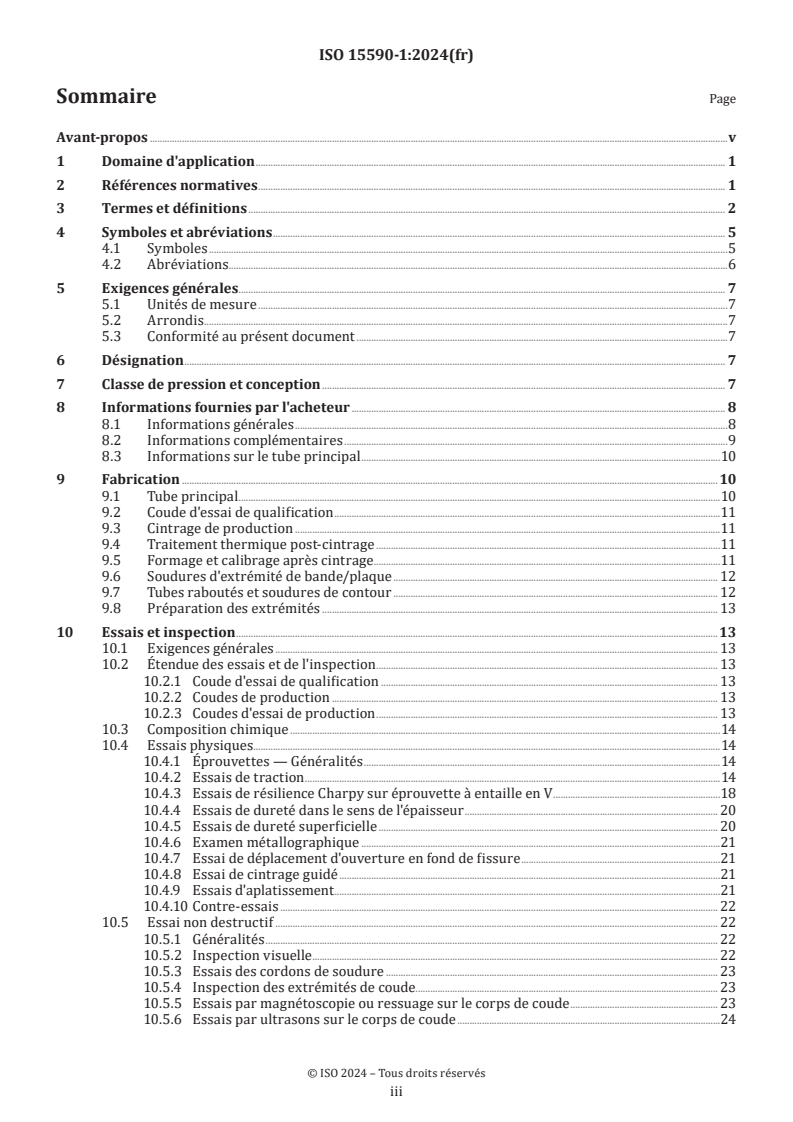
Sommaire Page
Avant-propos .v
1 Domaine d'application . 1
2 Références normatives . 1
3 Termes et définitions . 2
4 Symboles et abréviations . 5
4.1 Symboles .5
4.2 Abréviations.6
5 Exigences générales . . 7
5.1 Unités de mesure .7
5.2 Arrondis.7
5.3 Conformité au présent document .7
6 Désignation . 7
7 Classe de pression et conception . 7
8 Informations fournies par l'acheteur . 8
8.1 Informations générales .8
8.2 Informations complémentaires .9
8.3 Informations sur le tube principal .10
9 Fabrication . 10
9.1 Tube principal .10
9.2 Coude d'essai de qualification .11
9.3 Cintrage de production .11
9.4 Traitement thermique post-cintrage .11
9.5 Formage et calibrage après cintrage . .11
9.6 Soudures d'extrémité de bande/plaque . 12
9.7 Tubes raboutés et soudures de contour . 12
9.8 Préparation des extrémités . 13
10 Essais et inspection .13
10.1 Exigences générales . 13
10.2 Étendue des essais et de l'inspection . 13
10.2.1 Coude d'essai de qualification . 13
10.2.2 Coudes de production . 13
10.2.3 Coudes d'essai de production . 13
10.3 Composition chimique .14
10.4 Essais physiques .14
10.4.1 Éprouvettes — Généralités .14
10.4.2 Essais de traction .14
10.4.3 Essais de résilience Charpy sur éprouvette à entaille en V .18
10.4.4 Essais de dureté dans le sens de l'épaisseur . 20
10.4.5 Essais de dureté superficielle . 20
10.4.6 Examen métallographique .21
10.4.7 Essai de déplacement d'ouverture en fond de fissure .21
10.4.8 Essai de cintrage guidé .21
10.4.9 Essais d'aplatissement .21
10.4.10 Contre-essais . 22
10.5 Essai non destructif . 22
10.5.1 Généralités . 22
10.5.2 Inspection visuelle . 22
10.5.3 Essais des cordons de soudure . 23
10.5.4 Inspection des extrémités de coude. 23
10.5.5 Essais par magnétoscopie ou ressuage sur le corps de coude . 23
10.5.6 Essais par ultrasons sur le corps de coude .24
iii
10.5.7 Niveau de magnétisme résiduel .24
10.5.8 Réparations .24
10.5.9 Personnel en charge des essais non destructifs .24
10.6 Dimensions .24
10.7 Calibrage . 29
10.8 Essai hydrostatique . 29
11 Document d'inspection .29
12 Marquage .29
Annexe A (normative) Spécification du mode opératoire de fabrication (MPS) .31
Annexe B (normative) Coudes PSL 2S commandés pour un service en milieu corrosif.33
Bibliographie .38
iv
Avant-propos
L'ISO (Organisation internationale de normalisation) est une fédération mondiale d'organismes nationaux
de normalisation (comités membres de l'ISO). L'élaboration des Normes internationales est en général
confiée aux comités techniques de l'ISO. Chaque comité membre intéressé par une étude a le droit de faire
partie du comité technique créé à cet effet. Les organisations internationales, gouvernementales et non
gouvernementales, en liaison avec l'ISO participent également aux travaux. L'ISO collabore étroitement avec
la Commission électrotechnique internationale (IEC) en ce qui concerne la normalisation électrotechnique.
Les procédures utilisées pour élaborer le présent document et celles destinées à sa mise à jour sont
décrites dans les Directives ISO/IEC, Partie 1. Il convient, en particulier, de prendre note des différents
critères d'approbation requis pour les différents types de documents ISO. Le présent document
a été rédigé conformément aux règles de rédaction données dans les Directives ISO/IEC, Partie 2
(voir www.iso.org/directives).
L'ISO attire l'attention sur le fait que la mise en application du présent document peut entraîner l'utilisation
d'un ou de plusieurs brevets. L'ISO ne prend pas position quant à la preuve, à la validité et à l'applicabilité de
tout droit de propriété revendiqué à cet égard. À la date de publication du présent document, l'ISO n'avait pas
reçu notification qu'un ou plusieurs brevets pouvaient être nécessaires à sa mise en application. Toutefois,
il y a lieu d'avertir les responsables de la mise en application du présent document que des informations
plus récentes sont susceptibles de figurer dans la base de données de brevets, disponible à l'adresse
www.iso.org/brevets. L'ISO ne saurait être tenue pour responsable de ne pas avoir identifié de tels droits de
propriété et averti de leur existence.
Les appellations commerciales éventuellement mentionnées dans le présent document sont données pour
information, par souci de commodité, à l'intention des utilisateurs et ne sauraient constituer un engagement.
Pour une explication de la nature volontaire des normes, la signification des termes et expressions
spécifiques de l'ISO liés à l'évaluation de la conformité, ou pour toute information au sujet de l'adhésion de
l'ISO aux principes de l'Organisation mondiale du commerce (OMC) concernant les obstacles techniques au
commerce (OTC), voir www.iso.org/avant-propos.
Le présent document a été élaboré par le comité technique ISO/TC 67, Industries du pétrole et du gaz, y
compris les énergies à faible teneur en carbone, sous-comité SC 2, Systèmes de transport par conduites.
Cette quatrième édition annule et remplace la troisième édition (ISO 15590-1:2018), qui a fait l'objet d'une
révision technique.
Les principales modifications sont les suivantes:
— le titre est modifié pour être cohérent avec le nouveau titre de l'ISO/TC 67 en réponse au développement
vert et à faible teneur en carbone;
— le processus de cintrage par induction est classé en processus de chauffage local et processus de chauffage
général en fonction de la nuance d'acier;
— les exigences en matière de contrôle des soudures dans la zone de transition sont supprimées;
— une exigence d'essai pour l'extraction d'échantillons du métal de base de l'axe neutre du coude est ajoutée;
— les éprouvettes délaminées avec une épaisseur réduite pour les essais de traction sont ajoutées;
— des exigences pour les contre-essais sont ajoutées;
— une condition supplémentaire pour les essais non destructifs relatifs à la pollution par le cuivre est
ajoutée.
Une liste de toutes les parties de la série ISO 15590 se trouve sur le site web de l'ISO.
Il convient que l'utilisateur adresse tout retour d'information ou toute question concernant le présent
document à l'organisme national de normalisation de son pays. Une liste exhaustive desdits organismes se
trouve à l'adresse www.iso.org/fr/members.html.
v
Norme internationale ISO 15590-1:2024(fr)
Industries du pétrole et du gaz, y compris les énergies à faible
teneur en carbone — Coudes d'usine, raccords et brides pour
systèmes de transport par conduites —
Partie 1:
Coudes fabriqués par induction
1 Domaine d'application
Le présent document spécifie les conditions techniques de livraison des coudes fabriqués par le procédé de
cintrage par induction et destinés aux systèmes de transport par conduites des industries du pétrole et du
gaz naturel définis dans l'ISO 13623.
Le présent document est applicable aux coudes cintrés par induction, fabriqués à partir de tubes soudés et
non soudés, en aciers non alliés ou faiblement alliés.
NOTE Il s'agit généralement d'aciers C-Mn ou d'aciers faiblement alliés adaptés au niveau et à la nuance
correspondant au tube de conduite, conformément à l'ISO 3183.
Le présent document spécifie les exigences de fabrication de deux niveaux de spécification de produit (PSL)
des coudes cintrés par induction, correspondant aux niveaux de spécification indiqués pour les tubes dans
l'ISO 3183.
Le présent document n'est pas applicable à la sélection du niveau de spécification des produits (PSL) cintrés
par induction.
Le présent document n'est pas applicable aux coudes de conduites fabriqués par d'autres procédés.
2 Références normatives
Les documents suivants sont cités dans le texte de sorte qu'ils constituent, pour tout ou partie de leur
contenu, des exigences du présent document. Pour les références datées, seule l'édition citée s'applique. Pour
les références non datées, la dernière édition du document de référence s'applique (y compris les éventuels
amendements).
ISO 80000-1:2022, Grandeurs et unités — Partie 1: Généralités
ISO 148-1, Matériaux métalliques — Essai de flexion par choc sur éprouvette Charpy — Partie 1: Méthode d'essai
ISO 3183, Industries du pétrole et du gaz naturel — Tubes en acier pour les systèmes de transport par conduites
ISO 6507 (toutes les parties), Matériaux métalliques — Essai de dureté Vickers
ISO 6508 (toutes les parties), Matériaux métalliques — Essai de dureté Rockwell
ISO 6892-1, Matériaux métalliques — Essai de traction — Partie 1: Méthode d'essai à température ambiante
ISO 6892-2, Matériaux métalliques — Essai de traction — Partie 2: Méthode d'essai à température élevée
ISO 7438, Matériaux métalliques — Essai de pliage
ISO 7539-2, Corrosion des métaux et alliages — Essais de corrosion sous contrainte — Partie 2: Préparation et
utilisation des éprouvettes pour essais en flexion
ISO 8501-1, Préparation des subjectiles d'acier avant application de peintures et de produits assimilés —
Évaluation visuelle de la propreté d'un subjectile — Partie 1: Degrés de rouille et degrés de préparation des
subjectiles d'acier non recouverts et des subjectiles d'acier après décapage sur toute la surface des revêtements
précédents
ISO 10474, Aciers et produits sidérurgiques — Documents de contrôle
ISO 10893-4, Essais non destructifs des tubes en acier — Partie 4: Contrôle par ressuage des tubes en acier sans
soudure et soudés pour la détection des imperfections de surface
ISO 10893-5, Essais non destructifs des tubes en acier — Partie 5: Contrôle par magnétoscopie des tubes en
acier ferromagnétique sans soudure et soudés pour la détection des imperfections de surface
ISO 10893-8, Essais non destructifs des tubes en acier — Partie 8: Contrôle automatisé par ultrasons pour la
détection des dédoublures des tubes en acier sans soudure et soudés
ISO 10893-9, Essais non destructifs des tubes en acier — Partie 9: Contrôle automatisé par ultrasons pour la
détection des dédoublures dans les bandes/tôles fortes utilisées pour la fabrication des tubes en acier soudés
ISO 10893-10:2011, Essais non destructifs des tubes en acier — Partie 10: Contrôle automatisé par ultrasons sur
toute la circonférence des tubes en acier sans soudure et soudés (sauf à l'arc immergé sous flux en poudre) pour
la détection des imperfections longitudinales et/ou transversales
ISO 10893-11:2011, Essais non destructifs des tubes en acier — Partie 11: Contrôle automatisé par ultrasons
du cordon de soudure des tubes en acier soudés pour la détection des imperfections longitudinales et/ou
transversales
ISO 13623, Industries du pétrole et du gaz naturel — Systèmes de transport par conduites
ISO 17640, Essais non destructifs des assemblages soudés — Contrôle par ultrasons — Techniques, niveaux
d'essai et évaluation
ASTM E112, Standard Test Methods for Determining Average Grain Size
ASTM E214, Standard Practice for Ultrasonic Pulse-Echo Straight-Beam Contact Testing
ASTM E340, Standard Test Method for Macroetching Metals and Alloys
ASTM E797, Standard Practice for Measuring Thickness by Manual Ultrasonic Pulse-Echo Contact Method
N AC E T M0177: 2016 , Standard Test Method — Laboratory Testing of Metals for Resistance to Sulfide Stress
Cracking and Stress Corrosion Cracking in H S Environments
N AC E T M028 4: 2016 , Test Method — Evaluation of Pipeline and Pressure Vessel Steels for Resistance to
Hydrogen-Induced Cracking
3 Termes et définitions
Pour les besoins du présent document, les termes et définitions suivants s'appliquent.
L'ISO et l'IEC tiennent à jour des bases de données terminologiques destinées à être utilisées en normalisation,
consultables aux adresses suivantes:
— ISO Online browsing platform: disponible à l'adresse https:// www .iso .org/ obp
— IEC Electropedia: disponible à l'adresse https:// www .electropedia .org/
3.1
arc
partie courbe d'un coude
3.2
angle de cintrage
quantité de changement directionnel à travers le coude
3.3
essai de qualification d'un coude
BQT
essai de qualification consistant à produire un coude conformément à la MPS (3.20) et à démontrer qu'il est
possible de produire des coudes satisfaisant aux exigences spécifiées dans le présent document
Note 1 à l'article: L'Article 10 spécifie les exigences relatives aux coudes.
3.4
rayon de cintrage
distance du centre de courbure jusqu'à l'axe du tube coudé
3.5
selon accord
convenu entre le fabricant (3.19) et l'acheteur (3.23)
[SOURCE: ISO 15590-2: 2021, 3.1]
3.6
corde
segment de ligne reliant les points de début et de fin de la zone de coude, mesuré au niveau de l'axe
3.7
défaut
imperfection (3.12) dont la taille et/ou la densité de population sont supérieures aux critères d'acceptation
spécifiés
Note 1 à l'article: 10.5 et l’Article B.7 précisent les critères d'acceptation.
3.8
extrados
partie extérieure courbe de l'arc d’un coude (3.1)
3.9
technologie de chauffage général
cintrage par induction (3.14), processus dans lequel l'ensemble du coude, y compris les sections de l'arc
(3.1) et de la tangente (3.27), est poussé à travers la bobine de chauffage par induction et chauffé jusqu'à la
température de cintrage complète
3.10
coulée
fournée d'acier préparée en une seule opération de fabrication
3.11
sous réserve d'accord
caractéristique spécifiée dans la commande, devant être telle que prescrite, ou plus contraignante, à
condition qu'elle ait fait l'objet d'un accord entre le fabricant (3.19) et l'acheteur (3.23)
[SOURCE: ISO 24139-2:2023, 3.1.5]
3.12
imperfection
discontinuité ou irrégularité dans la paroi ou la surface d'un produit qui peut être détectée par des méthodes
d’inspection (3.15) décrites dans le présent document
3.13
indication
preuve obtenue par une inspection non destructive (3.22)
3.14
cintrage par induction
processus continu utilisant le chauffage par induction pour créer une bande circonférentielle étroite
chauffée autour du matériau en cours de cintrage
3.15
inspection
activités consistant à mesurer, examiner, soumettre à essai, peser ou calibrer une ou plusieurs
caractéristiques d'un produit, puis à comparer les résultats de ces activités par rapport aux exigences
spécifiées afin de déterminer la conformité
3.16
intrados
partie intérieure courbe de l'arc d’un coude (3.1)
3.17
délaminage
séparation interne du métal qui crée des couches généralement parallèles à la surface du tube/coude
3.18
technologie de chauffage local
cintrage par induction (3.14) processus dans lequel seul l'arc (3.1) d'un coude est poussé à travers la bobine
de chauffage par induction et chauffé à la température de cintrage maximale
3.19
fabricant
firme, compagnie ou société responsable de la fabrication et du marquage du produit conformément à des
exigences spécifiées
Note 1 à l'article: Les Articles 9 et 10 spécifient les exigences relatives aux fabricants.
3.20
spécification du mode opératoire de fabrication
MPS (manufacturing procedure specification)
document spécifiant les propriétés et la description du tube principal (3.21), le mode opératoire de cintrage,
l'équipement et le cycle de traitement thermique post-cintrage (si nécessaire), les résultats de l'essai de
qualification du coude, les modes opératoires des essais non destructifs et les détails des chanfreins de
soudure pour la réalisation des coudes
3.21
tube principal
tronçon de tube droit à partir duquel un coude est cintré par induction
3.22
inspection non destructive
inspection (3.15) destinée à détecter les imperfections (3.12) par des méthodes de contrôle radiographique,
aux ultrasons ou autres spécifiées dans le présent document et n'engendrant aucune perturbation, contrainte
ou rupture des matériaux
3.23
acheteur
partie chargée de définir les exigences relatives à la commande d'un produit, ainsi que du règlement de cette
dernière
3.24
soudage à l'arc sous flux
SAW (submerged-arc welding)
procédé de soudage qui produit une fusion et une coalescence des métaux en les chauffant avec un ou
plusieurs arcs entre une ou plusieurs électrodes consommables métalliques nues et la pièce, dans lequel l'arc
et le métal fondu sont protégés par inertage par flux granulaire
[SOURCE: ISO 15590-4:2019, 3.22]
3.25
condition de service
condition d'utilisation spécifiée par l'acheteur (3.23) dans la commande
Note 1 à l'article: Dans le présent document, les termes «service en milieu corrosif» et «service en mer» sont des
conditions de service.
3.26
soudure d'extrémité
soudure d'assemblage des extrémités d'une bande ou d'une plaque
3.27
tangente
section droite aux extrémités d'un coude cintré par induction
3.28
zone de transition
zone couvrant les points de début et de fin du chauffage par induction, incluant la matière qui s'étend du tube
principal non chauffé (3.21) jusqu'à la matière portée à la température de cintrage complet
3.29
amincissement de paroi
réduction de l'épaisseur d'origine d'une paroi de tube pour la ramener à l'épaisseur de paroi de l'extrados
(3.8) après cintrage
4 Symboles et abréviations
4.1 Symboles
A allongement de l'éprouvette de traction après fracture, exprimé en pourcentage
L profondeur d'aspérité
CVD
D et D diamètres extérieurs de deux sommets adjacents
2 4
D diamètre extérieur du creux intermédiaire
D diamètre extérieur spécifié
D diamètre extérieur désigné par le fabricant après calibrage, exprimé en millimètres
a
D diamètre extérieur désigné par le fabricant avant calibrage, exprimé en millimètres
b
D diamètre (extérieur ou intérieur) maximal mesuré
max
D diamètre (extérieur ou intérieur) minimal mesuré
min
l distance entre sommets adjacents d'une ondulation
O ovalisation
r rayon de cintrage axial
b
r rayon nominal à mi-épaisseur du tube principal
p
R résistance ultime à la traction
m
R limite d'élasticité pour un allongement total de 0,5 %
t0,5
S ratio de calibrage
r
T température de calcul minimale spécifiée par l'acheteur
dmin
t épaisseur minimale de paroi au niveau de l'intrados du coude
i
t épaisseur de paroi minimale requise conformément à l'ISO 13623 pour le tube droit adjacent
min
au coude, incluant toute surépaisseur de corrosion
4.2 Abréviations
CTOD essai de déplacement d'ouverture en fond de fissure
CVD profondeur d'aspérité
HAZ zone affectée thermiquement
HFW soudage électrique à haute fréquence pour la fabrication de tubes
HIC fissuration sous hydrogène
IB coude cintré par induction
MT essai par magnétoscopie
NDT essai non destructif
PSL niveau de spécification d'un produit
PT essai par ressuage
RT essai radiographique
SAWH soudage hélicoïdal à l'arc sous flux pour la fabrication de tubes
SAWL soudage longitudinal à l'arc sous flux pour la fabrication de tubes
SI système international d'unités
SSC fissuration sous contrainte en présence de sulfure
SWC fissuration en gradin
UT essai par ultrasons
WPS spécification de mode opératoire de soudage
5 Exigences générales
5.1 Unités de mesure
Dans le présent document, les données sont exprimées en unités internationales de mesure (SI). Pour un
article spécifique d'une commande, sauf indication contraire, un seul système d'unités doit être utilisé sans
qu'il soit combiné avec les données exprimées dans l'autre système.
5.2 Arrondis
Sauf convention contraire indiquée dans le présent document, pour déterminer la conformité aux exigences
spécifiées, les valeurs observées ou calculées doivent être arrondies à l'unité la plus proche à la position la
plus à droite des chiffres exprimant la valeur limite, conformément à l'ISO 80000-1:2022, Annexe B, Règle A.
NOTE Voir aussi l’ASTM E29-04.
5.3 Conformité au présent document
Il convient de mettre en œuvre un système de management de la qualité pour assurer la conformité aux
exigences du présent document.
NOTE L'ISO 29001 donne des exigences au secteur sur les systèmes de management de la qualité.
Un contrat peut spécifier que le fabricant est tenu de respecter toutes les exigences applicables du présent
document. L'acheteur doit être autorisé à effectuer toutes les investigations nécessaires pour s'assurer que
le fabricant s'y conforme et à refuser tout produit non conforme.
6 Désignation
Les coudes cintrés par induction doivent être désignés sous la forme «IB xxx-PSL 1» ou «IB xxx-PSL 2» ou «IB
xxx-PSL 2S», où
— «xxx» est la limite d'élasticité minimale spécifiée, exprimée en mégapascals (MPa);
— les lettres «PSL 1» ou «PSL 2» identifient la classe de conditions techniques de livraison pour les coudes
cintrés par induction non destinés à un service en milieu corrosif;
— les lettres «PSL 2S» identifient les coudes PSL 2 destinés à des conditions de service en milieu corrosif;
— les lettres «PSL 2O» identifient les coudes PSL 2 destinés à des conditions de service en mer;
— les lettres «PSL 2SO» identifient les coudes PSL 2 destinés à des conditions de service en mer et en milieu
corrosif.
7 Classe de pression et conception
La contrainte circonférentielle due à la pression interne du fluide dans le coude cintré par induction ne doit
pas dépasser celle admise dans l'ISO 13623 pour le tube droit à l'endroit du coude.
NOTE 1 Normalement, l'acheteur effectue la conception sous pression et spécifie la paroi minimale requise t .
min
L'épaisseur de la paroi de l'extrados du coude doit être au moins égale à t .
min
L'épaisseur de la paroi au niveau de l'intrados du coude doit être au moins égale à la valeur indiquée dans la
Formule (1):
2rr−
bp
tt=× (1)
i min
2 rr−
()
bp
NOTE 2 Pour les conduites de transport non conçues conformément à l'ISO 13623, l'épaisseur de paroi minimale
requise de l'extrados du coude peut être inférieure à t .
min
NOTE 3 Les exigences du présent article se rapportent à la conception d'un coude résistant à la pression interne.
L'acheteur ou le concepteur peut également tenir compte des autres charges, statiques et dynamiques, et des conditions
d'essai des conduites de transport afin de démontrer la conformité aux exigences de résistance de l'ISO 13623.
NOTE 4 Les dimensions géométriques du coude sont indiquées à la Figure 1.
Légende
1 zone de transition
2 soudure
Figure 1 — Dimensions géométriques du coude
8 Informations fournies par l'acheteur
8.1 Informations générales
L'acheteur doit fournir les informations suivantes:
a) la référence et l'année de publication du présent document (c'est-à-dire l'ISO 15590-1:2024);
b) la désignation de chaque coude;
c) la quantité de coudes;
d) la fourniture du tube principal par l'acheteur ou le fabricant;
e) les dimensions requises des coudes, y compris:
— le diamètre (intérieur ou extérieur);
— l'épaisseur de paroi minimale de l'intrados et de l'extrados après cintrage;
— le rayon de cintrage;
— l'angle de cintrage;
— les longueurs de tangente;
f) la préparation des extrémités si leur équerrage n'est pas requis.
8.2 Informations complémentaires
Il convient que l'acheteur spécifie les informations complémentaires suivantes:
a) la température de calcul minimale;
b) la température de calcul maximale (et toute exigence relative aux essais de traction à haute température);
c) l'épaisseur de paroi maximale;
d) les exigences dimensionnelles spéciales;
e) les exigences d'inspection et d'essais complémentaires;
f) les exigences de calibrage et d'autres mesures de dimensions, si elles diffèrent du présent document;
g) la norme de conception ou les coefficients de calcul des conduites de transport, s'ils diffèrent de
l'ISO 13623;
h) les conditions de fonctionnement des conduites;
i) l'application d'un traitement thermique post-cintrage, si nécessaire;
j) les exigences de propriétés mécaniques à la température de calcul maximale;
k) la température d'essai de résilience Charpy;
l) les exigences relatives aux essais d'étanchéité, d'éclatement ou hydrostatiques;
m) les points à attester et à approuver par l'acheteur;
n) l'état de surface;
o) les exigences de revêtement ou de peinture;
p) les exigences de marquage, si elles diffèrent de celles du présent document;
q) les exigences relatives à la protection des extrémités ou du chanfrein (par exemple, les capuchons
d'extrémité ou les protecteurs de chanfrein);
r) les instructions d'emballage et d'expédition;
s) l'organisme tiers chargé de l'inspection;
t) la désignation normalisée du document d'inspection requis conformément à l'ISO 10474;
u) les exigences relatives au format et au contenu complémentaire du document d'inspection;
v) les exigences des essais de dureté;
w) diamètre extérieur ou intérieur constant;
x) d'autres exigences particulières.
8.3 Informations sur le tube principal
Les informations suivantes concernant le tube principal doivent être communiquées au fabricant:
a) la spécification d'achat;
b) le diamètre du tube (intérieur ou extérieur);
c) l'épaisseur de paroi du tube (nominale ou minimale);
d) les longueurs de tube;
e) le fabricant des tubes;
f) la spécification et les certificats des matériaux des tubes, y compris la composition chimique, le
traitement thermique, les propriétés mécaniques, les dimensions et les résultats des essais non
destructifs;
g) la spécification du mode opératoire de soudage et la composition chimique du métal d'apport pour les
tubes SAWL et SAWH;
h) la spécification du mode opératoire de soudage de réparation des cordons de soudure pour les tubes
SAWL et SAWH;
i) l'applicabilité de l'Annexe B pour le service en milieu corrosif.
NOTE Les informations f), g) et h) sont nécessaires pour la conception du mode opératoire de cintrage par le
fabricant.
9 Fabrication
9.1 Tube principal
Le tube principal doit être fabriqué conformément à l'ISO 3183 ou selon accord.
Le tube principal destiné à la fabrication des coudes PSL 2 doit être fabriqué conformément à l'ISO 3183 pour
les tubes PSL 2.
Le tube principal destiné à la fabrication des coudes PSL 2S doit être fabriqué conformément à la
norme ISO 3183 pour les tubes PSL 2S commandés pour le service en milieu corrosif et aux exigences
supplémentaires spécifiées à l'Annexe B.
Le tube principal destiné à la fabrication des coudes PSL 2O doit être fabriqué conformément à l'ISO 3183
pour les tubes PSL 2O commandés pour le service en mer.
Le tube principal destiné à la fabrication des coudes PSL 2SO doit être fabriqué conformément à la norme
ISO 3183 pour les tubes PSL 2SO commandés pour un service en milieu corrosif et en mer et aux exigences
supplémentaires spécifiées à l'Annexe B.
Le tube principal peut être fourni par l'acheteur ou le fabricant.
Si le tube principal est fourni par l'acheteur, il convient de consulter le fabricant afin d'en connaître la
composition chimique, les propriétés et les dimensions requises (y compris le cordon de soudure et la
soudure de réparation de cordon) et de déterminer son aptitude au cintrage par induction.
Le corps du tube principal ne doit pas présenter de soudures de réparation.
L'épaisseur de paroi du tube principal doit permettre un amincissement de paroi au niveau de l'extrados
suite au cintrage par induction.
La surface du tube principal ne doit présenter aucune contamination due aux métaux à basse température de
fusion, tels que le cuivre, le zinc, le laiton et l'aluminium et peut être décapée par projection conformément à
l'ISO 8501-1, Sa 2.
9.2 Coude d'essai de qualification
Tous les coudes d'essai de niveau PSL doivent être fabriqués conformément à une MPS qualifiée conformément
à l'Article 9 avant le lancement de la production, ou au début, sous réserve d'accord.
NOTE L'Annexe A donne des détails sur les spécifications MPS.
Un coude d'essai ayant une longueur d'arc au moins suffisante pour permettre le prélèvement des éprouvettes
nécessaires doit être fabriqué conformément à chaque MPS préliminaire. L'inspection et les essais du coude
doivent porter sur des tangentes suffisantes et sur les deux zones de transition de début/fin si elles sont
incluses dans les coudes produits.
Le coude d'essai doit être soumis à essai et inspection conformément à l'Article 10. La MPS utilisée pour la
production doit, pour chaque variable essentielle du Tableau 1, spécifier:
— les valeurs enregistrées au cours de la fabrication du coude d'essai;
— la plage admissible pendant le cintrage de production.
La variation des variables essentielles ne doit pas dépasser les limites admissibles indiquées dans le
Tableau 1.
9.3 Cintrage de production
Les coudes doivent être fabriqués selon un procédé de cintrage par induction électrique, et la technologie de
traitement thermoplastique et le milieu de refroidissement appropriés décrits dans les caractéristiques du
travail à chaud du matériau du tube principal doivent être utilisés. Les coudes de type IB 555 peuvent être
produits à l'aide de la technologie de chauffage général ou de la technologie de chauffage local.
Le cintrage par induction doit être exécuté conformément à une MPS qualifiée spécifiée à l'Annexe A.
L'interruption de l'opération de cintrage par induction doit entraîner le rejet du coude.
9.4 Traitement thermique post-cintrage
Pour être conformes au présent document, les coudes ne doivent pas obligatoirement subir de traitement
thermique post-cintrage.
Un traitement thermique post-cintrage peut être effectué pour obtenir les propriétés requises du matériau,
améliorer la résistance à la corrosion, supprimer les zones de transition aux extrémités de l'arc du coude ou
éliminer les contraintes résiduelles.
Il convient que le traitement thermique post-cintrage soit effectué pour les coudes PSL 2, PSL S, PSL 2O, et
PSL 2SO avec des niveaux de résistance égaux ou supérieurs à 485 MPa.
La température de chaque fournée de coudes doit être surveillée au moyen de thermocouples directement
reliés aux coudes sélectionnés, et les valeurs relevées doivent être enregistrées. Le type et l'emplacement
des thermocouples doivent être tels que spécifiés dans la MPS ou dans les dessins dédiés réalisés pour le
chargement du traitement thermique.
Tous les essais et inspections doivent être effectués après le traitement thermique post-cintrage.
9.5 Formage et calibrage après cintrage
Aucun calibrage ou formage à chaud (chauffage ponctuel inclus) ne doit être réalisé, à moins qu'il ne soit
suivi d'un traitement thermique complet au-delà de la température critique supérieure.
Le formage ou le calibrage à froid sans traitement thermique ultérieur est autorisé pour les corrections
d'ovalisation et de diamètre sur les tangentes à condition que la déformation permanente induite ne dépasse
pas 1,5 %.
Sauf accord contraire, la déformation permanente est calculée à l'aide de la formule (2):
DD−
ab
S = (2)
r
D
b
Tableau 1 — Variables essentielles et variations maximales admissibles
a
Variable essentielle Variations maximales admissibles
Coulée d'acier Aucune
WPS du cordon de soudure du tube principal et consom- Aucune
mables de soudage
État de surface Selon accord
Diamètre nominal du tube principal Aucune
Épaisseur de paroi nominale du tube principal ±3 mm ou ±10 %, la valeur la plus faible étant retenue
Rayon de cintrage Une MPS approuvée qualifie tous les rayons plus grands
(mais pas plus petits) dans les plages suivantes:
a) jusqu'à 3D compris;
b) de 3D jusqu'à 5D compris
c) de 5D jusqu'à 10D compris
d) 10D et plus
Vitesse de formage ±2,5 mm/min
Température de formage ±25 °C
Conception de bobine Aucune
Fluide de refroidissement Aucune
Débit ou pression du fluide de refroidissement ±10 %
Température du fluide de refroidissement ±15 °C
b
Fréquence du chauffage par induction ±10 %
c
Emplacement du cordon de soudure ±10° par rapport à l'emplacement dans le coude d'essai
Traitement thermique post-cintrage Méthode: aucun changement
Temps de maintien en tempéra- +15
min
ture:
Température de maintien: ±15 °C
Vitesses de chauffage et de selon accord
refroidissement:
a
Les variations admissibles s'appliquent aux valeurs obtenues lors de l'essai approuvé de qualification de coude (BQT) en
régime stable.
b
La variation peut être portée à ±20 % pour les coudes d'essai qui seront soumis à un traitement thermique de trempe et
revenu post-cintrage.
c
Le long cordon du tube est normalement placé sur l'axe neutre pendant le cintrage.
9.6 Soudures d'extrémité de bande/plaque
Les coudes cintrés par induction ne doivent pas contenir de soudures d'extrémité de bande ou de plaque.
9.7 Tubes raboutés et soudures de contour
Les coudes cintrés par in
...
Questions, Comments and Discussion
Ask us and Technical Secretary will try to provide an answer. You can facilitate discussion about the standard in here.
Loading comments...