

ISO 2891:1977
(Main)Modular units for machine tool construction — Centre bases and columns
General Information
- Abstract
This second edition cancels and replaces the first edition (i.e. ISO 2891-1973). Specifies certain dimensions relating to the interchangeability of centre bases and columns used in special purpose machines constructed from modular units. Gives furthermore the location of centre bases.
- Status
- Published
- Publication Date
- 30-Sep-1977
- Technical Committee
- ISO/TC 39 - Machine tools
- Drafting Committee
- ISO/TC 39 - Machine tools
- Current Stage
- 9093 - International Standard confirmed
- Start Date
- 12-Jan-2023
- Completion Date
- 29-Aug-2026
Buy Documents
ISO 2891:1977 - Modular units for machine tool construction -- Centre bases and columns
ISO 2891:1977 - Modular units for machine tool construction — Centre bases and columns/1/1977
ISO 2891:1977 - Éléments standard pour la construction des machines-outils -- Bâtis centraux et montants
ISO 2891:1977 - Éléments standard pour la construction des machines-outils -- Bâtis centraux et montants
ISO 2891:1977 - Éléments standard pour la construction des machines-outils — Bâtis centraux et montants/1/1977
ISO 2891:1977 - Éléments standard pour la construction des machines-outils — Bâtis centraux et montants/1/1977
Overview
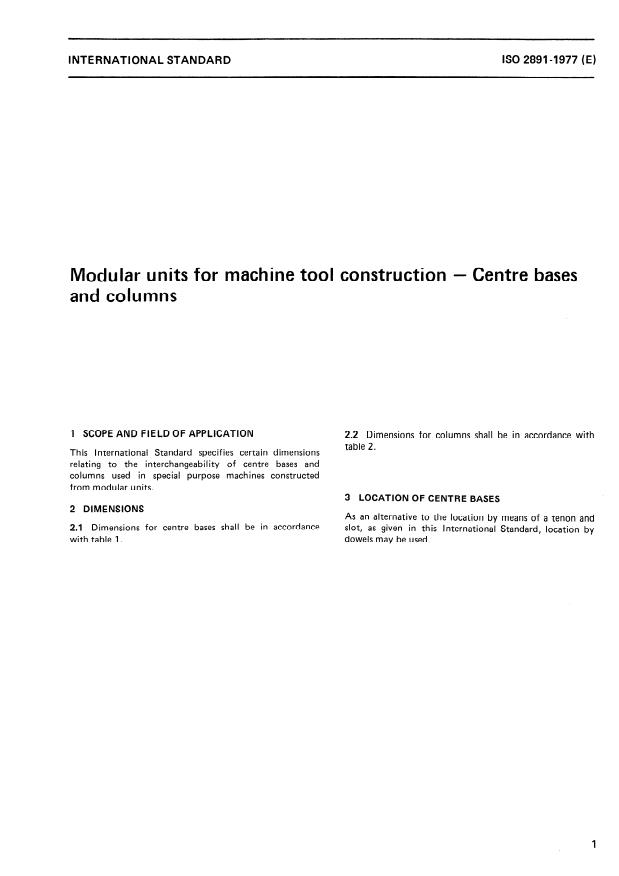
ISO 2891:1977 (second edition) specifies key dimensional requirements that ensure interchangeability of centre bases and columns used in special-purpose machines constructed from modular units. This edition cancels and replaces ISO 2891-1973 and was prepared by ISO/TC 39 (Machine tools). The standard defines location methods, preferred sizes and installation tolerances to support modular, repeatable machine-tool construction.
Key Topics
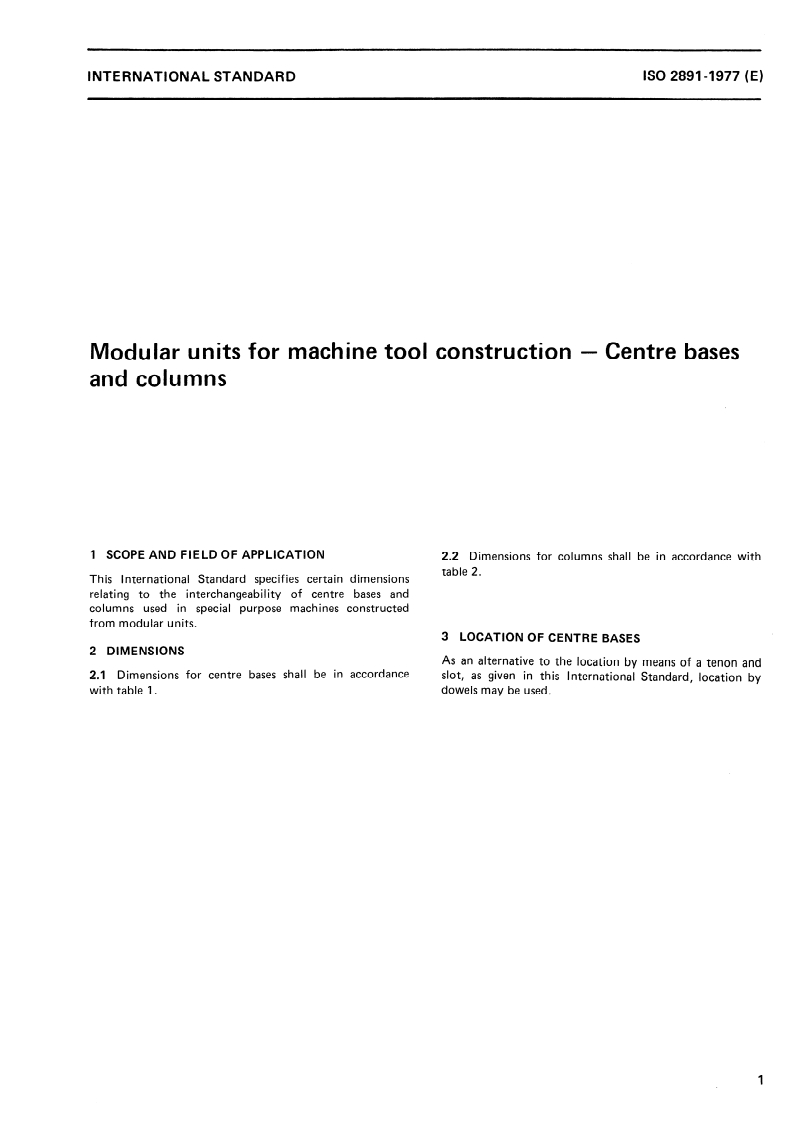
- Scope: Dimensions and location rules for centre bases and columns to permit interchangeability in modular machine-tool assemblies.
- Edition: Second edition (1977) - replaces ISO 2891-1973.
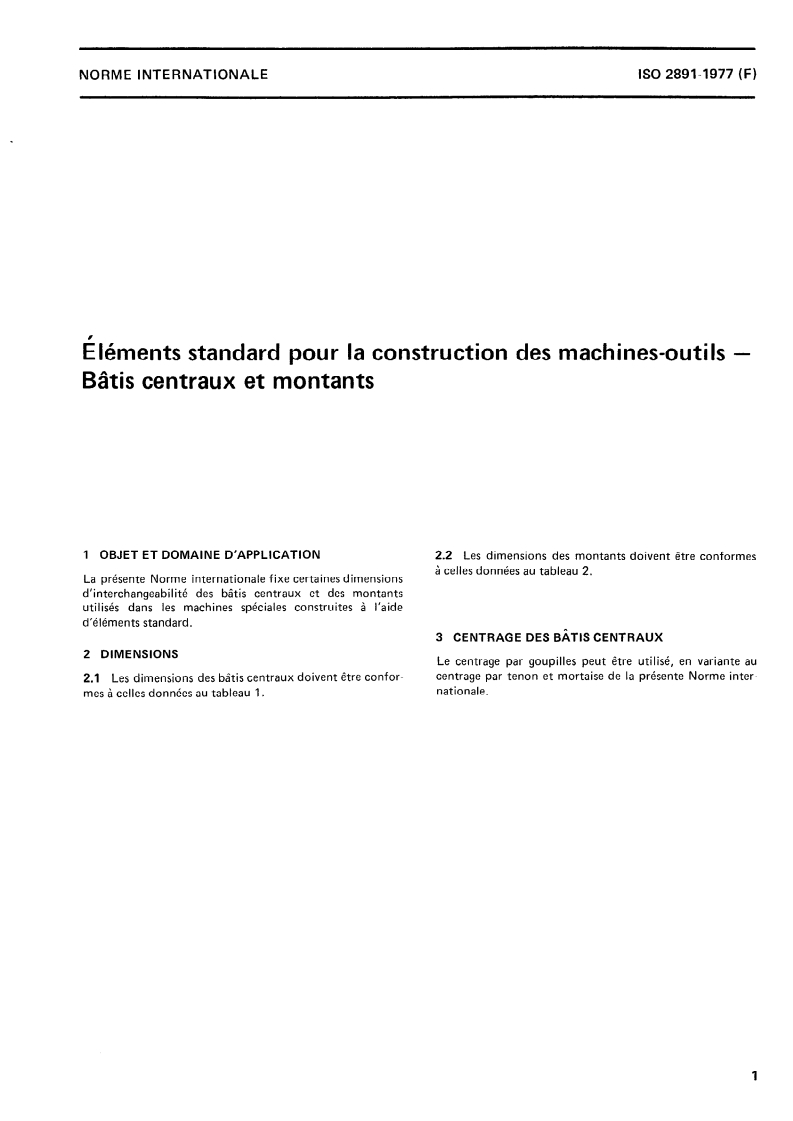
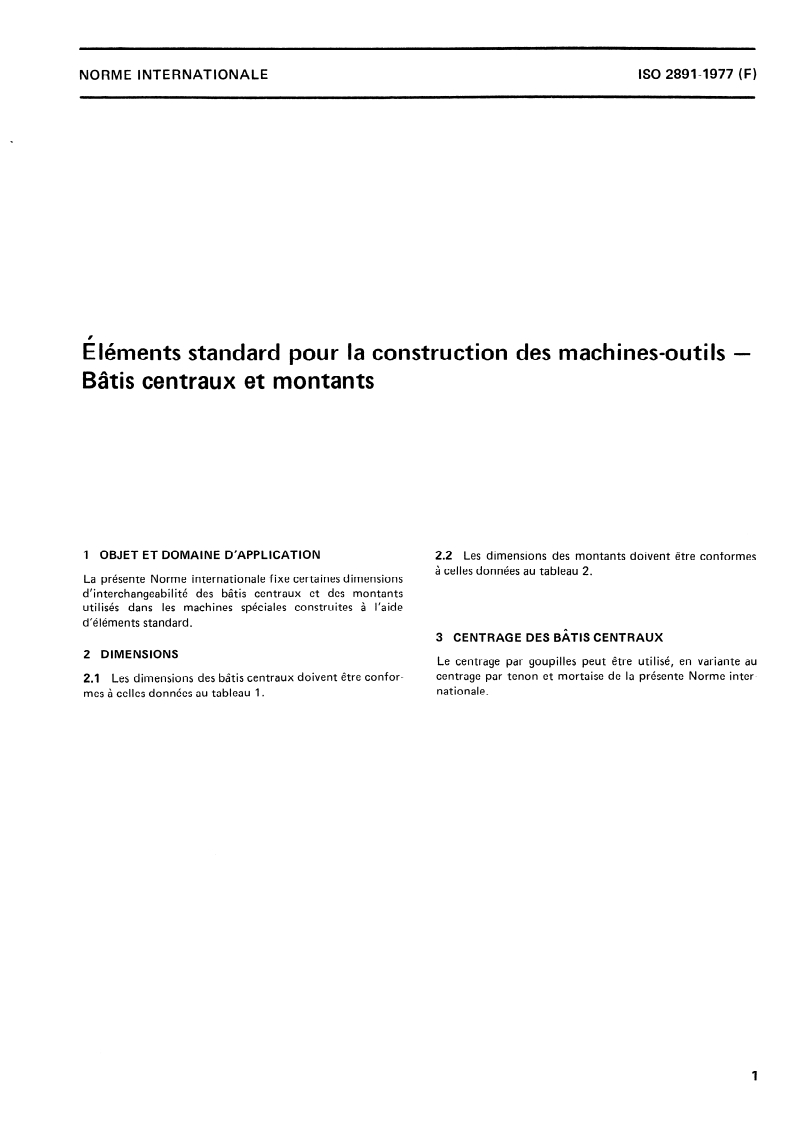
- Location of centre bases: Primary method uses a tenon and slot arrangement; dowels are given as an alternative for locating centre bases.
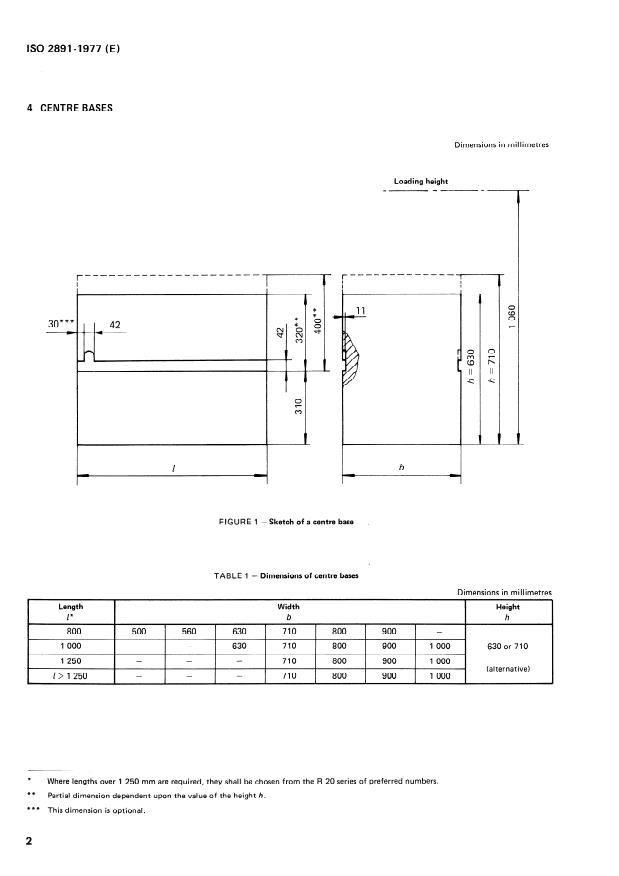
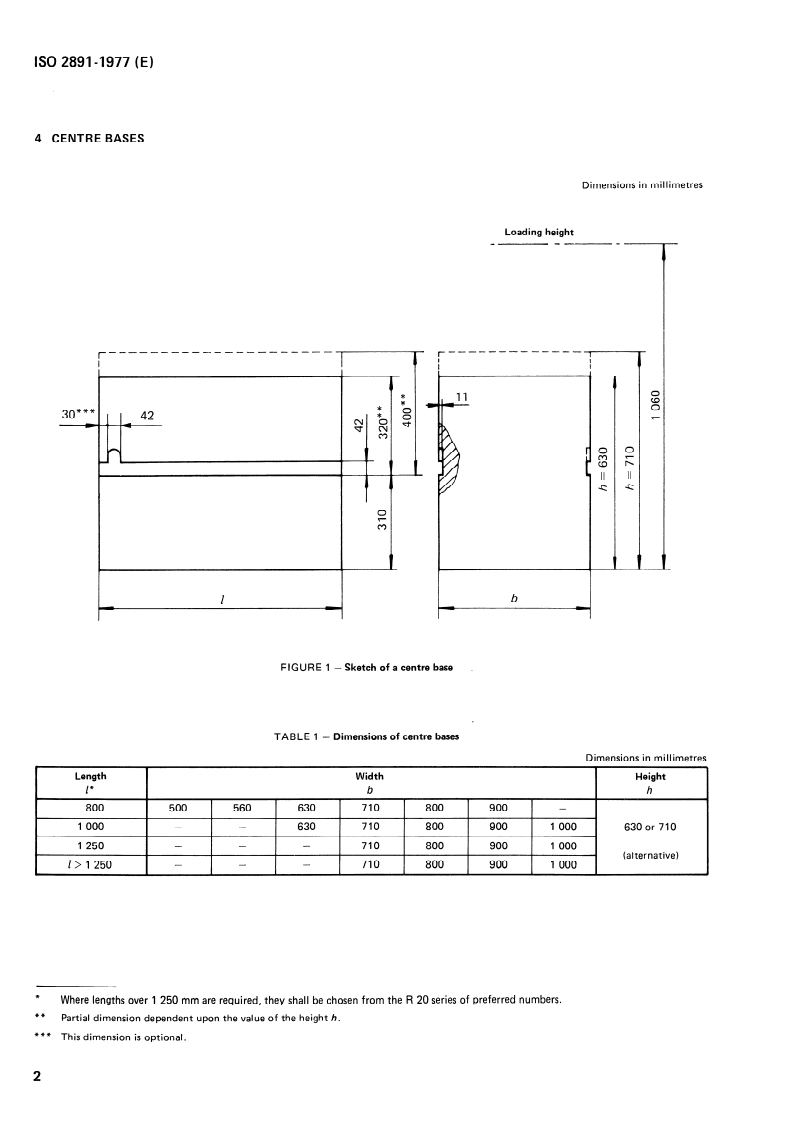
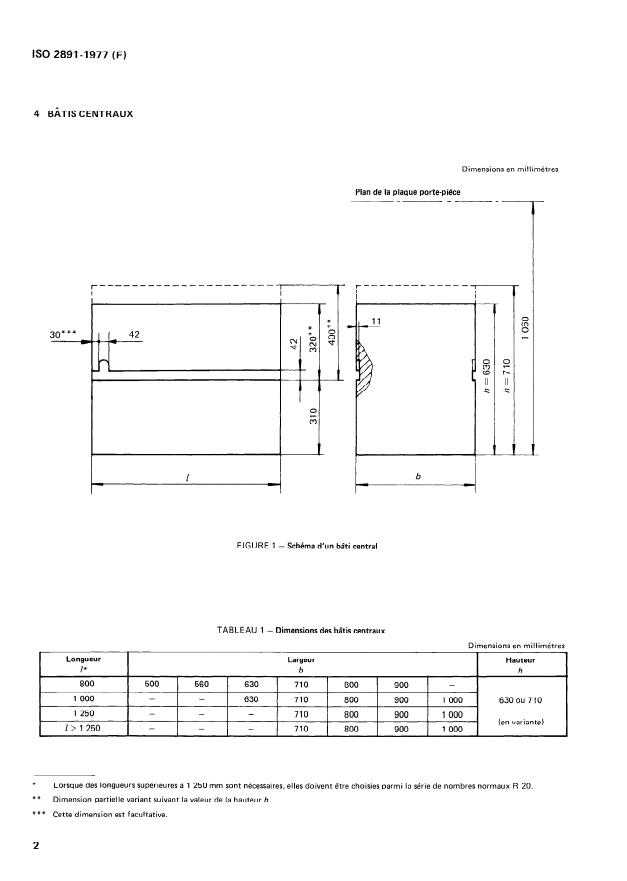
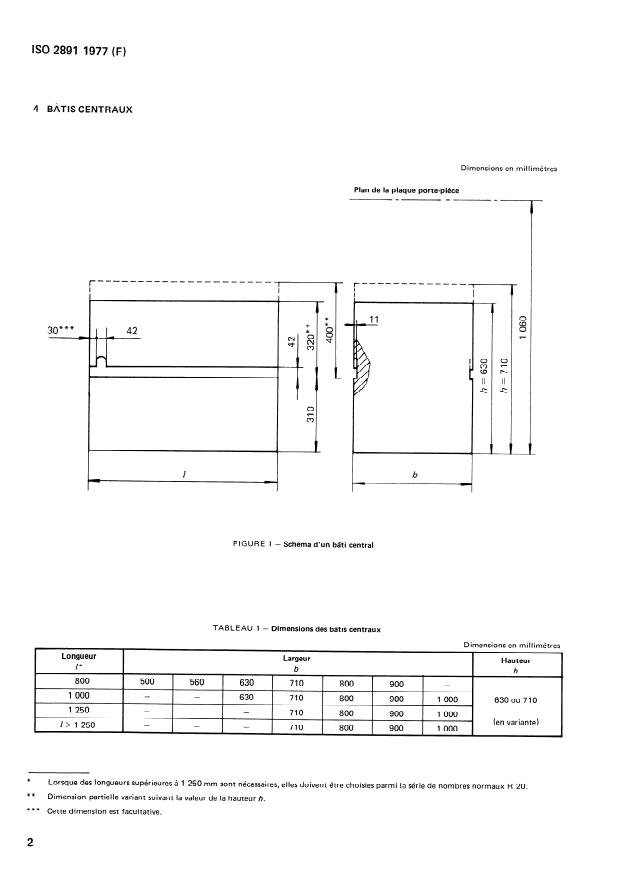
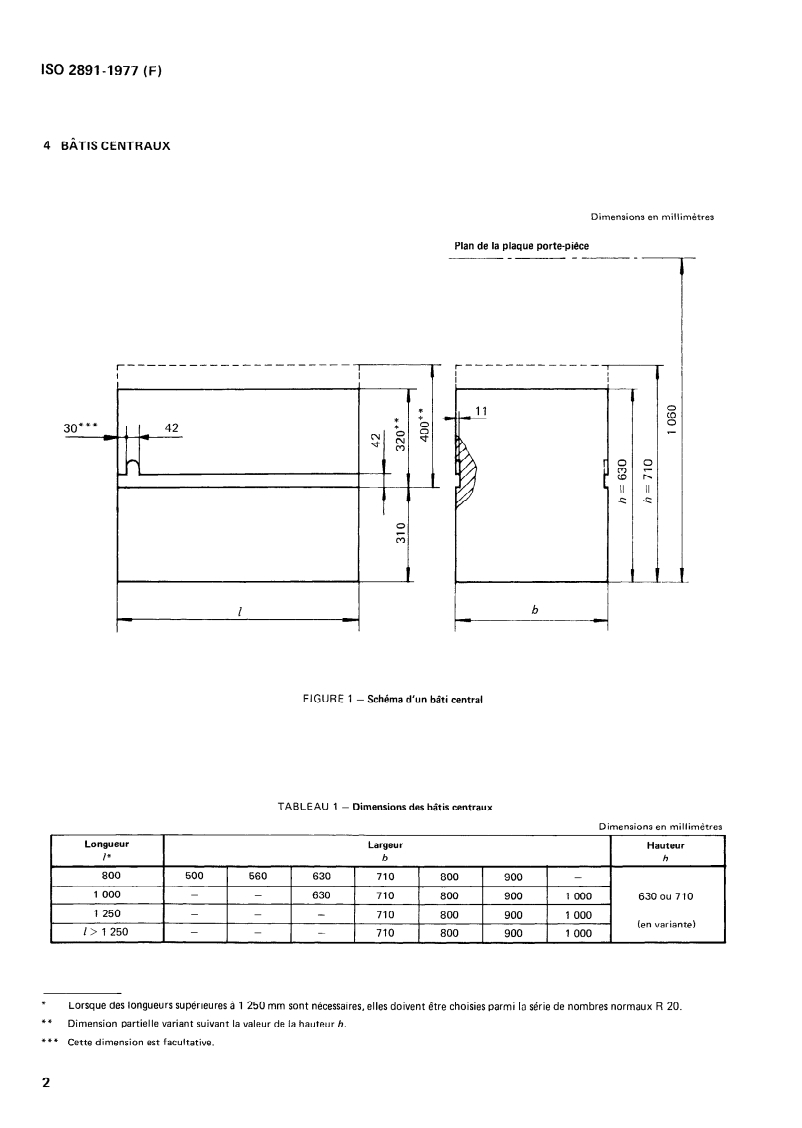
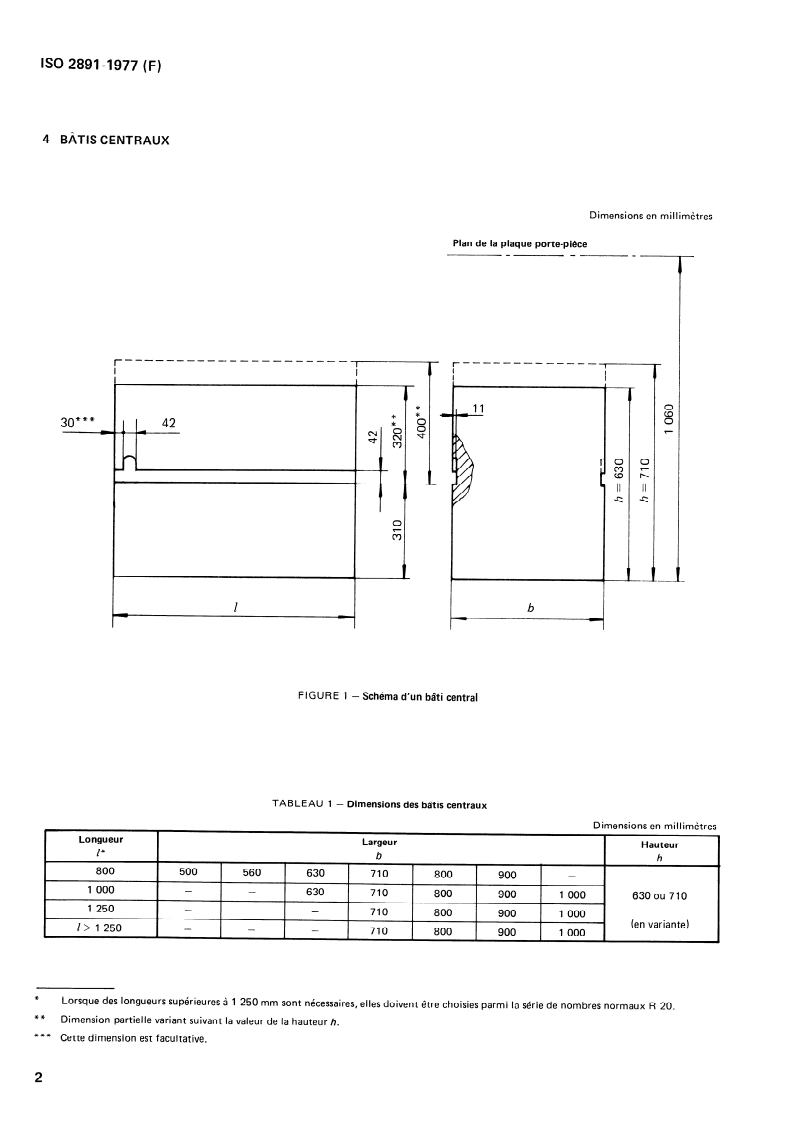
- Centre base dimensions: Values are specified in a table (table 1). Where lengths over 1 250 mm are required, sizes shall be chosen from the R20 series of preferred numbers. Some dimensions are noted as partial or optional depending on loading height.
- Columns: Column dimensions are given in table 2 and include nominal sizes and fixing arrangements. The published table lists typical nominal sizes (for example 250, 320, 400, 500, 630 mm) and associated pad widths and fixing details.
- Fixings and tolerances:
- Lateral fixing holes spaced in increments of 25 mm (manufacturer’s selection); tolerances between extreme holes: ±0.2 mm.
- Front fixing holes are spaced from the centre line in increments of 25 mm (manufacturer’s selection).
- Typical bolt sizes indicated in the table include M16 and M20 for various nominal column sizes.
- Illustrations: The standard includes sketches (centre base and column) and dimension tables to aid implementation.
Applications
ISO 2891:1977 is intended for designers, manufacturers and integrators of special-purpose machine tools who use modular construction techniques. Practical benefits include:
- Interchangeable modules that reduce bespoke machining and lower lead times.
- Consistent assembly practices across suppliers and models.
- Simplified maintenance and spare-parts management due to standardised dimensions and fixing patterns.
- Design scalability, using preferred-number sizing (R20) for longer elements.
Typical use cases: modular machine frames, custom tooling stations, retrofit columns and centre bases in production lines, and specification of supplier components for machine-tool assemblies.
Related Standards
- Prepared by ISO/TC 39 (Machine tools) - consult committee outputs for complementary machine-tool standards and guidelines.
- This second edition cancels ISO 2891-1973; users should reference the 1977 edition for current dimensional rules and table values.
For implementation, refer to the tables and figures in ISO 2891:1977 for exact dimension values, hole spacing patterns and the specified tolerances.
Buy Documents
ISO 2891:1977 - Modular units for machine tool construction -- Centre bases and columns
ISO 2891:1977 - Modular units for machine tool construction — Centre bases and columns/1/1977
ISO 2891:1977 - Éléments standard pour la construction des machines-outils -- Bâtis centraux et montants
ISO 2891:1977 - Éléments standard pour la construction des machines-outils -- Bâtis centraux et montants
ISO 2891:1977 - Éléments standard pour la construction des machines-outils — Bâtis centraux et montants/1/1977
ISO 2891:1977 - Éléments standard pour la construction des machines-outils — Bâtis centraux et montants/1/1977
Get Certified
Connect with accredited certification bodies for this standard

DVS-ZERT GmbH
German welding certification society.
CARES (UK Certification Authority for Reinforcing Steels)
UK certification for reinforcing steels and construction.
EWF/IIW (European/International Welding Federation)
International welding personnel certification.
Sponsored listings
Frequently Asked Questions
ISO 2891:1977 is a standard published by the International Organization for Standardization (ISO). Its full title is "Modular units for machine tool construction — Centre bases and columns". This standard covers: This second edition cancels and replaces the first edition (i.e. ISO 2891-1973). Specifies certain dimensions relating to the interchangeability of centre bases and columns used in special purpose machines constructed from modular units. Gives furthermore the location of centre bases.
This second edition cancels and replaces the first edition (i.e. ISO 2891-1973). Specifies certain dimensions relating to the interchangeability of centre bases and columns used in special purpose machines constructed from modular units. Gives furthermore the location of centre bases.
ISO 2891:1977 is classified under the following ICS (International Classification for Standards) categories: 25.060.10 - Modular units and other devices. The ICS classification helps identify the subject area and facilitates finding related standards.
ISO 2891:1977 is available in PDF format for immediate download after purchase. The document can be added to your cart and obtained through the secure checkout process. Digital delivery ensures instant access to the complete standard document.
Standards Content (Sample)
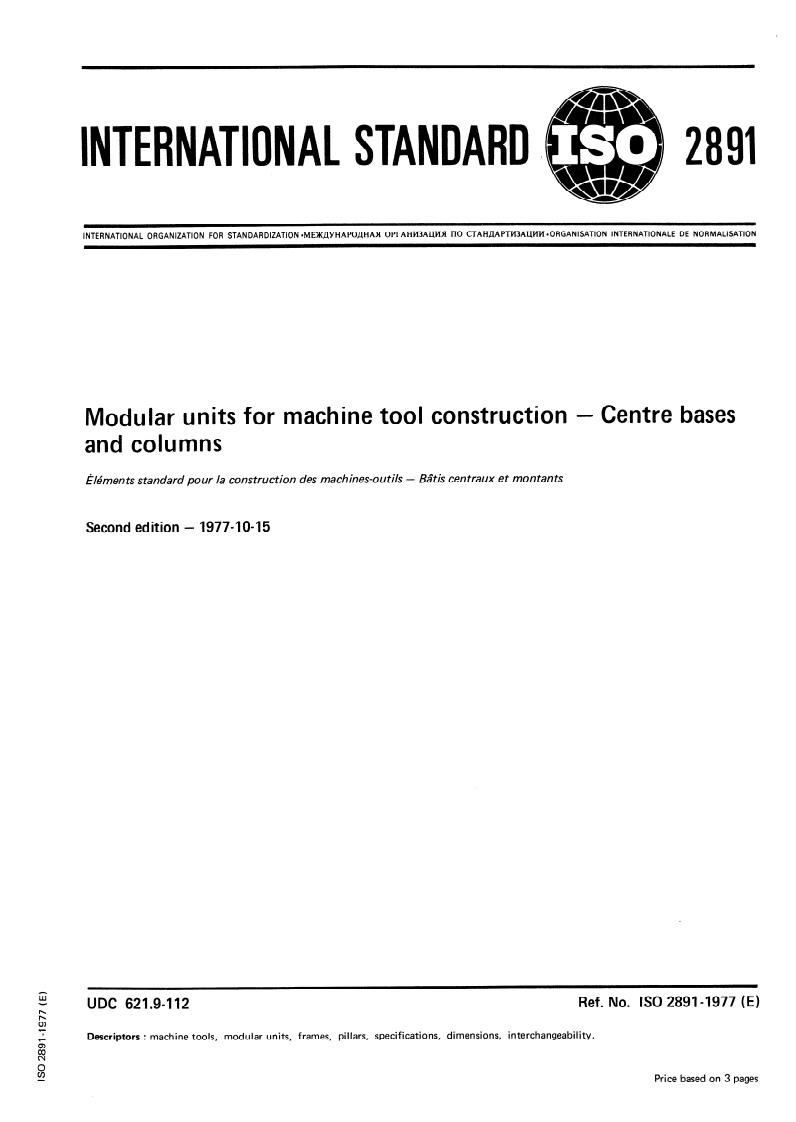
INTERNATIONAL STANDARD. 2891
INTERNATIONAL ORGANIZATION FOR STANDARDIZATION .MEXlIJYHAPOAHAR OPTAHM3AUMJl l-Io CTAHAAPTM3ALWi.ORGANISATION INTERNATIONALE DE NORMALISATION
Modular units for machine tool construction - Centre bases
and columns
&kments Standard pour Ia construction des machines-outils - Ba^tis centraux et montants
Second edition - 1977-10-15
Ref. No. ISO 2891-1977 (E)
UDC 621.9412
Descr iptors : machine tools, modular units, frames, pillars, specifications, dimensions, interchangeability.
Price based on 3 pages
FOREWORD
ISO (the International Organization for Standardization) is a worldwide federation
sf national Standards institutes (ISO member bodiesf. The werk of developing
International Standards is carried out through lS0 technical committees. Every
member body interested in a subject for which a technical committee has been set
up has the right to be represented on that committee. International organizations,
governmental and non-governmental, in liaison with ISO, also take part in the work.
Draft International Standards adopted by the technical committees are circulated
to the member bodies for approval before their acceptance as International
Standards by the ISO Council.
International Standard ISO 2891-1977, the second edition of this International
Standard, has been drawn up by Technical Committee ISO/TC 39, Machine took,
and contains the modifications which were circulated, in the form of an
amendment, to the member bodies in July 1976.
This amendment has been approved by the member bodies of the following
countries :
Austral ia India Spain
Austria Italy Switzerland
Belgium Korea, Rep. of United Kingdom
Brazil Mexico U.S.S. R.
Czechoslovakia Poland Yugoslavia
France Romania
Hungary South Africa, Rep. of
The member bod ies of the fol lowing countries expressed disapproval of the
document on technica I grounds :
Germany
Japan
This second edition cancels and replaces the first edition (i.e. ISO 2891-1973),
which had been approved by the member bodies of the following countries :
Austria Ireland Thailand
Belgium New Zealand Turkey
Czechoslovakia Poland United Kingdom
Egypt, Arab Rep. of Romania U.S.A.
France South Africa, Rep. of U.S.S.R.
Hungary
Sweden
India Switzerland
The m
ember bodies of the fol lowing countries had ex pressed disapproval of the
docum
ent on technical g rounds
Germany
Japan
0 International Organkation for Standardkation, 1977 l
Printed in Switzerland
...
INTERNATIONAL STANDARD. 2891
INTERNATIONAL ORGANIZATION FOR STANDARDIZATION .MEXlIJYHAPOAHAR OPTAHM3AUMJl l-Io CTAHAAPTM3ALWi.ORGANISATION INTERNATIONALE DE NORMALISATION
Modular units for machine tool construction - Centre bases
and columns
&kments Standard pour Ia construction des machines-outils - Ba^tis centraux et montants
Second edition - 1977-10-15
Ref. No. ISO 2891-1977 (E)
UDC 621.9412
Descr iptors : machine tools, modular units, frames, pillars, specifications, dimensions, interchangeability.
Price based on 3 pages
FOREWORD
ISO (the International Organization for Standardization) is a worldwide federation
sf national Standards institutes (ISO member bodiesf. The werk of developing
International Standards is carried out through lS0 technical committees. Every
member body interested in a subject for which a technical committee has been set
up has the right to be represented on that committee. International organizations,
governmental and non-governmental, in liaison with ISO, also take part in the work.
Draft International Standards adopted by the technical committees are circulated
to the member bodies for approval before their acceptance as International
Standards by the ISO Council.
International Standard ISO 2891-1977, the second edition of this International
Standard, has been drawn up by Technical Committee ISO/TC 39, Machine took,
and contains the modifications which were circulated, in the form of an
amendment, to the member bodies in July 1976.
This amendment has been approved by the member bodies of the following
countries :
Austral ia India Spain
Austria Italy Switzerland
Belgium Korea, Rep. of United Kingdom
Brazil Mexico U.S.S. R.
Czechoslovakia Poland Yugoslavia
France Romania
Hungary South Africa, Rep. of
The member bod ies of the fol lowing countries expressed disapproval of the
document on technica I grounds :
Germany
Japan
This second edition cancels and replaces the first edition (i.e. ISO 2891-1973),
which had been approved by the member bodies of the following countries :
Austria Ireland Thailand
Belgium New Zealand Turkey
Czechoslovakia Poland United Kingdom
Egypt, Arab Rep. of Romania U.S.A.
France South Africa, Rep. of U.S.S.R.
Hungary
Sweden
India Switzerland
The m
ember bodies of the fol lowing countries had ex pressed disapproval of the
docum
ent on technical g rounds
Germany
Japan
0 International Organkation for Standardkation, 1977 l
Printed in Switzerland
...
NORME INTERNATIONALE
INTERNATIONAL ORGANIZATION FOR STANDARDIZATION l MEXAYHAPOAHAJI OPl-AHM3ALWI n0 CTAHAAPTM3ALWiW.ORGANISATION INTERNATIONALE DE NORMALISATION
Éléments standard pour la construction des machines-outils -
Bâtis centraux et montants
Modular units for machine tool construction - Centre bases and columns
Deuxième édition - 1977-l O-l 5
Corrigée et réimprimée -
Réf. no : ISO 2891-1977 (F)
CDU 621.9-112
Qescripteurs : machine-outil, unité d’usinage, bâti, colonne de machine-outil, spécification, dimension, interchangeabilité.
Prix basé sur 3 pages
AVANT-PROPOS
L’ISO (Organisation internationale de normalisation) est une fédération mondiale
d’organismes nationaux de normalisation (comités membres de I’ISO). L’élaboration
des Normes internationales est confiée aux comités techniques de I’ISO. Chaque
comité membre intéressé par une étude a le droit de faire partiedu comité technique
correspondant. Les organisations internationales, gouvernementales et non
gouvernementales, en liaison avec I’ISO, participent également aux travaux.
Les projets de Normes internationales adoptés par les comités techniques sont
soumis aux comités membres pour approbation, avant leur acceptation comme
Normes internationales par le Conseil de I’ISO.
La Norme internationale ISO 2891-1977, deuxième édition de cette Norme
ISO/TC 39, Machines-mm%,
internationale, a été établie par le comité technique
et comprend les modifications qui ont été soumises aux comités membres, sous
forme d’amendement, en juillet 1976.
Cet amendement a été approuvé par les comités membres des pays suivants :
Afrique du Sud, Rép. d’ France Royaume-Uni
Australie Hongrie Suisse
Autriche I nde Tchécoslovaquie
Belgique Italie U.R.S.S.
Brési I Mexique Yougoslavie
Corée, Rép. de Pologne
Espagne Roumanie
Les comités membr es des suivants ont désapprouvé le document pour des
pays
raisons techn iques :
Allemagne
Japon
Cette deuxième édition annule et remplace la première édition (ISO 2891-1973),
qui avait été approuvée par les comités membres des pays suivants :
Afrique du Sud, Rép. d’ Irlande
Tchécoslovaquie
Autriche Nouvelle-Zélande
Thaïlande
Belgique Pologne
Turquie
Égypte, Rép. arabe d’ Roumanie
U.R.S.S.
France Royaume-Uni
U.S.A.
Hongrie Suède
Inde Suisse
des pays suivants avaient
Les comités membres désapprouvé le document pour des
raisons techniques :
Allemagne
Japon
0 Organisation internationale de normalisation, 1977 a
Imprimé en Suisse
NORME INTERNATIONALE ISO 28914977 (F)
Éléments standard pour la construct
...
NORME INTERNATIONALE
INTERNATIONAL ORGANIZATION FOR STANDARDIZATION l MEXAYHAPOAHAJI OPl-AHM3ALWI n0 CTAHAAPTM3ALWiW.ORGANISATION INTERNATIONALE DE NORMALISATION
Éléments standard pour la construction des machines-outils -
Bâtis centraux et montants
Modular units for machine tool construction - Centre bases and columns
Deuxième édition - 1977-l O-l 5
Corrigée et réimprimée -
iî
Y
CDU 621.9-112 Réf. no : ISO 2891-1977 (F)
h
Qescripteurs : machine-outil, unité d’usinage, bâti, colonne de machine-outil, spécification, dimension, interchangeabilité.
Prix basé sur 3 pages
AVANT-PROPOS
L’ISO (Organisation internationale de normalisation) est une fédération mondiale
d’organismes nationaux de normalisation (comités membres de I’ISO). L’élaboration
des Normes internationales est confiée aux comités techniques de I’ISO. Chaque
comité membre intéressé par une étude a le droit de faire partiedu comité technique
correspondant. Les organisations internationales, gouvernementales et non
gouvernementales, en liaison avec I’ISO, participent également aux travaux.
Les projets de Normes internationales adoptés par les comités techniques sont
soumis aux comités membres pour approbation, avant leur acceptation comme
Normes internationales par le Conseil de I’ISO.
La Norme internationale ISO 2891-1977, deuxième édition de cette Norme
internationale, a été établie par le comité technique ISO/TC 39, Machines-outils,
et comprend les modifications qui ont été soumises aux comités membres, sous
forme d’amendement, en juillet 1976.
Cet amendement a été approuvé par les comités membres des pays suivants :
Afrique du Sud, Rép. d’ France Royaume-Uni
Australie Hongrie Suisse
Autriche I nde Tchécoslovaquie
Belgique Italie U.R.S.S.
Brési I Mexique Yougoslavie
Corée, Rép. de Pologne
Espagne Roumanie
Les comités membres des pays suivants ont désapprouvé le document pour des
raisons techniques :
Allemagne
Japon
Cette deuxième édition annule et remplace la première édition (ISO 2891-1973),
qui avait été approuvée par les comités membres des pays suivants :
Afrique du Sud, Rép. d’ Irlande Tchécoslovaquie
Autriche Nouvelle-Zélande Thaïlande
Belgique Pologne Turquie
Égypte, Rép. arabe d’ Roumanie U.R.S.S.
France Royaume-Uni U.S.A.
Hongrie Suède
Inde Suisse
Les comités membres des pays suivants avaient désapprouvé le document pour des
raisons techniques :
Allemagne
Japon
0 Organisation internationale de normalisation, 1977 a
Imprimé en Suisse
NORME INTERNATIONALE ISO 28914977 (F)
Éléments standard pour la construction des machines-outils -
Bâtis centraux et m
...
NORME INTERNATIONALE
INTERNATIONAL ORGANIZATION FOR STANDARDIZATION l MEXAYHAPOAHAJI OPl-AHM3ALWI n0 CTAHAAPTM3ALWiW.ORGANISATION INTERNATIONALE DE NORMALISATION
Éléments standard pour la construction des machines-outils -
Bâtis centraux et montants
Modular units for machine tool construction - Centre bases and columns
Deuxième édition - 1977-l O-l 5
Corrigée et réimprimée -
Réf. no : ISO 2891-1977 (F)
CDU 621.9-112
Qescripteurs : machine-outil, unité d’usinage, bâti, colonne de machine-outil, spécification, dimension, interchangeabilité.
Prix basé sur 3 pages
AVANT-PROPOS
L’ISO (Organisation internationale de normalisation) est une fédération mondiale
d’organismes nationaux de normalisation (comités membres de I’ISO). L’élaboration
des Normes internationales est confiée aux comités techniques de I’ISO. Chaque
comité membre intéressé par une étude a le droit de faire partiedu comité technique
correspondant. Les organisations internationales, gouvernementales et non
gouvernementales, en liaison avec I’ISO, participent également aux travaux.
Les projets de Normes internationales adoptés par les comités techniques sont
soumis aux comités membres pour approbation, avant leur acceptation comme
Normes internationales par le Conseil de I’ISO.
La Norme internationale ISO 2891-1977, deuxième édition de cette Norme
ISO/TC 39, Machines-mm%,
internationale, a été établie par le comité technique
et comprend les modifications qui ont été soumises aux comités membres, sous
forme d’amendement, en juillet 1976.
Cet amendement a été approuvé par les comités membres des pays suivants :
Afrique du Sud, Rép. d’ France Royaume-Uni
Australie Hongrie Suisse
Autriche I nde Tchécoslovaquie
Belgique Italie U.R.S.S.
Brési I Mexique Yougoslavie
Corée, Rép. de Pologne
Espagne Roumanie
Les comités membr es des suivants ont désapprouvé le document pour des
pays
raisons techn iques :
Allemagne
Japon
Cette deuxième édition annule et remplace la première édition (ISO 2891-1973),
qui avait été approuvée par les comités membres des pays suivants :
Afrique du Sud, Rép. d’ Irlande
Tchécoslovaquie
Autriche Nouvelle-Zélande
Thaïlande
Belgique Pologne
Turquie
Égypte, Rép. arabe d’ Roumanie
U.R.S.S.
France Royaume-Uni
U.S.A.
Hongrie Suède
Inde Suisse
des pays suivants avaient
Les comités membres désapprouvé le document pour des
raisons techniques :
Allemagne
Japon
0 Organisation internationale de normalisation, 1977 a
Imprimé en Suisse
NORME INTERNATIONALE ISO 28914977 (F)
Éléments standard pour la construct
...
NORME INTERNATIONALE
INTERNATIONAL ORGANIZATION FOR STANDARDIZATION l MEXAYHAPOAHAJI OPl-AHM3ALWI n0 CTAHAAPTM3ALWiW.ORGANISATION INTERNATIONALE DE NORMALISATION
Éléments standard pour la construction des machines-outils -
Bâtis centraux et montants
Modular units for machine tool construction - Centre bases and columns
Deuxième édition - 1977-l O-l 5
Corrigée et réimprimée -
iî
Y
CDU 621.9-112 Réf. no : ISO 2891-1977 (F)
h
Qescripteurs : machine-outil, unité d’usinage, bâti, colonne de machine-outil, spécification, dimension, interchangeabilité.
Prix basé sur 3 pages
AVANT-PROPOS
L’ISO (Organisation internationale de normalisation) est une fédération mondiale
d’organismes nationaux de normalisation (comités membres de I’ISO). L’élaboration
des Normes internationales est confiée aux comités techniques de I’ISO. Chaque
comité membre intéressé par une étude a le droit de faire partiedu comité technique
correspondant. Les organisations internationales, gouvernementales et non
gouvernementales, en liaison avec I’ISO, participent également aux travaux.
Les projets de Normes internationales adoptés par les comités techniques sont
soumis aux comités membres pour approbation, avant leur acceptation comme
Normes internationales par le Conseil de I’ISO.
La Norme internationale ISO 2891-1977, deuxième édition de cette Norme
internationale, a été établie par le comité technique ISO/TC 39, Machines-outils,
et comprend les modifications qui ont été soumises aux comités membres, sous
forme d’amendement, en juillet 1976.
Cet amendement a été approuvé par les comités membres des pays suivants :
Afrique du Sud, Rép. d’ France Royaume-Uni
Australie Hongrie Suisse
Autriche I nde Tchécoslovaquie
Belgique Italie U.R.S.S.
Brési I Mexique Yougoslavie
Corée, Rép. de Pologne
Espagne Roumanie
Les comités membres des pays suivants ont désapprouvé le document pour des
raisons techniques :
Allemagne
Japon
Cette deuxième édition annule et remplace la première édition (ISO 2891-1973),
qui avait été approuvée par les comités membres des pays suivants :
Afrique du Sud, Rép. d’ Irlande Tchécoslovaquie
Autriche Nouvelle-Zélande Thaïlande
Belgique Pologne Turquie
Égypte, Rép. arabe d’ Roumanie U.R.S.S.
France Royaume-Uni U.S.A.
Hongrie Suède
Inde Suisse
Les comités membres des pays suivants avaient désapprouvé le document pour des
raisons techniques :
Allemagne
Japon
0 Organisation internationale de normalisation, 1977 a
Imprimé en Suisse
NORME INTERNATIONALE ISO 28914977 (F)
Éléments standard pour la construction des machines-outils -
Bâtis centraux et m
...