

ISO 2905:1985
(Main)Modular units for machine tool construction — Spindle noses and adjustable adaptors for multi-spindle heads
General Information
- Abstract
This second edition cancels and replaces the first edition (i.e. ISO 2905-1974). Specifies dimensions for spindle noses for use with adjustable adaptors and quick-change adaptors used multi-spindle heads. ISO 2905 specifies requirements for types of adjustable adaptors to fit taper shank drills, reamers and spot-facing cutters.
- Status
- Published
- Publication Date
- 27-Nov-1985
- Technical Committee
- ISO/TC 39 - Machine tools
- Drafting Committee
- ISO/TC 39 - Machine tools
- Current Stage
- 9093 - International Standard confirmed
- Start Date
- 12-Jan-2023
- Completion Date
- 29-Aug-2026
Buy Documents
ISO 2905:1985 - Modular units for machine tool construction -- Spindle noses and adjustable adaptors for multi-spindle heads
ISO 2905:1985 - Modular units for machine tool construction — Spindle noses and adjustable adaptors for multi-spindle heads/28/1985
ISO 2905:1985 - Éléments standards pour la construction des machines-outils -- Nez de broches et douilles de réglage pour tetes multibroches
ISO 2905:1985 - Éléments standards pour la construction des machines-outils -- Nez de broches et douilles de réglage pour tetes multibroches
ISO 2905:1985 - Éléments standards pour la construction des machines-outils — Nez de broches et douilles de réglage pour têtes multibroches/28/1985
ISO 2905:1985 - Éléments standards pour la construction des machines-outils — Nez de broches et douilles de réglage pour têtes multibroches/28/1985
Overview
ISO 2905:1985, titled "Modular units for machine tool construction - Spindle noses and adjustable adaptors for multi-spindle heads", is an international standard published by the International Organization for Standardization (ISO). This second edition, which cancels and replaces the first edition from 1974, specifies the dimensions and technical requirements for spindle noses and adjustable adaptors used in multi-spindle machine heads. The standard focuses on ensuring interchangeability, safety, and precise dimensioning of spindle noses and adaptors designed for taper shank drills, reamers, and spot-facing cutters.
The standard is essential for manufacturers and users of machine tools who require standardized interfaces for modular machine components to facilitate quick changes, reliable fit, and maintenance efficiency in multi-spindle machining operations.
Key Topics
Spindle Nose Dimensions
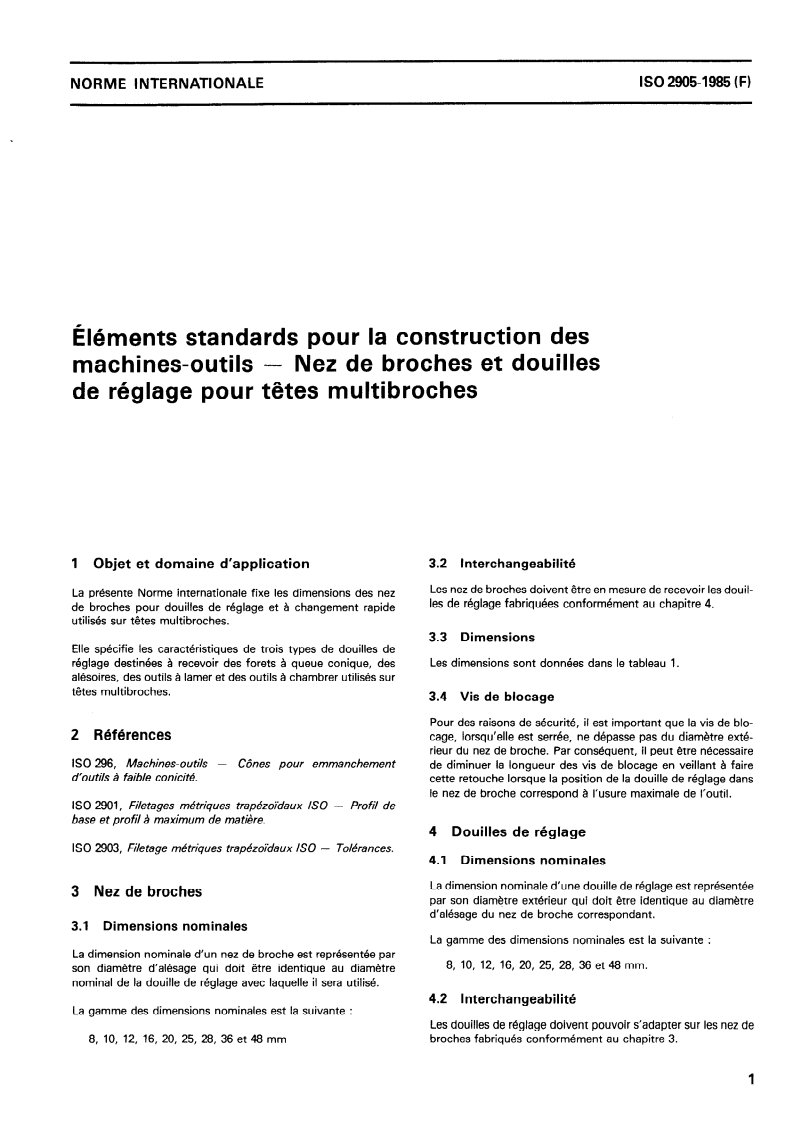
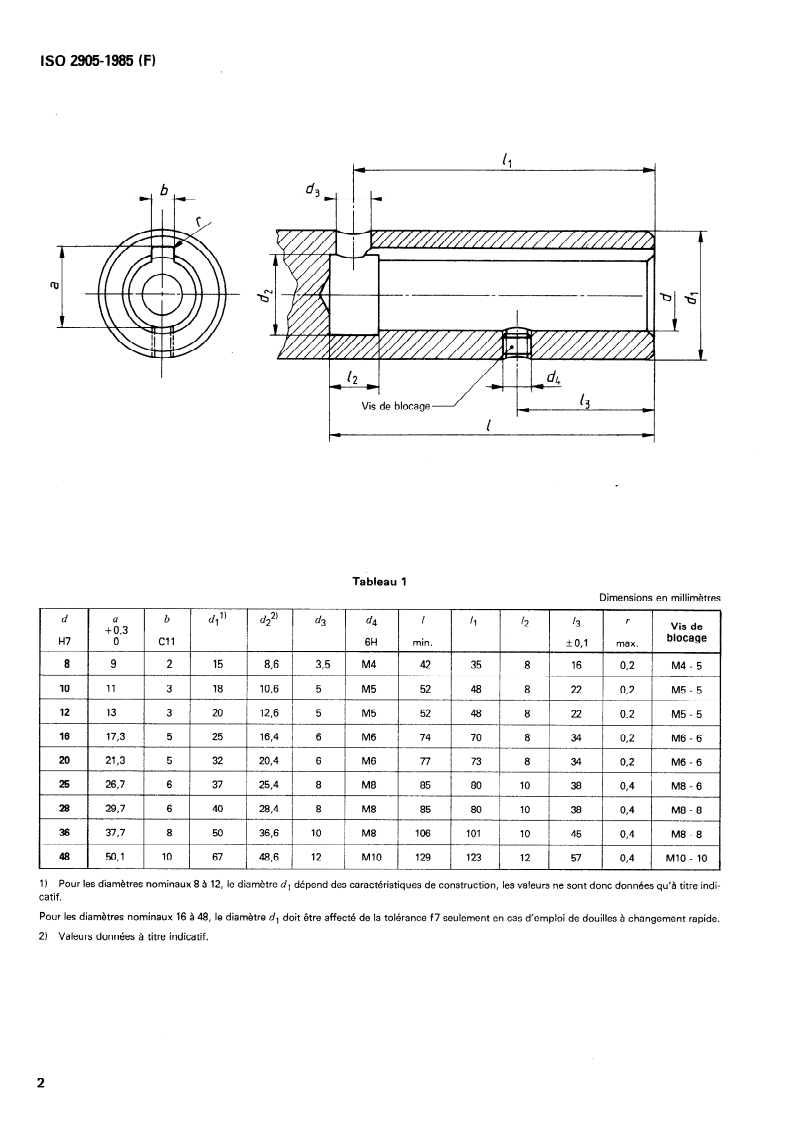
ISO 2905 defines nominal dimensions for spindle noses, represented by their bore diameters. The range includes nominal bore sizes of 8, 10, 12, 16, 20, 25, 28, 36, and 48 mm, ensuring that spindle noses accommodate a variety of adjustable and quick-change adaptors.Adjustable Adaptors
The standard specifies three types of adjustable adaptors compatible with taper shank drills, reamers, lapping tools, and spot-facing cutters. These adaptors are essential for modular machine design, enabling quick tool replacement while maintaining precision.Interchangeability and Fit
All spindle noses and adaptors manufactured according to ISO 2905 are designed for interchangeability, with consistent bore diameters and thread standards. This guarantees component compatibility across different manufacturers following the standard.Safety Requirements
The standard highlights safety considerations, especially regarding locking screws (vis de blocage). These screws must not extend beyond the spindle nose's outer diameter when tightened, preventing operational hazards and ensuring secure fastening of adaptors.Thread and Tolerance Specifications
Threads must comply with ISO 2901 and ISO 296 for metric trapezoidal threads, with specific tolerances adjusted for spindle nose diameters. The standard also details conical bore geometry per ISO 296 to ensure correct seating of adaptors.Marking and Identification
For traceability and proper usage, spindle noses and adaptors must be clearly marked with the type, nominal dimensions, and Morse taper numbers where applicable.
Applications
ISO 2905:1985 is primarily used in the manufacturing and maintenance of:
Multi-spindle Machine Tools
Multi-spindle heads used in operations such as drilling, reaming, and spot-facing where simultaneous machining with multiple tools increases productivity.Modular Machine Construction
Facilitates the modular assembly and interchange of components, enabling customization and adaptability in machine tool construction.Tooling Systems
Enables standardized design and production of adjustable adaptors for taper shank drills and cutters, ensuring quick changeover and operational precision.Machine Tool Maintenance and Upgrades
Ensures that replacement spindle noses and adaptors fit and perform identically to the original components as per the standardized dimensions.
Related Standards
ISO 296: Taper Shanks for Machine Tools
Defines the geometry and dimensions of taper shanks compatible with the adaptable spindle noses covered in ISO 2905.ISO 2901: Metric Trapezoidal Threads – Basic Profile and Maximum Material Condition
Specifies thread design and tolerances applicable to locking screws and adaptor threads in spindle noses.ISO 2903: Metric Trapezoidal Threads – Tolerances
Provides tolerance classes for trapezoidal threads, relevant for the threaded connections in adaptors and locking mechanisms.
Practical Value
Implementing ISO 2905:1985 ensures:
Enhanced Interchangeability
Components from different manufacturers or batches can be seamlessly integrated.Improved Safety
Locking screws and adaptors designed with safety margins reduce the risk of operational failures.Operational Efficiency
Quick-change adaptors reduce machine downtime during tooling changes.Standardized Manufacturing
Directs machine tool builders to manufacture parts within defined tolerances and dimensions, facilitating global compatibility.Maintenance Simplification
Uniform dimensions and clear marking simplify parts identification and replacement.
By adhering to ISO 2905:1985, manufacturers and users of multi-spindle machine tools benefit from a robust framework that supports modularity, safety, and operational precision in machining processes. This standard remains a critical reference in the design and construction of efficient and reliable machine tools.
Relations
- Effective Date
- 15-Apr-2008
Buy Documents
ISO 2905:1985 - Modular units for machine tool construction -- Spindle noses and adjustable adaptors for multi-spindle heads
ISO 2905:1985 - Modular units for machine tool construction — Spindle noses and adjustable adaptors for multi-spindle heads/28/1985
ISO 2905:1985 - Éléments standards pour la construction des machines-outils -- Nez de broches et douilles de réglage pour tetes multibroches
ISO 2905:1985 - Éléments standards pour la construction des machines-outils -- Nez de broches et douilles de réglage pour tetes multibroches
ISO 2905:1985 - Éléments standards pour la construction des machines-outils — Nez de broches et douilles de réglage pour têtes multibroches/28/1985
ISO 2905:1985 - Éléments standards pour la construction des machines-outils — Nez de broches et douilles de réglage pour têtes multibroches/28/1985
Get Certified
Connect with accredited certification bodies for this standard

DVS-ZERT GmbH
German welding certification society.
CARES (UK Certification Authority for Reinforcing Steels)
UK certification for reinforcing steels and construction.
EWF/IIW (European/International Welding Federation)
International welding personnel certification.
Sponsored listings
Frequently Asked Questions
ISO 2905:1985 is a standard published by the International Organization for Standardization (ISO). Its full title is "Modular units for machine tool construction — Spindle noses and adjustable adaptors for multi-spindle heads". This standard covers: This second edition cancels and replaces the first edition (i.e. ISO 2905-1974). Specifies dimensions for spindle noses for use with adjustable adaptors and quick-change adaptors used multi-spindle heads. ISO 2905 specifies requirements for types of adjustable adaptors to fit taper shank drills, reamers and spot-facing cutters.
This second edition cancels and replaces the first edition (i.e. ISO 2905-1974). Specifies dimensions for spindle noses for use with adjustable adaptors and quick-change adaptors used multi-spindle heads. ISO 2905 specifies requirements for types of adjustable adaptors to fit taper shank drills, reamers and spot-facing cutters.
ISO 2905:1985 is classified under the following ICS (International Classification for Standards) categories: 25.060.10 - Modular units and other devices. The ICS classification helps identify the subject area and facilitates finding related standards.
ISO 2905:1985 has the following relationships with other standards: It is inter standard links to ISO 2905:1974. Understanding these relationships helps ensure you are using the most current and applicable version of the standard.
ISO 2905:1985 is available in PDF format for immediate download after purchase. The document can be added to your cart and obtained through the secure checkout process. Digital delivery ensures instant access to the complete standard document.
Standards Content (Sample)
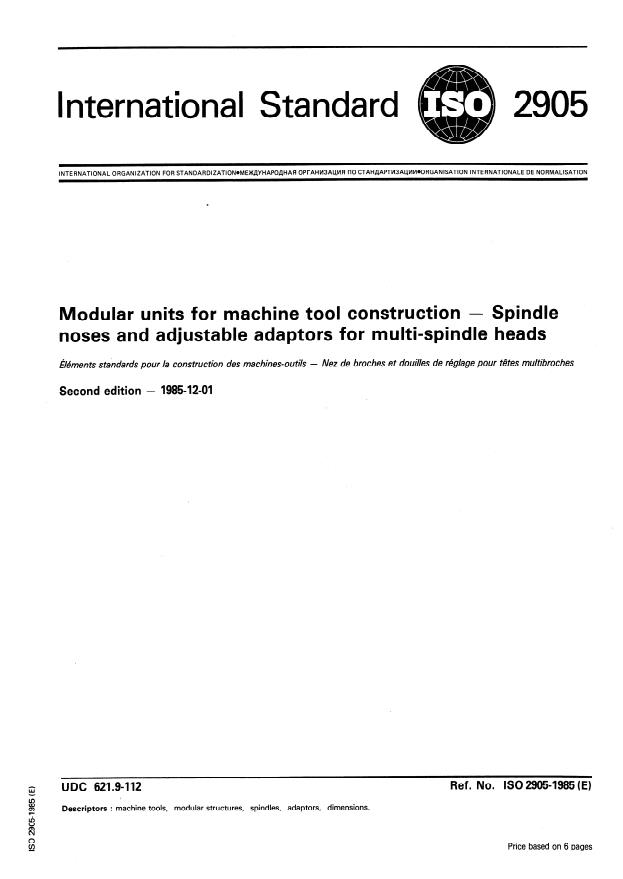
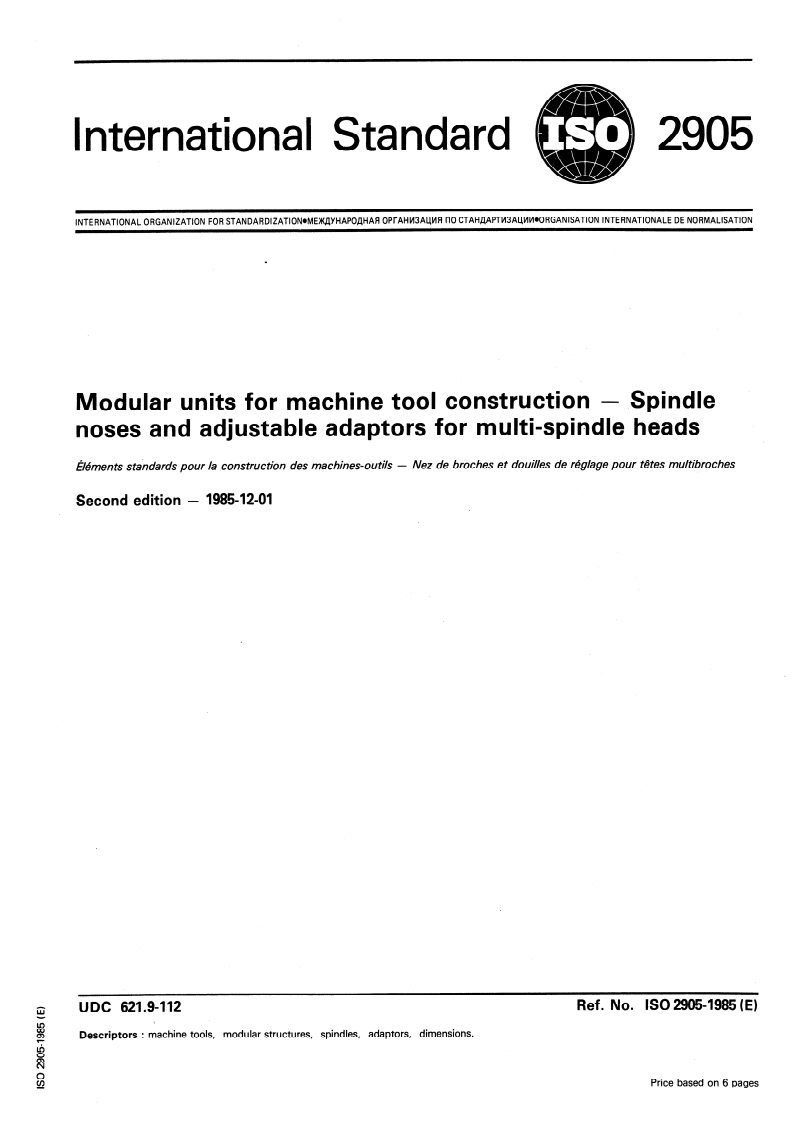
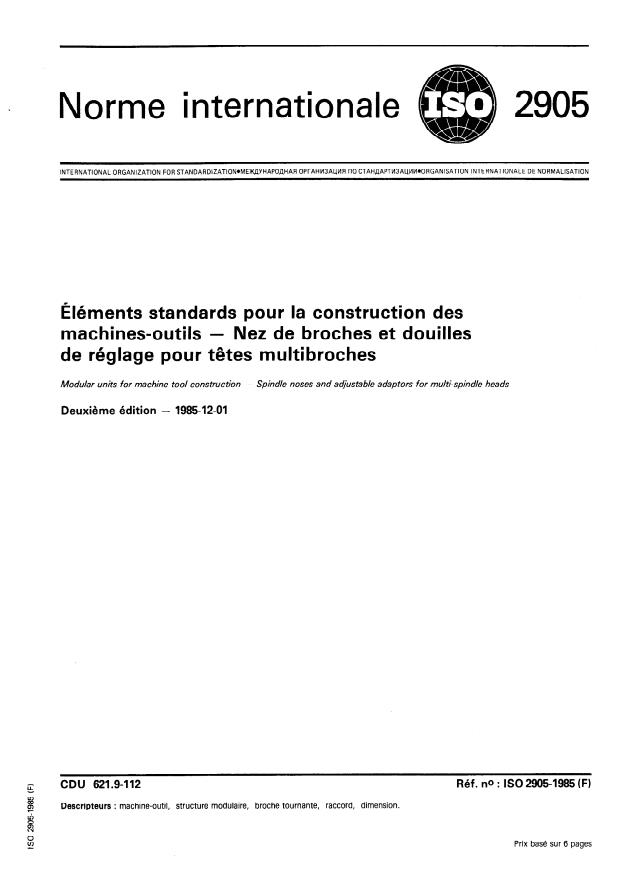
International Standard
INTERNATIONAL ORGANIZATION FOR STANDARDIZATION.MEXiIYHAPOfiHAR OPrAHM3ALlMR l-IO CTAHI1APTM3ALW~ORGANISATION INTERNATIONALE DE NORMALISATION
Modular units for machine tool construction - Spindle
noses and adjustable adaptors for multi-spindle heads
&ments Standards pour Ia construction des machines-outifs - Nez de broches et douifles de reglage pour t&es multibroches
Second edition - 1985-12-01
UDC 621.9412 Ref. No. ISO 29051985 (E)
Descriptors : machine tools, modular structures, spindles, adaptors, dimensions.
Price based on 6 pages
Foreword
ISO (the International Organization for Standardization) is a worldwide federation of
national Standards bodies (ISO member bodies). The work of preparing International
Standards is normally carried out through ISO technical committees. Esch member
body interested in a subject for which a technical committee has been established has
the right to be represented on that committee. International organizations, govern-
mental and non-governmental, in liaison with ISO, also take part in the work.
Draft International Standards adopted by the technical committees are circulated to
the member bodies for approval before their acceptance as International Standards by
the ISO Council. They are approved in accordance with ISO procedures requiring at
least 75 % approval by the member bodies voting.
International Standard ISO 2905 was prepared by Technical Committee ISO/TC 39,
Machine tools.
ISO 2995 was first published in 1974. This second edition cancels and replaces the first
edition, of which the tolerante on the adjustable adaptor outside diameter, d, has been
technically revised.
Users should note that all International Standards undergo revision from time to time
and that any reference made herein to any other International Standard implies its
latest edition, unless othetwise stated.
0 International Organkation for Standardiration, 1985 *
Printed in Switzerland
ISO 29054985 (E)
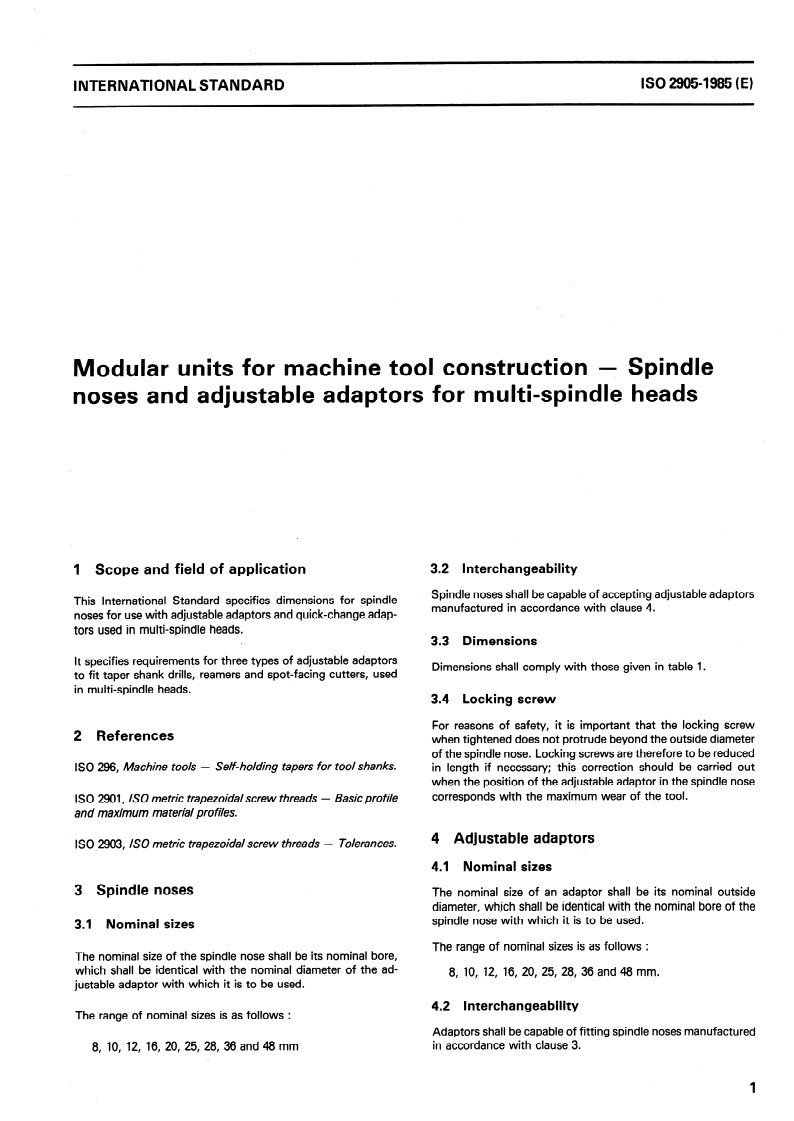
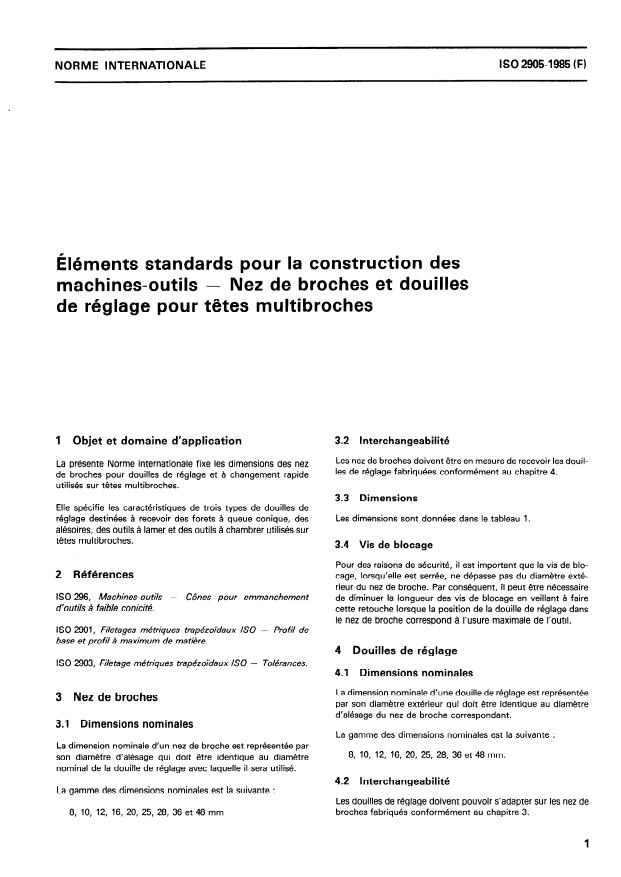
INTERNATIONAL STANDARD
Modular units for machine tool construction - Spindle
noses and adjustable adaptors for multi-spindle heads
3.2 Interchangeability
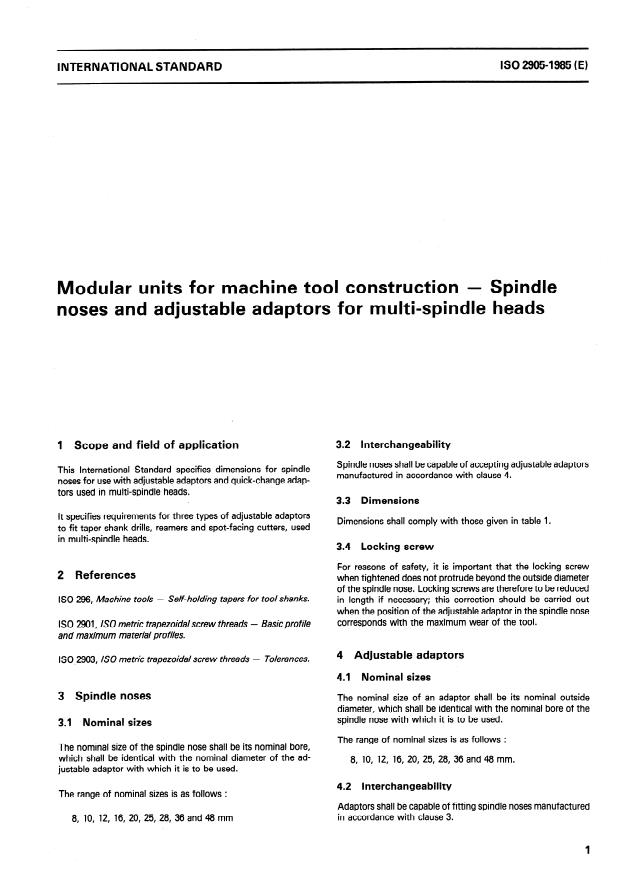
1 Scope and field of application
Spindle noses shall be capable of accepting adjustable adaptors
This International Standard specifies dimensions for spindle
manufactured in accordance with clause 4.
noses for use with adjustable adaptors and quick-change adap-
tors used in multi-spindle heads.
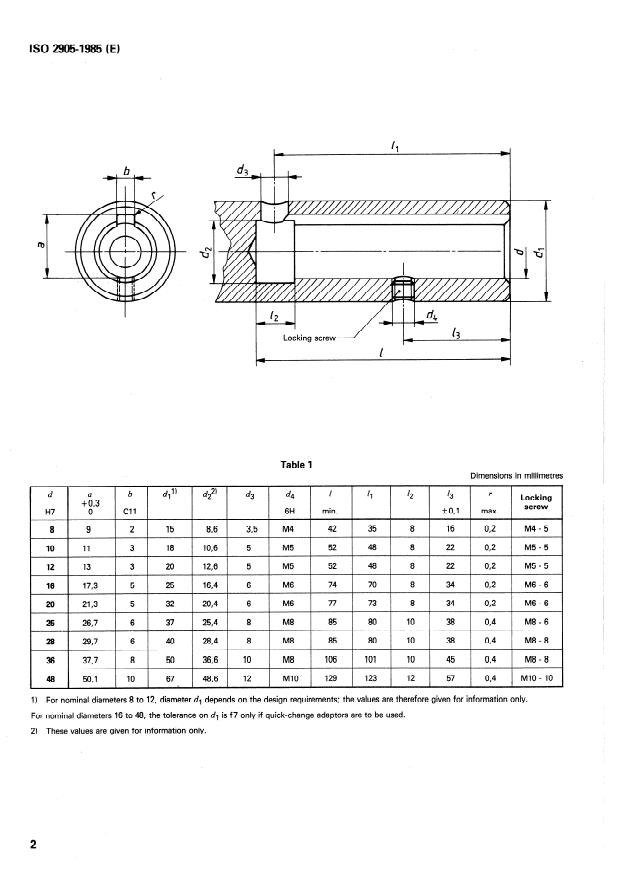
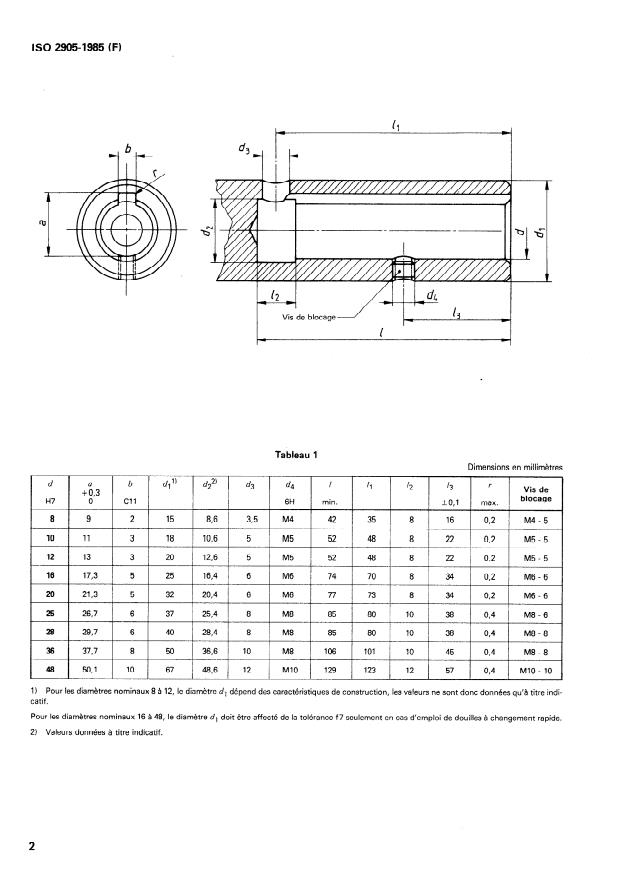
3.3 Dimensions
lt specifies requirements for three types of adjustable adaptors
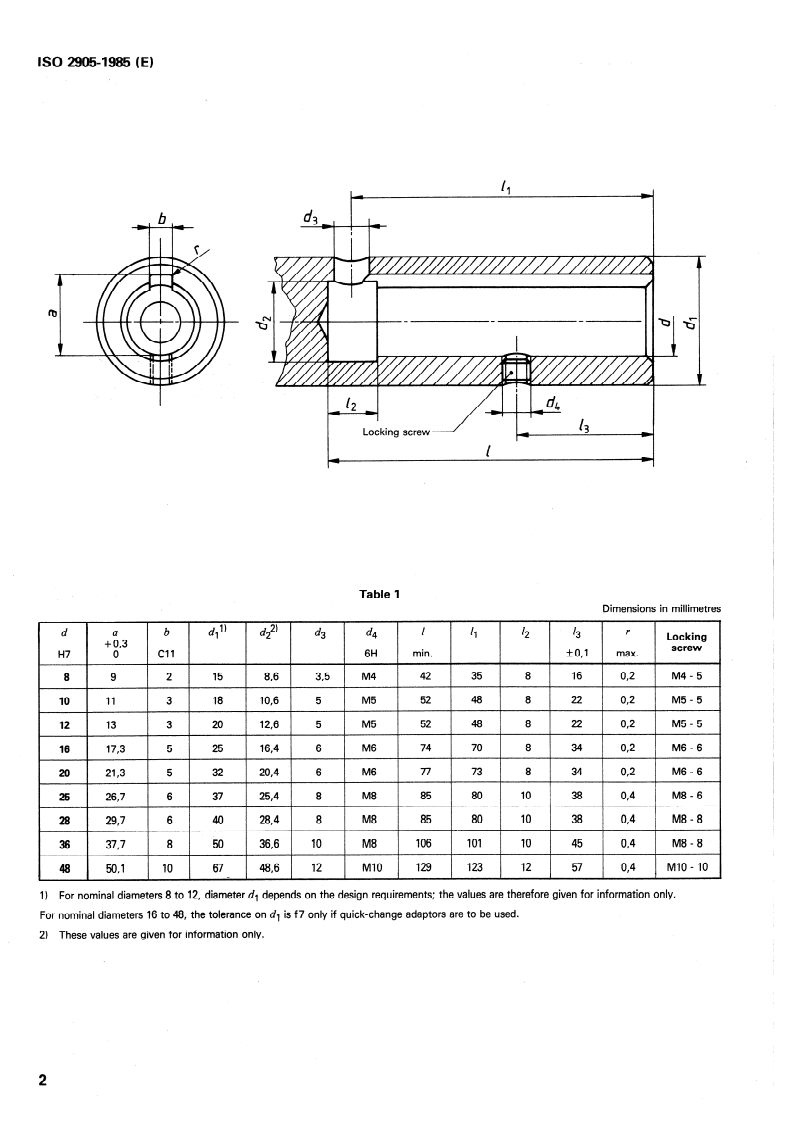
Dimensions shall comply with those given in table 1.
to fit taper shank drills, reamers and spot-facing Cutters, used
in multi-spindle heads.
3.4 Locking screw
For reasons of safety, it is important that the locking screw
2 References
when tightened does not protrude beyond the outside diameter
of the spindle nose. Locking screws are therefore to be reduced
ISO 296, Machine tools - Self-holding tapers for tool shanks.
in length if necessary; this correction should be carried out
when the Position of the adjustable adaptor in the spindle nose
corresponds with the maximum wear of the tool.
ISO 2901, ISO metric trapezoidal screw threads - Basic Profile
and maximum material profiles.
4 Adjustable adaptors
ISO 2903, ISO metric trapezoidal screw threads - Tolerantes.
4.1 Nominal sizes
3 Spindle noses
The nominal size of an adaptor shall be its nominal outside
diameter, whjch shall be identical with the nominal bore of the
spindle nose with which it is to be used.
3.1 Nominal sizes
The range of nominal sizes is as follows :
The nominal size of the spindle nose shall be its nominal bore,
which shall be identical with the nominal diameter of the ad-
8, 10, 12, 16,20,25,28,36 and48 mm.
justable adaptor with which it is to be used.
4.2 Interchangeability
The range of nominal sizes is as follows :
Adaptors shall be capable of fitting spindle noses manufactured
8, 10, 12, 16, 20, 25, 28, 36 and 48 mm in accordance with clause 3.
ISO 29051985 (El
Locking screw ----/
Table 1
Dimensions in millimetres
CI b 4 1) d2 2) d3 d4 I 4 12 13 r
d
Locking
+0,3
screw
min.
H7 0 Cl1 6H +0,1 max.
9 2 15 86 3,5 M4 42 35 8
8 16 02 M4 - 5
11 3 18 10,6 5 M5 52 48 8
10 22 02 M5 - 5
13 3 20 12,6 5 M5 52 48 8
12 22 02 M5-5
17,3 5 25 16,4 6 M6 74 70 8 34 02
16 M6-6
21,3 5 32 20,4 6 M6 77 73 8 34 02 M6 - 6
m
26,7
6 37 25,4 8 M8 85 80 10 38 03 M8 - 6
29‘7
6 40 28,4 8 M8 85 80 10 38 0,4 M8 - 8
37,7 8 50
36,6 10 M8 106 101 10 45 09 M8 - 8
1 50,1 , 10 67
48 , , 4W , 12 , MIO , 129 , 123 , 12 , 57 w MIO - 10
1) For nominal diameters 8 to 12, diameter dl depends on the design requirements; the values are therefore given for informa
...
International Standard
INTERNATIONAL ORGANIZATION FOR STANDARDIZATION.MEXiIYHAPOfiHAR OPrAHM3ALlMR l-IO CTAHI1APTM3ALW~ORGANISATION INTERNATIONALE DE NORMALISATION
Modular units for machine tool construction - Spindle
noses and adjustable adaptors for multi-spindle heads
&ments Standards pour Ia construction des machines-outifs - Nez de broches et douifles de reglage pour t&es multibroches
Second edition - 1985-12-01
UDC 621.9412 Ref. No. ISO 29051985 (E)
Descriptors : machine tools, modular structures, spindles, adaptors, dimensions.
Price based on 6 pages
Foreword
ISO (the International Organization for Standardization) is a worldwide federation of
national Standards bodies (ISO member bodies). The work of preparing International
Standards is normally carried out through ISO technical committees. Esch member
body interested in a subject for which a technical committee has been established has
the right to be represented on that committee. International organizations, govern-
mental and non-governmental, in liaison with ISO, also take part in the work.
Draft International Standards adopted by the technical committees are circulated to
the member bodies for approval before their acceptance as International Standards by
the ISO Council. They are approved in accordance with ISO procedures requiring at
least 75 % approval by the member bodies voting.
International Standard ISO 2905 was prepared by Technical Committee ISO/TC 39,
Machine tools.
ISO 2995 was first published in 1974. This second edition cancels and replaces the first
edition, of which the tolerante on the adjustable adaptor outside diameter, d, has been
technically revised.
Users should note that all International Standards undergo revision from time to time
and that any reference made herein to any other International Standard implies its
latest edition, unless othetwise stated.
0 International Organkation for Standardiration, 1985 *
Printed in Switzerland
ISO 29054985 (E)
INTERNATIONAL STANDARD
Modular units for machine tool construction - Spindle
noses and adjustable adaptors for multi-spindle heads
3.2 Interchangeability
1 Scope and field of application
Spindle noses shall be capable of accepting adjustable adaptors
This International Standard specifies dimensions for spindle
manufactured in accordance with clause 4.
noses for use with adjustable adaptors and quick-change adap-
tors used in multi-spindle heads.
3.3 Dimensions
lt specifies requirements for three types of adjustable adaptors
Dimensions shall comply with those given in table 1.
to fit taper shank drills, reamers and spot-facing Cutters, used
in multi-spindle heads.
3.4 Locking screw
For reasons of safety, it is important that the locking screw
2 References
when tightened does not protrude beyond the outside diameter
of the spindle nose. Locking screws are therefore to be reduced
ISO 296, Machine tools - Self-holding tapers for tool shanks.
in length if necessary; this correction should be carried out
when the Position of the adjustable adaptor in the spindle nose
corresponds with the maximum wear of the tool.
ISO 2901, ISO metric trapezoidal screw threads - Basic Profile
and maximum material profiles.
4 Adjustable adaptors
ISO 2903, ISO metric trapezoidal screw threads - Tolerantes.
4.1 Nominal sizes
3 Spindle noses
The nominal size of an adaptor shall be its nominal outside
diameter, whjch shall be identical with the nominal bore of the
spindle nose with which it is to be used.
3.1 Nominal sizes
The range of nominal sizes is as follows :
The nominal size of the spindle nose shall be its nominal bore,
which shall be identical with the nominal diameter of the ad-
8, 10, 12, 16,20,25,28,36 and48 mm.
justable adaptor with which it is to be used.
4.2 Interchangeability
The range of nominal sizes is as follows :
Adaptors shall be capable of fitting spindle noses manufactured
8, 10, 12, 16, 20, 25, 28, 36 and 48 mm in accordance with clause 3.
ISO 29051985 (El
Locking screw ----/
Table 1
Dimensions in millimetres
CI b 4 1) d2 2) d3 d4 I 4 12 13 r
d
Locking
+0,3
screw
min.
H7 0 Cl1 6H +0,1 max.
9 2 15 86 3,5 M4 42 35 8
8 16 02 M4 - 5
11 3 18 10,6 5 M5 52 48 8
10 22 02 M5 - 5
13 3 20 12,6 5 M5 52 48 8
12 22 02 M5-5
17,3 5 25 16,4 6 M6 74 70 8 34 02
16 M6-6
21,3 5 32 20,4 6 M6 77 73 8 34 02 M6 - 6
m
26,7
6 37 25,4 8 M8 85 80 10 38 03 M8 - 6
29‘7
6 40 28,4 8 M8 85 80 10 38 0,4 M8 - 8
37,7 8 50
36,6 10 M8 106 101 10 45 09 M8 - 8
1 50,1 , 10 67
48 , , 4W , 12 , MIO , 129 , 123 , 12 , 57 w MIO - 10
1) For nominal diameters 8 to 12, diameter dl depends on the design requirements; the values are therefore given for informa
...
Norme internationale
INTERNATIONAL ORGANIZATION FOR STANDARDIZATION.MEX~YHAPO~HAR OPrAHM3ALlMR Il0 CTAH,QAPTM3A~MWORGANISATION INTERNATIONALE DE NORMALISATION
Éléments standards pour la construction des
machines-outils - Nez de broches et douilles
de réglage pour têtes multibroches
- Spindle noses and adjustable adaptors for multi-spindle heads
Modular units for machine tool construction
Deuxième édition - 1985-12-01
Réf. no : ISO 29054985 (F)
CDU 621.9-l 12
Descripteurs : machine-outil, structure modulaire, broche tournante, raccord, dimension.
Prix basé sur 6 pages
Avant-propos
L’ISO (Organisation internationale de normalisation) est une fédération mondiale
d’organismes nationaux de normalisation (comités membres de I’ISO). L’élaboration
des Normes internationales est confiée aux comités techniques de I’ISO. Chaque
comite membre intéressé par une étude a le droit de faire partie du comité technique
creé à cet effet. Les organisations internationales, gouvernementales et non gouverne-
mentales, en liaison avec I’ISO, participent également aux travaux.
Les projets de Normes internationales adoptés par les comités techniques sont soumis
aux comités membres pour approbation, avant leur acceptation comme Normes inter-
nationales par le Conseil de I’ISO. Les Normes internationales sont approuvées confor-
mement aux procédures de I’ISO qui requièrent l’approbation de 75 % au moins des
comités membres votants.
La Norme internationale ISO 2905 a été élaborée par le comité technique lSO/TC 39,
Machines- outils.
La Norme international ISO 2905 a été pour la première fois publiée en 1974. Cette
deuxiéme édition annule et remplace la Premiere édition dont la tolérance sur le diamè-
tre extérieur de la douille de réglage, d, a fait l’objet d’une révision technique.
L’attention des utilisateurs est attirée sur le fait que toutes les Normes internationales
sont de temps en temps soumises à révision et que toute référence faite à une autre
Norme internationale dans le présent document implique qu’il s’agit, sauf indication
contraire, de la dernière édition,
CE
0 Organisation internationale de normalisation, 1985
Imprimé en Suisse
ISO 2905-1985 (F)
NORME INTERNATIONALE
Éléments standards pour la construction des
Nez de broches et douilles
machines-outils -
de réglage pour têtes multibroches
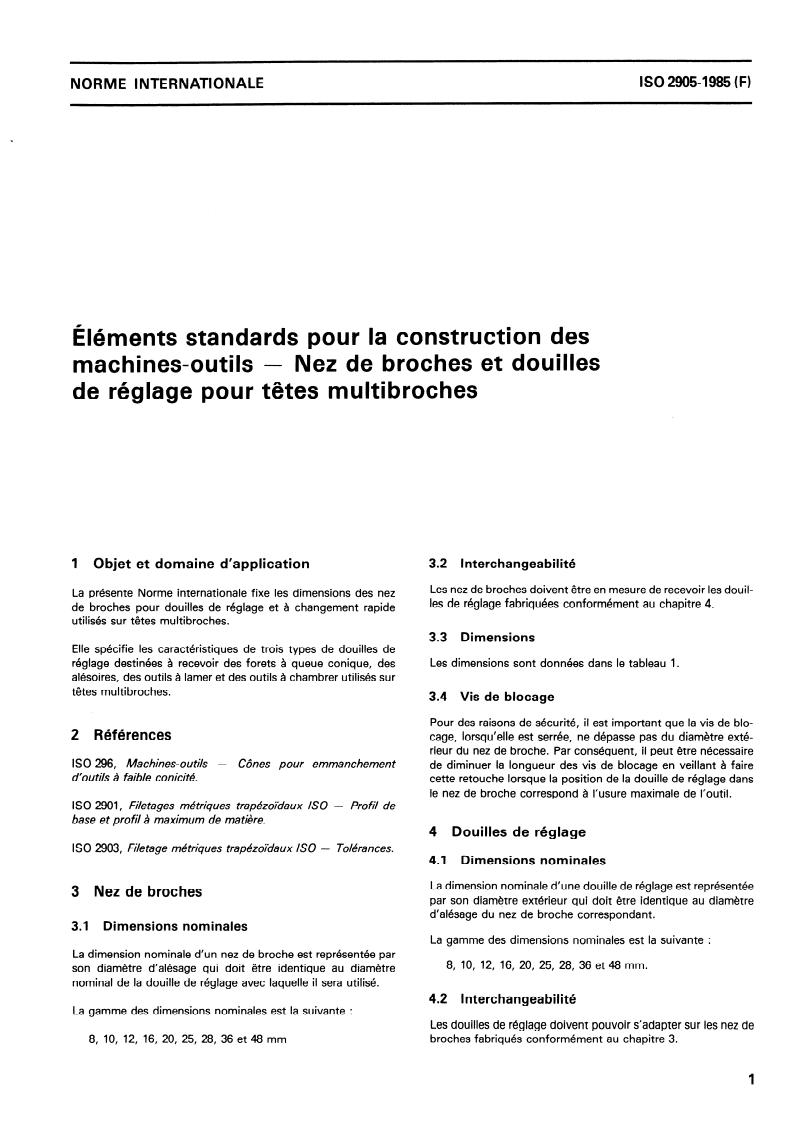
3.2 Interchangeabilité
1 Objet et domaine d’application
Les nez de broches doivent être en mesure de recevoir les douil-
La présente Norme internationale fixe les dimensions des nez
les de réglage fabriquées conformément au chapitre 4.
de broches pour douilles de réglage et à changement rapide
utilisés sur têtes multibroches.
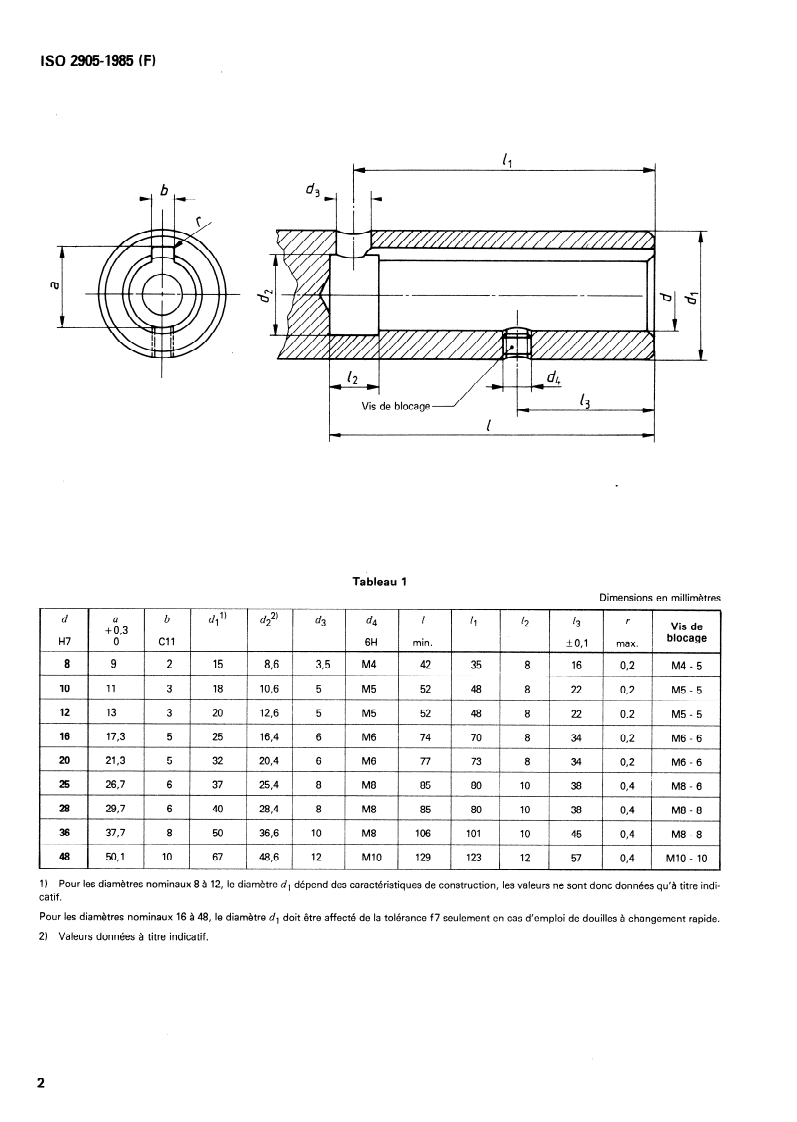
3.3 Dimensions
Elle spécifie les caractéristiques de trois types de douilles de
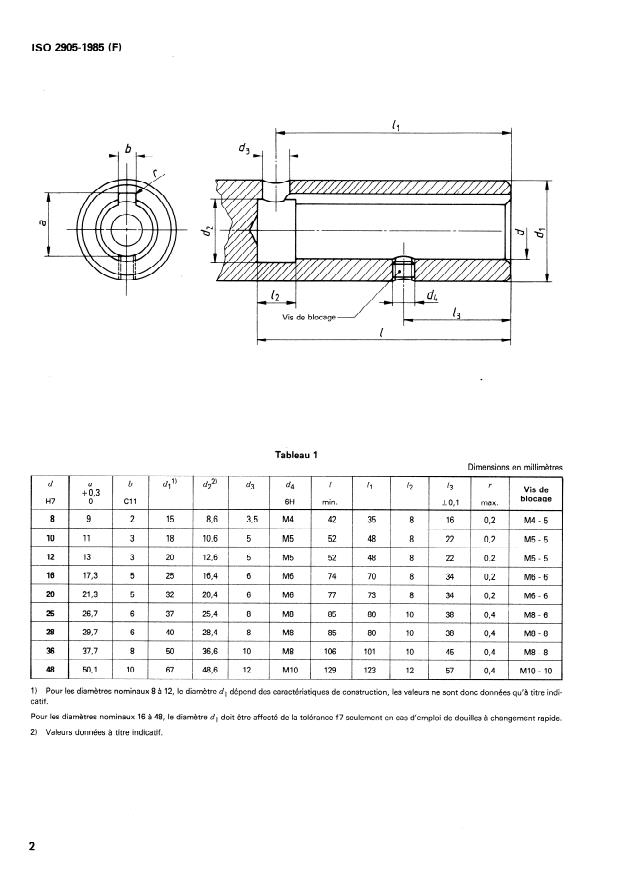
Les dimensions sont données dans le tableau 1.
réglage destinées à recevoir des forets à queue conique, des
alésoires, des outils à lamer et des outils à chambrer utilisés sur
têtes multibroches.
3.4 Vis de blocage
Pour des raisons de sécurité, il est important que la vis de blo-
2 Références cage, lorsqu’elle est serrée, ne dépasse pas du diamètre exté-
rieur du nez de broche. Par conséquent, il peut être nécessaire
Cônes pour emmanchement
ISO 296, Machines-outils - de diminuer la longueur des vis de blocage en veillant à faire
d’outils à faible tonicité. cette retouche lorsque la position de la douille de réglage dans
le nez de broche correspond à l’usure maximale de l’outil.
ISO 2901, Filetages métriques trapkoïdaux /SO - Profil de
base et profil à maximum de matière.
4 Douilles de réglage
I SO 2903, Filetage métriques trapézoïdaux /SO - Tolkances.
4.1 Dimensions nominales
La dimension nominale d’une douille de réglage est représentée
3 Nez de broches
par son diamètre extérieur qui doit être identique au diamètre
d’alésage du nez de broche correspondant.
3.1 Dimensions nominales
La gamme des dimensions nominales est la suivante :
La dimension nominale d’un nez de broche est représentée par
8, 10, 12, 16, 20, 25, 28, 36 et 48 mm.
son diamètre d’alésage qui doit être identique au diamètre
nominal de la douille de réglage avec laquelle il sera utilisé.
4.2 Interchangeabilité
La gamme des dimensions nominales est la suivante :
Les douilles de réglage doivent pouvoir s’adapter sur les nez de
broches fabriqués conformément au chapitre 3.
8, 10, 12, 16, 20, 25, 28, 36 et 48 mm
ISO 29054985 (F)
Tableau *II
Dimensions en millimètres
1) 2)
d a b I F-
4 12 13
dl d2 d3 d4
Vi
...
Norme internationale
INTERNATIONAL ORGANIZATION FOR STANDARDIZATION.MEX~YHAPO~HAR OPrAHM3ALlMR Il0 CTAH,QAPTM3A~MWORGANISATION INTERNATIONALE DE NORMALISATION
Éléments standards pour la construction des
machines-outils - Nez de broches et douilles
de réglage pour têtes multibroches
- Spindle noses and adjustable adaptors for multi-spindle heads
Modular units for machine tool construction
Deuxième édition - 1985-12-01
Réf. no : ISO 29054985 (F)
CDU 621.9-l 12
z
Y
Descripteurs : machine-outil, structure modulaire, broche tournante, raccord, dimension.
Prix basé sur 6 pages
Avant-propos
L’ISO (Organisation internationale de normalisation) est une fédération mondiale
d’organismes nationaux de normalisation (comités membres de I’ISO). L’élaboration
des Normes internationales est confiée aux comités techniques de I’ISO. Chaque
comite membre intéressé par une étude a le droit de faire partie du comité technique
creé à cet effet. Les organisations internationales, gouvernementales et non gouverne-
mentales, en liaison avec I’ISO, participent également aux travaux.
Les projets de Normes internationales adoptés par les comités techniques sont soumis
aux comités membres pour approbation, avant leur acceptation comme Normes inter-
nationales par le Conseil de I’ISO. Les Normes internationales sont approuvées confor-
mement aux procédures de I’ISO qui requièrent l’approbation de 75 % au moins des
comités membres votants.
La Norme internationale ISO 2905 a été élaborée par le comité technique lSO/TC 39,
Machines- outils.
La Norme international ISO 2905 a été pour la première fois publiée en 1974. Cette
deuxiéme édition annule et remplace la Premiere édition dont la tolérance sur le diamè-
tre extérieur de la douille de réglage, d, a fait l’objet d’une révision technique.
L’attention des utilisateurs est attirée sur le fait que toutes les Normes internationales
sont de temps en temps soumises à révision et que toute référence faite à une autre
Norme internationale dans le présent document implique qu’il s’agit, sauf indication
contraire, de la dernière édition.
0 Organisation internationale de normalisation, 1985 @
Imprimé en Suisse
ISO 2905-1985 (F)
NORME INTERNATIONALE
Éléments standards pour la construction des
Nez de broches et douilles
machines-outils -
de réglage pour têtes multibroches
3.2 Interchangeabilité
1 Objet et domaine d’application
Les nez de broches doivent être en mesure de recevoir les douil-
La présente Norme internationale fixe les dimensions des nez
les de réglage fabriquées conformément au chapitre 4.
de broches pour douilles de réglage et à changement rapide
utilisés sur têtes multibroches.
3.3 Dimensions
Elle spécifie les caractéristiques de trois types de douilles de
Les dimensions sont données dans le tableau 1.
réglage destinées à recevoir des forets à queue conique, des
alésoires, des outils à lamer et des outils à chambrer utilisés sur
têtes multibroches.
3.4 Vis de blocage
Pour des raisons de sécurité, il est important que la vis de blo-
2 Références cage, lorsqu’elle est serrée, ne dépasse pas du diamètre exté-
rieur du nez de broche. Par conséquent, il peut être nécessaire
Cônes pour emmanchement
ISO 296, Machines-outils - de diminuer la longueur des vis de blocage en veillant à faire
d’outils à faible tonicité. cette retouche lorsque la position de la douille de réglage dans
le nez de broche correspond à l’usure maximale de l’outil.
ISO 2901, Filetages métriques trapkoïdaux /SO - Profil de
base et profil à maximum de matière.
4 Douilles de réglage
I SO 2903, Filetage métriques trapézoïdaux /SO - Tokances.
4.1 Dimensions nominales
La dimension nominale d’une douille de réglage est représentée
3 Nez de broches
par son diamètre extérieur qui doit être identique au diamètre
d’alésage du nez de broche correspondant.
3.1 Dimensions nominales
La gamme des dimensions nominales est la suivante :
La dimension nominale d’un nez de broche est représentée par
8, 10, 12, 16, 20, 25, 28, 36 et 48 mm.
son diamètre d’alésage qui doit être identique au diamètre
nominal de la douille de réglage avec laquelle il sera utilisé.
4.2 Interchangeabilité
La gamme des dimensions nominales est la suivante :
Les douilles de réglage doivent pouvoir s’adapter sur les nez de
broches fabriqués conformément au chapitre 3.
8, 10, 12, 16, 20, 25, 28, 36 et 48 mm
ISO 29054985 (F)
Tableau *II
Dimensions en millimètres
1) 2)
d a b I F-
dl d2 d3 d4 4 12 13
Vis de
+0,3
...
Norme internationale
INTERNATIONAL ORGANIZATION FOR STANDARDIZATION.MEX~YHAPO~HAR OPrAHM3ALlMR Il0 CTAH,QAPTM3A~MWORGANISATION INTERNATIONALE DE NORMALISATION
Éléments standards pour la construction des
machines-outils - Nez de broches et douilles
de réglage pour têtes multibroches
- Spindle noses and adjustable adaptors for multi-spindle heads
Modular units for machine tool construction
Deuxième édition - 1985-12-01
Réf. no : ISO 29054985 (F)
CDU 621.9-l 12
z
Y
Descripteurs : machine-outil, structure modulaire, broche tournante, raccord, dimension.
Prix basé sur 6 pages
Avant-propos
L’ISO (Organisation internationale de normalisation) est une fédération mondiale
d’organismes nationaux de normalisation (comités membres de I’ISO). L’élaboration
des Normes internationales est confiée aux comités techniques de I’ISO. Chaque
comite membre intéressé par une étude a le droit de faire partie du comité technique
creé à cet effet. Les organisations internationales, gouvernementales et non gouverne-
mentales, en liaison avec I’ISO, participent également aux travaux.
Les projets de Normes internationales adoptés par les comités techniques sont soumis
aux comités membres pour approbation, avant leur acceptation comme Normes inter-
nationales par le Conseil de I’ISO. Les Normes internationales sont approuvées confor-
mement aux procédures de I’ISO qui requièrent l’approbation de 75 % au moins des
comités membres votants.
La Norme internationale ISO 2905 a été élaborée par le comité technique lSO/TC 39,
Machines- outils.
La Norme international ISO 2905 a été pour la première fois publiée en 1974. Cette
deuxiéme édition annule et remplace la Premiere édition dont la tolérance sur le diamè-
tre extérieur de la douille de réglage, d, a fait l’objet d’une révision technique.
L’attention des utilisateurs est attirée sur le fait que toutes les Normes internationales
sont de temps en temps soumises à révision et que toute référence faite à une autre
Norme internationale dans le présent document implique qu’il s’agit, sauf indication
contraire, de la dernière édition.
0 Organisation internationale de normalisation, 1985 @
Imprimé en Suisse
ISO 2905-1985 (F)
NORME INTERNATIONALE
Éléments standards pour la construction des
Nez de broches et douilles
machines-outils -
de réglage pour têtes multibroches
3.2 Interchangeabilité
1 Objet et domaine d’application
Les nez de broches doivent être en mesure de recevoir les douil-
La présente Norme internationale fixe les dimensions des nez
les de réglage fabriquées conformément au chapitre 4.
de broches pour douilles de réglage et à changement rapide
utilisés sur têtes multibroches.
3.3 Dimensions
Elle spécifie les caractéristiques de trois types de douilles de
Les dimensions sont données dans le tableau 1.
réglage destinées à recevoir des forets à queue conique, des
alésoires, des outils à lamer et des outils à chambrer utilisés sur
têtes multibroches.
3.4 Vis de blocage
Pour des raisons de sécurité, il est important que la vis de blo-
2 Références cage, lorsqu’elle est serrée, ne dépasse pas du diamètre exté-
rieur du nez de broche. Par conséquent, il peut être nécessaire
Cônes pour emmanchement
ISO 296, Machines-outils - de diminuer la longueur des vis de blocage en veillant à faire
d’outils à faible tonicité. cette retouche lorsque la position de la douille de réglage dans
le nez de broche correspond à l’usure maximale de l’outil.
ISO 2901, Filetages métriques trapkoïdaux /SO - Profil de
base et profil à maximum de matière.
4 Douilles de réglage
I SO 2903, Filetage métriques trapézoïdaux /SO - Tokances.
4.1 Dimensions nominales
La dimension nominale d’une douille de réglage est représentée
3 Nez de broches
par son diamètre extérieur qui doit être identique au diamètre
d’alésage du nez de broche correspondant.
3.1 Dimensions nominales
La gamme des dimensions nominales est la suivante :
La dimension nominale d’un nez de broche est représentée par
8, 10, 12, 16, 20, 25, 28, 36 et 48 mm.
son diamètre d’alésage qui doit être identique au diamètre
nominal de la douille de réglage avec laquelle il sera utilisé.
4.2 Interchangeabilité
La gamme des dimensions nominales est la suivante :
Les douilles de réglage doivent pouvoir s’adapter sur les nez de
broches fabriqués conformément au chapitre 3.
8, 10, 12, 16, 20, 25, 28, 36 et 48 mm
ISO 29054985 (F)
Tableau *II
Dimensions en millimètres
1) 2)
d a b I F-
dl d2 d3 d4 4 12 13
Vis de
+0,3
...
Norme internationale
INTERNATIONAL ORGANIZATION FOR STANDARDIZATION.MEX~YHAPO~HAR OPrAHM3ALlMR Il0 CTAH,QAPTM3A~MWORGANISATION INTERNATIONALE DE NORMALISATION
Éléments standards pour la construction des
machines-outils - Nez de broches et douilles
de réglage pour têtes multibroches
- Spindle noses and adjustable adaptors for multi-spindle heads
Modular units for machine tool construction
Deuxième édition - 1985-12-01
Réf. no : ISO 29054985 (F)
CDU 621.9-l 12
Descripteurs : machine-outil, structure modulaire, broche tournante, raccord, dimension.
Prix basé sur 6 pages
Avant-propos
L’ISO (Organisation internationale de normalisation) est une fédération mondiale
d’organismes nationaux de normalisation (comités membres de I’ISO). L’élaboration
des Normes internationales est confiée aux comités techniques de I’ISO. Chaque
comite membre intéressé par une étude a le droit de faire partie du comité technique
creé à cet effet. Les organisations internationales, gouvernementales et non gouverne-
mentales, en liaison avec I’ISO, participent également aux travaux.
Les projets de Normes internationales adoptés par les comités techniques sont soumis
aux comités membres pour approbation, avant leur acceptation comme Normes inter-
nationales par le Conseil de I’ISO. Les Normes internationales sont approuvées confor-
mement aux procédures de I’ISO qui requièrent l’approbation de 75 % au moins des
comités membres votants.
La Norme internationale ISO 2905 a été élaborée par le comité technique lSO/TC 39,
Machines- outils.
La Norme international ISO 2905 a été pour la première fois publiée en 1974. Cette
deuxiéme édition annule et remplace la Premiere édition dont la tolérance sur le diamè-
tre extérieur de la douille de réglage, d, a fait l’objet d’une révision technique.
L’attention des utilisateurs est attirée sur le fait que toutes les Normes internationales
sont de temps en temps soumises à révision et que toute référence faite à une autre
Norme internationale dans le présent document implique qu’il s’agit, sauf indication
contraire, de la dernière édition,
CE
0 Organisation internationale de normalisation, 1985
Imprimé en Suisse
ISO 2905-1985 (F)
NORME INTERNATIONALE
Éléments standards pour la construction des
Nez de broches et douilles
machines-outils -
de réglage pour têtes multibroches
3.2 Interchangeabilité
1 Objet et domaine d’application
Les nez de broches doivent être en mesure de recevoir les douil-
La présente Norme internationale fixe les dimensions des nez
les de réglage fabriquées conformément au chapitre 4.
de broches pour douilles de réglage et à changement rapide
utilisés sur têtes multibroches.
3.3 Dimensions
Elle spécifie les caractéristiques de trois types de douilles de
Les dimensions sont données dans le tableau 1.
réglage destinées à recevoir des forets à queue conique, des
alésoires, des outils à lamer et des outils à chambrer utilisés sur
têtes multibroches.
3.4 Vis de blocage
Pour des raisons de sécurité, il est important que la vis de blo-
2 Références cage, lorsqu’elle est serrée, ne dépasse pas du diamètre exté-
rieur du nez de broche. Par conséquent, il peut être nécessaire
Cônes pour emmanchement
ISO 296, Machines-outils - de diminuer la longueur des vis de blocage en veillant à faire
d’outils à faible tonicité. cette retouche lorsque la position de la douille de réglage dans
le nez de broche correspond à l’usure maximale de l’outil.
ISO 2901, Filetages métriques trapkoïdaux /SO - Profil de
base et profil à maximum de matière.
4 Douilles de réglage
I SO 2903, Filetage métriques trapézoïdaux /SO - Tolkances.
4.1 Dimensions nominales
La dimension nominale d’une douille de réglage est représentée
3 Nez de broches
par son diamètre extérieur qui doit être identique au diamètre
d’alésage du nez de broche correspondant.
3.1 Dimensions nominales
La gamme des dimensions nominales est la suivante :
La dimension nominale d’un nez de broche est représentée par
8, 10, 12, 16, 20, 25, 28, 36 et 48 mm.
son diamètre d’alésage qui doit être identique au diamètre
nominal de la douille de réglage avec laquelle il sera utilisé.
4.2 Interchangeabilité
La gamme des dimensions nominales est la suivante :
Les douilles de réglage doivent pouvoir s’adapter sur les nez de
broches fabriqués conformément au chapitre 3.
8, 10, 12, 16, 20, 25, 28, 36 et 48 mm
ISO 29054985 (F)
Tableau *II
Dimensions en millimètres
1) 2)
d a b I F-
4 12 13
dl d2 d3 d4
Vi
...