


ISO 1157:1975
(Main)Plastics — Cellulose acetate in dilute solution — Determination of viscosity number and viscosity ratio
Plastics — Cellulose acetate in dilute solution — Determination of viscosity number and viscosity ratio
Matières plastiques — Acétate de cellulose en solution diluée — Détermination de l'indice et du rapport de viscosité
General Information
- Status
- Withdrawn
- Publication Date
- 31-May-1975
- Withdrawal Date
- 31-May-1975
- Technical Committee
- ISO/TC 61 - Plastics
- Drafting Committee
- ISO/TC 61 - Plastics
- Current Stage
- 9599 - Withdrawal of International Standard
- Start Date
- 01-Nov-1990
- Completion Date
- 12-Feb-2026
Relations
- Effective Date
- 15-Apr-2008
ISO 1157:1975 - Plastics -- Cellulose acetate in dilute solution -- Determination of viscosity number and viscosity ratio

ISO 1157:1975 - Plastics — Cellulose acetate in dilute solution — Determination of viscosity number and viscosity ratio Released:6/1/1975
Get Certified
Connect with accredited certification bodies for this standard

Smithers Quality Assessments
US management systems and product certification.

DIN CERTCO
DIN Group product certification.
Sponsored listings
Frequently Asked Questions
ISO 1157:1975 is a standard published by the International Organization for Standardization (ISO). Its full title is "Plastics — Cellulose acetate in dilute solution — Determination of viscosity number and viscosity ratio". This standard covers: Plastics — Cellulose acetate in dilute solution — Determination of viscosity number and viscosity ratio
Plastics — Cellulose acetate in dilute solution — Determination of viscosity number and viscosity ratio
ISO 1157:1975 is classified under the following ICS (International Classification for Standards) categories: 83.080.20 - Thermoplastic materials. The ICS classification helps identify the subject area and facilitates finding related standards.
ISO 1157:1975 has the following relationships with other standards: It is inter standard links to ISO 1157:1990. Understanding these relationships helps ensure you are using the most current and applicable version of the standard.
ISO 1157:1975 is available in PDF format for immediate download after purchase. The document can be added to your cart and obtained through the secure checkout process. Digital delivery ensures instant access to the complete standard document.
Standards Content (Sample)
~__
INTERNATIONAL STANDARD @ 1157
INTERNATIONAL ORGANIZATION FOR STANDARDIZATION *MtR,l4 HAPOiIH4R OPrAHM3AUMR Il0 CTAHiIAPTM3AUMM.ORGANlSATlON INTERNATIONALE DE NORMALISATION
Plastics - Cellulose acetate in dilute solution - Determination
of viscosity number and viscosity ratio
Matières plastiques - Acétate de cellulose en solution diluée - Détermination de l'indice et du rapport de viscosité
First edition - 1975-06-15
UDC 678.544.4 : 532.133 Ref. No. IS0 1157-1975 (E)
Descriptors : plastics, cellulosic resins, cellulose acetate, solutions, tests, physical tests, viscosity index, viscorneters.
Price based on 3 pages
FOREWORD
IS0 (the International Organization for Standardization) is a worldwide federation
of national standards institutes (IS0 Member Bodies). The work of developing
International Standards is carried out through IS0 Technical Committees. Every
Member Body interested in a subject for which a Technical Committee has been set
up has the right to be represented on that Committee. International organizations,
governmental and non-governmental, in liaison with ISO, also take part in the work.
Draft International Standards adopted by the Technical Committees are circulated
to the Member Bodies for approval before their acceptance as International
IS0 Council.
Standards bv the
Prior to 1972, the results of the work of the Technical Committees were published
as IS0 Recommendations; these documents are now in the process of being
transformed into International Standards. As part of this process, Technical
Committee ISO/TC61 has reviewed IS0 Recommendation R 1157 and found it
technically suitable for transformation. International Standard IS0 11 57 therefore
replaces IS0 Recommendation R 1157-1970 to which it is technically identical.
IS0 Recommendation R 1157 was approved by the Member Bodies of the
following countries :
Australia Germany Poland
Austria Greece Romania
Belgium Hungary Spain
.,-
Canada India Sweden
Chile Ireland Switzerland
Turkey
Col om bia Israel
Czechoslovakia Italy United Kingdom
U.S.A.
Egypt, Arab Rep. of Japan
Finland Netherlands U.S.S.R.
France New Zealand
No Member Body expressed disapproval of the Recommendation.
The Member Body of the following country disapproved the transformation of
ISO/R 11 57 into an International Standard :
Canada
O International Organization for Standardization, 1975
Printed in Switzerland
~~~~~ ~ ~ ~~~~
INTERNATtONAL STANDARD IS0 1157-1975 (E)
Plastics - Cellulose acetate in dilute solution - Determination
of viscosity number and viscosity ratio
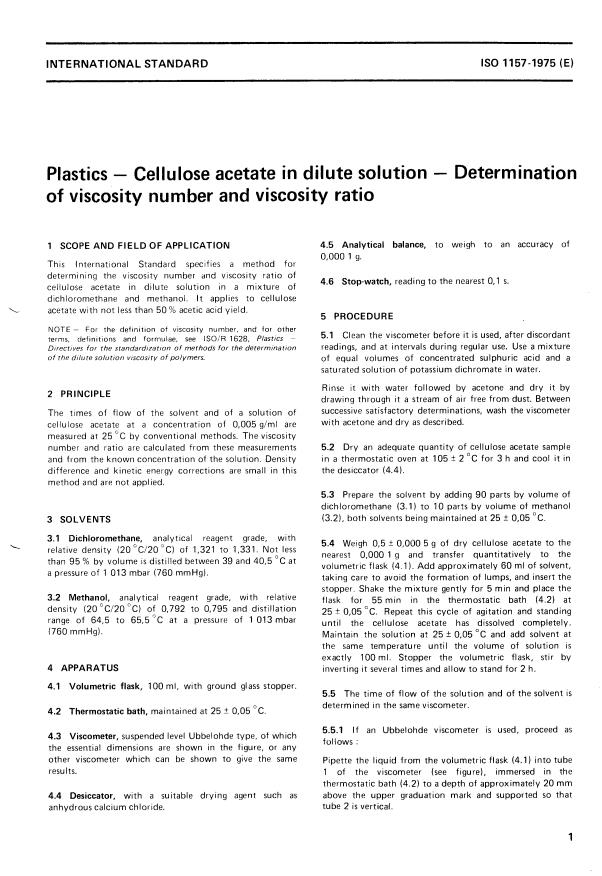
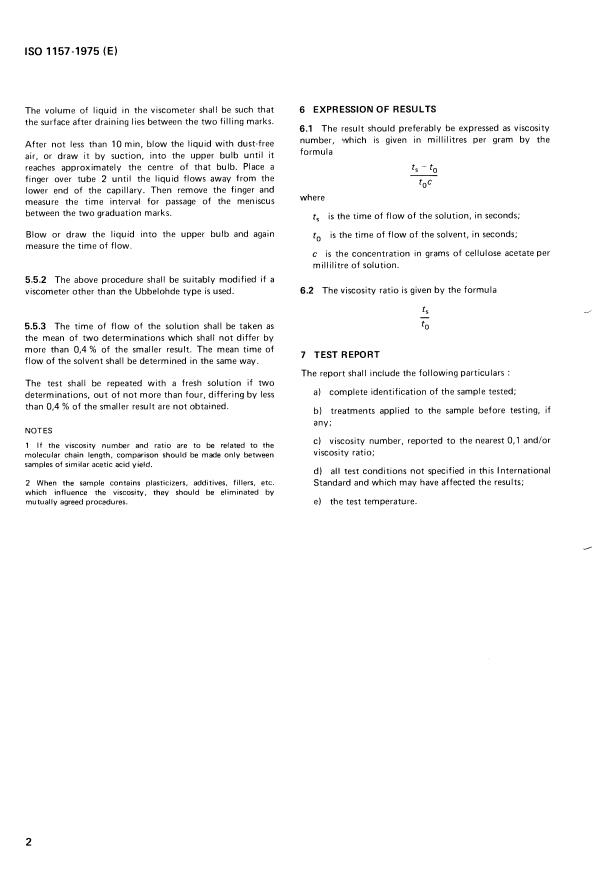
4.5 Analytical balance, to weigh to an accuracy of
1 SCOPE AND FIELD OF APPLICATION
0,000 1 g.
This International Standaid specifies a method for
determining the viscosity number dnd viscosity ratio of
4.6 Stop-watch, reading to the nearest 0.1 s.
acetate in dilute solution in a mixture of
cellulose
dichloromethane and methanol. It applies to cellulose
acetate with not less than 50 % acetic acid yield.
5 PROCEDURE
NOTE - For the definition of viscosity number, and for other
5.1 Clean the viscometer before it is used, after discordant
terms, definitions and formulae, see ISOlR 1628, Plastics ~
readings, and at intervals during regular use. Use a mixture
Directives for the standardization of methods for the determination
of the dilute solution viscosity of polymers.
of equal volumes of concentrated sulphuric acid and a
saturated solution of potassium dichromate in water.
Rinse it with water followed by acetone and dry it by
2 PRINCIPLE
drawing through it a stream of air free from dust. Between
successive satisfactory determinations, wash the viscometer
The times of flow of the solvent and of a solution of
with acetone and dry as described.
cellulose acetate at a concentration of 0,005 giml are
measured at 25 "C by conventional methods. The viscosity
5.2 Dry an adequate quantity of cellulose acetate sample
number and ratio are calculated from these measurements
in a thermostatic oven at 105 k 2 "C for 3 h and cool it in
and from the known concentration of the solution. Density
difference and kinetic energy corrections are small in this the desiccator (4.4).
method and are not applied.
5.3 Prepare the solvent by adding 90 parts by volume of
dichloromethane (3.1) to 10 parts by volume of methanol
(3.2), both solvents being maintained at 25 ? 0,05 OC.
3 SO
...
NORME INTERNATIONALE 11 57
~ ~~~ ~~
INTERNATIONAL ORGANIZATION FOR STANDARDIZATION *METL(YHAPOIlHAR OPrAHMJAUHX ii0 CTAHIIAPTH3ALIHH .ORGANISATION INTERNATIONALE DE NORMALISATION
Matières plastiques - Acétate de cellulose en solution diluée -
Détermination de l'indice et du rapport de viscosité
Plastics - Cellulose acetate in dilute solution - Determination of viscosity number and viscosity ratio
Première édition - 1975-06-15
CDU 678.544.4 : 532.133 Réf. no : IS0 1157-1975 (FI
Descripteurs : matière plastique, résine de cellulose, acetate de cellulose, solution, essai, essai physique, index de viscosité, viscosimetre.
Prix basé sur 3 pages
AVANT-PROPOS
L'ISO (Organisation Internationale de Normalisation) est une fédération mondiale
d'organismes nationaux de normalisation (Comités Membres ISO). L'élaboration de
Normes Internationales est confiée aux Comités Techniques ISO. Chaque Comité
Membre intéressé par une étude a le droit de faire partie du Comité Technique
correspondant. Les organisations internationales, gouvernementales et non
gouvërnementales, en liaison avec I'ISO, participent également aux travaux.
Les Projets de Normes Internationales adoptés par les Comités Techniques sont
soumis aux Comités Membres pour approbation, avant leur acceptation comme
Normes Internationales par le Conseil de I'ISO.
Avant 1972, les résultats des travaux des Comités Techniques étaient publiés
comme Recommandations ISO; maintenant, ces documents sont en cours de
transformation en Normes Internationales. Compte tenu de cette procédure, le
Comité Technique ISO/TC 61 a examiné la Recommandation ISO/R 11 57 et est
d'avis qu'elle peut, du point de vue technique, être transformée en Norme
Internationale. La présente Norme Internationale remplace donc la
Recommandation ISO/R 11 57-1970 à laquelle elle est techniquement identique.
La Recommandation ISO/R 11 57 avait été approuvée par les Comités Membres des
pays suivants :
Al lemagne
France Pologne
Australie Grèce Roumanie
Autriche Hongrie Royaume-Uni
Belgique Inde Suède
Canada Irlande Suisse
Chili Israël Tchécoslovaquie
Colombie Italie Turquie
Egypte, Rép. arabe d' Japon U.R.S.S.
Espagne Nouvelle-Zélande U.S.A.
Finlande Pays-Bas
Aucun Comité Membre n'avait désapprouvé la Recommandation.
Le Comité Membre du pays suivant a désapprouvé la transformation de la
Recommandation ISO/R 11 57 en Norme Internationale :
Canada
O Organisation Internationale de Normalisation, 1975
Imprimé en Suisse
IS0 1157-1975 (F)
NORME INTERNATIONALE
Matières plastiques - Acétate de cellulose en solution diluée -
Détermination de l'indice et du rapport de viscosité
1 OBJET ET DOMAINE D'APPLICATION 4.5 Balance analytique, d'une précision de 0,000 1 g.
La présente Norme Internationale spécifie une méthode de
4.6 Chronomètre, permettant des lectures a 0,l s près.
détermination de l'indice et du rapport de viscosité de
l'acétate de cellulose en solution diluée dans un melange de
dichlorométhane et de méthanol. Elle s'applique aux
'L acétates de cellulose ayant un titre en acide acétique
supérieur a 50 %.
NOTE - Pour les termes, definitions et formules, se reporter a
5 MODE OPÉRATOIRE
I'lÇOiR 1628, Matières plastiques - Directives pour la normalisation
des méthodes de détermination de la viscosité des solutions diluées
5.1 Nettoyer le viscosimètre avant de l'utiliser, et après
de polymères.
chaque lecture discordante, ainsi qu'a intervalles réguliers
pendant son utilisation. Employer un mélange en volumes
égaux d'acide sulfurique concentré et d'une solution saturée
2 PRINCIPE
de dichromate de potassium dans l'eau.
Les temps d'écoulement du solvant et d'une solution
Rincer ensuite le viscosimètre à l'eau, puis à l'acétone, et
d'acétate de cellulose a 0,005 g/ml sont mesurés a 25 "C
sécher dans un courant d'air exempt de poussière. Entre des
selon des méthodes conventionnelles. L'indice et le rapport
déterminations successives satisfaisantes, laver le
de viscosité sont calculés a partir de ces mesures et de la
viscosimètre avec de l'acétone et sécher comme décrit
concentration connue de la solution. Les corrections de
ci-dessus.
différences de masse volumique et d'énergie cinétique sont
faibles dans cette méthode et ne sont pas appliquées.
5.2 Sécher une quantité convenable d'acétate de cellulose
dans une étuve thermorégularisée a 105 t 2 "C durant 3 h
et laisser refroidir dans le dessiccateur (4.4).
3 SOLVANTS
3.1 Dichlorornéthane, pur pour analyse, ayant une densité
5.3 Préparer le solvant en ajoutant 90 parties en volume de
L relative (2O"C/2O0C) comprise entre 1,321 et 1,331, et
dichlorométhane (3.1) a 10 parties en volume de méthanol
dont 95 % en volume, au minimum, distillent entre 39 et
(3.2). en maintenant ces deux solvants à une température
40,5 "C,
...
Questions, Comments and Discussion
Ask us and Technical Secretary will try to provide an answer. You can facilitate discussion about the standard in here.
Loading comments...