

ISO 12843:2024
(Main)Plain bearings — Reuse, recycling and disposal of plain bearing materials
General Information
- Abstract
This document specifies how to effectively utilize material resources when recycling and reusing plain bearing materials. This document also specifies how to reduce the environmental impact of disposing of plain bearings.
- Status
- Published
- Publication Date
- 24-Jul-2024
- Technical Committee
- ISO/TC 123/SC 6 - Terms and common items
- Drafting Committee
- ISO/TC 123/SC 6 - Terms and common items
- Current Stage
- 6060 - International Standard published
- Start Date
- 25-Jul-2024
- Due Date
- 25-Feb-2025
- Completion Date
- 25-Jul-2024
Overview
ISO 12843:2024 provides guidance for effective reuse, recycling and environmentally responsible disposal of plain bearing materials. The standard explains terms (reuse, repair, recover, recycle, dispose) and specifies practical measures across the product lifecycle - design, manufacturing, operation and disposal - to maximize material resource utilization and reduce environmental impact.
This document was prepared by ISO/TC 123 (Plain bearings), Subcommittee SC 6, and includes a diagram (Figure 1) showing treatment paths for used plain bearings.
Key Topics
- Definitions: Clear terminology for reuse, repair, recover, recycle and dispose to support consistent decision-making when assessing used plain bearings.
- Design stage considerations: Select materials free of environmentally hazardous substances when possible; design for disassembly, repairability and material separability; specify ingredients in procurement agreements where disposal risks exist.
- Manufacturing stage measures: Minimize scrap and improve yields; separate scrap into reusable and non-reusable fractions; process reusable scrap as raw material; handle non‑reusable scrap according to disposal guidance.
- Example scrap types noted include runners and risers in casting, sprues and runners in injection molding, and chips from machining.
- Operating stage practices: Inspect bearings for damage or abnormal operation (e.g., increased noise, vibration, temperature rise, smoke or oil discoloration) and determine usability. If repairable, perform appropriate repair; if not, proceed to disposal. Inspections can reference ISO 7146-1 and ISO 7146-2.
- Disposal guidance: Remove bearings from end‑of‑life equipment where feasible; separate portions that contain hazardous substances; render hazardous materials harmless or engage certified disposal specialists. The standard cautions that substances considered safe today may be classified as harmful in the future.
Applications
ISO 12843:2024 is applicable to organizations involved in design, manufacture, maintenance and end‑of‑life management of plain bearings, including:
- Bearing manufacturers and material suppliers
- Equipment designers and OEMs integrating plain bearings
- Maintenance and asset managers assessing repair vs replacement
- Recycling and waste‑management service providers handling end‑of‑life components
Practical benefits include improved resource efficiency, reduced waste and lower environmental risk from bearing disposal, as well as clearer contractual expectations about material composition and end‑of‑life treatment.
Related Standards
- ISO 7146-1 - Appearance and characterization of damage to metallic hydrodynamic bearings - Part 1: General (referenced for inspection criteria)
- ISO 7146-2 - Appearance and characterization of damage to metallic hydrodynamic bearings - Part 2: Cavitation erosion and countermeasures
For implementation questions or national adoption details, consult your national standards body or ISO's online resources.
Get Certified
Connect with accredited certification bodies for this standard

CIS Institut d.o.o.
Personal Protective Equipment (PPE) certification body. Notified Body NB-2890 for EU Regulation 2016/425 PPE.

Kiwa BDA Testing
Building and construction product certification.
Kmetijski inštitut Slovenije
Agricultural Institute of Slovenia. Soil testing, plant health, agricultural product analysis.
Sponsored listings
Frequently Asked Questions
ISO 12843:2024 is a standard published by the International Organization for Standardization (ISO). Its full title is "Plain bearings — Reuse, recycling and disposal of plain bearing materials". This standard covers: This document specifies how to effectively utilize material resources when recycling and reusing plain bearing materials. This document also specifies how to reduce the environmental impact of disposing of plain bearings.
This document specifies how to effectively utilize material resources when recycling and reusing plain bearing materials. This document also specifies how to reduce the environmental impact of disposing of plain bearings.
ISO 12843:2024 is classified under the following ICS (International Classification for Standards) categories: 13.030.50 - Recycling; 21.100.10 - Plain bearings. The ICS classification helps identify the subject area and facilitates finding related standards.
ISO 12843:2024 is available in PDF format for immediate download after purchase. The document can be added to your cart and obtained through the secure checkout process. Digital delivery ensures instant access to the complete standard document.
Standards Content (Sample)
International
Standard
ISO 12843
First edition
Plain bearings — Reuse, recycling
2024-07
and disposal of plain bearing
materials
Paliers lisses — Réutilisation, recyclage et entreposage des
matériaux pour les paliers lisses
Reference number
© ISO 2024
All rights reserved. Unless otherwise specified, or required in the context of its implementation, no part of this publication may
be reproduced or utilized otherwise in any form or by any means, electronic or mechanical, including photocopying, or posting on
the internet or an intranet, without prior written permission. Permission can be requested from either ISO at the address below
or ISO’s member body in the country of the requester.
ISO copyright office
CP 401 • Ch. de Blandonnet 8
CH-1214 Vernier, Geneva
Phone: +41 22 749 01 11
Email: copyright@iso.org
Website: www.iso.org
Published in Switzerland
ii
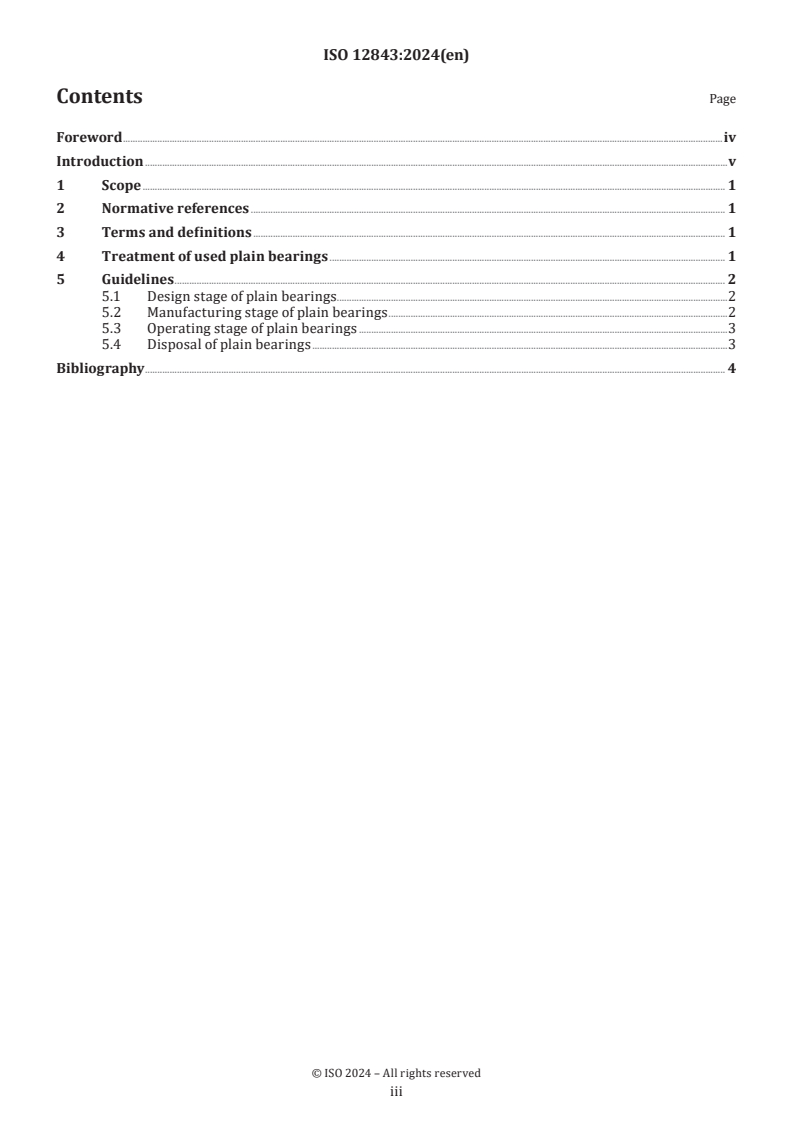
Contents Page
Foreword .iv
Introduction .v
1 Scope . 1
2 Normative references . 1
3 Terms and definitions . 1
4 Treatment of used plain bearings . 1
5 Guidelines . 2
5.1 Design stage of plain bearings . .2
5.2 Manufacturing stage of plain bearings .2
5.3 Operating stage of plain bearings .3
5.4 Disposal of plain bearings .3
Bibliography . 4
iii
Foreword
ISO (the International Organization for Standardization) is a worldwide federation of national standards
bodies (ISO member bodies). The work of preparing International Standards is normally carried out through
ISO technical committees. Each member body interested in a subject for which a technical committee
has been established has the right to be represented on that committee. International organizations,
governmental and non-governmental, in liaison with ISO, also take part in the work. ISO collaborates closely
with the International Electrotechnical Commission (IEC) on all matters of electrotechnical standardization.
The procedures used to develop this document and those intended for its further maintenance are described
in the ISO/IEC Directives, Part 1. In particular, the different approval criteria needed for the different types
of ISO document should be noted. This document was drafted in accordance with the editorial rules of the
ISO/IEC Directives, Part 2 (see www.iso.org/directives).
ISO draws attention to the possibility that the implementation of this document may involve the use of (a)
patent(s). ISO takes no position concerning the evidence, validity or applicability of any claimed patent
rights in respect thereof. As of the date of publication of this document, ISO had not received notice of (a)
patent(s) which may be required to implement this document. However, implementers are cautioned that
this may not represent the latest information, which may be obtained from the patent database available at
www.iso.org/patents. ISO shall not be held responsible for identifying any or all such patent rights.
Any trade name used in this document is information given for the convenience of users and does not
constitute an endorsement.
For an explanation of the voluntary nature of standards, the meaning of ISO specific terms and expressions
related to conformity assessment, as well as information about ISO's adherence to the World Trade
Organization (WTO) principles in the Technical Barriers to Trade (TBT), see www.iso.org/iso/foreword.html.
This document was prepared by Technica
...